Showing posts with label Wage Subsidy. Show all posts

Sunday, February 8, 2026

Revolution’s Reply to Reform. (Part 4) (1910)

From the March 1910 issue of the Socialist Standard

The answer to “Arms for the Workers: A Defence of the Programme of the Social-Democratic Party.” (E. C. Fairchild, Lon. Organiser, S.D.P.)


On a Workingman’s Wages.
Under the above heading Mr. Fairchild tells us that the third objection usually preferred against what he is pleased to call a Socialist programme is that some of its proposals would decrease the cost of living and result in lowering wages to the detriment of the working class. He says that this objection is generally advanced by “those who claim some acquaintance with economic science,” and declares that it “depends upon confusion of the amount of money the employer pays to the workman as wages with the amount or quantity of goods the workman can purchase with that money.” The confusion, however, is with our critic, for when we claim that some of the proposals would cause wages to fall, we do so in the full knowledge of the fact that “The food, clothing, or other things which the workman can obtain for his money” (i.e., wages) “is the real wage paid to him for his labour.” Nevertheless, if the money wage falls and buys less “food, clothing or other things,” the fact remains that “real wages” have fallen, and this notwithstanding that the deficiency is made good by a dole from “the municipal authority or the Government.” An argument which the revolutionary puts forward to show that the workers can be no better off for the so-called palliatives, is met by this bolster of capitalist politics with the retort that they will be no worse off ! What a defence of the palliative programme of the S.D.P. ! What a justification for this modern wandering in the arid Desert of Gobi, that after all the toil and travail of shifting a portion of their cost of maintenance from their employers’ pay-bill to the municipal alms box the workers are no worse off ! Such a defence is a complete surrender to our contention, yet the defence goes no further. An attempt is made, it is true, to exploit the eternal “if,” but the result is ludicrous. “If,” says Mr. Fairchild,
“the money wage paid by the capitalist should fall by 5s. weekly, and the municipal authority or the Government provided the workman with goods or services to the value of 5s. weekly, the workman would not suffer any hardship. If the municipal authority or the Government supplied him with goods or services worth 6s. weekly, the workman would gain, though his wages fall by 5s.”
If, if, if. But if the result of the “palliative” (in this case the “goods or services” supplied by the municipality or Government) is a fall in wages because it cheapens living, it is clear that the effect will be measured by the cause—in other words 6s. worth of “palliation” will be followed by a wage reduction, not of 5s., but, of 6s. There was no logical position for our reformer between absolute denial of the cause and full surrender to the effect, and when, he states that the “third objection” is due to confusion of money wages and “real” wages, and that the loss in money wages is compensated by the dole, he accepts the argument of the cause and effect, confesses that his only defence against the “third objection” is that workers are no worse off, and so doing surrenders, with the worst grace he can, to our contention that they are no better off, and that their efforts have therefore been in vain.

And Englishmen’s Homes.
The burden of this section is the housing problem. The proposal seems to be to provide the employers with homes for their workers at the expense of the landlord class. It is like the horse siding with his master in a demand for a free stable. But as our author says at the end of his previous section : “the source whence the workman draws his maintenance is a matter of no concern at all. The vital thing is that he gets maintenance.” It is a matter of no concern at all to the workers who pays “the cost of the land . . and also the interest payable to the lenders from whom the housing authority borrowed.” Such charges are in the same category as taxes, which even S.D.P. literature proves are not paid by the working class. The maintenance of the workers as a class in a certain average degree of health and strength and efficiency is the first and indispensable charge upon the wealth produced by the workers. It is the vitally necessary condition without which the workers’ power to produce wealth must cease. This degree of efficiency is determined by the degree of development and general conditions of production itself. The housing problem, then, is a problem for the master class. It is an important part of the problem how to provide the necessary maintenance of the workers with smallest possible call upon the latters’ total wealth production. For the rest it becomes a tussle between the industrial capitalists and the landlords for the plunder of the fruits of the workers’ toil. It is for this reason we find certain sections of the master class proceeding with municipal housing schemes and other sections opposing.

“If the money wages of labour were to fall by a sum equal to the reduction in rent—a decrease only possible if municipal housing was of stupendous magnitude . .” next says the S.D.P. oracle. It appears then that we can have too much of a good thing—even of an S.D.P. “palliative”—and that the time may come when we shall find the reform mongers anxious to get elected to undo their own handiwork, to keep wages from falling by preventing municipal housing attaining “stupendous magnitude.”

It would be interesting to know exactly what “stupendous magnitude” means. Where is the line to be drawn beyond which the reform cannot go without affecting money wages and why ? If one municipal house, through its reduced rent, does not affect wages why should ten ? If ten do not why should a hundred ? If a hundred do not why should a thousand, or ten thousand, or a million ? What is there in the last that is not contained in the first ? Nothing. The difference between one reduced rent and a million reduced rents is simply the difference between one and a million—a quantitative not a qualitative, difference—a matter of multiplication. Hence the effect of a million reduced rents can only be the multiplied effect of one reduced rent. This talk of the wage-reducing effect of certain “palliatives” only operating when the proposals become general, or “of stupendous magnitude” is rubbish, and comes fittingly from those who magnify a few municipally reduced rents into an important increase of “the amenities of the workers’ lives,” because they can see those reductions, but cannot understand an exactly equal and equally insignificant wage reduction because, as our author very felicitously puts it, they cannot know the things they cannot see.

One municipal house in every thousand houses in the London area would mean about a thousand municipal houses. We will not ask Mr. Fairchild if such a ratio would be of “stupendous magnitude.” A two-shillings per week reduction of this thousand rents is a visible movement, because it is concentrated. If it resulted in an equivalent reduction in money wages of the actual tenants of these houses, that would be a visible effect. It would be two shillings a week off the earnings of each tenant if there was one tenant to each house. But if this wage reduction, instead of affecting merely the actual participants in the reduced rents, were spread over all the wage earners of the area, it would mean less than three farthings—not per week but—per annum reduction to each. Of how much more “stupendous magnitude” must this become before our “palliator” can see and therefore know it !

Luxuries a Necessity.
The “mixed thinking” of the reformer is shown by our opponents’ remarks under the above heading. First declaring that “the supply and demand for labour regulates the wage that is paid,” he proceeds to flatly contradict himself in the words : “the employing class . . conspires to fix wages at a price sufficient to maintain the physical efficiency required for the production of average profits, . . .” Wages are the price of labour-power, hence to speak of the price of wages is to speak of the price of a price—which is idiotic jibberish. Again, to regulate a thing is to control its movements, therefore that which is regulated is not fixed. Still again, to attribute control of wages on the one hand to competition, in the labour market and on the other hand to conspiracy by the masters is taking idiot’s license, to say the least. Two flat contradictions and a lunacy in three dozen words is not a bad performance.

Of course, by one who holds that wages are fixed by the conspiracy of a to class yield profit, it is an easy transition to the argument that they can, by the conspiracy of another class, be fixed at such a level as to leave no profit at all (that they have ceased to become wages then need not trouble such free-and-easy economists). The first step toward this is for the workers to want more. “On first awakening,” we are told, “workman demands more bread in return for labour” (how much of the “palliators'” confusion arises from ignorance of the fact that the workman does not sell labour, but labour-power ?) “He will inevitably advance from that position into the struggle to acquire education, and refinement.” So it seems that the source of the workers’ troubles is that they haven’t wanted anything. How then, are we to read the next sentence : “The standard of comfort held by the workers is the result of prolonged conflict with the capitalist class.” If they have not wanted anything what have they been fighting for ? Are we to suppose that their share of the “prolonged conflict” has been resistence to a beneficent capitalist class intent on forcing upon them “luxuries” they have not wanted ?

A most fertile source of confusion is this spectre, “Standard of Comfort.” Behind it lurks the idea that it is all to do with the resistence of the workers, and they have only to wish for and strive for a higher “standard of comfort” in order to get it. This is far from the truth. In all their long struggle with the master class the workers have never for a moment forgotten their appalling poverty, have never for a moment been without a desperate and feverish longing for a higher standard of living. If desire could have endowed with “luxury” the working class would be redolent of comforts. As a matter of fact all their powers of resistence are necessary to enable them to realise for their labour-power its plain, naked value, without any reference to the adjustment of that mystery of mysteries, the “standard of comfort.” This resistence is common to all owners of commodities. They all sell as dear as they can, and according as the market is favourable to or against them, they now get a little more, anon a little less, than the value of their goods, but in the long run neither more or less than that value. Yet no one dreams of saying that if commodity-owners desired more for their goods they could get it. The same with the commodity labour-power. The owner’s resistence, his determination not to part with it for less than the most he can get for it, is the presupposed condition which enables its value to find expression. The “standard of comfort,” on the other hand, is one of the conditions of the determination of that value. The value must exist before it can find expression, therefore the conditions determining the magnitude of that value must come before conditions which enable the value to find expression in (in this instance) the wage. To say then, that “When no longer required to devote the same proportion of his wages to the purchase of absolute necessaries, the workman . . . can be trusted to follow the methods of the middle and upper classes, who spend more when they have more to spend,” is to take hold of the wrong end of the stick. The workers can never keep the suggested surplus because they have first satisfied “absolute” needs, but only because they have made “luxuries” equally with the so-called “absolute necessaries” a first charge upon their wages. And this they can only do when their environment has rendered those “luxuries” so necessary that they are prepared to go without food rather than abandon them, and then they have become “absolute necessaries” in the cost of producing labour-power, must therefore be embodied in its value, and eventually in wages.

All this is to say that the “standard of comfort” is merely the level of subsistence determined by the general conditions of production and the social and natural environment. “The gradual lowering of the cost of living,” therefore, must leave the standard of living unchanged. The gradual lowering of the cost of working-class living is a constant factor in capitalist society, and it is accompanied by a steady decrease in the proportion of the product of their toil which goes to the workers.

And if “the gradual lowering of the cost of living” does result in “the growth of new desires,” what are these but new miseries to be endured, new whips to scourge them into submission, new chains to bind them to their benches and desks ? The anxiety of the threatened is in proportion to the loss he is threatened with, and new wants can only add to the horrors of insecurity. Not all, not even the worst, perhaps, of the evil of the working-class position is contained in their actual poverty. Its most awful aspect is the utter insecurity, the growing precariousness of their hold upon the means of subsistence. To talk of “new desires . . . leading them to resist wage reduction” is to ascribe the workers’ present awful plight to the lack of desires. Heaven knows they have desires and needs enough, and are sufficiently conscious of them, to make such insulting mockery quite superfluous. The peculiar position of the working class decrees that necessity must precede means, hence the question of luxury can never arise for them.
A. E. Jacomb

Sunday, December 24, 2023

The workfare state: enforcing the wages system (2005)

From the December 2005 issue of the Socialist Standard

The changes which have taken place in what passes for welfare provision in Britain over the course of the last two decades were analysed in a book by Chris Grover and John Stewart, The Work Connection: The Role of Social  Security in British Economic Regulation, that came out in 2002. Largely inspired by Marxist economics, it represented a lucid  account of a domain where the harsh economic realities of capitalist exploitation contradict the illusions of reformist politics.

In many ways these illusions were fed by the extraordinary ideological success of the post-war Beveridge reforms, frequently presented as the triumph of half a century of reformist action led by Liberal, Labour and – to a lesser extent – Tory administrations. Any remaining illusions are now being dissipated. What welfare coverage and rights existed in the immediate post-war period are now being whittled away or simply done away with in order to more closely serve the form of capital accumulation which is now on the agenda. This new ‘inevitability of gradualism’ – to use the term adopted by the Webbs – means more exploitation and fewer rights of access to the means of subsistence for anyone unfortunate enough to have to try to find work for a living.

There never was a golden age of the welfare state. The history of income maintenance in Britain has been the history of coercion, discipline and surveillance. As the first functioning capitalist country, England experienced the workhouse test, ‘less eligibility’ and the doctrine of ‘deterrent’. It’s still one of the most miserly and punitive ‘welfare systems’ in Western Europe, although the other European countries are now catching up. (New rules in France mean that workers on the dole have fewer rights to refuse poorly paid jobs, the same is happening in Germany and Spanish workers are forced to be more mobile in the search for work. Whether the government is right or left changes nothing.)

However, now a new layer of social control has been added since the advent of British ‘workfare’, a policy loosely based on American precedents. In the past, maintaining labour discipline was a fairly simple task. Unemployment insurance benefits tended to be low compared to average wage rates. In a buoyant job market, the only workers who wanted to stay on the dole for a long period were the genial layabouts of the claimants’ unions, people who were using benefits to finance studies on the sly, actors ‘resting’ between roles and artists etc. In this situation, it was relatively easy to identify workers who were dodging work although, in practice, control procedures against the so-called ‘scroungers’ were not applied systematically. Nobody really had an interest in staying on the dole for too long but some did, much to the horror of Daily Mail readers.

The situation has now changed considerably. Successive governments have been trying to lower the wage levels of unskilled and semi-skilled workers (so-called ‘entry-level’ jobs) putatively in order to combat inflation. American ideas about the so-called ‘underclass’ popularised in the highly toxic pseudo-sociology of Charles Murray have replaced the episodic scrounger-bashing campaigns orchestrated by the Tories in the 1970s and 80s. Thus, whereas in the past the unemployed (now known as ‘jobseekers’) could refuse offers of work which didn’t correspond to their levels of skill or even standard trade union rates, now they are hassled into poorly paid jobs as quickly as their legs can carry them. This, in itself, has a particularly depressing effect on wage levels especially in the more lowly-paid occupations.

To make this process go even faster both Conservative and Labour administrations have introduced benefits to workers in low-paid jobs (in-work benefits) modelled on the Family Income Supplement set up in 1971 by the appalling Keith (later Sir Keith) Joseph, a Thatcherite bovver-boy and closet eugenicist. Officially, in-work benefits provide incentives to unemployed people – pardon, ‘jobseekers’ – to take on poorly paid jobs and to leave the supposedly luxurious world of inactive welfare dependency. In actual fact, subsidies to low paid jobs tend to have a depressive effect on wages. Employers know that they can get the labour power they need for less cash, the state stepping in to make up the difference. And of course, the increase in the number of workers coming onto the labour market increases supply and lowers price.

All this continues unabated under New Labour, indeed, with many subtle and often cruel refinements. These include the fine combing of the population of the partially disabled and their gradual inclusion in the reserve army of labour and the particularly brutal treatment meted out to lone mothers. Of course, New Labour has introduced the national minimum wage albeit on an extremely low level. But this only means that over the long-term the depressive forces working on wage levels will result in the legal minimum becoming the maximum paid out for unskilled work, the trade unions having been weakened by two decades of legal meddling.

In the final analysis, welfare administration is really only the problem of policing the frontier between the reserve army of labour – people who are on hold for later exploitation – and the surplus population – people who are simply maintained at low cost outside of the labour market. ‘Labour market activation’ – the trendy term for these new policies – is really about making some formerly excluded workers available for a spot of exploitation. Social welfare policies don’t solve the underlying problem of capitalist exploitation. But then again who would ever look to the Labour Party or New Labour to solve that problem?
MM

Wednesday, October 25, 2023

The Great 
Minimum Wage Swindle (1995)

From the October 1995 issue of the Socialist Standard
The Labour Party's support for the concept of a minimum 
wage is not based on its concern for low-paid workers, in fact, Labour's real aim is to cut the expenditure, in the form of 
benefits, of the capitalist state it hopes to inherit.
The Labour Party went into the 1992 general election committed to introducing a legally enforced national minimum wage which, they said, would eventually amount to two-thirds of the level below which half all wage and salary earners fall (or the “median wage”, as the statisticians call it):
“Labour will introduce a national legal minimum hourly wage, starting at a level of 50 per cent of the mid-point of men's earnings (the median) . . . Four million people will benefit form this minimum wage. Over time, Labour will increase the minimum wage as a proportion of earnings to a point where no-one is paid less than two-thirds of the median male hourly rate ” (Looking to the Future, 1990, p. 37).
In today’s money this would give an hourly rate of about £5.50, or a minimum wage for a 39-hour week of £214.50, or over £ 11,000 a year. Of course there was never any chance that this was going to happen. You can’t legislate into being wage increases of this order, amounting in some cases to over 50 percent. Capitalism just does not work that way. Its economic mechanism responds not to government decrees but the realities of profit-making in competitive markets. The government could indeed pass a law aimed at ordering employers to pay a minimum wage at this level but, as this would cut into profits, the result in an economy based on the economic law of “no profit, no production” would be an economic downturn and a growth in unemployment.

Shrinking figures
The Labour leaders—who are nothing these days if not economic “realists”— were well aware of this. Which was why they proposed to reach the goal of two-thirds of the median only gradually, starting by introducing a law to fix the minimum wage at half it. This is the £4.15 or so to which Bill Morris and the T & G and other unions are still committed. But even this is pie-in-the-sky which will never come about, and wouldn’t have come about even if Neil Kinnock had entered Number Ten in May 1992. The economic mechanism of capitalism just won't wear it.

Since Kinnock went, Labour, first under Smith and then under Blair, has backtracked even further. It is still committed to the concept of a national minimum wage but not to any specific amount. This, they now say, is to be fixed by a commission made up of employers, unions and others and, we predict, would amount to about the same as the old Wages Councils, abolished by the Tories in 1993, used to come up with: about £3 or so an hour (in today’s money).

In other words, the most Labour would do would be to restore the pre-1993 situation, extending it to all industries and services so as to be able to call it a “national” minimum. This latter will only be window-dressing since most industries pay their workers above this hourly rate, otherwise they would have been covered by a Wages Council.

But why does Labour—now under arch-realist Blair—want to keep to the idea of a minimum wage, especially as it is going to earn them a lot of stick from the Tories? Since they now take the support of active trade unionists for granted, it can’t be a sop for their benefit. The reason lies elsewhere: it is part of their plan to reduce spending on welfare benefits as their contribution to trying to solve the fiscal crisis of the capitalist state.

A bit of theory
The basis of capitalism is the wages system, under which the work of production is done by people selling their particular ability to work to an employer in return for a wage or salary. Wages for particular types of skill are fixed by market forces at the amount of money workers require to buy the things needed to maintain their particular skill, plus an element to cover the cost of raising a family to replenish the labour force when they retire.

In the long run workers must get paid this amount, otherwise they won’t be able to maintain their skill, and their employer will begin to suffer in terms of absenteeism, increasing labour turnover, shoddy work and lower productivity.

So, in a sense, market forces—aided by pressure from unions—already tend to ensure that wages don’t fall below a minimum level: that below which the workers wouldn’t have enough money to maintain their skill adequately. However, there have always been some kinds of work—those requiring little training or experience and performed for a mass of small employers—where, because supply permanently exceeds demand, and because trade union organisation is difficult, market forces bring about a wage that is below this level.

What this means is that, in the terminology of Marxian economics, these workers get paid less than the value of their labour-power. They don’t get paid a “fair” wage even by capitalism’s standard of fairness, i.e. the full value of what they are selling.

This creates problems both for their immediate employers and for the employing class as a whole which has to foot the bill for the increasing ill-health and destitution that result from paying workers over a long period less than the value of their labour-power.

The problem for their immediate employers is that, even if they wanted to be a “good” employer and pay their workers the value of their labour-power as a means of getting their money’s worth in terms of work done and profits made, they can’t because of competition from other employers. None of them dares make the first move for fear of losing business, indeed of going out of business.

The solution that has been adopted in Britain has been two-fold. First, to introduce minimum wages in the trades concerned and, second, to introduce Family Allowances.

It was the Liberal government in 1909 that took the initiative and set up trade boards, later called Wages Councils, in the “sweated trades”, such as the retail trade, hotels and catering, and the rag trade, where workers tended to be persistently paid a wage below subsistence level. Under this system the employers, the unions and government officials met to fix a minimum hourly rate for the particular trade. It was an offence for an employer to pay below this rate. There was no national minimum wage, only different minimum wages for the different trades.

Subsidising employers
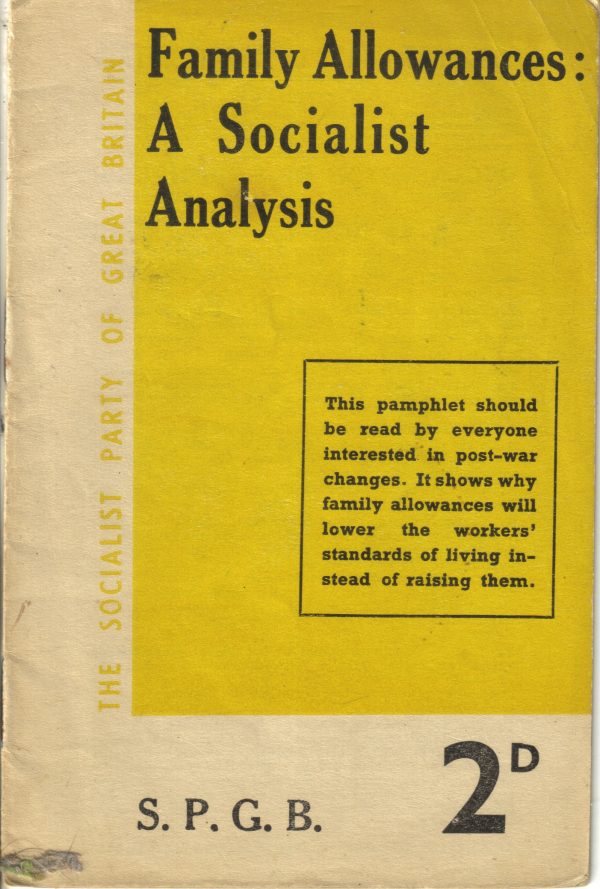
Family Allowances (now called Child Benefit) were introduced by the wartime coalition government in 1945. But, as the pamphlets Beveridge Reorganises Poverty and Family Allowances: A Socialist Analysis which we in the Socialist Party brought out at the time explained, this was not at all what it appeared to be: a money payment by the capitalist state which would leave all those with two or more dependent children better off by that amount.

Under capitalism and its wages system any regular payment received by workers in employment is going to have an effect on wage levels. This is because, as explained, wages tend to be fixed at a level which provides workers with enough money to buy what they need to maintain their particular skill in working order and also to bring up a family to take their place in the labour force when they are too old to work. If the state makes a contribution towards these costs, this means the workers’ immediate employer doesn’t have to.

The effect of any generalised state payment to workers in employment will be to depress, not necessarily the standard of living, but the wages paid by employers. This was why, in fact, Family Allowances were for a long time opposed by the trade unions. As we pointed out at the time:
"The real issue is not that certain unscrupulous employers may seek to save out of wages amounts paid in Family Allowances, but that once it is established that the children (or some of the children) of the workers have been ‘provided for' by other means, the tendency will be for wage levels to sink to new standards which will not include the cost of maintaining such children ” (Family Allowances, pp. 11-12).
In 1971 the then Tory government of Edward Heath breached a hitherto sacrosanct principle of the welfare state that no means-tested benefits should be paid to any worker in employment. They introduced a new benefit called Family Income Supplement (now called Family Credit), in effect a means-tested Family Allowance, payable to workers in employment whose income was below the poverty line, i.e. more or less what they would have got had they been on what is now called Income Support.

The logic behind this was to provide an incentive for people to take a job, however miserably paid. The result has been unsatisfactory from the point-of-view of the capitalist class as a whole. The cost of all state benefits payable to workers in employment (housing benefit, council tax benefit as well as Family Credit) has spiralled to over £2 billion a year.

Some employers—those in the modern sweated trades—have benefited. Knowing that the state will bring workers with children up to the poverty line they have been enabled to pay these workers below-the-poverty-lines wages. As Labour's deputy leader John Prescott has put it:
“Family Credit is now part of wage negotiations, with employers offering £1 an hour and saying: ‘I know you can‘t live on that, but if you nip down to Social Security, they’ll make up the difference (Observer, 28 August 1994).
Family Credit and other in-work benefits have, in other words, acted as a subsidy to these employers. This has caused resentment amongst other sections of the employing class who have to pay this subsidy out of taxes that, in the end, fall on their profits. This is where the Labour Party has come in with a proposal to help.

Labour to the Rescue
In their July 1995 campaign pack Low Pay. A Tory Failure, the Labour Party repeats again and again that their minimum wage is designed to reduce state benefits paid to workers in employment: 
“A minimum wage will not only act as a floor for pay. It will also ensure that in-work benefits do not act as a subsidy for low-paying and poor employers. ”

"Taxpayers would benefit because a floor under wages would reduce the need for tax handouts to low paying employers. Today employers have an incentive to lower wages at the taxpayers' expense." 

"Every taxpayer is now paying £100 a year for in-work benefits for people in low-paid work. People who have no protection against exploitative pay rates are forced into dependency on the benefits system whether they like it or not. And employers have no incentives to raise wages because they know the benefits system will subsidise the poor wages that they pay by what is, in effect, a tax handout to employers. ”
What Labour is proposing (and are rumoured to want to do over maternity pay) is what the Tories did over Sickness Benefit: to cut back on state payments by shifting a part of the cost on to employers in the form of statutory sick pay. Labour’s aim is to shift some of the burden of maintaining workers on low pay at the subsistence level on to the employers who have been benefiting from the present system.

But what about the workers? The low-paid workers existing on the poverty line. It’s not going to make much difference to them since the argument is about who is going to pay their subsistence income and in what proportions not about its level.

As far as the low paid are concerned what will happen is that what the right hand gives away in the form of a slightly higher minimum wage for some the left hand will take away in the form of reduced Family Credit. People on Family Credit get their benefit reduced by 70p for each £1 by which their income increases. So if their hourly wage was increased from, say, £2.50 to £3 they would only be 15p an hour better off not 50p. And if the increase lifted their income above the qualifying level for Family Credit they would find themselves worse off through losing the accompanying entitlement to housing benefit and free prescriptions and dental treatment.

Labour’s national minimum wage is not a genuine reform in the sense of a measure to bring about some improvement in working class conditions. It’s an economy measure designed to save the capitalist state money. They don’t fool us. Let’s hope that they don’t succeed in deceiving too many of the low paid either. 
Adam Buick

Sunday, October 8, 2023

Studies in Economic Fallacy (1930)

From the October 1930 issue of the Socialist Standard

Invest your savings—Don't "save” them.

Mr. Robert McLaurin has been writing in the Labour press, advocating that money should be turned into productive fields. The way to do it, he says, is to stop the banks paying interest on deposit accounts, and so compel the depositors to invest their “savings” in industry. The fact that we are suffering from over-production of goods is ignored by this finance reformer. If more goods were produced by more concerns being started, the situation would simply grow worse. Goods are produced for sale to-day, and as the market is already glutted in almost every trade, the suggested reform would not touch the situation. This writer savs “the system worked with comparative smoothness” until 1914 ! Poverty, insecurity, and unemployment of wage-slaves is apparently a post-war condition to this reformer !

Proudhon and his modern followers who advocate “Free Banking,” the currency cranks like Arthur Kitson, and the Labour crowd who want money reform, are all Utopians who seek a commercial competitive system without the laws of commerce or of competition. Most of them imagine that goods should be money and that banks should allow every owner of goods credit for the amount of his wealth. If the goods cannot find a market in exchange for the universal means of circulation—money—how can they find a market any easier by being put in pawn—if such a childish notion ever was adopted?

* * *

Will reduced wages mean more work?

Another “short cut to more jobs” is being advocated by some employers in the press. The simple scheme suggests that the money paid to “out of works” by the Government should be handed to employers instead, to enable them to capture orders from abroad. Every unemployed man engaged by the employers will get the difference between the so-called “dole” and his usual wage, made up by the employer. Present wages prevent contracts being obtained against foreign competition—so runs the cry! The profits, of course, are quite in order! Such a pass has capitalism come to, that the competition employers adore prevents them being able to pay a subsistence wage ! Does it? They don’t suggest that capitalism should be abolished, but that the ruling-class as a whole should subsidise those employers who cannot pay wages and profits out of their business.

Seeing that these same people complain that foreign countries subsidise industries and pay “low” wages, where will the process of cutting wages end ? The miners and many other workers in recent years have had such low wages that poor law relief has had lo make them up to subsistence level. Did that prevent unemployment growing amongst them? And when the rationalisation and electrification of foreign industries is copied here more and more, the unemployed will increase. The countries of “low wages” abroad have a growing unemployed army. “Low wages” hasn’t saved them.

The general adoption of the policy of supplementing part wages with so-called “doles” simply means that wages will be pushed down throughout the country. The employers who have not the capital to modernise their plants cry out for more wage reductions, and in the meantime the larger concern crushes or absorbs them.

* * *

The economic trend.

It is a plausible catch-cry to shout “wages determine prices,” but economic facts dispel that moonshine. Ford’s Motors in their last annual report showed that where they paid the highest wage in Europe (in Denmark) output was greatest, and where they paid the lowest (Belgium) the output was least. The real basis of world competitive prices is the amount of labour that it takes on the average to produce articles with modern methods. Where manufacturers, like Ford, have the capital to buy the latest and biggest quantity of machinery, they can reduce the time taken to produce goods, and so sell for less.

The manufacturers who cry out for subsidies to help them pay wages, won’t face the issue that production for the world market is wiping out many competitors and producing the combine or trust in every field. The successful firms have won by reducing costs, which means reducing the numbers of workers required to produce a given quantity of articles. Therefore, the chronic unemployment of to-day becomes a fixed feature of capitalism. Every country and every manufacturer is out for trade, and therefore profit, and in the wild scramble the workers do not count. They just produce the wealth and under the best conditions get just about enough of it back to keep them alive.

* * *

Shall we demand "lower prices”?

Labourites and “short-cut Socialists” are demanding cheaper goods. Consumers’ Bills and anti-profiteering campaigns are on the road to cut prices. These people are chasing a Will-of-the-wisp. “Reduce the cost of living” may be a good battle-cry for those who are consumers only, but the working class is a producing class. It does all the producing, but only a part of the consuming. How much the workers consume is determined by their wages. And what determines their wages? The basis of wages is the money needed on the average to keep a worker and his family. The number demanding work and the number of jobs available decides the daily fluctuations in wages, but the average level of wages is the cost of living of the worker. When the official index figures of the cost of living show a reduction, wages are reduced accordingly. In the daily Press of July 23rd we read that the Civil Servants have just been notified that their salaries are to be reduced, as the cost of living has fallen. Therefore, the campaign for cheaper goods will simply result, if successful, in reducing the worker’s wage. The money wages are only nominal—the buying power is the real wage. If the necessaries of life are “high,” wages may be raised to cover the increase, but the purchasing power of wages is always related to the cost of living of the workers. However cheap goods are, wages will always represent but a fraction of the wealth made by the workers.

The cry for cheapness to-day overlooks the economic tendencies of the system.

* * *

The march to monopoly. 

On the one side mass production serves to produce cheaply, but alongside of that is the rising power of monopoly, rings, and trusts to corner the supply and exact monopoly prices. Many manufacturers are against the prices of necessaries being raised and so driving them to pay higher wages. The general tendency of modern capitalism, however, is to concentrate the great sources of wealth and the products into fewer and fewer hands. If nature and man are very productive, and the supply grows quicker than the demand, the owners scheme to restrict production and actually to destroy products, in order to keep prices high enough to ensure their growing’ profits.

Centralised production on a large scale certainly works towards reducing costs, but the great combine owners are not interested in usefulness or cheapness as such—they are interested in profits. Once they have cut out the competitors, they plan “to get all the market will bear” by controlling the market. There is, of course, a limit which they cannot go beyond without reducing the amount they can sell.

The Consumers’ Leagues and similar bodies are powerless to effect their wishes, whatever Bills are passed to stem the economic tide. The concentration of wealth and the combine are the natural outgrowth of commercial competition, and can only be dealt with effectively by abolishing private and class ownership.

One other factor in “high” prices is the falling value of gold due to modern improvements in working gold-bearing ore. Thus economic development and economic laws of capitalism cannot be dodged by reform legislation. They must be understood—and then we’ll fight for Socialism.

* * *

The economics of "Labour.”

David Kirkwood, of the Clyde, Labour M.P. and I.L.P. chieftain, has a mental upsurge. He has discovered how to stop the downward march of workers’ conditions. He has brought in a Bill to make it illegal for employers to reduce wages. A Government in charge of the capitalist system of profit and exploitation is asked simply to decide “No more reductions in wages.” Employers must not cut the workers’ pay. Wages will then automatically stay put. Wages will fluctuate no longer downwards—but only upwards. Thus poverty will be grappled with.

A little economic knowledge would be dangerous to a Labour M.P. We will, however, try a small quantity.

Under this system an employer is not compelled to employ the workers seeking work. The number of men and women seeking work being greater than the number of jobs, wages tend downwards. The market—the labour market—is the place where competition for work causes men to accept the master’s terms. Having no wealth, the workers cannot hold out. Does Kirkwood’s Bill abolish that market and its competition? Does it wipe out unemployment? Does it abolish the lack of property—the force that drives men to work for others for a fodder wage? Does it alter the fodder basis of wrages ?

No. Kirkwood, playing with effects, would like to abolish the effects of capitalist system whilst leaving the system running. It is more sensational, vote-catching, and sounds drastic; it is easier than explaining capitalism and advocating Socialism.

* * *

Economic laws override statues.

A law to stop wages going down ! A war might do it for a time, whilst the demand exceeded the supply of workers, but a law under capitalism cannot stop the employer buying better and more effective machinery whenever wages tend to rise, and thus pushing numbers out. The rationalisation which Kirkwood criticises (New Leader, July 18th) would play havoc with his “law.” Centuries ago, laws were passed making it criminal to pay more or less than the wage fixed by statute. The plague had swept huge numbers of workers away, and wages rose rapidly. Conditions made the statute a dead letter. The cry of employers for labourers and the favourable situation for the men made reductions of wages impossible. Too many employers were willing to pay more than the legal wage.

When hunger drives hard, men and women go back to work even at terms (fixed with Labour Government’s assistance) involving ten per cent. reduction, as in the woollen trade. What has happened to the Minimum Wage Laws “won” by miners from Lloyd George? Where are the miners’ work and wages to-day? David Kirkwood, like his fellow Labour Members, should stick to “Pleasant Sunday Afternoon” meetings at the kirk.

* * *

Is shorter hours the remedy?

Mr. Geo. Hicks, of the General Council of the Trade Union Congress, has been telling his Building Trade Union of the effects of rationalisation on the building-trade. One hundred and fifty thousand are out of work in this industry, but more machinery and efficiency schemes are being used every week to get the work done “cheaper.” “A shorter working day,” he told them, would absorb some of the unemployed, and those pushed out by machinery should be given alternative employment or fully maintained.

Hours have been continually shortened in the builders’ craft, but has that absorbed the unemployed? The Union that can’t win a strike over some detail of their conditions is not in a position to win full maintenance. Mr. Hicks, like most Labour leaders, is busy supporting the Labour Government, which carries on capitalism and advocates the wholesale rationalisation which he complains about to his members.

Labour leaders do not tell their members the truth that the only way out is to abolish this system by winning political power for Socialism. It’s a much easier and more profitable way for leaders to keep the workers ignorant. Then they can be led.

* * *

A lesson for trade unionists.

Whilst the Trade Union leaders are busy as Labour M.P.’s supporting rationalisation, which will add to unemployment, the Unions beg the members not to add to the financial burden of the Unions by temporary stoppages, etc. The Boot and Shoe Union used to boast that by a “no strike” policy of conciliation they had won the best conditions. Now they complain that unemployment of their members in this machine industry is draining all their funds. The Cardroom Amalgamation of Lancashire has issued a circular to its members, warning them that the scales of contributions and benefits will not stand the chronic unemployment to-day.

The eight looms per weaver scheme, however, is being put through in Lancashire, where more than one-third of the operatives are already out of work. The Labour Government’s Committee of Enquiry, headed by J. R. Clynes, the Labour Minister, advised the greater rationalisation of the industry with the latest wages-saving automatic looms.

The workers in the Unions are still supporting the leaders who mislead them. Not by changing leaders, but by completely changing’ their ideas about society, is the only way the members can cure the situation.

Let the working class own the machines, etc., in common. Stop improving the machinery for the masters. Organise politically to end this system of profit-making.

* * *

Another "sheltered trade" gone.

The Railway Unions have benefited so much by brilliant leadership that since they got back their 2½ per cent. reduction in wages, short time or dismissal has been the rule in the railway shops. A greater speeding up of the work is the owners’ reply to the cancelled reduction of wages. Now we learn from the Daily Herald of June 17th that owing to the drop in the official cost of living figures, thousands of railwaymen have lost two shillings a week. Seventy-five per cent. of the railwaymen, according to the same authority, are down to the minimum rates of wages. They give the figures of £2 6s. for porters, and lamp-men and permanent way men £2 8s. In the meantime the railway companies have been buying up their ‘bus competitors, the money for which, I suppose, comes out of their losses. The Transport Unions and the Railway Union are now busy squabbling over which Union the members must join. Mr. Thomas, we expect, will add to the railway workers’ prestige by finding a place in the House of Lords. Such are the fruits of conciliation in industrv.

* * *

“The Iron Law of Wages." 
"The corner-stone of Marx’s theory, as expounded in ‘Das Kapital,’ is that labour is the creator of all wealth, but that under Capitalism labour is not paid by the value it produces, but by the price of labour power as a commodity on the market. This price, according to Karl Marx, is fixed by the economic laws under which we live at a point which just secures an adequate supply of labour for industry. This he called the ‘Iron Law of Wages’.”—(H. H. Tiltman in his Life of Ramsay MacDonald.)
The above is an example of the ignorance of Marx’s economics by the brainy bourgeoisie who write about him.

Marx did not call his law of wages the “Iron Law of Wages.” In fact he exposed the “Iron Law” theory, which was taught, not by Marx, but by Lassalle. In his criticism of the Gotha programme of the German Labour Party of 1875, Marx pointed out that the so-called Iron Law of Wages was a mixture of Malthus’ over-population theory with economic facts. The “iron law of wages” presupposes that wages cannot rise owing to an increase of population taking place if the subsistence level is increased. More workers born would crowd the labour market and bring wages down. Too few workers would raise wages, which, in turn, would induce larger families, and thus, through competition for work, wages would again fall to their former level.

Marx, on the other hand, showed that the cost of subsistence was the basis of wages. The level of wages, however, was not fixed and was not like iron. The union of workers and their struggle played a part in the raising of wages. The standard of living, too, was not fixed, but fluctuated, due to the changing social conditions; the efforts of workers to adapt their way of living to the period they lived in; and the need of employers to adapt the living standards of the workers to enable the speed and efficiency of industry to be maintained or increased.

The really vital factor in overcrowding the labour market was not the birth-rate, but the use of machinery by the employers. The critics of Marx seem to get their knowledge of him from his opponents.
Adolph Kohn

Friday, March 31, 2023

Cooking the Books: Supermarkets and sub-profits (2023)


The Cooking The Books column from the March 2023 issue of the Socialist Standard

The cost of living crisis has presented supermarkets with a problem. They depend for sales on what workers spend in their weekly shop but, with workers having to spend more on energy, they have less to spend on other essentials. This is why supermarket bosses have been pressing the government to reduce the amount workers have to spend on energy and to increase the money it pays to those on benefits. Prominent among these has been Richard Walker, the owner and boss of Iceland, which specialises in selling cheap frozen food to the lower-paid and those on benefits.

Last year, in an interview on BBC Radio 4, besides calling on the government to increase universal credit, he called on supermarkets to accept making less profit. Under the headline ‘Iceland boss suggests supermarkets should be willing to make zero profits during cost of living crisis’, Yahoo News reported:
‘A supermarket boss has said businesses like his should commit to making fewer, or even zero, profits during the cost-of-living crisis as food prices continue to rise (…) Richard Walker, managing director of Iceland, has urged supermarkets to show “responsible capitalism” and reduce prices – even if it means a hit to company profits. “I think [there should be] responsible capitalism, I think businesses [should be] accepting lower or no profits”’ (tinyurl.com/9e6ru542).
Actually, this was making a virtue out of necessity. Forgoing some profits is not a case of ‘responsible capitalism’ but something imposed on supermarkets by the state of the market for their wares. As workers are having to spend more on energy and so have less to spend on their weekly shop, if supermarkets put up their prices in line with the increase in the price of their supplies they would lose sales and so profits anyway. No wonder they are calling on the government to give workers more to spend — in their outlets.

But there is another side to the story. In another, TV, interview, he told Laura Kuenssberg:
‘… we pay minimum wage at £9.50. I’m not proud of that and I wish we could pay more, but the reality is to pay £10.90, the Real Living Wage would cost us £50 million, and that’s money we don’t have’ (tinyurl.com/2ca8f7fv).
The minimum wage is already a government subsidy to employers as workers on or just above it with family dependents can get their income topped up under the tax credit scheme.

Capitalists firms catering for the weekly consumption needs of the workers who buy from them are asking to be further subsidised by the government or, rather, ultimately, by other sections of the capitalist class.

This brings out a conflict of interest within the capitalist class. Supermarkets want other capitalist firms to pay more taxes to provide their customers with more money to spend. They would even like them to pay higher wages, but they are not prepared to do this themselves. What they are out to protect is not the pockets of their customers but their own profits, short and long-term.

Richard Walker wants to become a Tory MP. If elected, he will be able to continue to campaign to further the sectional interests of his section of the capitalist class. He might not get his way, though, as governments are there to look after the general interest of the capitalist class as a whole.

Monday, March 27, 2023

Letters: Making allowances (2004)

Letters to the Editors from the March 2004 issue of the Socialist Standard

Making allowances

Dear Editors,

The review of Beyond Capital in the December Socialist Standard deals with the question of wage determination as affected by the balance of class forces, there being no automatic passing on of workers’ higher living costs or taxes in higher wage levels. But government’s unceasing tinkering with the social wage in the form of benefits and subsidies shows that they are very much concerned with their role in maintaining and trying to regulate such a link.

The role of post-war Family Allowances in influencing wage levels is well known to Socialist Standard readers over the years. Rent control, introduced to prevent a wage explosion in the first world war, is another example.

More recently government has openly acknowledged Family Credits to be a top-up for low wages. Junior Employment Minister in the 1994 Conservative government, Philip Oppenheim, was reported as saying (Observer 28 August 1994):
“Employers cannot be expected to have regard to the family commitments of each of their employees. This must be the role of the tax and benefit system, which ensured that households have sufficient income upon which to live. That is why we introduced Family Credits and other benefits for lower-paid employees with a family to support. It would make no sense to outlaw every job which did not pay wages high enough to support a family.”
At the time now Deputy Prime Minister Prescott criticised the Conservative Party policy of this topping-up low wages, saying, “Family Credit is now part of wage negotiations”, encouraging low pay.

What is surprising is not Prescott’s tacit admission of his earlier ignorance of the purpose of much social welfare legislation, but the Conservative Party’s frankness in acknowledging the purpose of such “benefits” as being government policy in their attempts to regulate wage or, certainly income levels for the low-paid.

It is a case of government being compelled to throw its weight in the balance of class forces mentioned in the review, in order to maintain competitiveness and profitability of the national economy. Seen as a necessary response to capitalism’s compulsions and priorities, political and economic, it might well be considered “automatic”.
Bill Robertson, 
Brighton


RMT and the SSP

Dear Editors,

Now that the RMT has been expelled from the Labour Party, the party they helped found 100 years ago, I wonder how long it will be before they are expelled again if the Scottish Socialist Party develop into a total British party whose reformist policies will no doubt evolve into what the Labour Party practice, as any other party who promises to manager Big Business.
Joe Boughey, 
Newton-le-willows, Merseyside


Alec Hart

Dear Editors,

Further to the obituary published in the February Socialist Standard, I have received the following story from one of Alec’s friends in Johannesburg:

“During the apartheid era he (Alec) was visited on many occasions by the ‘Special Branch’. Alec had an enormous picture of Karl Marx on the wall and when asked by one of these detectives ‘Who’s that man?’, he quite blandly said it was Johannes Brahms. Fortunately they believed him!”

I would have included this in the obituary if I’d had this story at the time
of writing!
Phyllis Hart, 
Westerham, Kent

Friday, August 12, 2022

Luncheon Vouchers (1960)

From the August 1960 issue of the Socialist Standard

L.V.—this is the symbol which can be seen in the windows of many cafes, tea shops, snack bars and restaurants. It indicates that luncheon vouchers are accepted. The symbol has also cropped up in a recent advertisement, which shows a man sitting at a meal with, on his back, the words, “To work well he must eat well . . . regularly at lunch-time with L.V.” The advertisement also tells us that thousands of employers have arranged this nation-wide welfare service for the benefit of their workers. But is this all there is to say on the matter?

Many employers, when advertising vacancies, include the vouchers in the list of advantages extended to the lucky applicant. And workers fall for it: many of them, when bragging about having “an easy job,” remark that, along with the five day week, holidays with pay and sickness on full pay, they also receive luncheon vouchers. How nice, to think that employers are taking such an interest in the health and strength of their workers and are not leaving this vital matter to look after itself! Just fancy, instead of having to last the day on a ham sandwich or a bun and cuppa, our worker has his luncheon voucher and a whole hour in which he can eat to his heart's content. Every day, from Monday to Friday, our lucky working lads and lasses can wine and dine at the . . . at the . . . well, wherever they can get something for a two or three shilling voucher. We can be certain that, however they may “eat well,” the nurtured workers will not return to the job so full of lunch-time fare that they are too burdened to “work well.” Neverthelesss, these “better-off” workers are always grateful for small mercies, free meal tickets and all, and so skipping back to work, merrily they go.

Of course, Socialists will spoil it all by pointing out that the employer, instead of including the value of a week’s luncheon vouchers in his worker’s pay packets, merely gives out the same amount in the form of food tokens. And often uses this as an argument when resisting wage increases. The worker thinks he is being treated to lunch, instead of looking upon it as part of “the treatment.”

The question is why does the lunch on voucher amount to about three shillings instead of say, twenty-three? Simply because a worker's lunch can be bought for just about three shillings. In the same way, the total sum of all the purchases and expenses which a worker must make in order to live determines the total amount of his wages. He does not receive an unregulated sum which the employer hands out as a reward for being honest or hardworking or responsible. He gets roughly what it costs to maintain himself and his dependents.

But to return to our advertisement. We notice that its appeal is only to the employer and that it does not say “you (employer) must” but that “he (worker) must.” Is, then, both the eating and the working of the working class at the mercy of their masters? For example, if the workers cannot find an employer to buy their energies, there can be no work and very little eating. Our advertisement would not apply. Even to be allowed to work means that, to hold down their jobs, the workers must work well, try as some of them might to dodge it when the manager is out of sight. In fact, how well they work can be realised by a glance at any City Editor’s column. See there the facts and figures of the company reports, of the amazing profits which are made by the workers. Read, at the end of each chairman's chronicle, the compliments to the staff for working so well throughout the year.

And why only eat and work well? If, besides that, we were all to house and clothe well and to have everything else which we need, then all would be well, except for profits which would be so ill that they would die. It is inherent in the system of commodity production that the worker’s wages never tally with what he produces. The capitalist class, who own the factories, machinery and their produce, employ workers at the price of their wage. Workers are taken on to produce both enough to cover their wage and a surplus, which the capitalist commandeers. If the worker received as much as he produced, then his employer would not be able to dictate whether he should eat well or not; that would be his own responsibility.

To get rid of this exploitation, we must have a world in which food and all other wealth is produced simply to be used. A world in which all mankind has complete freedom of access to the world’s wealth, to satisfy its needs. It is the system of working for wages— whether or not they come partly as luncheon vouchers—which prevents the mass of people enjoying the full freedom and happiness which modern productive techniques can command. We need a world which works well for itself, to eat well—to live well
Joe McGuinness

Tuesday, April 12, 2022

The Economics of Rent Control (1957)

From the April 1957 issue of the Socialist Standard

The Socialist’s task is to preach Socialism and work to bring a Socialist society into being. This involves understanding and explaining the nature of the present social system; that it is a class-divided system in which the workers, in their own interest, need to struggle on the wages field and to take any favourable opportunity to press for higher wages.

Social reformers, including the members of the Labour Party disregard (or explicitly reject) the class- struggle. They see instead a world in which, as they suppose, it is possible bit by bit to gain benefits for the workers and thus progress towards a new social system. It is a deceptively plausible argument; but it rests all the time on a great illusion. The argument runs like this, "Would it not be a good thing if on top of his wages the worker with children received children's allowances? And if his wages remained the same and food prices were reduced by Government subsidies? And if his wages remained the same and his rent were reduced by rent restriction and housing subsidies?" It looks good, too good. It is too good to be true. The catch in it is the assumption that these “benefits" are added to wages and that wages can look after themselves. In truth the reforms mentioned, along with others of the same kind, have had the effect of undermining and weakening the working-class struggle for higher wages—and they were designs for that purpose.

Advocates of children’s allowances urged their adoption to avoid a general raising of wages; incidentally setting the married against the single workers. Food subsidies under the war time Coalition and under the 1945 Labour Government were used to manipulate the cost of living index in order to mask the real rise in the cost of living and fob off wage claims. And rent control was devised for for purpose of discouraging foe workers from fighting for higher wages at a time when low unemployment gave them a favourable opportunity to do so. It, too, has divided the workers paying restricted rents from the others, in high rented houses.

The final answer to the whole argument of the reformists is the fact that it was the Labour Government (following foe example of Tories and Liberals before them) that pursued the policy of the “wage-freeze," thus knocking the bottom out of their own case. They demanded of the workers that, in face of a rising cost of living, they should be content with “social services" in place of wage increases: and asked employers not to give higher wages.

The late Sir Stafford Cripps, Chancellor of the Exchequer in foe Labour Government, defined this policy in a speech in the House of Commons on 27 September. 1949, when dealing with the White Paper on "wage restraint" issued foe previous year:—
"The White Paper must . . . be observed strictly, and it is only in the exceptional and genuine cases where some wage survives which, together with all the subsidies and social services, is insufficient to provide a family a minimum standard of living, that there can be any possible excuse for going forward for an increase" (our italics).
The occasion of the speech was the devaluation of the pound, which Sir Stafford had denied for months that he intended to enact but which he had just announced. He knew that this would raise the cost of living still further but again he warned the workers that they must not expect wages to rise:—
“Especially and specifically there can, in our view, be no justification for any section of the workers trying to recoup themselves for any rise in the cost of living due to the altered exchange rate."
So the reformists who promised social reforms and low rents and prices to be a form of wage increase, ended up by asking the workers to put up with higher prices and a wage freeze!

The Curious History of Rent Control
Anyone who judges the present dispute over rents merely by what Labour Party leaders say about the Tory bill to free large numbers of houses from control and to raise the rents of those still under control will gain the impression that it is a clear issue between Tories, who are against low rents, and Labourites, who favour them. Yet the history of rent restriction shows that this does not fit the facts. It was a Tory Government that reimposed rent restriction when the war broke out in 1939 and a Tory Minister of Health, Mr. W. H. Long, in a Coalition Government, who started it all in 1915. What has to be explained therefore is why the Tories who began it, later on wanted to wipe it out. The explanation is really quite a simple one. The Tories (and Liberals) introduced it in 1915 and again in 1939 to deal with a particular problem arising out of war and when that emergency was over and new conditions arose they saw no point in keeping it in existence. What the MacMillan Government is doing now, through its new legislation, is, though on a restricted scale, what the Tory Government wanted to do in 1923. In that year the Onslow Committee, set up by the Government, recommended that rent control be entirely abolished and rents left to the free play of supply and demand. It was to be carried out in three stages so that by June, 1925, the last vestige of the war-time legislation would have been removed and landlords would be legally entitled to get what rents they could, as had been the situation before 1915. But this was so unpopular that the Government got cold feet and decided to make minor relaxations only so a large proportion of working class houses still had controlled rents when, in 1939 (again because of war) rents were pegged at their existing level.

Parallel with legally restricted rents was the policy of Government subsidies to enable new houses to be built and let at rents below the amount required to cover the full cost. This, too, was not a Labour Party invention but was started in 1919 by the Liberal-Tory Coalition Government. Recently the Tories sharply reduced the amount of subsidies and Mr. Butler, who was then Chancellor of the Exchequer, announced that the intention was to abolish these Government subsidies entirely (House of Commons, 26 October, 1955).

Why the war-time Governments Restricted Rents
As soon as the war broke out in 1914 the building of new houses was curtailed, and later on brought almost to a standstill, because men and materials were wanted for the armies and munition making. The result was that rents began to rise along with the rise in toe prices of food and clothing and other necessities. As there was little unemployment and a great shortage of skilled workers, the members of trade unions began to press for higher wages. The Government (and the employers) wanted to prevent the workers, especially the skilled men who were very favourably placed, from taking advantage of the labour shortage by striking. The Government appealed to their patriotism, with the help of Labour leaders; promised to keep the cost of living down; and took the drastic step of making it illegal for landlords to raise rents above the 1914 level. At the same time they fixed maximum wages for many workers. This policy of “wage restraint” succeeded almost beyond expectation and throughout the war wage rates, particularly those of engineering craftsmen, were kept far behind the steady rise of the cost of living. The following comment was published in the Labour Year Book, 1919 (published by the T.U.C., Labour Party and Labour Research Department):—
“By the spring of 1915 the skilled engineers would have been able, if they had acted without consideration for the national position, to demand a monopoly price for their labour—a situation which had not occurred in this century since the Black Death of 1381. And just as the government of that day had met the situation by a statute fixing the maximum price that must be paid for labour, so in 191$ the government passed the Munitions Act, which had substantially the same effect. Compulsory arbitration and the Leaving Certificate clauses combined to prevent the engineer from getting better terms for his labour by withdrawing that labour, either collectively or individually” (p. 235).
The article in the Labour Year Book went on to point out that at the end of 1916 engineers wage rates were only 20% above the 1914 level. By the same date the cost of living had risen by 65%. And just after the end of toe war (in January. 1919), while all industrial wage-rates had, on average, risen to about 100% above the level of 1914, the cost of living had gone up by 120% in spite of the freezing of rents at the 1914 level.

This policy was followed again in the second world war though the true picture was obscured by the falsity of the Govemment's cost of living index. On a real estimate of the rise of the cost of living during the war large numbers of skilled craftsmen (as well as most clerical workers) had increases of wage rates below the increase of prices. “Wage restraint” was continued after the war by the Labour Government and Mr. Richard Crossman, Labour M.P. and member of the Executive of the Labour Party, afterwards admitted how restricted rents and other factors were used by the Labour Government to keep wages down.
“The fact is that, ever since 194$, the British trade unionist could have enjoyed a far higher wage packet if his leaders had followed the American example and extorted the highest possible price for labour on a free market.

“ Instead of doing so, however, they exercised extreme wage restraint. This they justified by pointing out to the worker the benefits he enjoyed under the Welfare State—food prices kept artificially low by food subsidies: rents kent artificially low by housing subsidies; rent restriction; and, in addition, the Health Service “ (Daily Mirror, 15/11/55).
Rent Control not a Working Class Issue
In 1915 the Labour Party supported toe Govemmenfs decision to peg rents at the 1914 level and the Labour Executive in its report to their annual conference in 1916. claimed that “assuredly this Bill was a very big step against certain class interests.” The implication was— and every Labour Party supporter firmly believes it still— that a victory had been gained by the working class against, the Capitalist class. It was nothing of the kind. It was a measure for the safeguarding of capitalism taken at the expense of one section of the propertied class, the landlords. It was not a victory for the working class though then, and since, it may seem to have been in the interests of those individuals who happen to live in a house with controlled rent. It was intended as a means of dissuading the workers as a whole from pressing for the higher wages they could have got, and in this it succeeded.

Not only is this shown by what happened to wages and the cost of living in Britain during the two world wars and under the 1945 Labour Government, but it was demonstrated also by experience in continental countries, including Austria and Germany.

Low Rents, Low Wages, High Profits
The effect of rent restriction on workers' wages was inquired into more than once between the wars by the International Labour Office. One of their reports was The Workers Standard of Life in countries with Depreciated Currencies. (ILO, Geneva, 1925). Dealing with Vienna it showed that, because the Government had prevented rents from rising,
“the item of expenditure on rent in working class budgets was reduced to practically nothing in July, 1923, it was barely 1 per cent, of the total expenditure of a working-class family, whereas before the war it might be estimated at about 20 per cent. The change, however, directly benefited certain classes of workers only. But this applied only to unskilled wage earners in a few industries. Most of the workers were in the same position as those of Germany; they had practically no liabilities under the heading of rent, but the corresponding amount was not included in their wages. The actual gain was thus nil."(p. 97).
The Report went on to say that the real gainers were the employers, because they were able to reduce wages to the full extent of the missing item, expenditure on rent. 

Of course the losers were the landlord section of the propertied class.

Tory and Labour both now favour Higher Rents
Though the landlords had to put up with the sacrifice of their interests during the two wars they naturally used all the influence they had to set rid of rent restriction and thus restore the value of their investments when war ended. A number of factors helped them, including the remorseless economic law of capitalism that if there is no profit there is no production. If investors cannot get something like the normal rate of profit on house property they don't invest money in house-building or in repairs. So both the Tories and the Labour Party are agreed that the mere perpetuation of rent restriction is not wanted and must go. In 1923 the Labour Party members on the Onslow Committee recommended that rents should be reduced below the level then permitted under the Acts but no Labour Party spokesman advocates this now. Their main new proposal is that all rent-controlled houses occupied by a tenant be taken over by local authorities, repaired and improved and, as the Labour Party frankly admits, “there will inevitably be some increase in rent." (Labour Party “Talking Points,” No. 15, 1956).

The Tories on the other hand intend to free a large number of houses and raise the permitted rent in others, with the certainty that many rents will go up and the promise that some of the existing very high decontrolled rents will come down. In their view the private landlords, sure of a higher return, will look after the condition of the houses. Both parties agree that the present situation, with a great number of slums, and other hundreds of thousands of houses deteriorating fast into a slumdom, cannot go on.

The Wages Front in 1923 and 1957
The Tories wanted to get rid of rent control in 1923 because it had served its war-time purpose of discouraging wage increases and because by 1923 there were so many unemployed that the trade unions were not in a position to win wage-claims by strikes. They dropped the plan then because it was unpopular and they needed workers votes in elections.

In the past few years the situation has been different from that of 1923. There has been little unemployment and the Tories tried to carry on after 1951 the Labour Government's policy of wage restraint, but with increasing lack of success.

Whereas under the Labour Government from 1945 to 1951 wage-rates lagged behind the rising cost of living, since the Tories came in in 1951 a more aggressive attitude on the part of the workers has played its part in causing wage-rates to rise faster than the cost of living index.

In these changed circumstances the policy of “wage-restraint” by persuasion from above is on its way out, and with it goes any remaining belief by the Government and the employers that it is worth their while keeping widespread rent control in being as a means of discouraging wage claims. Far too many workers are already in decontrolled houses (including the high rented Council houses) or furnished apartments, for the workers as a whole to be as much influenced in that direction as they used to be.

It may be asked what, in face of this situation, is the Socialist Party's policy for the rent and housing problem. ( The answer can be brief. The workers' housing problem will not be solved while Capitalism remains. It is as old as capitalism—the first legislation to solve it was over 100 years ago—and it will last as long as Capitalism, whether the Government be Tory or Labour. It is just a part of the problem of working class poverty, for which neither of those parties has any solution whatever.
Edgar Hardcastle


Thursday, July 9, 2020

Cooking the Books: UBI – Useless Baseless Initiative (2020)

The Cooking the Books column from the July 2020 issue of the Socialist Standard

‘Coronavirus has united left and right on value of universal basic income’, was the headline of an article in the Times (2 June) by Philip Aldrick, its Economics Editor. This is the reform to capitalism under which the state would pay each of its citizens an unconditional minimum income.

The ‘right’ favour it to take the place of free and subsidised services provided to the poor; they want to give them instead the money to buy these services from private capitalists, The ‘left’ see it as a desirable social reform, some as a way to break the link between income and work. The Scottish First Minister, Nicola Sturgeon, has endorsed it, on behalf of the ‘centre’. Socialists are not keen on it at all.

On the face of it, giving people more money to spend seems a good idea. Who doesn’t want more money? But it won’t work, at least not as intended; for two reasons.

The first is that the payment from the state is never going to be much more than ‘basic’, something near the poverty line such as the level to which in Britain a person’s income is made up to under the Income Support scheme. This is in part because the capitalist state will want to keep the amount spent on UBI down, but also because, if the income was too high, it would undermine the economic coercion that is behind the wages system.

If people could live, even if rather sparsely, on the income there would be less pressure on them to go out and find an employer. Some advocates of the scheme say this would strengthen the low-paid workers’ bargaining position and see it as a reason why it should be introduced. But this is precisely why no capitalist government would introduce it at any level other than around the poverty line.

So, if introduced, it would only be as a tweak to the welfare or tax systems, with the basic income replacing other benefits, amounting to no more than a ‘redistribution of poverty’. The results of the Finnish experiment, on which reformists placed such hopes, showed that it did bring some benefit to the unemployed who received it in that they no longer had to submit to what even the Economics Editor of the Times called ‘intrusive and dehumanising’ means testing, nor trying to find a job that wasn’t there (capitalism needs a certain level of unemployment, so there are always going to be some unemployed), nor going on useless courses about how to fill in a CV. On the other hand, those receiving it didn’t show any extra inclination to seek out a job; which was why it is not going be adopted.

The other objection to the scheme is that, as it would be paid to every citizen, whatever their situation and even if they were employed, it would be bound to have an effect on wages; it would strengthen the employers’ hand in bargaining over wages as the price of people’s working skills. Wages reflect the cost of reproducing these skills. So, if wage-workers are paid an amount by the state, the employer will not need to pay so much. This wouldn’t happen immediately but it would exert a pressure for money wages not to rise in line with the general price level. In the end, what the right hand gave the left hand would take away.

The only viable way to break the link between income and work is on the basis of the common ownership of productive resources; that will allow the principle of ‘from each according to their their ability, to each according to their needs’ to be implemented.

Thursday, May 14, 2020

In the House of Commons. (1921)

From the August 1921 issue of the Socialist Standard

Ireland.

In addition to the usual charges and countercharges of murder, robbery, and arson, attention has been drawn to the attempted Sinn Fein commercial boycott of Ulster, with particular reference to the advocacy of this blockade by "Freeman's Journal." The Government is considering the advisability of taking action against "Freeman's" on account of this intention to "impede the natural flow of trade." This latter phrase is somewhat amusing when one remembers how this same Government has burned creameries and private business houses, stopped markets and fairs, curtailed railway services, and forbidden the sailing of coast food ships, all with the deliberate purpose of compelling the submission of the Irish by intensifying the existing distress.

o       o        o 

Your Stake in the Empire.

Of the total loan indebtedness of the Government amounting to £7,573,000,000 only £596,000,000, or less than 8 per cent., is held by small investors.

o       o        o 

Small Nations.

The Siberian Republic.
The Government couldn't take notice of the Japanese attack on this republic because it is not in diplomatic relationship with this country. The real reason, the one which always underlies the political sob-stuff served out to the workers when they are wanted to fight, was disclosed later (Hansard, July 6th): ". . as direct British interests in those regions are not great they do not propose to give recognition to the Republic at the present time." Is the price of the renewal of the Anglo Jap treaty the granting of a free hand to the Japs to protect (that is to exploit) Siberia ?

o       o        o 

Viscount Curzon, whose chief title to fame appears to be the frequency with which he gets fined for making himself a danger and a nuisance to pedestrians by road-hogging, asks if something cannot be done to prevent 'bus drivers from inconveniencing their passengers by starting off too soon !

o       o        o 

Agriculture.

Corn Production Acts (Repeal) Bill.
This Bill has provided some unusually vivid examples of the bad faith of a capitalist Government, and the unashamed lying and incompetence of its ministers.

The original 1917 Act was to last to 1922, and by the 1920 Agriculture Act the guaranteed prices for the farmers and minimum rates of pay for the labourers were to be continued with four years notice of discontinuance. Six months afterwards the Government suddenly announced its intention of abolishing the latter entirely and of giving the farmers some £19,000,000 for this year's harvest. During that six months the Minister of Agriculture, Sir A. G. Boscawen, who now says that the Agricultural Wages Board is an unmixed evil, fought an election in a rural constituency on the cry that he was the "author of the Agriculture Act which guaranteed a living wage to the Agricultural labourer" !

The Government in 1917 indignantly protested through Mr. Protheroe that the minimum wage was not dependent on the guarantees, but in 1921 abolishes the former because it is inseparable from the latter.

Boscawen objected to the Board because it and the National Union of Agricultural Workers had taken advantage of their legal position to compel defaulting employers to the number of 20,000 to pay up something like £100,000 arrears of wages, and then suggested that the method of conciliation and brotherliness was the better way. One remembers the argument of the early war period about arguing with mad dogs !

The experience of collecting these arrears brought to light a most amazing unanimity of thought and action among these farmers. Almost without exception they never knew there was a Wages Board (until it was about to be abolished); they had always paid more than the specified rate ; and lastly, if they had paid less then they had only employed their workers (who were all, it seems, physical and mental degenerates) out of charity.

This Minister of Agriculture also showed by his answers to questions that he didn't even understand the construction and functions of this very Wages Board, the abolition of which had become so urgent.

The Labour Party adopted a whining attitude as usual: (Mr. Wignal) "We as a Labour Party gave loyal support to the Government," and now see how we are treated! The most apt description was Mr. Spencer's "This Bill gives £19,000,000 to the farmer and goodwill to the labourers." Mr. Pretyman gave an instructive opinion on election addresses, their purpose and reliability. In answer to the interjection "What about your letter to your constituents? That admits the case he replied "I have nothing to do with any right hon. gentleman's letters to his constituents. They prove nothing."

At the moment of writing it seems probable that as the result of a very effective publicity campaign in the rural constituencies, conducted by the Agricultural Workers' Union, and the consequent fear on the part of sitting members that their seats may not be safe at the next election, the Government may grant a concession in the form of power to make legally binding on the industry agreements arrived at between workers' and employers' representatives on Conciliation Boards.

o       o        o 

Sir James Campbell for four and a half years' service as Lord Chief Justice of Ireland and Lord Chancellor receives a pension of £3,692 6s. 1d.

o       o        o 

Forty-two members of the Irish Police Force have been convicted of robbery since January, 1919.

o       o        o 

Colonel Wedgwood, member of the Free Trade Labour Party, wants the Government to prevent the Anglo-American Oil Co. (an American concern) from issuing capital in this country.

o       o        o 

How the Labour Party Fights the Government.

W. Graham (Railways Bill, 6th July): "We have been very fair and reasonable with the Government in Committee. We have been very much interested in many parts of the Bill, but we have studiously refrained from moving amendments other than those which appeared to us to be vital. I suggest to the Government that we are entitled to rather better consideration than they have shown . . ."

o       o        o 

How the Labour Party Fights Itself.

(War Pensions Bill, July 8.)
Mr. Lawson (Labour Party): "The Right. Hon. Gentleman has quoted the Labour Party's memorandum.    . . .   I have not seen that memorandum ; I do not hold with it.    .    ."

o       o        o  

Egypt.

Earl Winterton, greatly upset over the alleged ill-treatment of foreigners by native Egyptians in recent disturbances arising out of the Government's suppression of nationalist demonstrations, asked what steps would be taken to deal with these "crimes," these "fanatical anti-Christian, anti-European outbreaks." Is it really a matter for amazement that Egyptians should be prejudiced against Christians who were primarily advanced commercial agents and Empire builders, and Christians only incidentally ; against foreigners who came to liberate and enlighten, and who, despite a wearisome repetition of promises to depart, have remained to annexe ; who have given the Egyptian peasant in return for security and independence the illusory advantage of engineering marvels from which again incidentally the benefactors reap handsome profit ? Moreover, may these "backward" nations not ask that idle ornaments of the superior white races should before waxing indignant, see that their own houses are in order ? Were the loot-inspired anti-German riots of the war years on such a high moral plane that the Earl can afford to invite comparison, and did he raise his voice in. protest then ?

o       o        o 

How to Wangle Balance Sheets.

The Prudential Assurance Co., out of a total of £520,000 paid as dividends, puts down £120,000 income tax payments for its shareholders as "management expenses."
Edgar Hardcastle