Showing posts with label Referendums. Show all posts

Thursday, September 7, 2023

The Irish 'No' (2008)

From the September 2008 issue of the Socialist Standard
A socialist in Ireland looks at the vote there to reject the EU’s proposed Treaty of Lisbon.
On the 12th of June, voters in the Republic of Ireland rejected a constitutional proposal to ratify the Lisbon Treaty. The rejection has caused ripples across Europe and provoked a lively and continuing discussion in the letters pages of the newspapers and in radio phone-in programmes. It is a quintessential example of what passes for ‘politics’ under capitalism with heated debate amongst the protagonists and yet the result is as irrelevant to most people as the composition of government here after the next election. Closer inspection of the campaign and its aftermath reveals all the pointlessness, chicanery and opportunism of mainstream politics.

The European Union (although that wasn’t its name at the time) was founded by six, reasonably like-minded European countries by the Treaty of Rome in 1957. The aim then (and still now) was to make capitalism more efficient throughout the continent by organising it on a pan-European scale. The basic tenets of permitting the free movement of capital, goods and ‘labour’ (people in the real world) between member states had the intention of giving capitalists the opportunity to conduct their business in the most profitable location at any moment in time. Over the last 50 years the Union has grown so that it now has nearly 30 member countries ranging from the Mediterranean, to the Nordic states and includes most of the pre-1990 Eastern bloc. In fact most countries in Europe are now either members, candidate members, associate members or at a minimum aspirational members. Like any organisation, as it has evolved over time, its governing rules require continual amendments and the Lisbon Treaty is the latest such initiative. The main thrust of all these successive amendments has been to put flesh on and develop the principle of free movement and free trade within Europe.

The problem for the EU is that there is no longer unanimity amongst what may be termed the European capitalist class as to how the Union should develop and what are the appropriate rules for possibly completing structures for it. The Irish referendum debate and result is a manifestation of this and illustration of how the governing ideas in society are those of the capitalist elite. One section of the capitalist class, controlling large multi-national enterprises that are involved in international manufacture and tradable services are extremely concerned about global competition from the USA, China, India, South America etc. They want to see more integration of capitalism within Europe by the dismantling of any remaining national barriers in order to strengthen their position with respect to these external competitors. Some of this programme would involve having a uniform tax base throughout Europe and a ‘Services Directive’ whereby capitalists in any country in the Union would have open access to markets in all the other countries and not be hindered by any local labour or other regulations. Broadly this section of the capitalist class has the approval of the Brussels Commission, the ruling administration of the EU. Furthermore as part of this programme, they are prepared to accept a stronger social element to the EU in terms of certain aspects of workers rights to in effect partly compensate workers for the increased competitive environment in which they will have to sell their labour. This political philosophy usually goes by the name of Christian or Social Democracy where capitalist engage with the organised labour movement taking a long term view of the benefits to profits that stem from stability and social cohesion. As against that there is another rival section to the capitalist class. These generally operate smaller businesses acting in predominately national markets or trading almost exclusively with individual countries outside Europe such as the USA. They see no real need or advantage to be gained from deeper collaboration and are at a minimum, suspicious or completely opposed to these developments. To them other capitalists within Europe are as much a threat as those outside the EU. They also tend to be more resistant to the social aspects of Europe viewing it as a cost that confers no particular advantage to them.

Within Ireland, this uncertainty or confusion in the ruling circles of Europe also manifested itself. On the Yes or pro-treaty side was an uneasy and in parts unlikely alliance consisting of most of the important political parties, the employers’ umbrella organisation IBEC, the corresponding labour organisation, the Irish Congress of Trade Unions and important sectional groups such as the Farmers organisations. The political parties, although they spend huge time and effort in ritualistic attacks on each other, basically share the same Christian Democratic ethos which fits in with the EU philosophy and explains their support for the Treaty. Given the predominance of multi-national companies in Ireland’s industrial portfolio (who located here specifically to take advantage of membership of the EU), it was no surprise that IBEC also solicited a yes vote. The unions’ governing body, the ICTU was won over by the social concessions in the Treaty and a desire to be in line with the mainstream labour movement on the continent.

The anti-Treaty side was even more motley in terms of its make-up and consisted of two entirely disparate streams (one from the Right and one from the Left) each in turn containing a myriad of sub-organisations. From the right of the political spectrum were prominent businessmen such as Ben Dunne (retail), Ulick McEvaddy (airlines) and most prominently Declan Ganley (communications). Joining them were a variety of free-market commentators, staunch and unchanging Europhobes and some reactionary populists. The main plank of their opposition to the Lisbon Treaty could be summarised by the lessening of Ireland’s influence within Europe due to the proposed loss of automatic national Commissioners and less ability for Ireland to set independent tax and national macro-economic policies. This Rightist element of the No campaign also included a curious assortment of very traditional and conservative nationalists and extreme Catholics worried about threats to Ireland’s sovereignty and ability to set independent (i.e. Catholic) social policies. The Left side of opposition to Lisbon also had a multitude of identifiable sub-groups each with its own grievance. Although the Green Party is part of the government, a dissident wing of the Green Party opposed the centralising tendencies inherent in the Treaty. Sinn Fein claimed to be concerned about the effect on the position of Irish workers of unrestricted access to the Irish market by foreign capitalists and also were unhappy with the increasing role of a potential European army and its effect on Ireland’s traditional neutrality. The Greens and Sinn Fein were joined in their opposition by a large number of small groups of Leftist, Trotskyite, Anarchist, ‘Anti-War’ and some bizarre single-issue protest organisations (Rural Hospitals, Palestinian Solidarity, etc.).

Most of the debate was ridiculous. The Yes side warned of economic meltdown if the Treaty was rejected when everyone knew an economic recession was already underway caused by factors nothing to do with the issue. Sinn Fein (an organisation responsible for over half of all deaths in the 30-year Troubles through its former armed wing, the IRA) claimed to be worried about growing ‘militarism’ within Europe. The Left groups opposed the Treaty on the longstanding and remarkably persistent misapprehension that capitalism organised on an international basis is something reprehensible while if the same society exists on a national basis, then that is something tolerable. This presumably stems from their aspiration that national capitalism can be more easily converted into state capitalism than if it has an international character. In fact some of the claims, mostly by the No side, made about the EU were so conspiratorial that they had the air of a UFO crank convention.

In any event, the Treaty was rejected by 53 percent to 46 percent on a relatively healthy turnout of over 50 percent. While both elements of the No campaign claimed credit for the result, the real winner out of the debate is the mysterious Mr. Declan Ganley who in the space of a few short weeks went from being an unknown figure to being the perceived architect of the Irish rejection. He is a self-made millionaire who made his money through his close contacts with senior members of the American Bush administration which yielded a number of lucrative defence contracts with the US military authorities. Prior to that he had advised a number of former Communist countries in Eastern Europe on the implementation of ‘privatisation’ of state assets and interests. He set up the campaigning organisation, Libertas which provided the bulk of the resources of the No side in terms of flyers, posters, billboard and newspaper advertising. The generous funding of this body is mysterious and under electoral rules does not have to be disclosed until next year. Also because it is not a political party, the level of disclosure about its donors is less stringent than it would be otherwise. There are rumours (denied by Libertas) that the organisation is financially supported by right wing elements in the Republican Party in America who see a growing and more integrated EU as a future threat in the same way as they now view China. He is now the toast of Euro-sceptics throughout Europe (at least those of a rightist persuasion) and has become a leading standard bearer of trans-European opposition to the implementation of the Lisbon Treaty. He has been glowingly endorsed by the British euro-sceptics, UKIP and the Tory right.

It is clear that Libertas outspent all the other bodies involved in the campaign. They were helped in this by a court ruling, a decade ago in connection with another referendum which made it illegal for the Government to spend public money on advocating a Yes vote. At the time this ruling was viewed as a progressive measure (levelling the playing field in referenda campaigns) but all it has led to is the American situation where private money now dictates the campaigns and success usually goes to the best funded groups and not those with the best arguments or greater support. The practical effect of the ruling is that the Government parties had to spend their own party money and resources to encourage a yes vote. This led to a very token campaign on their behalf as the party loyalists were hardly going to be enthusiastic about selling a 260-page technical document to the electorate. Although the main opposition parties (Fine Gael and Labour) were nominally supportive they clearly decided against spending money to obtain a result that the government would ultimately claim as a victory for itself. There is nothing unusual about that; most political parties only spend real money on getting their own members elected in sufficient numbers to give them access to power where the prospects of enrichment and rewards are tangible. Spending money to change peoples’ minds for its own sake is not a priority. All in all this has left the Irish government with a headache they could have done without. They are under pressure from the leading integrationist countries such as France and Germany to resolve it before other countries with a history of cold feet about European federalism such as Britain, Denmark and the Czech Republic join the No bandwagon. At the same time they are hemmed in by the justifiable taunts of ignoring the peoples’ sovereign will if they ignore or try to legally finesse the outcome of the vote.

What the future holds for this issue, time will tell. Inevitably it will be resolved by some compromise and the System will continue. In five, ten or twenty years time, people will look back and marvel at the heat and dust that it has raised and maybe wonder whatever became of Declan Ganley. For Socialists such tinkerings with the system are of no real concern. Given that the Treaty itself is mainly technical in nature and independent studies show it will not make a huge change to the day-to-day operation of the EU, whether it is ratified or not will not significantly impact on our lives. Only when the over 90 percent of the world’s people, who make a meaningful contribution to life on earth, realize that their interests need a new outlet, can politics become real and meaningful.
Kevin Cronin

Thursday, September 15, 2022

World View: Euro or Krone? (2000)

From the November 2000 issue of the Socialist Standard

On 29 September Denmark awoke to a crisp, sunny day. Various people were nursing hangovers because the result of the previous day’s Euro referendum had been a “no” (53.1 percent—no, 46.9 percent—yes; 85 percent of 4 million eligible voters—turnout).

The Ministry of Finance distributed a (lengthy) booklet to households discussing the euro. TV had live, lengthy debates (where the audience could put questions to the panel) almost every day. There were even TV phone-ins where “Joe Bloggs” could question, e.g. the PM and leader of the Social Democratic Party, Poul Nyrup Rasmussen. Of course the real alternative to the euro didn’t get aired.

The summer months saw the hive of various parties’ activity grow nigh-on exponentially. (The Minority Party turned down a debate with the World Socialist Movement because they were too busy on their anti-euro campaign.) It was intriguing to see how parties, who are opposed to each other, took the same side and often put the same arguments. The most humorous propaganda of the whole campaign, has Holger Nielsen (leader of the Socialist Peoples’ Party) and Pia Kjaersgaard (leader of the ultra-nationalist Danish Peoples’ Party) in a stance parodying the film poster to Basic Instinct. The poster was produced by the (Young) Social Democrats, who urged for a “yes”, just like the Liberal Party (who are more conservative than the Danish Conservative Party, who are like the British Liberal Democrats—confused?). And our old “friends”, the Leninists, were urging for a “no”.

One of the major talking points prior to the referendum was Denmark’s sanctions, now lifted, towards Austria. The Liberals claimed this policy made voters, who were undecided, more inclined to vote “no”. the sanctions were a part of EU policy in the light of Jörg Haider and the Austrian Freedom Party’s electoral successes, where they form part of that country’s government now. As it was, 60 percent of Danes opposed those sanctions (57 percent in Nyrup’s party were against). The Liberals’ argument was fallacious because all sides had people against the sanctions. Political analysts (various sources) noted that the “no” camp was swelling because people found the government untrustworthy, and not because of its sanctions policy.

Statistics from the “Institutet for Konjuktur—Analyse” showed that 61.4 percent said the euro would be good for business, 52.1 percent said a nay would increase unemployment, 45.5 percent said a “ja” would make an independent fiscal policy difficult—33 percent took the opposite view, 73 percent thought a “yes” would lead to a “United States of Europe”, 57.1 percent said the euro was a threat to “Danishness”. And so on.

The statistics are of interest since they give some indication of the views held by Danish workers and Party leaders. (It would be wrong to say that the parties were unified around a “yes” or a “no”.) A few other arguments are worthy of note. The SDP leader Holger Nielsen said a “no” would make it easier for the Baltic states to join the EU. A fringe group, consisting of refugees and immigrants entitled to vote, urged a “yes”; they argued that a “no” would lead to a deterioration in the Welfare State and give fuel to Denmark’s already growing far-right parties. And then there was the notorious argument put forward a few days before the referendum by PM Nyrup: a “no” would force up interest rates and thus cost 20,000 jobs. (In fact the, unaccountable, National Bank director put up the interest rate by 0.5 percent the following day.)

In the statistics above, people argued that an independent fiscal policy would be made difficult by a euro. This is true. A central European Bank would have the control over the issue of euro notes and coin. But for how long? Countries can make agreements but history has shown that each country can and does break agreements or push for amendments, since each country’s government is the executive committee of the collective capitalist class. A European Bank would still have an inconvertible currency (the euro) and could still influence price levels via inflation. A Central Bank could never avert economic crises, which are an inherent part of capitalism, because it is a system of anarchic production.

Control of currency issue and interest rates, high or low exchange rates, etc and what monetary policies are carried out depend on which section of the capitalist class has enough lobbying power. Each party stood for a policy of running capitalism. Capitalism cannot work in the workers’ interests. It’s creed is profit.

The working class should not side with any of our class enemies. It should stand for its own interests—freedom from wage slavery and exploitation; socialism: a society of production for use and free access, where all will contribute according to their abilities.

Despite all the debating and statements and what not through the weeks and months, one thing was patently clear: the basic previous which the politicians based their specious arguments.on were not examined. Thus anybody could say anything without being asked any awkward questions, like “What is money anyway?”, “Why does money exist?” and “I don’t have enough euros, does that mean I’ll have to go without food still?”

As this article has hinted, a certain viewpoint was not addressed at all: socialism. Socialists are against capitalism. This means socialists are for a global union, and not nation states, federal unions or global capitalism. socialists are also not interested in what the name of a currency is, as we are for abolishing money.

The question of “euro or Krone?” was of complete irrelevance, as will be “euro or Pound?” when Britain holds its referendum, to the workers. The real issue is “Capitalism or Socialism?” That is why your humble scribe wrote “World Socialism—Abolition of the Wages System!” on his voting paper.
Graham C. Taylor

Thursday, July 14, 2022

At Home and Abroad . . . (1971)

The Home and Abroad Column from the July 1971 issue of the
Socialist Standard

At Home

The crisis in the shipyards of the Upper Clyde group showed capitalism, and its apologists, at their most typical. The crisis came not for any lack of skill or materials or need; it came simply because the yards cannot fulfill the basic capitalist requirement that they operate at a profit. In that situation UCS may well have to shut down, no matter how many ships may be sailing which for one reason or another should be replaced—and no matter how much waste of resources a closure might represent. The Labour Party may howl with rage at the shut down, as they often do when the principles of capitalism which they uphold when in office come into operation when they are in opposition. The Tories say they are applying their policy of making all undertakings stand on their own feet. But if this were to be generally applied, what panic there would be among the parasites of the ruling class !

Among, for example, the royal family who, if required to stand alone on their own feet would quickly collapse into a heap. They have just decided that they can no longer stagger along on the pittance of the few hundred thousands they get each year, even if this does supplement the income from their massive private wealth. Workers whose lives are given up to the toil which produces all this opulence by the side of indescribable misery should not be deceived into thinking that what the press called the royal “wage” claim makes the queen and her hangers-on anything other than the highest, the most publicised and among the richest, of the capitalist class.

To the members of that class, problems like rising prices, for example, are seen as if through the other end of the telescope from the one to which workers’ eyes are glued. We do not need the Labour Party to remind us that the Tories promised to end this problem, as Labour themselves promised. Now, the election pledges are as usual being forgotten, if sometimes they are remembered when something happens like Minister of Agriculture Prior’s gaffe. Perhaps he was trying the unusual course of trying to be honest; or perhaps he is just a fool; or are the Tories playing the excessively simple game of admitting, quickly and in words which all can understand, that they cannot control capitalism? Whichever it is, the working class could do themselves a good turn by undestanding.


Politics

It seems that the government will not have an easy ride into the Common Market, whatever happens at the negotiations. In this country there is a strengthening lobby which is pledged to fight the British entry. One theme which this lobby is playing is the fact that the people have not been consulted on the issue. This is not, of course, entirely true; anyone who voted for either Labour or Tory in the last election thinking that he was opposing Britain joining the EEC must have a serious mental blockage. More to the point, when were the people ever consulted on this kind of issue? When was there a referendum on a declaration of war? When did we have the chance to vote on issues like racist immigration Bills? Anti-trade union laws? So why make an exception over the Common Market? Could it be that the Labour Party are seeing in the issue the chance to grab quite a few votes and know that a middle line policy will grab them all the more and all the quicker? It is not unknown for issues like the Common Market to be obscured by a propaganda smokescreen behind which a capitalist party makes its attack. And the talk about a referendum is no more than a smokescreen put out to hide the essential fact that worker have no interests in the issue; whether Britain goes in or not will have no fundamental effect on our standing as workers.


Abroad

How romantic, how thrilling, that the Russians have an orbiting space station where they can grow things and watch the weather and the vegetation and so on down on earth! What brave men are their astronauts, to whizz up into space and start crawling about from one ship to another just so that they can grow those things and watch all the others! What clever scientists, to think it all up and then design all the ships and the equipment! Perhaps there will still be some of the thrills and the romance left, when it becomes obvious that the stations (there will assuredly be more of them) are also being used, probably primarily, for purposes connected with the war machines of the space powers. The world was similarly thrilled when man first flew and we all know where that landed us. Space travel, and the courage and ability which goes into it, shows again what human beings could do to improve our environment —and how capitalism corrupts it all. 

What capitalism does is being witnessed in India and East Pakistan, where disease follows war follows flood and will probably be followed by yet more horrible disaster. It is now coming out, that places like East Pakistan have for a long time been in a turmoil of bloodshed, with political murders so frequent that they hardly make the news. Other murders, of course, are even less like to be noticed. Across the border in Calcutta there is a similar story. It is likely now that this already desperate situation will explode into something even more horrifying. The answer which capitalism has to this is to appeal for charity and to represent the affair as a regrettable accident. We should remember the original motives for conquering the Indian continent, and for keeping it in the economic state it was kept in for so long, and then for giving it its “independence” in the way it was. In this perspective the horror of East Pakistan becomes more logical—and even more horrible.

Thursday, May 12, 2022

Party News (1998)

Party News from the April 1998 issue of the Socialist Standard

Annual Conference

The 94th Annual Conference of the Socialist Party will take place over Easter weekend on Friday and Saturday, 10 and 11 April from 10.15 to 18.00 on both days.

As with all our meetings, there are no closed sessions and visitors are welcome to sit in and listen to the delegates and to meet and discuss with members in the canteen or afterwards.


Local elections

Socialist Party candidates will be standing in Manchester, London, Tyneside and Bournemouth in this year’s local elections on 7 May. Further details and offers of help: South East Manchester, Central London, North East and Bournemouth branches and group respectively (see Directory on this page).


London Referendum

Also on 7 May electors in London will be voting on a government proposal for an elected mayor and an elected assembly to replace the GLC abolished by the Tories in 1988.

The Socialist Party has produced a leaflet explaining that real democracy is not possible under capitalism where some are more equal than others because they have more money and where the economic laws of the profit system work to frustrate improvements people vote for from being carried out.

London branches and members will be distributing this leaflet in April and early May. Copies for distribution can be obtained from: Election Dept, The Socialist Party. 52 Clapham High St, London SW4 7UN.


Apologies

Due to problems at our printers a couple of passages in the May Socialist Standard became incomprehensible.

The second paragraph of the editorial reply to the letter from Kimberley Ellis should have read:
“In short, we think that given the development of productive capacity since Marx made the distinction in 1875 between a 'first' (when full free access according to needs would not be possible) and a 'higher’ phase of 'communist society' (when it would), the so called higher phase con be established more or less immediately" 
Similarly, part of the third paragraph of the review of the play Junk was just that. Our apologies to both the writer and our readers.

Friday, September 4, 2020

The Referendum – Where We Stand (1997)

From the September 1997 issue of the Socialist Standard

A Parliament for Scotland? An Assembly for Wales? Unable to agree among themselves and afraid to go ahead without popular support–last time they put this to a referendum their proposals were thrown out–our rulers have decided to ask us our opinion on the matter.

We should be flattered, but don’t be fooled. These proposals are part of a smokescreen to disguise the fact that the Labour Party cannot deliver, and no longer wants to deliver, social reforms aimed at shifting wealth and power from the privileged few to working people.

Labour has always accepted the profit system. They used to believe they could humanise it by social reform legislation. Not any longer. Bitter experience has taught them that where reforms and profits come into conflict, it is reforms that have to give way. The last Labour government under Callaghan ended up applying this and Blair had promised to do the same even before he became Prime Minister.

The Labour Party fully accepts now that priority has to be given to profits and no longer promises more spending on social reforms. But, to distinguish itself from the Tories, Labour still wants to retain a reforming image. But how? By finding reforms which don’t come into conflict with profits. Constitutional reforms fill the bill perfectly. They don’t interfere with profit-making. They don’t cost more money. And they give rise to an illusion of change.

It is in this light that the Labour government’s proposals for a Scottish Parliament and a Welsh Assembly should be seen, along with their proposals for turning the House of Lords into a huge non-elected quango and for elected mayors and other such gimmicks. But it’s all completely irrelevant as far as ordinary people are concerned.

Constitutional reform is of no benefit or relevance to us. It leaves our lives and the problems the profit system causes completely unchanged. Exploitation through the wages system continues. Unemployment continues. A crumbling health service, a chaotic transport system, a polluted environment, failing schools, rising crime and drug addiction and the general breakdown of society all continue. As far as solving these problems is concerned, constitutional reform is just a useless irrelevancy.

Deficient Democrats

Naturally, Labour wraps its irrelevant, constitutional reforms up in democratic rhetoric. Elected assemblies in Edinburgh and Cardiff, we are told, would be an extension of democracy, bringing power nearer to the people, so how can Socialists not be in favour of this?

Yes, Socialists are in favour of democracy, and socialism will be a fully democratic society, but full democracy is not possible under capitalism. Supporters of capitalism who talk about “democracy” always mean only political democracy since economic democracy–where people would democratically run the places where they work–is out of the question under capitalism, based as it is on these workplaces being owned and controlled by and for the benefit of a privileged minority.

You can have the most democratic constitution imaginable but this won’t make any difference to the fact that profits have to come before meeting needs under capitalism. The people’s will to have their needs met properly is frustrated all the time by the operation of the economic laws of the capitalist system which no political structure, however democratic, can control.

It is not imperfections in the political decision-making process that’s the problem but the profit system and its economic laws. And the answer is not democratic reform of capitalism’s political structure but the replacement of capitalism by socialism.

As a society based on common instead of class ownership of the means of production, socialism will fulfil the first condition for a genuine democracy. Because it will be a classless society without a privileged wealthy class everyone can have a genuinely equal say in the way things are run. Some will not be more equal than others, as they are under capitalism, because they own more wealth. Socialism will be a society where the laws of profit no longer operate since common ownership and democratic control will allow people to produce to meet their needs instead of for the profit of a few as today.

The argument about elected Scottish and Welsh assemblies bringing power nearer to the people might have something in it if, even within the limited context of mere political democracy, the proposed assemblies were going to have some real powers.
But they are not.

All their money is to come from the central government, and the only “power” they will have will be to rearrange slightly how the limited amount of funds they will be given is to be spent. In other words, they will have no more power than existing borough and county councils.

They will be part of the administrative arm of central government and their members will be no more than elected civil servants spending central government money. All that would happen would be the introduction of another layer of elected bureaucrats. Another trough for the professional politicians to get their snouts into perhaps, but ofno significance to ordinary people.

If our rulers want to reform the machinery of capitalist government in this way, that’s up to them. But spare us the pretence that it’s some great extension of democracy.

Nasty Nationalists

Also urging a “yes” vote are the Nationalists of the SNP and Plaid Cymru. They see the sham parliament with token powers that is on offer as a step towards their goal of an independent parliament with full powers to impose taxes and make laws.

This argument for voting “yes” cuts no ice with Socialists either. We are not nationalists–in fact we are implacably opposed to nationalism in whatever form it rears its ugly head–and we see the establishment of an independent Scotland or Wales as yet another irrelevant, constitutional reform. One of the last things the world needs at the moment is more states, with their own armed forces and divisive nationalist ideologies.

Nationalism is based on the illusion that all people who live in a particular geographical area have a common interest, against people in other areas. Hence the supposed need for a separate state and a separate government to defend this separate interest.

This flies in the face of the facts. All over the world, in all geographical areas, the population is divided into two basic classes, those who own the productive resources and those who don’t and have to work for those who do, and whose interests are antagonistic.

The non-owning class have a common interest, not with the owning class who live in the same area, but with people like themselves wherever they live. The interests of workers who live in Scotland and Wales are not opposed to the interests of those who live in England–or France or Germany or Russia or Japan or anywhere else in the world.

Nationalists like the SNP and Plaid Cymru who preach the opposite are spreading a divisive poison amongst people who Socialists say should unite to establish a frontierless world community, based on the world’s resources becoming the common heritage of all humanity, as the only framework within which the social problems which workers wherever they live face today. This is why Socialists and Nationalists are implacably opposed to each other.

We are working in opposite directions. Us to unite workers. Them to divide them. So, insofar as the proposed assemblies in Scotland and Wales are a sop to nationalism–as to a certain extent they are–that would be more a reason for voting “no” than for voting “yes”.

Useless Unionists

So, what about voting “no”? It’s tempting. After all, Socialists don’t want constitutional reform (we want socialism) and a “no” vote would be a repudiation of the divisive doctrines of the narrow-minded Scots and Welsh Nats. But in the end the point at issue–a mere constitutional reform which will leave profit-making, exploitation, unemployment and all the other social problems quite untouched–is so irrelevant that it is not worth taking sides.

In addition, those leading the campaign for a “no” vote–various business people and the Tory rump–are conservatives in both senses of the term. They want to leave things as they are. They don’t want to change anything. We don’t see any point in diverting our energies to changing the constitution but we certainly want things to change. We want people to change the economic and social basis of society and establish socialism in place of capitalism. So we’ve nothing in common with them.

They fear that the proposed change will be the first step on a slippery slope leading to the break-up of the United Kingdom. Maybe, though this is not the opinion of Labour and the Liberals who are also Unionists. The leading “no” campaigners, too, are nationalists. Not of course Scottish or Welsh Nationalists, but British Nationalists, since that is what the Unionists are, spreading the poison that it is all the people in the British Isles who have a common interest against people everywhere else. But Socialists are just as much opposed to British Nationalism as we are to Scottish or Welsh or any other nationalism.

Just because we are not prepared to back the efforts of Scottish and Welsh Nationalists to break away from the United Kingdom–and vigorously oppose their efforts to split the trade union movement–does not mean that we are Unionists. We don’t support the Union. We just put up with it while we get on with our work of convincing people to reject world capitalism in favour of world socialism.

Vote for Socialism

So we shan’t be voting “yes” or “no”. We shall, however, be voting. We’ll be going to the polling station and, since they are not giving us this option on the voting paper, we’ll be writing the word “SOCIALISM” or “SOSIALAETH” across it.

If you want socialism, we urge you to do the same, as a way of registering your support for world socialism and your rejection both of separatist Welsh and Scottish nationalism and of unionist British nationalism.

This article is also available in leaflet form. Readers in Scotland and Wales wanting copies to distribute should write to: 52 Clapham High St, London SW4 7UN.

Tuesday, May 12, 2020

Who wants a referendum on Europe? (2008)

From the May 2008 issue of the Socialist Standard
  The argument about a referendum over the EU Treaty is not about democracy, but about politicians trying to control decision-making.
Some things seem to never change.  Alexander Hamilton, some two hundred plus years ago, was a luminary of the American revolution.  He espoused a creed of natural aristocracy – rule by the best among us (including, naturally, himself) for life.  In the presidential elections of 1800 his faction faced defeat at the hands of the democratic forces led by Thomas Jefferson.  Back then, the votes for the presidency in New York State were exercised by the state legislature.  When the legislature fell into the hands of the democratic party, Hamilton proposed that the rump aristocracy party enact legislation in the dying hours of their term, to put the votes for the presidency into the hands of the electorate at large.  That is, one of the true believers in authority and elite rule, one of the very most opponents of democracy, saw his very last chance in an appeal to the people against the leaders of the opposing faction.

Today, we see a similar story.  The Conservative Party in Britain, opposed to the Lisbon Treaty, are demanding a referendum on the former “constitution.”  Obviously, they choose to call for this because they are sure that Europe is unpopular, so any referendum would be certainly lost.  That is that they are being fundamentally dishonest.  In order to avoid exposing splits in their own party, they campaign for a referendum, rather than simply stating out loud that they oppose the treaty itself.

One extraordinary part of this call is the insistence, loudly declaimed by Tory nerd William Hague, that they are simply trying to live up to their manifesto commitment – and why won’t Labour do likewise?  This, from the party of Burke, the propounder of the theory that parliamentarians are not delegates, that they are not bound by any election promise, and can (and indeed should) vote as they see fit for the duration of their term.  “Your representative owes you,” he famously said “not only his industry but also his judgement; and he betrays, instead of serving you, if he sacrifices it to your opinion”.  This is the ideology of the party of natural rulers.  Perhaps this overthrowing of their own bedrock ideology is what they meant by the Conservative revolution.  Now, after having failed to get their democratic referendum in the House of Commons they’ll doubtless use their, er, unelected members of the House of Lords to try and get their way.

No principle is inviolate, none that cannot be overthrown to the first among them all: being in power is an end in itself.  Of course, the very same applies to Labour.  They only do not want a referendum because they know that they would lose it.  Jack Straw bleats how we are a “parliamentary democracy” we don’t do things via referendums (as if it doesn’t lie in his hands to change that fact), and besides, the issues are too complex.  This from a member of the party that took Britain into the EU after a referendum, and that has had referendums on local mayors, Scottish devolution, Welsh devolution, London devolution, North Eastern devolution, council housing and schools since it took office 11 years ago.  The self-same party that is now planning a potential referendum in Wales on further devolved power.

Wasn’t it, Jack, the self-same party that promised a referendum on the constitution in the first place?  That shamelessly forgot that “we live in a parliamentary democracy” and that the “issues are too complex” simply to get itself out of a temporary political hole?  Of course it was.  Obviously, Jack, you’d say that this isn’t the constitution now – and certainly the fripperies and fopperies of a constitution have been taken away, and Britain has secured its opt-outs.

Ah, yes, those opt-outs.  Enough opt-outs that it barely looks like Britain has opted in to anything.  The party of so-called Labour opting out of increasing workers’ rights.  They’ve opted out of the Charter of Fundamental rights (it won’t be enforceable in British law) despite being the proud trumpeters of enshrining the Human Rights Act into British law.  They’ve also opted out of majority voting on police and justice measures.  So many opt-outs, indeed,  that failure to secure the treaty itself will leave other European government heads wondering whether Britain should really be in the club at all.

The treaty is a deal hammered out in the old fashioned semi-feudal way of ministers meeting in darkened rooms and fudging a solution between each other in the European Council – very like the way in which Hamilton and his mates (the so called Founding Fathers) stitched up the US constitution to keep the filthy paws of the electorate as far from power as they could.

Albeit that the Lisbon treaty does actually make the European Council a fully fledged body of the EU, rather than just an informal meeting of heads of government.  Another EU body, the Council of  Ministers, which actually decides EU laws, already makes its minutes public and the directly elected Parliament has at least once sacked the commission.  The EU is democratising, at a snail’s pace.  Part of the drive for this is precisely that wheeler dealing in darkened rooms is perceived to be a hindrance to its development.  The veto is a road block to decision making and the interests of the most powerful blocs within the EU (principally France and Germany). In fact, the treaty extends majority voting, i.e. removes the vote, to a wide variety of matters.

There are three fundamental questions that can be asked of any decision making process.  (1) Who initiates proposals and policies?  (2) Who deliberates on and amends them and gets to decide the detail?  (3) Who gets to approve them and has the final say?  We can say that the more people are involved, or potentially involved, at any given stage, the more democratic the process is.  In the case of international treaties like Lisbon, or referendums on any subject a government may choose, the answers to 1 and 2 will be ministers and parliamentarians (and, so long as they have a majority, that means in practice the parliamentarians of the ruling party).

The point of difference between Labour and the Tories, then, is solely on the fruits of the third stage, a yes/no decision on a completed and formulated proposition with no chance of changing it.  This, clearly, isn’t a debate on principle between two differently democratic parties with one giving more power to the people than the other.  It is a pallid dance between pretenders to the crown who will be buggered if they surrender their capacity to dictate events willingly.

What differentiates them from someone like Hugo Chavez – the current darling of the Romantic lefty who likes to fall in love with far-flung revolutionary utopias?  At the end of last year, his referendum on constitutional reform was defeated.  It contained a raft of proposals, a mishmash of changes to property and electoral law.  Cunningly, it also included a provision to remove the two-term limit for the president that, er, he introduced when he originally wrote that constitution.  Such bundling is a trick beloved of those who have to submit their policy to someone else at stage 3.

Of course, despite those lefties, who will harp on that Chavez has won 7 elections in 9 years and is the paragon of democratic revolution, Chavez is perfectly upfront about his political goals.  He takes as his hero Simon Bolivar, who was, some two hundred years ago, a luminary of the South American revolution. He espoused a creed of natural aristocracy – rule by the best among us (including, naturally, himself) for life.  He was fond of creating constitutions too.

It would probably come as a surprise to the followers of Hugo Chavez and David Cameron just how much their idols have in common – and they would probably deny it to the bitter death in blood flecked phlegm.  The fact is, though, that the rules of the game for the rulers are the same by very dint of coming to power and trying to shape things to their individual will – like, as Chavez has it, an artist painting a picture, seeing the parts into a whole.  To rule you must initiate policy, and control the detail.  If someone else’s consent is required the skills of the card sharp are needed to force the right choice on your mark.

That is the nub of this dispute over Europe.  It is not an argument about democracy, but a turf battle between competing rulers protecting their own turfs, their zones of influence, versus the wider goals of creating a functional Europe wide market area.  Just as domestic politics is about one faction imposing  their will on the other, so, increasingly, is European politics – but at the cost of eroding domestic political power.  Both Labour and Tory are walking a fine line between trying to be part of the winning faction in Europe and staying in charge at home.  Their motto throughout continues to be: “All power to myself.”
Pik Smeet

Wednesday, April 8, 2020

“Pro-life” hypocrites (2002)

From the April 2002 issue of the Socialist Standard

On 6 March in the Republic of Ireland there was a referendum in which voters could say “Yes” or “No” to not having abortion. Confused? Simple, if you voted “No” abortion would not be made legal and, if you voted “Yes” abortion would remain illegal.

Still confused? Don’t worry, so were most people in the Republic. Shortly before the referendum, RTE’s Late, Late Show tried to unravel the confusion with a public debate. Firstly, the large audience was asked how many people understood the issues involved in the referendum. Only one person raised her hand. After that they invited three speakers from the “No” camp and three speakers from the “Yes” camp to explain the question. Every single speaker heartily disagreed with the other five and, though three supported each side of the argument, it was obvious that all represented different agendas. After this “clarification” the show’s host again asked members of the audience if they were any clearer. They were not.

Abortion was illegal under British rule in Ireland and, when the British vacated what is now the Republic of Ireland it was not an issue except when some poor woman went to a back-street abortionist and bled to death.

As elsewhere in Europe, abortion became an issue when it was restrictively legalized in some countries during the 60s and 70s. Cheaper air travel and television had brought Ireland out of the clutch of the infamous Index under which the state censors decided, at the behest of the Catholic bishops, which books, films and plays might be read or viewed within the New Ireland which had recently been “freed” by armed force from the British.

Cable television and the development of Information Technology brought the global village into Irish sitting rooms. More than half the population was under twenty-five years of age. Holy Ireland, however, stood resolutely against abortion and those allegedly “pro-life” elements, who now campaign with great viciousness, were then campaigning against the legalizing of all artificial means of contraception.

Two previous referendums within the last twenty years showed the burgeoning pressure on Church and state to move ahead with those states with which they now shared an economic and political identity in Europe. On both occasions, abortion was rejected.

Then came the famous ‘X’ case. A fourteen year-old girl had been raped and was pregnant and suicidal. Earlier a pregnant teenager had haemorrhaged to death as she lay in a country churchyard in Co Longford seeking the intercession of a stone statue of the Virgin Mary. In the “X” case medical and legal help took the place of sculptured stone and the Supreme Court accepted that the danger of suicide was real enough and grounds for allowing an abortion. This was later performed—in England.

It should be said that abortion remains illegal in Northern Ireland, too. The local religious Taliban – ironically, consisting of the most avid Catholic opinion together with fundamentalist fanatics like Paisley – represented a bulwark against the UK’s 1967 Abortion Act. It is just one area of ignorance where the two sides make comfortable bedfellows.

That there is a demand for abortion, north and south, is evidenced by the fact that some 7,000 women go from Ireland each year for abortions in England. These are the overt statistics. Given the climate of shame and embarrassment conjured up by those whose conception of democracy means they have, by virtue of their numbers, the right to suppress minorities, there must obviously be many others who make the sad journey covertly.

But why yet another referendum? The Supreme Court decision to allow an abortion to take place where clinical evidence suggested the possibility of suicide was seen as a possible loophole for women seeking abortions. The last referendum had written the ban on abortion into the Constitution, lest vote-hungry politicians in the future should use compassion as a bribe to a more enlightened electorate. Now it was necessary to amend the Constitution again in order to block the possibility of the Courts showing mercy to a suicidal, pregnant woman.

But the government and its political draughtsmen made a fatal mistake; they tacked onto the proposed Amendment an addendum legalizing the use of the morning-after pill.

“Mother o’Jasus!” intoned the biddies of both sexes, “Sure that morning-after thing is only abortion by another name”. The argument moved onto dark ground where the question became at what point life occurred in the womb and when the divine quartermaster imparted a soul to a foetus. Heavy stuff that had been disputed by earlier Christian theologians like Jerome, Augustine and Anselm long before Pope Pius IX imposed a positive embargo on abortion.

So confusion reigned among the various factions that stood firmly against abortion. If they voted “Yes”, in support of the government’s amendment, they could, it was argued, let in abortion via the threat of suicide. If they opposed the amendment, they would be allowing the legalizing of the morning-after pill. It represented a terrible dilemma for those who believed in an all-merciful and compassionate God.

Neither side of the argument raised by the referendum offered much to the exponents of a woman’s right of choice. In the main, however, the choice lobby felt that the “X” case offered some hope for women in extreme cases and that the proposed amendment should, therefore be opposed. So an opposition of some of those “pro-life” elements who opposed the legalizing of the morning-after pill and those supporting women’s choice emerged and, on polling day, the Government Amendment was defeated in a low turnout poll by 1.1 percent.

Abortion is a very serious issue and should not be viewed as an extension of the means of contraception. Today, these latter means are generally readily available. This writer feels that, where a sexually-active couple wants to avoid what is a traumatic experience, especially for the female partner, then there is a responsibility to avail of suitable means of contraception. Ultimately, this is simply respect for the female participant in the sex act and this respect should be a fundamental aspect of sex education.

Unfortunately, many of those who support the so-called “pro-life” stance are bitterly opposed to sex education beyond the most vague biological facts. As we have already observed, they are the same people who have fought a bitter rearguard action against the easy availability of contraceptive devices. As far as their opposition to abortion is concerned, most of the religious “pro-lifers” are less concerned about human life and more concerned with religious strictures.

The abuse of people who sincerely hold a contrary view to that of the “pro-lifers” frequently shows a contempt for the dignity of other human beings. The claim they make to women contemplating abortion, that they will give practical help following the birth of a baby is certainly designed to thwart the act of abortion rather than help children. In Ireland – as in Britain – for example, a third of all children exist below the official poverty line and the problems of poverty make the lives of hundreds of thousands of children a misery. Those who show such reverend regard for the unstructured foetus within the womb are woefully silent about the brutal and ongoing miseries heaped on so many children outside the womb.

Worldwide, an average of some 40,000 children under the age of five die every single day of hunger or hunger-related illnesses because those responsible for their upbringing have not got money to buy available food. They are murdered by the market system, so beloved of the Popes of the various religions. Those vociferous in their vicious condemnation of women who avail of abortion never condemn the savagery of capitalism’s wars. The person who has an abortion, or who makes abortion available to often distraught women may be pilloried as “murderers” but their defamers never condemn the child killers who fly aircraft over cities and drop bombs on hapless children.

Socialists can respect the views of people motivated by the idea of protecting all forms of human life out of regard for the supremacy of humanity. That after all is what Socialism is about. Unfortunately, most of those within the so-called pro-life organisation are concerned more with the strictures of religious leaders and less with genuine concern for human beings.
Richard Montague

Thursday, March 5, 2020

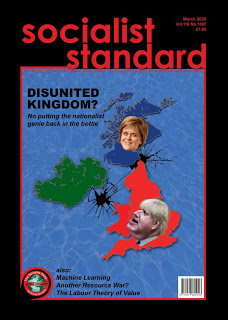
Scottish Independence : Tartan Delusions (2020)

From the March 2020 issue of the Socialist Standard

On the 31 January the blue Euro-banner was hauled down at Westminster and the Union flag raised in its stead. In Edinburgh, though, the self-awarded gold stars flag was pointedly left fluttering in place next to the saltire.

The SNP are making a none too subtle point. The antidote to the referendum they don’t like is to be… another referendum. It would seem the political ‘logic’ is that the best way to counter leaving a union is to leave a union.

It is somewhat ironic that the clash between Holyrood and Westminster stems from a single shared source, nationalism, be it competing nationalisms. The cause is perceived sovereignty, as if Scotland, or England, or Britain can stand alone, or at least break away from a power portrayed as inhibiting its freedom.

However, what would the SNP do in short order should they achieve independence? Give it up to the EU of course. Similarly, should Britain shake off the last vestiges of EU influence, then treaties will be sought and signed with such as the USA.

Not only will the USA want untrammelled access to the NHS for its big pharma, for example, there will be a demand for any arrangements to be subject to America’s legal system. For the USA substitute any other major trading nation/bloc and something similar will apply.

This is what ‘independence’ means in a global capitalist world. Significant change cannot be achieved by a binary vote in a referendum. At best there is some reordering of the arrangements, but essentially, adjustments made, capitalism continues unhindered other than by its own contradictions.

The SNP has previously stated its intention of retaining the monarch as their country’s head of state, continuing the use of sterling and joining NATO. Presumably unaware of any contradiction, they also want to be rid of the Trident submarine bases.

Do they really think that if capitalism degenerates to the point where international warfare results in the use of nuclear weapons, the removal of Trident bases will somehow insulate Scotland from the consequences?

Should the SNP decide the monarch was not to be their head of state, then a president or some such would fulfil that function. Has being a republic lessened the grip of capitalism, with its extremes of war, inequality and crises, on the USA?

If Scotland was denied the use of sterling presumably that would mean embracing the euro with all its financial hazards and, more importantly, subservience to, not independence from, the European Union. If sterling is retained, then economic policy would, ultimately, continue to be determined in London.

The formation of Britain enabled the industrial revolution to create a dynamic economy in which Scots, Welsh and English played full parts. This also led to the formation of the working class with interests transcending those of constituent regional and national parts. Workers in Scotland faced the same exploitative capitalism as they did in England and Wales and expressed their voice through their own organisations, the trade unions.

And nothing has changed. Workers on any side of a border, wherever it is drawn, all face the same fundamental problem, capitalism. To exist, capitalism must exploit workers to make profit. Painting your face blue with crossed white stripes alters this not one iota.

Whatever the outcome of another referendum the people of Scotland will continue to live under a parliamentary system designed to preserve the interests of capitalism. If they have opted for ‘independence’ they will find ‘sovereignty’ surrendered to the EU.

The parliamentary system has evolved to serve the interests of capitalism, not democracy. It does not matter if a parliament is situated in London or Edinburgh, nor if its benches are upholstered in tartan and populated by nationalist MSPs, it will remain subservient to the needs and preservation of capitalism.

Referendums are designed to give apparently simple solutions to complex problems, they are the chosen way of despots and demagogues attempting to garner some semblance of popular support of their self-serving programmes.

The ballot box can indeed be part of the response of the working class to taking economic and political power away from the capitalist class. But this will have to be just one element of a much wider movement in which the working class consciously acts for itself.

No referendum can solve problems for the working class, not in Scotland, not in Britain via Brexit (or re-joining the EU at some point), not anywhere. There is no Tartan alternative to socialism.
Dave Alton

Tuesday, November 12, 2019

Irish neutrality — a scrap of paper (1997)

From the May 1997 issue of the Socialist Standard
Sometime this year or next year, the Irish people can expect a constitutional referendum on the issue of neutrality.
The need for a referendum has been sparked by the possibility of the Republic of Ireland either joining the "Partnership for Peace" or some form of common European defence network. The debate has only really commenced and as it can be expected to be rancorous the government is possibly relieved that it will be settled by a popular vote and not a government decision. It follows a recent pattern in Ireland whereby divisive social issues are dealt with by referenda, avoiding the need for politicians to openly commit themselves.

The issue of Europe producing a political controversy is unusual in Ireland where, unlike Britain, there has been no large-scale Euro-scepticism. However the possible dropping of neutrality is perceived to involve an irreversible change in Irish national sovereignty and hence evokes a visceral response from Irish nationalists. To the socialist, the whole question of neutrality exposes a great deal of the stale cant in capitalist politics and confusion within society about the true meaning of "national sovereignty" and the origin of war.

Isolationist Ireland
Irish neutrality has become to many of its supporters a key part of the distinct identity of the modern Republic of Ireland. In fact the successful Sinn Fein independence movement of 1921 was in large part fuelled by opposition to the threat of London extending conscription to Ireland in 1917. The avoidance of Irishmen being sent abroad to fight in foreign wars at the behest of the colonial power was claimed as one of the major advantages stemming from independence.

The identification of neutrality with Irish freedom was further strengthened by the government's policy during World War Two of remaining aloof from the conflict. The country’s non-belligerent status, while not unanimously approved of, was welcomed by a clear majority of the people, eager to avoid the waste of modern war. Memories of the struggle against Britain were too recent to allow Ireland to join the Allies, and apart from a fringe element within the IRA. there was no appetite for collaboration with Nazi Germany.

In World War Two neutrality conveniently coincided with pragmatic politics but a more opportunistic attitude to the principle itself was revealed in 1949. Ireland was approached to join NATO, expressed an interest but in return wanted Britain to end partition and arrange reunification with Northern Ireland. The proposed deal in effect fell through and Ireland passed through the Cold War era as a member of no military alliance. It is true to say that, whatever the original reasons, the passage of time has meant that neutrality is now regarded as an honourable principle of Irish foreign policy by many people. Thus, although not constitutionally enshrined, it is accepted that any significant changes to it would require a referendum.

While the debate is in its early days the opposing sides have started to take shape. Against any change in the current status of neutrality are the nationalist/traditional wing of the Fianna Fail party, an assortment of left wing groups and leftist elements within the Labour Party and Democratic Left, the Greens. Sinn Fein and what can be generally termed as Irish Irelanders holding to the founders’ original ideal of an independent isolationist Irish state. The assorted nature of this nascent coalition can be seen by noting that Fianna Fail, the largest party in Ireland, are currently in opposition while both the Labour Party and Democratic Left form part of the current coalition government. The constituents of such a widely disparate group have obviously differing motives for their position but in the final analysis they all believe in national sovereignty and have a gut suspicion of trans-national institutions. On the pro side of the debate are the modern Irish "establishment", in the loose sense of the word. Euro-enthusiasts and of course the army which anticipates that an expanded rôle for it will deliver more funding and prestige.

Disappointing debate
To date — from a socialist perspective — the debate has been quite disappointing in its content. Those against closer defence co-operation with Europe say weakening Ireland’s neutrality is in effect an inevitable pro-war strategy and they make valid, though in this context somewhat irrelevant points, about the pernicious effects of the European armaments industries in the developing world and the use of nuclear weapons. They also complain loudly about the future possibility of Irish people being conscripted into a European army, seemingly unaware or indifferent to the fact that at the moment Irish workers can be peremptorily conscripted into the Irish army. On the other side those in favour of joining some NATO-based system say maintaining neutrality will leave Ireland isolated and open to the charge of “free-loading" on western security arrangements. They make clearly erroneous counter-arguments that a united European defence network would have averted the protracted debacle in Yugoslavia and will in the future provide "stability" for the continent.

Socialists oppose both camps who promulgate empty and useless platitudes about being opposed to war while seeking futile measures to avoid its occurrence. Unlike these groups, we are able to draw on a long and principled history, backing up our claims of complete opposition to all conflicts between nation states; this is because we recognise that war is an inevitable feature of the market economy no matter how it is configured. Socialists eschew a nationalistic line as we are as much opposed to workers being conscripted into "their" own armies and fighting for "their” countries as being conscripted into and fighting for anybody else’s.

Neither do we have a legalistic or altruistic view of a policy of national neutrality. As shown with Belgium in 1914. Holland in 1940 or Cambodia in 1970,  protestations of neutrality are no protection if a large power decides that strategic military necessity means invasion of a neutral bystander. When the war needs of any power require intervention, which in a class-based society means the needs of the ruling élite, then they will do so.

Irrespective of the wishes of the majority of the world’s people, wars will, inevitably occur as long as our planet is divided into rival economic units and blocs. Debating the pros and cons of neutrality while passively accepting that the world will continue to be segregated into competitive class-based societies is in the long run a futile exercise. A more gainful approach is to recognise that if we can build and live in a world where the causes of armed conflict no longer exist then neutrality debates, along with war. will become part of our curious history.
Kevin Cronin

Monday, November 4, 2019

Brexit and Democracy: The Value of Your Vote (2019)

From the November 2019 issue of the Socialist Standard

Thoughts on Democracy and Brexit

From the Chartists, through the Suffragettes, there has been an ongoing struggle for democracy. The suffrage, the vote, has been a focus of that struggle, the measure of just how democratic society has become. The ballot box is the echo chamber for the voice of the people. Except, it isn’t.

Should I choose not to cast my vote I am upbraided for betraying those who fought for, perhaps even died for, universal suffrage by not recognising its value. However, the contrary is the case.

I value my vote so highly I will not simply fritter it away. It is not to be given to anyone or any party or cause who do not deserve it. It is all too easy to claim to grudgingly favour the best of a bad lot from a misplaced sense of duty. In the end a valuable asset is all too easily squandered.

So it was for the 2016 EU referendum. Plebiscites have, at best, a poor history. They are the favoured means by which despots seek a thin veneer of popular support for their tyranny. The fundamental weakness is the attempt to present a binary solution to complex issues. And, more often than not, there is insufficient or no factual data whereby a rational decision can be made.

So it was in 2016. Both Brexiteers and Remainers made assertions and shouted loudly, but detail was in very short supply. As economists frequently demonstrate, predicting the economic future is beyond our ken.

In capitalist terms, it is quite possible that the UK may well suffer short term difficulties if ‘we’ ‘crash out’ of the EU, but then go on to prosper, until the next inevitable recession that is. Staying in might well be an economically safer bet in the short term, but if Germany’s manufacturing industry continues to decline it could drag the rest of the EU with it. Both sides might as well slaughter a chicken, metaphorically of course, and examine the entrails.

Therefore, not voting in the referendum was the most rational position to take: hold on to the vote, value it, and don’t give it away to the mountebanks on both sides. Approximately 27 percent of the electorate did precisely that, they didn’t vote. However, that vote uncast, my vote, still counts.

This means that while the outcome has subsequently been presented in binary form, the result was actually a three-way split. In rounded figures: 37 percent voted to leave, 34 percent voted to remain and nearly 29 percent abstained. What is often presented by Brexiteers as an overwhelming vote in their favour, is in fact a minority position, with 63 percent not voting for it.

Governments often gain office on the votes of a minority of the electorate. But at least individual constituencies are represented by individuals from various parties. The party accruing the largest minority of votes aren’t then awarded all the seats in the Commons. And that government can, of course, be subsequently voted out. There isn’t the assertion that ‘the people have spoken’ and so there’ll be no need for future general elections.

Staying in or leaving the EU will ultimately solve none of the problems fundamental to capitalism. Trade wars and actual wars will continue to rage around the world, economic crises will periodically haunt us all, the environment will be further degraded in the ceaseless quest for profit. It must be that way whatever the EU or any other trading arrangements decide. ‘Leave’ or ‘Remain’ – either way capitalism remains intact and dominant.

The solution is achievable through democracy, the vast majority of people consciously choosing socialism. That will involve casting votes, making them even more valuable. But in themselves they will not be enough. True democracy demands a greater commitment than simply turning up at the polling station occasionally.

Voting in a majority of socialist MPs will not lead to socialism unless they are the expression of the majority working actively to bring socialism about throughout society, and around the world. The ballot box is an indicator, not the solution. Democracy has become a passive process playing upon false hopes, alienation and, unfortunately, prejudice. It has become an instrument to divide the working class against itself. Brexit being a clear example of this.

The referendum implies that singular issues can be isolated. However, all that actually happens is the political focus becomes so narrow and myopic that people fail to see what really needs to be confronted, to be dealt with in their own collective best interest.

Whether or not Brexit happens and how, climate change, war, low pay and insecure employment, recessions, poor housing and homelessness, desperate refugees, and so on and so on, will all continue as features of capitalism. Not because capitalists are heartless, they may or may not be, but because capitalism exists for one purpose only, capital accumulation – the pursuit of profit.

In or out of the EU, this will remain the case. It’s not a matter of leaving or staying, but transcending the EU and all capitalist economic and political arrangements by the mass conscious choice of democratically establishing socialism. The true proof of democracy is the vast majority actively deciding on and pursuing a better way of living.

So we say it is worth holding on to your vote, don’t squander it on short term solutions that actually solve nothing. It will prove to be far more valuable when used not as a palliative, but a democratic cure of society’s present ills.
Dave Alton

Tuesday, October 22, 2019

On the Eve of the Referendum in Northern Ireland – Workers Have a Choice! (1973)

From the March 1973 issue of the Socialist Standard

Fellow Workers,

This Referendum is a sham. You are being offered a false choice. The constitutional position of Northern Ireland is not an issue of any concern to you.

Whether Northern Ireland remains part of the United Kingdom or becomes part of the Republic of Ireland will make no difference whatsoever to the basic structure of society where a privileged class monopolises the means of production while the rest have to work for wages and where wealth is produced not to satisfy human needs but for sale with a view to profit. It won’t even make much difference to your present standard of living in terms of wage levels, housing, unemployment and the other problems you face.

Yet it is this class structure of society — which exists equally in Britain, Northern Ireland and the Republic — that is the basic cause of the economic and social problems faced by the great majority of society, those who, whatever their religious background, depend for a living on earning a wage or salary. This is why a mere constitutional change will make no difference, not even a radical one achieved by violence.

Look at the Twenty-Six Counties which achieved “Independence” in 1921 after a bloody war against the British Army. What difference has this made to the position of wage and salary earners there? It has merely provided a different political framework within which they can suffer the problems of capitalism, governed by Irish, instead of British, politicians representing capitalist interests. It has meant little more than painting the pillar boxes green. And painting the pillar boxes in Northern Ireland green is about all voting to join the Republic would achieve. Not of course that staying part of the United Kingdom is going to make any difference to these problems either.

The only change that will is a world-wide social revolution that would make all that is in and on the Earth the common heritage of all mankind to be used to provide an abundance of wealth to which all could have free access according to need. This essentially peaceful revolution can only occur when the great majority of wage and salary earners in all countries are in favour of it and organise democratically to carry it out. It involves a rejection of all nationalism and all attempts to solve problems on a national scale. In the context of Northern Ireland it requires you to reject both Republicanism and Unionism, and their various offshoots.

For years you have allowed yourselves to be enmeshed in a political argument, even to the extent of killing and being killed, that was of no concern to you. The Republicans, on the one hand, sought your support for the establishment of an independent All-Ireland State. The Unionists, on the other hand, wanted you to back their demand that the North-East of Ireland remains part of the United Kingdom. Both sides have not hesitated to use violence, legal and illegal. Because, as far as the capitalist interests they represented were concerned, the issues at stake were vital: Should or should not the highly industrialised area round Belfast have been cut off from the rest of industrial Britain behind the tariff walls of an industrially-backward Irish State? Should or should not the Belfast capitalists have been denied free access to the markets of the British Empire just so that the smaller capitalists of the rest of Ireland should be protected from British competition?

These were the purely capitalist issues that lay behind the facade of religious and constitutional conflict. But for the past ten or so years, as first the Anglo-Irish Free Trade Agreement of 1965 and now the Common Market show, this issue no longer divides the capitalists of Ireland. But, unfortunately, their battles of yesterday continue to be fought by some of you today.

Though a sham, this Referendum does at least provide a chance for you to protest against the kind of politics that has dominated this part of the world for nearly a hundred years and which has brought it to the brink of an utterly pointless civil war. If you want to register your rejection of both Irish Republicanism and British Unionism in favour of World Socialism, we suggest you don’t abstain but go to the polling booths and write the words “World Socialism” across your ballot papers.

Saturday, October 5, 2019

Eire constitution changed (1973)

From the January 1973 issue of the Socialist Standard

In a referendum held last month the Eire constitution was amended to abolish the "special position" of the Catholic Church (see Socialist Standard, August 1972) and to reduce the voting age to 18 (see Socialist Standard, September 1972).

Thursday, September 26, 2019

The Irish Euro Referendum (2012)

From the July 2012 issue of the Socialist Standard
Voting one way or the other was not going to change the reality that capitalism in a slump means extra austerity.
On the 31st May, the electorate of the Republic of Ireland went to the polls to decide on the latest European Union fiscal treaty. The referendum was passed with 60 percent of voters in favour and 40 percent opposed. The Treaty (known as the Stability treaty to its supporters and referred to as the Austerity treaty by opponents) is part of the attempt by Europe to contain the turbulence that has engulfed Euro-zone countries for the past three years. In broad terms signing up to the pact, commits the governments of the signatory countries to limit annual deficits and over the economic cycle to maintain a balanced budget. In return for committing to this, the signatory countries are promised access to the EU’s new assistance fund, the European Stability Mechanism (ESM) if needed in the event that countries cannot raise funds from the capital markets. Most countries within the European Union, both within and outside the Euro-zone, have indicated a willingness to ratify the Treaty and it is expected to come into force early in 2013.

Yes and No
Regarding the campaign that preceded the vote in Ireland, the sides lined up in a predictable fashion. Advocating a Yes were the government (a coalition of the centre-right Fine Gael party and centre-left Labour Party) together with Fianna Fail (long a dominant force in Irish politics but currently much diminished due to their abject handling of the economic crisis that overwhelmed Ireland in 2009) and the majority of big business and farming interests. Conventionally these are regarded as the establishment centre ground.

The opposition consisted of Euro-sceptics from the left and right and single issue political mavericks who customarily appear on these occasions. Leftist opposition primarily consisted of Sinn Fein augmented by the Socialist Party, Socialist Workers Party, Communist Party of Ireland and People before Profit (an organisation that could be characterised as a front for the two ‘Socialist’groups). The rightist component of the opposition in the main came from Declan Ganley and his mysterious Libertas organisation (having minimal membership or popular participation in Ireland and yet amazingly well funded) together with some non-party members of the Irish Parliament and further reinforced with certain publicity-seeking economic commentators. As a whole the trade union movement adopted a position of neutrality though individual union leaders could be found on either side.

The whole context of the debate was framed by the fact that Ireland is currently in receipt of a large loan from the International Monetary Fund and the EU to cover both the government deficit and the huge losses sustained by private Irish Banks due to the property boom (formerly called the Celtic Tiger) that took place in Ireland prior to 2008. The fact that the Irish government (popularly interpreted as the Irish taxpayer/citizen) has had to pick up the tab for 40 billion euros of private debt has proved especially controversial and naturally has caused genuine and understandable bitterness across whole swathes of Irish society. While the initial decision to cover the losses on these private speculative loans was taken by the Irish government, to prop up the banking sector, the continuance of the banking guarantee has been insisted upon by the European Union as a condition of the bail out. Over the past three years, this has been the main bone of contention between the government of the day and the opposition; the former regarding it as unpalatable but unavoidable while the latter demand a tougher stance to be taken on the issue with Europe.

For and Against
Given the major uncertainty that now exists about the medium term future of the European economy and particularly of the fate of the Euro itself, a trump card for the Yes side was the fact that Ireland may require a second bail-out when the current IMF/EU assistance ends next year and the thus need to ensure access to the EMU fund in that eventuality by backing the Treaty. This almost certainly swayed people who depend directly on the state for their income such as pensioners, public sector workers and those in receipt of social welfare payments. The government also kept repeating the point that passing the Treaty would instil confidence in Ireland from international investors and the subsequent inflow of funds would promote job creation and help the economy to recover.

The No side’s major argument was that passing the Treaty would copper-fasten a monetarist economic strategy and prohibit future governments from stimulating the economy with Keynesian type initiatives. They declared it would result in many years of unbroken austerity to come with inevitable cuts to social services. A more nationalistic message was also put forward accusing the government of being too timid in defending Ireland’s interests and too willing to fall into line with the wishes of the large powers in the EU (primarily meaning Germany) especially in readily subsuming the massive private bank debt into sovereign debt in order to help stabilise the Euro currency.

While the government won the debate with its clear-cut electoral victory, it derived very little political capital from its success as it just ensures continuance of the status quo. A defeat would have damaged its standing, both nationally and internationally so in that sense the referendum was always going to be thankless for them. It’s generally accepted the big winners were Sinn Fein as the lead mainstream organisation on the No side. Irish electoral rules demand equal access to be given to both sides in any referendum on the constitution irrespective of the relative size of either side. Hence Sinn Fein received huge publicity and air time to expound their ideas and the campaign marked a further stage on their long and calculated transition from being the front organisation and principal apologist for an entirely undemocratic terrorist group (Provisional IRA) to becoming an acceptable alternative to the existing political options. During the campaign their spokespeople blended vaguely radical sentiments about taking a tough line with Bankers (both Irish and European) to defend Irish interests while assuring the electorate of their commitment to financial discipline. From that perspective, they are part of a long history of parties who have moved from a nominal, if unconvincing, opposition to capitalism to outright acceptance of it as the only means of ordering society.

Left-wing advice
The debate associated with the campaign highlighted yet again the fact that many movements claiming to be Labour or Socialist or Left Wing ultimately are only offering a re-ordering of capitalism. The Communist Part of Ireland advocated a No vote and suggested Ireland should borrow money from sovereign wealth funds from countries such as Russia, China, Norway and various Middle East funds as an alternative to seeking to obtain loans from the markets or the European Stability Mechanism on the basis that better terms would be available. Such financial advice to the government of the day is a curious activity for a group with the name of ‘Communist’in its title. Kieran Allen a leading member of People Before Profit and the Socialist Workers Party also attacked the Treaty from a financial standpoint on the basis that it was a ‘bad deal’for Ireland and that its costs would exceed its benefits. He may of course be proved correct but again this viewpoint is devoid of socialist content. He also indulged in the common electoral practise of scaring pensioners about the entitlements they might lose if the Treaty was passed which of course is the type of tactic that all political parties engage in as part of the shoddy custom of drumming up votes from sectors of the electorate. Possibly the most poignant aspect to all of this is that May 2012 marked the 100th anniversary of the formation of the Irish Labour Party in a congress in Clonmel in 1912. One of the resolutions at that meeting committed the new party to the notion ‘that labour unrest can only be ended by the abolition of the capitalist system of wealth production with its inherent injustice and poverty’. While it is not news that such revolutionary rhetoric has long been discarded, it does highlight the fruitless path that these social-democratic parties have followed whereby they are now further away from their original goals than when they first started out.

On one level from a socialist view, the campaign and its result is entirely devoid of interest. There has been a boom and now we have the bust; this is an inevitable part of the capitalist system. Voting one way or the other was not going to change this reality and studies revealed that this was tacitly accepted by the majority of the electorate. The referendum was an example of the sham that is democracy under capitalism; as members of whatever electorate we happen to belong to we are constantly being cajoled to take part in the democratic process when it’s clear that voting will not make any meaningful difference to our future. For the case in point, the prospects for Ireland’s economy and the future of the Euro will not be decided by the result of the Irish referendum but will depend more strongly on economic developments in Spain and the political situation in Greece. Fundamentally as regards the common currency it will hinge on the willingness of German capitalism to persevere with the Euro by balancing the great benefits it bestows to its powerful export sector against the costs it imposes on the wider economy and its ability to strike a bargain with France on the issue.
Kevin Cronin