Showing posts with label September 2018. Show all posts

Sunday, December 30, 2018

Rear View: Socialism and nothing but (2018)

The Rear View Column from the September 2018 issue of the Socialist Standard

Socialism and nothing but
Attempts to reform capitalism have a very long history, as long as capitalism itself. The original Communist Manifesto of 1848 listed some progressive reforms, but ceased advocating them by 1872. William Morris gave a lecture in 1884 where he stated: ‘the palliatives over which many worthy people are busying themselves now are useless because they are but unorganized partial revolts against a vast, wide-spreading, grasping organization which will, with the unconscious instinct of a plant, meet every attempt at bettering the conditions of the people with an attack on a fresh side.’ It would be incorrect, however, to deny that certain reforms won by the our class have helped to improve general living and working conditions.

There are examples of this in the fields as education, housing, child employment, work conditions and social security. However, such ‘successes’ have in reality done little more than to keep workers and their families functioning and, while it has taken the edge off the problem, it has rarely managed to remove it completely, as the profusion of charities – nearly 170,000 listed at www.gov.uk – attests.


Mote in our eyes
The whole point, missed by charities like Child Poverty Action, is that the privations afflict the working class – the top 1 percent have no such worries because they do not depend on working for their living. Mervyn Pike in 1966 as the then Conservative Shadow Minister of Social Security stated ‘we all recognise that all large families, except those who are very rich, have greater difficulties than smaller families.’  Poverty persists worldwide. ‘The little girl hated going to the bathroom at school. The pit toilets were so dark, dirty and crumbling. Many children were so afraid of them that they simply relieved themselves in the schoolyard to avoid the ordeal. But as she played with her best friend during recess, the girl, Ziyanda Nkosi, a 6-year-old first grader, really had to go. She stepped warily inside the closet-like latrine. Even with the gentle pressure of her tiny frame, the floor caved in. Ziyanda flailed wildly, clinging to the edges of the hole, frantically trying to keep herself from falling in and drowning in the fetid pool below. “Mommy! Mommy!” she screamed, managing to hold on long enough for an older boy to run in and save her. Hundreds of parents . . . demanded justice from the provincial government led by David Mabuza, a former math teacher who had become one of the most powerful figures in the African National Congress and was positioning himself to become South Africa’s deputy president’ (‘South Africa Vows to End Corruption. Are Its New Leaders Part of the Problem?’, nytimes.com, 4 August).


The revolutionary alternative
History shows that organisations which claim to want socialism, and which also promote reforms, ignore socialism and spend their time working for reforms. The Social Democratic Federation had its first meeting in June 1881, yet by December 1884 some 200 members including William Morris resigned saying they had not joined a socialist organisation to advocate reforms. Today, every major party in Europe, the US and elsewhere, whether originally socialist – even the Humpty Dumpty variety – or not, seeks the opportunity to govern capitalism by offering various reforms. They repeatedly fail dismally as far as our class is concerned. If you are convinced, however, that groups or parties promising reforms deserve your support consider:
  1. The campaign, whether directed at right-wing or left-wing governments, will often only succeed if it can be reconciled with the profit-making needs of the system, i.e., the reform will often be turned to the benefit of the capitalist class at the expense of any working class gain.
  2. Any reform can be reversed and eroded later if a government finds it necessary.
  3. Reforms rarely, if ever, actually solve the problem they were intended to solve.

In other words, although individual reforms may be worthy of support, the political strategy of reformism – promising to win reforms on the behalf of others is a misery-go-round. The profit motive of capitalism is a major cause of the problems we face in today’s society – ever increasing inequality, poverty, alienation, crime, homelessness, environmental degradation, the list could go on and on. There are countless ways in which the working class (even members of the capitalist class) suffer as a result of the profit system. Unless we organise and choose the revolutionary road, the profit system will continue on its blind, unswerving path.


Anti-imperialist rhetoric (2018)

Book Review from the September 2018 issue of the Socialist Standard

Indefensible. Democracy, Counter-Revolution, and the Rhetoric of Anti-Imperialism. By Rohini Hensman. Haymarket Books. 2018.  380 pages.

This book sets out to expose the hypocrisy of those the author calls ‘pseudo-anti-imperialists’.  She criticises them for their opposition to Western imperialism only and for supporting all sorts of oppressive regimes on the grounds that they are opposed to the West. When the West is involved in military action, these ‘anti-imperialists’ support the opposing side whatever the nature of their regime. She instances and goes into detail about Serbia, Iran, Iraq and Syria. Argentina, Libya and North Korea could be added.

What is odd is that, although Russia doesn’t claim to be socialist any more, some continue to exclude it from anti-imperialist criticism, as she documents in detail over Ukraine and Syria. She has no illusions about the former USSR. It was, she says, state capitalism, making the additional point that a socialist revolution was not possible there in 1917. Not that knowing that Russia was state capitalist necessarily rules out pseudo-anti-imperialism. The Stop the War Coalition is supported by people who know this, yet while it loudly criticises bombing in Syria by the West, Turkey and Israel it is not very vocal about bombing there by Russia and the Syrian government. She mentions Corbyn as being in this tradition.

This is a fair criticism, and one we have long made ourselves.

Anti-imperialism is a slippery concept because its meaning depends on how you define imperialism. This ought to mean the policy of acquiring an empire, which European states joined by the USA and Japan increasingly pursued in the latter part of the 19th century. This was a development that needed analysing. Those in the Marxist tradition tended to give an economic explanation (acquiring a protected market, need to export capital). Lenin elevated imperialism to ‘the highest stage of capitalism’ and that’s when the rot set in.

It wasn’t that his analysis of the First World War as a war between imperialist powers for the re-division of the world was wrong, but the political implications he drew from this once he himself was in control of the Russian state. First, he developed into a full-blown theory his idea that the parties of the Second International had supported their governments in the war because the section of the working class they represented benefitted from imperialism in terms of higher wages and social reforms. Then, the revolution in Europe having failed to materialise (it was never on the cards anyway), he saw in the rising of ‘the peoples of the East’ against imperialism a way to relieve pressure on the Bolshevik regime in Russia.

Hence ‘anti-imperialism’ became the policy of the Russian state and its supporters abroad. Under Stalin after the Second World War, it became opposition to the West, the US-led bloc that was its rival. It was hypocritical because by then Russia too was manifestly an imperialist power, having acquired the Baltic states and parts of Poland under the 1939 Nazi-Soviet Pact and, after the Second World War, Eastern Europe, apart from the empire in Central Asia it had inherited from Tsarism. Hensman aptly writes of ‘the Russian State Capitalist Empire.’

Her starting point is that, as Rosa Luxemburg put it out in a passage she quotes:
  ‘Democracy is indispensable to the working class because only through the exercise of its democratic rights, in the struggle for democracy, can the proletariat become aware of its class interests and its historic task.’
From which she concludes that it is in the interest of workers in countries which do not have political democracy to obtain it, whether or not the government there is ‘anti-imperialist.’ True, but the way to do this is not to support one capitalist group against another either in politics and certainly not in war, nor by the various changes to the UN she naively suggests in the final chapter.
Adam Buick

Franchise Centenary: A Very Limited Democracy (2018)

Elizabeth Garrett Anderson (1836 – 1917)
From the September 2018 issue of the Socialist Standard

Centenary of Votes for All Men and Some Women
The demonstrations in June to mark the centenary of the coming into force of the Representation of the People Act 1918 (which was obviously a good thing) didn’t tell the whole picture. It is quite well-established now that the Suffragists (constitutionalists) and the Suffragettes (direct actionists) were both campaigning not for votes for all women, but only for votes for women on the same terms as men, votes for ‘middle class property-owning women’ (see: LINK).

As about a third of men didn’t have the vote before 1918, this would have left an even higher proportion of women without the vote. Hence the criticism of both the Suffragists and Suffragettes for standing for ‘Votes for Ladies’ and ‘Votes for Rich Women’.

Actually, already before 1918, Ladies had the vote, but only for local elections. Bebel describes the position in the 1910 edition of his Women and Socialism:
    ‘In regard to municipal administration, woman suffrage in Great Britain is constantly expanding. In the parish councils tax-paying women have a voice and vote as well as men. Since 1899, women in England have the right to vote for town, district and county councils. In the rural districts all proprietors and lodgers – including the female ones – who reside in the parish or district are entitled to vote. All inhabitants who are of age may be elected to the above-named bodies, regardless of sex. Women vote for members of school boards, and, since 1870, are eligible to stand on the same terms as men. But in 1903 the reactionary English school law deprived women of the right of being elected to the school board in the county of London. Since 1869 independent and unmarried women have the right to vote for the privy councils.
   Two laws enacted in 1907 made unmarried women in England and Scotland eligible to district and county councils. But a woman who may be elected as chairman of such a council, shall thereby not hold the office of justice of peace that is connected with it. Women are also eligible to parish councils and as overseers of the poor. The first woman mayor was elected in Aldeburgh on November 9, 1908. In 1908 there were 1162 women on English boards of charity and 615 women on school boards. In Ireland, tax-paying women have had municipal suffrage since 1887, and since 1896 they may vote for members of boards of charity and be elected to same.’
The Mayor of Aldeburgh, a town on the Suffolk coast, was Elizabeth Garret Anderson, the first woman doctor and sister of Millicent Fawcett, the Leader of the Suffragist National Union of Women’s Suffrage Societies, whose statue outside Parliament was unveiled in April.

Tristram Hunt in his (hostile) biography of Engels notes that in the 1876 elections to the London School Board Engels gave all his 7 votes to the woman candidate. This was Alice Westlake in the Marylebone ward, who topped the poll.

She was a Suffragist who was later a member of the central committee of the NUWSS. And like Fawcett a Liberal.

What, it might be asked, was Engels doing voting for a Liberal? Presumably he wanted to make the point that socialists stand for woman’s political and social equality. In which case, he was wrong for the right reason. Socialists do stand, and have always stood for women’s equality.

How to Destroy Capitalism: Blueprint for Revolution (2018)

From the September 2018 issue of the Socialist Standard

 In 2016 the pressure group Corporate Watch published a book Capitalism, What it is and How Can We Destroy it? Written by a dyed-in-the-wool anarchist, it didn’t provide a satisfactory answer to the second question, just that if enough individuals did their anarchist thing that would do it. Nor is it a question of simply destroying capitalism but of replacing it with a society that does serve human needs and interests. Still, how to get rid of capitalism is a good question. But, first, what is capitalism?

Economic process
From a purely economic point of view, capitalism is a process of ‘expanding value’, as the first translators of Marx’s Capital rendered the German word he had used (modern translations translate the same word as ‘valorisation’ but that doesn’t capture Marx’s meaning so immediately).

For Marx, capital was not simply items of wealth used to produce more wealth, but a sum of values used to create more value. This is why he logically began Capital by defining what he meant by ‘value’. Basically, value was the form an item of wealth assumed when it was produced for sale and which governed the proportions in which it exchanged with other items of wealth produced for sale. For Marx, its size reflected the amount of labour needed on average to produce it from start to finish.

Capital, then, is the value of a combination of items of wealth – buildings, machines, raw materials, intermediate products, energy, etc – plus the value equivalent of the labour-power needed to use them to produce other items of wealth. In money terms, capital is a sum of money used to produce a greater sum of money. The aim of capitalist production is to end up with more money (more value) than before. Hence capital is ‘expanding value’. For Marx, the source of the new value was the extra value added by those who did the actual producing over and above what they were paid as wages (the value of their labour–power).

Legal entities
Actually, of course, capitalism is not just an economic process; it is one embedded in social institutions and can only take place through them as the action of particular people who Marx described as ‘functionaries of capital’. These are those who own the factories, machines, etc that make up the means of production.

Originally, when capitalist production started, means of production were the property of (units of capital were embodied in) individuals or a small group of partners. But, as capitalism developed, the amount of money required (the value of the means of production) grew too large for an individual or partners to mobilise. At that point, reached by the middle of the 19th century, the law had to be changed to permit capital to be embodied in a ‘company’ (Britain) or ‘corporation’ (US). This is a legal form in which means of production are collectively owned by shareholders whose liability to pay for any debts if things go wrong is limited to the amount of their shareholding. Today, most capital in terms of value is embodied in this type of legal entity.

In the limited liability company the state has created a legal entity to embody capital that has a fictitious personality in that it can act as if it were a person, by entering into contracts with real persons and with other companies as legal persons. Joel Bakan in his 2004 documentary and book The Corporation takes up this fiction and shows that, if a company really were a person, that person would be diagnosed as a psychopath. This, in view of their relentless pursuit of a single aim – that of making as much profit as possible – to which everything else is subordinated and regardless of the effect on others.

This is a valid point but it is not the legal form of a corporation that imposes this behaviour on its directors even though it lays this down as their legal duty. The legal form reflects the underlying economic process of any capital’s need to expand its value. It is economic reality that determined the law, not the law that has determined economic reality. This is why no change in company law can change the way in which the capitalist economic system works.

In fact, the other legal forms that have been legislated for to embody capital – nationalised industries, mutuals, cooperatives – are under the same pressure to seek to maximise profit as a condition for surviving as an economic institution embodying capital. It is just that in their case the trustees – the functionaries of capital – are different: government appointees, even worker-elected boards. As are the rules for distributing profits that are not re-invested (not added to the original value): they cannot be distributed as dividends (though they can be, and are, as bloated salaries).

Uncreating corporations
That the main form in which most capital is embodied today is a state-created legal entity provides a clue as to one step in replacing capitalism – winning control of the state so as to be in a position to ‘uncreate’ these legal entities. This done, the means of production cease to be private property and become nobody’s property; which is the same as saying they become everybody’s common property.

This new reality too has to be embodied in social institutions. Political action to abolish corporations presupposes that there is a majority in favour of this but also that this majority is organised on the ground ready to take over control of the now commonly-owned means of production and operate them.

It is not as if capitalist shareholders own the means of production vested in these legal entities in the same way as they personally possess personal items such as clothes, houses, or cars that can be physically taken from them. This is not what needs to be done in the case of the factories and machines owned by corporations as the capitalists who own them don’t do so by virtue of physically possessing them but by virtue of holding pieces of paper saying that they are shareholders in a legal entity with a fictitious personality. The obvious way to end their ownership is to render these pieces of paper worthless by dissolving the artificial entity.

Workers in a factory could take it over but that wouldn’t result in common ownership by society as a whole. At most it would result in worker ownership. To achieve society-wide common ownership requires society-wide action. The easiest way to do this is by political and workplace organisation, political to end the legal status of corporations and workplace to continue to operate the means of production.

The alternative, that used to be more widely proposed and still is by those who haven’t thought the matter through, would be for some society-wide economic organisation to proceed to take over the means of production in a general workplace occupation while ignoring the state. This would be stupid when there’s an easier way. If a majority favour taking over the means of production, that majority would also be able to take control of political power through the ballot box. On the other hand, if they won’t vote for it they are not likely to take the bolder step of actually doing it. It is true that, given a majority in favour of making the means of production commonly owned by society, ignoring or trying to by-pass the state might succeed in the end but at the price of unnecessary chaos and violence. Why break into a house when you can get the keys to the front door?

When the means of production cease to be owned by legal entities and become common property, at the same time they also cease to be capital in that they can now be used to produce directly and solely to meet people’s needs. The economic process – the economic imperative – to ‘expand value’ would no longer impose itself. Capitalism will have been abolished.
Adam Buick

Cooking the Books: When did capitalism start? (2018)

The Cooking the Books column from the September 2018 issue of the Socialist Standard

 In an interview in In These Times (10 May) about his latest book Bullshit Jobs, celebrity anarchist David Graeber raised an interesting point. After digressing to say that he was currently working with people campaigning for a basic income and wondering whether asking the state to pay people money was compatible with anarchism, he suggested that we might be living in a long period when capitalism was transforming into some other form of society (but ‘which might be just as bad’); but how would we know? He went on:
  ‘I remember having this argument with conventional Marxists about the transition from feudalism to capitalism. Okay, say that capitalism started around 1500. And the Marxists insist that capitalism is organized around wage labor. But wage labor was marginal until the industrial revolution, around 1750. How can you say that wage labor is central to capitalism if, for 250 years, it was a tiny element?’ (Link. ).
He said he got the reply:
  ‘Well, you’re not thinking dialectically. From 1500 to 1750, people were in a process that was going to lead to wage labor, they just didn’t realize yet.’
 We were one of the ‘conventional Marxists’ he discussed this with, in the October 2012 Socialist Standard. But this can’t have been us, as our reply was that capitalism is a market society in which all the elements of production, including human labour power, are bought and sold, but that this would not complete until the actual producers had been separated from the means of production, whether land or tools; which was a gradual process.

 On the question of whether the elites in control of political power up to 1750 understood where society was going, we replied that a section of them were indeed consciously seeking to spread market relations and the concept of the individual free to enter market relations with other individuals; which did include the right to sell their ability to work.

 Another reply (again, not ours), would be that of Immanuel Wallerstein and the world-system theorists that the essence of capitalism was not wage-labour but production for sale on the world market with a view to profit, whether carried out by serfs (as in Eastern Europe) or chattel slaves (as in the Americas) and not just by wage-workers. However, while capital investment in production of cash crops by serfs or slaves was viable, this was not the case for manufactured products; here wage-labour was more efficient from a capitalist point of view (which of course is why the slave trade and then slavery were abolished in favour of wage-slavery).

 Capitalism is a system where money-capital is invested in production for sale with a view to a monetary profit. ‘Merchant capitalism’, which in previous discussions Graeber said some Marxists had suggested was what existed from 1500 to 1750, was where merchants invested money-capital with a view to profit, not in production, but in buying (or looting) products from one part of the world and selling them in another part at a higher price. It might have been a transition to capitalist production but it wasn’t what Marx meant by ‘the capitalist mode of production’. 

 In any event, to say that capitalist production first appeared in the 16th century is not the same as saying that capitalism as a socio-economic system started then. The capitalist ‘mode of production’ gradually spread, with the aid of the state, until it became the dominant one. That would be the point at which it could be said that capitalism as a society had come into being. 1750 seems about right for this. Adam Smith, writing in 1776, was already using a three-class model, even for agricultural production, of landowners, tenant farmers and wage-workers.

Memories of the Future (2018)

The Wood for the Trees Column from the September 2018 issue of the Socialist Standard

Humankind has always had a fascination for both its past and its future. Although the events that make up history are unchangeable their interpretation is always evolving and dependent, to a large extent, on the political and cultural context of the historian.

The same is true of speculations and prophesies for the future. When I was a kid in the 1960s the optimism for the future was ubiquitous and unbounded. The dominant form of political speculation for the future today is dystopian. The reasons for this are many: the failures of leftist politics to produce the promised social justice together with the perceived betrayal of technology to enable a better life for the majority are two of the more obvious. As socialism invests heavily in an analysis of the past, present and future what does it make of this dystopian vision so beloved by writers, movie makers and political prophets of the early twenty-first century within western culture?

Two of my memorable examples of ’60s optimism were a couple of TV shows: Tomorrow’s World and the US sci-fi drama Star Trek. The former programme was an optimistic compilation of technical innovations that promised both greater productive efficiency and thus more quality leisure time. Watching it today it seems hopelessly naïve and, more often than not, completely wrong about the social implications of specific technological inventions. Star Trek remains, through various TV and movie spinoffs, one of the few optimistic visions of human future. Ironically the American cast represented a future with no gods, countries or money! It was the child of the optimism of ’60s liberal America and the ‘baby boomer’ generation of post Second World War youth culture. The aliens in that show represented the dark side of US culture: Borg/Fascism, Farengi/Capitalism, Klingon/Gung Ho Militarism, etc. Many of the storylines circulated around the concept of the ‘Prime Directive’ which prohibited the human crew from interfering with the technological evolution of less developed alien cultures (a response, perhaps, to the genocide of the indigenous American population of the previous century). For socialists this represents an optimistic and, to the surprise of many, a realistic vision of the future. Let’s look at the dystopian narrative and define why socialists find many of them unrealistic.

There are several kinds of dystopian narratives including the post-apocalyptic which may be a result of a pandemic or natural disaster but what really interests and frustrates socialists is the technological and political dystopia. The idea that technology can and does have unintended social consequences is taken to an extreme in such films as Terminator, The Matrix and more recently Anon where any political responsibility for the imagined futuristic cultural context is completely absent. We have become the puppets of our own products in these films and although some recognition of the secrecy of business or state is present the blame for the plight of the characters is firmly with technology itself. Blaming humanity’s technological progress rather than its political institutions is the ultimate Luddite excuse for political cynicism and underlines the limited economic and historical understanding of those who create these stories. In the future such films will be seen to represent the tropes associated with the despair of neo-liberalism and the failure of the left just as the science fiction films of the 1950s are now seen primarily as a response to the ‘cold war’ politics of the time.

Political dystopias such as Huxley’s Brave New World, Orwell’s 1984 and Rand’s Anthem are critiques of the attempt to create utopias and the associated ideas of rebellion and revolution. Whether they are right-wing or left-wing dream societies the implication is that any attempt to improve society is doomed to create something infinitely worse than that which it seeks to replace. Again a basic political analysis is absent because these are merely different types of capitalism which is always at the heart of actual and fictional political failure. We are dissuaded from the political struggle for a better future by these narratives and as such they represent a reactionary defense of the status quo. As critiques of the politics of left and right they are informative, if rather repetitive, but they do not and cannot represent a valid critique of socialism. These stories feed the political cynicism which has been created by the failure of leftwing and, to a lesser degree, rightwing political regimes and represents one of socialism’s greatest enemies.

If humankind’s future is indeed to be in space then economic activity will have to be liberated from the fetters of capitalism and its production for the profit of the few. Only when the economic security of the majority is secured can such an undertaking be morally and economically justified – and only socialism can provide this. This is why we find high tech dystopias so unrealistic; if we survive as a species to a point where space travel is ubiquitous it can surely only be post socialist revolution. Our limited forays into the firmament have mainly been motivated by military/economic considerations or as a new playground for the mega-rich with pure scientific curiosity being an afterthought. This may also be a reason why extraterrestrials have not contacted us; they have respected the ‘prime directive’ in terms of our very limited political development and impatiently await the time when the answer to their test demand ‘take me to your leader’ will be answered with: ‘we’re sorry but we have no leader’.
Wez

Pathfinders: Plastic not so fantastic (2018)

The Pathfinders Column from the September 2018 issue of the Socialist Standard

On 10 July 1940 war-time Britain saw the launch of the Great Aluminium Scare and a Beaverbrook campaign to ‘turn your pots and pans into Spitfires and Hurricanes, Blenheims and Wellingtons’. Patriotic citizens responded by sacrificing useful metal kitchenware and bathroom fittings which created mountains all over the country. Scrap metal mania even extended to tearing up the railings round municipal parks, though cast iron scrap had little practical value. Indeed most of these scrap mountains went into landfill or post-war scrap metal shops since, as RAF Museum curator Rob Skitmore pointed out in 2005, ‘in fact we had lots of aluminium, what we needed more of were pilots’ (see Link).

The point of course was to give the population something practical to do so they could feel like part of the war effort. In short, a propaganda exercise. After all Lord Beaverbrook, aside from being Churchill’s minister of aircraft production, was also owner of the Daily Express, the world’s largest circulation newspaper at that time.

Is something similar happening today with the Great Plastic Scare? It seems to have started with the BBC Blue Planet II documentary earlier this year, which highlighted the problem of plastic ocean waste and resurrected 2016 World Economic Forum predictions that by 2050 there will be more plastic in the oceans than fish. Now the rush is on to ditch the use of plastic cups, cotton buds, plastic straws, wet wipes, plastic bags, plastic food wrappings, in short, plastic anything. The UK government is now compiling a list of plastic items to ban and a plastic tax is being considered by the Treasury (‘Public ‘back’ taxes to tackle single-use plastic waste’, BBC, 18 August). Practically overnight, plastic has become the new demon.

The problem is, things are always more complicated than news headlines make them out to be. While there’s no doubt that global capitalism is using the planet like a giant dustbin, the solutions aren’t always so obvious. Whatever you do is going to have an environmental impact. If you swap single-use plastic bags for a cotton tote bag, you’ll have to use it 131 times before reaching impact parity, because of the high environmental cost of cotton production (New Scientist, 13 June). If you avoid food containing palm oil but drive with the latest ‘green’ biofuels, you’ll be burning palm oil instead of eating it and thus still contributing to the devastation of Madagascar. In theory one could use different vegetable oils in fuel, but they would require massively more land than oil palms need. If you decide to avoid fossil gas central heating in favour of a trendy and ‘clean’ wood burning stove, you’ll be treating your neighbours to the equivalent of eight trucks parked in the street with their engines on all night (New Scientist, 2 June).

People during the war probably didn’t need or want to know that they were making pointless sacrifices. What they craved was the feelgood factor. So today people don’t perhaps want to know that most of the contents of their recycle bins is likely to end up incinerated or in landfill, or sent abroad. According to the National Audit Office, the government doesn’t have any idea whether or what percentage of ‘recyclables’ is being recycled, has ‘turned a blind eye’ to known problems in the waste stream, has only carried out 40 percent of the recycling checks it was supposed to, and has been exporting over 50 percent of the waste it claims as ‘recycled’ (‘Recycled packaging ‘may end up in landfill’, warns watchdog’, BBC, 23 July).

You’d be excused for thinking that the whole recycling programme is a bit of a con. Most of the plastic we rinse and put in recycle bins is not actually recyclable, largely because manufacturers use cheap, low-grade and non-biodegradable industrial polymers. Well of course they do, but other reasons are more trivial. Fresh food containers are very often carbon black because food products apparently look good on black, but recycling machines can’t detect black (‘Plastic food pots and trays are often unrecyclable, say councils’, BBC, 4 August). Plastic cups don’t get recycled, not because they couldn’t be, but because there is no regional collection infrastructure for them. And if there was, would the road haulage fleet required then cancel out the carbon benefits of the recycling?

It’s not that we shouldn’t bother making any individual efforts. Of course we should, and many of us do, because a future socialist society wouldn’t last five minutes without a strong and abiding sense of personal responsibility. But too much focus on little things like cotton buds and wet wipes – which apparently cause giant ‘fatbergs’ in London’s sewage system – can become a seductive invitation to forget the big picture, to kid yourself you’re doing something when you’re really not.

Some young activists, too young even to vote, are making bold attempts to take their governments, or international corporations to court over climate change (New Scientist, 18 August). How much success these ‘climate kids’ are going to have suing capitalist institutions inside capitalist courts is something socialists can hazard a cynical guess at. But at least they’re trying to raise the climate stakes to match the rising temperature.

What really needs putting in the dock of course is capitalism itself, and the total control and squandering of Earth’s resources by less than 1 percent of its population. If the public scare about plastic is viewed as an indicator of a growing sense of communal outrage on behalf of the planet, we might be encouraged, but only if this outrage starts to take an explicit and political form. If however people are happy to settle for tokenistic efforts for the sake of a quiet life, the class war will continue indefinitely, and socialists will have to battle on alone.

Genoa Bridge Collapse
As we go to press the cause of this collapse is not yet known, but metal corrosion in the steel cables reinforcing the concrete structure is suspected. Acoustic sensors are a new technology which can ‘hear’ internal corrosion, and recently resulted in London’s Hammersmith Flyover being urgently refurbished, but most bridges don’t have them, as the cost would be huge. Globally bridges are often in a poor state. 7 percent of French bridges are at risk of collapse, 12 percent of Germany’s are in bad condition, and 54,000 US bridges are ‘structurally deficient’ (New Scientist, 17 August). No doubt a 10-year recession and government cutbacks in every country have done nothing to improve matters. Whatever the state of road bridges in socialism might be, at least we can say that saving money wouldn’t be a factor.
Paddy Shannon

Wednesday, November 28, 2018

50 Years Ago: What! No money! (2018)

The 50 Years Ago column from the September 2018 issue of the Socialist Standard

Millions of viewers of the BBC programme last June on the students will have heard Tariq Ali declare “we believe in the abolition of money”. Someone pointed out that “the others looked very doubtful”.

As well they might. Even Cohn-Bendit has only called for equal wages, presumably to be paid in money.

Tariq Ali himself probably did not understand the implications of what he said. But he did break a left-wing taboo. Normally they don’t like to fly so much in the face of popular prejudice and risk being called “Utopians”.

No, normally they like to be seen as r-r-revolutionaries boldly declaring they believe in violence!

Whatever the reason for his lapse Tariq Ali did at least provoke some discussion in the papers as to whether or not it was practical to do away with money. Most people ridiculed the idea but one Guardian letter-writer pointed out that the absurdity of capitalism should be obvious every time you get on a bus and have “to exchange metal discs for a ritual rectangle of paper which an intelligent man was paid to punch”.

Of course to abolish money without making any other changes would be foolish. Capitalism produces wealth for sale on a market with a view to profit and where there is an exchange economy money is very useful. The only alternative is barter which would be cumbersome and lead to a drastic drop in trade and production.

But this is not what Socialists want. We have always stood for a change in society which would make money redundant. Once the means of wealth production are the common property of the whole community they can be used to turn out wealth directly to meet human needs. When this has been done then everybody could have free access to it and take what they felt they needed. And why not, when the resources of the world can provide plenty for all? It is not those who want to abolish money who are absurd but those who want to keep it.
[Socialist Standard, September 1968]

Obituary: Dorothy Morriss (2018)

Obituary from the September 2018 issue of the Socialist Standard

The family have informed us that Dorothy Morriss died peacefully on 5 August in Poole hospital, aged 90.

She was born Naomi Dorothy Thomas on St. Helena, the island in the middle of the Atlantic, and lived in Australia and New Zealand before finally settling in Britain, in Bournemouth, in the 1970s. She and her husband, Harry, who had joined the Party in 1945 before emigrating, were members of the SPNZ and transferred to the party here. She was an active member of the one-time Bournemouth Group and, with other local members, helped stake out the pitch and run the Party stall at the annual Tolpuddle Martyrs Rally every July.

In a tribute, the family, to whom we extend our condolences, write: ‘A party stalwart, Dorothy was simply a marvelous lady. Believing deeply in the ethos of equity and the power of community, Dorothy consistently championed the unconventional and always the underdog. With a network of close friends spanning both tropics, Dorothy’s warm, wonderful nature was remarked upon everywhere. She raised a wonderful family and is survived by her daughter Ann and her two grandsons, Chris and James, who looked up to her benevolent spirit ever so fondly. To a life well lived, all our love, your family.’

Saturday, November 24, 2018

The Hard Left: A 21st Century Anachronism (2018)

From the September 2018 issue of the Socialist Standard

The conservatism of the Hard Left
One of the things the Socialist Party is often accused of by what is loosely called the Hard Left is ‘utopianism’. We are ‘utopian’ for wanting to establish an alternative to capitalism where goods and services are no longer produced for sale but to directly satisfy human need, where the class division of society into employers and employees, along with the whole system of waged labour, has ceased to exist and where the productive resources of society are owned in common by everyone.

This is indeed a utopia in the strict sense of the term – meaning ‘nowhere’. A socialist society does not exist, and has not existed, anywhere. But that does not mean it cannot exist.

True, on the Richter scale of political insult being called a ‘utopian’ ranks fairly low down. One could be called a lot worse in the colourful lexicon of the Hard Left.  We could have been branded as ‘revisionist’ or an ‘imperialist stooge’.

All the same, there seems to be something a little odd about this charge of ‘utopianism’; it has the ring of cognitive dissonance about it. After all, aren’t these assorted grouplets of Trotskyists, Stalinists, Marxist-Leninists, Maoists, Hoxhaists, Castroists and the like, supposed to have as their ‘ultimate objective’ precisely what the Socialist Party stands for? Are not the ‘iron laws’ of history, in their view, relentlessly pushing us in that direction, anyway?

Well, it seems not. It seems that the Hard Left – we can forget about the Soft Left who don’t even pretend to have socialism as a long term goal – have hit the pause button on history and that is where they intend to indefinitely remain. It seems that the pragmatic necessity of campaigning for reforms is always going to take precedence over the need for social revolution. Their reasons for thinking this will be examined later

Preconditions of Socialism
It should be obvious that to bring about a socialist society you have to have a significant majority who want it and broadly understanding what it entails. That is because socialism constitutes a radical change in the ‘rules of the game’, so to speak – meaning the norms and social expectations that govern human behaviour.

For instance, in socialism, since the very notion of economic exchange will have disappeared as a logical consequence of making the productive resources of society the common property of everyone. Exchange, after all, denotes an exchange of property titles and, hence, the existence of private property – what this means is that labour in a socialist society could no longer be coerced by the need to sell our working abilities for a wage; it must necessarily take a voluntary form. It also means that products of our collective labour – the goods and services we consume – would be made available to all on a completely free basis without any kind of quid quo pro exchange being involved.

In fact, these two things – ‘free access’ and ‘volunteer labour’ – hang together as social practices inasmuch as the one implies the other. They constitute the very essence of what is meant by the old socialist slogan ‘from each according to ability to each according to need’. But, clearly, in order to implement this, people have to know what to expect of each other. We need to feel the sense of security that stems from a shared vision of how society ought to function and a common set of values to guide and motivate us. Otherwise, the result will, very obviously, be chaos and societal breakdown.

Equally obviously, this social arrangement can only be implemented where there exists the technological potential to produce enough to satisfy the needs of the population.

Otherwise, chronic material scarcities would undermine and subvert the cooperative ethos upon which a socialist society depends. Self-interest, instead of complementing altruistic values (as would be the case in a healthy, balanced society), would increasingly work to crowd out the latter, as individuals scrambled to grab what they could regardless of the consequences for others.

Socialists contend that this technological potential has long been in existence; the barrier to its realisation is capitalism. Not only does capitalism deliberately curtail production to what can be profitably sold but a very large and steadily growing share of economic activity under capitalism is devoted, not to meeting human needs, but to meeting, instead, the systemic needs of capitalism itself – a prime example being the entire financial sector of the capitalist economy.

This massive wastage of human and material resources (from the standpoint of meeting human needs) will abruptly come to an end in socialism. These resources will be freed up for the purpose of significantly increasing the overall output of socially useful wealth while also, paradoxically, helping to mitigate the enormous and unsustainable pressures currently being exerted on our global ecosystem – simply by changing the basic purpose for which wealth is produced in the first place. That is to say, by changing the nature of the society we live in.

Supporting Capitalism
Where do the Hard Left stand in relation to all of this? Since they are not really interested in talking about, let alone advocating, socialism – because it would be ‘utopian’ to do so in their eyes – how is a mass socialist consciousness ever going to come about, in their view? When precisely will it no longer be ‘utopian’ to talk about socialism – if ever?

They frequently cite in their defence that famous quote by Marx in The German Ideology (1845), completely misunderstanding the point Marx was getting at, and interpreting it as justification for their lack of interest in promoting a genuine alternative to capitalism:
   ‘Communism is for us not a state of affairs which is to be established, an ideal to which reality [will] have to adjust itself. We call communism the real movement which abolishes the present state of things. The conditions of this movement result from the premises now in existence.’
A major premise to which Marx was alluding here was precisely the existence of a sufficiently developed technological potential to make communism (aka socialism) realisable. While socialists contend that this potential has long been around, the Hard Left, on the whole, tends to deny this and, in doing so, inadvertently and unnecessarily helps to prolong capitalism.

For them, it is not really capitalism that is responsible for the persistence of needless poverty. Though they may rail against ‘greedy corporations’ and how these prioritise profits over people, the problem, they suggest, is that we still lack the necessary technological infrastructure that could make socialism a material possibility. In short, we still need more in the way of capitalist development.

For instance, absolute poverty, defined by the World Bank as a condition of severe material deprivation in which individuals are compelled to live on an income of less than $1.90 per day in 2011 prices, continues to affect hundreds of millions of people around the world. Overwhelmingly the absolute poor are concentrated in the Global South. From this it is inferred that the problem boils down to the unequal relationship between the ‘rich world’ and the ‘poor world’ – as if poor people don’t live in the former and rich people don’t live in the latter.

For many on the Hard Left this unequal relationship is a function of ‘imperialism’ rather than capitalism as such. Consequently, what is required is a struggle against imperialism and the imperialist nations – in particular, the United States. This entails supporting ‘national liberation struggles’ in the Global South and the efforts of these poor countries to develop themselves economically, freed of the malign influence of this First World imperialism. In this manner do the Hard Left partisans of ‘Third Worldism’ align themselves with the interests of local capitalisms in the Global South.

The problem is that capitalism is a global system; it is everywhere driven by the same logic. That is a logic that works to block the realisation of the enormous productive potential we already possess and it is only by establishing a global alternative to capitalism that we can hope to release this potential. You can hardly do that if you are an advocate of Third World nationalism. Nationalism is no threat to capitalism; on the contrary, it is an ideological prop to capitalism.

Not only that, the Hard Left naively assume that ‘material abundance’ is something that must become an empirical fact, an experiential reality for everyone, before we can even begin to talk about socialism – a sociologically inept idea, anyway, given capitalism’s compulsion to constantly induce in us, through the power of advertising and the like, a chronic sense of deprivation, even when our lives are already cluttered with often useless gadgets and our fridges are stuffed to overflowing with packaged food. Until then, argue the Hard Left, capitalism is still needed, albeit under the tutelage of the benevolent state and dressed up in the trappings of socialist terminology.

Such backward and distinctly non-revolutionary thinking stems from their deep attachment to the state capitalist model of capitalist development such as was implemented in the early decades of the Soviet Union. At the time this model did indeed seem to permit a comparatively rapid rate of capital accumulation in international terms. A case can certainly be made that state capitalism was better suited (from that point of view) to an earlier period of capitalist development than rival models (such as laissez faire capitalism) – what the economist, Walt Rostow, called the ‘take off’ stage of economic growth in his influential book, The Stages of Economic Growth: A Non-Communist Manifesto (1960).

Later, however, as the Soviet economy grew in size and complexity and shifted from an extensive to an intensive form of economic growth, this state capitalist model with its built-in structural rigidities and inefficiencies, increasingly became an impediment to capitalist development, resulting ultimately in the collapse of the Soviet Union itself. But the fundamental conservatism of the Hard Left, with their obsessive preoccupation with ‘productivism’ and GNP growth for its own sake, makes it difficult for them to relinquish their blind faith in state-led capitalist development. It is as if they are trapped in a 1930s time warp when good old Uncle Joe Stalin ruled the roost and so called ‘central planning’ was all the rage.

Since (state) capitalism is still needed, in their view, a corollary of this is that there is no point in working to put in place that other major premise upon which the establishment of a socialist society is predicated – namely, majority understanding of, and the desire to bring about, socialism. Such talk, they say, is premature and ‘utopian’. Their stock defence of this position is that they are ‘materialists’ so putting forward the case for socialism is ‘idealist’. We learn not through ‘abstract propaganda’ but ‘practical experience’.

Hard Left idealism
Actually, this betrays a crude, mechanical and completely reductionist view of what materialism is actually about. Ideas are part of our social environment, not something separate from it. There is no dichotomy between ‘ideas’ and ‘experience’. Ideas are the means by which we make sense of our experiences. In the Communist Manifesto there appears the following passage:
  ‘All previous historical movements were movements of minorities, or in the interest of minorities. The proletarian movement is the self-conscious, independent movement of the immense majority, in the interest of the immense majority’.
The emphasis on ‘self-consciousness’ here is deliberate and intentional. You cannot logically separate the notion of a working class that has become aware of its status as the dispossessed productive class in capitalism – Marx’s ‘class-for-itself’ as opposed to a ‘class-in-itself’ – from the collective desire to make the means of wealth production the common property of all. The one thing implies the other. In other words, putting forward the case for socialism – what the Hard Left dismisses as ‘utopianism’ – is actually a key part of the development of proletarian self-consciousness.

In the Hard Left’s mechanistic conception of what ‘materialism’ is about, the desire for socialism is somehow supposed to magically spring out of the material conditions in which workers find themselves without the active intervention, or propagation, of ‘ideas’. But how is this possible since we don’t live in a socialist society and can only anticipate it in our imagination? Yet it is precisely the role of imagination that the Hard Left is intent upon deriding and downplaying in its mechanistic conception of revolution.

In Capital, Marx touches on precisely this point when he distinguishes between the instinctive labour of (other) animals and human labour:
  ‘A spider conducts operations that resemble those of a weaver, and a bee puts to shame many an architect in the construction of her cells. But what distinguishes the worst architect from the best of bees is this, that the architect raises his structure in imagination before he erects it in reality.’
(Volume 1, chapter 7).
Precisely the same argument can be applied to the establishment of socialist society. And yet, the process of imagining such a society as a precondition for establishing it is dismissed by the Hard Left as ‘utopianism’. Tellingly for them it is only when the vanguard (which – presumably – alone possesses this ability to envisage an alternative to capitalism) has captured political power on behalf of the workers that the latter can be instructed or socialised into the ways of socialism.

In short, their mechanistic view of materialism goes hand in hand with their own elitist, social engineered conception of revolution.

A self-fulfilling prophecy
Thus does the Hard Left’s entire thinking on this matter help set in motion a kind of self-fulfilling prophecy that fundamentally hampers the spread of socialist ideas. The mere fact that the socialist cause continues still to attract comparatively few supporters is cynically cited by them as the very reason for spurning it. In this way, the Hard Left joins hands with the overt supporters of capitalism in striving to ensure socialism remains firmly off the political agenda.

But as long as the socialist cause is spurned, so long will it continue to attract few supporters. Its lack of support is somehow equated with a lack of credibility – though ironically many of these groups that ridicule us for being ‘utopian’ are significantly smaller in size than the Socialist Party itself.

However, the basic assumption being made here – that if an idea attracts little support it must therefore be lacking in credibility – seems questionable. In an ideal world size shouldn’t matter. An idea would stand or fall on its own ground and irrespective of the support it attracted.

After all, Hitler came to power on the back of the electoral support of literally millions of German workers. Are we then to infer that Nazi ideology had much to commend itself for this reason? Conversely, Nicolaus Copernicus advanced his heliocentric theory in the 16th century in the face of near universal opposition, even outright hostility. Should he have abandoned that quest and caved in to the prevailing consensus? Some historians suggest that Copernicus’ ideas are what helped to kick-start the subsequent scientific revolution.

Without wanting to stretch the analogy too far, socialists today are in some ways the political equivalent of Copernicus back in the Renaissance era. What is scorned and mocked today can become the common sense and convention of tomorrow and more rapidly than we can ever imagine in a world in which the pace of change is accelerating

Socialism is an idea whose time has come and, small though the number of socialists may now be, it only takes the logic of the Butterfly Effect to make a real and cumulative impact on the world we live in.
Robin Cox
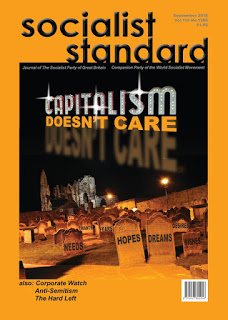
Sunday, September 23, 2018

Exhibition Review: Macclesfield Silk Museum (2018)

Exhibition Review from the September 2018 issue of the Socialist Standard

 From the sixteenth century Macclesfield had a button industry, which developed into one making silk buttons and later into a full-scale silk industry. This also applied to other nearby towns, such as Congleton, but Macclesfield remained the main centre. Its School of Art, opened in 1851, trained designers, and its former buildings are now the site of the Macclesfield Silk Museum, which has informative displays relating to design and manufacturing processes, examples of products and a gallery with looms and other machinery.

 Silk throwing is the preliminary stage of manufacturing, making single fibres into usable thread for weaving. The various processes of throwing and weaving were originally carried out in workers’ homes but gradually transferred to mills and factories. The mill workers were mainly women, with men mostly performing skilled and supervisory work, but there was also much child labour, with over a quarter of the workforce being children in 1873. Wages were in general lower than those in cotton mills. There were many ups and downs in the silk industry, partly due to overseas competition and the rise of artificial fabrics such as rayon, sometimes offset by bans on imports. Trade flourished during the Napoleonic Wars as competition shrank, but then declined afterwards. In the Second World War, the silk industry emphasised the production of parachutes and escape maps, with much trouble taken to secure supplies of raw silk.

 One consequence of the booms and slumps in the silk industry and resulting periods of unemployment was the emigration of workers. One man from a family of Macclesfield mill owners set up a silk factory in Paterson, New Jersey in 1845. A temporary display at the museum has some information about the silk industry there but says very little about the notorious strike of 1913, which saw 1,850 workers arrested and two people killed (one a striker, shot by a strikebreaker).
Paul Bennett

Thursday, September 20, 2018

Proper Gander: Revenue Streams (2018)

The Proper Gander column from the September 2018 issue of the Socialist Standard

Since the internet came along, we’ve got used to having instant access to whatever information or services or media we want (or are supposed to want) whenever we want it. This easy availability has left many older ways of doing things lagging behind: online shopping is pushing out the high street, newspaper sales have declined as we increasingly turn to our smartphones for fake news, and traditional broadcast television has similarly been under threat. The BBC, ITV and Channel 4 started to lose their market dominance when satellite and cable channels popped up, and now all of them have to compete with streaming media platforms like Netflix and Amazon Prime. These let us watch any of their programmes at any time (for a price), so waiting for a show to come up on a channel’s schedules now seems as old-fashioned as a squarial. 

 Younger people are particularly likely to embrace newer ways of watching telly. According to a recent report by Ofcom, teenagers and young adults now watch around 40 per cent less through old-school channels than they did seven years ago. This has meant fewer people watch the adverts between shows on ITV, Channel 4 and Channel 5, with the consequence that their advertising revenue fell by 7 percent in the last year due to ad agencies turning to the internet. There’s less money in all of the terrestrial channels, who now spend 28 percent less on programming than they did twenty years ago. And for the first time, streaming media has overtaken older paid subscription channels in the race for customers. 

 There are now 15.4 million subscribers to Amazon Prime, Netflix and Now TV (nearly 40 percent of households in the UK) compared with the 15.1 million who pay for satellite or cable channels like Sky, Virgin and BT. However, the pay channels are still raking in much more dough than their online rivals: yearly revenues for pay channels are £6.4 billion compared with a mere £895 million for streaming services (Link.).  Both are also contributing to the decline of the shiny disc; sales from streaming and downloads of films and TV shows are now greater than those of DVDs and Blu-ray discs.

Streaming media and traditional broadcast channels tend to lend themselves to different kinds of programmes. Netflix specialises in lengthy drama serials we can binge-watch on a lazy Sunday afternoon, with crime drama Breaking Bad being the first to benefit from the platform boosting its audience. Since 2013, Netflix has started producing its own shows and films as well as buying content from other studios. Recently, it has brought us popular series including House Of Cards, Orange Is The New Black and The Crown. And there have been a couple of transfers, with Netflix bagging the terrific anthology drama Black Mirror from Channel 4, and that irritating trio of presenters from the BBC’s Top Gear selling themselves to Amazon Prime with The Grand Tour. Broadcast channels suit ‘event television’ better, such as live coverage of sporting events and royal weddings, and shows which play out over a few weeks, like reality TV and The Great British Bake Off. They have also adapted to the internet age with catch-up and on-demand services like the ITV hub, Channel 4’s All 4 and the BBC’s iPlayer and BBC3. And the three channels have already started looking into collaborating on a joint streaming service to challenge Amazon and Netflix. 

So, the TV industry marketplace is split between the licence-funded BBC, channels paid for by advertising revenue, subscription-based satellite and cable channels and now streaming services, each competing for our attention and money. As streaming media fits in better with our have-it-now expectations, its popularity and profitability are growing. This doesn’t mean that corporations like Netflix have just been in the right place at the right time to cater for media-hungry millennials. 

 Their rise is largely down to knowing their customers well enough to churn out and effectively promote what’s going to attract viewers. As well as handing over their money, subscribers hand over large amounts of data about who they are, what they watch, when they watch it, how much they watch of it and how much they like it. Number-crunching this data enables Netflix not just to predict the kind of shows its customers want to see but to shape them. Algorithms can target particular shows at those people most likely to be receptive, and can even determine preferences for the styles, tones and designs of their content. In his 2014 book The Visual Organization: Data Visualization, Big Data, and the Quest for Better Decisions, Phil Simon describes how data can be used to make decisions as specific as the colour schemes of promotional posters. The principles behind all this aren’t new, of course: the BBC is bound to use market research and focus groups to inform the kinds of programmes it makes, and adverts slotted in around Coronation Street, for example, have been placed there to appeal to its particular audience. The difference is that Netflix’s way of gathering and using data is personal and meticulous enough to smack of being insidious. 

 The technology’s already here to let us have any media we want delivered straight to our screens, and there’s something socialistic about this kind of ready access. Sadly, the reality is that this always comes at a price: what we can afford and what makes a profit for the media moguls. Bringing data and algorithms into all this gives streaming services more power over our choices, making them less of a choice than we think.
Mike Foster

Sunday, September 16, 2018

Anti-semitism: What it is and What it isn't (2018)

From the September 2018 issue of the Socialist Standard

Anti-semitism: what is it?
Some Jewish organisations, echoed by the media, have been accusing the Labour Party of tolerating anti-semitism in its ranks. There are bigots who don't like Jews and deluded people who imagine that 'the Jews' control the world; and there are neo-Nazis. However, it is not these that the critics have in mind but Palestine Arab nationalist sympathisers who criticise Israel, its policies, history and the campaign to establish it.

Some of these have, apparently, occasionally crossed the line between criticising Israel and criticising 'the Jews'. On the other hand, some of Labour's critics also cross the line, in the opposite direction, and see such criticisms of Israel as anti-semitic.

So, what is anti-semitic and what is not?
Until the establishment of the state of Israel in 1948 antisemitism had a clear meaning:  dislike, discrimination, persecution or conspiracy theories aimed at Jews. There was, however, the question of who were Jews. Originally they were seen as those who practised Judaism, the religion, and this was the basis of antisemitism in Mediaeval Christian Europe. In the nineteenth century, however, unsound theories of biological human nature designated the Jews as one of many 'races' , which meant that it was possible to be considered a Jew without practising Judaism, even in fact after converting to Christianity or becoming an atheist.

 The Socialist Party is opposed to all prejudice and discrimination against fellow workers. So, it goes without saying that we have always opposed antisemitism. It flourished in its 'racial' form as an ideological weapon used by reactionary landed interests to try to prevent their position being undermined by the development of capitalism. In so far as it found an echo amongst workers, we opposed it as a prejudice that misidentified the cause of working-class problems as being due to Jewish immigrants or to exploitation by Jewish finance capitalists rather than to the capitalist system of minority class ownership and production for profit.

 With the end of aristocratic rule and the granting of political rights to Jews, most integrated and assimilated into the country where they lived, and considered themselves to be British, French, German, Dutch, etc. Those who were still religious saw themselves as citizens of the state where they lived who happened to follow Judaism rather than Christianity or having no religion.

 Some, however, accepting the view that the Jews were a 'race' or a 'nation', advocated that the Jews, like other nations, should have their own country and their own state. These Jewish nationalists called themselves Zionists and the place they chose for their state was Palestine, at the time a province of the Ottoman Empire. In 1948 they achieved their goal when the state of Israel came into being in a part of Palestine. To this day the Zionists still urge Jewish workers in Europe and America to emigrate to Palestine.

 The existence of Israel has made the definition of anti-semitism more complicated, with Zionists claiming that anti-Zionism is anti-semitic and alleged anti-semites saying that they are really anti-Zionist rather than anti-semitic.

 In 2016 the International Holocaust Remembrance Alliance adopted a ‘working definition’ of antisemitism that was not that different from what had been previously been accepted. They added a list of examples of its manifestation. These included:
  ' making mendacious, dehumanizing, demonizing, or stereotypical allegations about Jews as such or the power of Jews as collective – such as, especially but not exclusively, the myth about a world Jewish conspiracy or of Jews controlling the media, economy, government or other societal institutions.'
The Socialist Party has always denounced these anti-semitic stereotypes, conspiracy theories and factual errors, and produced articles and pamphlets refuting them.

 Another of the examples, however, was more contentious as it extended the definition of antisemitism to include opposition to Jewish nationalism: 'denying the Jewish people their right to self-determination.'

 Opposition to Jewish nationalism never used to be regarded as anti-semitic and was in fact common amongst Jews themselves.  This example begs two important questions by assuming, first, that humanity is divided into separate nations each of which has the 'right' of self-determination in the sense of the right to establish a state on a part of the globe's surface, and, second, that those making up such alleged nations form a community sharing a common interest.

 Socialists reject both contentions.

 Nations are not natural divisions of humanity; they are political constructs, 'imagined nations' as it has been put. The notion that there are collectivities called nations with rights is a product of the capitalist era of human history. States – coercive institutions ruling over a given territory – existed before capitalism, but, once control over them had passed to the capitalist class and its representatives, the new rulers sought to legitimise their rule as that of representatives of 'the nation'.

 Nearly everywhere those they ruled over were not homogeneous in terms either of language or religion. They had to be moulded into a 'nation' by having it drummed into them that they had a common history, interest and destiny. As most states are of relatively recent origin such 'nation-building' is still going on today in many parts of the world.

 All states are class-divided into a minority who own and control the means of living and those forced by economic necessity to sell their mental and physical energies to an employer for a wage or salary. The interests of these two classes are diametrically opposed as the profits and privileges of the one result from the economic exploitation of the other. There is no common 'national interest', only a class struggle between the two. That the members of both classes share a common interest is one of the ideological means by which the dominant minority class obtain the acquiescence and support of those they rule over and exploit.

 Nationalist movements demanding 'the right to self-determination' are movements in favour of local capitalists who want their own state so as to be better able to pursue and defend their economic interests. The so-called 'right to self-determination' is the right of a group of capitalists to have their own state. The Socialist Party has always opposed such movements as unworthy of working class support as they are movements in the interest of present or future exploiters. That this is so has been borne out by the experience of all parts of the world where nationalist movements have achieved their goal. The exercise of the so-called 'right to self-determination' has resulted everywhere, not in 'national liberation', but in a change of masters.

 The Socialist Party applied this analysis to the Jewish nationalist movement, or Zionism, when it made its appearance. We have opposed, from 1918 on, the view that the establishment of a Jewish state would be a solution to the problems that Jewish workers faced. A Jewish state would be a capitalist state in which the Jewish workers who emigrated there would be exploited by Jewish capitalists instead of by the capitalists of the state in which they resided. The interest of Jewish workers lay, rather, in uniting with the rest of the workers of the world to establish a global socialist society, in which there would be no discrimination against any group as the principle of ‘from each according to their ability, to each according to their needs’ would apply.

 So socialist opposition to Zionism is certainly not anti-semitic; it is opposition not just to Zionism but is based on opposition to all nationalism and all nationalist movements wherever they are found.

(Introduction to forthcoming Socialist Party pamphlet on “Why Socialists Oppose Zionism and Anti-Semitism”)

Friday, September 14, 2018

Material World: Ortega – The new Somoza? (2018)

The Material World Column from the September 2018 issue of the Socialist Standard

There are those on the Left who view the protests in Nicaragua as instigated by US imperialism intent upon creating a compliant client state. Kevin Zeese, for instance, describes the disorder as an attempted coup: 
 'This unrest is a full-scale regime change operation carried out by media oligarchs, a network of NGOs funded by the U.S. government, armed elements of elite landholding families and the Catholic Church, and has opened the window for drug cartels and organized crime to gain a foothold in Nicaragua.'
A great number of the poor do support the Sandinista National Liberation Front, as it introduced free healthcare and education. Ortega reigns as a paternalistic 'caudillo' strongman with a grassroots loyalty to him as a party leader.

 There are others, however, who see recent events very differently. According to Dora María Téllez, founder of the Sandinista Renovation Movement:
 'The family of Ortega and Murillo have taken over the Sandinista National Liberation Front like a parasite, using their control to benefit their family. It is basically the same as what the Somozas did. He’s a representative of big capital. He and his family are now among the richest in Nicaragua. This is a profoundly corrupt system that completely betrays the principles of the Sandinista movement.'
Alejandro Bendana, Nicaraguan ambassador to the UN from 1979 to 1990, says about Ortega:
  'He embraced corporate capital in Nicaragua. He adopted the most retrograded positions of the church and entered into an alliance, and reached an understanding with the US, so that he was able to barely win the presidency in 2007. But by that time, he himself is no longer a Sandinista. Yes, the trappings, the colors are still there, but his entire government has been, in essence, neoliberal. Then it becomes authoritarian, repressive.'
Prof William Robinson, who worked with the Nicaragua News Agency and the Nicaragua Foreign Ministry in the 1980s, says:
 '... In Nicaragua, the Ortega government has presided over this new round of capitalist expansion, including a wave of transnational and local corporate investment in free-trade zones, agro-industry, mining, logging and tourism, spurred on by the government's tax breaks, land concessions and other policies that have been praised by neoliberal institutions such as the International Monetary Fund...the international left cannot seem to let go of the illusion that governments such as the FSLN in Nicaragua or the African National Congress in South Africa still represent a revolutionary process that advances the interests of the popular and working-class masses -- this, even as the new ruling castes turn to escalating repression to dispossess those masses, plunder the state and impose the interests of transnational capital...'
Ortega's own brother, Humberto, admitted that people shouldn't pay too much attention to the Sandinista government's anti-capitalist rhetoric, because 'one thing is discourse for the political clients, and another thing is what the reality shows you are doing.'

 The cause of the current unrest arose from an attempt to increase workers' contributions to their pensions while reducing the pension payments themselves. Ortega later cancelled his plans but the demonstrations had turned into a wider opposition against his government. Over 300 demonstrators have been murdered, thousands injured. 23,000 Nicaraguans have applied for political asylum in neigbouring Costa Rica since the unrest began.

 Robinson concluded:
'. . . The real tragedy of the April protests is not that they threaten a fictitious revolutionary process, but that the population is caught between the corrupt and repressive Ortega government and the traditional oligarchy, backed by the international right wing which has never been comfortable with the Sandinista monopoly of political power and wishes to hijack the revolt to recover that power for itself. . . '
 This was a view reflected by the anarchists of Crimethinc:
  'Doubtless, various capitalists and state actors have their own agendas for Nicaragua and they hope to take advantage of the uprising to implement them. But ordinary people have legitimate reasons to rise up. We should identify the participants in the uprising who are pursuing goals complementary to our vision of a world without capitalism and the state, in order to direct our solidarity towards them. Otherwise, as the Ortega government attempts to retain power by brute force, the revolt will likely be hijacked by right-wing and colonial interests.'
There exists a conflict between rival factions of Nicaragua's ruling class, a clique who possesses political power and an oligarchic elite who seek control of the state. Being few in number and too cowardly to fight themselves, both appeal to working people to act for them. Workers should understand that they are pawns in a power struggle and rather than become a tool for another class, they must democratically and independently organise with the object of placing their own interests at the forefront.
ALJO