Showing posts with label Alexander Berkman. Show all posts

Tuesday, September 5, 2023

The anarchist way (1978)

From the September 1978 issue of the Socialist Standard

Anarchists derive their ideals of justice, liberty and equality from the eighteenth century, since when they and their followers have wandered up one blind alley after another in their search for the right road to their utopia.

In the early nineteenth century, there was “the immortal Proudhon” with his “mutualism”. He held that capitalism could be persuaded to wither away by the simple yet so practical expedient of reducing interest rates to zero, and allowing anyone to print money and operate as a banker. As he told Marx in a letter of 1846:
we should not put forward revolutionary action as a means of social reform . . . But I believe that I know the means of solving this problem with only a short delay.
Instead of Socialism, Proudhon’s goal was “social liquidation”. Indeed, liquidation and bankruptcy could be the only possible consequences of such a policy! But mutualism was an idea already in the air when Proudhon wrote What is Property? in 1840: an Equity Store, or Time Store, and similar ventures, were operating in the USA from about 1827. Capitalism, however, survived.

In the mid-nineteenth century, socialists and anarchists worked together in an uneasy alliance. The split came in 1872 when the anarchists, led by Bakunin, were finally expelled from the First International. Bakunin denied that there was any need for the workers to form a party in order to gain political power. In place of the Marxist policy of developing working-class political organisations to take over the powers of government, the anarchists argued for industrial organisation and the use of the general strike to destroy the state.

The Syndicalist Fallacy
In ABC of Anarchism (1929), Alexander Berkman devoted a whole chapter to the organisation of labour, and the use of the general strike, the work-in and workers’ control as the means of social revolution. Nowhere in the book, however, does he give any hint of what the police and armed forces would be doing while the workers were busily occupying factories, mines and railways. Perhaps they were to be away on holiday during the social revolution.

Yet Berkman was perfectly aware that, when necessary, governments are ruthless in their use of force and coercion against the working class:
There is no record of any government or authority, of any group or class in power having given up its mastery voluntarily. In every instance it required the use of force, or at least the threat of it.
It follows that a government faced with an attempt to expropriate the means of production would use all powers at its disposal to protect the "rights of property”, not stopping short of massacre (remember the Commune).

While Berkman followed Bakunin in arguing against political action and for the syndicalist folly of using the unions and the general strike against the state, the Italian Malatesta argued in Amsterdam in 1907 that working class unity is a myth, that the rĂ´le of union officials is as “corrupting” as parliamentarism, and that a general strike without armed insurrection must fail, as workers would starve faster than the rich and could easily be crushed by the state’s armed forces. He concluded that workers should seize political power by armed insurrection, a policy as suicidal as syndicalism, and for the same reasons.

The Propaganda of Deed
The last quarter of the nineteenth century was a period when some anarchists, in America as well as Europe, pursued yet another policy. It was named the “propaganda of deed”. Various spectacular assassinations and bomb outrages took place, much publicised by the bourgeois press.

It was the failure of the tactics of riot, especially in Italy after the attempted insurrection of 1877, which led Bakunin’s followers to support terrorism. As Louise Michel said:
We have already seen numerous revolts by people who wished to obtain urgent reforms. What was the result? The people were shot down. Well, we think the people has been sufficiently bled; it is better large-hearted people should sacrifice themselves, and, at their own risk, commit acts of violence whose object is to terrorise the government and the bourgeois.
To this day, we hear of individuals and groups who practise this policy. The Angry Brigade in this country, and in Italy the Red Brigade, who describe their actions as “striking at one man to educate a hundred”: propaganda by deed is exactly what they mean.

The consequences of such acts are entirely negative. They give the state popular support for reactionary and draconian measures. To reject the need to gain political power, to gain control of the state machine, to organise the working class politically, is all too often to accept defiant but pointless gestures— demonstrations, squatting, assassination, armed insurrection, kidnapping.

For those anarchists who follow Bakunin, it is the State that has to be abolished. For George Woodcock, as for Berkman, it is the “principle of government”. Kropotkin dreamt of making bonfires of laws, edicts and all sorts of rules and regulations, while Faure's basic definition of the anarchist viewpoint was:
the negation of the principle of authority in social organizations and the hatred of all constraints that originate in institutions founded on this principle. Thus, whoever denies Authority and fights against it is an Anarchist.
But if laws are destroyed, there is still a government to fight. If the entire government is murdered (something of this sort did happen in Russia, remember) there will still be no change in the economic basis of society. It will not have tackled the root cause of most of society’s problems—the class ownership of the means of production and distribution. The working class would still be wage-slaves since they do not own the means of life.

The anarchist demand to “smash the state” is based on a lack of understanding of the role of the state and of the whole reason for its existence. This is that in a property-based society the owners of capital need to defend their class interests as against those of the workers. But merely to “smash the state”, without first abolishing capital, is a wasted effort. It would be like trying to get rid of nettles in one’s garden without digging up the roots.

“Pure and Simple Destruction”
Nechayev — a friend of Bakunin, and a man whose Revolutionary Catechism influenced Lenin — wrote naively:
The only form of revolution beneficial to the people is one which destroys the entire state to the roots . . . Our task is terrible, total, universal and merciless destruction.
Berkman was consistent to the destructive streak in anarchism when he wrote:
when government is abolished, wage slavery and capitalism must also go with it, because they cannot exist without the support and protection of government.
(ABC of Anarchism)
Yet, neither explains just how the state and the government can be abolished while the workers remain mere wage-slaves, dependent for next week’s meals on this week’s pay-packets. Go on strike? The workers and their families would starve a lot sooner than the rich. Try to occupy the factories, shops, mines, farms and so forth? Not a chance if they are defended by government-paid mercenaries, imported if necessary, armed to the teeth.

Unless and until the working class organizes itself politically so that the state’s coercive forces may be used for rather than against the revolution, we cannot expect to change society. As Engels wrote (letter to Cuno, 1872):
Do away with capital, the concentration of all means of production in the hands of the few, and the state will fall of itself . . . Without a previous social revolution, the abolition of the state is nonsense; the abolition of capital is precisely the social revolution, and involves a change in the whole mode of production.
As long as capitalism lasts, workers will be plagued with well-meaning idealists who rebel against the double standards, and violence of the system. But the social revolution must be built on more solid foundations. The best basis for the creation of a new world is a community of class-conscious working people who realize that it is in their interests as a class to end capitalism and who understand that they can never end commodity-bondage unless they organize, democratically and politically.
Charmian Skelton

Blogger's Note:
The following correction appeared in the December 1978 issue of the Socialist Standard:
Correction. 
In “The Anarchist Way”, an article which appeared in our September issue, it was stated that Malatesta held the view “that workers should seize political power by armed insurrection”. This is incorrect. What Malatesta advocated was that workers should destroy political power by armed insurrection. We apologise for this mistake.
Editorial Committee

Wednesday, January 26, 2022

Nothing New (2022)

Book Review from the January 2022 issue of the Socialist Standard

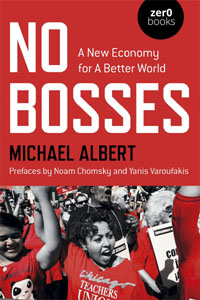
No Bosses. A New Economy for A Better World. By Michael Albert. Zero Books. 2021. 220 pages. £13.99.

Another book by Michael Albert arguing for his blueprint for a future economic and social system that he calls ‘participatory economics’, or ‘parecon’. He presents it as an alternative buying-and-selling economy both to one where wages and prices are determined by the market and to one where they are fixed by the government. His blueprint involves your work and income being decided by your work colleagues and what you consume by your neighbours. It also involves numerous meetings and votes to decide what should be produced.

Yanis Varoufakis, in a politely critical preface, makes the point that it could turn out to be a dystopia rather than a utopia:
‘While I see how Michael’s proposed organisation would rid workers of individual bosses and market pressures, I fear they may end up being bossed around by tyrannical majorities.’
Yaroufakis is writing from the position of someone who thinks that giving the market a role would allow people a greater freedom of choice. We don’t agree with that of course but would make the same criticism on the ground that post-scarcity conditions make free access possible along with the application of the principle ‘from each according to their ability, to each according to their needs’.

Albert, however, insists that consumption should be linked to the ‘duration, intensity and onerousness’ of the work an individual does and is implacably opposed to ‘from each to each,’ devoting four pages to criticising it, or rather a caricature of it. Basically, he thinks that it would lead to people not working hard enough and/or consuming too much. He calls it ‘The Anarchist Objection’ and, indeed, Kropotkin and Alexander Berkman who he cites as among those who have influenced his blueprint, could both have answered his arguments. It is not just an objection made by some anarchists but also by us, as he knows since he has debated with us, both in person and in the columns of the Socialist Standard (April 2006).

There is nothing new in the book except for Varoufakis’s point.
Adam Buick

Wednesday, December 4, 2019

What is Wrong With Using Parliament? (2011)

From the November 2011 issue of the Socialist Standard
 The anarchist paper Black Flag recently reviewed our pamphlet on this under the title “We use it as a Dung Market”. We reply.
It seems ironic that the review should start with a romantic nod in the direction of William Morris when one of the things that Morris is well known for was his passion for “making Socialists”, something that the Socialist Party is rightly or wrongly often simplistically ridiculed for.

In essence, Morris’s socialist “propagandising” was about making sure that there was a strong body of socialists who had a good understanding of the workings of capitalism and a clear understanding of the components of a society in contrast to it. He happened to call this socialism, as we do, and it rested on the view that there needed to be a mass of opinion in favour of it as a classless, stateless, moneyless society.

If people start to believe in the possibility of a future society beyond the market and the state then it seems sensible that they should cover all bases and rob any ounce of legitimacy that the capitalist class (including leftist would-be managers with their own statist dreams) will try to bestow upon themselves. The icing on the cake is that we don’t allow them that privilege and that we should go into in parliament as rebels. Of course this implies a mass of anti-capitalist opinion outside parliament of which those elected would be the mandated delegates.

The anarcho-communist Alexander Berkman once pointed out that:
  ‘Our social institutions are founded on certain ideas and as long as these are generally believed, the institutions built on them are safe. Government remains strong because people think political authority and legal compulsion necessary. Capitalism will continue as long as such an economic system is considered adequate and just. The weakening of the ideas which support the evil and oppressive present-day conditions means the ultimate breakdown of government and capitalism.’
In other words, the big holding power that capitalism in more “developed” countries has over many is in people’s heads in that the majority believe that there is no alternative or/and that they are “free” and living in a “democratic” society. It is precisely in the countries that have a semblance of democracy that seem to be the most stable in capitalist terms, for the reasons stated by Berkman above. So if that’s the case, what’s wrong with using the platform offered by parliament to call their bluff about being democratic?

The common objection to this raised by anarchists is the “corrupting effects of politics”. If that’s a problem then anarchists wouldn’t be able to trust their own mandated recallable delegates either, since such delegates is what we propose when we seek the platform of parliament to further articulate that desire for a society free from capital and the state and ultimately capture those powers that could be used against us. And if who controls the state is not important then why are so many anarchists concerned about the BNP getting hold of it?

The Socialist Party doesn’t have a blueprint for how a future society may come about but isn’t it wise to minimise as much as possible the risk of violence that states which, if left at the disposal of those who currently control them via their own “delegates”, could more easily deploy against the development of a new society?

Any process that has as its aim the revolutionary transformation of society has to have a future vision as a realisable possibility. This has to increasingly gain ground by being articulated in workplaces, the community, shops, pubs, in the arts and culture in general. As that future society gains ground as a tangible possibility then the conversation, discussion and plans will be increasingly enthused about how best to organise and adapt in all areas to meet society’s needs.

What’s the best way to help this process? Should we go down the route of fetishising every struggle going as, according to many on the left, struggle in itself is going to magically transform the consciousness of those involved into hardened revolutionaries? But if struggle alone is supposed to incrementally revolutionise us all then what’s the reason why so many workers who’ve gone through a lot of struggle, the miners, construction workers and others, have not reached radical conclusions but sometimes very reactionary ones such as “British jobs for British workers”?

To focus on explaining the root cause of society’s problems rather than tinker around with the edges (symptoms) is one of the most important reasons for an organisation like the Socialist Party to exist. That’s why we think it important not to spend endless amounts of time campaigning as a party to try to deal with the inevitable aspects of what capitalism throws at us as workers.

Anyone would think from reading the review that all our members do is campaign to persuade people to resort to the ballot box .The conception that the review has of the Socialist Party supposedly thinking that strikes are a “diversion” is a complete red herring. What fairy tale was that whisked up from? Strikes are an inevitable part of the class war that workers can sometimes utilise to defend or improve their working conditions or rates of pay. Our members are involved in these as workers. What’s wrong thinking that all these things don’t necessarily lead to revolution? Surely if they did then, with all the struggles on the economic front that the working class is forced to engage in every day since it came into existence, we should already be there in the review’s (for want of a better term) “councillist utopia”?

This rosy view of the working class doesn’t accord with reality. Most workplaces in the developed world are not one big “comradely experience” although most people are pretty decent despite the competitive environments they find themselves in. In the UK for example it’s the “Service Sector” that accounts for 73 per cent of GDP. I have worked in it and wonder why the reviewer has not been able to see what I see. Low pay, poorly unionised, competitive and non-stop, target-driven bullshit for many. Hierarchies built-in all over the place, where managers believe they’ve got a better deal than other workers who they generally view as their subordinates, and where often in return the other workers have respect or/and fear of the “higher ups”. In many cases the view is that the way to improve one’s position is done not as a class but as a rat in the rat race up the ladder. The effect is that the higher up the worker goes, the more they are forced to compromise and conform and get those beneath them to do the same.

Try openly putting across revolutionary or even militant ideas in workplaces like this (and many typically are) and you will be seen as “different” by your fellow workers who generally have very reactionary ideas in their heads. There’s also the problem of all the informal hierarchies that are there as well as the real ones. Ever seen The Office? It’s a brilliant example of this kind of behaviour. Once the bosses get an idea that there may be a “real revolutionary” in their midst, one that can’t easily be compromised that is, then they’ll soon “come up” with a “plausible” reason to get rid of them.

In addition, the figures for part-time work, temporary contracts and self-employment pose severe problems with the various “down tools” scenarios. And what about the unemployed, those on benefits, the retired or those dependent on partners or parents who may well go along with the way things are?

Those pushing papers around in the world of academia or those working out how to push some product onto the “consumer”? What clout do they or will they have if just tied down to a concept of revolution as a purely economic struggle?

What was probably most offensive about the review is the final paragraph where the reviewer sites the Socialist Party “slap bang in the middle of the Marxist vanguard groups whose characteristics it shares – authoritarian structure, party chauvinism and so on”. One of the reasons I joined the Socialist Party was because I didn’t like the de facto personality-dominated politics that often crept into groups that deemed themselves to be “anarchist”, with little or no structure to get the “personalities” to come down from their privileged positions. In this respect at least, I felt that the Socialist Party was actually more “anarchist” than the anarchists! An important part of my “anarchism” meant allowing for the widest conception of democracy possible to suit the needs of society.

The Socialist Party is merely a tool to be used by those who want socialism and who think that organising democratically is more important than seeing yourself as bigger than the society that you want to inhabit and think it important to have a voice for the possibility of a future that is so often buried.

Ultimately, what socialist conscious workers decide to do will be for them to decide. If they decide that parliament is an irrelevance then they will ignore it. On the other hand, if they see that to ignore it could be dangerous and also that it has potential, then they will make use of that potential.
Stair

Tuesday, December 11, 2018

The A.B.C. of Anarchism (1955)

From the December 1955 issue of the Socialist Standard

What is Anarchism?
Anarchists say that [it] is the negation of governmental authority and State interference in the life of the individual and of the community as a whole. Anarchists claim that anarchism is a condition of society where all live “in freedom"—a "free" society. As we shall see later this “free" society envisaged by anarchists can mean almost anything.

To the anarchist the cause of most of the evils that beset us today is the existence of government and a coercive state apparatus. The anarchist does not seem to see the State as part of a private property society; as something that has come into existence with the emergence of private property relationships; as an (undesirable and coercive) effect of present-day society. .

The State and Government are THE CAUSE of all our troubles, they say.

Many, but not all anarchists hold that forms of parental, educational and religious authority cause or contribute to the problems of general—and particularly sexual—neurosis. Most, but not all anarchists oppose all forms of external authority—although there are a number of Catholic anarchists in America, and possibly elsewhere, who accept the authority of Rome.

Many kinds of Anarchists
Although most anarchists envisage and desire a future state of society which they call Anarchism (from the Greek word Anarkia, “a condition of being without government") there are many schools of anarchist thought —almost as many as there are anarchists

Some anarchists are Pacifists, whilst others are advocates or defenders of various kinds of violence. Thus, Alexander Berkman in his A.B.C. of Anarchism (first published in America as What Is Communist Anarchism?):—
  "Yes, Anarchists have thrown bombs and have resorted to violence . . . under certain conditions a man may have to resort to violence." (p. 11).
In all fairness tojthe anarchists, bomb-throwing is now no longer popular among anarchists—particularly the British ones.

Many anarchists combine anarchism with syndicalism—the theory of the General Strike and industrial action as a revolutionary method. They are known as anarcho-syndicalists. Whilst followers of Peter Kropotkin—the “Anarchist Prince” (there are no anarchist princes in this country, only Knights!)—and later Alexander Berkman, both Russians, are usually known as “Communist- anarchists" as they also advocate the common or collective ownership of the land and the means and factors of production. Their method of achieving their object is usually through the general strike. It is syndicalist in method, and Communist in objective.

The anarcho-syndicalists advocate the workers’ control of the factories and workshops in which they work, i.e. the coalmines would be controlled and run, and owned, by the coalminers, the railways by the railway men. etc.

As stated above, there are very many kinds and varieties of anarchists and anarchism. Not all anarchists are Communists or Syndicalists. Some are Individualists, other Mutualists. Even today Max Stirner has his advocates, and Proudhon is not yet forgotten.

Whilst Communist-anarchists and anarcho-syndicalists advocate the general strike, or the overthrow or smashing-up of the State, the Individualists and Mutualists do not believe in revolution. They think that our present society will gradually develop into anarchy—almost like the Fabians! The Individualists also uphold the right of the individual to own private property. They advocate “free" competition—truly an utopian bourgeois concept!

Practice what they Preach?
Although all anarchists claim to be opposed to government, the use of the ballot, and the so-called Western and Eastern ways of life, this does not prevent them, when they think fit, supporting these governments, institutions, or “ ways of life."

For example, the well-known Belgian anarchist. G. Emestan. writing in Freedom (1/3/52). said:—
  “The rearmament of Western Europe it necessary. and victory of the West in case of war it desirable: let us be frankly and sincerely with Truman."
Or more important, the support that the anarchists gave to the Russian Revolution and the Bolsheviks.

From the beginning the Socialist Party said that the Russian Revolution was a “bourgeois” revolution; that it would not and could not emancipate the workers and peasants of Russia from poverty and exploitation; but that it would result in a new class society—a society of new rulers and oppressors. But not the anarchists.

Most of the anarchists all over the world supported both the February and October “revolutions” of 1917.

Nowadays, like the followers of the late Leon Trotsky, they say that the revolution was “betrayed”; it failed. Alexander Berkman, in his A.B.C. of Anarchism, supported both the 1917 revolutions but admitted that “ the masses lacked both consciousness and definite purpose”! But. the following admission of Emma Goldman, another well- known Russian anarchist, should damn the anarchists for all time. In “Trotsky Protests Too Much” (published in Glasgow by the “Anarchist-Communist Federation ”) she wrote:—
   ‘‘During the four years’ civil war in Russia the Anarchists almost to a man stood by the Bolsheviki, though they grew more daily conscious of the impending collapse of the Revolution. They felt in duty bound to keep silent and to avoid everything that would bring aid and comfort to the enemies of the Revolution.” (p. 15).
When it suits them anarchists will support any movement or form of government, democratic or totalitarian.

But it was not only during the first few years of the Communist Government in Soviet Russia that some of the anarchists supported its leaders. Writing in 1938, during the Spanish Civil War, Felix Morrow in his book, “Revolution and Counter-revolution in Spain,” shows us how low anarchists can sink:—
  “Currying favour with Stalin, the Anarchist leaders had been guilty of such statements as that of Montseny: 'Lenin was not the true builder of Russia, but rather Stalin, with his practical realism.’ The Anarchist press had preserved a dead silence about the Moscow trials and purges, publishing only the official news reports. The C.N.T. (Anarchist 'trade unions’) leaders even ceased to defend their Anarchist comrades in Russia when the Anarchist, Erich Muehson, was murdered by Hitler, and his wife sought refuge in the Soviet Union, only to be imprisoned shortly after her arrival, the C.N.T leadership stifled the protest movement in the C.N.T. ranks. Even when the Red generals were shot, the C.N.T. organs published only the official bulletins." (pp. 127-8).
At this time prominent anarchist leaders in Spain were helping the Republican Government in its war with Franco and the German and Italian Interventionists. Anarchist leaders, like Montseny, were either—or had recently been—members of the Central Madrid or Catalan Governments. And the Government had, for some time past, been receiving war supplies from the Soviet Government.

Anarchists in Spain
Ever since the days of Bakounine and the break-up of the first Working Men’s International, the anarchists have been most numerous in Spain—probably the most backward nation in Europe; which, perhaps, explains why the anarchists are so strong there.

The majority of anarchists in Spain were also members of the C.N.T. (ConfederaciĂ³n Nacional de Trabajo— the National Confederation of Labour). Its leaders were also often prominent members of the F.A.I. (FederaciĂ³n Anarquista Iberia—the Anarchist Federation of Iberia).

According to Felix Morrow the C.N.T. leadership was sympathetic to the Russian Revolution, and in fact sent a delegate to the Comintern Congress in 1921. Although supposedly opposed to politics and political parties, Spanish anarchism had, in the F.A.I., a highly centralised Party apparatus, through which it could maintain control of the C.N.T.

In the February, 1936, election in Spain the anarchists, who had in the past, abstained (anarchists are supposed to be opposed to any form of voting) voted for the Popular Front. The “left” parties increased their vote by about a million over the 1933 election. D. A. Santillan admits that this can, to a great extent, be put down to the anarchist vote. Santillan was a leading member of the F.A.I., organiser of the anti-Fascist militias in Catalonia, and later an anarchist minister in the Catalan Government. In his book, “Porque Perdimos la Guerra,” he says:—
  “We gave power to the Left parties, convinced that in the circumstances they represented a lesser evil.”
We seem to have heard this “lesser evil” argument before somewhere!

Afterwards anarchists entered both the Madrid and Catalan Governments. On November 4th, 1936, four members of the C.N.T. entered the Caballero Government.

Supposed opponents of war, government, the ballot box and “ democracy,” the anarchists in Spain—and elsewhere—have supported all these things.

They are neither consistent nor logical. They are both opportunist and utopian.

In Britain, unlike Spain and elsewhere, they are of little consequence, but their views are similar. Their groups afford a welcome to frustrated “intellectuals” who are tired of government interference and State authority; (the continual docketing, the red-tape, and conscription, that is part of our lives under present-day Capitalism.

Unlike the Socialist the anarchists do not have a definite set of principles—in fact they are governed by expediency—or a practical objective—socialism.
Peter E. Newell

Sunday, June 28, 2009

Remembering Alexander Berkman

To-day is the anniversary of the death of the anarcho-communist Alexander Berkman , who died this day in 1936 from suicide .

A review of his book ABC of Anarchism can be found here
As a communist-anarchist, Berkman advocates a system without commodity-production or any “price system”, wages or payment of money. “This”, he says, “logically leads to ownership in common and to joint use. Which is a sensible, just, and equitable system, and is known as communism”. And “work will become a pleasure instead of the deadening drudgery it is today”. His views are similar to those of William Morris in as far as, in communism, people will no longer be employed in useless toil, but will be appreciated according to their willingness to be socially useful. People will live in freedom and equality.

Anarcho-communists, as their name suggests, are anarchists who are communists in the sense of standing for a society based on common ownership where people would produce goods and services to be taken and used without buying and selling and in accordance with the principle “from each according to their ability, to each according to their needs”. In other words, they stood more or less for what we call Socialism.

According to Berkman, “the social revolution can take place only by means of the general strike ...It is most important that we realize that the General Strike is the only possibility of social revolution. In the past the General Strike has been propagated in various countries without sufficient emphasis that its real meaning is revolution, that it is the only practical way to it. It is time for us to learn this, and when we do so the social revolution will cease to be a vague, unknown quantity. It will become an actuality, a definite method and aim, a program whose first step is the taking over of the industries by organized labour.” - The general strike is the revolution.

Unlike Berkman and the anarchist-communists , the SPGB claim that such actions as a general strike by workers would not, and could not, bring about a socialist society. In our view the working class must organise consciously and politically first, for the conquest of the powers of government, before it can convert private property in the means of production into common property. Our reasoning goes like this. We want the useful majority in society (workers of all kinds) to take over and run the means of production in the interest of all. However, at the moment these are in the hands of a minority of the population whose ownership and control of them is backed up and enforced by the State . The State stands as an obstacle between the useful majority and the means of production because it is at present controlled by the minority owning class. They control the state, not by some conspiracy, but with the consent or acquiescence of the majority of the population, a consent which expresses itself in everyday attitudes towards rich people, leaders, nationalism, money and, at election times, in voting for parties which support class ownership. In fact it is such majority support expressed through elections that gives their control of the state legitimacy. In other words, the minority rule with the assent of the majority, which gives them political control. The first step towards taking over the means of production, therefore, must be to take over control of the state, and the easiest way to do this is via elections. But elections are merely a technique, a method. The most important precondition to taking political control out of the hands of the owning class is that the useful majority are no longer prepared to be ruled and exploited by a minority; they must withdraw their consent to capitalism and class rule - they must want and understand a socialist society of common ownership and democratic control. We simply argue that it is quite possible, and highly desirable, for a large majority to establish socialism without bloodshed. The more violence is involved, the more likely the revolution is to fail outright, or be blown sideways into a new minority dictatorship. Far better, if only to minimise the risk of violence, to organise to win a majority in parliament , not to form a government , of course , but to end capitalism and dismantle the State.

This not a dispute between supporters and opponents of socialism but a discussion amongst people who are agreed that the way forward for humanity lies in the establishment of a world of common ownership, democratic participation and production to meet needs and the question is what is the better way to achieve that .

Alan Johnstone

Anarchist communism (2003)

Book Review from the March 2003 issue of the Socialist Standard

ABC of Anarchism. By Alexander Berkman. Freedom Press (Anarchist Classics) 2002 edition, 112 pages

First published in the United States, in 1929, under the title What is Communist Anarchism?, this slightly shortened version has been reprinted 12 times by Freedom Press. The present edition also reprints an introductory biography of Berkman, originally written by this writer in 1970 for the fifth edition.

Many of the words and phrases in the ABC of Anarchism were dated thirty years ago, and are even more so now. Nevertheless, it is still one of the best introductions to the ideas of anarchism, written from the communist-anarchist viewpoint. Berkman's knowledge of economics in general, and Marxist economics in particular, is somewhat shaky, although he has no time for capitalism and the profit system, unlike some anarchists such as individualists and mutualists. Like Marxists, Berkman argues that “there is a continuous warfare between capital and labour”. Again, as with other anarchists, he claims that communist-anarchists “are at one on the basic principle of abolishing government”. He sees government, rather than private-property society that needs and perpetuates government and the coercive state, as the main cause of humanity's problems. Like his companion, Emma Goldman, Berkman was not always consistent regarding governments. On their return to Russia in 1919, they were quite sympathetic towards the Bolsheviks and the Soviet government, but soon criticised Lenin and Trotsky for jailing and executing anarchists, Mensheviks and Social Revolutionaries.

Berkman admits that some anarchists have thrown bombs, and have advocated violence, but argues that anarchism is not about bombs, disorder or chaos. He says that anarchists “have no monopoly on violence”, and that governments have committed far more acts of violence than anarchists. For Berkman, anarchism is the very opposite of violence.

As a communist-anarchist, Berkman advocates a system without commodity-production or any “price system”, wages or payment of money. “This, he says, “logically leads to ownership in common and to joint use. Which is a sensible, just, and equitable system, and is known as communism”. And “work will become a pleasure instead of the deadening drudgery it is today”. His views are similar to those of William Morris in as far as, in communism, people will no longer be employed in useless toil, but will be appreciated according to their willingness to be socially useful. People will live in freedom and equality.

How will such a society come about?, asks Berkman.

To him, the idea is the thing. People must want fundamental change. They must want a revolutionary change before they can achieve a social revolution. And they must prepare for a social revolution. Unlike some anarchists, Berkman does not put much faith in spontaneous uprisings, although he does not reject them on principle. Indeed, he says “we know that revolution begins with street disturbances and outbreaks; it is the initial phase which involves force and violence”. Such a phase is of short duration. According to Berkman, “the social revolution can take place only by means of the general strike”. The general strike is the revolution. (All emphasis in the original). And such a strike can only be carried out by workers organised in labour, or industrial, unions. In his last chapter Berkman assumes that such a revolution would have to be defended by “armed force” if necessary .

This, very briefly, is Alexander Berkman's case for anarchist-communism and revolution. Is it desirable, and would it work? The answer is “yes” and “no”. The Socialist Party advocates and is organised for the establishment of a world-wide system of production solely for use and the abolition of the wages system; such a society would, of necessity, replace government over people by democratic administration of things. Unlike Berkman and the anarchist-communists, however, socialists claim that such actions as insurrection and a general strike by workers would not, and could not, bring about a socialist society. In our view (but not held by this writer 30 years ago!), the working class must organise consciously and politically first, for the conquest of the powers of government, before it can convert private property in the means of production into common property.
Nevertheless, the ABC of Anarchism by Alexander Berkman should be read by all those interested in what anarchists in general, and anarchist-communists in particular, stand for.
Peter E. Newell