Showing posts with label Esperanto. Show all posts

Monday, April 11, 2022

Letter: World language (1977)

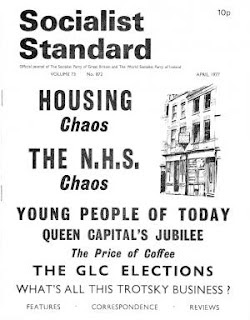
Letter to the Editors from the April 1977 issue of the Socialist Standard

World language

I have been a reader of the Standard for many years now and agree wholeheartedly with the ideas contained therein. I would like to know if the Party is aware of the existence of the international language Esperanto and what views you might have about it.

On the assumption that Socialism must be established on a world-wide basis, surely Socialist understanding must also be spread on an equally cosmopolitan scale. I think that you will agree that the greatest barrier to international or perhaps “intercultural” working-class understanding must be the language barrier. This barrier is small to international capitalism, which merely adds the cost of employing professional translators to the final price of commodities. The working-class does not have such resources, so surely the Socialist message would spread much more quickly if a global means of communication were used.

Esperanto does not aim to replace natural languages, only supplement them as a second language for all. The adoption of one of the complicated national tongues for this purpose, e.g. English, would give tremendous prestige and advantage to that culture and create resentment on the part of others. Esperanto would protect minority cultures and put all communication on an equal footing. I feel that Esperanto would be a powerful weapon in the Socialist armoury.
W. Mountford
Stoke-on-Trent


Reply:
We wish it were true that languages constituted "the greatest barrier” tc Socialist understanding!

In fact you are presenting a somewhat unreal position. If (at the present time) we printed Socialist material in Esperanto, it would have not the wide international circulation that you imply but a relatively very small specialized one. To make it effective we should have to become propagandists for Esperanto to some extent; and in turn to concentrate Socialist propaganda on Esperantists — bearing in mind that the majority of them are not Socialists.

However, over the years the SPGB has had keen Esperantist members who believe in its usefulness as you do, while understanding the reasons why as a Party we cannot adopt a collective attitude (i.e. impose a commitment on our members as a whole) over it.
Editors.

Tuesday, August 21, 2018

Socialismo au naciismo (1969)

From World Socialism '69

Kutime oni supozas ke la interesej de homare dividighas lau nacieco. Ekzemple, britaj laboristoj decidis labori duonhoron potage seapage, por subteni ‘Britujon’ en internacia komerca konkurado. Sed tia patrioteco ne profitos ilin, sed nur la bilancon de la brita dungantaro. Kiom ajn da eksportoj ili produktas, ili ankorau estos salajrsklavoj: ili devos vendi sian laborkapablan, jaron post jaro, por akiri la vivnecessajhojn.

Internacia komerca konkurade, politika luktado kaj milito estas la afero de grupoj de nacioj kapitalistoj, reprezentataj de shtatoj, pri la defendo kaj akiro de influsferoj merkatoj, devenoj de krudmaterioloj kai komercvojoj. Naciisme estas ilo uzata por fortigi la disciplinon, unuecon, kaj subtenon de la laboristaro en tiaj kuktoj, kiu ne kamprenas ke la lukte ne temas pri iliaj interesoj. Tio aplikas egale al la shtatkapitalistaj landoj kia Rusujo, kie klaso de shtatkapitalistoj posedas kaj controlas la ekonomion, kune dungantaj la laboristaron.

Ekzemple konsideru la militon en Vjetnamio, lukton inter la usona kapitalista klaso, kiu volas teni Sudvjetnamion en sia infusfero, kaj oponi la entendigho de la potence de ghia shtatkapitalistaj rivaloj en Sudorientan Azion, kaj la vjetnamaj ‘komunistoj', kiuj volas disvolvigi kapitalismon en Vjetnamion si mem, sen usenaj korporaciegoj.

Socialistoj celas je demokrata monda komunumo, sen nacioj, kie chio sub kaj sur la tero estos la kemuna posedo de la tuta homaro. Homoj kunlaboros sendevige por produkti abundajn richajhojn, kaj chiu prenos kien ajn li bezonas por ghue vivi. Tia socio estos ebla nur kiam la plimulto de homoj deziros ghin, kaj do eni povas establi ghin nur per demokrataj metodoj. Socialisme estas praktikebla, kaj necesa venonta, stadio en socia evoluade. Ghi estas la sola celo de la frataj socialistaj partioj.

Sunday, November 12, 2017

A Letter from Russia (1936)

From the January 1936 issue of the Socialist Standard
(The letter below is translated from “Here sulo," an Esperanto journal published in Paris. The letter is dated November 15th, 1935, and is written from Russia. Owing to the savage repression of Socialist and other opponents of the Communist Party, the name and address of the writer are not given. The letter is useful as a reminder that independent views still gain expression in spite of the Dictatorship.')
Although I do not doubt that you certainly have sent me “heretical" literature, yet, if by chance this letter reaches you, it will show that I have received nothing from you for the past two months— absolutely nothing. I should like to pour out my indignation concerning this grave-like home of orthodoxy in which I am compelled to live—with a mask over my face. You will understand that the more indignant one may be, the more necessary it is outwardly to exhibit approval of the regime, and to cry loudly on every occasion, “Long Live Stalin the Great!” But this pouring out of indignation would avail nothing, and I know that you prefer concrete, exact facts and figures.

Therefore, you will find on the other side a table, which I compiled from the most trustworthy sources and which relates to prices at the beginning of October. You can prepare a similar table of prices in Paris, and in that way will be able to judge the standard of living of the Soviet working-class as it is eighteen years after its “emancipation.” [This table, and a similar one compiled for France, are excluded for reasons of space. They show that average wages in Russia will buy much less food than can be bought by average wages in France. The comparison is, however, incomplete, because it does not take into account the low rents in Russia and the services provided free of cost.— Editorial Committee.]

However, I cannot refrain from saying that this low standard of living is not the worst side of our “socialist" regime; at least, so far as I myself am concerned. In the main, I long for freedom of speech and of meeting; I am sick to death with. “officialism." But— and that possibly will be the most terrible news to you — more and more people here lose the desire for liberty: the new generation does not even understand what liberty means to you and me. Its chief care and desire is only to follow precisely the instructions from the Kremlin.

In the schools they are shamelessly reintroducing the old, traditional method of teaching, with strict discipline for the scholars. And it will appear to you very characteristic that there is great agitation to put all the scholars into uniforms. Soon our schools will be like barracks. In the Army also, discipline becomes more and more strict. Recently, they even re-established the old ranks, so that “Comrade" Vorosilov is now a Marshal! In every way they popularise him by means of articles and pictures. On the specimen postcard accompanying this letter you can admire his fat, jovial and self-satisfied face, and his breast decorated with eight orders.

What also characterises our present rĂ©gime is the widespread campaign of so-called “udamiks," whose task is to speed-up production and secure a record output.

The new kind of exploitation under our State capitalism has reached such a degree that in some places workers, in their resentment, have attacked these record-breakers. Of course, the result has been that the suppression has been intensified. I knew working conditions in Czarist times, and can assure you that the working-class were less driven then than now (literally “their sweat was more precious then than now ”).

Not only was their sweat more precious, but their lives also. With regard to that, judge for yourself from the following information, which is printed in black and white in Izvestia, on November 10th, 1935. Nozdrin, a railway conductor, was condemned to death and executed because he caused a collision between two trains. Note that no lives were lost, and that the accident occurred between goods trains. Under the Czarist regime such a monstrous punishment would not have been possible, nor, I am sure, would it be possible in any other country. Our technical experts are more heartless than aristocrats or plutocrats.

Possibly it would be wiser for me to forget these things, ignore what is around me, and simply enjoy the privileged situation which I personally happen to have. But I just cannot forget that we made a revolution in order to stop the exploitation of men by men, and that the result is quite different from what we aimed at. If only our experience could teach the Western working-class! But it seems not so, as our exploiters are still considered by you to be revolutionaries.

Dear comrade, pardon the bitter tone of my letter, and only remember this: on no account and at no time should workers resign the right of free speech and of meeting freely; under no excuse and in no circumstances ought they to consent to their trade unions and co-operative movements becoming part of the State apparatus, and consequently instruments in the hands of exploiting leaders; no-how should they permit the re-establishment, under any kind of guise whatsoever, of that which aims at destroying the revolution.

Sunday, November 8, 2015

The Socialist Movement in Bulgaria. (1905)

From the October 1905 issue of the Socialist Standard

[The following facts are extracted from a long letter, written in Esperanto, which has been received from Comrade P. Petrov, of Tambol, and should be interesting in view of recent developments in this country.]

Industrially, Bulgaria is where Britain was 100 years ago, but slowly, nevertheless most certainly, capitalism penetrates and will continue to penetrate into the land. After the country's liberation from Turkish rule it commenced to shape like the Western European states; its government, its army, its political and economic life commenced to take an entirely new form and direction. European news, and news of European Socialism were spread throughout the land. But because production was still in the hands of the small middle-class, because the ordinary labourer did not exist as in England, the labour movement was entirely weak, and in no way Socialistic. 

From 1894 there has existed a Social Democratic Party, but at the commencement the members were principally of the middle-class. The majority of the party consisted of merchants and small proprietors. During the years 1898 to 1901 there was an economic crisis, which greatly affected the merchants, small proprietors and agriculturists, who then began to doubt the capability of the different bourgeois parties, who were politically dominant, and to look with a favorable eye to the Socialists, thinking that they (the Socialists) might improve their adversely affected condition. At that time the Socialists were exceedingly active amongst the people, but in their propaganda paid more attention to the minimum program of the Social Democratic Party than to the maximum, and they succeeded in sending 7 deputies to Parliament. But the success was not lasting. In the following years the crop was exceedingly good and the economic position improved. Discontent subsided and the majority of the middle-class members left the ranks of the party. Then some of the Socialists began to advocate a middle course. They doubted whether capitalism would spread over Bulgaria, and, desiring immediate success, they, little by little, fell away from Socialist principles and advocated strenuously, "One common cause amongst the producing corporations." Then commenced a battle amongst the Socialists themselves. Some desired to remain true to the party principles, especially on the question of the Class War. Others wished to make "Labour Compromises," and in March, 1903 the party divided into two sections, one wishing to work specially amongst the laborers, whilst not ignoring the lower middle-class, who were being gradually forced into the ranks of the laborers, and always holding to the class war, and the other dreaming about the common cause between the producing corporations, and advocating compromises. To the first came all true and conscious Socialists, to the other a few workmen, sincere, but led astray. And thus were formed two Socialist sections, acting as independent parties. But it was soon remarked that the second section was acting as an enemy of the Labour Movement and of Socialism ! Because the first section worked amongst a smaller circle and severely held to the principles of scientific Socialism, they were named "narrow Socialists" ("Impossiblists"), and the others were named "broad Socialists" or "common-causers" "opportunists."

The “narrowers" assured of the economic development in the future, knowing that capitalism was spreading and would continue to spread, commenced a quiet but continuous and fruitful policy of educating the workers in their class interests. Many workmen's societies, enlightened and instructed, and syndicates (trade unions) soon sprang up, in which a strong propaganda was conducted, aiming at the creation of sound, conscious and capable fighters, worthy to be enrolled under the Red Flag, and shoulder to shoulder, to defend their class, and together with tlie proletariat of the whole world. to organise for the establishment of the Socialist Republic. In a short time the members of the party, and of the separate societies, greatly increased.

Meanwhile, the enemies of the workers, the "broad" Socialists, preached and still preach to the workers organised in trade unions "neutrality," i.e.. no political action by the unions. They wish the unions to see nothing but their direct trade interests, to fight only on the economic field. The "narrow" Socialists, on the other hand, preach that the workers must also fight the capitalists politically, and of course must come to the Socialist party, which alone in Bulgaria defends the class interests of the workers. They say, always and everywhere, that the economic and political battles are the two foundations of the class war.

The "broad" "ex-Socialists" as the "narrow" ones term them, pursue a policy which is entirely contrary to the principles handed down to us by our great first instructors, Marx and Engels. They are like the Bernsteinianers in Germany, the Jauresists in France (previous to their union with the Guesdists) and the Turatists in Italv. A few trade unions are under their influence, but their number ever declines. They cannot even conduct a strike !

The "narrowers" have a good Socialist literature. Their chief organ, "Workers' Gazette" appears twice weekly, and is also the official organ of the trade unions. The "New Time" is a monthly review, and there are many others. The "broad ones" also issue a journal twice weekly — "The Workers' Battle". They also issued a review — "The Common Cause," but this has ceased. They make full use of the literature and translations of the "narrows."

In Tambol, whence our comrade writes and where he lives, there is a Workers' Instruction Society, which aims at preparing members for the party. They thoroughly study Socialism, and when by their action and consciousness they prove that they understand it, and not till then, they are admitted to the ranks of the active Socialists.

The Party Congress took place in August, and amongst other things it was decided that in future no one should have the right to issue any gazette or review, unless the Party gave permission. The question of the unity of the Bulgarian Socialists, arising out of the Amsterdam resolution, occupied attention, but it was decided that as the "broad" Socialists are not really Socialists, that instead of helping the coming of scientific Socialism, they hindered it, no union could take place, but every true friend of Socialism was called upon to enrol under the red flag of the genuine Socialist Party, those who would he termed in Britain, the "Impossiblists."  
J. K.