Showing posts with label Journalism. Show all posts

Tuesday, October 27, 2026

The Report on the Press (1949)

From the September 1949 issue of the Socialist Standard

At the Annual Delegate Meeting of the National Union of Journalists, held in 1944, a report by a sub-committee dealing with the post-war policy of the Union, was referred back by the delegates on the grounds that it did not deal with "the basic question of the trend towards monopoly in the industry.” From this molehill developed a mountain —the Royal Commission on the Press. The question of whether its labour brought forth a mouse—as the Conservatives would prefer to think, or a much larger animal—as the Labourites say, we must leave until later in the article.

To get back to the National Union of Journalists. Its first report having been referred back, the committee concerned made a second attempt and submitted a further report the following year; its conclusion this time was that the information required could only be obtained by means of an independent enquiry. This was accepted by the Union and a further committee was set up to investigate the slightly different question of the effects of monopolies upon the development of the Press.

So far, all these events had taken place within the Union itself, but at the 1946 Delegate Meeting a resolution was passed (with only one vote against) recommending that the Government should take the step of appointing a Royal Commission. In line with this, two Labour M.P.s (both journalists and members of the Union) raised the matter in Parliament and a resolution giving the necessary authority for the appointment of a Commission was carried by a large majority. The resolution was carried on a free vote, the Labour Party generally voting in favour and the Conservatives against. Seven Labour M.P.s also opposed the motion; and though most Ministers voted in favour, Attlee, Alexander, Cripps, Wilmot, Barnes, Griffiths and Silkin abstained. This was in October, 1946. The Commission held its first meeting in April, 1947, proceeded to take a vast mass of evidence from all kinds of organisations and individuals connected with the Press, and published its findings in June of this year.

The above summarises briefly the main events leading up to the issue of the Report.

Its Reception by the Press.
The reception that the Press gave to the Report makes interesting and amusing reading. The Conservatives had generally been hostile to the idea of a Press Commission and this hostility had been reflected all along in most of their newspapers. When the Report (in their own opinion, of course) turned out to be not as bad as they had feared, their Press was openly jubilant, a typical headline being the Daily Graphic's “British Press is Vindicated.” On the other hand, the Daily Herald, which had. enthusiastically echoed the Labour Party’s demand for an enquiry, found the Report very little to its taste, and its lack of enthusiasm was most marked. The best it could do was a five-inch single-column write-up under the timid headline “Press Council Urged.” True, the reference managed to get itself placed on the front page, but it was not among the top headlines; rather did it show all the signs of having been tucked quietly out of the way. Most significant feature of all, there was a complete absence of editorial comment.

With a few exceptions, the line taken by the Press on the Report served, ironically enough, to heavily underline one of the Commissions own findings—that “ Their treatment of public affairs is . . . . frankly partisan” (p. 150). On this question the Observer, which had itself come under heavy fire from the Commission for a breach of accuracy, said (3/7/49): —
“That newspapers are capable of inaccurate reporting was nicely demonstrated last Thursday, when almost every popular newspaper summarised the findings of the Royal Commission on the Press in a manner favourable to themselves. No one who relied on these papers for his information could have guessed that much of the Commission’s Report was unfavourable to our industry or profession. The Commission proves, with example after example, that personal and political bias often dictate the way in which an event is reported.” 
But the most damning comment of all came from one of the members of the Commission itself. Sir George Waters, who spoke to the Institute of Journalists on the 12th July, and was quoted in the House of Commons by Mr. Oliver Stanley, M.P., as follows:— 
“I have been seriously disturbed by the selective treatment which the Commission’s Report has received from the editorials of newspapers. I can assure you that the Commission never intended this to be a white-washing report; nor is it. It has been hailed as a complete vindication of the Press, or, in any case, as a vindication. It is nothing of the kind. Those who say so cannot have read the Report or cannot have understood it. It is, in fact, severely critical of the performance of the Press; it is a vindication of the organisation, not the performance of the Press. I still feel that there is more in the Report than is good for the health of our profession or any profession. Some of my colleagues thought the Press very inefficient in the medium of self-criticism . . . Yet the case against the general council, as stated in one newspaper after another, rests on the assertion that the Commission found little or nothing wrong with the Press. This unwillingness to face the facts, this wanton neglect of the plain conclusions of the Report, shows the Press, I am sorry to say, in a very poor light.” (“Hansard,” Col. 2703, 28.7.49.)
The Report of the Commission.
Of what value is the Report to Socialists? Primarily as a useful and comprehensive source of information about the Press—about its ownership, its organisation, its control, and its standards of reporting. The wrangles of the Labour Party and the Conservatives over monopolies and concentrations of ownership quite frankly leave us cold. The attitude of the Tories is naturally that there is little wrong with things as they are, and they obviously would not weep great salt tears if ownership became more concentrated. This was expected and nobody should be surprised. But what of the Labour Party? All kinds of motives have been read into their hue and cry for a Press Commission; but with them we are not concerned. We judge die Labour Party, not by their motives, but by their actions, and their actions over this question demonstrate quite clearly to us that they are once more pre-occupied with chasing the shadow instead of laying hold of the substance. They are chasing the will-of-the-wisp of newspaper monopoly whilst leaving the marsh of Capitalism undrained, just as a few months ago they tried to lay hold of six other will-of-the-wisps by appointing a Monopoly Commission. They are once again trying to reform Capitalism whilst leaving its basis untouched.

Our position on this issue is quite clear, as it is on other attempts to reform Capitalism. Our concern is not to reform it, but to abolish it. To do this we need the conscious understanding of the majority of the working class, which in turn requires political democracy and the ability to speak and write freely, together with access to information which, even if it is not accurate, can be checked in the light of other information and its inaccuracy confirmed. That democracy, making all allowances for shortcomings in certain directions, exists in this country now, and we are able to propagate our ideas as a result. But it is important to remember why it exists and upon what factors it depends. It is not made by Press Barons, nor is it dependent upon them. It is dependent upon two things—first that British Capitalism finds it more efficient and useful to have democracy, and, secondly and most important, the working class have fought for it and desire to retain it.

The task of getting Socialist knowledge across to the working class is a difficult and arduous one. That is one reason why the enthusiasms of Labourites for this Press Commission make us smile. What is their case? First, that there is a danger of monopoly in the industry. Newspapers, they argue (and with some truth), are being concentrated into fewer hands, into “chains.” Let us take this argument, as it affects the S.P.G.B. Imagine the most extreme situation, where all the Conservative Press is concentrated in the Daily Express, the Liberal Press in the News Chronicle, the Labour Press in the Daily Herald, and the Communist Press in the Daily Worker. What would be changed as far as we are concerned? Only this—that anti-Socialist propaganda would be put out by four newspapers instead of a dozen or more. Our job would still be to push our own Press, the Socialist Standard. Our task of trying to get workers to understand Socialism would still be unchanged.

As for inaccuracy, misreporting, deliberate distortion, these make us smile still more. The S.P.G.B. has suffered from the distortions and omissions of the Press for years, and we have received no better treatment from the Daily Herald than we have from the others. On these matters it is tarred with the same brush as the others, as the Commission’s report amply proves. But the whole game is given away as far as we are concerned when we find that one of the most severe rebukes administered by the Commission was given to the National Union of Journalists and certain journalist M.P.s. Dealing with the evidence they submitted, it said: —
“We called before us several of the journalists who spoke in favour of the motion demanding the appointment of the Commission, but neither they nor the National Union of Journalists produced much positive evidence in support of their criticism, and some of what was produced did not stand up to examination. The Memorandum submitted to us by the Union was not a survey of the Press as a whole, but rather an attack on the right wing portion of it. In the light of what follows in this chapter, the fact that the Daily Worker and the Daily Mirror were the only national daily papers not characterised by name, while the Daily Herald was scarcely mentioned, is some indication of the selective nature of the document. The Memorandum gave us no coherent and comprehensive picture and no means of reaching general conclusions about the extent and character of the abuses which had been said to exist.” (Page 107.) 
The Daily Herald, the Daily Worker, and the Daily Mirror! What a noble trio of examples to the Press! And what a fine comment upon these crusaders after truth, accuracy, and impartial reporting.
Stan Hampson

(To be continued)

Friday, October 16, 2026

Between the Lines: East Enders (1985)

The Between the Lines column from the October 1985 issue of the Socialist Standard 

East Enders
 
There are three views which can be arrived at about EastEnders (BBC1, Tuesday and Thursday. 7.30pm). One is that it is an insultingly nasty caricature of London workers. Indeed, at times the producers of this series seem to be stuck in the rut of the My Fair Lady image of working class existence: decent folk with ruddy cheeks who say "Gawd blimey", need looking after and aren't too bright. The producers' assumptions that East End workers spend their lives fluctuating between the small talk of the semi-conscious and the violent dramas of deranged maniacs may contain a grain of truth, but the ultimate picture derives from superficial caricature rather than serious social characterisation. For example, the long scene in which Angie attempts to seduce Lofty (5 September) owes more to the remote observer's image of how the uncouth and immoral proletarians carry on than to likely reality.

The overwhelming image given out by the programme is of life as experienced by people who are too dull-witted to cope; thank goodness for Dr Legg who is always there to keep the hapless wage slaves on the straight and narrow — not to mention the escapee from Dock Green. Detective Quick. (Who thinks up these names?)

Secondly, one can see the series as a realistic portrayal of members of the working class whose lives are full from day to day with endless problems. We are shown it as a reflection of our own lives. Arthur's long search for a job. the repeatedly failed efforts of the three young lads to succeed as entrepreneurs in the knitting business. Den's need to trade in stolen goods in order to supplement his income from the pub, the lack of facilities for the young unmarried mother, the fear of the old women who dare not walk in the streets.

All of these problems flash before us and we are expected to accept complacently that "this is reality" as we watch the victims of the system crawl out of one contradiction and into the next. It is possible to imagine a person living in a future socialist society, watching video recordings of EastEnders and asking how such miserable lives could be offered as entertainment. After all. at least in Shakespeare's tragedies the audience was not expected to share the same fate as the fictitious victims; but the point of "reality" drama like EastEnders is that the viewer is supposed to relate through experience to the wretchedness on the screen.

There is a third point to be made about EastEnders: that it is nothing more than an attempt by the BBC to beat their ITV rivals in the soap-opera audience ratings war. TV programmes are like other commodities and TV companies are out to win viewers; EastEnders was devised by a gang of BBC whiz-kids whose prime aim was not to entertain or to convey a message, but to push up the ratings. If this could be achieved by screening performing jugglers, then that is what we would be shown.

Capitalism — the system which prides itself on providing for individual needs — is not interested in programme schedules which satisfy such needs, or high dramatic standards, but in putting on whatever will draw a mass audience.

The BBC is succeeding in this aim: EastEnders has now more than once beaten Coronation Street to the top of the ratings league. It will be interesting to see whether C4's Brookside, which was devised originally by its producer, Phil Redmond, as the soap with a social conscience, will be able to maintain its tendency to be more honest in its depiction of social reality than the mainstream soaps. The series certainly succeeded in this in its early days (especially those episodes written by the very able Jimmy McGovern) but, as C4 finds itself increasingly under IBA pressure to win in the ratings' war, it is significant that there has been a recent tendency to abandon realism for populist sensationalism, for example the July siege of the nurses' house and the sentimentalised saga of Edna's protracted death. One more piece of evidence. perhaps, that there can be no escape from the market even in the comfortable fantasy-land of the soaps.


Whose vision on our telly ?

Sounds of scandal and indignation from Broadcasting House as news of the activities of Room 101 is leaked. The NUJ protests. This is the thin end of the wedge, proclaims Vincent Hanna, who usually makes a living out of calling people extremists for getting hot under the collar like that.

Can it be true that M15 is vetting the job applications of BBC journalists? Can it be true that any BBC journalist with a modicum of political intelligence could have imagined up to now that MI5 was not vetting them? Of course the state will do its best to ensure that the right workers are appointed to the important jobs of telling its lies and distorting social reality. It is the function of the state machine, as the instrument of class rule, to see that the social order is upheld without interference from subversives.

Socialists do not call on the government to cease such secretive and undemocratic practices at once — to do so would be to express a degree of naivete which we do not possess. As long as the bosses are allowed to own and control the means of wealth production and distribution, which includes the means of mass communication. they will exercise their control to the advantage of minority class power and to the detriment of democracy. The task is not to democratise the BBC. as the NUJ might wish, but to revolutionise society: nothing less will do.

In a speech by George Howard, then chairman of the BBC. at Hull College of Further Education on 26 April 1982. the following quotation from the BBC's Charter and licence Agreement was quoted: "The Secretary of State may from time to time by notice in writing require the Corporation to refrain at any specified time or at all times from sending any matter or matters of any class specified in any such notice; and the Secretary of State may at any time or times vary or revoke such notice. The Corporation may at its discretion announce or refrain from announcing that such a notice has been given or has been varied or revoked". In other words, a government minister may force the BBC to refrain from putting out certain messages and the BBC authorities, appointed by the government, are free not to tell viewers that this has been done.

George Howard made the point, in his published speech, that such a provision in the Charter "would make a nonsense of our independence if. in fact, he (the minister) ever attempted" to use it. But how are we to know that it has not been used, for according to the wording of the provision it can be implemented and revoked without the BBC ever being under an obligation to tell the viewers. Now. there's something for the NUJ to think about.
Steve Coleman

Blogger's Note: 
According to this short piece about state vetting of BBC personnel during this period, it was Room 105 rather than Room 101.

Tuesday, March 17, 2026

Proper Gander: Reporting on reporting (2026)

The Proper Gander column from the March 2026 issue of the Socialist Standard

Journalist Steve Rosenberg hasn’t chosen the easiest of careers. His appearances on BBC News as their correspondent in Russia raise questions about how free he is to investigate and report on what’s happening there, especially since the war in Ukraine reignited in 2022. The Panorama episode Our Man In Moscow (BBC One) offers an answer by showing what Rosenberg, his producer and camera operator do between the times we see him on air. Their trip to the city of Tver to interview people on the street is interrupted by both the police and state media asking what they’re doing, with the producer saying this could have turned out to be ‘much worse’ than an identity check. The forums and summits which they and other journalists attend are as slickly presented as those anywhere else. Although Rosenberg says that some of the attendees are now reluctant to speak to the BBC, he has put in questions to Putin on a couple of occasions. At an annual press conference, Rosenberg lists some of Russia’s problems then asks Putin ‘do you think you have taken care of your country?’, to which he predictably replies in the affirmative. The following year, Rosenberg asks what future Putin plans for Russia, including militarily, and is told ‘there will be no operations if you treat us with respect’. Rosenberg’s analysis is that the Kremlin’s confidence is fuelled by Europe being weakened because it is distanced from Trump’s America.

Steve Rosenberg became interested in Russian culture and language during his teenage years in Chingford. His first visit to Russia was in 1987, when the Soviet Union was starting to open up more to global markets, and he was there a few years later when it broke up. Having lived and worked as a reporter in Moscow since the mid-1990s, Rosenberg is now the BBC’s Russia Editor. He’s nostalgic for the country he saw when he was younger, which he tells us had more optimism. He describes the time when Putin came to power by saying ‘it felt as if this huge black cloud had come over’. Being a journalist there now is compared to walking on a tightrope: ‘You can’t relax, really, for a second. You want to report accurately and honestly about what’s happening, but you don’t want to fall off the tightrope onto the minefield below, and hit a mine’.

According to Reporters Without Borders’ World Press Freedom Index, Russia ranks 171st out of 180 countries, making it among the most restricted places for what news is reported, how and by whom. Virtually all media produced there comes from state-owned or affiliated organisations, with controls on its content increased further due to the war. Military personnel are banned from speaking to journalists, and the dissemination of ‘unreliable information’ about the armed forces is punishable by up to 15 years in prison. Dozens of critics of the authorities and the war are currently jailed, some for spying charges, and most foreign reporters have left the country. Rosenberg explains that he’s one of the few western journalists remaining in Moscow, as he walks through an empty office which used to be bustling with colleagues.

Rosenberg and his crew have got used to being monitored by the state, learning that it’s safest to calmly present the required documents when approached by the police while out reporting. They are also followed by plain-clothes agents, one of whom denies this when Rosenberg challenges him. These agents wouldn’t be too concerned that they have been rumbled, for the reason that Rosenberg is likely to be more unsettled and restrained being aware that they’re watching him. The authorities will probably watch the Panorama documentary too, which Rosenberg, his colleagues and BBC executives would realise, and so they wouldn’t have included anything too incriminating.

Rosenberg isn’t popular with the nation’s state-owned media either, which depicts him as an anti-Russian propagandist by selectively editing quotes from his reports. We see some Russian journalists questioning him on his reporting, albeit in their role as state lackeys. Television is more prominent as a source of information in Russia than in western countries: nearly two-thirds of its citizens mainly get their news in this way, according to Reporters Without Borders. We see a clip of an angry TV show host calling Rosenberg a ‘conscious enemy of our country’ and (oddly) a ‘defecating squirrel, constantly surprised by things’. Admirably, Rosenberg perseveres with his job despite the tense position it places him in, walking his tightrope. He comes across as professional and sincere, having developed a personal understanding of Russian culture and politics.

While the context Rosenberg works in is different to that of most reporters, it illustrates how journalism isn’t as simple as a dogged pursuit of the truth. In Russia more than elsewhere, the restrictions and threats hanging over journalists will shape their approaches and the words they use. Many have been silenced completely, further limiting awareness and viewpoints. Alongside this, the Russian state’s media has become even more empowered, dominating the market. Legislating speech is an obvious admission by the state that it wants to control the narrative, skewed to promote both the ruling elite and the system which enables it.

Journalism is moulded not only by regulation, but also by what’s acceptable to the organisations which produce it. Being an employee of the BBC, Rosenberg has to work within the corporation’s frame of reference. This isn’t just its editorial guidelines, but its overall ethos as part of the establishment, creating both conscious and subconscious bias in its news output. So, the war between Russia and Ukraine is analysed only on the surface level of capitalist politics, between rival governments. Mainstream journalism, whether in Britain, Russia or anywhere else wouldn’t examine more fundamentally how the war is between factions of the capitalist class for their economic interests, not those of the working class.
Mike Foster

Friday, August 2, 2024

Proper Gander: Anti-social media (2024)

The Proper Gander column from the August 2024 issue of the Socialist Standard

ITVX’s recent drama serial Douglas Is Cancelled draws on several of society’s current trends to produce an unsettling description of how status impacts on people. Its writer, Steven Moffat, is known particularly for his contributions to more fantastical fare such as Doctor Who and Sherlock. His best scripts carefully guide how much information the viewers and characters have as the story progresses, often by playing around with story structure. Douglas Is Cancelled uses techniques (and actors) familiar from Moffat’s other work, with its subject matter being the television industry itself. Potential viewers are warned that ‘spoilers’ about how the plot is resolved are mentioned below.

The Douglas of the title, portrayed by Hugh Bonneville, is a longstanding TV journalist, co-hosting a popular news programme with the younger Madeline, played by Karen Gillan. A social media post accusing Douglas of telling a sexist joke at a wedding goes viral, leading to concerns among Douglas, his agent, and his producer Toby (Ben Miles), that enough of a negative reaction and suspicions of chauvinism will get him ‘cancelled’. The backdrop of social media being crucial in how we perceive people is a given. Anyone with a profile on X, Facebook, Instagram or TikTok knows they’ve put themselves in an arena where their words are scrutinised and judged publicly, with the stakes being higher for those already in the public eye, such as trusted television news presenters. Even a hint of scandal creates interest, and each repost, comment or like lucratively promotes the social media platform itself as well as whatever’s trending. The combative nature of online discourse is represented in the drama by Douglas’s teenage daughter, sensitive to any kind of perceived offence.

The focus of Douglas Is Cancelled isn’t ‘cancel culture’ though, but the culture of the news media industry. The script contains many cynical swipes at journalism, such as Toby saying of journalists, ‘having opinions about things we didn’t witness is the entire point of our existence’, and Madeline using ‘every dirty trick’ interviewers employ to get to their subject. Key to the plot is when Douglas angrily says ‘the truth needs a little help now and then… our audience wouldn’t understand the truth even if we had the guts to tell it or knew what it was in the first place’. In the context of the story, these lines lead to Douglas’s downfall because of how they dismiss both his audience and his profession, even though he’s right to recognise that journalism isn’t as objective as it pretends. The bias of a mainstream media outlet reflects the prerogatives of its owners, with their ‘truth’ being a stance which both reinforces their own position, however subtly, and less subtly, also attracts viewers and therefore income.

The media’s attitude to the truth isn’t really the focus of Douglas Is Cancelled, though. Its target turns out to be how the industry has mistreated women. Much of episode three is a flashback to just before Madeline secured the job as co-presenter, set in a hotel room where Toby is trying to manipulate her into having sex with him, using psychological tricks to confuse and control her. This thread of the story reminds us of the accusations of sexual harassment and rape made against American film mogul Harvey Weinstein and others, which revealed the extent of abuse in the industry. In the drama, Toby uses the influence he has as an established producer over Madeline, who is made vulnerable by being at the start of her career. He has this influence because of the imbalance of power between his position and hers. Employment, and the hierarchies which it involves, inherently encourages us to objectify people and treat them according to their status in the organisation. Some people, such as Toby and his real-life counterparts, represent how this attitude can lead to the most dehumanising and damaging extremes. The drama doesn’t only highlight how abusers have operated, but also that people like Douglas, who ignored the situation Madeline was in and then made jokes about it, enable the perpetrators. Even though the ‘casting couch culture’ is being exposed and tackled in real life, the conditions which create it remain.

Despite being promoted as a ‘comedy drama’, Douglas Is Cancelled describes a grim, sordid news industry, with relationships shaped by rank within the profession and by the cut and thrust of social media beyond. The similarities to real life situations make the serial very much a product of, and reflection of our times. But behind the modern trappings of social media and anti-social media executives, an old story is being retold. When a workplace, an industry and, indeed a society is structured so that some individuals are in a position of power over others, then the resulting hierarchies allow some people to become abusers. Legislation, policies and procedures aim to prevent and ameliorate harm, but can’t address the structural causes which enable abuse. Employment itself is exploitative, even if when it doesn’t involve people as toxic as presented in Douglas Is Cancelled. The damage caused by and to the characters is expertly acted by the serial’s small cast, helped by a precisely-crafted and perceptive script.
Mike Foster

Wednesday, May 11, 2022

Value For Money? (1998)

TV Review from the March 1998 issue of the Socialist Standard

Value For Money?

A new concept is invading television; the concept of “value for money”. The TV executives aren’t attempting to deliver a fair return for the licence-payers’ cash of course, but they have discovered that the search for “good value” can provide them with an endless stream of cheap programmes.

It is a concept that the ordinary person is familiar with, since modern-day crusades are more likely to be carried out under the banner of Fair Trading than anything else. The Bargain has become the Holy Grail of the 20th Century and is proving to be equally elusive—because it is equally mythical.

Any local news programme shows how deeply ingrained this myth of “value” is. A recent report showed an elderly woman expressing her disgust that diabetics should have to pay more vehicle insurance simply because they constitute more of a risk. It didn’t seem to occur to her that the nice man from the Prudential advert wants to make as much profit as he can, and will penalise diabetics all the way to hell and back if that’s what it takes. Incredibly, many people share this delusion, the untenable belief that private companies are in some way providing a public service.

My job enables me to see this widespread fallacy at work. Charging for entrance to a multi-feature attraction with a single admission fee, I find that those who don’t want to see all the attractions tell me this is “stupid”. Stupid? Do they seriously believe that it’s some kind of oversight on the part of the management? It’s a deliberate policy designed to extract as much money as possible from visitors. And it works.

In this society goods and services are produced with one aim in mind, the production of profit. Capitalism dictates that only what is profitable can be done, so there is little hope of companies behaving in a selfless way. They will never allow those who constitute a greater risk to pay the same insurance premiums as others, because this would lose them money. They will not selflessly decline the opportunity to make a profit since profit is the oxygen they breathe. They are bound by the rules of The System just as we are. It is The System which creates “raw deals”, and to end them we must end the system.

There may be times when we can buy what might be called “bargains”, articles priced at less than we might normally expect to pay for them. Prices are not reduced out of generosity though, but with the aim of minimising losses and enticing people to spend more. In short, the bargain is just another means by which the capitalist machine ensures that profit is made.

Nonetheless, the value-for-money myth has now provided us with five different flavours of Watchdog. It’s a profitable seam to mine—but the rip-offs that concern the BBC are far removed from the fundamental exploitation which lies at the heart of capitalism.

Anyone who feels they’ve had an unfair deal can now write to Anne Robinson and have their claim investigated on a Thursday or a Friday. The introduction of the second show is proof, if any were needed, that the first show wasn’t working.

Sooner or later Robinson will have to admit not being quite the Wonderwoman she’d like to be. No matter how much she probes and sniffs there are always enough rip-offs left to fill the next edition of her show.

If she was honest she’d admit that you might as well write in to her show to complain about the weather. Watchdog has more chance of securing a sub-tropical rainy season for Great Britain than it has of getting a “fair deal for the consumer” whilst capitalism survives. But are we to be faced with five channels of 24-hour Watchdog before she realises this? I hope not, especially as the answer is staring her in the face. Were she to turn around the title of her own show’s sister programme—Value for Money—she would have the key to the solution.

The bigger rip-off
Value For Money. Money for value? Does money equal value? Are our wages (money) equivalent to the value of the things which we produce? Clearly they are not, otherwise where would profit come from? It might then occur to her than even if someone managed by some incredible fluke to purchase nothing but “bargains” throughout their entire life, they wouldn’t be getting a fair deal by any means. They would still be exploited.

The working class are paid less than the value of what they produce, or else are condemned by The System to bare subsistence on the dole, as part of the army of unemployed that capitalism requires to keep wages down. Would Robinson grasp that there can only be the occasional piece of “good value” because everything else is very bad value indeed? No matter how cheap an item may be it is still far, far too dear, for why should we be forced to labour in order to have what should be ours by rights?

Perhaps she would see the irony of the fact that the capitalist who, in order to make a profit, pays workers less than the value of their labour, always gets good value for money, whereas the producer never does. The mists would then clear, allowing her to see the answer to the difficult question of why so many companies are unscrupulous, why so many people are exploited, cheated and penalised, whilst others live in luxury and why unnecessary things are produced even though much that is vital is left undone.

I’d be quite happy to see the Ginger Ninja fighting our corner. She may grate the nerves but she’s a tough opponent, and I could even bring myself to tolerate her infamous winking, if every wink were a symbolic nail in the coffin of capitalism. But for the time being we must put up with her being an apologist for the myth that a Fair Deal can be had under capitalism.
Matthew Vaughan Wilson

Tuesday, February 8, 2022

A dish of tripe. Selected from “Lansbury’s Weekly”. (1925)

From the November 1925 issue of the Socialist Standard

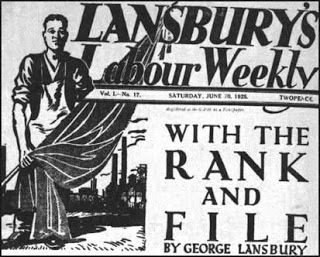
Although the dictionary does not mention it, there are two kinds of tripe. One is an article of food prepared from the stomachs of ruminant animals. Cooked in milk and seasoned to taste, it forms a light and nutritious meal—for those who like it. The other tripe is a euphemistic expression applied generally to soft and sloppy utterances, or expressions of unusually foolish opinions. Take Lansbury’s Labour Weekly, for instance. When we say ”take” it, we speak figuratively. Refrain from so doing if you doubt your ability to distinguish tripe from treacle. Only a particularly vindictive newsagent would deliver it in mistake for a newspaper. We have done him no harm that we remember. Fortunately he relented after the one deadly stroke and we have seen no more since the issue of September 26th.

The cover and get up are strongly suggestive of that other organ of culture, John Bull. The same buff cover, with a shockingly drawn carpenter holding a flag of some sort, instead of the tun-bellied, pugnacious dog-fancier who adorns the rival journal. Inside we find the same flamboyant headlines, the same “open letters” to selected public officials, many of the same advertisements, the same type, and the same printers. The reading is different, naturally, as a separate twopence is required for each journal. You may judge if the twopence would not be better spent on an ice-wafer after sampling the following spoonfuls. They are as typical as spoonfuls of such a dish can be.

Problems of Real Life are answered by “Martha.” They make one sigh for an “unreal” life, whatever that state might be. These are the problems that are racking the revolutionary readers of Lansbury’s Labour Weekly. Need an illegitimate child produce a detailed birth-certificate when obtaining a job? X.Y.Z. asks if she is still legally married after having given the wrong age. Answer : “Forget all about it and go and see your mother.” A Comrade writes that because he has not matriculated he cannot become a Sanitary Inspector. “Another example of Tory unfairness,” he says. “Not at all,” says “Martha,” “read Jack London’s books.” H.T.C., a miner, is horribly fed up with coal getting, writes poetry, and wonders if he will ever get out of the mine. “Yes,” says “Martha,” “you won’t stay in your mine. I think you will write some day. . . I have a suit in good condition that would fit a very big man. Send me a p.c. if you think you would fit it.” Another Comrade who has just married a man with four children, is appalled at the amount of food they eat. Answer: “Martha” knows that workers have more right to sirloins of the roast beef of old England than shirkers, but they simply can’t afford it. “Make good, nourishing stews,” says “Martha.” And suet pudding. It certainly has a “filling” effect. Lastly, we come to “Morning Sickness.” “Several husbands have written about this subject, saying how it distressed them.” Ye gods! Husbands with morning sickness. We have heard some in the Labour movement referred to as “old woman,” but never in our wildest dreams guessed it was so literally true. It is a painful subject, though, physiologically interesting. Let us hurry to Lansbury’s Editorial. He is pleased to inform his readers the number contains “two articles by myself. The second one you owe to the fact that on two Sunday evenings I sat at the feet of Dr. Annie Besant.” He does not say whether she stroked him or patted his head. The article itself is redolent of its origin. He should be old enough to know that no good writing is possible sitting at someone else’s feet. Seated, more rationally, at a table or desk, the blood gets a chance to flow to all parts of the body without hindrance, and may possibly even reach the brain. No one with a properly functioning cerebrum would pen such unqualified flatulence as “for me there is no better teaching than that we can all learn from the prophets and seers of all the ages” ; or, “Our great Movement . . . sometimes appears like a flock of sheep without a shepherd.” The other article, “Empire Trade” (in big letters on a background of soldiers, black men, colonists, and bales of goods), almost defies analysis. If we give it its true name we shall have to quote samples : and our space has some value, anyway.

There is the usual advertisement in Labour journals recently of the Co-operative Investment Trust, a company in which Emil Davies, the New Statesman’s financial tipster, is the guiding light. Dr. Williams’ Pink Pills find the “comrades” fruitful soil, as likewise does Sister Smith with her Massagene. The mind of the eager reader is safeguarded from congestion consequent on the high informative tone of the paper, by two very diverting tales—illustrated. Each of the illustrations depicts that dignified and ennobling spectacle, one man smashing another on the jaw. This should attract readers in great numbers, especially from those high-brow centres of classic learning where jaw-smashing is a regular nightly entertainment. You will be glad to learn that the first jaw-smasher eventually got the other man’s job, whilst the second face-batterer participated in a purse of £2,410. As Annie Besant is quoted : “There can be no peace, no real content without religion.” It is uplifting stuff.

Then Mrs. Leonora Eyles lets herself go on that well-tried topic: the slums. She has made some astonishing discoveries in the Potteries. There, one learns, there are slum houses, but no slum people. “Their Nonconformist consciences have kept them rigidly respectable and God-fearing as far as their homes go. Yet at the same time the illegitimate birth-rate is well above the average.” . . . One notes that the Nonconformist conscience is much like the ordinary conscience, and does not extend below the equator. Wherever Mrs. Eyles goes to-day she finds the workers talking revolution, she says. Our experience is that most of them are talking of rheostats and megohms. She observes that if you herd people in miserable hovels, revolution follows as a natural corollary. This is only very partially true, but Mrs. Eyles draws a curious conclusion from it. She wishes she could shout it in the House of Commons and in comfortable people’s drawing-rooms. What for? They would only start a new Labour Weekly. Numbers of earnest people have contracted “clergyman’s throat” in the House of Commons and many more have induced dyspepsia by drinking tea in comfortable drawing-rooms, airing the agony of the workers. The rich will do anything for the workers, except get off their backs. Shouting won’t shift them. We propose shaking them off.

We do not propose to go through the remainder of the paper seriatim, but hope enough has been given to dissuade any member of the working class from wasting his time and his money. As we have said in this journal with tiresome iteration, the working class has but one problem, and but one solution. All else is fustian and illusion. All other questions melt and dissolve into it. The working class is a slave class. It must end its slavery. There is one way, and only one way, to do it. The workers must grip and conquer the political power that holds them down. There is no “step-at-a-time,” there is no “something-now,” there is no “half-loaf,” that will or can satisfy them. They cannot even remain as they are, be they never so craven. Capitalism moves inexorably on towards the day when its overwhelming plethora will spell universal over-production and economic chaos. The beginnings are here. Who would have thought, seven years ago, that a highly developed country like Great Britain would carry an unemployed surplus of over a million for a period of years? What will happen when all Europe and America and then the at present backward races start producing wealth in immense quantities? When their only markets will he each other, and each has battered its working class down to the lowest practicable limit? When labour-saving machinery and devices have thinned the essential workers to still slenderer limits? We suggest that the workers do not wait until that time. We suggest it is not only desirable, but immediately possible, for the workers in this and every other well-developed capitalist country to inaugurate a new and higher system of society. They must abandon their Micawber attitude of waiting for something to turn up, and organise, definitely and at once, to capture the political power of the State. The next General Election would do, if the workers but understood. Once in possession of political power, the workers can re-organise society upon the lines we have so often sketched out. To the producers, all they produce. He that will not work, neither shall he eat. To each according to his need; from each according to his ability.
W. T. Hopley

Friday, September 24, 2021

Tit-Bits from the Press (1941)

From the September 1941 issue of the Socialist Standard

Journalism – Twentieth Century

The dishing up of news in the newspaper world is a complicated one with many facets, but in general it may be said, particularly with regard to articles and news items prepared in this country for home consumption, that they have to be written up in such a way that they will appear to support the policy advocated by the newspaper in which they appear. The quizzical attitude in which journalists have come to look upon their profession is exemplified in the following paragraph from the Newspaper World, of June 28th last: —
 The vindication of King Leopold of the Belgians is a perfect example of the need to walk warily the difficult path of newspaper criticism in war-time. Many writers must be wondering now how long it will be before they must think up nice things to say about Stalin. You never know where you are these days. It is not wise to put out the tongue which should be left in its neat resting place—the cheek.
It was on June 22nd that Germany attacked Russia, and prior to this date it was definitely not the fashion to “write up” the wonderful qualities of the Russian dictator.
R.M.

Tuesday, April 27, 2021

Running Commentary: Not cricket (1981)

The Running Commentary column from the April 1981 issue of the Socialist Standard 

Not Cricket

Life as a working-class “non-white” in South Africa is an especially abject experience. We say working-class because many wealthy members of the capitalist class who would otherwise be regarded as “non-white”, notably Japanese industrialists. have enjoyed all of the privileges of accommodation, travel and services usually reserved for “whites”. Here the white African capitalist’s thirst for profits from Japanese trade overrides his racialist prejudices.

The lot of the propertyless black in South Africa is to be treated as subhuman, herded in ghettoes and camps, segregated in squalor from whites in every walk of life and relentlessly harried by the forces of the state. A “white” wanting to return a book to a public library, for instance, will probably have to comply with a rule requiring the book to be enclosed in a polythene bag if it is taken back by a black servant.

Against this backdrop it was understandable that the English Test cricketer Robin Jackman was recently ordered out of Guyana because of his links with South Africa. But as this issue developed and the Test match against the West Indies was disrupted, various contradictions were exposed.

In the Summer of 1980 assorted spokesmen and parrots of the “right-wing” (although some Liberals and Labourites were also vocal on this matter) insisted that British athletes should boycott the Olympic Games as a protest against the oppressive regime in the USSR. The policy of the politicians then was to try and use sport as a political medium. Yet a few months later many of these same politicians and their dutiful echoes are sounding the “keep politics out of sport” slogan. The fact is that the politicians have not suddenly changed the principle on which they seek to act from “Use politics in Sport” to “Keep politics out of Sport” as neither of these mottos was ever really their concern. It is economic considerations (and that doesn’t mean yours or mine) which are the reality behind government policymaking in the profit-system. Whereas the Russian Empire and its expansion pose a serious threat to the interests of the British owning class, no such fear is generated by trouble in the West Indies. On the contrary, they have the prospect of continued substantial trading. Looked at like this, it becomes clear why many of the spokesmen for British capitalism could welcome political hostility in sport at the Games and oppose any political disruption to the Second Test match against the West Indies.

Needless to say, governments of several of the West Indian countries, notably Jamaica and Antigua, allowed the Tests to go ahead on their territories to generate some cash for their flagging tourist trades, rather than exclude supporters of apartheid and jeopardise the series. It is not only the white South African leaders who demote principles below the pressure for profits.


Not Cronkite

Walter Cronkite of CBS television was much beloved by many Americans as — in the words of one newspaper — “something between the national flag and God”. Applauded by many at the time of Vietnam for his view that America should withdraw from the war, his recent retirement as a newscaster brought high praises from all and sundry.

Every evening he would enter the homes of millions of American workers to avuncularly present them with a careful selection of reports written unwaveringly from the viewpoint of the owning class. While the working class in America was wrestling with all of the problems of capitalism — inflation, inadequate housing, poverty and insecurity — old Walt would insist on spinning out the old yarns. Every broadcast was impregnated with false assumptions: all American people have a common interest; the protection of property benefits all equally; anyone can become a capitalist if he or she has the talent and initiative; the working class will always have to follow leaders; communism exists in Russia; and if the political ideas of economic equality were given any chance then all mayhem would break loose and Americans would be eating each other alive on the sidewalks.

Did Walt ever open up a bulletin with the news that Americans in employment were being paid less in the form of a wage or a salary than the value of what they had produced? Did he ever report that the wars are the logical outcome of the continuous struggles over trade routes, markets and territories by financiers, industrialists and land owners? Did trusty Walter ever point out that with advanced technology and abundant natural resources there is no need for a third of the world to go hungry? Sadly Walt never uttered a syllable on these points; he dealt only with items neatly processed for general consumption, images and distorted facts designed to maintain the status quo, the string of silent assumptions which riddle every thoughtfully chosen news item.
Gary Jay

Thursday, April 22, 2021

Oscar Wilde on journalism. (1923)

From the July 1923 issue of the Socialist Standard
  “In England, Journalism, except in a few well-known instances, not having been carried to such excesses of brutality, is still a great factor, a really remarkable power. The tyranny that it proposes to exercise over people’s private lives seems to me quite extraordinary.
  “The fact is that the public have an insatiable curiosity to know everything except what is worth knowing.
   “Journalism, conscious of this, and having tradesmen-like habits, supplies the demands. In centuries before ours, the public nailed the ears of journalists to the pump.
    “That was quite hideous.
    “In this century journalists have nailed their own ears to the keyhole.
   “That is much worse.”
Oscar Wilde

Saturday, February 13, 2021

A ‘Free’ Press (2005)

From the February 2005 issue of the Socialist Standard
  A free press is a de-facto sign of a liberal democratic capitalist state, and an independent media can often make things uncomfortable for those in charge. So why does the criticism persist that the free press is not really free, and that these champions of public opinion in fact collude in perpetuating not truth but capitalist mythology? 
  “The Primary Freedom of the Press lies in not being a Trade”
(Karl Marx, Rheinische Zeitung, May 1842.) 
   “Freedom of the press belongs to those who own one” (Anon)
For the last twenty years there has been increasing public awareness that journalistic integrity and the capitalist press are uneasy bedfellows. Various writers, particularly in America, have highlighted the incompatibility between a supposedly ‘free press’ and the production of a newspaper as a commodity for profit. Those who have criticised the press have every right to be scornful. But this is no breakthrough in investigative journalism; capitalism has always corrupted the press and led to it functioning as a mouthpiece for the ruling class, a point explosively demonstrated by Upton Sinclair in 1919 when he first published The Brass Check (republished by University of Illinois Press in 2002). In a timeless and scathing attack on the capitalist press Sinclair asserted “that American journalism is a class institution serving the rich and spurning the poor”, likening the journalist to a prostitute, enslaved in the business ideology of the owning class and functioning to work hand in glove with political leaders and big business to deceive public opinion.

Brass Check was written in the ‘Progressive Era’ at the beginning of the 20th century, a period that saw large swathes of US industry come under the sway of immensely powerful inter-linking monopolistic corporations controlled by a highly concentrated elite of powerful owners. The monopolistic ownership of the newspaper industry that spawned a new journalistic style that trivialised and sensationalised news, abandoning journalistic integrity and independence, caused particular outrage and was branded ‘yellow journalism’. But the essence of this condemnation was more seditious than a simple dispute over the presentation of newsprint. Critics argued that the newspaper monopoly strangled public awareness, censored all anti-business opinion and now served solely to express the owner’s class interests that operated, in Sinclair’s words, for the “hoodwinking of the public and the plunder of labour”. The press, it was argued, must be cleansed of corrupting class bias and function as a neutral conduit for the communication of meaningful information enabling the public to exercise informed democratic preferences.

Capitalist business
In Britain, a similar concentration of ownership had already dramatically altered the newspaper industry that stifled and later decimated the popular press. During the first half of the 19th century Britain had enjoyed a thriving and vigorous popular press that criticised appalling working conditions and was spurred on by the ‘betrayal’ of the 1832 Reform Act and anger at the 1834 Poor Law. The radical press produced numerous papers that “promoted greater collective confidence by repeatedly emphasising the potential power of working people to effect social change through the force of ‘combination’ and organised action” (James Curren and Jean Seaton, Power Without Responsibility: The Press and Broadcasting in Britain, p.24). The radical press was a major source of antagonism to government and the propertied class but neither libel actions nor stamp tax on newsprint were effective in subjugating it. Nevertheless, by 1865 the radical press was in decline, broken not by laws but by a combination of rising costs and market forces.

By the second half of the 19th century the rising cost of printing technology to support national newspaper circulation required major investment. Newspaper set-up costs in Britain rose from £1,000 to over £50,000 between 1840 and 1870 while in America these capital costs rose by 600 percent between 1855 and 1875, a huge investment that excluded all but the extremely wealthy. In addition to rising costs, the growing importance of advertising in Britain greatly disadvantaged the alternative press because successful advertising meant appealing to people who had money. The readers of the radical press were mainly working people on low incomes and advertisers discriminated against these newspapers because “their readers are not purchasers, and any money thrown upon them is so much money thrown away” (quotation from 1856, in James Curren and Jean Seaton, p.43). Advertising revenue acted as a subsidy enabling newspapers to be sold at a price below the cost of production and, once exposed to the realism of commercial capitalism, competitors without advertising revenue were forced from the market or sufficiently weakened to be taken over by larger companies. Newspaper production had become a capitalist business.

Sinclair too identified advertising as a main corrupting agent enabling wealthy advertisers to drive-out the US radical press and exert pressure on editors to mould content and editorial comment. “Everywhere in the world of journalism, high and low, you see this power of the advertiser,” Sinclair declared at a time when advertising, accounting for two-thirds of US newspaper income, greatly enhanced the concentration of ownership. Little has changed in an industry that allows little opportunity for new entrants to enter the market. Today, twenty-four inter-linking US corporations control over half of newspapers and most magazines, broadcasting, books and movies, while Britain is reputed to have the most highly concentrated newspaper ownership in the world, being dominated by five immense corporate groups.

Newspapers must appeal to wealthy corporations as a platform for advertising and to a readership with sufficient purchasing power to satisfy the advertisers’ selling aspirations. Making a newspaper attractive to advertisers is achieved by altering content to suit the values and prejudices of those who pay advertising revenues, as was pointed out in 1910 by US Professor Edward Ross: “When the news-columns and editorial page are a mere incident in the profitable sale of mercantile publicity, in it is strictly ‘businesslike’ to let the big advertisers censor both”(cited by Robert McChesney and Ben Scott, Monthly Review) A newspaper boasting a large circulation but lacking content that appeals to advertisers will rarely survive, a fact that provides an explanation for the disappearance of ‘labour news’ and the widespread growth of lucrative ‘business news’ aimed at a minority audience. The demise of the Daily Herald and Sunday Citizen in the 1960s also illustrate the point. In its final year the Daily Herald enjoyed 8 percent of daily circulation but attracted only 3 percent of the net advertising revenue while the Sunday Citizen received barely one-tenth of net advertising income of the Sunday Times. Both newspapers were considered hostile to business and therefore denied advertising patronage, while in the US the corrupting influences that Sinclair so scathingly criticised have free rein, frequently suppressing news carrying anti-business content by threatening to cancel corporate advertising accounts.

Self-censorship
But besides advertising other, less obvious, factors have also worked to make newspapers a willing mouthpiece for corporations and for government. Newspapers demand a constant flow of low-cost material from reliable sources that avoids expensive research. With budgets squeezed, newspapers must focus where ‘meaningful’ news is most likely to occur. Government, corporations, trade groups and business lobbies with press and PR offices feed the press with stories that are presumed accurate, with mutual benefit derived by delivering cost reductions to the newspaper while tending to mute criticism by limiting the access of alternative views. Similarly, purchasing news from enormously powerful agencies like Associated Press or Reuters has cut costly international newsgathering. Of course, not all news can be printed, but when reputedly less than 2 percent of the world’s news gathered by these agencies is actually passed on to the news media, it raises serious questions about the criteria used to filter news deemed fit for our consumption. News that seriously threatens the status quo is given scant exposure or will simply be omitted – as if it never existed. Clearly, not all capitalism’s misdemeanours can be simply ignored because the consequences cannot always be hidden. The press must be seen as criticising the behaviour of a company or government, for no other reason than to maintain credibility, though such incidents are generally quickly forgotten as the press moves on to the next story.

But although censorship by omission certainly occurs it would be wrong to assume that journalism, in Britain at least, is consciously censored or that a conspiracy amongst journalists exists to hide facts from public scrutiny. Instead self-censorship linked to the personal economic necessity to conform to institutional and company requirements make journalists, in Sinclair’s words, drift “inevitably towards the point of view held by their masters”. This is precisely what George Orwell meant when he wrote in his unpublished introduction to Animal Farm, that “unpopular ideas can be silenced, and inconvenient facts kept dark, without any need for an official ban” (Times Literary Supplement, September 1972.)

In capitalist society the production of a successful newspaper means journalistic integrity and editorial objectiveness are subordinate to the institutional requirement of production for profit. There can be no other way, for as Professor Edward Ross pointed out in Sinclair’s era:
  “To urge the editor, under the thumb of the advertiser or of the owner, to be more independent, is to invite him to remove himself from his profession. As to the capitalist owner, to exhort him to run his newspaper in the interests of truth and progress is about as reasonable as to exhort the mill-owner to work his property for the public good instead of for his private benefit.” (Edward Alsworth Ross, ‘The Suppression of Important News’, Atlantic Magazine, March 1910, quoted in Monthly Review May 2002).

More recent testimony to this enduring law of capitalist newspaper production was expressed by Piers Morgan, former editor of the Daily Mirror, when he stated, “I only judge a story on what sells and what doesn’t” (Guardian, 30 November 1996).

Unreformable
Today, newspapers perform in much the same way as they did in Sinclair’s time, precisely because they operate in the same economic conditions. They lock-in our views to prevailing ideology by playing on prejudices and aspirations, incessantly communicating messages that instil working people with beliefs needed to integrate them into a life of wage slavery, with advertising assisting to create a ‘virtual’ world conducive to buying. “Journalism,” Sinclair wrote, “is one of the devices whereby industrial autocracy keeps its control over political democracy; it is the day to day, between elections propaganda, whereby the minds of the people are kept in a state of acquiescence, so that when the crisis of an election comes, they can go to the polls and caste their ballots for either one of the two parties of the exploiters”.

Sinclair’s book is a penetrating analysis of the early US capitalist press. But it is also the work of an author who, despite his stinging criticisms of the capitalist newspaper industry, believed that the press could in someway reform itself to stand outside class struggle and be recreated as a neutral independent force within capitalist society. Sinclair held the views that capitalism and genuine democracy could co-exist and journalism could be freed from the economic laws of capitalism to give expression to popular demand and abstract ideas of ‘social justice’ and ‘fairness’ that were divorced from the actual material conditions. But the reality is that as long as newspaper production is a profit-driven business it can never be free from the corrosive economic influence of capitalism. We need not lament this fact – for the press can perform in no any other way in capitalist society. But nor should we waste our energies on bankrupt delusions of press (or any other) reform, as Sinclair did, that at best can offer only temporary respite. Instead, we should organise to replace a society that corrupts and debases everything it touches and build socialism where a free and equal people will enjoy a free and informative press.
Steve Trott

Saturday, May 23, 2020

Beanos with cheesecake (1979)

From the May 1979 issue of the Socialist Standard
  There are now three almost identical tabloid newspapers competing in their efforts to misinform workers in Britain. 
Capitalism — the accumulation of wealth through the exploitation of working-class labour-power—is the inevitable social development of commodity-production to the point where abundance becomes possible; and where only the circumscriptions of the profit-system itself prevent society from freely producing and enjoying wealth.

But where—an innocent inquirer might ask—does all this leave us when we turn our attention to such seemingly useless ephemera as the popular—some would call it ‘gutter’—press? And in particular, Fleet Street’s undistinguished and indistinguishable troika. The Sun, the Daily Mirror and The Star. A cooker, after all, is a cooker; a car is a car; and although these commodities are coming off the production-lines even tinnier and more unreliable than their tinny and unreliable predecessors, they do have their practical uses—their more tangible qualities.

A moment’s reflection, however, should be sufficient to convince us that, despite its tawdry and fleeting characteristics, a tabloid—or a so-called “quality” newspaper— is no less a commodity, produced for sale with a view to profit, than those other more substantial items. (Last year, for instance, The Sun produced a profit of more than £13 million— a considerable figure by any standards).

Here, however, the analogy ends; for a newspaper, unlike the cooker and the car. has little material value. (If, that is to say, we except its undoubted uses as wrapping-paper for fish-and-chips, or as fire-lighting material). Its qualities are self-evidently abstract and representational and, under capitalism, on a par with those of a megaphone in the hands of a political huckster. For what we buy from our newsagent is, after all, merely what the capitalist press-lords think is ‘good’ for us and, of course, for them: their own political opinions, to begin with. And what is ‘good’ for us often includes their idea of the type of material which can most successfully seduce us from the dangerous exercise of thinking for ourselves. Hence, the acreage of easy-on-the-eye illustrations ("We liberated the nipple”, roared The Sun, recently) and the column-miles of trivial rubbish which occupy most of what remains. Those few journalists—and there are some, no doubt—who are allowed to submit meatier copy are either chosen for their relatively uncontentious political and economic views or kept well away from such delicate areas. (When, for example, can we expect to see the likes of Marjorie Proops discussing family or marital distress within its proper context—that of a class-based society in which, given the intolerable pressures to which millions of us are subjected, it is astonishing that many more of us do not succumb to breakdown and despair!)

Ironically enough, some insight as to the true nature and purpose of the tabloid press may be gained by comparing titles with content. The very last qualities one may expect to find within the columns of The Sun, the Daily Mirror and The Star are enlightenment or a reliable reflection of the truth; certainly about those matters which could be of any conceivable value for working-class consciousness—and all three journals claim to reflect or illuminate our aspirations and interests. At best they are shallow and uninformative and. particularly when it comes to news of world affairs, as prone to sins of omission as of commission. At worst they are vicious exploiters of personal grief and human weakness, their editors and reporters trawling for salacious gossip, cheque-books in hand, in the murkiest of waters; always ready, of course, to justify their miserable activities with hypocritical references to ‘the freeflow of information in a democratic society’. In between these two fairly approximate poles we have the more conventional forms of entertainment—pages and pages of it, crammed with sensational trivia masquerading as the truth about showbiz and sports personalities, together with exaggerated accounts of the latest gladiatorial contests in the boxing-ring or on the sports-field. (The Romans had a phrase for it all: “panis et circensis”—bread and circuses!—very useful for keeping the otherwise restless plebians from overturning the patricians’ apple-cart)

Finally, there is the inevitable commercial advertising of a type which is deliberately aimed at what is sometimes revealingly termed the ‘down-market’ consumer.

Naturally the three doughty and almost identical warriors are busily tearing each other’s throats out in the interests of what they would euphemistically describe as ‘healthy competition’. The circulation of The Sun, for example, has now substantially overhauled that of the Daily Mirror which—or so The Observer (8/10/78) would have it—has cheapened (how? one wonders!) its product in its efforts to re-capture its market. The Star seems to be wallowing in the wake, not only of its main competitors, The Sun and the Daily Mirror, but also of its sister-publication, the Daily Express. (This latter newspaper and the Daily Mail constitute the remaining prime sources of mis-information in tabloid form). And this despite a truly heroic effort to outdo them all in journalistic mediocrity. (Perhaps Victor Matthews, its proprietor, was hoping to emulate the remarkable success of The Sun, the title of which had been acquired by Rupert Murdoch in 1969 for £600,000—IPC. from whom he bought it, are still licking their wounds, no doubt!) But there must surely be a limit to the amount of junk-journalism which an already-overloaded market is able to absorb.

However, all newspaper owners do share one overriding interest: the preservation of the political status quo; whether that be under the ‘chairpersonship’ (how appropriate that ambiguous word seems in this context!) of Margaret Thatcher (currently championed by The Sun and The Star) or James Callaghan (favoured by the Daily Mirror). Nobody can accuse Victor Matthews and Rupert Murdoch, or the owners of IPC, of timidity when it comes to the defence of the capitalist system. And it is increasingly apparent that they will go to any lengths in terms of journalistic incontinence in order to succeed.

Given this assumption we can safely draw a veil over that all-too-familiar nonsense we still hear from time to time about so-called editorial independence. By way of confirmation we have on record the words of no less a personage than the editor of The Sun himself, the aptly-named Larry Lamb. He is reported as saying (Observer, 8 October, 1978):
  Mr Murdoch and I had a long discussion about the kind of newspaper we envisaged. It emerged, fortunately, that we had virtually identical concepts. We have never had a prolonged discussion about the policy of the newspaper since that night.
 The venal Larry—self-styled ‘leftist branch secretary of ‘NALGO’ in his youth—has evidently found his true vocation.
  And at shop-floor level? It is reliably reported that the Sun’s sub-editorial and other staff, working under that redoubtable editor, sneeringly dismiss their own product as “The Beano".
Richard Cooper

Thursday, April 30, 2020

What The World Wants. A Vapourer Criticised. (1921)

From the April 1921 issue of the Socialist Standard

On reading in any newspaper the editorial comments appertaining to what is known as a "question of the hour," one is continually and increasingly aware of the obliqueness of mental vision, or the conscious hypocrisy (or often a combination of both), shown by the writer of such commentary. If there is any possibility of the facts of the case being distorted or the generalisations deduced from such facts being drawn exactly the reverse of their sequential logic, one may reckon with confidence on the possibility becoming a certainty.

What a Leader Writer Wants.
The main qualifications for success as a writer of editorials seem to be a blindness to the truth, a vagueness of expression, and a fear of facing the facts of life and the obvious and inevitable deductions any intellectually honest man would draw therefrom.

The writer of a recent leader in the "Daily News" under the heading "What the World Wants," gives a very fair example of the truth of the above statement. To start with, the title he uses, "What the World Wants," is in itself vague and misleading. He seemingly uses the word "world" as embodying the whole of the individuals existing in the world, and takes it for granted that the needs and desires of every individual must be similar to those of every other. He presumably does not and cannot understand that the desires of one portion of the populace may—owing to the basis on which our present social structure is built— very well be strongly objectionable to some other portion.

What Parson Wants.
He quotes and agrees with the President of the National Free Church Council, whose opinion is that "the most obvious need of the day is a renaissance of personal morality." The supposition is that what is here meant is personal sexual morality. (By the way, why is it that religious people are always so obsessed with the idea of sex ?) Undoubtedly greater sex continence would be an excellent thing, both for the individual and for the race. But supposing, for a moment, that the President had his way and all the vicious people became virtuous, what does he propose to do with the monstrous army of women who now earn their living by pandering to the vicious desires that run rampant in the modern social system, and who would then be thrown out of employment ?

What our author DOESN'T Want.
Here is a question that the editorial writer might very well have attempted to answer; but as that would have necessitated a scrutiny into the fundamentals of capitalist society, it is perhaps just as well for his peace of mind and the retention of his position as a wage-worker, that he elects to pass over what is, after all, a difficulty impossible of solution whilst society remains on its present basis.

What WE Don't Want.
After writing some meaningless rubbish about the world needing "a renaissance of personal religion, using the word in its broadest and oldest sense," and pointing out very truly that "to the horrified eyes of many very honest men and women the great war and 'the little peace' which has followed it has [sic] revealed a generation as cruel, as unscrupulous, as frivolously selfish and wonton as any that preceded it," the writer goes on to deplore the fact that the virtues and vices of the man of to-day tend more and more to be mechanical products, the conventions of the class in which he lives. "Man is becoming morally standardised to a degree never before approached."

We congratulate him on his realisation of the truth of the Socialists' contention that the material conditions prevailing in any given society determine not only the economic position of the men and women comprising such society, but also their moral and conventional outlook; indeed, it may be said that their whole mentality is so determined. We are afraid, however, that our congratulations will not be accepted with the grace they deserve. The writer of the editorial, being of the usual type of journalist, that is, timid, conservative, and unintelligent, is frightened at his discovery, and the remainder of his article is an endeavour to convince himself and his readers that the theory of historic materialism must, somewhere or other, contain a flaw, its acceptance implying a reversal of the laws of nature ; that only by the workings of what he calls "personal virtue," and "individual effort," and "individual conscience" can the world be saved.

The Socialist knows that man is, always has been, and always will be, the creature of circumstances. To-day, as heretofore, he is the outcome of the social system in which he lives. He must conform to the capitalist morality and conventions. The laws under which he lives, the ethics and religion which he learns in childhood, the rules and tastes which govern his conduct and which he acquires in the same way and at the same time as he acquires what is miscalled his "education," are all themselves offshoots of the tree of capitalism.

They force his mentality into a groove useful and necessary for the maintenance and development of capitalism. Mentally and physically, capitalism holds a man fast in its iron embrace so long as he is born and dwells within its precincts. The writer says "The system is made for man and not man for the system." True, man is not made for the system, but neither is the system made for man, Man is born—without volition on his part—into the system, and its workings and ramifications determine his outlook on life and his mental and physical development. He may indeed react against his environment (he may be a Socialist), but even then his efforts are infinitesimal compared with the mighty social forces which encompass him on all sides. He may perhaps slightly accelerate the development of the system, may hasten to some extent the dissolution of what he has come to consider an inherently rotten condition of society, but, in the main, he will be compelled to watch and wait until the system works itself out. Capitalism, like any other organism, has had its birth, has developed and matured to the full extent of its powers, and to-day we are witnessing the gradual decay and disintegration of what has been, in some respects, the greatest, and in other respects the most brutal and degrading, social system ever known.

Although we can see on every hand signs and portents of the ultimate downfall and dissolution of capitalism, yet the intelligent man—that is, the man who is able to appreciate the facts and conditions of life in their right proportion relative to his status as an individual amongst other social units—will certainly not be content to sit with folded hands watching the wheels of capitalism run on to their destined end. Inactivity is the forerunner of stagnation and atrophism ; one's mental faculties must find some outlet of expression, otherwise they quickly become effete and cease to function. By organised collective effort much can be done to accelerate the forces of disintegration working in the midst of capitalism; and further, the power behind such collective effort will gather strength in a ratio proportionate to the growth of the organisation.

Moreover, it must be remembered, the organisation can, by means of written and oral propaganda, raise the mentality of its members and the outside general public to a plane sufficiently high to enable them, when the change from the present order of things to the forthcoming order ensues, to seize and take charge of the institutions then obtaining, and use, divert, and improve them for the benefit of society as a whole.

To the ordinary non-Socialist member of the working class, the present outlook is, without question, black and threatening. To such a one existence must appear very similar to that of a rat caught in a trap, running round and round and turning this way and that, in wild and abortive efforts to find a means of egress from captivity to freedom. Only when he hears and accepts the lessons taught by the Socialist philosophy, when, for example, he realises that organic society—like any other organism—is doomed by its governing laws eventually to pass from its present form onward to a different and, as we believe, a vastly superior and higher form, will a gleam of hope appear on the dark horizon of his fears and disappointments. Nay, more, to the man who understands his class position, who is able to conceive the possibility of the emergence of his class from wage-slavery into the freedom of Socialism, the gleam of hope will glow ever brighter as the erstwhile problems and puzzles of his economic and political position are found quite easily solvable ; until, standing on the high peak of Socialist philosophy and viewing the whole intricate workings of capitalism spread like a map beneath him, he will be able, by the power of his imaginative reasoning, to catch glimpses of the promised land of Socialism, whose actuality is not yet too bright for the purblind, still chain-bound victim of present-day conditions altogether to visualise.

What does the world want ? What common factor can be found whereby the people of the world shall benefit ? The Socialist, looking at all phenomena in the light of his Socialistic knowledge, sees that until the present system of private property ends, the majority of the people—the working class, that is—will remain in their present condition of penury, sordidness, and degradation, dependent upon another class for their very existence.

The capitalists themselves, although they would probably scoff at the idea, would actually be far higher under Socialism (where, of course, they will have ceased to be capitalists) than they can ever hope to be while capitalism lasts. When there is neither a class to exploit nor a class to be exploited, all men then being on an economic equality, it would be possible for everyone—the former capitalists included—to live sane, healthy, and joyous lives. To-day, the workers are born, they suffer, they die— such is an epitome of working-class life; while, on the other hand, the capitalists live amid a whirl of inane and unsatisfying pleasures, or in a state of brutal rapacity.

But we can leave the case of the capitalists on one side. It is our own class—the working class—to which we appeal for help in our task of making Socialists. We ask for their co-operation so that when capitalism falls, out of the wreck the working class will rise, phoenix-like, from the ashes of an outworn and unregretted order, into a new world of freedom and happiness.

Looking back, we seem to have travelled a long way from the editorial in the "Daily News" to the words just written. How far have we travelled, is it asked ? As far as the distance dividing the "Daily News" from the Socialist Standard and the writer of a capitalist editorial from a Socialist writer.
F. J. Webb.