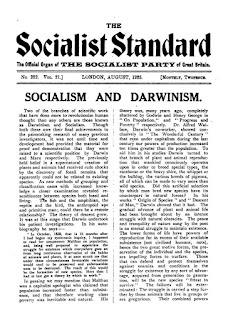
Showing posts with label Socialism and Darwinism. Show all posts

Sunday, September 10, 2023

Evolution and Revolution. (1905)

From the September 1905 issue of the Socialist Standard

With the certain knowledge that his Socialism is in entire accord with the teaching of Science, the Scientific Socialist can afford to smile at the vain efforts of the “Socialism-by-the-farthing’s-worth” reformers to twist facts to suit their interests.

Not only is the conception of history of Marx and Engels in complete harmony with all social-history, but it finds numerous parallels in-natural science. Thus Professor Darwin, son of the illustrious Charles Darwin, emphasised this fact in his Presidential Address to the British Association this year. He said :—
“His point of view was illustrated by a reference to political history. The degree of persistence or permanence of a species, of a configuration of matter, or of a State depended on the perfection of its adaptation to its surrounding conditions. If they traced the history of a State they found the degree of its stability gradually changing, slowly rising to a maximum, and then slowly declining. When it fell to nothing a revolution ensued, and a new form of government was established. The physicist, like the biologist and the historian, watched the effect of slowly varying external conditions ; he saw the quality of persistence or stability gradually decaying until it vanished, when there ensued what was called in politics a revolution.

These considerations led him to doubt whether biologists had been correct in looking for continuous transformation of species. Judging by analogy, they should rather expect to find slight continuous changes occurring during a long period of time, followed by a somewhat sudden transformation into a new species, or by rapid extinction.”

Monday, August 14, 2023

Mr. Brown goes to town (1946)

From the August 1946 issue of the Socialist Standard

Mr. W. J. Brown, M.P., in an Evening Standard article (15/3/46), "What Price Utopia?”, says Darwinism reduces man to a non-moral unrestrained biological process (unproven, of course) and has served to justify the barbarities of capitalist anarchy and the Marxian "Class Struggle.” Also Marxism is merely its application to the political field. Such trivialities are a commonplace of anti-Marxist propaganda, but Mr. Brown is as useful as anyone else to provide the means for restating some Marxist essentials.

His unsupported contention that Darwinism is unproven implies that its partner in crime, Marxism, is likewise. “David” Brown thus kills two ”Goliaths” with one stone. True Darwinism has been implemented by further research, but Darwin’s evolutionary principle of organic life—with overwhelming evidence—remains to-day the touchstone of biological science. Further, it would be a strange theory of evolution in which the theory itself failed to evolve.

Mr. Brown’s non-moral allegation exhibits abysmal ignorance as to the scope and function of the scientific method, which is a discipline of general and impersonal facts, and no more relevant to the scientist’s personal bias than pipe-fitting is applicable to a plumber’s politics. Scientific investigation is ethically neutral and no more impugned than the activity of bricklaying, regardless as to whether that activity assists in building a church or a brothel. Ethical consideration of those institutions, like other things, is a matter of social evaluation. Science as a social result is subject to social motivation, which depends on the nature of the society. In this profit-motive society, science serves to increase wealth productivity and is a social instrument for increased working-class exploitation.

In like manner is the birth and growth of scientific ideas integrated into the prevailing social structure. A closed feudal economy, with fixed hierarchical status, and where men prayed to be kept in their station of life, would have made an evolutionary conception of life impossible, even unthinkable. An early capitalism needed science, and "the reign of scientific law.” Moreover, in its quest for markets it opened up the world, and vast unknown tracts of land with unknown animals and plants, which hitherto would have made it impossible to generalise about life, could now be explored. The practical triumphs of capitalism also brought into being a leisured section who could devote time to intellectual and scientific pursuits. Thus Darwin was handed on a well documented and detailed classification of Natural History. Geological science also expanded in this expanding world and gave Darwin those vast time periods needed for the presentation of his cosmic drama. And because mid-Victorian capitalism was still expanding, what more natural that the capitalist class should, with mid-Victorian complacency, view it as the best of all possible worlds and see in Darwin’s scientific theory their own social projection as "the fittest to survive.” But the first expanding bloom has withered, and in the sombre deepening of modern capitalism’s insoluble contradictions and conflicts the theme of scientific apologetics is replaced by mysticism and miracles; virile confidence gives way to doubt and even despair, unconscious credos, perhaps, of a doomed social order.

Is there a parallel, then, between Darwinism and Marxism? The answer, is only in so far as they both reveal the same ordered pattern of evolutionary development. Purely biological considerations, however, do not hold good in social relationships. Society is not a biological organism, but a social organisation into which men consciously enter into relationships for a given end. The development of society is not a result of man’s biological adaptation of his own organs to a natural environment, but the development of productive tools—for he is the only tool-producing animal- in a "social environment.” The enormous material advance which this tool-producing ability has made possible gives to social development its unique character. The laws that explain this unique development constitute Marxism.

Marx did not invent the class struggle, he traced it to its objective source and found it was not located in the consciousness of men but in the relationship in which they stood to each other in the division of wealth. If, for instance, you have at different periods slave labour, then the feudal windmill, and later the modern power plant, then not only will you have different methods of wealth production, but a correspondingly different division of classes of owners and non-owners in the distribution of wealth as between master and slave, feudal overlord and serf, capitalist and wage dependent. The different methods of production create then their own type of economic structure, and economic struggle over the participation of the fruits of labour. This will not only profoundly affect men’s lives, but through their lives, the social institutions and ideas of the period. Productive activity and social institutions, however, do not exist apart from or prior to each other, for all these activities are found in any period as an interrelated and interacting living whole, each exercising a mutual influence on the other. Thus politics influences religion, education, law and economic struggles, and is in turn influenced by each. But the economic factor or the way men live in order to reproduce their kind constitutes the central structural factor of social life. and forms the preponderating influence in social development. The functioning of the methods of wealth production and the changes that arise in them provide the key to the driving force of social development.

The significance of changes in the instruments of wealth production is seen especially in modern societies, and in the course of development a stage is reached where the forces of production come into conflict with the relations of production, which means that the method of distributing income arising from class ownership and control does not permit the fullest expansion of the productive agencies, or as Marx says: "From forms of development of the forces of production the relations of production turn into their fetters.” The class, then, that suffers from the existing operation of wealth production must seek to strike off these fetters and secure the widest possible expansion of these productive forces in their own class interests. To-day the wealth-producing but non-owning class, the working class, merely receive, the value of their labour power, or the average sufficiency of things necessary to sustain and restore their working capacities. All over and above what they produce goes to the owners of the wealth-producing agencies, the capitalist class, in the form of surplus value. The struggle of the workers to maintain or improve existing “standards” and the desire of the capitalists for greater profits produce the mutual antagonism of class interests in the participation of the social product. The capitalist class will then seek to improve the productive efficiency of the workers as an incentive for greater profit. But on the basis of income distribution, inherent in capitalist society, certain results ensue. Working class consumption of available wealth is limited by their wages, which is a fraction of this total available wealth. The consumption of surpluses in the hands of the capitalist class and its retainers is restricted by physical limitations. This tends to lead to heavier investments of the residue of these surpluses, in industries making productive goods, rather than consumption goods. This, however, ultimately leads to greater productive efficiency and consequently to a greater quantity of commodities being thrown on the market. A point is finally reached where effective demand ceases or, to put it another way, no purchasers can be found. Overproduction then results. It must not be thought that this is under-consumption of what the worker needs, for that is merely determined by the value of the commodity he sells—his labour power. Moreover, workers' wages always tend to be higher in the boom which precedes the slump. It is his under-consumption in relation to what he produces.

To produce for use, however, would undermine the very foundations of capitalist society. To turn out wealth to the fullest extent of existing plant capacity would normally invite, comparatively speaking, a “standstill” over night. For that reason its monopolistic class character compels it at one period to restrict and destroy the wealth so lavishly produced at another. For the working class it must ever remain the system of organised scarcity.

But the working class, to secure the greatest expansion of productive forces, must become a self- conscious independent political force, having as its aim the replacement of the existing system by one based on its own economic interests. For that reason it must seek through existing agencies the control of the State, which, because of its own control of the armed forces, provides the ultimate physical sanction for all social authority. This is our own historical justification as a political party. The struggle between the working class and the capitalist class is, however, the last historic form of fundamental social antagonism. With the abolition of private property in the means of production, it is no longer a question of who shall enjoy the fruits of ownership, but the vesting of ownership in the hands of a community of free producers for satisfying the needs of society as a whole. The State itself, as an instrument of class domination, likewise disappears and is replaced by “the administration of things.”

The class struggle is not then an eternally imposed necessity of “Nature red in tooth and claw." Even within capitalism working class resistance seeks to limit the system's rapacious and degrading effects. In its final outcome the class struggle establishes universal co-operation, thus constituting the greatest progressive human force in history.

Mr. Brown's diagnosis of our troubles as a Cosmic sadness, and deep frustration, haunting and troubling man's soul, and his remedy a return to the faith of the past, with its conception of the Fatherhood of God, brotherhood of man, and duty towards our neighbours, might further suggest that there is no place for morality in the Marxist critique. That is a denial of Marx's own dictum, “ that men make history.” What Marxism denies is the relevance of an abstract classless morality in a class-divided society. Class conflicts generate moral conflicts. The shining swords of moral truths often reveal the camouflaged weapons of class interests. A system productive of class conflicts, racial hatreds, fierce national rivalries, and even though still war-exhausted can yet contemplate the final "atomic” catastrophe, "where only the stars will be neutral,” turns such alleged categorical imperatives as the brotherhood of man, love thine enemy, etc., into ghostly and grisly caricatures. There is a morality, of course, as old as man's social instincts, but each class struggling towards political maturity gives its own significance to moral concepts in accordance with its class aims. Each class then fashions its moral code. Against the "ruling” morality largely divorced from social practice, and tending to become an ethical game whose rules are politely admitted in theory, but ignored in practice, an increasingly politically conscious majority will oppose with a higher moral code, based on higher social objectives. The moral idea becomes then an indispensable feature of working-class emancipation. With the growth of class knowledge grows the moral indignation to finish with this sorry scheme of things—forever. Morality by itself cannot, however, in a class society, provide a common ethical denomination to which some general social goal is referable. Reduced to a social abstraction, it merely seeks a change of heart, but class needs are alone capable of changing a social system and realising in practice what the moral ideal merely contemplates. Because Socialism has an economic basis its ideals, nevertheless, lose none of their greatness, or impoverish in any way the rich field of human experience. It is in the struggle for what is attainable that men are motivated by that deep sense of urgency arising from deep social needs, and it is this which gives to their actions its intrinsic human character. Likewise, the brotherhood of man and duty towards our neighbour will, when based on democratic co-operative economic equality, cease to be a vain ethical plea and become integrated into the social practice—"From each according to his capacity, to each according to his needs.”

Mr. Brown’s own remedy is grotesque. He proposes to retain the man-eating tiger, capitalism, and convert it into a playful pet as well, while in the moral atmosphere of the jungle he would expound the ethics of the Bible class. Like many others, Mr. Brown sees no economic problem, only a religious and psychological malaise. He thus appears to have become a neurotic victim of his own views. Having no solution for the future, he seeks salvation in the past . . . for him everywhere the horizon looms dark and menacing . . . it is the Socialist who sees on the skyline the classless commonwealth.
Ted Wilmott

Wednesday, November 2, 2022

50 Years Ago: The Darwin Centenary (2009)

The 50 Years Ago column from the November 2009 issue of the Socialist Standard

As this month is the hundredth anniversary of the publication of Darwin’s Origin of Species, a book that raised a storm in its day, we are devoting considerable space in this issue to Darwinism and its relation to Marxism, particularly as Marx published the first section of his main work the same year.

  Darwinism is an outlook based upon certain fundamental propositions put forward by Charles Darwin, just as Marxism is an outlook based upon certain fundamental propositions put forward by Karl Marx. Books by both of them were published in 1859 which clearly stated their fundamental propositions, and each devoted the rest of his life to accumulating facts in support of the theories that had been put forward. In both instances their theories have been enriched and qualified in certain directions by subsequent investigation, but in neither instance has the accuracy of their fundamental propositions been affected.

  Just as Darwin brought order into biological investigation, so Marx brought order into social investigations. Darwin demonstrated that living forms evolve and Marx demonstrated that social forms evolve.

(…)

  In the early years of the Socialist Party of Great Britain the Darwin controversy was still at white heat. We accepted his theory of evolution and had to defend it from the platforms and in our literature. Now the antagonists have fled the field, the evolutionary theory is generally accepted, and the various religious denominations, which used to be its bitterest opponents, are trying their hardest to digest it into their deluding creeds, just as the economists and historians are trying to digest and demoralize Marxism.

(Editorial, Socialist Standard, November 1959)

Saturday, February 5, 2022

Socialism and Darwinism. (1925)

From the August 1925 issue of the Socialist Standard

Two of the branches of scientific work that have done more to revolutionise human thought than any others are those known as Darwinism and Socialism. Though both these owe their final achievements to the painstaking research of many previous investigators, it was not until time and development had provided the material for proof and demonstration that they were raised to a scientific position by Darwin and Marx respectively. The previously held belief in a supernatural creation of plants and animals had received rude shocks by the discovery of fossil remains that apparently could not be related to existing species. As new methods of grouping and classification came with increased knowledge a closer examination revealed resemblances between species both fossil and living. The fish and the amphibian, the reptile and the bird, the anthropoid ape and primitive man; could there be a remote relationship? The theory of descent grew. It was at this stage that Darwin undertook his patient investigations. In his autobiography he says:—
“In October, 1838, that is 15 months after I had begun my systematic inquiry, I happened to read for amusement Malthus on population, and, being well prepared to appreciate the struggle for existence which everywhere goes on from long continuous observation of the habits of animals and plants, it at once struck me that under these circumstances favourable variations would tend to be preserved and unfavourable ones to be destroyed. The result of this would be the formation of new species. Here then I had at last got a theory by which to work.”
In passing we may mention that Malthus was a capitalist apologist who claimed that population increased faster than subsistence, and that therefore working class poverty was inevitable and natural. His theory was, many years ago, completely shattered by Godwin and Henry George in “On Population,” and “Progress and Poverty” respectively. Dr. Alfred Wallace, Darwin’s co-worker, showed conclusively in “The Wonderful Century” that even under capitalism during the last century our powers of production increased ten times greater than the population. To aid him in his studies Darwin turned to that branch of plant and animal reproduction that mankind consciously operates upon in order to breed special types, the racehorse or the heavy shire, the whippet or the bulldog, the various breeds of pigeons, all of which can be made to vary more than wild species. Did this artificial selection by which man bred new species have its counterpart in natural forces? In his works “Origin of Species” and “Descent of Man,” Darwin showed that it had. The gradual advance of plant and animal life had been brought about by an intense struggle with natural obstacles. The peace and tranquility of nature sung by the poet is an eternal struggle to maintain existence. The lower forms of life have powers of reproduction far in excess of their available subsistence (not civilised humans, note), hence the two great motive forces, the preservation of the individual and the species, are impelling forces to warfare. Those that can defend and protect themselves against enemies and conditions in the struggle for existence by any sort of advantage, acquired from generation to generation, will be the new species “fittest to survive.” The failures will be exterminated : The struggle is carried a step further by those animals that live in groups or are gregarious. Their combined powers give them a new strength of protection both for themselves and their young. Bearing in mind the immense periods of time taken for development in nature’s working it will become more clear how such groups developed social feelings, instincts and advantages, that enabled them to struggle successfully right up to the man-like apes, our progenitors in the line of development.

The final step that enables man to emerge from the animal kingdom is the making and use of tools. He acquires the first rudiments of speech and becomes “primitive man.” Space only permits of a brief mention of the proofs of the correctness of Darwin’s theory. Man within his body contains many rudimentary parts only explicable on the basis of his lowly origin. The physical and mental differences of living races of men are greater than those between the lowest men and the highest apes, and a study of embryology shows that the human embryo recapitulates the whole history of the evolution of the species, the last form left behind being that of the anthropoid ape.

What organs are to the animal world, tools are to mankind. These man-made tools in conjunction with other discoveries give him a great advantage in the struggle for the food supply over the animals, he is indeed able to dominate them and later domesticate them. Struggle at this stage does not cease, it merely takes a different form, those groups or tribes of men who possess better tools and weapons compete more successfully in the conflict and struggle now takes place between tribe and tribe. Further development in tools and methods of production makes the preservation of those captured in conflict desirable, a surplus can be produced, slavery begins :

All history says Marx “is the history of class struggles ” (i.e., since the break up of the tribes) and thus he supplies the key :
“In every epoch the prevailing mode of social production and exchange, and the social organisation necessarily following from it, form the basis upon which is built up, and from which alone can be explained, the political and intellectual history of that epoch.” (Communist Manifesto).
As with Darwin and Wallace in the domain of natural history, so with Marx and Engels in the materialistic conception of history. Marx shows that with changed economic conditions, come new social classes, new ideas, new interests. The subject class that has sought to possess tools or means of livelihood has always fought for political supremacy. Every class struggle must be a political struggle. The decline of the Roman Empire, the French Revolution, the vast changes within capitalism including the growing conscious discontent of the workers, can only be explained by Marx’s theory.

The handicraft worker had a mentality different from the city proletariat of to-day, the conditions had not developed the Socialist who is a product of the modern slave system of social production : What then is the struggle that is paramount to the Socialist? It is the Class struggle, it is the struggle between the producers, and the non-producers who possess and control the means of life, between the wage workers and the Capitalists. To remove poverty and degradation the workers must wage that struggle consciously for the establishment of a higher order of society in which class distinctions will be abolished and all can enjoy the comfort and leisure modern means make possible. The decadent parasites of Capital will be no match for a majority organised for Socialism. It will indeed be “the survival of the fittest.”
W. E. MacHaffie

Monday, June 28, 2021

A Man’s Eye View of Evolution (1960)

From the June 1960 issue of the Socialist Standard


The study of the cosmos is a study of physical-chemical relationships.

Astronomy, which arose out of material developments, eventually gave rise to the next smaller great generalization of existence, geology, the science and study of the earth.

Some billions of years ago a hot gaseous mass emerged from the sun. In all the conflicting speculations and educated guesses as to the specific details of the origin of the earth, there is no quarrel that the solar system consists of the various planets revolving around the sun in their respective orbits.

It took a few billion years before the gaseous mass became a vast sea and, later, came the emergence of the geological formations. Evolution in geology can be traced through the strata by the fossils found in them. The evolutionary stages of geology may be summarized as archeozoic (transition to and beginnings of life), proterozoic (earliest life), paleozoic (ancient life), mesozoic (middle life, reptiles) and cenozoic (recent life, mammals).

In the course of a very long time there appeared on earth pre-biological forms which later developed into living matter. Organic life is only a more complex organization of inorganic substances which have acquired the properties of growth and reproduction. In order for life to arise on earth, propitious conditions had to exist. The earth’s average mean temperature had to cool sufficiently to support life, which can only exist within relatively very small limits of temperature. There also had to exist an atmosphere, moisture and other favourable circumstances. [2].

As a rule, charts of the tree of life start with the single-celled animal, as though this were the simplest and earliest form of life. Of course, this is not true. The single-celled animal is already a very complex form of a living being.

Inorganic matter, more especially carbon, with other elements, became joined together into complex molecules which were the building blocks of ultra-microscopic life. Of special significance is it that proteins are inorganic, yet under certain specific conditions function as organic matter. The viruses may be called the first true life forms. The next higher stage is bacteria. Eventually appeared the single-celled plants.

The primary distinction between plants and animals is that plants can subsist on inorganic matter, i.e., they can transform the inorganic into organic substances whereas animals can only subsist on the organic. In order of evolution, single-celled plants preceded single-celled animals.

Starting with the single-celled plant, the evolution of plants were algae, mosses, ferns, non-flowering seed producers and, its highest development, the flowering seed producers.

The evolution of animals was from single-celled animals into spores, fishes, reptiles, mammals and, finally, man. In this man’s eye view of the evolution of existence, we are only considering the main trunk and ignoring the branches of the tree.

Again, we see that evolution is a continuing process. The appearance of homo sapiens on the scene gave rise to sociology. In a very real sense, sociology is but a division of biology; which, in turn, is a division of geology; in its turn, a division of astronomy; which is but a branch of the greatest generalization of all matter.

Man "is the only animal species that, from the very moment he came into existence, has been continuously changing and during a continuing process has become a different thing.” [3] Through the interrelations of his brain and thinking processes, his acquirements of speech and the development of tools man has become a social animal whose evolution can be traced through his social organizations. Only a Marxist, such as Anton Pannekoek in his invaluable “Anthropogenesis,” [3] could have filled in the gap between the primates and the origin of homo sapiens, i.e., tied Darwinism and Marxism into an interrelated whole.

Man, the social animal, evolved from the pre-cave man into primitive tribal society (savagery and barbarism) and, then, into chattel slavery, through feudalism into capitalism and is now on the very dawn of a new society.

This whole development of social evolution arose from changes taking place in the material conditions of existence under which mankind lived. In response to these changes, there evolved changes in his ideas and institutions. Man makes his own history, “not out of the whole cloth” but out of the conditions at hand. This is Marxism, in a nutshell.

Our tribute to Darwin is for emancipating man from biological superstitions by his revolutionary contribution revealing the material forces that brought about the evolution of the species in biology.

Our tribute to Marx is for furnishing the key that unlocked the mystery of mankind’s social evolution and for establishing the understanding that it is now possible and necessary for man to be master of his own form of social organization and, at the same time, the lord over nature.
Isaac Rab
(WSPUS)

(concluded)

[2] All the speculations about life on other planets in the cosmos, more especially our sister planets in the solar system—Mars and Venus, are predicated upon the existence on them of the conditions favourable for the support of life. Though there may be millions of planets in the cosmos (a relatively small number, actually), it is not reasonable to imagine that very many of them have life-forms.
[3] Published by North-Holland Publishing Company, Amsterdam, Holland


Saturday, May 29, 2021

A Man’s Eye View of Evolution (1960)

From the May 1960 issue of the Socialist Standard

It is no longer a moot, question or a matter of opinion whether the theory of organic evolution (Darwinism) is valid or not. The science editor of Saturday Review, John Lear, in a special Darwin issue (14/11/59) says:
 . . . the irrefutable evidence (proves) that living things—from invisible microbes to man—slowly acquired their present dimensions, properties and functions (including consciousness) under such analyzable natural law as variations and natural selection.
This general acceptance of Darwin's epoch-making contribution underlies the widespread celebration of the 100th anniversary of the publication of the Origin of Species. There is hardly a popular journal that has not had a special issue devoted to Darwinism.

It is especially significant that Darwinism has uprooted religious superstitions. In spite of the appearances of religious growth and persistence, hardly any one is any longer religious in his own daily spheres of activities. Apologists usually qualify their defence of religion with statements that transform their “convictions" into statements of ethics and morals. A case in point is no less an authority than Samuel Miller, Dean of the Harvard Divinity School, who wrote in a featured article, devoted to Darwinism, in the Saturday Review (14/11/59);
  The whole imaginative structure of Christian truth, elaborated in myth and symbol, for the most part has crumbled under the impact of the last three centuries of revolutionary thought, scientific methods, and historical studies. The vision of reality articulated in this great Biblical formulary has evaporated and no longer serves as the frame of reference for elucidating the mysteries of being human . . . We have reached a new maturity of freedom from superstition and credulity.
And John Lear (referred to above) goes a step further:
  Our now misplaced supernaturalism. slightly mitigated, but persisting into the new Age of Science, has left our social and political leadership unprepared to define accurately our present problems. 
We find the key for the understanding of biological evolution in Darwinism, which deals with the evolution of biological organs in particular, the evolution of animal organs transmitted through heredity. Marxism may be summarized as the study of the social evolution of human tools (the deliberate planning and making of things to be used by man) as a substitute for animal organs. Progress of man may be seen in his ever-increasing mastery over nature, traced through the evolution of his material conditions of existence.

Both Darwinism and Marxism have the same purpose of explaining the processes enabling living beings to ensure their food and life.

Darwinism shows why those animals best adapted survive in the struggle for life and transplant their more suitable qualities on to their progeny. What is selected and transplanted is their equipment—their organs. These organs are part of the body and are subject to biological laws of heredity and variation.

Marxism, in its examination of man’s evolution, is the study of tools, outside the body. Man’s struggle for existence is carried on with tools. Its evolution is a social phenomenon and not a biological one. Man is not limited by biological restrictions as is the rest of the animal kingdom. Man is not limited to specific modes of life or natural environments. With the aid of tools he adapts himself to varying climates and changing conditions. Whilst his bodily equipment essentially has not changed for tens of thousands of years, his “artificial organs” (tools) have enabled him to adapt to constant and rapid changes. (It might be said that man, with his knowledge of biological laws, is bringing to a close the biological evolution of the previous billions of years. Truly, man is on the verge of becoming master over his own destiny.)

Materialism
The reason why the Marxists of 1859 were among the very first to hail Darwinism was the realization of a landmark in corroborating the validity of the materialist attitude that there are physical-material explanations for all phenomena and that everything is interrelated and in a constant process of motion and change. Modern science is becoming aware that there is neither dualism (the concept of the universe being two-fold, the spirit world and the material world) nor design in nature and that it is monist (the concept that all existence is an interrelated whole with no independent parts).

Coupled together, Darwinism and Marxism were powerful blows against superstition and led the way to the realization of the evolution of existence. Who would deny, today, that there was a time when there were no men or even living organism? Anyone aware of geological truths would not dispute that there was a time without the existence of the earth. Less understood is that there was a time without astronomy and without mass (matter in the form of particles). What more appropriate occasion to point out the spreading recognition of evolutionary processes in all phases of infinite existence than in these comments dealing with Darwinism and Marxism.

We next proceed to the ambitious task of correlating the multitude of scientific explorations and contributions into a unified outlook on science, as an interrelated whole, establishing the patterns of evolutionary processes that bring us up to the present.

Let us summarize a man’s eye view of the evolution of existence in light of today’s science. It is a summary of processes and not mechanisms. It is concerned with generalizations and not specific details. Both Darwinism and Marxism are on sound grounds in their generalizations of processes, yet history may and does reveal errors in their specific details and applications.

All existence may be classified into five major stages: Matter, Astronomy, Geology, Biology and Sociology.

By its very nature, existence is never at rest, it is in a constant process of motion resulting in a parade of changes. The further one goes back, the simpler, more widespread and longer-enduring are the stages. In the evolutionary process, each succeeding progression emerging out of its antecedents becomes more complex and less widespread. Each later stage is but a particular phase of the preceding larger general stage of evolution.

The all-encompassing generalization of all existence is matter, from which rose astronomy. Eventually, geology—the child of astronomy—appeared on the scene, one of its consequences being biology, from which sprang sociology.

The above description of motion and change also applies within the development of each of these great generalized stages of existence, as well.

In a word, we are tracing, here, the evolution of existence from its simpler and earlier form as energy to its latest and most complex form as capitalism.

All existence consists of matter. Matter is not confined to mass, however (things that are tangible and occupy space). Energy is also matter. The very strides in atomic physics are the visible demonstration that both energy and mass are forms of matter—are material. The famous Einstein formula (Energy equals mass times the square of the speed of light) speeded up the actual conversion by man of tangible mass into intangible energy (NOT the release of energy already stored up in mass, such as the heat energy in coal). Likewise, intangible energy can be converted to mass.

The earliest and most abundant phenomenon of existence that we are aware of is energy. [1]

Over countless eons of time, eventually, a single positively-charged proton became the nucleus around which a single, negatively-charged electron revolved. This object was both a form of energy and a form of mass. It is hydrogen, the simplest and the most plentiful (over 99 per cent.) of all the mass in existence.

Evolution can be visualized in the atomic scale which lists elements by the quantities of electrons in their atoms. Elements start with hydrogen (one electron), the first element, then helium (two electrons), all the way up to uranium and the man-made elements.

Eventually, elements combined into molecules. The earliest molecules were gasses, later liquids and the highest form of mass is solids; each form of mass is distinguished from the other by the speed and distance of their electrons in their orbits and also by their organisation within the molecule.

The evolution of matter is from its simplest form as energy to its most complex form as solids.

The embryo of astronomy was nurtured in the evolution of energy into mass. Not until the particle, hydrogen atom, appeared did space come into existence. Space is a relationship of mass, it has no meaning, otherwise.

Evolution in astronomy is traced by densities; the earlier stages being less dense and the higher stages being relatively dense. The most rarified aspect of astronomy is intergalactic space. The space between galaxies constitutes over 99 per cent. of all astronomical existence and illustrates how relatively insignificant is the amount of mass in the cosmos. The density of intergalactic space is estimated to be one hydrogen atom per cubic meter. Man has been unable to even come close to this sort of a vacuum in the laboratory. The next higher stage in astronomy is interstellar space, which consists of one hydrogen atom per cubic centimeter. Then arose planetary nebulae with thousands of hydrogen atoms per cubic centimeter and which is quite a vacuum on its own merits. The next higher development in astronomy is stellar atmosphere with its millions of hydrogen atoms per cubic centimeter. Finally, came the stars and, in particular, our own star, the sun.

Our vast solar system, with its fantastic distances, is like a small pebble near the outer edge of the Milky Way, our own galaxy. Our sun is but one of billions of suns in the Milky Way. All these stars, put together, are dwarfed into a tiny fragment of the area of our galaxy. Then, there are groups of galaxies forming an astronomical system known as a cluster. Sometimes, these clusters are called universes (the term, “universe” is also used to refer to both a galaxy and the cosmos). There are billions of clusters each with billions of galaxies. And all, clusters and galaxies, revolve around a centre and have orbits. The term, cosmos, usually refers to the entirety of astronomical phenomena.
Isaac Rab
(WSPUS)


[1] We have no information about evolution within energy but we do know that the properties of energy are related to their frequencies.

Saturday, October 12, 2019

Socialism and Darwinism. (1906)

From the January 1906 issue of the Socialist Standard

Socialists are reproached for being revolutionists, by alleged Darwinians, (who have never studied evolution) as well as by some pseudo Socialists, who pretend to apply Darwinism to social movements. Both sections object to revolution, as unscientific. This objection can only arise from a misunderstanding of evolution, or from a deliberate attempt to switch the working-class off the revolutionary path. Socialism, as expounded by the S.P.G.B, through its official organ and its lecturers, is essentially scientific, never pandering to ignorance or prejudice, or attempting to escape from scientific truths by bowing to unscientific sentiments. This being so, and science being considered from the standpoint of evolution, we must consider the laws of evolution.

“The survival of the fittest,” is the law arising from the fact that all things constantly change. It means that an organism, out of harmony with its surroundings, must either adapt itself to the new conditions, or perish, Let us apply this law to society and see if the position taken up by the Socialist is tenable, bearing constantly in mind that man can consciously act on his environment, and thus help to bring it into harmony with his needs.

To-day capitalist society is composed of two classes, a working class producing all the wealth of society, and, a capitalist class that, as such, produces nothing. The members of the working class own none of the means of living, and are only allowed to use the means owned by the other class, on the condition that a profit is made out of their power to labour by hand or brain, which, being their only possession, they are forced to sell to obtain the necessaries of existence. This system of society has evolved from previous forms in which were other class distinctions. Just as, following the lines laid down by Darwin, we trace the evolution of man from his ape-like ancestors, so, from that stage onward, we trace his social evolution.

The Socialist deals with society, that is with man as a social being. He does not run counter to the laws which govern physiological development; rather does he find the same laws running parallel, both in biology and in sociology.

Take man as he was just a few stages ahead of his fellow animals, He lived in caves and trees; his means of subsistence were the spontaneous products of nature – roots, fruits and nuts, The development of articulate language, and the discovery of the use of fire enabled him to convert fish into an article of food, and caused a revolution in his means of securing an existence. Stationary conglomerations of individuals were transformed into migratory co-operative groups, following the shores of lakes and seas, and the courses of rivers. The numerous dangers that now confronted man, and the more easy acquirement of food by co-operative effort, caused the cementing together of various groups on a co-operative principle, holding wealth, that is, food, etc., in common. Thus the earliest known form of society was what is termed Primitive Communism, that is, a society based upon the common ownership of the means and necessaries of life, with those means used co-operatively for the benefit of all members of the community. This had its reflex in a form of government, crudely democratic, to correspond with the economic basis of that society. Thus, man carried on collectively the struggle for existence.

The next stage was common ownership within the consanguine group, i.e., within a group whose members considered themselves to be descended from a common ancestor, With the growth of chattel slavery, first of all in the Eastern hemisphere, the domestication of animals and the development of agriculture, we can trace the growth of the patriarchal system. This system was a further step from primitive communism, as, while it was still mainly a system of consanguine collectivism, it contained the beginnings of private property – other than purely personal articles, such as ear and nose rings, &c.

In other tribes property was held by the women. This, the matriarchal system, arose from the fact that the earliest known forms of property were the weapons of fighting and hunting and domestic utensils,  and, as the division of labour took place along the line of sex, the women, who had control of the domestic utensils in the first instance, continued to control other property as it came into existence, though the nature of that property had changed. This lasted throughout the earlier forms of society, down to the Greek and Roman civilisations, with the exception of the minority of tribes who had established the patriarchal system.

Even in early society, after the break-up of primitive communism, there were struggles over the ownership or non-ownership of wealth. After the discovery of the art of writing, and the ascendancy of man’s power over Nature, the struggle for existence took the form, not so much of the character of man against Nature, as class against class. Then, after generations of. development of the matriarchal and patriarchal systems, a revolution took place in some parts of Asia and Asia Minor that completely overthrew the form of society based upon a real or fictitious blood-relationship of its members, and established the system of political society based upon territory rather than kinship, the basis of modern civilisation. The various struggles that took place in the old Roman Republic are common knowledge to most students of history. The struggle for political supremacy between the holders of large and small estates, the ownership of chattel slaves, etc., continued till that form of society, a bastard form as it was, was finally overthrown and feudalism became general in Europe. The struggles that took place between the old feudal nobility and the rising merchant class that had developed out of the old guildmasters, the growth of manufacture, &c., with which all historical students are familiar, culminated in the overthrow of feudalism and the establishment of capitalism. The development of machinery and the application of steam thereto, completed the work and put the capita1ist class into supreme power. To-day the struggle proceeds between the capitalist class and the working-class.

Present day capitalist society is, therefore, seen to be the result of evolution, consisting of a series of revolutions, mainly consummated by the force of arms. Sixty years ago, in the Communist Manifesto, the evolutionary theory had been applied to society, even before Darwin’s Origin of Species had appeared. It is pointed out in that manifesto, how the economic factors develope within society until the political and social superstructure of that society prevents their further development. Society then undergoes a revolution in order to harmonise its social and political conditions with its economic foundation.

To-day the production of wealth is a social act, but the wealth is appropriated by individuals; and although man’s power of producing wealth is greater than ever it has been in the world’s history, yet we see the greatest poverty. Each class that controlled the means of living in the past, did so by virtue of controlling the political power and endeavouring to maintain the politica1 and social superstructure best suited to the maintenance of its economic power. Society only entered upon a new stage of progress when the class beneath overthrew the class above and established its own particular social and political forms. To-day the ruling class, the capitalist class, is wholly destitute of the ability to govern society. It performs no useful function; and the biological law, that when an organ or organism becomes useless, it atrophies and finally perishes, will apply here. The ring, combine, and trust have proved the capitalist class to be superfluous, while the chronic poverty of the workers in the midst of plenty, the evil of unemployment, and the thousand-and-one evils that afflict modern society, show it to be unable to control the productive forces. It must, therefore give way to a more vigorous class that shall establish a new system in consonance with the social character of production. That class can only be the working-class.

Professor R, Darwin, in delivering the first portion of his inaugural address to the British Association at Cape Town recently, stated that in applying the evolutionary method to the state, we found that the state would progress until it reached the point when it could no longer properly perform its functions; then a revolution was necessary for that progress to go on and a new state to be established. This from the son of  the man whom these pseudo-scientists and bogus Socialists would use against us! Thus after 60 years of comparative obscurity, the revolutionary scientific principles are acknowledged as correct. So will the revolutionary scientific attitude of The Socialist Party of Great Britain be acknowledged as correct, and rescued from obscurity when those ill-balanced evolutionists and bogus Socialists have been prevented from misleading the workers, and attempting to rob them of the vigour which a clear knowledge of the scientific principles of Socialism imparts,

Socialism, then, is a necessary complement to evolution. He who admits  evolution in Nature generally, but denies it to society, has grasped only half its application and cannot form a correct judgment, He who would deny that revolution is a necessary factor in social evolution, is a dangerous misleader who must be opposed on every occasion. The revolution from capitalism to Socialism can only be accomplished by a conscious act on the part of the working-class. For the workers to clearly understand their position in society and the historic role they are called upon to play, they must be educated along these lines. To educate them in these principles, and organise them on this basis, is the work of the Socialist Party. When the unconditional surrender of the capitalist class shall have been demanded by an educated intelligent proletariat, the hour of revolution will have struck. With the establishment of the Socialist Commonwealth by the workers, it will have been demonstrated that the effete and corrupt capitalist class has perished – that the workers have survived. It will have been demonstrated that Socialism means “the survival of the fittest.”
E. J. B. Allen

Thursday, October 11, 2018

Darwinism and Marxism (1959)

From the November 1959 issue of the Socialist Standard

Darwinism and Marxism both reveal in their respective spheres an ordered pattern of evolutionary development. Because one deals with the world of organic nature and the other with the world of men organised in Society, we can say that Marxism begins where Darwinism leaves off, yet together they form two halves of a unified cosmic whole.

That both Marx and Engels were highly gratified with the publication of The Origin of Species there was no doubt. Marx said, “It provides the basis in Natural History for our own theory,” while Engels comments on “Darwin’s emphasis on struggle and the discomforting of the conventionally religious who believed in the harmonious co-operation of organic nature.” Yet both Marx and Engels were critically conscious of the limitations of Darwinism and its shortcomings.

What are the limitations of Darwinism? We may begin by saying that while Darwinism can account for the emergence of a biologically gifted creature from a simian ancestry, it cannot adequately explain man himself. By this is meant, man, not as a bare biological entity but as a social animal, capable of entering into definite relations with his kind via a form of economic organisation unprecedented in the animal kingdom.

It is true, animals adapt themselves to their environment and within narrow limits can change it. But the animal world is itself a largely unchanging one, certainly not a transformative one. On the other hand, humans live in a world which they change and which changes them in turn. Moreover, men do not alter the environment as the result of organic or instinctive activity. They do not confront it with their bodily organisation but through their social organisation. Their mode of adaptation is not one of tooth and claw but of tools, techniques and division of labour. Men never face nature as bare individuals, or directly, as a fish in water or a bird in the air, but always as socially organised productive units.

Because men act upon their environment not as biological units but social units their environmental adaptations are social ones, via the medium of economic production. Thus the launching of the “Queen Mary” or the test flight of a Viking aircraft are not adaptations to the elements by way of fins, gills or wings: they are society’s adaptation to the elements through a given division of labour.

It may be said that ants and bees are organised for production. But their organisation is the outcome of innate responses and will be reproduced ad infinitum. The economic organisation of men is not innate. It is not instinctively regulated, but consciously directed. This economic organisation is not “inside” an individual but outside of him. Simply, it is men entering into productive relations with other men. This does not presuppose some voluntary act, but the conditions in which men find themselves. For it is only by the necessity of economic organisation, in which men enter into such production relations with other men, that the production and reproduction of themselves becomes possible. So while human economic organism is external to each single man he is indissolubly connected with it by his relations with other men who are indispensable for his existence.

This interdependence of human beings expressed through their economic organisation reveals that the bond between man and man is not metaphysical or psychological, but practical. Men discover each other’s bodies and actions, before they discover each other’s minds. Men need one another in order to live before they need one another in order to converse. Consciousness is social before it is individual. The “us” is discovered prior to the “me.” Before there is a man there are men.

Humanised Environment
Men are born into a set of social relations which they do not determine although these relations provide a range of possibilities, which, if actualised by men, can change or modify these relations and thus initiate a new range of possibilities and set new limits. While men are environmentalised humans they are nevertheless able to humanise their environment, and this progressively so. And this humanised milieu is reflected in towns, cities, roads, canals, bridges, machines and power stations, etc. Thus men are able to change their environment and be changed by it in a way not possible to an animal economy. That is why different environments have produced different men, be it the Australian bushman, Athenian gentleman, the Roman centurion, the medieval knight, serf and guildsman, or wage worker and capitalist.

Man’s environment is not something over and above him, a set of natural conditions to which he must conform, not something against which he operates, but something through which he operates. Man’s environment is a humanised environment because it is the externalisation of human economic production. Human society is not something in which men stand in contrast to an externally imposed nature; human society is the interaction between nature on the one hand, and man and man united in economic production on the other. Nature, then, in that it becomes itself the subject matter of men’s productive activities, is social nature and historical nature. This is the essence of historical materialism.

It is the unity of this double interacting process between collective man, i.e., men socially organised in production and nature which constitutes the warp and woof of human society and marks it off from the rest of the animal kingdom.

The infant born as a biological entity into human society does not face a natural environment in which its growth and maturity are dependent on a pre-determined pattern of behaviour or innate responses. He is born into a social organisation and adapts himself to society. The biological unit born into a humanised environment becomes an environmentalised human with a humanised nature which comprises the characteristic human qualities—language, consciousness and self-consciousness, i.e., individuality. It is then socially organised men, organised through the instrumentality of economic production, who are able to act on and through their environment and, by changing it, change themselves. It is this interacting process of man and his environment and the changes which result which constitute the law of historical development. It is not, then, the history of man in isolation, of abstract man, it is the story of active man entering into concrete, productive relations with others of his kind. It is the story of associated man who in changing the world has changed himself. “By acting on the external and changing it, man changes his own nature.” (Capital, Vol. 1, p. 198) “All history,” proclaims Marx, “is the modification of human nature.” Human nature, far from being, as believed by many Darwinists, a constant in world history, is a variable which can within wide limits be modified by man’s social and historical development. It was for this reason that Marx and Engels saw the limitations of Darwinism when they were fitting in that other half of the cosmic picture. The story of man is, then, the story of associated man, the story of what makes his social organisation and what makes him.

It was this other half of the cosmic whole which showed how from the economic production of associated man grew ritual, convention, social authority, and from which there evolved art, ethics and law, and the State, called by Marx the social superstructure, and because, in the evolution of society, the superstructure has become more remote from the economic foundations of society, it is imagined by many to have a life of its own. It was Marx who showed how these “flowers of civilisation,” ethics, law and politics, could only grow and be nourished from the economic soil.

The Dynamic of History
It was historical materialism which showed that the starting point of history is the nature and intensity of man’s needs and how man in order to more adequately satisfy old needs improves his tools and productive techniques and in the process discovers new needs. The dynamic of history is the interaction of man’s needs, and the changes in productive and technological processes in order to meet them; and by needs Marx meant not the bare vulgarised formula of mere food, clothing and shelter, for these themselves undergo qualitative changes. He included the whole of social culture, art, aesthetics, philosophy, science, as constituting formative human needs. The change in the quality and character of human needs and the technological means of gratifying them is the keynote to changes in human society and human nature. In fact, part of Marx’s massive indictment of present society was that its class conditioned character was inadequate to satisfy human needs at any worthwhile human and cultural level.

But if human needs and the search for the means to gratify them have constituted the principle of historical evolution, then who have been the active carriers or agents of this change? Here Marx’s answer was, from the point of historical research, revolutionary and revealing. Out of the needs of men, he said, arose the division of labour and from it arose specific vocational activity which came to confer social and economic advantages on those who performed them, and from being organisers and custodians of tribal property there evolved a privileged section who acquired class control over the productive resources and who held the unprivileged rest to economic ransom via exploitation.

Since the breakdown of primitive society human needs have been conditioned and expressed in the form of class needs, and the drive for the expansion of fresh outlets to gratify needs has been via class interest and activity. An extant ruling class will seek to preserve the conditions in line with its class needs and interests. Another class will seek to actualise and extend in line with its own needs the possibilities of economic development inherent in the old set-up in line with its own class needs. There is thus a struggle between the old and new contending social factions which, as Marx says, either ends in the overthrow of the old class or in the common ruin of the contending factions.

Marx showed that class struggles have, since the breakdown of early tribalism, taken a line through slavery, feudalism and capitalism. He also showed how the evolution of class society had brought about the conditions for the abolition of classes and the possibilities for realising a classless order.

Perhaps without unduly straining the meaning of the term, the materialist conception of history, we could call it the labour theory of history. For it was Marx and Engels who showed the vital part played by the labour process in the formation of human society and hence man himself, and were thus able to shed light on a subject which the subject-matter and nature of Darwin’s investigation could not adequately deal with. That was the transition of a special kind of anthropoid ape to human organisation.

Dismissing the notion of a bare individual man, living apart from associated man or, what comes to the same thing, apart from society, we are forced to the conclusion that sub-human anthropoids were unwittingly forced to associate in some primitive form of economic organisation and it was this economic activity over vast periods of time which compelled them to become man in the making and finally men. It was this pre-labour process, because labour does not strictly begin until man has become a tool-producing animal, which co-ordinated their activities and by bringing them together increased their mutual support and widened these activities and multiplied their mutual efforts.

Social Evolution
“Natural selection”—”the survival of the fittest,” have no determination in the making of human society. Mutual co-operation certainly, though not in the biological sense, but by a primitive economic organisation of sub-humans interacting with its environment, which modified it and was modified by it in turn. Via social inheritance, cumulative changes were continuously transmitted and with the richer and more diverse and ever-growing experience, came ever-increasing ability to carry out productive acts to more complex levels. Finally, consciousness becomes the directing agent in production and man emerges. It is not man’s biological gifts which constitute social life, but social life which facilitates and gives them expression in a socially organised way.

It was in the formation of this labour process that articulation became increasingly necessary as a means of communication. It was this impulse that developed the larynx of our simian ancestry and by means of greater and greater modulation, it finally came about that man learned to speak to man. Speech thus became the expression of human consciousness and itself the practical outcome of the need of socially organised existence.

While Darwinism dealt with biological evolution which included man, Marxism dealt with the evolution of man himself, i.e., associated man or human society and in doing so filled in important gaps left by Darwinism.

It might be said Darwinism is accepted today and Marxism is not. Darwinism, however, appeared as a threat to religion, not private property. Marxism threatened the existence of both.

It would be an overstatement to say that Darwin’s theory is accepted in a real sense. A Society such as this, without real social direction and purpose, and whose economic forces work blindly and destructively, must reflect this in its social attitudes and theories. That is why magic, fetishism and religion remain the mirrors of a distorted reality. Even “science” retreats before “the higher truths.” To accept scientifically and objectively man’s link with the animal world presupposes a humanity and humility inconsistent with a set of social relations itself based on the domination of man over man, and which generates in its decline a vast malaise and a neurotic impulse to self-destruction.

Only a classless society will have the humanity to objectively proclaim its link with the animal world—only a socialist society will fully acknowledge both Marx’s and Darwin’s great contribution to the intellectual heritage of mankind.
Ted Wilmott

Monday, October 1, 2018

Editorial: The Darwin Centenary (1959)

Editorial from the November 1959 issue of the Socialist Standard

As this month is the hundredth anniversary of the n publication of Darwin’s Origin of Species, a book that raised a storm in its day, we are devoting considerable space in this issue to Darwinism and its relation to Marxism, particularly as Marx published the first section of his main work the same year.

Darwinism is an outlook based upon certain fundamental propositions put forward by Charles Darwin, just as Marxism is an outlook based upon certain fundamental propositions put forward by Karl Marx. Books by both of them were published in 1859 which clearly stated their fundamental propositions, and each devoted the rest of his life to accumulating facts in support of the theories that had been put forward. In both instances their theories have been enriched and qualified in certain directions by subsequent investigation, but in neither instance has the accuracy of their fundamental propositions been affected.

Just as Darwin brought order into biological investigation, so Marx brought order into social investigations. Darwin demonstrated that living forms evolve and Marx demonstrated that social forms evolve.

Again, in both instances, their theories were assailed from all sides, and they were showered with vituperation, but, in spite of the critical efforts focussed upon them, a great deal that each put forward has become absorbed into accepted practice today. Every writer of repute in biological fields seeks to explain living forms at any period by delving into those that existed before them, in order to see how the new ones came into existence. In like manner, every writer of repute in sociological fields seeks to explain the social forms of a period by delving into the social organisation that preceded them, and observing the changes that brought into existence the new social form.

The idea of evolution was in the air long before Darwin wrote his book, but he brought it to earth by his observation and comparison of different living forms, and of the biological forms that had existed in past ages. In like manner the idea of Socialism was in the air long before Marx wrote anything, but it was associated with experimental colonies out of touch with the general conditions of life of the times. Marx brought the idea to earth by his analysis of capitalism and of the forces within it that made for change, the principal of which was an organised and understanding working class. He also brought hope by showing the inevitability of a change from the present sordid system of profit-hunting, into a system where everyone could enjoy the best that life could offer.

In articles in this issue will be found an assessment of the work of both Darwin and Marx, and the effect they have had upon subsequent ideas.

In the early years of the Socialist Party of Great Britain the Darwin controversy was still at white heat. We accepted his theory of evolution and had to defend it from the platforms and in our literature. Now the antagonists have fled the field, the evolutionary theory is generally accepted, and the various religious denominations, which used to be its bitterest opponents, are trying their hardest to digest it into their deluding creeds, just as the economists and historians are trying to digest and demoralize Marxism.

Wednesday, March 30, 2016

Darwin and socialism (1984)

From the November 1984 issue of the Socialist Standard

The viewpoint that discerns and identifies an historic linkage between Charles Darwin and Karl Marx in regard to their respective, earthshaking theories seems not to be obvious to scientists, generally, in our times. Most scientific people, to the extent that they do attempt analysis of our social system, are no more cognisant of the traditional Marxist critique than is the bulk of the population. When it comes to political science, their thinking is dominated by the ruling class approach to the extent of permitting their political views to influence, or colour, their research efforts. In any case, a century and a quarter after the publication of Darwin's Origin of the Species it would not be easy to find scientists, other than an occasional Marxist, who do see a connection between scientific evolution and scientific socialism.

This was not always the case and in the decades immediately following the publication of Darwin’s monumental work in 1859. there was frequent and heated debate among scientists over the question. For example in 1877, Ernest Haeckel, the famed German embryologist, delivered an eloquent address in which he defended and propagated Darwinism which was, at that time, under violent attack. A few days afterwards Virchow, the noted pathologist, assailed the Darwinian theory of organic evolution raising a terrible cry of alarm: “Darwinism leads directly to socialism".

The German Darwinians, headed by Haeckel and Oscar Schmidt, immediately protested, insisting that Darwinism is in direct, open and absolute opposition to socialism. In the words of Schmidt, writing in the Ausland of 27 November 1877
If the Socialists were prudent they would do their utmost to kill, by silent neglect, the theory of descent, for that theory most emphatically proclaims that the socialist ideas are impracticable.
And Haeckel wrote (in Les preuves du transformisme, Paris, 1879. p. 110 et seq):
. . . there is no scientific doctrine which proclaims more openly than the theory of descent that the equality of individuals, toward which socialism tends, is an impossibility; that this chimerical equality is in absolute contradiction with the necessary and, in fact, universal inequality of individuals . . .
In the ever popular misconception of Marxist goals. Haeckel portrayed socialism as a demand for “equal rights, equal duties, equal possessions and equal enjoyments". And having erected this straw man (one need not elaborate on the vast difference between the concept of equality in work and rewards on the one hand and a society based on from each according to one’s ability to each according to one’s needs, the societal goal of socialism, on the other) the scientist demolished it with an outpouring of words calculated to demonstrate that Darwin’s theory of descent proved that there can be no scientific validity to the “socialist goal" of equality in work or reward. In fact it proved, he argued. that the tendency of society is not even toward democracy — let alone socialism — that it can only be evolving in the direction of aristocracy!

But that was all argued out a long time ago and little if anything seems now to be said about a relationship between Darwinism and human societies. The Darwin theory has long since graduated to the status of an accepted fact by all but a minority of die-hard fundamentalists whose effect on the machinery of capitalist society is minimal at most. The capitalist class has long since accepted Natural Selection. To them, perhaps, it also provides a logical explanation for their own status; they, the "fittest", have survived the no-holds-barred struggle.

In point of fact, Darwinism has nothing to do with democracy, aristocracy, socialism, or any other sort of social system. The theory of Natural Selection, no doubt, was somewhat applicable to primitive humans but once they got organised into civilised societies (slavery, serfdom, capitalism) their survival depended more on human-made factors than natural. True, there is a ferocious competition among members of the same class — for profits or for jobs — as well as relentless contention between the classes (workers against capitalists) in capitalist society. But that is a by-product of this social order and will become non-existent in a society based on common ownership and free access to all wealth.

But aside from this factor, scientists for the most part have gone overboard on Natural Selection. As Darwin also pointed out, human beings have always been social animals with the propensity for mutual aid. At the end of Chapter 11 of The Descent of Man he wrote:
The small strength and speed of man, his want of natural weapons, etc are more than counterbalanced, firstly, by his intellectual powers, through which he has formed for himself weapons, tools, etc, though still remaining in a barbarous state, and. secondly by his social qualities which lead him to give and receive aid from his fellow-men. No country in the world abounds in a greater degree with dangerous beasts than Southern Africa; no country presents more fearful physical hardships than the Arctic regions; yet one of the puniest races, that of the Bushmen, maintains itself in Southern Africa. as do the dwarfed Esquimaux in the Arctic regions . . . (p.333, Modern Library ed.)
So much for what Haeckel had to say — especially on that “pitiless" struggle for existence that supposedly has always taken place among the human race. Even among the most primitive it was not that pitiless — according to Darwin and Mutual Aid naturalists such as Peter Kropotkin. Populations among the more primitive have always been small — whereas in civilised societies, despite the most horrible hardships, death-dealing implements and pollutants unimagined by primitives, populations have continued to multiply. Mutual aid does play an important role, even under advanced capitalism.

But what of the socialists and their reaction to Darwinism? Beginning with Marx himself, there was tremendous enthusiasm. Darwin’s book was published in the same year as Marx’s A Contribution to the Critique of Political Economy. In the words of John Spargo of the old Socialist Party of America:
. . . Marx regarded it as a fortunate coincidence that his own book appeared in the same year as that of Darwin. He recognised at once the importance and merit of Darwin's work, and at once brought it to the attention of his fellow radicals at their meetings. Liebknecht has told us how for months the Marx circle spoke of nothing except the value of Darwin’s work. With great frankness Marx likened his own work in the sociological field to that of Darwin in the biological field, and he was always manifestly pleased when others made the comparison Once, in the late sixties, when it had become commonplace in Marxian circles. W. Harrison Riley, editor of the International Herald, made the now familiar comparison and Marx replied: "Nothing ever gives me greater pleasure than to have my name thus linked with Darwin’s. His wonderful work makes my own absolutely impregnable. Darwin may not know it, but he belongs to the Social Revolution”. (Karl Marx: His Life and Work, B. W Huebsche, NY. 1910. p 200)
It did not take long for Darwin to indicate that he was not anxious to be thought of as belonging to “the Social Revolution". Isaiah Berlin writes, in his Karl Marx, His Life and Environment:
(Marx) offered to dedicate his Capital to Darwin, for whom he had a greater intellectual admiration than for any other of his contemporaries. regarding him as having, by his theory of evolution and natural selection, done for the morphology of the natural sciences what he himself was striving to do for human history.
But Darwin was apparently not interested in being identified with a revolutionary socialist. He must have realised that his own book would give him more than enough troubles as it was, so:
(he) hastily declined the honour in a polite, cautiously phrased letter, saying that he was unhappily ignorant of economic science, but offered the author his good wishes in what he assumed to be their common end — the advancement of human knowledge. (A Galaxy Book, NY, Oxford University Press. 1959. p.232)
We should also have a brief look at what Engels had to say on the subject. In his Anti-Duhring, he devotes some eleven pages to a defence of Darwin against the attack by Herr Eugen Duhring, a German “reformer” of socialism:
The main reproach levelled against Darwin is that he transferred the Malthusian population theory from political economy to natural science, that he was held captive by the ideas of an animal breeder, that in his theory of the struggle for existence he pursued unscientific semi-poetry, and that the whole of Darwinism, after deducting what had been borrowed from Lamarck, is a piece of brutality against humanity. (Foreign Languages Publishing House. Moscow. 1954. p.97)
A little later Engels writes:
Now Darwin would not dream of saying that the origin of the idea of the struggle for existence is to be found in Malthus. He only says that his theory of the struggle for existence is the theory of Malthus applied to the animal and plant world as a whole. However great the blunder made by Darwin in accepting the Malthusian theory so naively and uncritically, nevertheless anyone can see at the first glance that no Malthusian spectacles arc required to perceive the struggle for existence in nature — the contradiction between the countless host of germs which nature so lavishly produces and the small number of those which ever reach maturity, a contradiction which in fact for the most part finds its solution in a struggle for existence — often of extreme cruelty . . . the struggle for existence can take place in nature, even without any Malthusian interpretation. For that matter, the organisms of nature also have their laws of population, which have been left practically uninvestigated, although their establishment would be of decisive importance for the theory of the evolution of species. But who was it that lent decisive impetus to work in this direction too? No other than Darwin, (page 99)
In retrospect one can understand the excitement of revolutionaries like Marx and Engels, in the latter half of the 19th Century, over a book such as Origin of the Species. The basic message of Darwinian evolution, they were certain, would sweep the world and with the spread of scientific information superstition would be forced into swift retreat. The superstition of religion had been, historically, a major pillar of capitalism. Origin of the Species knocked the very props from under it. And the general acceptance of biological evolution must, they thought, lead inexorably to an acceptance of social evolution and the principles of socialism.

To put it mildly, the pioneers of scientific socialism were over-optimistic. On the one hand, in these last two decades of the 20th Century, we have a battle still being waged between so-called Scientific Creationists and Evolutionists while religions such as Roman Catholicism and various Protestant denominations are able to teach Darwinian evolution in their Church-owned schools of higher learning with no apparent damage to the future stability of their adjoining temples of superstition. On the other hand, some nations of state capitalism such as Russia. China and North Korea, have demonstrated that they are able to carry on the basics of a capitalist economy with little more than a limited toleration of religion — or no apparent organised religion whatever.

So the general acceptance of Darwinism in modern biology, even in the “communist" and “socialist" worlds has added little to the basic political understanding of the workers.
Harmo.

Thursday, January 9, 2014

Marx and Spencer (2003)

Book Review from the November 2003 issue of the Socialist Standard

The First Darwinian Left. Socialism and Darwinism 1859-1914. By David Stack, New Clarion Press, 2003.

This book is in part a reply to Peter Singer's A Darwinian Left: Politics, Evolution and Co-operation (reviewed in the April 2001 Socialist Standard) in which he agreed with those who have turned Darwinism into a theory of biological determinism and pleaded for reformists to become biological determinists too.

Stack points out that, when Darwin's theory was first making headway at the end of the 19th century, amongst its prominent advocates were Socialists and leftwing reformists. Only, what they saw in Darwin was not a theory of biological determinism but a theory of evolution that could also be applied to human society.

Reformists, such as Ramsay MacDonald of the ILP in Britain and Edouard Bernstein in Germany, saw Darwin's theory of evolution, when applied to society, as backing their case for a gradual reform of society. According to them, since society was a sort of organism it could not be changed mechanically or forcibly by a political revolution but could only change gradually, organically, through slow evolution. Hence Bernstein's agreement to call the English translation of his 1899 criticism of Marxism, sponsored by MacDonald's ILP in 1909, Evolutionary Socialism. All this is examined in detail by Stack.

But it wasn't just reformists and gradualists who were influenced by the idea that society was an organism and that it, too, evolved. In fact, this did not come from Darwin himself at all but rather, in Britain, from the philosopher Herbert Spencer (1820-1903). The early members of the Socialist Party were influenced by Spencer, as can be seen the volumes of his Principles of Sociology, inherited from an early member, lying unread today on the shelves of our party's library. There were also favourable references to Spencer in the 1910 SPGB pamphlet on religion and in early articles in the Socialist Standard: e.g., the front-page article of the December 1906 issue was entitled "Is Society an Organism?", to which the unequivocal answer was given: "Herbert Spencer and others have so firmly established the fact of the organic nature of Society that one is surprised to find it brought into question".

How did the revolutionaries refute the gradualists' arguments for evolution? Seeing society as an organism, they saw it too as having to survive by adapting to its environment (i.e., to the technological way in which its members got from the rest of nature what they needed to survive). Society in its capitalist form was based on the private ownership of the means of production, while the production process had become socialised or collective. This arrangement was ill-adapted to its environment and so society had to change, or rather had to be changed by the revolutionary action of the working class.

The view that Darwinian evolutionism did not rule out revolutionary change was given a boost, by a passage in his presidential address to the annual conference of the British Association for the Advancement of Science in Cape Town in 1905, by one of Darwin's sons, Professor George Darwin:
"The physicist, like the biologist and the historian, watched the effect of slowly varying external conditions; he saw the quality of persistence or stability gradually decaying until it vanished, when there ensued what was called in politics a revolution. These considerations led him to doubt whether biologists had been correct in looking for continuous transformation of species. Judging by analogy, they should rather expect to find slight continuous changes occurring during a long period of time, followed by a somewhat sudden transformation into a new species, or by rapid extinction".
This passage was quoted on a number of occasions in the Socialist Standard. It has to added, though, that Professor Darwin was an astronomer and mathematician not a biologist himself (though he does seem to have anticipated Stephen Jay Gould's theory of 'punctuated equilibrium').

Stack makes the point that pre-WWI Marxism was hardly influenced by the ideas of Hegel. As the pun put it, it owed more to Haeckel (a German Darwinist) than to Hegel. He offers this as a criticism but it is open to question whether Hegel would have contributed anything more, or any less, useful than Spencer. (The only people in England at the time who read Hegel were a group of Idealist philosophers in Oxford.)

Stack's book throws some interesting light on the intellectual life of the period during which our party was founded and which inevitably had some influence on it. One curious omission is any reference to Anton Pannekoek's Marxism and Darwinism that was published in English by Charles Kerr in Chicago in 1908, so falling within the period.
Adam Buick