Showing posts with label Religion in Britain. Show all posts

Thursday, May 14, 2026

The Salvation Army and the Working Class. (1910)

From the March 1910 issue of the Socialist Standard
The Safety of England lies in her Sunday.”Guizot.
A Notable Utterance.
At the time this famous bon-mot, was uttered (1848) any one who had travelled much on the Continent of Europe would naturally contrast the mental equipment of the English workers with that attained by the proletariat of other countries. To such an one the witty saying of the “great” French statesman would have been pregnant with meaning. Sunday was the “day of rest.” The tavern and its next door neighbour, the chapel, were then practically the only means of Sabbath recreation open to the worker. This being so, he would be little likely to bother his head with theories about the reorganisation, of society.

Drugged and stupid with heavy doses of “Beer and Bible” Sunday, but little inclination on his part would be evinced to rise in revolt against his masters. The bourgeois could therefore comfortably settle himself in his cosiest arm-chair, and, as he sipped his glass of after-dinner port, purr softly to himself, “God’s in his Heaven, all’s right with the world!”

Could the shade of the astute middle-class Gaul in this our present day revisit this country, we can well imagine him adding further point to his epigram in some such words as : “and in her Salvation Army.”

Two great assets the masters rely on to keep their wage-slaves in a state of subjection. The armed forces of the nation—which they are able to manipulate to suit their own ends—and secondly the lamentable state of almost hopeless ignorance in which the workers are still steeped.

Chloroforming the Workers.
In fostering and keeping alive this state of ignorance numerous charitable and philanthropic agencies play an ever-increasing and important part. The bourgeois in this our beloved country is a greater adept than his French or German confrere at the gentle art of building temporary bridges across the yawning chasm which lies between him and the proletariat. In the attempt—too often, alas, successful—to hide the running sore of working-class degradation, more time, money and effort are spent in this country than in any other under the sun. Coals, blankets, soup and the visitation of the sick are a very present help whenever it is desired to trail a red herring across the path of the deluded worker.

This, of course, also applies to Continental Europe, but there either the drug is administered in much smaller quantities, or the trick is clumsily performed. Verily, his “charitable institutions” are a tower of strength to the British “employer of labour.” This being so, we shall not have far to seek for one of the chief reasons why the English worker is as yet so unresponsive to the teaching of the Socialist. “Where ignorance is bliss, t’were folly to be wise.”

The Vicar of Hell.
Among the many agencies employed by the capitalist class to bring about this state of affairs, the Salvation Army is one of the most successful.

We have no hesitation in saying that the influence of the Salvation Army on the mind of the working class is wholly evil.

In two ways : Firstly, by its drum and trumpet performances at the street corner, coupled with the exhortations of the “captain” and the “Hallelujah lasses” to “come to Salvation,” a by no means inconsiderable section of the workers is persuaded that “conversion” is the one thing needful, and that the reformation of the individual and the building up of character must precede any attempt to better material conditions.

In this way the worker, being “well saved” “snatched from Satan” (or whatever form of expressive but inelegant cant is used), his eyes turned from his material interests (the only ones that matter) towards a heavenly throne (which doesn’t), is gradually reduced from a potential thinker to a docile, humble and obedient slave.

And that is exactly what the masters want.

The “Great Idea” Fraud.
Thus in a recent issue of a great daily paper [Daily News Dec., 4, 1909] we read the following:
“SALVATION ARMY IDEAL.

In a “foreword” to the annual report of the social work of the Salvation Army—written by Mr. Arnold White under the title of “The Great Idea”—the author expresses “the conviction that in the Salvation Army we have a strong barrier against Godless Socialism,”

“To grasp the Great Idea,” he adds, “is to understand the height and depth of the self-sacrificing devotion, the reason for the common-sense, the resource and readiness of the Booths and their officers, in seeking the rescue of the Lost Brigade. It imparts hope to the man whose failure in the battle of life is due to his own character and conduct.”
Now science knows no such thing as an individual character, apart from social surroundings.

In the second place, the worker’s mind is muddled and befogged by the “Army’s” ministrations to his creature comfort in the shape of “Soup and Shelter.”

Sentimental Slosh.
How often is the Socialist critic met with some such question-begging argument (!) as this ?—”When I was out of work the officer came round and helped my missis and the kids. Don’t say anything against the Salvation Army or I’ll, etc., etc.”

(This, of course, loses sight of the fact that our diatribes are levelled at the “Army” as an institution, not at the inoffensive and often sorely-sweated wage-slaves of that venerable fraud, the autocrat of Queen Victoria Street.)

Or again—”Whilst you fellows are spouting at the street-corner, General Booth and his men are feeding people and giving them shelter from the cold ! Why don’t you do something for the poor? ”

Saving the Rates.
The fact cannot be too strongly insisted upon that the Salvation Army provides the bourgeois with a cheap and effective form of sticking-plaster wherewith to cover up the hideous ulcer which is eating out the vitals of our class. For are we not told by Mr. F. A. McKenzie—the “Army’s” spokesman for 1908—that “it is the business of the Salvation Army to help and reform. And where I have worked out costs on both sides the Salvation Army does for £1 what costs the Guardians £3.“—”Waste Humanity,” 1908, p. XVIII. (The italics are ours.)

This is letting the cat out of the bag with a vengeance !

We are well aware that the workers in other capitalist countries enjoy the blessings of the “Army’s” efforts to please, both on the religious and the material side. Stray items of news do sometimes filter through from “foreign parts” to show that the rate-saving dodge is not confined to British soil. The following paragraph will serve as an illustration.
"COUNCIL SEEKS ARMY’S AID. 

The Helsingfors Town Council has again turned to the Army for a solution of its unemployment problem. Numbers of out-of-works had adopted a threatening attitude towards the authorities, and demanded 10,000 Finnish marks from the council for food and clothes.

In their dilemma, the authorities approached The Army and handed over the sum of £200 (half the money demanded), with the request that we should find some of them work.”—War Cry, Feb. 12, 1910.
But it is in Britain and “our” colonies that the operations of this gigantic many-sided fraud can best be observed from the point of view of working-class economics.

The “Army” and the Public.
Articles and paragraphs criticising the Salvation Army have from time to time appeared in various magazines and newspapers. We nevertheless believe that no detailed attempt has yet been made to approach the subject from the Socialist point of view. Even Mr. John Manson’s monumental work on the subject [The Salvation Army and the Public,” by John Manson. Routledge, 4½d] (to which we have gone for many of the facts and figures to be herein quoted, and which should be read by all Socialists) deals mostly with the “Army” from the public’s (i.e., the capitalist public) standpoint. We are emboldened to quote, when necessary, from Mr. Manson’s work for two reasons.

First, it is almost impossible for anyone who does not possess an inexhaustible stock of time and patience to gain direct and straight forward information from the Queen Victoria Street authorities themselves. Secondly, although the work above referred to was first published in July 1906—a subsequent and cheaper edition being issued in 1908—General Booth and his assistants have never yet thought fit to make any reply to the charges brought against them, although repeatedly urged to do so by their journalistic supporters in the capitalist Press. The vague and airy nothings of the “General” on this subject can be at once eliminated—e.g.: “These attacks are too silly to need refutation” [General Booth, 1906.] (although a few months previously an interviewer was informed at “Headquarters” that the book was officially admitted to contain “a good deal of truth.”)

(Here let us state that, in accordance with our custom, the columns of the SOCIALIST STANDARD are at all times open to apologists for the “Army,” official or otherwise.)

With the manipulation and management or mismanagement of the Salvation Army’s funds the Socialist is not directly concerned. The money collected is subscribed out of surplus-value, the donations of the workers being, we believe, in proportion to the whole a negligible quantity.

As Socialists our business is first and foremost with the effect the “Army’s” schemes have upon the economic position of the working class. Our enquiry will naturally fall into two divisions.

A. The results of the purely “tradesman” or “shop-keeping” operations of the “Army.”

B. The inception, growth, and present position of the “Darkest England” scheme with its manifold ramifications, viz., Elevators, Farm Colonies, Emigration, etc.

With the first of these divisions: “The ‘Army’s’ Trading Schemes,” we shall at once proceed to deal.
“Fritz”

Thursday, August 7, 2025

Editorial: No Escape from Holy Deadlock (1937)

Editorial from the August 1937 issue of the Socialist Standard

Mr. A. P. Herbert, M.P., hit on a telling phrase when he described unsuccessful marriages for which the law provides no remedy as a state of “holy deadlock.” His Bill to allow divorce for desertion, cruelty and incurable insanity, as well as for adultery, is now to become the law. Mr. Herbert is very proud of his contribution to human happiness and, doubtless, the amended law will simplify life's problems for a number of people, but the Socialist who reads the speeches of the M.P.s and the Peers as the Bill ran the gauntlet through the two Houses of Parliament will have other thoughts. He will be conscious that most of our legislators, both the elected and hereditary kind, do not appreciate at all what are the main problems of marriage for the greater number of the population. Consequently, their efforts to wrestle with divorce left them in a state of strangling deadlock equal to that of unhappy marriage. Much of the discussion was about the marriage problems of the well-to-do; quite naturally, for most of the legislators are themselves well-to-do. Then there were the Roman Catholics and some non-Catholics who believe that marriage is a “sacrament”—as they are quite entitled to do—but who are not content to refuse divorce themselves but want, in addition, to force their peculiar, and to many people detestable and immoral, attitude on the rest of the population. The Archbishop of Canterbury confessed himself torn between the desire to keep up the sanctity of married life, which he would like to believe exists, and his recognition that the present arrangements do not work out as he would like them to. He was forced, therefore, both to support and oppose the Bill, and refrained from voting. The sanest views were those of some of the medical men and lawyers in the House of Lords. But nearly all of them spoke as if marriage and divorce can be considered in a vacuum apart from the economic organisation of society. The fact is that capitalism makes it increasingly difficult for the population to make a success of marriage or of any other personal relationship. Looking for an ideal marriage law under capitalism is therefore as hopeless as asking the capitalist powers to honour the pious aspirations of die League of Nations. It is not in the main the greater or less facility for divorce that poisons the relationships of working-class men and women, but the problem of economic security, the need for adequate food, clothing and shelter, freedom from worry about war and unemployment and, of course, the need for the individual man and woman to be economically independent.

Socialism alone will provide these necessary conditions for successful marriage and without them not all the Peers and Bishops and Members of Parliament can do anything very much to improve things. It can be said in favour of any relaxation of the divorce laws that it is better for the individual men and women that they should use their own judgment in handling the problems arising out of their personal relationships than that their conduct should be forced on them by the law, but the major problems will still remain insoluble.

So the new law will be open to almost as much criticism as the old. In a few years' time we shall have the opponents of all divorce and the seekers for that impossibility: an ideal marriage law, combining to expose the hardships and miseries existing under the law. They will be quite right, except that the miseries are caused by capitalism and cannot be cured by tinkering with divorce laws.

Thursday, June 19, 2025

The Church of England today (1958)

From the June 1958 issue of the Socialist Standard

According to the survey of social life and activities made in Derby by T. Cauter and J. S. Downham (The Communication of Ideas, 1954), about three million people in Britain are nominally members of the Church of England. Nearly as many are Roman Catholics, and a little under two millions belong on paper to the major free churches—Methodist, Congregationalist, Baptist and Presbyterian. If a million and a half are added for the Welsh and Scottish churches, plus half a million Jews and perhaps another half-million for all the sects and queeriosities, you have a total of about ten million people in Britain who claim (or are claimed as having) adherence to religious bodies. That is, one person in four: so that three-fourths of the population belong to no religion at all

Few people will admit to having no religion, however: in the Derby survey, only 2 per cent. Most people, asked the question, put themselves down as C. of E., even though, to quote Cauter and Downham. “for half or even two-thirds of the people church-going is so occasional an occurrence as to play an almost insignificant part in their daily life.” In fact, the membership figures themselves mean very little. Archdeacon Mayfield’s The Church of England (Oxford, 1958) estimates "just over two millions who as Easter communicants may be reckoned as the hard core of Church membership.”

About 65 per cent, of the population are baptized in the Church of England and 26 per cent, are confirmed, usually in adolescence. It is worth remembering that only in relatively recent years has church attendance been entirely voluntary. In the nineteenth century it was common for farm workers and domestics to have to attend church as a condition of employment, and in town and country there were all kinds of economic and social pressures. The nearest thing to formal adult membership today is enrolment in the parish electorate, and these rolls show a steady decline since the first world war.

The Church of England is the "established” church: that is, the State recognizes the laws of the Church and incorporates them into the national laws. Thus, the Sovereign must be a member of the Church of England, and the two archbishops and twenty-four diocesan bishops have privileged places in the House of Lords. The Church conducts all national religious observances, and is the official religious body in hospitals, prisons and the armed forces; certain academic posts in universities can be held only by Church of England clergy. The State appoints archbishops and bishops, and the measures of the Church Assembly—including the contents of the Prayer Book—must be sanctioned by Parliament.

The Church has two legislative systems. The first, the Convocations of Canterbury and York, is concerned with creed and faith. The other, the Church Assembly, is the central administrative and financial body. In addition, there are the Church Commissioners, whose task is to execute the business side of Church affairs. Their gross income in 1955 was £10 529,490 from investments and property. In recent years it has become their policy to replace gilt-edged investments with investment in commercial and industrial securities, to obtain a greater yield: an analysis of these investments is given in The Church Commissioners: A Short Review of Their Work (1955). The income from property in 1955 was £3.339.673, with outgoings of £744,926. The property includes over 1,000 farms and 50,000 buildings and, again, the Commissioners' aim now is to buy up—to quote Mayfield—"the best type of property investment, both agricultural and urban."

Most of the clergy's stipends are paid by the Church Commissioners, the remainder coming from "Easter offerings," fees for burials, marriages, and so on. Until 1936 tithes were a source of income in about 7,000 parishes, but the Tithe Act of that year took this away and gave instead £70,000,000 of government stock. A parson's minimum stipend today is £550-600 a year, plus a house free of rates and dilapidations. The minimum for a diocesan bishop is £2,500 a year, plus residence, plus such out-of-pocket expenses as secretary, chauffeur, postage, travel and the costs of hospitality. The numbers of the clergy have fallen and are still falling. In 1901, with a population of 32 millions, there were over 22,000 clergymen; today, there are 16,000 of them among 44 millions, and their average age has risen to 50.

The Church of England is a vast organization: what part does it play in the structure of capitalism in Britain? All religions serve the interests of ruling classes, and an established or State church is one which has frankly contracted to do that. The Church of England was the product of the sixteenth-century Reformation, fathered by new and emergent interests which needed a Catholic—i.e., universal—church, but must throw off the incubus of Rome. There was not only the question of the Catholic Church's ownership of land; there was the need for recognition of the new learning as against Papal fundamentalism, and the growing national consciousness on which, again, the claims of Rome were oppressive.

The Reformation, in fact, only developed the idea of establishment which had been implicit in the relations of Church and secular rulers all through feudal times. Even the modern Free Churches are by no means free in this respect, being regulated by trust deeds and special Parliamentary statutes. For the truth is that, even though religion is "the sigh of the hard-pressed creature," without the support of the ruling class religion as we know it would have very little influence in society. And conversely, of course, the ruling class needs the great religions to promulgate and make sacred principles of capitalist ideals.

The major social function of the Church of England is this: to explicitize and lay down the body of morality that is held to govern personal behaviour and social relationships in our world. Thus, the Church's teachings concerning marriage, which have caused much argument in recent years, are simply the doctrine of the ideal monogamous family in property-based society. Indeed, the division of opinion about this within the Church itself reflects clearly the disintegration of that family and the consequent search for a modified morality suited to changed circumstances. 

Because the Church hold this position as the apparent arbiter of morality and conduct, the pronouncements of the archbishops and the Convocations do attract attention and carry weight The effect of an archepiscopal statement on, for example, the hydrogen bomb, is to lay down a line of "Christian" judgement of the issue; that is, to give moral sanction to what the ruling interest requires. And even the opinions of the small-fry clergy, often as ignorant and foolish as can be, are supported by the prestige of the Church of England (during two world wars, some of the most bloodthirsty incitements to "wipe Germany off the map ” came from civilian clergymen).

It is all too easy to close one's eyes and say it doesn't matter because, after all, religion is dying out Though religious observances have fallen off perceptibly, the Church of England has regrouped its forces in recent years. No longer able to preach the property gospel to enough people in church, it has made its aim to penetrate the various spheres of national life instead. It has, for example, secured a firm foothold in radio and television. The B.B.C.'s Annual Report and Accounts for 1951-52 showed 3 per cent. of the total broadcasting time—about eight hours a week—given to religious matter, and estimated that "about one-third of the total adult population heard at least one religious broadcast" on Sundays: Cauter and Downham's survey also found that the majority of people listen to religious services on the radio.

There has been considerable extension of Church influence in education under the 1944 Education Act: a development "undreamed of only twenty-five years ago,” says Mayfield, which has "broadened the Church's constituency in the national life.” Other movements include the Industrial Christian Fellowship, an attempt (scarcely successful so far) to obtain a footing in factories and the trade unions, and towards ends like this it has increasingly joined forces with other churches and denominations, as in the "Christian Crusader" campaign of 1947. In 1923 talks with the Catholic Church were initiated with a view to some rapprochement, but they quickly broke down; today, the Church of England is pressed into extra militancy by the Catholics' campaign to gain converts who would be most likely to come from the Anglican ranks.

The appeal of the Church of England has always been to the "middle class"—that is, to the section of the working class which, through real or imagined (and always slight) superior status, sees itself as having an interest in this capitalist society. Its hold upon people as actual churchgoers has been weakened by social developments (including the gradual spread of knowledge, and including also the emergence of other opiates): it has, however, largely compensated for this by pushing farther forward in schools, in the mass communication media, and everywhere else it can.

In the hands of the established church, the supernatural is a tool in the teaching of submissiveness and acquiescence before the interests of the owning class. Its growth and identification with the capitalist State; its teaching of reverence for property (itself a great property-owner) and all the institutions of property society; its support and blessing for every war for capitalism (prayers for victory for the British ruling class)—all make clear where the Church of England stands.

It stands, that is, four-square against the working class.
Robert Barltrop

Thursday, February 2, 2023

Is Religion Any Different Today? (1973)

From the February 1973 issue of the Socialist Standard

A few times every year the Socialist Standard receives letters which read, on average, as follows: “I have been a reader for some months and agree with nearly all you say, except that you seem to find no room for Christianity in your socialist case. Surely Christianity and Socialism both aim at the same objective, i.e. the brotherhood of man? I am myself a lifelong member of the Anglican Church . . .”

The answer is that ever since its foundation the Socialist Party of Great Britain has been unequivocally opposed to religion in every form. No-one holding a religious belief is admitted to membership. The opposition is twofold. First, to give credit to the supernatural and supposed absolute truths is to have blockades up against an intelligent understanding of the world. Second, organised religion has always been fostered by rulers to keep subjects in their place. With fear and ignorance as stock-in-trade, and poverty and submission as blessed states, belief provides a perfect instrument. “Let them eat cake” means the divine ready-mix on which every status quo in history has been nourished.

Lingering Decline
In 1910 we published the first of numerous editions of Socialism and Religion, the pamphlet in which our attitude was fully stated. Then, as now, it was an attitude which only Socialists could take. Plenty of other organisations and individuals may have shared the feeling that the churches were in the pockets of the ruling class, but were not prepared to damage their prospects of power by publicly declaring it; the evasive principle “religion is a private affair” had widespread acceptance in the Labour and radical movements. The churches knew the position only too well, however. In 1914 a Catholic Congress in Belfast heard an address on Socialism and Religion. “The poisoned breath of Socialism” was the lecturer’s phrase, and his plea “that it shall never be allowed to establish a foothold within the fair hills of holy Ireland”.

Why is not Socialism and Religion published today? If there were money to spare, we might have done it; but the fact is that the exposure of religion is no longer a “must”. The social importance and the influence of religion have declined steadily in the western world. There are, of course, special cases — principally where Catholic populations exist. Nevertheless, if it can still be inflammatory to write “Kick the Pope” on a wall, it is hard to imagine “Kick the Archbishop of Canterbury” causing indignation (“Kick the Chief Rabbi” would annoy the Race Relations Board more than anyone else). A regular churchgoer is now almost an exceptional figure. In non-urban areas where the churches’ direct influence on social life has continued longest, only handfuls now attend. In recent years between eight and nine hundred churches in Britain have been shut up or demolished and their parishes incorporated in others.

Without doubt, the vestigial beliefs linger on. Most people if asked would probably acknowledge never attending church except for baptisms, marriage and funerals; but assert also the “rightness” of it on those occasions and profess faith in God and an afterlife. They would think it wrong, too, to swear in front of a clergyman or anyone known to be “religious”. The word “atheist” has curious connotations of shockingness (“agnostic” is more respectable, conveying vague intellectual qualities). Indeed, Christians seem to take for granted a right to make themselves offensive to whoever does not share their beliefs. Tell one that you are an atheist and he will say either “I hope you’ve thought about this” (well, yes: have you?) or “I hope you don’t thrust it down your children’s throats” — which, considering all the religious throat-thrusting, is as absurdly insolent a remark as could be made.

Playing for Safety
Why do these traces and assumptions hang on as gross impediments to sensible thought? One reason is simply conditioning: what we are brought up on is not readily relinquished. Prayers, axioms, reverence, the annual reiteration of the Christmas and Easter myths — no-one escapes them in childhood, and it is made heavily inconvenient to do so afterwards. Another is psychological need: many people’s inability, itself promoted by the social environment which includes religion, to face the conflicts and problems of life. Its phenomena range from Moral Rearmament’s screaming that sex is a Communist plot, to the small boom in spiritualism after every war. The common word for adopting belief in such circumstances, “embraced”, is remarkably apt. It suggests arms thrown round in an imploring hold, hugging tightly for support lest the subject slide to the ground.

Do they really believe it? All the evidence suggests that mostly the vestigial beliefs are professed and rational thinking rejected as a kind of post-burial insurance, a hedged wager to cover the however-unlikely chance of the outsider coming in. As Samuel Butler wrote, the well-known hymn ought to say “I bet that my Redeemer liveth”. This is in fact the agnostic’s position — despite lofty phrases like “an open mind”, agnosticism is merely hoping not to be caught out. Certainly the usual claim that it is “scientific” to be an agnostic is the height of inanity: how far would science get if practised in the frame of mind that leprechauns are always a possibility?

Belief and Action
But nor do the more ardent Christians believe in the nonsense they preach. George Orwell, replying to a critic in 1944, wrote: “Most Christians profess to believe in Hell. Yet have you ever met a Christian who seemed as afraid of Hell as he was of cancer?” There is a shrewdly-conceived episode in The Ragged Trousered Philanthropists where a preacher is challenged over a biblical passage saying believers may take poison without being harmed, shown a likely-looking bottle, and invited to demonstrate. His answer—”I wouldn’t be such a fool” — is precisely what all Christians would say about the literal pursuit of their beliefs. Why should they not be expected to pursue them if they do believe them? After all, it is usually Christians who say to holders of unrespectable views: “What would the world be like if everyone were like you?” Well, what would it be like if everyone acted on Christian precepts? To see large numbers of people rejecting riches, turning the other cheek, giving precedence to the meek and lowly, etc., would be a nice change.

Bottom Knocked Out
There has been an interesting example recently. General Amin, when he first proposed to expel the Ugandan Asians, announced that he had been told by God in a dream to do so. Considering the precedents for this, the political and religious leaders in Britain should have been very deeply impressed by it. Instead, it was universally taken as proof that Amin was mad. So the hushed reverence with which the Bible stories of similar visitations are told and received is a spurious currency, circulated against the background knowledge that repetitions would not be allowed to upset the way this society goes on.

Of course, many Christians disclaim the superstition and mythology; most of our correspondents do. They could hardly say otherwise if an argument is to be had. The main supernatural claims of religion have been demolished by scientific discovery which has become everyday fact, from Darwin and Lyell to space-exploration. Even allowing that many Americans reportedly think no-one has been to the moon and the whole thing is a TV studio production, nobody has commented that one of the oldest props of rule by fear has gone. It was never suggested or expected that the astronauts might run into flights of angels or pass Paradise on the way; yet only a generation ago schoolchildren were taught and adults believed that they were all above the earth, looking down.

The religious fashion today is to talk as if those beliefs were never taken seriously, and the remaining supernatural doctrines can (if it suits, that is) be disowned. Thus, the self-styled “thinking” Christian can play a game of can’t-catch-me: on one hand repeating Creation, virgin birth, Hell, Holy Trinity, resurrection, on the other explaining that these are allegories whose meanings his opponents don’t understand. It would be more to the point to say that he finds them impossible to support but is anxious for other people to believe them.

Meanwhile, in Society …
The decline of religion is due to more than simply scientific knowledge, however. Just as devout Christians do not live according to the Commandments and the Beatitudes because it would be materially inconvenient to do so, working people generally are less and less ready to swallow doctrines palpably against their interests. A notable instance is the increasing failure of working-class Catholics to comply with their Church’s orders about family life. Irish Catholics practise birth-control of a kind by marrying as late as possible, but in Britain and America the majority of Catholic families are seemingly affected by relative sterility. The reason is obvious. In a different environment, the extreme poverty of outsize families becomes unacceptable : belief goes to the wall.

It is worth reflecting, too, on the altered social status of the clergy. Up to, roughly, the second world war they were taken seriously. Churchmen’s pronouncements were reported on the front pages of newspapers. In country districts they were almost dictatorial, virtually commanding people to church. If you look at jokes in old numbers of Punch, a great many were about the clergy; curates were usually nincompoops with fertile wives, but bishops were always shown as awesome figures of rectitude. Compare that situation with the minuscule congregations and the clergy-jokes of today, as in the TV comedies like All Gas and Gaiters. In them, clergymen (including bishops) are shown as asses who impress nobody and think of not much besides fleshpots. These depictions are not tremendously funny, but that is not due to any feeling of sacrilege. When real prelates and vicars can be seen on television, bumbling in news items and burbling in religious programmes, for sheer hilariousness there is no comparison. The clergy, apparently, do not complain of Gas and Gaiters; the actors would have a far better case for complaining of unfair competition.

Nothing in Common
But what of “the brotherhood of man”? Can the absurdities, the superstitious and absolutist elements be stripped from religion and an entity remain which Socialists and Christians are striving for alike? The answer is no. The presumption that brotherliness and co-operation are “what Christianity is all about” is another religious spoof. They are what, humanity is all about. Man is a social being, with co-operation and order as his dominant tendencies — if he had not them, we should not be here today.

Socialists therefore do not seek the brotherhood of man: it exists already. What we aim at is the creation of a society in which it can flourish, instead of being continually frustrated and perverted as it is under capitalism. And, to come back to where we began, religion gives no aid in that task. On the contrary, by the churches’ support for capitalism and Christians’ hocus-pocus beliefs, it is an enemy of social progress. If, improbably, in a sane society there turned out to be individuals who could not live without imaginative consolations, that weakness would be accepted (certainly it would not be treated with the malevolence with which Christians behave towards atheists today). However, we are in the world of capitalism, and in that context socialism and religion are diametrically opposed.
Robert Barltrop

Sunday, March 7, 2021

Christianity's Diminishing Returns (1939)

From the March 1939 issue of the Socialist Standard
“Thy Kingdom Stands, nor Falls for ever.”—(Well-known hymn.)

Thirty-five years ago, when the S.P.G.B. was founded, religion was an issue in debate. To-day the churches are trying to recapture their failing interest, and preserve what is left. A year or two ago the Archbishop of Canterbury, and others, loudly announced a Recall to Religion. The promoters of a united faith have been busy. At the world conference on “Faith and Order,” in August, 1937, the Scottish Roman Catholic Archbishops departed from a long-established practice, and sent observers with a watching brief. On the one hand, growing scientific knowledge has lowered the Church’s stock. The pundits thought they could find refuge in the  writings of the oracles of modern physics. But they found none among recent discoveries in other fields, and especially in psychology. These latter were much more intelligible to most people, equally exciting, and widely read. On the other hand, week-end amusement, ready to hand in the shape of cheap transport, radio and cinema, has eclipsed the churches in their appeal. Even the cheap-jackery of advertisement fails to fill many a parson’s empty pews. God is on diminishing returns.

One of the attempts to weld together the faithful appeared in the form of a report on “Doctrine” last January. Ostensibly, the Committee was set up in 1922, by the late Dr. Davidson, then Archbishop of Canterbury, and Dr. Lang, the Archbishop of York, to—
  Consider the nature and grounds of Christian doctrine with a view to demonstrating the extent of existing agreement within the Church of England, and with a view to investigating how far it is possible to remove or diminish existing differences.” —(Page 55, Manchester Guardian Weekly, January 21st, 1937.)
but it is patently an attempt (adapting the words of the Manchester Guardian at the time) “to make the acceptance of the traditional doctrine of the Church easier for men of modern ways of thinking.”

The Committee was prepared to modify what were once thought to be central tenets of the Anglican faith in order to make adherence less exacting. (For instance, they no longer demanded belief in the Virgin-Birth. Some were prepared to grant the “symbolism” of the creeds and the miracles. They were, likewise, not prepared to insist upon the historicity of the Gospel accounts, but were willing to accept a wide variation of opinion on the character of the Sacraments.) They practically omitted to deal with more fundamental matters, on the ground that these lay outside the terms of reference. As a matter of fact, to face the issue squarely in the light of modern knowledge, would be filing a petition of Christian bankruptcy.

True, as the report sometimes states, even members of the Commission were not always unanimous—a circumstance which they bore with greater composure than the history of the Church would have led one to expect.

But even though unification may be achieved, religion is rapidly losing its claim on the people. C. E. M. Joad wrote two articles in the New Statesman and Nation (January 22nd, January 29th, 1938), in which he analysed the losses on various flanks. Between 1906 and 1936 the Anglican and Free Church schools lost over three and a half million scholars—about fifty per cent. The number of clergymen active in the Church of England has also halved during the same period. An analysis carried on in churches and chapels shows a drop during this time of over seventy-five per cent, in attendances. This drew one resentful letter from a cleric, who tried unsuccessfully to discount the facts. There is also a shortage of candidates for Dedication. A memorial submitted to the Archbishops (December 13th, 1937) proposed to combat this by a number of simple devices. One of these was to urge celibacy as a less expensive mode of life, which would enable the ministers to live on a more meagre salary: —
   The memorial deals with the changes in the social aspects of country districts. Fewer sons of the wealthier classes are being ordained, it is stated; fewer ordinands have any private means. Filling country livings becomes increasingly difficult.
   The remedy at present sought is the amalgamation of benefices, very unpopular in the parishes. This, says the memorial, is surely wrong. The remedy is for the priest to live not in the big glebe house but in a cottage, like his humble parishioners.”—(Daily Telegraph, December 13th. 1937.)
The growth of the poorly-paid element in the Church has been partly responsible for a new outlook, especially in the great cities. In the words of the New Statesman and Nation (January 22nd, 1938): "The Church of England, once the backbone of Conservatism, has become increasingly sympathetic to the more moderate aspirations of Labour ” (p. 107).

But now that working-class demands and actions are a factor in the life of the nation, the Church has had to trim its sails accordingly. The working class will find little support, however, from the classical upholders of privilege and wealth. The Bishop of Durham's letter to The Times (September 24th, 1935) is quoted because, typically, it hides under a cloak of apparent devotion to the miner’s interest a deep antagonism:—
   As matters stand with us in England, I am fully persuaded that strikes and lock-outs are not only widely calamitous to those directly concerned, but unfair to the nation as a whole, and, in the true sense of the word, immoral. It has been my experience to live through two great strikes in this Diocese, and I am unable to see that any other result came from them than suffering, economic confusion, and lamentable social embitterment
   Therefore, in the interest of the whole community, and therein specially of the miners, the clergy cannot, in my judgment, rightly or wisely associate themselves with movements which contemplate, and logically result in, open conflict.
But, to confine ourselves to exposing the religious sham would be a sterile undertaking. Belfort Bax wrote in 1902, in ”The Religion of Socialism ”: —
  There is a party who think to overthrow the current theology by disputation and ridicule. They fail to see that the theology they detest is so closely entwined with the current mode of production that the two must stand or fall together . . .
And that, indeed, is the truth. Religion has slavishly adapted itself to the needs of the hour, and can in these latter days even court the working class. The Kingdom of God has been proven a myth. The Church is no longer militant. Religion serves no ethical, moral or social purpose other than that which corresponds to the need of a privileged class, who take little further stock in it. And the sooner the workers get rid of both, the better; and so much the quicker find a more prosperous state than they are likely to get from the declining ministry upon earth.
C. J. Kilner.

Tuesday, October 8, 2019

Doing God (2012)

The Halo Halo! column from the May 2012 issue of the Socialist Standard

“We don’t do God,” Alastair Campbell famously said when he had to rein in Tony Blair from voicing his religious delusions from Downing Street. But of course politicians have always ‘done’ God. And as they jumped on the god bandwagon in the run up to Easter he was well and truly done. Done so thoroughly that if he’d actually existed his head would be spinning and there would be steam coming out of his ears.

It started with George Galloway posing for the cameras and thanking God for his victory in the Bradford West by-election. Galloway, it must be admitted, has quite a way with words but by thanking the Almighty it would appear that he is even able to persuade him to cast his omnipotent influence on the election results.

A popular view (among the tabloids at least) was that Galloway won because he was able to convince the largely Islamic local population that because he didn’t drink, he had a beard and he was about to marry his fourth wife, he was in fact almost a Muslim. Whether that had an effect or not is anyone’s guess.

Barack Obama, meanwhile, gave an Easter address to re-assure gullible Christians that he most certainly wasn’t a Muslim. To make sure they got the message he hit them with a sanctimonious speech packed with references to the “redemption at God’s hand”, “the gift of grace”, a “saviour who died so that we might live”, and a “blessed and happy Easter to all Christians celebrating the resurrection.”

An alarming load of codswallop from the President of the United States. But if Americans don’t believe he’s a genuine U.S. citizen even after producing his birth certificate, perhaps they’ll fall for that load of old cobblers.

Back here David Cameron showed that he, too, can pontificate with the best of them. During his Easter effort he droned on about when “as Christians we remember the life, sacrifice and living legacy” of the invisible man in the sky. And in case anyone was sceptical about this fervent belief, he assured them that he welcomed a “Christian fight-back”.

He also mentioned his disagreement with the Church over their opposition to gay marriage, but he added “If this doesn’t go ahead, to those of us who’d like it to go ahead, there will still be civil partnerships”. And “I hope we won’t fall out too much over gay marriage.”

The American ‘Christian Post’ website honed in on this part of Cameron’s speech. “British Prime Minister David Cameron has pleaded for Christians in the country to stick by him despite his attempts to legalise same sex marriage in the U.K.,” it told them.

Well God takes a dim view of this kind of thing in America. And so, too, do his barmy supporters at the Westboro Baptist Church in Kansas. These are the people who picket the funerals of gays, U.S. army personnel, and anyone else that God doesn’t like. They’re a strange lot, but at least they’re consistent. The god of the Westboro Baptist Church hates everyone. But especially gays.

They run a number of websites including: GodHatesTheMedia.com; JewsKilledJesus.com; and even GodHatesTheWorld.com. But their favourite seems to be GodHatesFags.com. And no, this is not a heavenly anti-smoking campaign. It’s people’s sexuality that drives God’s pals at the Westboro Baptist Church nuts.

Having politicians interfering with every area of people’s lives is bad enough, but when they want to appease the god squad as well it’s bloody dangerous.
NW

Friday, April 19, 2019

Groan with the Bishop. (1930)

From the March 1930 issue of the Socialist Standard

Bishops are such poor fish; it seems a shame to hurt them. Their job is hard enough already, convincing their thinning flocks of the blessedness of short commons, whilst dallying themselves with the cursedness of plenty. Formerly, when their palsied logic was reinforced with the rack, the thumb screw and the stake, they were formidable enough, but their day has passed, and their excursions into publicity are more humdrum. So long as their pearls of wisdom are cast before their dumb and docile congregations, or scattered in the dry leaves of their parish magazines, little harm is done. They may be left to peter out painlessly in the dank, gloomy caves where they hide from science. Their brief excursions into the open are unfortunate. We remember with amusement their recent controversy over their book of petrified prayers. One had to mingle amusement with amazement at the spectacle of holy bishops quarrelling over the question as to whether pieces of bread, “blessed” by a priest, could remain sacred if stored in a cupboard. One remembers former controversies and activities. Their opposition to elementary education unless it included their superstitions; their opposition to a widower marrying the sister of his dead wife; their incitements to murder in the recent Great War.

They are engaged, as we have said, in a difficult task, and the day rapidly approaches when they will be forced to do something useful for a living. They realise that in the competitive world they have so lauded, their chances of as cushy a job again, are remote. One gloomy and reverend brother has taken time by the forelock, and makes money by contributing two columns of Christian thought weekly, to one of our bright evening news sheets. When the crash comes, and the Church goes into liquidation, he should be certain of a job on the News of the World. Unlike the scriptures, his writings are copyright in all countries.

But to revert. The Daily News espied a sparkling gem of clerical thought in the Bishop of Gloucester’s diocesan letter for January. Says the Bishop
   A combination of sentiment and the influence of trade unions has steadily aimed at keeping wages above their economic level. The only results of that can mean that a large number of persons are unemployed. [Horrible English, but it is the Bishop's.] Until that is corrected unemployment will go on, but apparently it is unChristian to say that a person should give wages in accordance with the money that he has at his control. If a man is employing four workmen and giving each of them £1 a week, it will cost him £200 a year. If he is told that he must give each of them- £2 a week, there are two alternatives. The one is he can throw up business and throw all out of work; the other is to pay two of them £2 a week, and throw two out of work: but the probable result will be that his business will fail and all four will be thrown out of work.
I like these simple illustrations, don’t you? They are so easily grasped, even by the meanest intellect. They are so clear, so luminous, so self-evident, so—well, what is the use of all these terms like gold standards, and socialisation, after all? What we want is simplicity. One employer and four men; everyone can grasp that position. Four men work, one man pays them each £l, out of his scanty pocket, and then they go home. Having spent their substance in riotous living, they listen to a combination of sentiment and trade unionism, and straightway go unto the one man and demand of him £2 each. The Bishop sees but two alternative courses; either he should satisfy the clamour of two of them, and tell the others to go hang, or he shall throw up the business and tell them all to go hang. It is a pity the ecclesiastic vision could discern but two courses. For, having thrown up the business, what is he to do now? Having no business he will be in the same boat as the four. And then again, how far is the process to go. Are all the other employers who so kindly give £2 a week to their workmen to follow his example and throw up their businesses when asked for more? There is another course open too. If the employer in the illustration went to the same school of economics as the Bishop, he could take an enlightened view and at one fell swoop, solve the unemployment problem. He could reduce their wages to 5/- a week and take on twelve more men. They would object, you will say! Simple. The Bishop would beg a ride from some friendly carman, and fortified by his frugal bread and cheese, would go to them and explain the simple elements of his economic system to them. Being at bottom, sensible men, and impressed by the spectacle of dignified penury before them, they would throw their sentiment into the adjacent gutter, and break their trade unions across their knees, and thus would dawn a new era. There would be no unemployment, for the appearance of any man asking for a job, would only be the excuse for a little sum in simple division. When I come to think of it, the whole poverty problem would be solved too. For poverty, after all, is only a relative condition. If everyone were getting the same sum, big or little, the term poverty, would cease to serve any useful purpose. So you will see there is more in the Bishop’s clear reasoning and simple illustration than one might think. And yet some people grudge them their £15,000 a year.
W. T. Hopley

Saturday, December 15, 2018

Religion, Ethics or Socialism (1945)

From the December 1945 issue of the Socialist Standard

The usual line of defence put up by the secularists when faced with the assertion that their movement is trivial and unreal beside that of Socialism has always been that Socialism could make no headway with the workers until religion had been eradicated from their minds.

We have never belittled the power of religion when used by an unscrupulous ruling class to befog the minds of those they ruled. Furthermore, we assert that it has been consciously used as a bulwark to discourage active thought by the workers on the why and wherefore of capitalist supremacy and privilege. We do not dispute the fact that Socialism cannot be achieved by a working class that believes in the supernatural. Socialism is based on the scientific interpretation of history. Religion is part of that history, and is the result of man's ignorance of natural forces. With their progress in the knowledge of Socialism the workers must, therefore, shed their superstitions and become materialistic in their outlook.

Years ago it was pointed out by Paul Lafargue and others that modern industry was rapidly performing that process. That the materialist outlook was the natural result of man's progressive understanding of nature. Lafargue pointed out that the capitalist relied for his income on stocks and shares that fluctuated in value from day to day from causes over which he had no control. He was consequently susceptible to all forms of superstition. On the other hand, the worker in his everyday life dealt with material things, their sequence and interaction. He had no belief in miracles. If something unusual happened in some industrial process, it was not luck or mischance—it was perhaps misjudgment, and he looked for the cause. That is not to say that the workers have already become materialistic. The forces at work in their everyday life are pushing them along that road. The majority have become largely indifferent to religion. In a letter from a parson which was given prominence in the Daily Telegraph, July 14, 1945, we read the following about an Englishman's religion:—
   "It is a religion of unconscious assumptions imposing no severe obligations and retranslating the behest, 'Thou shalt love thy neighbour as thyself.' into a loose belief in tolerance and withheld judgment.
    "We shall recognise this quotation from a recent book as a substantially accurate description of the basis upon which perhaps 70 to 80 per cent. of English men and women conduct their lives."
The writer then argues that while this is highly commendable and much to be thankful for, it is not religion. We agree. The Christian religion is belief in a personal god and a life hereafter, plus worship, prayer, ceremonial and intercession, etc. Social conduct and relationships have no real connection with those beliefs, though priests have always claimed that authority in these matters comes direct from God. They also claim that belief is an added incentive to good behaviour. That the omniscient presence has a deterrent effect on the would-be wrong-doer.

To link ethics with religion has been the policy of the church after Aristotle. The essence of religion being a belief in spiritual life independent of matter, it follows that it can have no concern with material conditions. Ethical standards are independent of spiritual beliefs. Moreover, ethical standards are part of the social superstructure erected by man on the economic foundations already in practice. They are modified by every considerable change in the means and methods of producing and distributing wealth. Thus the ten commandments of Moses was a patriarchal code. The Runnymede charter a feudal code, and the Franchise and Trade Union Acts, which largely dominate modern thinking, have become part of a code that could only arise in the peculiar conditions of advanced capitalist society.

Almost from the beginning of social life men have thought and planned for an ordered relationship in their dealings with each other. But a changing environment has always defeated them. In their struggle with nature for the necessaries of life, the discoveries they made always changed the nature of the problem. There could be no resting place. No period in history where they could truthfully say, "There will be no more history." Where conditions were static and man's relations within society could be determined once and for all. This has always been the dream, not only of Utopians, but of every despot and every class, throughout the ages, that has achieved power. Their dreams and plans have passed with them. Has the present ruling class any hope of achieving stability? Does society at present show any signs of being able to control and regulate the production and distribution of wealth on lines satisfactory to all? Emphatically no.

The prediction that capitalism is destined to dig its own grave is working itself out. Capitalism produces the conditions that destroy capitalism. Capitalist industry trains the working class in logical materialism. That training cannot be confined to industry. 70 to 80 per cent,.are indifferent to religion. They are not concerned with the controversy between atheists and Christians. They are looking for a solution to their own problem: poverty alongside unlimited powers to satisfy their needs. We have that solution—the object and principles of the S.P.G.B. The harvest is ripe. Go to it, reapers.
F. Foan

Sunday, July 8, 2018

What shall it profit a man? (1982)

From the April 1982 issue of the Socialist Standard

Robert Runcie, Archbishop of Canterbury, recently had to suffer the indignity of abuse and the interruption of his sermons by chanting and slow handclaps. The reason for this antagonism? His support for the visit of the Pope to this country in May, to bless his own faithful and further the cause of Christian unity. This vociferous minority obviously have long memories. They resent the visit of the successor of the man who refused the Defender of the Faith permission to divorce his wife and marry Anne Boleyn, thus forcing Henry VIII to proclaim himself Head of the Church of England in order to achieve his ends.

However, many religious people interested in such matters—certainly the majority of Roman Catholics in the country—are looking forward to the Pope’s visit. If precedent is anything to go by, they will trek long distances to see him or be among the tens of thousands attending one of the open air masses which will put Billy Graham’s crusade meetings in the shade. The visit will be costly, and there is even talk of a levy of £9 or £10 on every Roman Catholic adult in the country to pay for it. Obviously the Vicar of Rome, astride one of the greatest collections of wealth in the world, cannot be asked to help to defray the costs. (One wonders who paid for his visit to Poland—and why.)

On the other hand, there are some who will gain financially from the visit. One souvenir factory, instead of going broke now that royal anniversaries and weddings are over for a while, is taking on extra staff to produce plastic busts of the Pope, and Catholic headquarters are giving official approval to other selected souvenirs of “good taste’’. Although we are not sure that this description holds good in one particular case, it certainly shows ingenuity. The Daily Telegraph (4/3/82) called it “Credit Card to Heaven”—a Plastic Pope! A simulated credit card “in glorious colour”, with a picture of the Pope on the front and the usual signature panel on the reverse. It is, according to the advertisements, “manufactured to the same high specifications as the bank card in your wallet or purse”, which is probably not a vain boast as the originator, Barry Collins, learned his trade working on Barclaycards. This card is, of course, useless for earthly purchases, but it is pointed out that for £1.25 “it may open the gates of heaven’’—surely an offence under the Trades Description Act?

The cards are to be sold through parish priests and teachers, using children as the salesforce. The brochure sent out to schools says: “Get your pupils to sell to families and friends” (a novel interpretation of “suffer ye little children to come unto me”); “sell 1,000 cards and buy a colour TV or video. Use the cards as admission tickets to dances and functions”. The brochure sent to parish priests states: “Get your parish organisation involved . . . and watch your profits grow”. Special deals are offered for bulk orders from large business organisations. Collins, who is himself a good catholic, says he wants to make the Pope’s visit a success . . . “obviously I’m also in it for the money” he adds.

Church headquarters are not happy with his selling methods. “We certainly agree that this material is way over the top. It is not the type of material we would have approved.” But to an organisation which has sold “indulgences” and masses for the dead, there is nothing amiss in principle in selling heavenly credit cards.
Eva Goodman

Thursday, August 3, 2017

Religion Retreats (1967)

From the December 1967 issue of the Socialist Standard

The last decade has seen the rise of a new phenomenon— Christian Unity. Salvation Army bands play in Anglican cathedrals; Baptists, Methodists and Congregationalists co-operate in “Free Church Councils" and, most startling of all, priests of the Roman Catholic Church, that most unbending of bodies, preach in the churches of other denominations.

A glance at the strife-torn history of Christianity will show just how novel such a situation is. Britain, like the United States, has always been particularly rich in religious denominations. Each denomination, with its particular theories held as essential truths, was in conflict with others. These conflicts were bitter, often bloody. What has happened to draw the members of this much divided society together?

The early development of Capitalism in Britain, and comparative freedom from autocracy, produced an unusual degree of religious freedom. Controversy could rage and it became both the right and duty of dissenting minorities to form their own circle, and to proclaim the truth as they saw it. This was unlike Catholic or Lutheran countries, where a strong tradition of conformity prevailed. There, when disagreements occurred, new groups were formed, but within the framework of the main body. A united front was thus presented, that was often deceptive; war to the knife, as between Jesuits and Dominicans, could be fought within the folds of the Church.

One of the results of the religious freedom in Great Britain has been the virtual absence of politico-religious parties. Catholics and Protestants, Atheists and Jews, are found in any and every political party, according to individual conviction, and there are no anti-clerical parties. Only in Ireland, with its tragic and violent recent history, does religion wear a political garb.

Towards the end of the last century a fundamental change began. Scientific discoveries, and the works of biologists like Darwin, ceased to be the prerogative of the educated few and began to be accepted as commonplace by the many. The great retreat had begun. The dogmas upon which each denomination stood began to become obsolete. When you are struggling to prove the very existence of a God, such questions as whether the bread and wine used at the Mass actually turn into the blood and flesh of Christ, or whether they are just symbolic, become academic.

But there was nothing academic about it 400 years ago. Then men were prepared to kill and be killed for it Many people went to the stake for denying the dogma of Transubstantiation, as it was called, while as many more died for upholding it. Faced with this dilemma not only theology, but large chunks of the Bible itself, have been jettisoned in an effort to make Christianity fit in with modern knowledge. It is difficult at times to know just what Christians do still believe. Fundamentalists have become a minority.

There are many denominations, large and small, in Britain, each one a product of a particular stage in history. First, there are the three Churches, the direct descendants of the Medieval Churches of England and Scotland: Anglican, Roman Catholic and Presbyterian. In Medieval Western Europe only one religious authority existed—the Catholic Church with ultimate authority in Rome. Any attempt to deviate was ruthlessly crushed. The English Church had always been rather more independent. Britain’s geographical position, plus its excellent army, made Papal intervention difficult and its early emergence as a centralised State produced an extreme chauvinism.

Saintly kings, like Henry III and Henry VI, had always been regarded with suspicion, as being too open to foreign influence, and the suppression of foreign based monasteries was always a popular move. When the Church of England withdrew its allegiance to Rome, it still remained the Church of England. The monarch became its head instead of the Pope, but it remained in all other respects a Catholic Church. Its doctrine, its organisation, its ceremony and vestments, remain to this day basically Catholic. It is Episcopalian, which means the government of the church by Bishops, and it is still the official church. This makes it unique among religious bodies. It is not, contrary to popular misconception, financed and run by the State, but in keeping with the British practice of forgetting out of date legislation, rather than repealing it, the Church possesses vast powers in theory that it has long since lost in practice.

In this it resembles the Monarchy and the Nobility, to whom it is tied. Bishops sit in the House of Lords, the Royal Family must be members of the Church of England and Parliament decides major Church policy. It conducts all State religious ceremonies like Coronations. It is still a very large landowner, and finds itself the custodian of a vast number of historic buildings and works of art. It has always been very liberal in allowing a diversity of ideas within its ranks, even down to a “communist’’ Dean and a near-atheist Bishop. Because it is the official Church, the semi-religious turn to it for marriages, burials, and christenings, as well as somewhere to scamper in times of trouble.

The old joke about people with no fixed views being C. of E., is based on fact. This makes it difficult to gauge the Church’s true strength. The figures for 1964 gave the number of people in England baptised in the C. of E. as 27,005,000, the number confirmed as 9,748,000, but the number on the “Electoral Rolls of the Parishes’’, as only 2,739,023. This is nearer to its true strength. In spite of its landowning, and other special assistance, it ultimately rests, like all other groups, on its hard core of members.

Throughout the 16th century there raged within the Church a three cornered battle for control between the Episcopalians, the Catholics and the Puritans. Fortunes fluctuated; under the regency of Edward VI extreme Protestants got the upperhand. Later under Mary I England returned to Roman Catholicism. Parliament supported this move, but on the very important condition that they hung on to the lands plundered from the monasteries. Neither Catholic nor Protestant had the slightest intention of handing these back. The main body of Puritans favoured the Presbyterian system, a more democratic form of church government with no Bishops, and with government by presbyters or elders who are elected. They are Calvinistic. Once again there was no question of freedom, the Puritans wished to control the church, and were just as keen on coercion as the rest. Presbyterianism reached its peak in England during the Civil War, but lost out after the Restoration. In Scotland however Presbyterianism was adopted by the Church, and replaced Episcopalianism. In modern times Presbyterian Churches have been established in England, but Scotland and Northern Ireland are its main strongholds. Its membership in Scotland is 1,400,000 but in England only 71,000.

The third body, the Roman Catholics, lost out both in England and Scotland, and were forced underground for over two centuries. In 1829 the Catholic Emancipation Act removed most of the restrictions on them, and they began to build up anew. They are perhaps the largest, and certainly the best organised, religious body in the world, with about 487 million members. They are not very large in Britain—only about 3 million—but they are still the largest single denomination here. The most important factor is a constant influx of members from Ireland. If the Roman Catholics had to rely solely on converts in Britain, they would be much smaller.

The Catholic Church is the most authoritarian and keeps a tough grip on its members. Its organisation is such that it can retain the waverers that others would lose. The Roman Catholic Church is retreating, but it is an orderly retreat. The recent irony, when the Catholic Herald stated that the arch-enemy Luther was really a good Roman Catholic, will take some swallowing by the faithful but they will manage it. They’ve swallowed worse than that. The Hierarchy are masters at the game, and will certainly dig their heels in when they have to.

The Puritanism of the 16th century had another side—the Independents, and in them one can see the beginnings of modern thought. The mass of the people still tended to think in Medieval terms, and still visualised a State Church, but one dominated by their own particular ideas. The Independents, or Congregationalists, as the names imply believed that churches should be self governing bodies composed of believers only. Each church should be autonomous and the congregation itself should be the ultimate authority. In other words direct democracy. This was extremely revolutionary in the 16th century, and for long after, and brought down the inevitable persecution. The independents were sometimes called Brownists, after one of their founders. The Pilgrim Fathers were mainly composed of Brownists. They covered a wide range of ideas, and from the Independents arose the Congregationalists, the Baptists, and the Quakers.

They were strong in the manufacturing and trading areas, such as London, East Anglia, Bristol and Hull. They had their main following among the skilled artisans and the merchant class. Their great breeding ground was the New Model Army of Cromwell, and they found political expression in such movements as the Levellers and Fifth Monarchy Men. In the 18th century they slipped into obscurity and stagnation, to emerge again at the beginning of the 19th Century. The Congregationalists and Baptists each have a membership of about 300,000 in Britain but they have a very wide following throughout the world.

The Baptists are the largest religious body in the United States, with a considerable following in such unlikely places as Spain and Russia. The Society of Friends, or Quakers, have never been very large but their influence has always been much greater than their numbers. They have always carried Puritan simplicity and democracy to its ultimate. Their most outstanding feature has been opposition to war. One effect of this has been that Quaker industrialists have tended to avoid not only armaments but heavy industry, and concentrated on light industry. Their membership is about twenty thousand.

The early stages of the Industrial Revolution gave rise to extensive movements of reform within the Church of England. The most important offshoot was the Methodist movement founded by John Wesley, an Anglican priest, which eventually broke away as an independent Church. Unlike the old non-conformist bodies, the Methodist Church was authoritarian. Its greatest importance lay in its educational efforts among an often illiterate membership. Wesley was an extreme reactionary, although an outspoken opponent of slavery, but ironically in later years the movement became a breeding ground for Radicals. Many leading Chartists were Methodists. The Methodist Church has a membership of about a million in Britain but nearer to 20 millions throughout the world.

A typical product of the late 19th Century was the Salvation Army. Founded by William Booth in the 1870’s, it was proletarian in origin. Its unique feature was its quasi-military form of organisation, and it concentrated extensively on social welfare work. It was completely authoritarian in its organisation. It added nothing very new to religious ideas, its theories being uncomplicated and nothing more than basic Protestant dogma. Alone amongst large Protestant bodies it has not really changed its ideas, although it has ceased its extreme isolation and is prepared to co-operate.

The picture of the main religious bodies is one of retreat before the growth of scientific ideas and a steady but slow decline of membership. Their dilemma is that as they weaken their case, far from increasing membership, they decline. Too much should not be read into this; there are still something like ten million members of Christian Churches in Britain, although this would include a large number of very lukewarm members. Christianity is tough, it has had massive drifts away before, and could very well make a comeback. But at the moment the retreat is on.
Les Dale

Friday, July 14, 2017

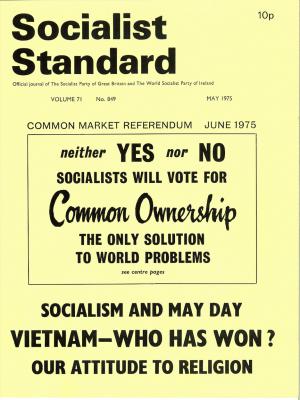
Religion and Ourselves (1975)

From the May 1975 issue of the Socialist Standard

Several letters have come in recently about the Socialist Party’s attitude to religion. They might appear to show a revival of religious belief, but we do not think so. The more likely explanation is that we have extended the Correspondence section of the Socialist Standard and religious people, who seem to take as a natural right that they may stuff their views down others’ throats, have applied themselves to it.

It will therefore save much repetition if the Socialist position on this matter is stated here. From its formation the SPGB has opposed all religion, and no-one holding a religious belief is admitted to membership. The reasons for our opposition were explained fully in our pamphlet Socialist and Religion, which first appeared in 1910 and was reprinted continually in the next twenty years.

The opening section of Socialism and Religion was headed "The Need for Frankness’’. In 1910 as now there were several organizations using the word “socialism”, but none was willing to declare itself on this question. Instead, they took refuge in the evasive principle “Religion is a private affair”; in other words, out to catch votes and nothing else, they were not going to risk alienating supporters by insisting on proper understanding.

The Socialist Party’s position is altogether different. Of course we want more members and supporters, but on the essential condition that they understand Socialism and its implications. That is why our attitudes and policies are stated unequivocally all the time. On religion, we say now what was said in 1910: “No man can be consistently both a Socialist and a Christian. It must be either the Socialist or the religious principle that is supreme, for the attempt to couple them equally betrays charlatanism or lack of thought.”

Irreconcilable
It is noticeable that no letter-writer argues a case for the established Churches. In bygone years it was sometimes put to us that the Catholic Church was benevolent to the workers; we do not recall anyone ever defending the Church of England. Generally our correspondents appear to take for granted what our pamphlet in 1910 had to spell out, that the big religious institutions are in the pockets of the ruling class. What they urge us to accept is that Christian belief in “the brotherhood of man”, etc., is in harmony with Socialism.

Whatever social messages are inferred from religious beliefs, they are first and foremost beliefs — that is, they start by envisaging the supernatural; the divinity of Christ, the soul, the after-life. These are probably the bare minimum, but if they are reduced still further there remains a fundamental element of all religions which makes them the antithesis of Socialism. This is what in philosophy is called idealism: the belief that ideas have an existence independent of natural and social causes.

Socialism is not a philosophical idea, but the expression of the material interest of a class created by historical development. Its foundation therefore is materialism, in opposition to idealism. The materialist standpoint towards man is that given his social existence (a datum everyone is bound to accept) everything results, or will be found to result, from the interplay of social forces. Any alternative explanation must lead to other conclusions than Socialist ones.

The Losing Side
However, we do not find that it is Socialism our correspondents want. Professing to have common ground with us, they approach it in a remarkably one-sided way. It might be possible to have sympathy with one who said: “Christianity and Socialism are both vital. In order to join forces, let us both give up a principle. If you will abandon a Socialist attitude, we will reject a chunk (which you may select) of our belief.” But of course they say nothing of the kind. Their demand is for Socialists to give way to Christian claims. What sort of common ground is that?

It is also asserted, frequently, that the influence and fervour of Christianity can never be extinguished. The writers seem unaware of what is happening, and not at the hands of Socialists. In October last year the newspapers reported a national poll of religious beliefs undertaken for a BBC religious programme. Only 29 per cent. of those asked believed in a personal God, and 40 per cent. of the 16-34 age group rejected the idea of life after death. (Guardian, 14th October 1974.)

When we say that Socialist society will do without religious beliefs, it is greeted with indignation as our proposal to abolish. That is not the case; we simply remark that in a sane, stable world people will not need consolation by illusions. But the abolishing is being done by capitalism, which once needed religion and now no longer has much use for it. Perhaps that is why Christians have taken to petitioning the Socialist Standard; but it is they, not we, who must change.
Robert Barltrop

Saturday, April 23, 2016

Churches in retreat (1987)

From the February 1987 issue of the Socialist Standard

Christian churches in Britain have lost half a million members in the last five years. According to the UK Christian Handbook, Christian church membership has declined to under seven million people, which is about fifteen per cent of the population. But other religions have shown an increase. In particular the number of Muslims has increased by over a third to 852.000 and many churches have been converted into Mosques. Other religions to have increased their membership, on a smaller scale, were Sikhs. Hindus, Buddhists and Satanists while the number of Jews showed a slight decline.

Although there has been a change in the type of superstitious nonsense being peddled, on the whole religion is a very minor activity in Britain. There will be a greater number than the above who still profess a belief in a god of some kind but who don't want to be confined to the absurd behaviour patterns these churches demand.

In fact, Christianity has been in decline for some time. It has also continuously retreated from what it claims to be able to explain. At one time it said that the world was created by god in six days and that the sun revolved around the earth. Although there are still some who claim a literal translation of the bible, most Christians now accept the theory of evolution and other scientific facts. Instead they now try to stress the "symbolic" nature of god and the bible — how god is about love and kindness — and play down the roasting in Hell bit. Hardly a week goes by without some trendy bishop on the telly saying that religion is fun and positive and not about saying no to the things people enjoy.

The churches have always felt able to say that, despite god being all-powerful and creating the world (even if he used evolution to do it) when anything unpleasant happens it's always the fault of human beings. So he takes the credit for humanity at its best when we are being loving, kind, creative and successful. But when it comes to Hiroshima and Auschwitz, pyorrhoea and Aids it's got nothing to do with him - unless he is moving in mysterious ways.

Religious ideas and socialist ideas are incompatible. Socialism is about understanding the way society operates with a view to changing it. Religions preach submission, basically saying that a superior being controls our destiny and we must accept our lot. Such beliefs grew up to explain away large gaps in human knowledge. But as our knowledge has widened, the religious explanation is shown to be increasingly untenable.

The persistence of religious ideas can be understood against the background of an insecure world where, due to the class- divided nature of society, people feel powerless. Religion, with its promise of a pie-in-the-sky afterlife, may offer some hope and comfort. But as Marx said, "The abolition of religion as the illusory happiness of men, is a demand for their real happiness. The call to abandon their illusions about their condition is a call to abandon a condition which requires illusions".

Religion has often been used by ruling classes to justify their dominance and the subjugation of the poor. Kings rule by the grace of god, it is supposedly ordained from on high. Often the first shock troops of the British Empire were the missionaries, who sought to convert the natives and teach them their proper (servile) place in the world.

The Catholic Church has made deals with fascist dictators in the past and is often a force for reaction in Latin America, although some priests have embraced "liberation theology", perhaps in an attempt to be on the right side of any new ruling class.

In Ireland, religion has been used to viciously divide workers to fight for their employers' interests, and many of the wars and disputes in the Middle East use religion and the idea of a holy war to get workers spilling each other s blood. Millions of deaths in capitalism's bloody wars have been blessed by religion.

Religious ideas are political and must be defeated. Only when workers are free from such illusion will be we able to set about the real task facing us, transforming the world into a place fit for people to live in. It is the only world we will get and we should make the most of it. And not let any trendy bishops or long-haired preachers get in our way.
Ian Ratcliffe