Showing posts with label January 1941. Show all posts

Sunday, January 30, 2022

The Interesting Case of Sir Richard Acland, M. P. (1941)

From the January 1941 issue of the Socialist Standard

In the October issue of the Socialist Standard,  some remarks were made about Sir Richard Acland’s views, based on a letter written by him to the News-Chronicle. In a subsequent letter to the Socialist Standard Sir R. Acland suggested that instead of criticising his brief letter to the News-Chronicle we should consider the full statement contained in his book, “Unser Kampf” (“ Our Struggle ”—Penguin Edition, 6d.).

The argument of “Unser Kampf” is that the war against Germany will be long and costly unless the military weapon is backed up by propaganda that will appeal to the German people. It is of no use, he says, to threaten the dismemberment of Germany as this would rally the German workers round Hitler. As he proposes instead that we should proclaim “common ownership” as our “new order” it may appear that he has reached the Socialist standpoint. When, however, the book is examined it is found that though the author imagines he has broken with capitalism, his alternative, far from being the revolutionary one he believes it to be, is a naive, impossible scheme for imposing radical reforms on the capitalist world.

Sir R. Acland can see some of the features of capitalism, the inequality of incomes, the restrictions on production, the monopolies, unemployment, etc., but he gives no sign of understanding that the monetary system, the production of goods for sale, the system of wage-labour, the existence of property incomes through exploitation, and the competition for world markets are all part and parcel of capitalism : he does not see that if the capitalist private property basis is abolished and common ownership is introduced all the rest go too. If Sir R. Acland can contemplate “common ownership” without this necessary consequence of it, the reason is that he does not really mean common ownership. His scheme is that industry (in the first place banks, insurance companies, railways,, mines, steel, and a few other industries, p. 145) shall be taken over by the State and that the owners shall receive compensation on a graded basis providing a maximum annual income of £3,000 a year (p. 100). This would be for the life of the shareholder, but with the alternative of a somewhat smaller income which shall continue for the life of his children too. This payment of compensation he justifies on the ground that it would be both unwise and unfair to leave the former owners “to fend for themselves in the labour market like anyone else” (p. 98). This is a curious argument. Sir R. Acland does not appear fully to realise that property incomes, including these compensation incomes, can only exist through the exploitation of the workers who produce the wealth. And if this “ new order ” really offers to the whole population a satisfactory life, why should it be “unfair” to the capitalist that they should enjoy its blessings too?

What is still more revealing is that Sir R. Acland believes that “common ownership ” exists in Russia (p. 76). He says nothing of the vast inequalities of income in that country but claims that “no one in Russia sits back and draws income in respect of the ownership of property ” (p. 91). He does not seem to have heard of the enormous National Debt in Russia running to thousands of millions of roubles, through which investors can sit back and draw investment income. Or perhaps he would argue that this is not income “in respect of the ownership of property”? Yet it is not essentially different from investments in State loans in other countries where the capitalist State has industrial undertakings under its control.

He envisages that under his scheme there will be “for at least the first century or two ” better pay for “ better work or more skilful or responsible work ” (p.110). In other words, like the Bolsheviks. Sir R. Acland wants the retention of a privileged group. He fails to offer any justification for this, and does not consider the kind of methods that would have to be used to force an enlightened working class to accept it. Does he imagine that the low-paid hewers of wood and drawers of water in Bolshevik Russia willingly consent to the arrangement by which the Party men, technicians, administrative officials, writers and artists, and other favoured groups receive incomes dozens of times larger than their own miserable wage? If he wants to enforce the same system he will need the same forcible methods to compel its acceptance. He does not state a reasoned case for wanting this inequality to be perpetuated.

“Common ownership” as used by Sir R. Acland is a term that he also finds it possible to associate with Nazi Germany. He thinks it likely that the German army leaders and the Nazi Party leaders may “deprive the German owners of their swollen profits and of their grip on industry” (p.90). Then “there would,” he says, “ be common ownership in the hands of the Nazi Party." Well may the workers say that if "common ownership” means what exists in Russia, and what is possible under the Nazis, they do not want it.

One curious omission from the book is any denunciation of the State capitalist concerns that exist already in this country. Is Sir R. Acland unaware that the workers in the Post Office and in the London Passenger Transport Board are treated in essentially the same way as workers in any other capitalist concern? Yet when he is denouncing capitalist monopoly (p. 45) and gives a lengthy list of instances, he does not mention these. On the other hand, he writes approvingly of the Post Office (p. 105), and has no criticism of Labour Party plans for State capitalism except their speed of application.

For the conduct of international affairs Sir R. Acland wants an international armed force (p. 135). He does not get down to the vital question how, under conditions as they will actually exist after the war, of a continuing fierce struggle for markets and capitalist groups are to be persuaded or forced to for the control of strategic points, etc., the interested accept any international control unless it falls in with their interests. On his own showing the adoption of what for him is “common ownership” will not solve the problem of war, since he accuses “common ownership” Russia of aggression against the Finns "as damnable” as the German invasion of Poland (p. 148). He even accepts the possibility that Russia may enter on a “ Napoleonic stage ” of attempted world conquest and expansion (p. 85).

In short, as Socialists, we can only say that the solution for all the problems that Sir R. Acland takes in his field lies in Socialism, i.e., a system of society based on common ownership in the real meaning of the term. This cannot be achieved by some swift campaign to get the population to accept “the new morality” (p. 144) and change the Government (p. 139), but only by the steady, thorough winning over of the working class internationally to Socialism.

In order to remove any misunderstanding it must be pointed out in conclusion that Sir R. Acland is quite wrong in his acceptance of the view that “the Russian doctrine” is “ Marxism ” (p. 91).

It will be interesting to see where Sir R. Acland's well intentioned and courageous, though misdirected, investigations of capitalism will lead him. At present he is a Liberal whose conceptions are likely to be as unacceptable to the Liberal Party as they are to Socialists. The Labour Party will not like his independence and the Communists denounce his criticisms of the Russian onslaught on Finland 
Edgar Hardcastle

The Flimsy Basis of Race Prejudice (1941)

From the January 1941 issue of the Socialist Standard

The racial question has become an urgent problem in political controversy in recent years owing to the significance given to it in Germany, where appeals to race prejudice have been used mainly to promote discrimination against the Jews. Antagonism to the Jews is also showing signs of developing in quite unexpected quarters. It is therefore worth while devoting a little space to a brief examination of the question.

In the first place what does the word “race” really mean? Immediately we ask this question we realise into what a morass we have stepped, because the term is used to cover quite different meanings. For instance, the “Black Race,” the “Brown Race,” the “Yellow Race,” each covers groups of people in varying stages of culture and with contrary attributes apart from the colour of their skins. The “American Race,” the “British Race,” the “African Race,” applies to the inhabitants of a particular territory. The “Mohammedan Race” and the “Jewish Race” is a religious distinction. The “Celtic Race,” the “Aryan Race” and the “Semitic Race” refer to particular types of language.

Here, then, are four different meanings commonly applied to the term “race,” and there are many others including those that apply to the shape of the head and to the nature of the hair.

The meaning that it is attempted to foist upon the word “race” is that there are certain groups of people to-day who, like the thoroughbred horse, have kept their blood free from alien mixture for hundreds of years.

At the outset it may be pointed out that there are no physical distinctions that can denote purity of blood. People from this country who spend most of their lifetime in the Colonies develop physical characteristics that mark them from their relatives who have remained at home. In a book by Brunton entitled “Kings and Queens of Ancient Egypt” there are a number of coloured illustrations of Ancient Egyptian women. If one covers the headdress of many of these women with a piece of cardboard the features and colouring are the replica of many present-day English women who have a murky heredity. The reader can multiply instances from his own experience where a black face, apart from its colour, is the facsimile of white faces of allegedly pure blood. Every physical characteristic that one seeks to use as the hall-mark of a particular “race” bristles with exceptions. There are all varieties of white, black and red faces. It is therefore obvious that neither the colour nor the contour of a face is evidence of racial purity.

It may be added that round heads, long heads, and nondescript heads are associated with all varieties of colour, hair and facial characteristics, and even differ in the same family.

Again, place of birth is nothing to go by, as man has been on the move for thousands of years, and the most important geographical unities is inhabited by a vast assortment of mongrels. England is an example in point where one meets many who proudly boast of their “British Nationality” in strange accents. Think, also what a hotch-potch America is where nationals from all over the world have gone into the melting pot, and British and other film stars and “famous” people have recently become “American citizens.” Again, consider the people abroad whose fathers and grandfathers were born abroad, and yet the present generation still calls itself English—they look to England as their “country.” Consider also the varieties of people of alien origin born in England.

These facts banish place of birth or country of origin as a criterion of race.

The fact is that man’s wanderings over the earth have promoted such a mixture of blood that there is no such thing nowadays, even in remote places, as genuine blood purity. Twenty-five thousand or so years has bred many varieties of the human species and will go on doing so. A name may be carried down for generations, but the blood associations of that name through the female side are beyond calculation. Many a fine name has a bundle of skeletons in the cupboard.

Language is also no guide to purity of ancestry. The most diverse people speak the same language now, and did so in the past. For example, at one time Latin was the language of both Roman and Barbarian. To-day Spanish is the language of native inhabitants of South America as well as the people of Spain. English is the language of that mixture of people occupying England, South Africa, Australia, America, Canada and other places. Here we come to another point—the question of “Aryan Race.” But Aryan is a language and not a blood connection. The Aryan-speaking peoples, like the Celtic, were of mixed descent. The barbarian hordes that flooded Europe in the middle ages and mingled with the population destroyed any possibility of racial purity existing in our day.

There is, in fact, no single scheme of classification that will satisfactorily cover the different types of human beings in existence. Alpine, Nordic, Mediterranean and other strains are present in varying degrees in all the peoples of Europe.

The human race comes into the world naked, and clothes with habits and traditions the result of social circumstances. Different sections of the human race rise and fall in culture or importance according to the nature of the social environment, irrespective of colour, language or religion. Egypt, Greece and Rome were each at the top of the cultural scale and each has come down since the time of flowering.

In the long run the social environment blends people of different stocks into one type, with similar habits and outlook. In modern times the United States is an excellent example of this.

The people that to-day are regarded as representative of a low cultural stage may, under favourable social circumstances, rise to supremacy tomorrow. The Australian Maori, not long ago looked upon as at the bottom of the cultural scale, is imbibing the arts of civilisation at a remarkable rate, and may soon be equal to the highest product of civilisation.

In mankind purity of race is impossible, even if it were desirable. Even among domestic animals the greatest care can only guarantee purity from a certain point. The classic example, the thoroughbred racehorse, is only thoroughbred from the already mixed Arabian strain that was introduced into Europe two centuries ago. On the other hand, mixture of peoples has been synonymous with cultural advances from the time of Babylon and Egypt to the present day. Peoples which have not been subjected to the invigorating influence of alien blood have, like the Chinese, stagnated.

The Jews, over whom race-prejudice has been revived in a violent fashion, are of mixed origin, and represent a type with a religious basis and a particular historic tradition. It may be noted that a people that has been battered and hunted for centuries is liable while, and wherever, those conditions exist, to display the characteristics of the battered and hunted—distrust, clannishness and cunning.

Throughout the middle ages the Jew was ruled out of practically every occupation except finance, and consequently they became adepts in that business. Since then, as other occupations have been thrown open to them, they have brought into the new spheres the single-minded concentration forced upon them by their social history and have consequently excelled. This ability has produced distinguished workers in music, literature, science and the art of war. Jews are also as generous, brave, cowardly, self-seeking as other types of people who are proud of their nationality. These “virtues” or “vices,” it may be remarked, have really nothing to do with race, but depend to a great extent upon age, health, sensitiveness, knowledge and circumstances, and vary as much in one type of people as in another. It may be added that they also depend upon the point of view of those concerned.

While, in certain circumstances, the rich Jew is fair game for the rich non-Jew, the poor Jew is always fair game for both under capitalism.

Finally, the Jewish question is not really a race question at all but an economic one. When other excuses fail it serves, as in Germany, to hide the real source of the misery of the mass of people of all colours and creeds. If it is not submerged by the mixture of races by that time it will certainly be solved by the advent of Socialism, under which there will not be economic crises, stagnation and poverty for millions that require a scapegoat to explain. Also there will not be either the competition for markets or for jobs that breed the unnatural fiends of envy, pushfulness and callous brutality.

In conclusion, it may be remarked that we all use the word “race” loosely for want of better terms. But this does little harm as long as prejudice is not tied to it.

Perhaps it may allay prejudice in the mind of the reader of the above if it is mentioned that the writer is of “pure” Irish stock for several generations back—or else the skeletons have been very effectively hidden.
Gilmac.

Saturday, January 29, 2022

Letter: Capitalist Rewards and Responsibilities. Is the Worker Free? (1941)

Letter to the Editors from the January 1941 issue of the Socialist Standard

The following letter has been received from Mr. Maurice Hely-Hutchinson, M.P. : —

House of Commons, S.W.1. 
November 30th, 1940.

To the Editor, THE SOCIALIST STANDARD.

Sir,

I write to thank you for your courtesy in sending me a copy of your issue of November, 1940, containing an article entitled “Incentive Under Socialism” over the signature “H.,” in which the writer points to some actual and some apparent exceptions to a general statement of mine that “there must be a hierarchy of incomes if there is to be a hierarchy of responsibility.”

The article is all the more stimulating because it is both pleasantly and temperately stated. I do not know to what extent it may be your policy to open your columns to a reply, but may I say at the outset that as the “truths” of “Capitalism” rest on an empirical rather than a doctrinal basis, then if, and to the extent that they fail in practical application, they call for qualification.

As a background to a reply, here, in very condensed form, are some of these “truths” ; and it will be apparent that each one of them falls short of universal application. Indeed, as I think Aristotle taught, the only abstract truths are mathematical; in life itself, there can be no such thing as truth and justice except in relation to a set of facts.

The fundamental human urge is parentage. The unit of society is the family, not the individual or the State; and, as the late Pope declared, “The Head of the Family is above the State.”

The bias of capitalism is towards personal rather than collective responsibility. Some form of reward is necessary to induce people to accept increased responsibility. Hemmed in as most of us are by pitiless circumstance—and this applies not only to the poor—this reward must be in most cases, to a great extent, material. This does not exclude other forms of reward. It is possible, for example, to give instances of persons who have refused Cabinet Office not directly on account of the loss of income involved, but because that loss of income would have involved sacrificing their children’s education: otherwise they would gladly have accept the lesser income.

The maximum of satisfaction is likely to result from leaving people free, as far as possible to contract for their own goods and services, to their own best advantage as they see it (undoubtedly this will not prevent some people being dissatisfied with the result), and to take the consequences of their decisions, e.g., of rating their goods or services so high that they fail to sell them. It is undesirable that an Officer of the State should be the judge of individual advantage, for tastes differ.

Enterprise and invention are essentially qualities of the individual. The State is only a fabric of organisation, it has no personal life. While many activities, especially those which have themselves become standardised can best be conducted—and are so conducted—by the State, improvements and extensions, and new activities are most likely to come into being as a result of individuals using their own initiative in pursuit of what they conceive to be their own advantage.

As Henry Maine wrote, the history of emancipation is the story of progress from “status” to “contract.”
As a result of freedom of contract many anomalies appear. But no substitute which the wit of man can devise will ever prevent strong men and beautiful women from getting more than their neighbours. Is this a bad thing? Admittedly it is easier to grieve with the sad than to rejoice with the glad—but that is because of the universality of jealousy. It is untrue that all men are equal; nor is it desirable that either they or their circumstances should be; there must be a difference of potential if the current is to flow ; nor can it be said that social justice will be achieved by seeking to make all men lie on the bed of Procrustes.

It is not possible to conceive of productive property save in conjunction with the idea of management, and of responsibility therefor. There can be no such thing as wealth without intelligent direction; the tests of intelligence must, from the nature of things, be empirical rather than theoretical; there is no mechanical substitute for judgment. It is because of the association of productive property with management that the State has from the earliest times recognised and supported the testamentary power, to ensure the continuity of management and therefore of production; and parallel with the growth of forms of property divorced from the responsibility of management, e.g., stocks, shares and particularly debentures, taxation of unearned income and on property passing at death has progressively increased. As to the concentration of large, or relatively large amounts of property in individual hands, this is to the advantage of the community if the owner’s capacity for management is above the average. If it is not, nothing can long prevent a fool and his money from being soon parted. Bankruptcy and the sack are the safety-valves of capitalism. The noise of history is made by the clatter of the wooden sabots going upstairs and the “frou-frou” of the silken petticoats coming down.

Finally, Sir, let me acknowledge the truth of what Taussig, the American economist, once wrote. So long as life presents to one man the chances of battle, of reward for accomplishment, of great prizes for the taking of great risks or the exercise of great talents, while to another it presents nothing but the intolerable prospect of hopeless competition with better equipped superiors, so long will the endless debate as to the relative merits of private enterprise and Socialism continue.
Yours faithfully,
Mr. Maurice Hely-Hutchinson.


Reply
Our correspondent, Mr. Hely-Hutchinson, covers a great deal of ground in his letter, so much, indeed, that it is impossible to deal with each separate point. There is, however, a general observation that can be made on the whole letter. While giving an account of what are described as the truths of Capitalism, and explaining why they are only partly applied, Mr. Hely-Hutchinson does not explain what is the ultimate basis of these “truths.”

Is the ultimate basis nature, including human nature ? Or is it, as Socialists perceive, the particular form of private ownership known as the Capitalist form? If these “Capitalist truths” are merely the ways of adjusting industry to the needs of the privileged class, then it is necessary for our correspondent to go farther into the question of having a different basis (common ownership) for which these adjustments will not be required.

While it may be highly convenient, under Capitalism, to make some approximation to relating the wages of grades of workers to their degree of responsibility to the Capitalist for the safeguarding of his property, no such need will exist when Socialism replaces Capitalism, and there is no longer a wages system. Socialists do not agree that human beings cannot and will not accept responsibility except on the condition that it carries a higher income. All kinds of voluntary activities carried on now show this to be untrue. Mr. Maurice Hely-Hutchinson will readilv recognise this in the conduct of voluntary political organisations (the S.P.G.B. among them), and in the field of amateur athletics, dramatic societies, choirs, music societies, expeditions of exploration, etc. A very large part of the population habitually accept responsibility in some activity or other for which they do not receive an additional income.

Conversely, and this is vital for the apologists of Capitalism, a willingness and capacity to accept responsibility has exceedingly little to do with the ownership of property to-day. At one time the apologists would have maintained that Capitalists are “self-made men,” and that this demonstrates their superior right to own property. Nowadays, this is utterly untenable since it is common knowledge that the great bulk of the wealth of the present generation of Capitalists is inherited. Mr. Hely-Hutchinson offers instead the plea that “nothing can long prevent a fool and his money from being soon parted,” but this, again, does not now accord with the facts. The wealthy “fool” has his investments spread over many concerns, and has at his disposal paid advisers who are not fools.

Again, personal responsibility for the management and direction of industry is becoming the exception. Personal responsibility is merged into the collective responsibility of companies, corporations, etc., and it is not true that “there can be no such thing as wealth without intelligent direction.”

In the concluding paragraph of his letter, Mr. Hely-.Hutchinson quotes a passage from the American Economist, Taussig. If Taussig meant that the propertyless workers are always at an enormous disadvantage as compared with the few who own the means of production and distribution, and that out of this arises the workers’ growing interest in Socialism, Socialists can agree. But there is nothing to indicate that either Taussig or our correspondent really appreciates the truth about the workers’ disadvantageous position. Elsewhere in his letter Mr. Hely-Hutchinson refers to Henry Maine’s theory that “the history of emancipation is the story of progress from status to contract.” It is interesting here to consider the words used by Maine in his “Ancient Law” (end of Chapter V). He says: —
  “Starting . . . from a condition of society in which all the relations of Persons are summed-up in the relations of Family, we seem to have steadily moved towards a phase of social order in which all these relations arise from the free agreement of individuals.”
He goes on to say that “the status of the slave has disappeared—it has been superseded by the contractual relation of the servant to his master.”

The important point to notice about this is that Maine thought he could see “the free agreement of individuals.” Socialists point out that there is not, and cannot be, any such thing as “free” agreement of workers and employers, because the workers are without access to the means of production and distribution, except by the consent of, and on the conditions laid down bv, the owners. The progress envisaged bv Maine has only run half its course. Socialism will finish it and achieve actual emancipation.

Briefly replying to other points in the letter, it is surely wrong that “the fundamental human urge is parentage”—before it comes hunger. And the unit of Capitalist society is not the family—the State applies its penalties to the individual in the main.

Also, though, perhaps, this is a matter of taste and opinion, is it really true that all our Capitalists are “strong men and beautiful women”? Who are these company directors and millionaire captains of industry who frequent the spas ? And is Lady X——? really beautiful?
Edgar Hardcastle

The Mixed Blessing of Big Canadian Wheat Harvests (1941)

From the January 1941 issue of the Socialist Standard

On November 19th two newspapers, the Manchester Guardian and the News Chronicle, both published some observations on the bumper harvest in Canada. The Guardian had a letter from Mr. Robert Tasker, M.P., who asked that “in the midst of our thanksgiving for the home harvest let us hold in grateful remembrance this year the bounty of the Empire crop. . . . All told, Canada will have about 730,000,000 bushels of wheat this season, as against 591,000,000 a year ago.”

In the News Chronicle Mr. Reuben Hogg was not quite so certain as Mr. Tasker. He wrote at length on the necessity of prompt and drastic steps to deal with this bounty. It will mean, he wrote, “that Canada has an exportable surplus equal to the entire world’s peace-time needs for about 14 months. But actually only about a quarter of Canada’s surplus is likely to be exported before her next harvest. A very large quantity will have to be carried forward . . . .”

Here enters problem number one, for the Canadian banks “are naturally hesitant to advance money for wheat that may never be marketed.” So the Canadian farmer will be the first to curse the superabundance of wheat.

Then there will be repercussions on British agriculture—”Farmers at home cannot see these surpluses accumulating with equanimity. Remembering the collapse in British agriculture that followed the last war, they are wondering more and more if things are not beginning to point to a repetition of that sad event.” Then there is the Argentine : —
 “The Argentine faces a similar problem with maize, for which a surplus of 25,500,000 quarters is anticipated next April. Unsold feeding stuffs are also piling up elsewhere, particularly in parts of the French Empire. It is said that Indo-China alone has a million tons of feeding stuffs held up and unsold.”
So although the bumper Canadian harvest may make it easier to supply the demand in Britain during the war, it looks as if Mr. Tasker’s thanksgiving for Nature’s bounty will not be shared by quite a number of people.

Capitalism is indeed a curious system of society.
Edgar Hardcastle

No Compromise (1941)

From the January 1941 issue of the Socialist Standard

The recent successful operations by Greece and Britain against Italy have given rise to a feeling of optimism amongst the unthinking section of the proletariat: one frequently hears the opinion expressed that the war will be over very shortly, or that it will not last beyond the spring.

A moment’s reflection enables one to see that the wish is father to the thought: there are as yet no signs of the end; everything points to the fact that hostilities are only just beginning.

It is to be noted that the Prime Minister is extremely cautious when he speaks on recent events. He infers that the situation is hopeful, but this is unaccompanied by any prophecy indicative of a knowledge of something likely to bring about a quick finish.

The Radio and the Press are supposed to supply us with information in regard to what is transpiring, and one would have thought that the recent wonderful improvements in the methods of communication, etc., could be of great service in this connection, but, alas! though much is written and spoken, very little is said. That which appertains to the real position is for the initiated to know; a wise ruling class sifts the news and decides what shall constitute the mental pabulum of the wealth-producing section of the community.

The working class in the main think in accordance with what their masters have put into their heads: so long as the wage slave views life from the same standpoint as the exploiter, he will dance to any tune his master cares to play; he will work, fight, join the ranks of the employed or unemployed at the word of command, and justify or explain his conduct as his tutors have decreed he should.

This war is said to be a fight to a finish between Dictatorship and Democracy. We are not indifferent in regard to the issue, but we are not so enthusiastic as we are told everybody else is. It is plain that under a Dictatorship you are robotised: you do not think, you obey; under a Democracy yon imbibe ideas, carefully fostered, which result in causing you to believe you are following your own inclinations when safeguarding ruling class interests.

We much prefer a Democracy to a Dictatorship. We have been brought up that way, but when we see the dangling carrots held in front of the donkey to induce him to pull the load, we are wise to the game. In peace or war, so long as Capitalism shall last, the wage slave is doomed to drag his weary burden, and to receive as a recompense just about sufficient to enable him to do so. The promises regarding the improvement to be made in his lot after the war are on a par with those made to his predecessor.

“The proletariat cannot raise itself without the whole of Society being sprung into the air.” Even were our masters desirous of increasing our wages or improving our standard of living, they could only do so within certain limits. If they can get more out of us when on the job, they can put a little more into us. They can improve the quality of labour power and get more production and—increased profits.

Relatively, the wage worker’s position declines, though his standard of living may be higher than that of his grandfather. Man is a social animal, and those now living should have their lot judged in accordance with the times in which they live; the future of the upper strata of Capitalist society is being safeguarded now as far as is humanly possible; that of the lower is left to the future winds of chance. There is no outspoken demand outside Socialist circles for the common ownership of the means of life : the henchmen of our masters never even hint that such a change is desirable; all the propaganda emanating from the master class, and even from platforms of the Labour and Communist Parties is designed to induce the working class to give up their Socialist birthright in exchange for a mess of Capitalist pottage. Why is State ownership pedalled as Socialism if not to trap the minds of the unthinking and the unwary? The crimes of Dictators smell to high Heaven, and the hypocrisy of the leaders of Democracy arouse disgust amongst those to whom working class interests are paramount. Now, as never before, we must hew to the line. Amidst the chaos and confusion, the greed and the graft which Capitalism entails and the war intensifies, we must stand for Socialism. Capitalism has its own economic laws which work in defiance of the decrees of governments or the platitudes of politicians : things are not going to be better after the war if the system is maintained, but a jolly sight worse, no matter which gang of exploiters happens to be in control of the reins of power.

The war will undoubtedly shake Capitalism to its foundations, but unless the working class organise to abolish the wages system, the mechanism of exploitation will survive the struggle, and this means that the relative positions of wage slave and Capitalist will be maintained, and labour power remain in the category of a commodity.

When a Greek sticks a bayonet into an Italian fellow-worker on an Albanian mountain side, one may ask what induced both of them to go there ? The reply, obviously, is that one was sent by the Greek ruling class, and the other by Mussolini; the latter was desirous of subjugating Greece and sent soldiers for that purpose; the Italian working men were driven back by Greek working men. The property of Greek Capitalists was safeguarded by those who do not own it. If the invasion had succeeded, the Italian working class would have derived no benefit from the enterprise. War, from the standpoint of working class interests, is a ghastly tragedy; it is the price we pay for the luxury we are supposed to enjoy under Capitalism. Mussolini has not hesitated to use the most brutal methods to attain his ends; he has been ruthless, he has mercilessly exploited the Italian people for his own self-aggrandisement. Force, however, has its limits. Those rulers who rely solely upon this means of subjugation will shortly realise to the full the truth of the maxim of Napoleon, “You can do anything with bayonets except sit upon them.”

King Winter is just commencing his yearly reign. He will be followed by King Famine and King Fever. Millions will suffer from cold, starvation and disease. Countless numbers are already doomed to agonising deaths. Although we in this country may be relatively fortunate in this connection, we shall not escape those horrors which war brings upon the working class of a country involved in a war.

The policy of Britain in Europe is the maintenance of the Balance of Power. The ruling class of this country will never allow any single nation to dominate the European Continent. To do so would be to pave the way for the dissolution of the Empire. Consequently, we may expect our masters to stake everything on the outcome and fight it out to a finish. As the resources which Britain can command are greater than those Germany possesses, or can obtain, in the view of the writer the latter is doomed to defeat.

There is, however, no peace under Capitalism, and if the system is allowed to continue, the overthrow of vampire Hitler does not mean the abolition of war. Neither Russia, Japan, or any other Capitalist nation has the slightest intention of beating their swords into plough shares. Russian “Communism”‘ German Nazi-ism, and Italian Fascism are different sects of the same religion, which is not, as the followers of Hitler would describe it, “National Socialism,” but can only be defined correctly as National Capitalism.

Although Britain can be expected to win the war, the people of Britain cannot expect to win the peace, no matter what is attempted by the ruling class in the way of social reform. In a Capitalist sense this country is handicapped; her natural resources, except coal, are practically exhausted; she has few natural means of producing power cheaply, and in a competitive world she is thus in a bad position as an industrial nation. Trade may be expected to move westward, the Pacific Ocean will probably supersede the Atlantic as the highway of commerce. After the war, the workers of Britain will be fighting a rearguard action, trying to defend a declining standard of living. The working class in a country where Capitalism is developing, where new means of production are being produced and operated, are relatively in a favourable economic position, and are therefore able to win certain concessions from their exploiters; they act and save the movement from stagnation.

As for us, who are seared with the brand, let us remember, at all times and under all circumstances, that the class struggle is the guide to tactics: we rejoice in the fact that thousands of Italian workers are refusing to fight for Mussolini, and we look forward to the time when all who live by selling their labour power will refuse to support those who run Capitalism, and organise for the express purpose of transforming the present social order into something nearer to the heart’s desire.

It is quite true to state that the present issue is an issue between a Capitalist Dictatorship and a Capitalist Democracy. We freely acknowledge that we prefer the latter, because, under a Democracy, there is a better chance for the laws of social evolution to work themselves out without unnecessary violence.

On the class issue, however, we are adamant. Our slogan is, “No Compromise.” We extend the hand of comradeship and fraternity to all workers in all lands who, like ourselves, stand without equivocation for Socialism.
Charles Lestor

Sacrifice and the Influence of Money (1941)

 
From the January 1941 issue of the Socialist Standard

Constant appeals are being made to us for war savings. We are asked to save to the limit. Sir Robert Kindersley says : —
 “Pennies, sixpences, shillings, pounds—all are needed to reach the goal. Let us hold nothing back that we can spare. And when I say “spare,” I mean by saving to the point of sacrifice.”—(Sunday Express, November 17th, 1940.)
When we read these words addressed to workers we wonder if people in the economically sheltered position of Sir Robert Kindersley have any real conception of the workers’ position and social circumstances. The workers are always saving to the point of sacrifice if they have a penny over at the end of the week after paying for absolute necessities, which include some minor means of enjoyment. In fact, they have to go without many things that are really necessities because they have not the money to pay for them, and they suffer accordingly.

When one compares appeals like that with contemporary actions, one is struck by the overwhelming influence of private property and profit making on the actions of people even at a time of self-confessed dire national crisis. The very same paper that reports the above appeal also has a few paragraphs on ”Ramp in Leeks,” from which it appears that on account of the onion shortage a ramp in leeks is starting, and four-pence worth of leeks now costs three shillings !

A further illustration of the evil influence of money is provided by an instance that has been brought to the writer’s notice. Although all London traffic is under the control of the London Passenger Transport Board, which appeals to the public to stagger hours and do what they can to ease the transport difficulties, yet a person holding an underground season ticket from Baker Street to the Bank may not use the alternative service of the buses unless the underground is out of action—because he has paid for a ticket on the underground. If he goes by bus he must pay again. One sees here how, even under the fiction of public control, and even though the buses be nearly empty and the underground packed to suffocation, people are still only allowed to use the particular service they paid for. Sacrifice does not enter into the question, money is the all-important guiding principle.

Again women and children of the poor are urged to evacuate from London to areas where they are less likely to suffer the horrors of bombing. Among the reasons that prevent them from going some women have pointed out that one of the principal obstacles is providing the necessary warm clothing and boots required by children in country districts. A magnanimous government has informed them that they can be supplied with these necessities, and instead of paying for them all at once, payment can be spread over a few weeks—like the hire purchase arrangements with which the poor are only too familiar. As these people cannot even afford to adopt such a procedure it has not apparently occurred to the authorities that the solution of the problem is to supply the article in question for nothing—a simple and reasonable way out of the difficulty. Why ? Because the idea of giving something for nothing is repugnant to the system we live in to-day—unless that something is profit.

Another instance which appears in the same paper (the Sunday Express), illustrating the chasm between poverty and riches, the privilege of having money and the penalty of being without, is contained in the report of the case of Captain Marenday, imprisoned for taking an unauthorised photograph. In his story Captain Marenday made the following statement: —
“Later they put me in a bay of the prison (Brixton) and I was given the special privileges of a remand prisoner. All of us there were able to order our own food from restaurants outside. Always providing we were ready to pay for it.”
So that privilege even extends to prison, and the remanded rich man can eat luxuriously while the remanded poor must keep to prison fare. A queer twist to the idea of freedom and democracy and one born out of the power of money.
Gilmac.

Notes by the Way: Workers Sacked for their Opinions (1941)

The Notes by the Way Column from the January 1941 issue of the Socialist Standard

Workers Sacked for their Opinions

A case came before the Court recently in which three workers claimed that it was illegal, under the National Service Act, for their employers (a Co-operative Society!) to sack them merely because they were conscientious objectors. The magistrate, quite properly, confined himself to the legal position, and refused to express any opinion on the action of the Co-operative Society, but his judgment made it clear that not only under that Act, but also at Common Law, it is quite legal for an employer to dismiss his workers because he does not like their opinions.

The following extract from the judgment of the Huddersfield Stipendiary Magistrate, Mr. W. R. Briggs, is taken from The Manchester Guardian (October 29th, 1940): —
 “The evidence was, and he had already found as a fact, that each complainant was dismissed because he was a conscientious objector. No man was bound to employ another of whose opinions or conduct he disapproved, and provided that he gave the proper amount of notice an employer might dismiss his employee for any or no reason.  
  It was possible that there might be employers who would dismiss a man because he was a Conservative or a Communist, a trade unionist or a non-unionist, a Roman Catholic or an atheist. Such action might or might not be reprehensible— he expressed no opinion on that point—but if the proper notice was given it would certainly not be illegal. Similarly in his opinion it was not illegal either at Common Law or under the Act to dismiss an employee because his religious beliefs made him a conscientious objector. For these reasons he was of opinion that the prosecution had failed to establish the commission of any offence and all the summonses would be dismissed.”
The defenders of Capitalism will say, of course, that the wages contract is a free contract between worker and employer, and it is free to the worker to leave because he does not like his employer’s views just as it is open to the employer to dismiss the worker. The notion of equality before the law is nonsense. The worker faces the loss of his livelihood, while the employer is at most slightly inconvenienced if a worker leaves.

The absurdity of the law can be seen from another angle, the activities of the National Institute of Industrial Psychology and similar bodies. For example, in the April, 1940, issue of their journal, “Occupational Psychology,” is a report by two investigators who used various tests to discover why a number of unemployed girls came to be out of work. The investigators studied the “intelligence” of the girls in the light of various intelligence tests (The so called “Dotting Test,” under which “the subject” ims through a slot at a number of paper discs fixed on a rotating plate, is worthy of notice by “Beachcomber”). The investigators and the Institute are no doubt thoroughly reliable, there is no trouble they will not go to, and no field of inquiry is closed to them— well, no field except one. Never on any occasion are they called in by the workers to conduct Dotting Tests or any other tests, on the intelligence, diligence, nervous stability, etc., etc., of the shareholders, directors, or other bosses in the concern. Nowhere do they ever conduct intelligence tests based on the principle that the more intelligent the worker the mere he or she resents the privileged position of the propertied class and the crass stupidity of the present industrial arrangements for which the latter are responsible.

Among all the very clever people who conduct investigations, including all the bright brains known as captains of industry, and the thousands of inventive geniuses, not one can rise to the slight insight and imagination required to see that industry could be (and will be under Socialism) run on a basis which will separate working from getting a living. Every one of them accepts it as a kind of inescapable law of nature that the worker (but not the Capitalist) shall only get a living if and while he can get an employer to approve of him (and his opinions). They fondly imagine, if they ever think about it at all, that unless the threat of the sack is always held over the heads of the workers, work would cease and all would die of starvation. They do not understand the obvious fact that the cult of dislike for work is itself simply a product, on the one side, of the Capitalist’s snobbish contempt for those who have to work because they are propertyless, and on the other, of the workers’ resentment of the conditions under which they have to work. Socialism will have its problems, but this will not be one that will be of dimensions sufficient to cause anyone the slightest disquiet.

* * *

A New World Order for Millionaires

New world orders are all the rage to-day, though some of them do not look very new. On the day that the Press published an account of Mr. Herbert Morrison’s outline of his new world order, the Ministry of Information issued a pronouncement from which it seems that the new order is already in being in the British Empire. When the Ministry claims (Daily Herald, December 12th, 1940) that “This is the only kind of World Order worth having—the only guarantee of security and happiness when the war is over,” they are very optimistic if they think that it will look so attractive to the populations of countries outside the Empire. The Daily Herald wants the Government to issue a statement of war aims, “making it clear that we are fighting for a new kind of world” (December 12th), but at the same time it wants the statement to be one “to which every party subscribes, and which carries the endorsement of the whole Commonwealth.” What sort of statement is it going to be if it fulfils the condition? Plainly, if it has got to be endorsed by the Conservative Party, it will be about as new and attractive as the kind of new world produced after the last war. It will certainly not be the only kind of new world worth having, a Socialist world. In his speech at the Dorchester Hotel, Mr. Morrison wanted an end to social insecurity and of a state of things “where millions go in need while supplies are deliberately kept short, or prices high, so that profits may be safeguarded,” but if the Daily Herald report is correct, he nowhere pointed to the cause, the class division of society. Had he done so, it would certainly not have been possible for one of his audience, Lord Nuffield, to say to the Chairman, Lord Nathan, afterwards, “I agree with every word of the speech—and I am a millionaire.” (Daily Herald, December 12th.) Another sidelight on the meeting was the statement attributed to Mr. Morrison by the Evening Standard (December 12th): ” I want change so big that I do not like to tell you about it.”

* * *

War has a Logic of its Own

Molotov has been reported to have said, recently, that war has a logic of its own. This is something worth considering by anyone who thinks that war can be waged under all kinds of restrictions designed to curb its ferocity. The following passage is taken from General de Gaulle’s “The Army of the Future “: —
  “If war is, in essence, destructive, the ideal of those who wage it remains, none the less, economy, the least massacre with the greatest results; a combination of forces making use of death, suffering and terror in order to attain the goal as quickly as possible, and so put an end to all three.”
As Alexander Werth says, in the Manchester Guardian (December 3rd, 1940): “Except, perhaps, for the last few words, the German Generals would no doubt fully subscribe to these sentiments.”

* * *

Mr, Maurice Webb Makes a Discovery

Mr. Maurice Webb writes articles for the Daily Herald. He shares their political views, and supports the Labour Party policy on war. That is to say, he has for years preached that it was necessary to “stand up to Fascism,” even if that meant waging war against the Fascist countries. He believes that there was no other way of securing peace and Democracy for the world’s workers. He not only held these views, but he took it upon himself, in the columns of the Daily Herald, to teach these things to others, who, in his view, had not grasped the truth about world affairs. Now those who set up as teachers are in effect assuring those who listen to them that they have learned before teaching and have fully considered the consequences of what they say should be done. But Mr. Maurice Webb, it seems, did not do this. It is only now, when the war is well into its second year, that he has begun to notice what war is, and what it does.

At the beginning he was full of that curious belief that we were all very friendly towards the German workers, and that the war was being waged not only for us but also for them. We would, he thought, just strike a blow to remove their oppressors, and then, all free men joined together in amity, we would set the world aright. Only Mr. Webb had quite forgotten to study war, its consequences, and the way it has to be waged. So now he has had a shock. He wrote an article, in the style that his readers adored at Christmas, 1939, only to find that this Christmas his readers, or many of them, have moved on and don’t want that kind of stuff any more. They have been bombed and they think differently.

He still thinks in terms of “Peace without vengeance.” They want vengeance, and plenty of it. In the Daily Herald of December 7th, he reproduces extracts from their letters. For them the German people are snakes in the grass, “and must be ruthlessly exterminated.” Likewise the Japs The German is “a loathsome beast.” Emphatically, “there are no good Germans.” “Grind them down to misery and poverty for a million years.”Wipe the damned lot off the face of the earth.” Poor Mr. Webb says, sadly, “there can be little doubt that the majority of Britons are beginning to nurse very bitter feelings towards the German people.”

Now Mr. Webb is in a quandary. If we are to have permanent peace, there must be no vengeance after the war, but the Allied Statesmen will not be able to succeed in that task, he says, if they have at their backs “hosts of envenomed ‘clean sweepers’ urging them on to suicidal and ruinous policies.” It looks, indeed, as if Mr. Webb is almost convinced already that the kind of peace he says we must have is just the kind of peace his readers decidedly will not accept. They have had a bitter dose of war, and the consequence is just what everyone expected who had seriously taken note of what modern war is and what it does. But Mr. Webb was not one of these. He did not share the Socialist view that war sets in motion all sorts of destructive forces which make it impossible for war to be the kind of benevolent, constructive agent he thought possible.

If Mr. Webb is now learning his lesson and taking a responsible view of things, perhaps he will let us have his second and more useful thoughts. We would like to hear from Mr. Webb what he now thinks about his past notions.

* * *

The Profiteer

Socialists want to see the end of the profit system altogether, and have always thought the popular attitude to what is called “profiteering” an odd one. If it is good and necessary to encourage the making of profit, why try to limit it? Can there be too much of a good thing ?

Logical or not, war always brings a popular outcry against what are called profiteers. But when this war broke out, all the newspapers and politicians were agreed that it would be run on different lines from the last. Never again would there be big increases of prices, and emphatically not the making of big profits.

The following, however, is taken from the Sunday Express (December I5th, 1940): —
  “The food profiteer is among us. He is making a lot of money. Last week hundreds of complaints concerning the swiftly rising prices of all kinds of unrationed food were received by the Food Ministry.

  They alleged unfair distribution of food and “illegal conditions of sale” imposed by some brokers and wholesalers upon shopkeepers.

  Another charge was that fixed price orders were being sidetracked by unscrupulous buyers.

   Lord Woolton, the Minister, has now stated that anyone found imposing “conditions of sale” or buying over the fixed price will be prosecuted. Reports by his investigators will be placed before him to-morrow.

   This much has been established. Huge profits in food are being made by someone, or some group of people, at present unidentified.”

* * *

Who Will Civilise America ? 

Mr. Robert Lynd, in a review of a book called “America, Our Ally,” by H. N. Brailsford, summarises Mr. Brailsford’s views thus: —
 “He advocates the liberation of India as the best way in which to impress America of the sincerity of British professions, and he urges America to throw herself wholeheartedly into the war, to send men as well as money, in order to establish a civilisation that will ensure to all belligerent peoples security and work.—(News-Chronicle, December 2nd, 1940.)
Mr. Lynd finds himself in agreement with the author of the book, but what simplicity lies in their hopes. They assume that India (does this mean the Indian peasant and workers?) will be “liberated” through a change in the relationship of the British Empire. Yet they must know that such a change, even if it meant complete severance, would still leave the mass of Indians enslaved to their own native-born ruling class. Next they assume that a desire to impress American opinion of their sincerity is a factor of vital importance to the British interests that stand for the retention of India. Why should it be? Equally flimsy is their expectation that those who at present control the United States will be concerned with establishing a new and better social order for the benefit of the populations of the European countries at war. Before inviting these rulers of America to put Europe right, Mr. Brailsford might have asked what the same gentlemen have done to America. In a recent issue of the Daily Telegraph (August 9th, 1940) it was reported from New York that there are in the U.S.A. more than 50 persons whose yearly income is £200,000 or more, and according to the Manchester Guardian (November 21st, 1940) a mere 13 families in that country control as part of their fortunes £540 million worth of securities in 200 of the leading corporations. This information was published in a report by the United States Securities and Exchange Commission, and the same report disclosed that this colossal wealth represents only a part of the total possessions of the 13 families.

Among the 13 are Fords, with upwards of £120 million; Du Ponts, with over £110 million; and Rockefellers, with £80 million or more. This, be it noted, is after eight years of Roosevelt’s administration.

The necessary accompaniment of this accumulation of American resources in the hands of these and other industrial and financial barons is the existence of extreme poverty in the ranks of the workers, millions of unemployed, widespread undernourishment and all the other evils of capitalist civilisation. One aspect of this has again been brought to light when conscripts were called up under the compulsory military training scheme. According to the New York correspondent of the Daily Telegraph (November 28th, 1940), “much surprise has been caused by the large proportion of men called up …. but rejected by army doctors. Although these men had been passed as physically fit by a medical examiner who assisted the local selective boards, many who are now reporting for duty are being sent home again, principally on the grounds that teeth or eyesight are not up to army standards. It is estimated that rejections are roughly at the rate of one in four . . . .”

Before Mr. Brailsford concluded that the Fords, Du Fonts, Rockefellers and their like are to be the civilisers of Europe, he should have wondered when the American workers are going to begin a little job of civilising at home.
Edgar Hardcastle

“S.S.” difficulties (1941)

Party News from the January 1941 issue of the Socialist Standard

We have had some difficulty in getting the “SOCIALIST STANDARD” out this month. The type for the issue was set up ready for printing but was destroyed during one of the bomb attacks on London. Some of the articles have been lost and the continuation of the “War: Offensive and Defensive Methods” will have to be re-written. Portions of other articles have also disappeared.
ED. COMM.

Appeal for the “Socialist Standard” (1941)

Party News from the January 1941 issue of the Socialist Standard

Readers will be aware that during recent months we have been losing heavily on THE SOCIALIST STANDARD. Sales have fallen owing to the difficulties of holding meetings and of distribution. On the other side, costs have risen. One method of reducing the loss is to cut down the number of pages. This will have to be done unless other methods are found. We therefore ask all those who can afford to do so to send donations to enable us to keep the “S.S.” at its present size. The need is urgent. Send donations to the Treasurer, 42, Great Dover Street, S.E.1. Postal Orders and cheques should be crossed.

Friday, August 31, 2018

This Month's Quotation: Charlie Chaplin (1941)

The Front Page quote from the January 1941 issue of the Socialist Standard
  "You, the people, have the power to make this life free and beautiful—to make this life a wonderful adventure ” 
(Charlie Chaplin in the film "The Great Dictator”)

Friday, January 26, 2018

So Much Alike! (1941)

From the January 1941 issue of the Socialist Standard

Russia, according to the Stalin Government and its unthinking groups of devotees, is a Socialist country. We have the strange spectacle of a prominent clerical dignitary declaring one-sixth of the earth to be Socialist. Now, surely, it is a sound guide to know your fundamentals first. Thus, if an object is declared to be triangular, we can only agree that it is so, if we first know a triangle. On the same principle, if Russia is declared a Socialist country, is it not the surest and safest thing for us to understand Socialism first, otherwise how are we to be sure we are not being sold a pup ? Therefore the knowledge of Socialism is vital. What then is Socialism? Socialism is a system of human society of a special kind. Its fundamental is the common ownership of all that is necessary to the common good. This implies the end of buying and selling and the end of the wages system. From this fundamental we must look at Russia. When we do look we find that buying and selling and wages obtain there as elsewhere—wages varying in rate, etc. Then, as Russia does not conform to our fundamental she cannot be Socialist. The Communist party, Left Book Club and similar people, however, have a ready answer. This is it! The fundamental (no wages) is a fundamental of Communism, and Socialism is a half-way house in which wages, money, buying and selling must exist until, by a slow process, they are eliminated and Communism is then reached. Russia, we are told, is going that way. Let us take them at their own word. If Russia is Socialist and moving towards Communism, according to the Stalinites each move should be away from payment for goods or services. The recent decree of the Russian rulers, however, is away from free education in schools to payment for it, ranging from one hundred to four hundred roubles. Let us face the facts and declare openly—Russia is not a Socialist but a Capitalist country, approximating to, though not identical with, totalitarian Germany. The German capitalist class have bluffed millions by styling their system “National  Socialism," the bulk of their population being German. Russia could not do this as easily, large chunks of her people being non-Russian. In order to gain support for her capitalism Russia has to delude millions of people that she too is Socialist (though not national). In order to slip this across the world she has made a “Socialism” of her own (like Germany), and subsidises numerous organisations to boom this for her (again like Germany). Those in her own borders who do not agree because they perhaps understand Socialism she shoots or imprisons (how like Germany). Prominent people (not understanding Socialism) write about a Socialist sixth of the world. Socialists, however, see through the game.
Lew Jones

Sunday, July 23, 2017

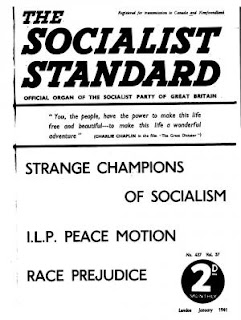
Editorial: The I.L.P. Peace Motion (1941)

Editorial from the January 1941 issue of the Socialist Standard

On December 5th, 1940, the I.L.P. group of M.P.s (Messrs. Maxton, McGovern and Campbell Stephen) put forward a motion calling for a peace conference. They condemned the Government because it has failed to set forth the terms upon which peace could be made, and
has failed to propose that a conference should be called to bring this conflict to an early conclusion, on the basis of the restoration of freedom in each country, and the pledge of all the contending governments to put at the disposal of the conference all their resources, at present being massed for producing the instruments of destruction and death, for the production of all instruments of well-being for rebuilding the homes in Europe and the establishment of a new social order which would mean the end of German, British, and other imperialism and provide a decent home and standard of life for each family in every country of the world.
The motion was rejected by 341 votes to 6. The six who supported were the three I.L.P. M.P.s, together with two Labour M.P.s (Dr. Salter and Mr. Kirkwood), and also Mr. W. Gallacher, the one Communist M.P. (Hansard, December 5th, 1940, col. 763).

Mr. Gallacher explained to the Daily Worker (December 7th) that he voted for the motion but did not agree with it: —
    William Gallacher was unable to speak in the debate, but commenting on it afterwards, he pointed out that his vote for the motion was in order to demonstrate his opposition to the Government.
   “The I.L.P. amendment,” he declared, "is typical of a loyal, orthodox opposition. It raises no question of class. It does not present the question of ending the war as a task of the people in the warring countries, but proposes a peace conference of the Imperialist Powers to end war and imperialism.’
   “I went into the lobby against the Government,” said Mr. Gallacher, “in order to express the determination of the Communist Party to organise the fight of the people against the war and to achieve a People’s Government and a People’s peace.”
The Daily Worker's editorial attitude was summed up in the words, “Peace through an appeal to Hitler! The proposal is farcical. . . .”

The Labour Party officially opposed the motion, and Mr. Attlee devoted some time to showing the impossible position in which the I.L.P. put themselves. They ask for a conference of Governments and make it a condition that they shall not only restore the position of August, 1939 (i.e., German and Russian evacuation of occupied territories), but also that they shall pledge themselves to establish “a new social order” which would mean the end of all imperialism and provide a decent standard of life for all. What happens if one side or the other refuses to accept the conditions?

Mr. Attlee pressed the question on Mr. Maxton:—
    “Mr. Maxton is suggesting that this Government should put forward certain terms of peace. If the Government does, will he support them? If it comes to a conference and Herr Hitler refuses to listen to the so-called voice of reason and rejects Mr. Maxton’s idea of liberty and social justice, what will Mr. Maxton do then? Will he fight, or will he give way? ”
Mr. Maxton’s answer, after first seeking to avoid it by saying that it was a hypothetical question was : —
     “If he and His Majesty’s Government accept my suggestion, I and my hon. friends will not be found wanting.”—(Col. 758.)
This was, in fact, precisely the same situation that arose during the last great war, when Macdonald and Snowden, for the I.L.P., proposed peace negotiations. When pressed to say what they would do if the terms were rejected by the German Government, they replied that they would go on with the war.

No other answer was logically possible, then or now. If Mr. Maxton were to say that his present answer does not mean going on with the war but some action not directed to capitalist Governments but directed to the workers, he only shows up still more clearly the illogical nature of the I.L.P. motion with its call for a conference of Governments.

That, of course, is a difficulty inherent in the situation. Effective control is in the hands of Governments, none of which will or could pledge themselves to introduce Socialism (if the motion does not mean a pledge to introduce Socialism then it is meaningless altogether, for it assumes that wars and poverty can be abolished without Socialism). Mr. Gallacher points this out, but is in no better case than Mr. Maxton. How does Mr. Gallacher imagine that the Russian workers can represent their views at a Conference, over and above the heads of their own dictatorship? What does he think would happen to Russian workers who, for example, had sought to end the Russo-Finnish war by seeking direct contact with Finnish workers against the will of the Russian Government bent on capturing territory and controlling resources that happened to be inside the Finnish frontiers?

It is, as the Daily Worker says, farcical to appeal to Hitler, but it happens to be Russian Government policy to enter into friendly relations with the Hitler gang, both for the purpose of providing materials required by the German forces and for sharing the spoils of conquest. (What has happened to that onetime popular slogan of the Bolsheviks, “no secret diplomacy” ?)

The question of appealing to workers over the heads of Governments, either to end war or for the purpose of helping Socialism, has a double aspect. No workers are going to be influenced by appeals to oppose the Government in their own country, no matter how much they are opposed to it or its policy, if the appeal comes from quarters associated with the Government of some other capitalist country. Those who could address an appeal to the workers of all countries without their own bona-fides being suspected are those whose every word and every action demonstrates their single-minded concern for the establishment of Socialism.


Saturday, February 6, 2016

Strange Champions of Socialism (1941)

From the January 1941 issue of the Socialist Standard

Socialists have long pointed to a significant change that came over political propaganda in the years after the last Great War. Before then it was possible for politicians openly to champion Capitalism and be supported by the workers for doing so. Then gradually they had to change their tactics. The workers were so suspicious of Capitalism that the supporters of it laid stress more and more on the necessity of reforming its abuses, until finally they were falling over each other in their anxiety to show that they were really in favour of “Socialism.” Needless to say what they called Socialism was only the old Capitalism in disguise, but the trick worked. They all in greater or less degree adopted as their slogan “We are all Socialists now.”

This atmosphere naturally continued in a Europe at war, and one might almost gather from some of the speeches that the armies on both sides (not to mention the Finns and Russians) are all striking a blow for Socialism.

Thus, Hitler in his speech at Berlin on December 10th. The following is from the report published in the Evening Standard (the morning papers the following day all appear not to have noticed this passage): —
“Should Nazi methods be victorious, the ruling class in the democracies would have to renounce their dividends of 40 and 100 and 160 per cent. In Germany 6 per cent, is the highest rate of dividend, and 3 per cent, of this has to return as taxes, while the remainder must be disposed of in the interests of the nation."—(Evening Standard, December 10th.)
According to a further report published in The Times (December 11th), Hitler impudently described the Nazi programme as “our Socialist work of construction,” and contrasted it with what he said is the attitude of the ruling class outside Germany, who say:—“ If we lose, our world capitalist structure will collapse and the idea will spread among our peoples that labour is the decisive element.”

The Manchester Guardian felt impelled to take up the challenge that Germany is “Socialist ” and the rest of the world capitalist: —
"He [Hitler] depicted the war as a struggle between two systems—that of the Socialist German people, on the one hand, and the Capitalist governing class of Great Britain, on the other. For Hitler—or, rather, for Hitler’s hearers— there is in Great Britain no 100 per cent. Excess Profits Duty, or income tax at 8s. 6d. in the pound, nor are there any Socialists like Bevin or Morrison in the war effort of the democracies."—(Manchester Guardian, December 11th.) 
Those who know the case of the S.P.G.B. will recognise that we, and we alone, are in a position to reject all of these specious arguments. It may be true that profits in Germany are normally restricted to 6 per cent., but knowing the unlimited corruption of high Nazi circles, and the commanding influence exercised by big capitalist interests, it is unbelievable that they do not find a variety of ways of evading the law. What is more, even if the law’ were enforced, the restriction of dividends has nothing whatever to do with Socialism and has never been supported by the S.P.G.B. It is not even a means of lessening the inequality of wealth under Capitalism. It still leaves the owners of big investments their colossal incomes, and their opportunities to continue accumulating wealth on which to receive the permitted percentage. They are quite willing the put up with some temporary interference with their freedom of action, counting on a still bigger harvest of profits when the restriction ends.

Much the same can be said from the Socialist standpoint of E.P.D. and a high rate of income tax. They have no serious effect on the existing inequality of accumulated wealth of income.

As for Mr. Morrison and Mr. Bevin, Socialists have never ceased to point out that schemes for reform are not Socialism, and that the administration of Capitalism does not become Socialism because there are among the members of the Cabinet men claiming to be Socialist.

*      *      *
HAIL ETON!

Hitler was rather nasty about Eton and our other " public schools ” (“public” in about the same sense that the Labour Party’s “Socialist” public utility corporations are public). He said: —
"Their State is governed by quite a thin upper class, which class always sends its sons to its own educational institutions. They have Eton College. We have the Adolf Hitler schools, the National-Socialist education institute, and the national political schools. They are two worlds. In one of them are the sons of the people; in the other only the sons of a stupid aristocracy and financial magnates. I admit one of these worlds has to perish."—(The Times, December 11th.)
The Times was able to retort that when Hitler’s Foreign Minister, Ribbentrop, was over here he tried to send his son to Eton.

The Daily Express (December 10th) added a little piece of information about some of Eton’s sons:
Among greetings from Old Etonians received on Founder’s Day at Eton—which is celebrating its 500th anniversary—were:—
A letter from 64 OEs in a German prison-camp,
A telegram—in Latin, as the custom is—which read:— “Etonians fighting for the fatherland, for honour, for truth at —, remembering the playing-fields of Eton, salute her. Floreat Etona. Gordon-Canning, H.W.T. 1907, Pitt-Rivers A.M.G., Ramsay E.W.S. 1912."
The signatures are those of Captain R. C. Gordon-Canning, former member of The Link; Captain George Pitt-Rivers, pro-Fascist Dorset squire; Captain Ramsay, M.P.
The place from which the wire was sent was " indecipherable."
Hitler went on to say that from the English public schools like Eton come the only men who “play a role in the State, while here (in Germany) the men who play a role come from the people.” (Manchester Guardian, December 11th.)

Hitler here is claiming merit for the fact that careers under Nazidom are open to men drawn from the ranks of the poor. Even it were wholly true instead of being only partly true—Goering and Papon were never poor—it in no way supports his absurd claim that there is something Socialistic about Germany. Socialists are not concerned with earmarking the plums of capitalist industry and administration for ambitious “sons of the people.” We do not agree with Mr. P. Thorne (son of Will Thorne, M.P.), who wrote to the Daily Herald (December 14th) saying:—“As we are fighting for Democracy, and as most of the ‘ high-up’ jobs go to the ‘old school tie’ candidates, isn’t it time the sons of the workers gained access to these public schools? ” 

As for the reference to the public school education of British politicians, Hitler is only echoing what the Economist wrote a few weeks ago. In an article, “The Supply of Brains” (Economist, November 23rd), it was stated that “the public schools turn out perhaps 10,000 boys a year; from this tiny fraction—about 2 per cent.—of each year’s graduates to life we select the great majority of those who are to be given an easy road to the top. The selection is clearly not one of merit.”

The Economist went on to suggest a remedy: "The social barriers will be broken down, not when a few poor boys go to the rich boys’ schools, but when a lot of rich boys go to the poor boys' schools —as they do in France, in Germany, in Scandinavia, in America, in the Dominions, in Scotland (until very recently), in fact, everywhere but in England.”

It would seem from the reference to Germany in this connection that the Economist rather agrees with Hitler. Yet it is only necessary to note that all of the countries mentioned are countries with the usual gulf between rich and poor, capitalists and workers, to appreciate that the remedy remedies nothing.

Socialists, of course, know the remedy. Not sending the rich to the poor schools, or vice-versa, but abolishing a class-divided society which perpetuates riches and poverty.
Edgar Hardcastle