Showing posts with label March 1941. Show all posts

Monday, May 16, 2022

More About the People’s Convention (1941)

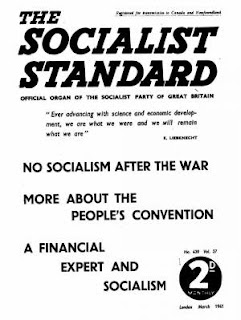
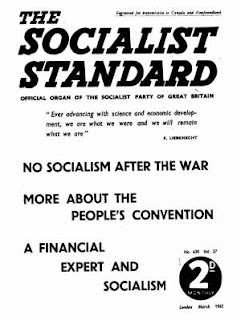
From the March 1941 issue of the Socialist Standard

Political organisation in this country takes many forms. There are organisations which exist solely in order to gain one reform. When it has been gained their purpose has gone. This was true of the women’s suffrage organisations. There are the Tory and Liberal parties, agreed on the retention of capitalism but divided over such questions as free-trade and tariffs, and the amount of taxation to be laid on the backs of different sections of the propertied class. Until capitalism is ended such parties can go on existing, there are always new problems arising for them to deal with, always new opportunities of fighting for their respective sectional interests, and always the need to obtain working-class support for capitalism by the offer of reforms to alleviate the most distressing hardships. Then there are the Labour Party and Co-operative Party, which came into existence primarily to defend the interests of the trade unions and co-operative societies respectively. They have attained stability by taking over much of the former support given to the Liberal Party by workers desiring reforms of one kind or another. Then there is the S.P.G.B., which exists solely for the achievement of one purpose, though a fundamental one, the establishment of Socialism in place of capitalism.

Another category of political parties is what may be called the parasite parties. They live by exploiting the disgruntled supporters of the bigger parties. Among these have been the Communist Party, and all the brood of organisations hatched out by the Communist Party. Every crisis that happens at home or internationally produces its groups of persons dissatisfied on personal or other grounds with the policy adopted by the majority in the bigger parties. Always there are a certain number of workers who vaguely see that there is something wrong with asking for moderate reforms and think the remedy is to ask for bigger reforms—so if the Labour Party asked for a 5s. increase of old-age pensions they would easily fall for propaganda which tells them it is more “revolutionary” to ask for 7s. 6d. As the Labour Party by tradition is nowadays the normal gathering ground for discontented workers it follows that the parasite parties have their most favourable opportunity whenever it happens that the Labour Party is otherwise engaged; for example, when the Labour Party is in office wrestling with problems of the administration of capitalism, or when it is part of a Government carrying on war. While this situation lasts everything plays-into the hands of those adepts at political scheming and wire-pulling, the Communist Party. Their latest venture is the so-called People’s Convention, which met on January 12th, 1941, at the Royal Hotel and Holborn Hall, London. A pamphlet, The People Speak,” has been published by the National Committee (price 3d.), described somewhat erroneously as “The Official Report.” It does not contain a full report of the proceedings. Out of 62 pages, 34 are given up to the speeches of three of the leading lights—Mr. Harry Adams, Mr. Pritt, K.C., and Mr. W. J. R. Squance. Then follow 15 pages consisting of “points from speeches” of 26 delegates, prominent among them being leading Communists. The remainder of the pamphlet is taken up with messages sent to the Convention, resolutions passed, and particulars of delegates, etc. The claim is made that there were present 2,234 delegates “directly representing 1,200,000.” Since the Convention took place several organisations have repudiated the representative capacity of the delegate who claimed to represent them; nevertheless, it may well be true that the Convention had something like the support it claims; there are, unfortunately, very large numbers of muddle-headed people capable of supporting the hotch-potch programme of the Convention.

The People Speak—Under Direction
The claim is made early in the pamphlet that the Convention was for democracy. “Here, indeed, were the People. Here, indeed, was democracy in action.” It is a little odd, therefore, to find no sign that the “people,” i.e., the delegates, had any hand in selecting the star speakers or in deciding that what purports to be an official report should contain very little of what the rest of the delegates had to say. Equally odd is the way in which “the people” selected their National Committee. On page 61 we are told that the Standing Orders Committee (who elected them, by the way; and how?) “recommends that 26 be elected by this Convention to the National Committee.” And on page 62 we are told that the Standing Orders Committee itself also presented to the delegates a list of 26 persons whom it recommended to be the elect! “Here, indeed, was democracy in action” !

What was Said and left Unsaid
On every page of the report are the unmistakable signs of the nature of the Convention and of the handiwork of the wire-pullers behind the scenes, carefully leaving the well-meaning muddlers to have their say “from their hearts.”

The first point to notice is that among the prominent figures are men who claim that Socialism is their aim and who have (elsewhere) been heard to admit that Socialism is the only hope of the workers. On this occasion there was, it seems, a curious reluctance or forgetfulness to say anything about Socialism. The resolutions contain no reference to it. Nor do the speeches, although here and there were appeals to Socialists to support the campaign. About the nearest approach was that of Mr. Palme Dutt, Communist Party, who (page 37) mentions Socialism and suggests that “a People’s Government” is “the first step forward.”

This coyness about mentioning Socialism prompts the question whether “the People” had spoken prior to the Convention urging all and sundry not to raise such a disturbing question. Or perhaps the idea of soft pedalling came from some other quarter.

The Chairman, Mr. Harry Adams, was frank and enlightening about the origin of the Convention. On page 9 he is reported as saying : —
“The mighty movement of popular anger surged forward last year after exposure of ruling class incompetence and bankruptcy as shown in Norway and at Dunkirk in the corruption of war profiteering and the neglect of the needs of the people. This was the starting point of the People’s Convention Movement.”
What happens to a Party which owes its birth to a mood of pessimism about the war when the tide turns? “Born after Dunkirk, died after Benghazi,” may well be its epitaph.

The Programme adopted by the Convention contains about a couple of dozen demands, ranging from “adequate A.R.P. bomb-proof shelters” to increased wages, soldiers’ pay, pensions, compensation, insurance and unemployment allowances. Also, of course, a “People’s Government,” and a “People’s peace.” Some delegates added a few things of their own. The Chairman favours nationalisation of the mines (page 12). Mr. Pritt calls the League of Nations “an admitted swindle” (page 21) but did not say a word about the Russian Government and the British Communist Party who tried for several years to foist that swindle on the workers. He demanded that the banks “must serve the whole people.” It would be entertaining to have that scintillating legal mind explaining just how a bank can serve the whole people. He also wants men to be “free to speak or write, not merely without losing their liberty, but without losing their jobs” (page 24), but gave no reason why that very desirable end is good for this country but not for workers in Russia. Mr. Pritt was scathing about the charge that the Convention is “against the Labour Party” (page 25). But surely, Mr. Pritt, either the Labour Party is in favour of the Convention Programme, in which case there is no need for the Convention, or the Labour Party is against the Programme, in which case Mr. Pritt, on his own showing, should be against the Labour Party?

Mr. Pritt does indeed answer this question. The only way in which the Convention Programme cuts across Labour policy and principles, he says, “is the linking up of its leaders with their class enemies” (page 25). This means, of course, the present Government. But who are the present Government? A large number of them are the leaders of the Labour Party, and the Prime Minister is Mr. Churchill. “Ah,” Mr. Pritt would say, “they ought not to be in the Government with Mr. Churchill.” Elsewhere in the pamphlet (page 48) Mr. Pollitt of the Communist Party made this quite plain. He spoke of the real enemies of the workers being “in the Churchill Government,” and wants the Churchill Government to be removed to make way for the People’s Government.

But has Mr. Pritt really forgotten that it was Mr. Pollitt and the Communist Party who were bellowing in March, 1939, for Mr. Churchill, Sir A. Sinclair and Mr. Attlee to get together and form a Government? What about it, Mr. Pritt?

All the delegates and speakers appear to have had not a particle of doubt that a “People’s Government” (whatever that is, nobody troubled to explain) would solve all things. In particular they saw in a “People’s Government” the Open Sesame to Peace. Perhaps they have all forgotten that this is not the first occasion a lot of them have wanted a “People’s Government.” As recently as September 19th, 1939 (when the Communist Party was still all in favour of the war) the Daily Worker was demanding “a People’s Government capable of prosecuting that war.”

“The war to halt Fascist aggression,” shouted the Daily Worker, “must go on with redoubled energy, and the British people will insist on a People’s Government capable of prosecuting that war.”

On the subject of war it is also worth while to recall that, although the Communist Party denounces the present Government and the Chamberlain Government for not building adequate deep bombproof shelters to protect civilian population fully against air-raids, the non-existence of such shelters did not deter the Communist Party from calling for the war before it came and demanding its energetic prosecution after it had begun, knowing full well what the consequences would be for the civilian population.

Among other objects of the Convention are the strengthening of the Co-operative movement, but simultaneously “we will work to safeguard the interests of the small shopkeeper, small farmer and consumer” (page 57). Mr. Squance, in his speech introducing this, went a bit further and claimed that the Convention also represents the interests of “small business men” (page 32). One delegate, who claimed to speak for landworkers, does not seem to have thought such a lot of helping small farmers, for she spoke up for “collectivisation” (page 44).

Altogether as much nonsense was talked as it was possible to crowd into a one-day Conference. The cost to the National Committee was £2,200, a lot of steam was let off, and a good time was had by all.
Edgar Hardcastle

Editorial: No Socialism After the War. Reassuring America. (1941)

Editorial from the March 1941 issue of the Socialist Standard

Those who are in control of United States foreign policy, and who are deciding whether and to what extent munitions of war should be advanced to aid the British forces against the Germans, are naturally interested in the question what social changes are likely to occur in Great Britain after the war. They are behaving in just the same way as did the British propertied class during the Spanish civil war. It was all very well for the Duchess of Atholl and the Labour leaders to tell them that a Franco victory achieved by German and Italian arms would endanger British imperial interests, they still wanted to be assured that the Republican Government was not controlled by groups hostile to capitalism. They had and have their own very definite ideas about the greater and the lesser evil and it is only very naive Labourites and Communists who imagine that the way to secure support from the propertied class is to proclaim encroachments on propertied interests as a war aim. 

It is, therefore, not surprising that American politicians have been asking questions and have been given comforting—and as it happens, quite truthful—answers.

When Mr. Joseph Kennedy, former United States Ambassador in London, went back to U.S.A. he was questioned by a committee of Congress in connection with Roosevelt’s “Lease or Lend” Bill to aid Great Britain, and one of the questions put to him was, “Is England rapidly going Socialist?” Mr. Kennedy does not think it is. He said, however : —
“If you mean is the Labour Party becoming more effective in Government, that is so”.—(Daily Herald, January 22nd, 1941.)
Then there is the well-known American writer, Mr. Mark Sullivan, who is much disturbed by reports of the coming of Socialism to Great Britain. The Manchester Guardian (February 19th, 1941) reports him as follows : —
“Since our Congress is, in effect, about to underwrite British victory, it is reasonable our Congress should know any commitments that may have been made by responsible persons in Britain, to take effect in the event of victory; whether there are war aims which include Socialism for Britain.”
The Manchester Guardian, commenting on this, professes not to know the answer—”we are afraid that not even a Senate Committee will be able to help him. Indeed, we shall have to admit him to the secret that we are just as much in the dark about what Britain (and the United States) will be like after the war as he is himself.”

It is very modest on the part of the Guardian to disclaim knowledge, but not convincing. The Guardian knows as well as anybody that Mr. Churchill and the Tory Party have not entered into a secret pact with Mr. Bevin and Mr. Attlee to dispossess the capitalist class on the day the war ends. The confusion only arises because the Guardian, like other newspapers, has the habit of talking of Socialism when it means something else. This is clearly brought out in the words that come after those quoted above: “But we might guess . . . that both countries will have gone a good deal further on the New Deal road.” It appears that Mr. Mark Sullivan does not like Roosevelt’s “New Deal” programme of reforms of capitalism, and because he is himself ignorant or because he writes down to the ignorance of his readers he chooses to call this “Socialism.” The Manchester Guardian is certainly correct in its guess that the post-war difficulties will bring a new crop of social reforms; but that is not Socialism.

Sir Walter Citrine has been lecturing in U.S.A. and, according to the Daily Telegraph, he has been answering similar questions. Not being a man given to vagueness and hot air he has been able to reply in similar vein : —
“The tour (of Sir Walter Citrine) has been a great success and has proved very popular with American Federation leaders. In particular, it has had a reassuring effect on those who feared Britain was turning, or would turn, into a Socialistic State, which would prove as difficult for a democratic country like the United States to get on with after the war as Russia or Germany.”—(Daily Telegraph, January 29th, 1941.)
If it is true that Britain and America will not go over to Socialism at the end of the war, what will happen and what can Socialists usefully do? Is there indeed any point in carrying on with Socialist propaganda ?

What Will Happen After the War?
When it comes down to questions of detail Socialists are no better able than the Manchester Guardian to guess what particular forms the post-war aches and pains will take and what remedies will be prescribed by the rival political medicine men. Certain conditions can, however, be discerned fairly clearly. When peace comes there will at once be acute political controversy about the abolition of war-time restrictions and controls and State regulation of industry. Those industrial, commercial and financial concerns with sufficient resources to weather industrial depression will want a free hand to get back to the normal business of profit-making. They will make the most of a widespread popular reaction against restrictions and will exploit to the full any instances of civil service “red-tape” and inefficiency. The weaker firms and industries will, no doubt, look to Government subsidies to save them from bankruptcy at the hands of their bigger competitors, and will be prepared to support a continuance of Government control as the price that has to be paid. They will find themselves campaigning alongside the Labour Party, which will try to use increased State control as a means of extracting social reforms and of stabilising the position of the trade unions. The compromises resulting from this struggle will certainly contain legislation on such matters as pensions, workmen’s compensation, hours of work, health and unemployment insurance, school-leaving age, the trade unions, etc.; no Government will dare to face the workers entirely empty-handed.

An interesting forecast of the post-war world as it will affect one industry, cotton, has been sketched out by Mr. Raymond Streat, Chairman of the Cotton Board. The following summary from the News Chronicle is worth pondering over: —
“Mr. Streat starts from the assumption that the Lancashire cotton industry must export or die. Without a sufficient export trade added to the home trade the industry cannot retain the volume and variety of production necessary for efficiency and thus ultimately for survival. But can this sufficient volume of export trade be established in the face of foreign competition, which must be expected after the war to be even more formidable than before? Mr. Streat thinks it can be—within a period of five years, if the Cotton Board’s policy is adopted. This policy is a campaign on six fronts, or, as I would rather call it, a Britannia’s trident with six prong’s.

The first prong is Government assistance in the form of international trade agreements (“with a front seat for cotton goods every time”), export credits, etc. The second and sharpest is price control within the industry. “Managed prices,” says Mr. Streat, “confer enormous benefits on the producers,” but in return for these benefits they must sacrifice part of their former liberty : they must agree to tackle their own redundancy problems and must co-operate with labour and in technical advancement, “not defensively for the sake of their individual balance-sheets, but aggressively for the good of the industry.”

The third prong is commercial policy—a reform of Lancashire’s merchanting organisation and a selling price policy based on the principle of “what the traffic will bear.” The fourth prong is technical progress, the fifth a rational wages system—higher wage rates, but a sweeping away of obsolete operational practices and agreements—and the sixth is propaganda, sales promotion and market research.”— (News-Chronicle, February 3rd, 1941.)
Here is a programme on which the employers, the trade unions and the Labour Party will certainly be able to come together, but notice one very important feature to which the City Editor of the News Chronicle draws attention: —
“Such, very briefly, is Mr. Streat’s programme. Underlying it is his conviction that post-war international commercial relations will be based on the same nationalistic, protectionist principles as obtained before the war. International trade will be a matter of hard bargaining between Governments on import quotas : exchange control will persist as a permanent phenomenon, and with it barter and bilateralism. So the cotton trade must discipline, itself and arm itself with every offensive weapon known to modern trade warfare. Mr. Streat does not use quite this language, but this is really what it amounts to.”
So it is not going to be a very nice new world after all: and this is where Socialist propaganda comes in. Mr. Streat’s kind of programme means ; the danger of new and bigger wars if it is allowed to remain the basis of the social system for another 10 or 20 years after this war is ended. It is for Socialists to determine that that shall not happen. It is our task to explain to the workers why a seemingly “safe and sane” policy of seeking reforms and wage regulation is a policy surrounded by the same risks as existed before 1914 and before 1939. Probably people with Mr. Streat’s ideas will have their way, but the only safeguard for the future will be a large and growing number of workers who can get below the surface and see what are the limitations and dangers of such ideas.

Above all, Socialists alone can do the invaluable work of persuading the workers to give up their weakness for meaningless abstractions. They befog the clarity of thought without which there can be no correct action. Beware of vague appeals and promises about “justice,” “fair play for everybody,” “economic democracy,” etc. Insist always on explicit and concrete statements from the parties and politicians who promise to re-shape the world. Make sure that you understand precisely which way emancipation lies. If you are still convinced that capitalism can be made to work if only there are sufficient laws restricting the freedom of action of the capitalist, then be honest with yourself and declare that you are for capitalism and against Socialism. At the same time remember that it is your own responsibility to understand what Socialism is before you reject it; no leader can take that responsibility off your shoulders without the penalty of your neglect some day falling on you.

Notes by the Way: The Little Corporal: Then and Now (1941)

The Notes by the Way Column from the March 1941 issue of the Socialist Standard

The Little Corporal: Then and Now

One of the curious by-products of the rise of Hitler has been the revision of formerly accepted views of his predecessor, Napoleon. Typical of this swing-over are the following: —

On August 12th, 1940, the Daily Telegraph published an article by Mr. E. C. Bentley entitled “Hitler’s Mirror can reflect no Napoleon”; with the sub-heading “The Corsican, for instance, was a gifted and constructive despot: To his vassal states he brought order, not a gang wielding whips of persecution.”

Then on December 15th, 1940, 100 years after the ceremonial burial of Napoleon’s ashes brought home from St. Helena, The Times wrote similarly, saying: ”English historians have assessed scarcely less highly than French the value of Napoleon’s contribution to the structure of European civilisation.” The Times finds the following distinction between Buonaparte and Hitler: —
“The difference is that, whereas the opinions that Napoleon’s arms carried across the Continent were in their origin noble, and only became debased by the manner of their propagation ; we fight to-day against opinions that are evil in their very conception.”
If this is true it prompts the two-fold reflection that the British ruling class contemporary with the French Revolution and Napoleon held very different views, and that quite a number of their successors who witnessed the progress of Nazi brutality in our time were convinced that there was a lot of merit in Nazism.

On February 13th, 1941, the Manchester Guardian also explained that “in a great many cases his [Napoleon’s] own ideas were, of course, more enlightened and more just than the arrangements in force in old Europe.”

Now contrast these views with the abuse heaped on “Boney” by all and sundry when he was rampaging across Europe and Russia and threatening invasion of England. Not much then about his “enlightened” views.

Mr. Seymour Cocks, M.P., speaking in the House of Commons on December 19th, 1940, recalled the words applied to Napoleon by the Allied Powers which defeated the French armies over 100 years ago—”having broken every pledge and treaty, had placed himself outside the bounds of civil and social relations and, as the general enemy and disturber of the peace of the world, was abandoned to public justice.” Mr. Cocks wants the British and Allied Governments now to issue a similar declaration about Hitler.

William Cobbett, in his letter written in 1803 urging the Government to issue an appeal to the British public to resist Napoleon’s invasion, used words curiously like those now applied to the Nazis : 
“Now, like gaunt and hungry wolves, they are looking towards the rich pastures of Britain; already we hear their threatening howl, and if, like sheep, we stand bleating for mercy, neither our innocence nor our timidity will save us from being torn to pieces and devoured. The robberies, the barbarities, the brutalities they have committed in other countries, though, at the thought of them the heart sinks, will be mere trifles to what they will commit here … no man, woman, or child would escape violence of some kind or other. . . .”
If the capitalist historians could wash off all those blemishes from Napoleon it looks as if the principal qualification required of them is a capacity to wield a whitewash brush. What will they be doing with Hitler 20 years ahead ?


Merchant of Death

In years past the Communists have been among those who have expressed their horror at the spectacle of munition firms making profit by supplying weapons and materials of war to both sides engaged in a war. Now it seems that circumstances alter cases. The Russian Government is interested in the profits to be made out off international trade, including trade in essential war materials, and when the Russian Government cynically supplies such materials to those whom it denounces as the enemies of the working class and of democracy its apologists can see nothing wrong. A case in point is a letter written to the Manchester Guardian by Mr. Albert Inkpin, Secretary of the Russia To-day Society. Here is what Mr. Inkpin says:—
“Germany is importing oil products, raw materials, and grain from the U.S.S.R. Commenting on the recent new agreement, the official Soviet newspaper, “Izvestia,” states the willingness of the Soviet Union to trade “with other States, both belligerent and non-belligerent,” thus showing its readiness to trade also with Britain.” (Manchester Guardian, January 21st, 1941.)
A somewhat similar line is taken by Mr. Pat Sloan, though he was dealing with the fact that while the Italian Government was destroying Abyssinian troops and civilians by aerial bombardment the Russian Government went on supplying Italy with the necessary oil fuel for their aeroplanes. (It will be recalled that at the time the Communists were very indignant at the suggestion that this was happening.) This is Mr. Sloan’s statement, in a letter to Reynolds News (February 16th, 1941): —
“According to your book review, “Nazi Ways in Russia,” Arthur Koestler has written a novel the U.S.S.R. in which an “Old Revolutionary” goes anti-Soviet because the U.S.S.R. sold oil to Italy during the Abyssinian war and trades with Germany to-day.

As one who was in U.S.S.R. during the Abyssinian war, I may say that the Soviet people were proud that their Government was the first to apply sanctions against Italy, and that it proposed the application of further sanctions. I never met a single individual who advocated unilateral sanctions without the cooperation of the other States.

I may also say that nobody I ever met in the U.S.S.R. objected to trading with Britain so soon as the British Government adopted a reasonable attitude to the U.S.S.R.”
Now it is quite true that the Russian Government offered to support international action to stop oil supplies reaching Italy, but how does the refusal of other states to take action relieve the Russian Government of its responsibility in the matter ? Take the parallel case of the munition firms, they use precisely the same argument and excuse. British and American munition firms have repeatedly excused their action in selling arms (in peace-time) to all and sundry on the ground that if they did not get the trade somebody else would. The one difference between the Russian Government and the munition makers is not in their action but in their professions. The “merchants of death” admitted that they were concerned with trade and profit; the Russian Government affects to be guided by loftier motives.

There was a time when the Communists were demanding a world boycott of the Fascist countries and condemning the international trade union movement for its failure to make such a boycott effective, but we have not heard what reply, if any, the Communists and the Russian Government have given to the appeal made by the Greek trade unions (reported in The Times, November 2nd, 1940) asking workers in Russia and other countries to insist that their governments forbid exports of raw materials to Italy.


A Labour Peer on Profit

Writing to the Picture Post (January 11th, 1941), Lord Strabolgi, a Labour Peer, put in its briefest form the attitude of mind of the Labour Party as a whole on the subject of Capitalism and Socialism. He wrote: —
“I agree with Douglas Jay that monopolies should be broken ; but we are not ripe for the complete abolition of the profit motive.”
It is true enough that the majority of the workers are not yet ripe for Socialism, but whose fault is that ? What has the Labour Party been doing to make them ripe ?


Graziani Flatters Them

When Marshal Graziani, Italian Commander-in-Chief in Libya, retired with his defeated army from a village near Cyrene, he is reported to have told the village priest that the Italian settlers had nothing to fear : —
“The British are gentlemen. . . . They will treat you kindly and leave you to work in peace. . . .” (Daily Herald, February 7th, 1941.)
This was all right but we cannot help feeling that Graziani’s final words betray a slightly wrong idea if they are intended to apply to the British “gentry” as a whole. What he told the priest was: “If you want anything, ask them for it.”

Graziani cannot have seen the stony glare that some of the very best people in this country can put on when their workers ask them for another few bob a week.


“The Niceties of Civilization”

Fears have been expressed that tribesmen in Abyssinia may exact a savage revenge on the Italian settlers in Abyssinia when Italian control of the country breaks down. The tribesmen have bitter memories of the way the Italian invaders, armed with all the latest weapons of the modern arsenal, treated them five years ago. But what exactly did the Daily Mail Services Correspondent have in mind when he wrote (February 5th, 1941) that some of the tribesmen have “little regard for the niceties of civilisation” ? Niceties is hardly the word we would apply to modern war between “civilised” countries.


What is “Economic Democracy”?

The Labour Party has always fought shy of committing itself to any explicit proposal for the abolition of capitalism and its replacement by Socialism. That is why in the last 20 years Labour speakers and writers have made so much use of the term “economic democracy” as a description of their aim. It appeared to say a great deal but was capable of any number of interpretations.

Now comes Mr. J. A. Cecil Wright, M.P., writing to The Times (February 5th, 1941) to say that he, too, is all in favour of it. But before jumping to the conclusion that Mr. Wright is declaring for Socialism read the following: —
“If we are going to retain a capitalist system, and I hope we shall, because with safeguards it is the fullest system of life in an industrialised world (in fact it is economic democracy), then we must see to it that the essential ingredients of capitalism and democracy are there . . . .”
Edgar Hardcastle

“Uproot It !” (1941)

From the March 1941 issue of the Socialist Standard

The more a Socialist considers the present social system, and the facts of working-class existence under capitalism, the more its realities show that the root-cause of the many’ evils of to-day is nothing else but the class-ownership and control of the means of living.

For out of that class-ownership spring the wage-slavery of the overwhelming majority of mankind, their exploitation, misery and poverty, and the innumerable evils that arise from this system of Production for Profit.

For the workers, as a class—the wealth producers—are a dispossessed class; and though our labours of brain and brawn produce the colossal wealth of the world, yet we do not own or control the means and instruments of production, nor yet the products of our toil.

As wage-slaves, in order to live, we can only purchase to the degree represented by the buying-power of our wages or salaries.

Our chief function in life to-day is to work— and that to produce a surplus-value for an idle and parasitic class of exploiters. We work to live; but to most of us it seems as though we live chiefly to work ! Capitalism is a harsh taskmaster: its yoke is heavy.

Our masters, owning the means of living, own and control our lives !

We, as a class, own but one thing—our ability and power to produce wealth by the use of our physical and mental energies. And those we have to sell for wages or salaries. We can do nought else in order to “get a living.” And quite a lot of our class at times are unable to get an opportunity to obtain work—however much we desire it or try to obtain it. For our masters—the exploiting class—will only employ workers when it suits their purpose to do so. And then it is for one purpose—to extract a surplus-value from our efforts on their behalf. We are employed as creators of surplus-value : a value over and above what is given us as wages or salaries.

And that surplus-value created by the working class represents in the aggregate a vast sum annually. For out of it, “Rent,” “Interest” and “Profit” go to the respective recipients. It means that a gigantic system of plunder has been in operation, and robbed the workers, who not only have produced the value represented by their wages, but a huge surplus-value also.

The wages-system is nothing else but an organised system of legalised robbery.

Capitalism might aptly be described as a “buying and selling system.” The production of commodities for sale in the market, in order to realise a profit, goes on and on with an intensive competition between the manufacturers. And the workers’ one commodity—their labour-power—is bought in just the same matter-of-fact way as margarine. They sell their labour-power because they needs must, in order to live. They are “employed” to function as human wealth-producers—as producers of surplus-value.

The parasitic class that lives on our labours look on us as the human source of their wealth. Their machinery and “labour-saving” devices are operated by our class for that purpose. Without our efforts their machinery would not function, the commodities would not be created nor distributed to the markets of the world.

The “wheels of industry” our masters do not set in motion. The workers everywhere perform the work of the world; and the employers and their fellow-parasites reap the benefit resulting from the organised plunder effected by the pernicious wages-system. They reap it on its sale in the markets.

For surplus-value is produced by the workers in the factory and workshop. But it is only realised on the sale of the commodities in the markets themselves. And markets must be found !

The most frantic efforts are made to find or create them.

Ah ! and further : to grab all that they possibly can to augment their plutocratic possessions and power.

We thus see that the ruling class, who, in truth, control our very lives, maintain their privileged position by coercive power whilst engaged all the time in systematic plunder of the working class !

The intense rivalries between the groups of competing states seeking for a market causes much national and international strife among them. They purchase labour-power as cheaply as they can safely do, create a speeding-up of production, employ labour-saving machinery, and eliminate as much waste of time and material as they can: everything is done to enhance their ultimate gain. 

Access to raw materials and sources of wealth are greedily sought after. With envy and avarice they seek to gain and control territories of potential wealth, the trade routes, and the monopoly of markets. This all leads, sooner or later, to a serious conflict of industrial, commercial and financial interests amongst themselves.

Is it any wonder that with such an anarchical and chaotic system as obtains to-day—the production of commodities simply for the private profit of a class—should result not only in a commercial warfare and “crises,” but ultimately in the use of the armed forces in war?

For militarism is but the valet of insatiable and aggressive capitalism.

The armed forces are retained for two main reasons—to keep capitalism’s wage-slaves in order and subjection, and to gain and retain our masters’ stolen wealth and its natural sources.

It must be clearly seen from the foregoing that (1) capitalism has as its roots the Class Ownership and control of the means and instruments of wealth-production and distribution; (2) that through that ownership they control the very lives of the working class; and (3) that through the wages-system our masters exploit and plunder us systematically.

The consequent result is that the exploiting class grow ever richer, relatively, to the wealth-prodmcing workers.

And thus the conflict of interests created between exploiters and exploited results in a class-struggle.

It is obvious that only by the abolition of capitalism, including its very roots, can the workers abolish for ever the evils inseparable from the system itself.

Look at the widespread poverty of our class—in a great degree chronic; the slums with their misery and disease; the social curse of unemployment, and the terrible results of malnutrition, industrial diseases, etc. Consider the colossal waste of human life in capitalism’s frequent wars, with their untold suffering and miseries for the working class. Capitalism, as a social system, creates incalculable waste in many spheres.

Can we content ourselves with the continuance of such a pernicious system, when we:, its wage-slaves, suffer so from its effects ?

Is there any reason why we should tolerate its patching-up by petty reforms when we could, in truth, rid ourselves of the root-cause of its evils? It has blighted the world, and been the cause of infinite death and destruction.

Capitalism is indeed the enemy of the workers. It robs us of freedom, happiness, and life in the fullest sense. Wage-slavery, and the resulting poverty of the workers, must be abolished, and, to achieve these things, capitalism must go !

Our masters, having control of political power, are, through it, able to dominate our very lives. Only by our capture and control of that power can we, as a class, overthrow capitalism and establish Socialism. To do that the majority of the working class must first understand their slave-condition ; must earnestly desire the overthrow of capitalism, and the triumph of the Socialist Commonwealth.

Nothing could withstand the organised might of a working class the majority of whom were fully bent on establishing Socialism !

Full of Socialist knowledge, and intensely conscious of their class-interest and aims, they could and would by their immense unity of purpose capture the key of the position: Political Power.

Thus would they smash the pernicious system that is indeed their enemy, and proceed to usher in the Socialist system of society which will liberate all mankind and bring to every nation Freedom, Happiness and Peace !

Hail the dawn of the Socialist Commonwealth of the World ! !
Graham May

War: Methods of Offence and Defence (continued) (1941)

From the March 1941 issue of the Socialist Standard


(Continued from February issue.) 

An excellent picture of the times is contained in contemporary reports of the siege of Jerusalem in 1099 by eye-witnesses and participants in the event. A number of these reports are contained in the above-mentioned work of Duncalf and Kreg, from which the following extracts are taken.

Firebrands were hurled into the city. They consisted of burning wood and straw.
“The wood was dipped in pitch, wax, and sulphur, then straw and tow were fastened on by an iron band, and when lighted these firebrands were shot from the machines, all bound together by an iron band, I say, so that, wherever they fell the whole mass held together and continued to burn.“ (Raymond of Agiles. Canon of Puy. “History of the Franks who captured Jerusalem”—written about 1112.)
This writer follows on with a description of the incidents after the capture of the town.
“But now that our men had possession of the walls and towers, wonderful sights were to be seen. Some of our men (and this was more merciful) cut off the heads of their enemies ; others shot them with arrows, so that they fell from the towers; others tortured them longer by casting them into the flames. Piles of heads, hands and feet were to be seen in the streets of the city. It was necessary to pick one’s way over the bodies of men and horses. But these were small matters compared to what happened at the temple of Solomon, a place where religious services are ordinarily chanted. What happened there ? If I tell you the truth, it will exceed your powers of belief. So let it suffice to say this much at least, that in the temple and portico of Solomon, men rode in blood up to their knees and bridle reins. Indeed it was a just and splendid judgment of God, that this place should be filled with the blood of unbelievers, when it had suffered so long from their blasphemies. The city was filled with corpses and blood.”
Another writer states : —
“Neither woman or children were spared;”
and adds:—
“Our squires and poorer footmen discovered a trick of the Saracens, for they learned that they could find byzants [gold coins] in the stomachs and intestines of the dead Saracens, who had swallowed them. Thus, after several days they burned a great heap of dead bodies, that they might more easily get the precious metal from the ashes.” (Fulk of Chartres, “The Deeds of the Franks who attacked Jerusalem.”)
Another contemporary author says : —
“Afterwards, the army scattered throughout the city and took possession of the gold and silver, the horses and mules, and the houses full of loot for all.” (“Deeds of the Franks and Crusaders,” by an anonymous author.)
Curious how little war has changed, in its fundamental aspect, across the ages.

Towards the end of the Middle Ages, after the introduction of gunpowder to Europe in 1320, cannon replaced the former feeble siege weapons in the attacks on strongholds. Primitive though they were, they yet hurled missiles heavy enough and forcefully enough to batter breaches in the walls of the most powerful fortifications. From that time dates the decline of the impregnability of the mediaeval castle. The capture of Constantinople by the Turks in 1453 was due to the use of artillery. The Turks changed over to artillery long before Europe. They used arquebuses and field-pieces—the latter joined together by chains to prevent horsemen charging between them.

As the big barons swallowed little ones the internal wars began to come to an end. Military protection being no longer needed by the town and country people, the baron was transformed into a courtier. When gunpowder had revolutionised mediaeval warfare, the power of the baron declined still further. The equipment and maintenance of a company of artillery was so expensive that it became the monopoly of the wealthier princes, and the power of the latter consequently grew as the barons declined.

Gunpowder finally brought back into war the mass of the people as a fighting power when the infantrymen, with gun and cannon, ousted the armoured cavalrymen as the supreme striking force and cut the ground from under the privileged aristocracy of Feudalism.

Thus, gunpowder helped to destroy the mediaeval lord, raise the bourgeoisie (the monied class, as such) and established for a time the power of kings. We have now reached the end of one form of social organisation and the beginning of another— the end of the mediaeval world and the beginning of the modern or capitalist period.

Before continuing the discussion of the development of the implements of war we would like to direct attention to some points that are worth bearing in mind.

Imperialism and the building up of empires commenced with the introduction of slavery as a general feature of communities. All the great antique civilisations were based upon chattel slavery, which freed fighting men for the pursuit of loot—in fact, built up masses of wealth worth looting. In the period of tribal communism, which preceded the introduction of slavery, there were no empires. Even the largest aggregations of settled tribal peoples, such as the confederation of Iroquois tribes occupying what is now the State of New York, exhibited no empire-building traits.

Another interesting fact is that empires grew cut of small city states like Babylon, Athens and Rome, or were established by war chiefs like Mahomet, Genghis Khan and Tamerlaine. In each case, behind the apparently accidental growth of a mushroom empire there was productive development of a high order. This is shown in the invention and workmanship of the offensive and defensive armour. The mail-clad Arabians and the gunpowder-using warriors of Genghis Khan are evidence of this.

When the economic development within a group reached the point of enabling them to produce a supreme weapon or method of warfare it started them on the road to conquest. If other conditions are favourable, such as the position of Rome on crossing trade routes, then the bid for empire is likely to be successful.

Some of the empires of the past were of huge extent, even judging by present-day standards. The Tartar Empire of Genghis Khan, in the 13th century, was one of the largest ever built up, comprising a vast area of Russia, China and Central Asia—half of the known world of the time. After the oft-repeated legends of the barbarous Mongol hordes it is refreshing to read the following recent description of the effect of the Tartar conquest: —
“The blood feuds of the grand princes of ancient Russia—lords of Iwer and Vladimir and Sasdol were buried under a greater calamity. All these figures of an elder world appear to us only as shadows. Empires crumbled under the Mongol avalanche, and monarchs fled to their deaths in wild fear. What would have happened if Genghis Khan had not lived, we do not know.

What did happen was that the Mongol, like the Roman peace, enabled culture to spring up anew. Nations had been shuffled to and fro—or rather the remnants of them—Mohammedan science and skill carried bodily into the Far East, Chinese inventiveness and administrative ability had penetrated into the West. In the devastated gardens of Islam, scholars and architects enjoyed, if not a golden age, a silver age under the Mongol ll-khana; and the thirteenth century was notable in China for its literature, especially plays, and its magnificence—the century of the Yuan”.—(Pages 200 and 207. “Genghis Khan, Emperor of All Men,” by Harold Lamb.)
Apparently neither Chinese nor Mongols knew how to cast cannon, but they were well-acquainted with the detonating effect of gunpowder and used it in fire-projectors to burn or frighten the enemy. 

A Chinese annalist at the Siege of Kaifong, in 1232, records the following: —
“As the Mongols had dug themselves pits under the earth where they were sheltered from missiles, we decided to bind with iron the machines called chin-tien-lei (a kind of fire-projector) and lowered them into the places where the Mongol sappers were ; they exploded and blew into pieces men and shields” (quoted by Lamb, page 224).
Now to get back to the development of gunpowder-using weapons.

We will first examine the evolution of small-arms, leaving until later the evolution of cannon, which were first used in ships.

The principal steps in the development of firearms concerned the method of igniting the charge. The progression was: Primer and match, matchlock, wheel-lock, flint-lock, percussion cap.

Early in the 15th century a hand cannon came into use. It was probably the first form of hand firearms and consisted of a small cannon fixed to a wooden stock, and it was fired by applying a match to some fine powder that had been poured on the touch-hole. These hand-guns required two men to handle, one levelling the gun while the other applied the priming and the match. The loading, levelling and fixing, however, took such a long time that in their early use they rarely fired more than one shot during a battle. In spite of this their effect upon enemy troops was considerable. They were used successfully by the Swiss in 1476 at the battle of Morat, at which were employed 6,000 of these hand-guns or culverins. Their most successful use at the time, however, was by cavalry, to which they were soon adapted. In practice, one group of cavalry fired a volley and then made way for another group to do the same, while they reloaded, thus keeping up a constant fire.

Early in the 16th century the Spaniards invented the arquebus, or match-lock. Its great feature was a lighted match held in a serpentin or hammer in such a position that when the trigger was pulled the serpentin dropped into the flashpan and the match ignited the priming powder. This speeded up the firing.

The match-lock was troublesome in wet weather and when a method of covering the match was devised it was necessary to blow it into flame before firing or it might not ignite the charge.

The next step was the invention of the wheel-lock in Germany in the 16th century. In this a flint was placed in the serpentin, which dropped to the flash pan when the trigger was pulled. The edge of a wheel, rotating at the side of the stocks after the style of a ratchet, came in contact with the flint and produced sparks that ignited the priming.

The wheel-lock was intricate and very expensive to use, consequently it did not come into general use, being employed mainly by the wealthy for sporting purposes.

Early in the 16th century the flint-lock was invented by the Spaniards. This gun was in use for over a century. In it the cover plate of the flashpan was knocked back by a blow from the flint that was screwed into the cock or hammer, and the resulting sparks ignited the priming powder.

In 1807 the Rev. M. Forsythe patented the percussion principle of igniting gunpowder in muskets by means of detonating powder, and percussion caps came into use between 1820 and 1830.

This brief description will give some idea of the steps in the development of small firearms. After their introduction the best workmanship and much ingenuity was employed in producing very fine specimens, both for quality and for ornamentation. Some of the guns were very richly embellished. It was not until the introduction of the rifled barrel that the accuracy of these guns could be depended upon in spite of intricate sighting arrangements.

We will have to leave for the next article a consideration of the effect these different inventions had on the conduct of warfare.
Gilmac.

Letter: War, Conscription and the Workers (1941)

Letter to the Editors from the March 1941 issue of the Socialist Standard

A correspondent (C.A.C., Southend) says that he has heard members of the S.P.G.B. express the opinion that the workers willingly take part in war. He asks why, then, it is necessary to have conscription.

To what extent the workers are willing to support war and all the suffering it involves is and must be a matter of opinion, since there are no means of finding out what all of them think on the subject. Judging by the results at by-elections last year where there were anti-war candidates, the great majority would appear to be in favour of the war.

The question of conscription raises other issues. The fact that conscription is applied does not necessarily mean that the majority are opposed to war. It is possible to have a majority who are themselves willing supporters but who resent the possibility that the minority may escape. They therefore favour the imposition of conscription in order to put the minority in the same position as themselves. During the last war the reverse arose. While conscription was imposed in Great Britain it was not imposed in Australia, and when a plebiscite was taken on the question a majority of Australian soldiers who were themselves serving in the army as volunteers voted against the imposition of conscription in Australia. Their view was reported to be that they preferred to have with them men who were volunteers rather than men who, as conscripts, might be less reliable soldiers.
Editorial Committee

Reviews (1941)

Book Review from the March 1941 issue of the Socialist Standard

All who have enjoyed Plekhanov’s “Anarchism and Socialism” will be glad that his weightier “Materialist Conception of History” has been issued in capital book-form at a reasonable price (Socialist Book Shop, 1s. 6d.).

For a short exposition of a vitally important subject, this brilliant little work could hardly be bettered; it is a welcome relief from the heavy stuff turned out on the subject from the Moscow factory, using sheer distortion of the doctrine to justify infamous tyranny masquerading as “Dictatorship of the Proletariat.” Unfortunately, the I.L.P. has spoilt an otherwise good thing by retaining a “Publisher’s Preface,” which is on the usual familiar Communist Party lines. The claim is made (page 10) that Lenin and Stalin “raised Marxism to a new and higher level” by “creating a proletarian party capable of leading the revolutionary struggle.”

An excellent point made by Plekhanov is:
“By entirely eliminating teleology from Social Science, and explaining the activity of man by his NEEDS, and by the means and methods of satisfying them prevailing at a given time, the Materialist Conception of History for the first time imparts to this science the ‘strictness of which her sister—the science of nature—would often boast over her ” (page 24).
Before “Race” pretensions had assisted in bringing to birth the hideous nightmare now afflicting the world, Plekhanov pointed out that “we know of the art of the Stone Age, the art of the Iron Age, but we do not know of any distinctive arts of the so-called different ‘races,’ white, yellow, etc.”

The impatient propagandist is wisely reminded that “Man’s cognition of his situation more or less lags behind the development of the new actual relations which cause that situation to change” (page 45). Let him take heart: “Old customs” do “begin to disappear, and old rites to break down when men enter into new social relations” (page 54). The Socialist Party of Great Britain is doing its part on the political field, by administering vigorous kicks to the pants of a sluggish Body Politic, to lessen the irritating “time-lag.”

Chapter XI should be carefully pondered by enquirer and propagandist alike; to the unprejudiced enquirer it will come as a revelation; it is a model of apt illustration for the teacher. If anything better on the relation of Descartes’ philosophy to contemporary French politics and social relations has been written, the writer will be grateful for information. . . . Incidentally, it is good to see that G. H. Lewes’ early work in exploding the pretensions of “metaphysics” is acknowledged.

For anyone seeking a handy formula embracing the main truth of the M.C.H. the following is exceptionally apt: “The productive forces at man’s disposal determine all his social relations” (page 28).

* * *

Events crowd on events with bewildering rapidity; last week’s map is to-day but an historical document; any aid to keeping fairly well abreast of recent history is welcome; the Union of Democratic Control’s pamphlet, “The Near and Middle East” (6d.), performs this service for the last few years (up to French defection) admirably. It is a sober record of sheer facts, practically free from propaganda, intent or gratuitous prophecies which characterise the highly-priced bulletins of the “Imperial Policy Group”; it is a pity that difficulties attending production entailed a scrappy and somewhat unsatisfactory map.
Augustus Snellgrove

Special Offer: Back Numbers of “The Socialist Standard” (1941)

Party News from the March 1941 issue of the Socialist Standard

We repeatedly advise readers who want to know more about Socialism to read back numbers of the Socialist Standard. There is no better way of becoming acquainted with the Socialist attitude towards other political parties and to the innumerable attempts to solve social problems by means of reforms and palliatives. The pages of the Socialist Standard in the 36 years of its publication will reveal to the reader the strength and weakness of working-class organisation, the dangers of wrong methods and muddled ideas, and the difficulties of Socialist propaganda and organisation. So many seemingly original proposals have been made and exposed 10, 20 or 30 years ago. So many “new” evils have all happened before. So many binding pledges have been made and broken. It is all there in the back numbers of the Socialist Standard. No Socialist can afford to be without this knowledge.

The most permanent form in which to keep Socialist Standards is bound volumes. The prices are advertised each month on the inside front cover.

Many readers are, however, unable to afford bound volumes, and for them two alternative offers are made.

The first offer is 14 years’ unbound copies, at a total cost of 7s. (8s. if sent through the post). This offer covers the years up to 1935. For nearly every year since 1918 the whole 12 issues are available, but one or two months are now out of stock and cannot be supplied. In earlier years a number of issues are out of stock.

The second offer is that back numbers up to and including 1940 can be supplied at 1d. per issue (post free l½d.), or 1s. for 12 issues (1s. 6d. post free). This offer covers all years from 1904 to 1940.

All who are interested in these offers should send in their orders without delay. Owing to pressure on space it has become necessary to clear out surplus stocks of back numbers and after three months many of these surplus back numbers will have to be disposed of.

Send your order through nearest branch or direct to the Literature Secretary, 42, Great Dover Street, S.E.I.

Bad News for ” S.S.” Readers
Owing to increasing eosts we regret to say that it may shortly be necessary to increase the price to 3d.
Editorial Committee.

Friday, August 31, 2018

This Month's Quotation: Wilhelm Liebknecht (1941)

The Front Page quote from the March 1941 issue of the Socialist Standard
   “Ever advancing with science and economic development, we are what we were and we will remain what we are”
Wilhelm Liebknecht

Friday, January 26, 2018

Press Cuttings (1941)

From the March 1941 issue of the Socialist Standard

A Reuter Moscow telegram says that the Russian people are told in the Soviet journal "Socialist Agriculture” that the "capitalist Powers,” including Britain, are trying to "wreck the Soviet Union" by sending diseased seeds and bulbs into the country.

During the past nine years, says the paper, the Leningrad quarantine laboratory has examined 1,200,000 samples of seeds and plants from 67 foreign countries and has found 6,000 insects and diseases in them. The earth surrounding the roots of medicinal herbs bought from England are alleged to have been infected with potato cancer, while tulip and hyacinth bulbs bought in Holland were also found to be diseased. (Manchester Guardian, December 16th, 1940.)

#    #    #    #

The B.B.C. is extending its anti-Pacifist blockade. It has now blacklisted three famous preachers—Dr. Donald Soper, of Kingsway Hall and Tower Hill; Dr. George MacLeod, of Iona; and Canon Charles Raven, Regius Professor of Divinity at Cambridge. . . .  In these three cases, as in the case of the Glasgow Orpheus Choir, banned because of the pacifist views of its conductor, Sir Hugh Roberton, the B.B.C. is assumed to have acted as the instrument of the State. No attempt has been made to disguise the reason for the action. . . . (News Chronicle, January 4th, 1941.)

#    #    #    #

The concept that twice two make four is somehow differently tinged in the minds of a German, a Frenchman, a negro, or a Jew. (Herr Hommes, a Nazi writer on Racialism. Manchester Guardian, January 2nd, 1941.)

#    #    #    #

On the plinth of General Sherman’s statue in Washington are cut these words: “The legitimate object of war is a more perfect peace.” To me this is a profoundly wise saying. (Major-General Fuller, Evening Standard, January 4th, 1941.)

#    #    #    #

Three Stalin prizes of 100,000 roubles each, and five prizes of 50,000 roubles each are to be awarded to Soviet citizens for outstanding work in science and art. Three prizes of 100,000 roubles each will be awarded for outstanding work in poetry, prose, drama and literary criticism.

In addition 25 prizes of 100,000; forty prizes of 50,000 roubles each; and 60 prizes of 25,000 roubles each are to be awarded for outstanding inventions, including military inventions.

It has been decided by the Soviet Government that these prizes will be awarded not only for work in 1940, but also for work during the last six or seven years. (Daily Worker, January 15th, 1941.)

#    #    #    #

Sir,—“ We wish to know,” an old Chief said to me the other day, ‘‘how it is that England, France, and Germany can have a war whenever they like, but when we want to fight another village the District Officer comes with his police and stops us.” (A letter to The Times from a correspondent in Africa, January 1st, 1941.)

Sunday, July 23, 2017

A Financial Expert and Socialism (1941)

From the March 1941 issue of the Socialist Standard

Mr. Douglas Jay will be known to readers of the Daily Herald. Until recently he was the City Editor of that newspaper and, among other things, gave advice on how best to invest one’s money. This was, indeed, a useful and noble service to the worker-reader, in view of the latter’s ever-present problem: that of making ends meet. Now, however, Mr. Jay has given up his job on the Herald, having obtained another with the Ministry of Supply; but—and note this— he has the satisfaction of knowing that he has done his duty well.

In his farewell article, published on New Year’s eve, he explained how, on account of the war, financial reform measures, urged by himself and the Labour Party, have been carried in this country. With a feeling of satisfaction, he writes: —
“Almost all the reforms proposed by Socialists four years ago have been carried through. Almost all the causes championed in this column have been victorious." 
And the title of his article is: “Socialism Comes to the City.”

These remarks of Mr. Jay’s bring to mind similar ones made during the last war in the Labour Leader, the organ of the I.L.P. in those days. Like the Douglas Jays of to-day, some l.L.P.-ers claimed, during the 1914-18 war, that Britain had embraced Socialism.

To refer back to the quotation from the City Editor’s article, we must point out that by “Socialists ’’ are meant “Labourites,’’ for, in no respect, can it be said that Socialism has been established in “the City.”

The S.P.G.B. has on numerous occasions, both in these columns and on the platform, shown that the Daily Herald is not a Socialist newspaper, nor the Labour Party a Socialist Party.

The trouble is that for most supporters and members of the Labour Party anything that savours of State control is Socialism. Enthusiastically, Jay continues : —
“Throughout industry itself, Government control has become almost the rule rather than the exception.”
And again: —
"We have to-day full Government control of the foreign exchanges, of the new investment market and of almost all the commodity markets.” 
Judging from the standard set by Mr. Jay, the Nazis, too, could rightfully claim to be Socialists, so could the Bolsheviks. So could Bismarck or any other supporter of State control.

The fact is, of course, that Socialists do not aim at Government control of finance and industry. They have always emphasised that nationalisation and such things are not Socialism, but State capitalism. Such changes leave the fundamental position of the worker untouched. Always under capitalism—whether State controlled or not—he is a wage-slave, who, in order to live, must sell his energies (or labour-power) to the capitalist class. Because he is divorced from the means of production, he can work only if by so doing he produces profits for the owners of these means of production, i.e., the capitalist class.

Socialism involves the abolition of capitalism. It involves the abolition, therefore, of the roots of capitalism, i.e., wage-labour and capital. Under Socialism there can be no wages-system, no finance, no investments. In Socialist society the means of production—land, factories, railways, and so on— will belong to all society; all its able-bodied members will take an active part in production and each and every one will have free access to the means of life.

Before leaving Douglas Jay we must point out one or two other things. First, even he is not quite sure that, although “Socialism has come to the City,” things are as they should be. Otherwise, why should he state: —
  "The Daily Herald will continue . . .  to keep a vigilant eye on such City activities and personalities as still need watching’’?
Secondly, the whole idea underlying the viewpoint of Douglas Jay and many Labour leaders— the idea that Socialism can come without our being aware of its coming, without effort on the part of the workers—is extremely dangerous.

The workers will certainly need no one to tell them when Socialism replaces capitalism. As Marx and all Socialist thinkers have emphasised, Socialism will only be achieved by a working class that knows what it is about, that wants Socialism and that organises politically to capture the State machine in order to introduce it democratically.

The Jays, and such-like people, ignorant of Socialism, confuse the minds of the workers; by making believe that Socialism can come without an effort on the part of the workers, they cause apathy among those who alone can establish Socialism— the working class. Therefore, whether they mean to do so or not, they play into the hands of the capitalists.
Clifford Allen


Saturday, March 25, 2017

Two Quotations About Marx (1941)

From the March 1941 issue of the Socialist Standard

The Daily Express (November 30th) had an editorial blaming Marx for the prevailing “worship of the State": —
  This worship of the State as if it were something better than the individual is a foul delusion, a product of the Teutonic bogs and mists. It came from Germany in the form of class war out of Karl Marx. It came from Germany in the form of military tyranny out of Hitler. We can very well do without either Marx or Hitler.
  While we readily agree to State compulsion in time of war, we will remember that we do so to overthrow tyranny, not to enthrone it.
  We will therefore rejoice at every victory for good order and commonsense when it springs from the heart of the individual rather than from a State Order in Council.
There is nothing new in this line of attack on Marx, but error does not become truth because the Daily Express goes on repeating it. If the writer of the editorial and the editor who passed it would give a few hours to reading what Marx had to say about the State they would know that the charge of State-worship is the most absurd of all the charges that can be levelled against him. They would learn that Marx aimed at a system of society in which the State, having no longer the function of acting as the instrument of the ruling class against the ruled, would wither away. Some of the more ignorant journalists would of course say, in good faith, that Russia is Socialist and also a country given over to State-worship, and that therefore Marx can be held guilty. This, however, is not a plea that can be put in the Daily Express, for that newspaper has repeatedly recognised that Russia is organised on the basis of State capitalism.

It is particularly interesting to compare the Daily Express editorial with an article written by Mr. Michael Foot, who is a frequent contributor to Express newspapers. The article, “Karl Marx’s ‘Das Kapital,’ ” from which the following is an extract, appeared in the World Review (November, 1940). Perhaps the Express would like to reproduce it just to show that they mean what they say when they boast of the “ freedom of the Press.”
  "It requires a politician, an historian, an economist, a philosopher, a scientist, to pass final judgment on ‘Das Kapital.’ But those of us who are none or only one of these can grasp something of the terrific scale of his thought. It was no puny, miserable reduction of everything in life to economic terms, as some have suggested, which Marx gave to the world. It was a bold and spacious argument. He had learnt from many masters and defied them all. He quotes Shakespeare as often as Ricardo. He understood pity as well as force. He had wit to match his scorn. He lived only part of his life among books. He moved among men and stirred them as he himself was stirred.
Awe-Inspiring Prophecy  "He was the great prophet of catastrophe when the world believed in progress. He foretold clash when men still had some excuse for trusting in smooth amelioration. He understood the vast significance of the disease of unemployment when the disease was but a germ. He said capitalism would collapse before it had reached its heyday. He saw the State shrivelling to a gang, utterly ruthless, years before Fascism was ever dreamt of. He prophesied wars engulfing the globe.
  "At least do him the favour of judging him on his own works. Do not take it from his disciples. Most of them suffer from carbuncles in their later as well as their earlier chapters.”
Edgar Hardcastle