Showing posts with label July 1975. Show all posts

Wednesday, July 5, 2023

The Abolition of Tied Cottages (1975)

From the July 1975 issue of the Socialist Standard

The government has promised legislation in the near future to end the tied cottage system in farm employment. A report on it was published on 11th June by the Tavistock Institute of Human Relations, supported by the Minister of Agriculture. Last year the Shelter organization produced a report condemning the system.

The promise has a long history. Tied cottages have been a grievance of farm workers throughout the century, and their abolition was part of the Labour Party’s programme in the nineteen-twenties. In Sharpen the Sickle! The History of the Farm Workers’ Union, 1948 (pages 215-220) Reg Groves describes the expectations that the second Labour Government in 1929 would legislate on the lines of statements and pledges made; and the great bitterness when it failed to do so.

The number of farm workers is smaller today than ever before, of course. The total number was 1,591,300 in 1881 and 1,198,000 in 1931 (Astor and Rowntree, British Agriculture, 1939). In 1951 it had fallen to 882,000 and was only 352,000 by 1970, including seasonal and part-time workers (Agricultural Statistics, MAFF). Thus, it can be said of the tied cottage — as of many another social problem — that the reformers step in valiantly when the high tide has gone, forty or fifty years late.

Poverty the Problem
According to the Tavistock Institute report, about 90,000 farm workers live in tied cottages today. The official term is “service tenancy”, and it should be pointed out at once that agricultural tenancies of this kind are part of a much larger member covering various occupations and circumstances. The provision of a dwelling subject to remaining in a job applies to tenant licensees of public houses policemen, many shop workers, caretakers, country teachers, and others.

When the employment ceases so does the right to the dwelling. The worker may have bad health, or be sacked, or choose another job; in the end anyway he must retire; and in all these circumstances he can be and generally is told to go. Though a court order is required to evict him, there is no case he can present against it. The NUAAW reports about 300 farm-cottage evictions a year, but these are the cases reported to it and the true number is estimated to be three times greater. If a worker dies, his widow and children may be evicted.

A large number of workers in service tenancies make early applications for council houses, and this is where reformers have always sought the remedy. In 1925 Noel Buxton, Minister of Agriculture in the first Labour Government and a former President of the farm workers’ union, wrote:
The tied cottage is an almost equally serious grievance suffered by the farm-worker. Adequate provision by local authority of cottages in or near villages is the solution best calculated to deal with this evil.
(The Book of the Labour Party, Vol. 2)
The deputy director of Shelter says the same thing in 1975: ‘“That is where the problem must be tackled — by ensuring that adequate housing is made available in the rural areas,’ he said,” (Guardian, 11th June.) This well-established “answer” contains its own implication that it is addressed to the wrong question. The tied cottage system is an effect, not the cause, of farm workers’ miserable situation. Adequate housing is available — see the property advertisements in any local paper, or Country Life; but poverty makes it inaccessible and makes them mendicants to employers and local councils (the same people, quite likely).

Past and Present
Despite its promises, the Labour Party in office was no more likely than any other government to abolish tied cottages in the past. In the nineteen-twenties farm workers’ wages fell from a national minimum of 46s. in 1920 to an average of about 28s. in 1924 and in 1938 were about 35s. Agriculture was depressed, with bankruptcies common and land going out of cultivation. According to sources quoted by Groves, one reason for farm wage cuts in 1923 was “a hope that a big upheaval might bring Government action to help farmers”.

Tied cottages (together with living-in by unmarried farm hands and domestics) helped keep wages down, and legislation which would have tended to raise them was therefore impossible. It can be added that the standard of accommodation was rock-bottom. Rural areas were almost universally without piped water, electricity or drainage, and the maintenance of cottages cost practically nothing.

The position today is much different. Farming is supported by subsidies; not only does it employ only a quarter of its pre-war numbers, but there is now a high proportion of skilled workers. The dissolution of small farms has meant a further reduction in the dwellings required, and in the last ten or fifteen years large numbers of cottages and farmhouses have been sold as private houses. In many cases they are certified as unfit for habitation, but this makes them eligible for the high-priced market in which they are renovated to become "period cottages" and "houses of character”.

A further consideration from the Government viewpoint is that maintaining evicted families in public institutions, as well as intensifying a grievance, is costly. This is the "practical" case urged by the reformers; since the families have to be housed by local authorities in the end, why not recognize that and do it in the beginning? Along with this goes the fact that farm wages are now rising. In the opinion of many farmers there is an imminent shortage of skilled labour and wages must rise higher. In that case, the farm operative may pay a council-house rent or have a mortgage like any other worker: the problems of the tied cottage are redundant.

Reform leading Where ?
At any rate, farmers are not strongly opposed to the idea of abolition. The Guardian report on 11th June said that 46 per cent. of them claimed tied cottages to be necessary; which, put the other way round, means that more than 50 per cent. apparently do not mind.

There is a special reason why many should not. Between 30 and 40 per cent. of farmers in Britain are tenants (figures given in Farming in Britain Today, J. G. S. and F. Donaldson, 1972) and are themselves required to move out on retirement or in difficulty. Though the majority would not have to fall back on council housing, legislation which protected them from the demands of takeovers, for instance, would be very acceptable.

One other motive which should not be overlooked is the Labour Party’s hopes of winning votes in rural constituencies which are mostly Conservative. Only about 30 per cent. of farm workers belong to the NUAAW and about 5 per cent. to the Transport and General Workers’ Union. This is largely due to the difficulty of organizing workers who are scattered over wide areas; but it also represents disappointment with the unions’ inability to extract the fulfilment of Labour promises in bygone years.

The tied cottage system as it has always existed is a crude example of what the working class gets from capitalism — cheap maintenance, and out on the scrap-heap after use. If an end to it is made, we shall have the familiar situation over reforms: a grievance remedied when it has diminished, not for humane reasons but to suit the needs of capitalism, and with other beneficiaries than those named.

Of course nobody would wish a system which permits summary evictions to continue. However, if the proposed legislation is to aim at farm cottages only, the facility for evictions from other service tenancies can still remain. Certainly farm workers will find that when bad old days have gone things will have altered less than they may have thought, and their basic position not at all. That will happen only when they and other workers decide to change to Socialism.
Robert Barltrop

Why be Efficient ? (1975)

From the July 1975 issue of the Socialist Standard

We have all heard Trades Union leaders on television blaming British management for inefficiency — claiming that this is the root cause of “our economic difficulties”. To most people the word “inefficient” means something bad and “efficient” means something good, so they are prepared to believe this claim. It also seems to be in line with their personal experience.

If you intend to erect a fence around your garden because you cannot afford to pay someone to do it, you will soon discover (if you did not know it already) that the most efficient way is first to cut all the timbers to their correct sizes, then to drill all the holes in the timbers, then to dig all the holes in the ground and then to mix all the required amount of concrete — and so on. This, in miniature, is mass production, as compared with performing each process over and over again as you proceed around the garden. Why is this called “being efficient”? Because it saves you labour time — your labour time — and after a hard week’s work this is of benefit to you and your family.

It is perhaps natural to transfer this idea to the larger world of industrial production and to conclude that greater efficiency in the factory will also be of benefit to you and your family. As things are at present, nothing could be further from the truth. Let us quote from a report in The Times of May 6th.
The British Steel Corporation’s plan is to increase output at its low-cost general steel plant at Scunthorpe and strip mill plants at Port Talbot and Llanwern, with the general steel plants in Scotland being supplied with their ingots from Ravenscraig. The effect of this will be to trim between 7,500 and 10,000 jobs in the general steels division and 9,000 to 10,000 jobs in the strip mill division (Our italics).
The above-mentioned plants are obviously more “efficient”, have more streamlined production processes and more up-to-date machinery (like using a power drill to make the holes in your timbers for the fence). But is all this efficiency of benefit to the workers who will become unemployed — or their families?

Who then does benefit by greater efficiency in industry? Someone does or it would not be considered worth striving for. To answer this question we have to understand in broad terms the economics of capitalist production.

The owners of factories, whether they be private companies or state enterprises, purchase raw materials or partly processed materials, together with plant and machinery. They then employ the abilities of
(from opposite) a labour force to produce finished materials or goods. These are then sold on the national or international market and there is a margin of profit for the shareholders or the investors in Government stock. This profit is not plucked out of the air. It represents the difference between the wages and salaries paid to the workers in the factory and the value of the work they have actually performed. Where else could the profit come from? Why do employers of labour try to minimize wages? Why do they use mass production methods? Why do they introduce better machinery? The answer is obvious: minimum wages, less labour time or fewer workers means a smaller wage bill. A smaller wage bill means a larger difference between costs of production and sale price — equals more profit.

All this is called “efficiency”. But it is primarily for the benefit of the shareholders, not the workers in the factory. For them it may, as now, be very much to their disadvantage.

The above quotation from The Times is part of an account of a meeting between a TUC committee and Mr. Wedgwood Benn, the Secretary of State for Industry. The account is concluded as follows:
Mr. Benn, the members of the (TUC) committee said, had been sympathetic and they had told him that in their committee’s view the corporation’s proposals at this stage were completely unacceptable.
So, closing down inefficient plants is now completely unacceptable to Trades Union leaders.

But there is still one more question to be answered. Why were these inefficient plants not closed down or improved long ago? Simply because the demand for steel was such that, overall, a very handsome margin of profit was attainable in the past at the market prices the industry could then command. Now there is worldwide overproduction and fierce competition between producers. The only way to compete is to be more “efficient”, that is, to cut labour costs. It is difficult to see what the TUC committee can do about that.

But there is something the workers can do about it. They can consider a system of production and distribution in which steel (and all the other things they require) is produced to the extent that they need it — and not to the extent that it can be sold at a profit on a competitive market. Such a system is what we mean by Socialism, not Mr. Benn’s nationalized British Steel Corporation or Mr. Heath’s Imperial Chemical Industry.

Let Mr. Benn and Mr. Heath answer one question: why should workers be unemployed when they need the wealth that industry (and agriculture) can produce?

Under Socialism as we mean it, and as the word originally meant, workers would be working for themselves — like the chap fixing a fence around his garden. Then it would be worthwhile being efficient.
John Moore

News of Party Activity (1975)

Party News from the July 1975 issue of the Socialist Standard

Two more successful debates have taken place recently, and we give short reports of both below.

Labour Party

A good-sized audience attended Ealing Town Hall on 6th June for our debate with the Labour MP Sydney Bidwell. The subject “Labour Party and Socialism — is there a connection?” was chosen by Bidwell himself; he also asked for last-minute changes in the speaking arrangements. After he had thus called the tune, it turned out to be an atrociously flat one.

Bidwell spent more than half his opening twenty minutes on the positions he held and the importance of the work he did. In the remaining time he spoke of the Labour Party as a loose movement not bound by principles and of its being supported by trade unionists. No attempt was made to explain “socialism”, or the political purposes of the Labour Party.

Our representative, Comrade Barltrop, defined Socialism and gave an analysis of capitalism. Being a loose movement without principles meant simply that Labour existed on the support of non-Socialists. Labour’s history was of reform legislation and — on the quoted evidence of many Labourites themselves — this left capitalism and the situation of the working class unchanged. The Labour Party was an anti-socialist, anti-working-class party.

A period of questions to both speakers showed unmistakably what the audience thought. Bidwell responded to every instance of the perniciousness of Labour policies by saying that the Tribune group, of which he was chairman, disowned all the disagreeable things. His closing speech was received silently, while our speaker’s summing-up of the Socialist case was enthusiastically received. Literature sales for the evening were excellent.


Common Market

In a debate arranged by the Philippa Fawcett College on 30th May on the Common Market Referendum issue William Shelton (Tory MP for Streatham) spoke in favour; John Fraser (Labour MP for Norwood) urged a “No” vote; Sue Slipman (NUS Executive) also said “No”; and C. May (SPGB) put the Socialist position.

Shelton argued the benefits of staying in. He spoke of the greater opportunities for capital investment which would give more jobs; the military advantages; and the myths put out by the anti-Marketeers to frighten the electorate. Fraser’s case was that membership had not brought the promised benefits and would create difficulties for the Labour Party in carrying out its programme. Sue Slipman’s remarks can be summed-up as “student nationalism”; her concern was that European influence would dictate how our colleges and universities would operate.

Comrade May challenged the other speakers on the poverty of their contributions. He analyzed the EEC’s capitalism and pointed out that the problems of unemployment, housing, poverty etc. were features of capitalism everywhere. All the other contributors had to offer the working class was work (and that only if things went to plan).

The SPGB would vote neither “Yes” nor “No” but register votes for Common Ownership: a world system to deal with world problems. Socialism would organize production solely for use and abolish all markets. Such a society could solve the major problems. When the majority understood and wanted it they would take political action to build a world where, in the words of Oscar Wilde, “Man will be known not for what he has, but for what he is” — a refreshing thought compared with the abysmal standard of contribution on the Referendum issue.

There was an audience of about 70.


The Guardian Doesn't Apologize

On 1st June we held a rally at Trafalgar Square on the theme “Common Ownership not Common Market”. The Guardian published a photograph of part of the audience, with a caption describing the meeting as an “anti-EEC” rally. Two letters of correction, one from a regular contributor to this journal and the other from a speaker at the rally, produced only the reply that The Guardian would try to print a clarification of our position at some time. A further letter to the Editor, saying that printing one of the letters now was the only useful way of rectifying the matter, received no answer. Presumably The Guardian has varied its old slogan to: “Comment is sacred, but facts are free.”


A Silly Weekend

We were recently in touch with London Weekend Television over the possibility of a Party speaker taking part in a discussion of London rates. At their request, we sent a three-minute script outlining the Socialist case on this question. London Weekend’s reply was that this was not appropriate to their programme because: “You have no particular proposal to make other than that an unspecified form of socialism would wipe out the need to pay taxes and rates.”

Well, it isn’t much of a proposal when you think of it, is it? All these people want to do is abolish capitalism and change the whole of society, and get rid of money and have free access instead. What’s special about doing that?

What the reply reveals is that TV discussion programmes want only trivia, of course. If our script had proposed replacing rates with a Tax on Amorous Glances, or putting comic hats on parking meters, we should have been invited to send a speaker to sit facing an interviewer with corrugated brow asking "But is it viable ?” — and, no doubt, a couple of economists saying earnestly “What about the cost- push and demand-pull?”


Interesting Figures

One feature of the Common Market Referendum voting was the large number of ballot papers recorded as “spoiled”, i.e. marked otherwise than as required. The total over Britain was nearly 55,000, and there were 6,874 in Greater London.

At every election we urge people (except where there is a Socialist candidate) to write “Socialism” across the ballot papers as a means of registering what they want. How many did so on this occasion?


Trafalgar Square

A successful 2½-hour meeting was held with an attentive audience of around 500 on a fine but occasionally chilly afternoon. A total of £14.60 literature was sold from the two literature tables, in addition to sales by members; the final total was probably in the region of £18. Two collections realized £21.06.

58 members were present and the three speakers dealt with the subject of the Common Market extremely well. Several members of the audience took advantage of the roving microphone to ask the platform questions, and it was a most successful propaganda meeting.

The Common Market & the Workers (1975)

Party News from the July 1975 issue of the Socialist Standard

Speech in Trafalgar Square on 1st June

On one point both sides are agreed in the Referendum debate. They all prophesy Doom and Disaster. The “pros” if we come out — and the “antis” if we stay in. And they are both right!

The Government’s own statement confirms this. “In or out of the Common Market, it will be tough going for Britain over the next few years”, it says. They will not frighten us! The workers will increasingly realize that their fate under capitalism, British or European, is wage-slavery — and that they have nothing to lose but their chains, European or British.

The creation of the so-called European Common Market merely rubber-stamps Government approval on a fait-accompli, an established fact, which normal capitalist development makes inevitable. As soon as the European continent was covered with motorways and sprinkled with airports, the ancient fragmentation of city-states was on the way out. (Lichtenstein is now a tourist curiosity.)

Now an Unholy Alliance has been formed to counter the competition of the Soviets and the Yanks. “One capitalist kills many”, wrote Karl Marx in Capital. This is all the Common Market is about. “The capitalist class cannot exist without incessantly revolutionizing society. It invades every quarter of the globe . . . it deprives industry of its national foundation. The old local isolation is replaced by the interdependence of nations. It ends the fractionization of the means of production. Independents and provinces are consolidated into a single nation with one government, one legal code, one interest and one fiscal frontier.” (Communist Manifesto.)

By an elaborate system of subsidies, import bars and tariffs they are ganging up against the other two giants, although (as in the case of Italian wine in France and French eggs in Britain) they will ignore joint decisions when it suits them. For this they have stacked mountains of beef and butter, lakes of wine and vast stocks of eggs and bricks. It is the 1975 version of the old Free Trade-versus-Protection battle of a century ago, between those who wanted cheap food “for the workers” and those who wanted to keep up prices.

But cheap food means cheap labour. The pathetic TV discussion about the price of a tin of baked beans in various countries is an exposure of the real poverty of the working class in all of them. Still more absurd are the pitiful arguments about “sovereignty”. What “sovereignty” has a poor devil with a twenty-year mortgage round his neck? who can only go to bed by kind permission of a building society — there to lie beating his brains out about “control from Brussels”! Frederick Engels wrote ninety years ago that “the question of Free Trade or Protection moves entirely within the bounds of the present system, and has, therefore, no direct interest for us Socialists who want to abolish it”.

He was careful to add, however, that we are indirectly interested in anything which expands and develops the capitalist system as quickly as possible, hastening the day when its replacement by Socialism becomes inevitable. The Common Market will intensify all those factors which will destroy capitalism. Overproduction, glut, crises, depression — this is the normal course of capitalism, and the creation of a still smaller class of still wealthier capitalists, with the proletarianization of the remaining peasantry of Europe, will speed the growth of the Socialist movement.

For us Socialists the issue is not big capitalism or small, not British trade or European trade, not exploitation by British or European government, but the abolition of capitalism by the establishment of Socialist society. Not a European community which is nothing but a capitalist power-bloc, but the worldwide multi-racial commune of humanity — Socialism.
Horatio

Världssocialism (1975)

From the July 1975 issue of the Socialist Standard

This is the name of a journal now being published by a Comrade in Sweden. Copies and information about it, can be obtained from
Ake Spross,
Garvargatan 22
112 21 Stockholm
or from the Socialist Party of Great Britain, 52 Clapham High St., London S.W.4. The price in Britain is 10p plus postage.

So They Say: Surplus to Requirements (1975)

The So They Say Column from the July 1975 issue of the Socialist Standard

Surplus to Requirements

The pollution free oil tanker is with us. The ships, very large crude carriers (VLCCs) are already in existence and extend in some cases to well over 250,000 dead weight tonnage. Furthermore the increase in world tonnage of the VLCCs is estimated to be 1 million tons per week from the present time to the end of 1977, unless immediate cancellations of orders are made. And why should such cancellations be made? — it is the same reason as that behind their being pollution free — the ships cannot be used.
The disastrous slump in demand for big tanker capacity which has dozens of 150,000-ton and 250,000-ton vessels laid up in moorings from the Hebrides to the Pacific, is no temporary aberration, the report (by one of Britain’s major oil companies) says. It will not reach bottom, even on an optimistic assumption on oil usage until 1979 or 1980.
Sunday Times, 15th June 75.
H. P. Drewery (Shipping Consultants) estimated in March that up to 40 million tons of oil tanker tonnage could be laid up by the end of 1975 (Shipping Statistics & Economics) and the writers of the recent report recommend that every VLCC “on order from the world’s shipyards — apart from those actually now being built — should be cancelled immediately” in order to avoid a “surplus to requirements” tonnage in excess of 110 millions by 1980.

So we have it: the classic solution to the classic problem. While the prospects for profit were good the owners rushed capital into the field, each desperate to claim as large a share of the market as possible, now the market is glutted they have a problem — there are no more profits to be found. The Sunday Times on 18th May referred to this “boom and bust” phenomenon as a “grotesque reversal of normality,” but we would disagree. Given the capitalist’s jungle there is nothing unusual here; What is to be condemned is that the jungle still exists.


A Sordid Indictment

The recent case of the fatal virus disease, Lassa Fever, brought into Britain has caused the authorities to build a “Close security laboratory” at the Microbiological Research Establishment in Porton Down, Wiltshire, to study the disease. This wing will also attempt to learn more about other similar diseases for which there are no known antidotes. The laboratory was formally opened on 9th May by its director Professor Robert Harris who said at the time:
Smallpox is child’s play when handling Lassa fever virus. There is no immunization and so people working with the agents are to some extent on their own.
Times, 10th May 1975.
It is certainly a tribute to the determination of science through the individual workers on the project that they are prepared to run such risks in order to overcome a potentially serious hazard to the health of others, but things are not so straightforward in class society. The newspaper report continued :
Asked about the possible military significance, Professor Harris said the question whether Lassa fever would make a good biological weapon depended on how much people wanted to commit suicide.
It is a sordid indictment of capitalism when medical men have to be asked if their researches might prove valuable for warfare. The journalist who asked the question cannot be accused of any personal perversity — if he had not asked it he would be failing in his (limited) function to find facts, or at least, newsprint. It reaches further when we consider that Professor Harris’ team would also be failing in their jobs should they refuse to make their findings known to the masters of the laboratory — the Ministry of Defence.


Not Important

The following piece appeared in the London Evening Standard on 5th June:
Technology and resources exist to produce enough food to supply developing countries up to the year 2000 and possibly for a generation beyond, Mr. Walter Pawley, director of the United Nations Food and Agricultural Organisation said in Toronto.

“But,” he added “if you ask me whether I think production will in fact increase in accordance with the resources and technological possibilities, I must say I am pessimistic.''
It warranted 1½" of type. So much for these “united” nations.


The Capitalist Disease

J. B. Priestley the author had some profound comments to make in the Sunday Times of 15th June. Writing in the Opinion column he relieved himself of a stream of ill-reasoned verbiage. His topic was the “English Disease” — an imaginary ailment which Priestley, along with other self-righteous “thinkers” attribute to the English working class.
I mean English not British, because I am not prepared to discuss the problems of the Scots and the Welsh. (As for the Ulster folk, too many of them refuse to come out of the 17th Century.)
Although he fails to define the nature of the disease, the inference is clearly made that the English simply don’t work hard enough. His solution? — Self discipline.

In times gone by, he argues, the English (good table-thumping stuff this) were disciplined by circumstance. This he defines as “grim hard facts (which) shaped their lives.” We take it that he means working class poverty. But not any more however:
If they are slack and lazy, nobody is telling them to clear out and starve.
In his anxiety to point a finger at the offenders, without in turn offending the “decent” folk among whom he classes himself, he picks upon "the younger set.”
They are not on the way to self discipline, ready to transform themselves into sensible reliable citizens. Their freedom only entangles them with whims and fancies, silliness and self-indulgence. And it is largely they who are responsible for that malaise, that English disease . . .
We allow for the possibility that Priestley has entered the seventh age of man, but he really should be prepared to read other copy apart from his own. On page 53 of the same newspaper we leave the realms of fiction and return to the “grim hard facts” of capitalism. The following is the first paragraph from the article “Is your child heading for the dole?”
During the next few weeks 500,000 British school-leavers will get their first taste of working life. For a record number of them this will mean going straight to the end of a dole queue. When unemployment rises, the young always fare the worst. With almost worldwide recession, this summer’s crop of graduates and school-leavers face the least hopeful prospects since before the war.
A prospect guaranteed to be no less severe now that Britain has confirmed its membership of the EEC — an aim supported by “Writers for Europe” among those numbers the prim sage Priestley figured.
Alan D'Arcy

The Price of Nationality (1975)

From the July 1975 issue of the Socialist Standard

It is worth noting that anyone can acquire British nationality in the usual way we buy other “commodities”, in this case by paying down a mere £40.
The Home Secretary has decided to raise the fee for the naturalisation of a foreign national as a citizen of the United Kingdom and Colonies from £30 to £40.
(Home Office Press Notice 18th Feb. 75)
For the foreign wives of UK citizens the price is still a paltry £10.

Considering that men are sometimes expected to get themselves killed to protect our sacred Britishness, you’d think they’d put a rather higher price on this rare treasure — Nationality. At present the equation works out at L = N = £40, where L — lives (any number) and N = nationality. So much for defending the Red, White and Blue !
Charmian Skelton

The Size of the cake (1975)

From the July 1975 issue of the Socialist Standard

A popular and specious argument against Socialists is that — “if all the wealth in the world were shared out equally amongst the world’s population,” (a) all the individuals would still be poverty-stricken and (b) in a short time the “clever” people would be rich again and the “not-so-clever” would once more be poor. Both arguments reveal a total ignorance and misconception of the scientific Socialism as elucidated by Marx and propounded by the SPGB and its counterparts in other parts of the world.

To start with, Socialists never make the slightest suggestion that we shall “make people equal” by giving them equal amounts of the world’s wealth. We mean that they’ll take not an equal amount of that available, but an amount desired and needed by each one as an individual. Each will take freely according to his or her needs. Under these circumstances it is absurd to say that “after a while the clever will get a lot and the not-so-clever only a little.”

The argument about the “share of the cake” each would receive under present economic circumstances is equally irrelevant. There certainly is not enough to go round under capitalism, because its production is geared to what can be sold for profit and not what is needed by the world population. But just consider how big "the cake” could be were capitalism abolished and a sane, benevolent order of society substituted.

First, look at the teeming millions of the world's population who, at present, are completely unproductive, or, outright destructively employed. Armies of clerical workers adding up wages, profits, rents, interest on investments, or employed in advertizing, insurance, customs and excise, salesmanship, real estate, banking, stock exchange, shops, stores and supermarkets, or in millions in armies, navies, air and police forces, and many more besides — would be liberated from these useless and degrading occupations to do something creative and productive of their own choice and enjoyment.

Food and other wealth would not be destroyed on a gigantic scale the world over in order to preserve high prices, nor vast tracts of land laid waste in peace and war, as is the case under capitalism. Moreover, products made for use, rather than for sale, would be made to last rather than to wear out by the time the guarantee expires. Only the best and most durable would be produced, no effort being wasted on the manufacture of the cheap and nasty for “the poor people”.

We are aware of the fact that many inventions capable of enormous increases of wealth and energy are not made available to the community because patents have been bought by capitalists in order to suppress their potential rather than to utilize it. Just how many more wonders of science we are denied we do not know. It could be that we only see the “tip of the iceberg”.

Quite right, under capitalism there isn’t enough to go around. But the potential size of the cake is staggering in its super-abundance.
R. B. Gill

50 Years Ago: The Failure of the Labour Colleges (1975)

The 50 Years Ago column from the July 1975 issue of the Socialist Standard

By dint of strenuous and persistent agitation the National Council of Labour Colleges (NCLC) has won its fight for recognition by the General Council of the Trades Union Congress. It and the London Labour College are to be permitted to take part in an Educational Scheme in co-operation with their old enemies the Workers’ Educational Association, Ruskin College and the Co-operative Educational Committee.

Elated by being recognized, the Plebs League and other supporters of the NCLC appear not to have recognized that this event has a quite other significance . . . the death of an idea, it gives the final blow to the theory of Independent Working Class Education which they have proclaimed and popularized. The scheme means co-operation with the organizations which in the past have been denounced by the NCLC and the Plebs League as camouflaged instruments of capitalist propaganda.

★

The hard truth is that independence can be had only at a price. You cannot base an educational system on the urgent need for the overthrow of capitalism and yet honestly gain the financial support of Trade Unions whose members would not approve the overthrow of capitalism . . . the NCLC and the Plebs have just decided that the price is too great.

(From an editorial Working Class Education — the Failure of the Labour Colleges, published in the Socialist Standard, July 1925.)

FOOTNOTE: In The Times, 2nd May 1975, Mr. J. P. M. Millar, General Secretary of the NCLC had an article “How the Labour Colleges were Destroyed” detailing the way in which the TUC, once it got control, closed down almost all the activities of the NCLC and has caused the Plebs magazine to cease publication.

Letters: Trade Unions & Jobs (1975)

Letters to the Editors from the July 1975 issue of the Socialist Standard

Trade Unions & Jobs

You have repeatedly pointed out, in the SS that membership of a Political Party, other than the SPGB, only strengthens Capitalism and brings Socialism not a wit nearer. Your reasoning compels me to accept the logic of this viewpoint. The Labour Party, beloved by so many of the working class, has proved itself a hypocritical fraud on innumerable occasions.

One of the main props of the Labour Party, the Trades Unions, must also support Capitalism as they are a reformist body and nowhere do they support Socialism, therefore it follows that membership of the SPGB and any Trade Union are irreconcilable, or so I should have thought. Could I have your thoughts on this.

I should also like your views on another point that has been bothering me. In the April edition of the SS paragraph 3 page 63, R. Barltrop says that unemployment means a loss of respect for the worker. As I am unemployed I would concur, but how can you advocate employment when to work degrades us to the position of being a mere wage slave. Surely the SPGB should not concern itself with employment, full or otherwise. The object of the Party is the establishment of Socialism, there are plenty of other parties to concern themselves with such things.
P. Steed,
Tyne & Wear


Reply
We are aware of the limitations of Trade Unions but workers are in a better position to bargain over pay and conditions if they are organized in a Union. The jobs of some of our members may necessitate their Union membership. No Socialist pays the political levy to the Labour Party.

In the article you mention, past Labour Party aims concerning unemployment were contrasted with the fact that, despite the Welfare State, unemployment is still a dread prospect for the working class. It is essential to be well informed about capitalism the better to show that the system has outlived its usefulness. This does not mean we advocate reform of the problems we analyze. You will not find Socialists in the ranks of those demanding “the right to work”. In fact the article said that reform cannot remove a problem “in-built in capitalism”. As you rightly say the object of the SPGB is Socialism.
Editors.


Can We Predict ?

The article “Is Socialism Inevitable?” is a model of left-wing revolutionary positivism, and underlines the crude deterministic interpretation given by the SPGB to the Materialist Conception of History.

Let me remind your readers of the sentiments expressed. “Socialist society will be the result of historical necessity. There is a law of social development which traces the birth, growth and decay of social systems . . . its scientific validity has been demonstrated repeatedly . . . Socialist ideas are indestructible and cannot be destroyed any more than you can abolish the law of gravity”.

Comparison is therefore made between the “laws” of natural science and those social laws of development supposedly discovered by Marx and Engels. As the Law of Gravity enables us to predict with certainty that the apple will fall, so the social laws enable us to predict with equal certainty the eventual fall of capitalism.

Such is the stuff of which dreams (and SPGB dogma) are made. Evolutionary positivism, with its portrayal of nature and a vast mechanical structure operated by the laws of science now long since expired — put out of its misery by Planck and Einstein. Events can no longer be predicted with certainty only with a degree of statistical probability. The apple does not necessarily fall, neither do men necessarily become “conscious of the need for social change”.

But this is perhaps a philosophical (do I hear you say bourgeois?) quibble. A more serious objection to be made against assertions such as “There is a social law of development which traces the birth, growth and decay of social systems” is that no distinction is made therein between a law and a trend. A law is a statement of regularity such that of two classes of event the occurrence of an event of the other kind. A knowledge of the laws which hold in a given situation is never by itself sufficient to enable us to predict. To predict we must know both the relevant laws, which enable us to infer correctly from the occurrence of certain causes, the occurrence of certain effects — and in addition, the antecedent and concomitant conditions which hold. A man who tries to make predictions without a knowledge of these is a man who tries to infer the conclusion “an event of type Y (e.g. men changing society) will occur”, with the premise whenever an event of type X occurs (e.g. men seeking and gaining Socialist knowledge), an event of type Y will occur, without seeing that he can only derive his conclusion validly if he is also able to assert that “an event of type X will occur” — and to do this he must be certain that no external interests will prevent the occurrence of an event of type X. Can you be certain that these will not occur, can you be certain for instance that reformist propaganda will not continue to spread?

A trend is a sequence of historical events moving in a certain uniform direction. Clearly one cannot predict a trend without knowledge of both the relevant laws and the relevant antecedent and concomitant conditions; when the SPGB and its mentor Engels try to predict trends unconditionally that is, independently of antecedent and accompanying circumstances, they are both mistaken.
T. J. Caulfield, 
Manchester


Reply
Our correspondent’s criticism amounts to this: (1) the SPGB interprets the Materialist Conception of History is a crude deterministic way: (2) that it is impossible to predict the eventual fall of capitalism: (3) that men do not necessarily become conscious of the need for social change; (4) we do not distinguish between a law and a trend.

Our correspondent objects to our maintaining that there is a social law governing the activities of men living in society. The law referred to in the text of the article is the law of social growth known as the Materialist Conception of History, which explains the rise, growth and decay of social systems throughout history, and the reasons why social change occurs. He appears to recognize the existence of the MCH but attacks us because of our alleged crude deterministic interpretation of the theory. We are left in the dark as to what his interpretation is, as he offers no evidence, nor does he state his own view. He claims that we predict the demise of capitalism without having any knowledge of the factors involved. Again, he does not name the factors which we have failed to take into account. He accuses us of confusing laws with trends: a trend he tells us is a “sequence of historical events moving in a uniform direction”, but he adds that you cannot predict this trend without knowledge of the relevant law. But even this is insufficient. We must also know the antecedent and concomitant conditions in addition to knowing the law. We find this very confusing. The law of social growth to which the article refers is a scientific proposition and as such takes into account all the factors dealing with the evolution of society, past, present and future. It is these factors which go to make up the law. Whoever heard of a metereologist predicting the weather without taking into account all the factors involved — wind, sun, time of year, local conditions, etc? It is part of the science of metereology that everything that relates to that particular science is considered. So it is with the science of socialism. It is a historical fact that men, again and again, socially organized in different social classes, did take part did become conscious of their conflicting interests in class struggles, did change the basis of society, and did promote the unrestricted development of the productive forces. What is there to prevent men doing this again? Surely, if through a study of the evolution of human society you are able to identify a pattern of social change and development, and the causes responsible, you are entitled to arrive at certain conclusions as to the future course of social change. We predict correctly that capitalism causes unemployment, crises, war and poverty. We explain the laws governing its operation. In the same way we predict that we will get control of the political machinery when we have a majority of Socialists. At the moment we do not know the speed of the socialist revolution but we do know its specific direction. We are certain of our goal and of the efficacy of the methods we use to achieve it.

The substance of our correspondent’s letter suggests to us that the writer does not wish to be hampered in his criticism by the existence of the laws of history and economics, and would prefer to keep his purely negative criticism on some academic philosophical level. For our part, the simple issue is — are the historical conditions present which will enable Socialism to be established; can the workers understand Socialism and establish it, and where are the factors which prevent it?
Editors.


Fair Comment

Let no-one say the readers of the Socialist Standard are uncritical! In the May issue, in writing of the “Myth of the Middle Class”, I commented: “There’s no such thing as fairness in fixing the price of labour-power, any more than in the fixing of the market price of any other commodity.”

In case these words seem ambiguous (and I have at least one critic sharpening his hatchet), I wish to stress that I was not saying that wages are unfair. In general, labour-power is sold at or around its value — like other commodities.

The point I was trying to make is that all talk of fairness (or unfairness) in connection with wages, the price of our labour-power, is as irrelevant as talk of a fair or just price for a house. The question of fairness just doesn’t come into the picture. Perhaps it ought to, but that’s not how capitalism works.

I would like to add that capitalism’s inefficiency is, if anything, understated in the Socialist Standard. For instance, in the article on “The Housing Shortage”, we learn that it takes almost 21 months to complete a dwelling for local authorities and over 14 months to completion in the private sector. Yet on a Woking site some houses on a prepared site were built in May from start to finish in the course of one week. I repeat, one week. On the assumption that site preparation took about 3 weeks on average, that gives 4-6 weeks as necessary time from the production side. The rest of these endless months are presumably frittered away in legal and financial haggling, tax juggling and the like. Meanwhile the tele-pundits wring their hands and wonder why there are battered wives and battered babies, broken families and millions taking pills for unhappiness and depression . . .

Finally we should note that capitalism does one thing very well indeed. It is continually producing evidence to support our arguments. In April I wrote that “even Civil Servants go on strike”. By the time the May Standard reached its readers, the university dons and professors had followed suit, and as of now the hospital consultants are still in dispute with the NHS. No wonder John Gorst’s Middle Class Association was still-born!
C. Sultan, 
Woking


The Helping Hand

I read with great interest your article “Charity begins and never ends”. As a receiver and a giver of capitalist charity you put me in a great dilemma. Looking at the problem of the homeless from both sides I ask myself how does one get these humans politically orientated towards a socialist programme. I find the answer, sad as it may seem, negative. Do I now await the great day while my friends on the embankment die of exposure and malnutrition, or do I continue to try and rehouse and feed these unfortunate people? I would like your opinion on this.

One point about your article; you state the Salvation Army provided 8,001,323 meals and 1,636,578 beds. This is very misleading. The Sally Army charge extortionate prices for the food and shelter; dormitory accommodation at 80p a night, tea at 5p a cup etc. which is another example of capitalist exploitation.
George Watts,
London S.W.1


Reply
Over the years we have been asked many times about the plight of those in desperate need, the implication being that solving their problems could not wait for Socialism. So decades of well-meaning effort have been wasted in attempts to solve the problems in isolation from their cause. Socialists are not different from other individuals in that we will give in a personal way such help as we are able to those we find in distress — but one of the reasons why we are in the Socialist Party is our awareness that the distress remains as a social problem. When attempts to relieve distress are put on an organized basis, the inevitable result is reform movements perpetuating it. A little help to friends is part of being human, but not to be confused with the need to change society.
Editors.


Population & Plumage

You should be ashamed of yourselves for attacking Thomas Malthus. By attacking Malthus you are helping the Catholic Church and also the so-called Communist Party. The wise man has always had bother from the masses as well as the boss-class. You should know the boss-class like the ignorant masses to have big families so they can get more cheap labour.

Your Party does rather keep within the bounds of legality. One good way to refute that reputation would be for Party members to be more non-conformist in dress. Most people are cowardly conformist in dress. Why not some Marxist clothing? I should like to see garments with “Abolition of the wages system”, "Why tolerate buying and selling?” and the head of Karl Marx. Why not be different?
J. E. Catercole,
London N.4.


Reply
The Catholic Church does not oppose birth-control from enthusiasm for Malthus, but for its own reasons. The argument that by attacking a false theory one is helping different opponents of it would, if heeded, prevent any criticism of anything. We criticize Malthus because he was wrong.

The Socialist Party keeps “within the bounds of legality” because that is the means to attain our Object, not for the sake of reputation. If you like garments with slogans and pictures, by all means wear them; but don’t imagine that conformity or non-conformity in dress has anything to do with working for Socialism.
Editors.


More About Art

Your reply to my letter “Art and the Ruling Class” (May SS) seemed to me to be quite superficial. Because of your assumption that Historical Materialism can explain all art and aesthetic tastes then, no doubt, from your point of view I am confused.

You say if the ideas embodied in Beethoven’s music — or Shakespeare’s plays or Burns’s poems — did not come from society, where did they come from? The obvious answer to that is from the minds of these creative men of genius. Can you explain Burn’s “Tam O’Shanter” through economics? And what had Coleridge’s “The Rime of the Ancient Mariner” to do with capitalist society?

And again, why did the Muslims who believed in the same God as the Christians build mosques and not cathedrals? What is the historical materialistic explanation of the aesthetic taste of the Muslims? And why did the Chinese prefer pagodas to Indian temples?

You also talk about Socialist art, but where is it, and what is it?
Ron Smith,
Dundee


Reply
Part of your letter is not reproduced because it only repeats assertions made in the previous one. It will be in place here to recall a line from Goldsmith’s The Deserted Village:
E’en though vanquish’d, he could argue still.
We do not at all dispute that there are differences in ability among people: good poets, composers, engineers, etc., while the capabilities of others run in different directions. Do you imagine that Socialists don’t appreciate Shakespeare, Beethoven and The Rime of the Ancient Mariner? We say of the arts what Marx said of all human activity: “Man makes his own history, but he does not make it out of the whole cloth, he does not make it out of conditions chosen by himself, but out of conditions such as he finds close at hand.”

This is opposite to your sweeping claim that it all comes from “the minds of these creative men of genius”. You do not mention Shelley, but he wrote: “The mass of capabilities remains at every period materially the same; the circumstances which awaken it to action perpetually change.”

Variations in architecture arise from the technical means available: in particular the local materials and the state of scientific knowledge. Building a pointed arch requires the solving of a mathematical problem (which precedes “aesthetic taste” in the matter). Classical Greek architecture was the elaboration of the one arch-shape available — the lintel — in the material available. Its magnificence shows those restrictions caused by the organization of society to have been the source of what you would call works of genius.

Likewise, other architectural forms have been the making grandiose of one of two shapes which were technically possible — the round arch, the ogee, and so on — and of structural necessities like the buttress. Why the ancient Egyptians did not build a St. Paul’s can be explained from their stage of society, but not by words like “preference”.

Socialist art is the products of man in the Socialist future.
Editors.


Women's Lib, Go Home

When the equal pay for Women Law becomes operative hell will be let loose, and Speaker’s Corner (where the SPGB speak). Charing X Road and Lincoln Inn Fields won’t be in the picture !

Women only use the industrial field as a stop-gap till such times as they get married, then the men become enslaved and tied up with capitalism more than ever!

The capitalist class don’t fear women on the industrial field as they can easily be used, thus increasing the profits of the capitalist class.

Women under capitalism play a rôle, a dominant middle rôle, and playing a rôle is not the same as being a product of capitalism. If my remarks are correct, then it is the duty of all men to avoid and not work with women on the economic jungle.
R. J. Todd,
London S.E.17


Reply
We hope you will soon feel better. In the meantime, give some thought to the following.

First, women have had equal pay in a number of occupations for several years. Have you noticed hell being let loose among teachers or Civil Servants?

Second, you want women out of "the economic jungle” but say that marriage makes men worse enslaved in capitalism. If you had your way on the first count you would be still more discontented on the second: men would then have to support not only wives but non-working daughters, sisters and others.

Third, you do not explain how women getting equal pay would increase the profits of the capitalist class. The latter do not seem to be grasping the opportunity you discern. The Equal Pay Act has been on the statute book since 1970, and the complaint of those specially interested in it is of lack of progress and a general lack of concern on the part of employers.

We do not understand your remarks about “a dominant middle rôle”. Middle of what?
Editors.
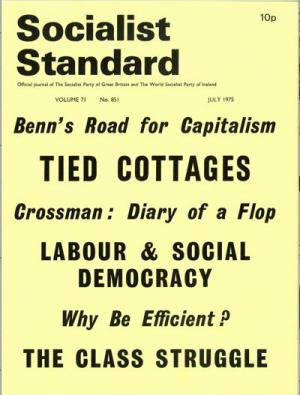
The Labour Party and Social Democracy (1975)

From the July 1975 issue of the Socialist Standard

In recent years the so-called right-wing of the Labour Party has taken to calling themselves “social democrats”. The term is also used by some of those — such as Dick Taverne, Christopher Mayhew and Lord Chalfont — who have left the Labour Party because they feel it has become too much dominated by its “left wing”.

What, then, is a social democrat supposed to be? Before the First World War it was almost a synonym for Socialist, even though Engels never liked the word — and, indeed, in origin it did mean a democrat who also favoured social reforms, as opposed to a democrat pure and simple. On the other hand, “social democracy” could be an alternative name for Socialism — as a society characterised not only by a democratic administration, but also by democratic control of all aspects of social life, including the use of the means of production — and was indeed used as such in the very early issues of the Socialist Standard.

But those who call themselves “social democrats” in the Labour Party certainly do not want to suggest that they stand for a society based on the common ownership and democratic control of the means of production by the whole community. Quite the contrary. They want to make it clear that they accept legal, private property rights, as one of them, Ashley Bramall, a Labour GLC leader wrote in a letter to The Times:
Social democracy involves the acceptance of a mixed economy, but a mixed economy in which public ownership is the predominant and not the subordinate form of ownership. It involves far greater equality than exists at present.

Social democrats are, 1 suppose, distinguished from some other socialists by believing (1) that socialism is to be obtained only by the processes of democracy; (2) that democratically enacted laws are to be obeyed, and (3) that property should not be acquired without compensation.
In other words, they are using the word to mean a democrat who wished to reform capitalism by a certain amount of state control and intervention.

Bramall claims to be a “socialist” as well. We in the Socialist Party of Great Britain are not alone in rejecting this claim. The journalist Peter Jenkins discussed this in an article in the New Statesman called “The Social Democratic Dilemma”. He wrote:
“Now it is of no practical importance, and of small ideological significance, whether the Labour Party chooses to call itself ‘socialist ’or ‘social democratic’. But for our purpose here we must be clear as to what we mean. The word Socialism originally had a quite precise meaning and the late George Lichtheim’s uncompromising formulation is historically the correct one. He wrote: ‘Anything that falls short of abolishing the wage relation has no claim to being described as socialism, although it may be station on the way thereto".
(New Statesman 24 Sept. 1974)
We cannot agree that it is possible to have any “station on the way” to Socialism — either you have capitalism or you have Socialism, you cannot have anything between — but otherwise Lichtheim’s point about Socialism being a wageless society is very important. Wages are a price, the price of a person’s ability to work. But the very fact that most people’s ability to work has a price shows that it is a commodity and that they are excluded from the ownership and control of the means of production and have to sell their ability to work in order to live. Socialists even before the time of Marx denounced the wages system and called for its abolition. Today the wages system can only be abolished by the conversion of the means of production into the common property of society and their democratic control by the people who make up society. Then the producers would cease to be wage-earners and instead become free and equal men and women cooperating to produce what they needed to live and enjoy life.

Jenkins went on to suggest a definition of “social democracy”. He wrote :
“. . . we should mean a form of policies or economic organisation of society which does not envisage, or indeed intend, the achievement of socialism in a future however distant. Whether this is ideologically congenial or not it is surely an accurate enough description of reality. Can it, then, be seriously contended that the Labour Party is working towards or envisages the achievement of socialism?”
Of course, not. Jenkins realizes that the Labour Party stands for trying to reform capitalism and has never stood for the abolition of the wages system.
Adam Buick

Wednesday, July 25, 2018

Crossman: Diary of a Flop (1975)

From the July 1975 issue of the Socialist Standard

It was Iain MacLeod, the Tory leader whose ambition was as plain and disfiguring as a broken nose, who said that the only life worth living was that of a government minister. It was probably something to do with the ever-attendant television crews, the crowds, the red despatch boxes, the big limousines. Who could resist such excitement? Especially if, like some Labour ministers, your working life had begun hewing coal or standing behind the counter of the local Co-op.

But what happens when the excitement is taken away, when the minister is sacked or his party loses an election? What remains, to console him for absent crowds and the unremarked drive home in his Morris 1100? Well, he can usually find a place on at least one board of directors. If he is a Labour man he may be able to conceal his function as a whip-lash of exploitation behind a title like Industrial Relations Consultant. Or he can write his memoirs, which can be profitable for him and illuminating for the rest of us, who have got little amusement from him while he has been in office.

The Labour government of 1964-70 yielded a crop of memoirs — with more to come, no doubt. Harold Wilson, after losing the 1970 election, applied his famous memory and capacity for hard work to producing a 790-page door-stop of a book about his first government. It took him five months. At the same time, George Brown rushed out his version of those times — thinner and lighter in every sense. But the most notable up to now — because of the controversial embers upon which they have blown — have been the diaries of the late Richard Crossman, who for years attracted both adoration and loathing as one of the most gladiatorial of Labour’s con-men.

The retirement or defeat of a prominent politician can be the time for him to make some embarrassing revelations about the way capitalism is governed — about ruthless ambition among men who preach that the rest of us should be selfless, about blunders by ministers who are assumed to be near-infallible, about the confusion among politicians whose reputations rest upon their being in confident control. There is an official rule aimed at preventing such embarrassment to people who are still alive — so that George Brown, is allowed to tell about Bevin’s accusation that he was ". . . acting as office-boy for that bastard Dalton”, but Crossman is hampered in revealing what a civil servant thought about two of the great men of the time:
   . . .  his characterization of Alf Robens: 70 per cent slyness, alertness and charm and 30 per cent a straight madman — almost as bad as George Brown.
Crossman was keen that his diaries should be published quickly — he thought they would lift the lid on “the secret operations of Government, which are concealed by the thick masses of foliage which we call the myth of democracy.” This was bound to be awkward to those politicians who still have the job of keeping the foliage as luxuriant as possible and it was over this that the battle of the diaries has been fought.

If “fought” is the right word, when the ammunition consists of missives worded as gently as “I should be grateful if you would confirm . . .” Much more combative was George Brown’s riposte in The Sun, when he slung some of the mud back by revealing the motives Crossman admitted to in Cabinet:
   Prime Minister, if you ask me not to compile these diaries I shall just resign.
I am not interested in sitting here as a Minister except in so far as it enables me to write this record.
Crossman, let it be remembered, was in the Cabinet as Minister of Housing, pledged to ease one of the most desperate aspects of working-class poverty.

George Brown never shrank from embarrassing anyone but in his memoirs the effect is often unconscious. Brown bid for his place in history with some of the more extravagant gimmicks of British capitalism in the sixties — among them the Statement of Intent on Incomes and Prices and the National Plan. At the time Brown and his colleagues were telling us they had a consistent policy to keep capitalism well under control. But his memoirs give a different story:
   We (at the Department of Economic Affairs) were trying to persuade people to restrain wage demands and to hold down prices at the very time when the rest of the Government, as a matter of deliberate policy, was forcing up prices. (In My Way.)
Yet no hint of defeat shadows the declining days of George Brown. He consoles himself (The Sun) that Wilson must be regretting now that he did not listen more attentively to his advice.

There is no more reality about Wilson’s memoirs, which offer the history of a human computer alone refusing to be impressed by the election forecasts which could turn out to be wrong; his policies being justified to confound gloomy predictions; his smooth transformation of hostile demonstrators into ecstatic supporters. Wilson’s memoirs prove him right in everything and even when wrong it was somebody else’s fault:
   On Friday 1st. July (1966) George Brown, Jim Callaghan and I met to discuss the economic situation . . . The Chancellor, with all his Treasury and Bank of England briefs before him, drew a picture of blue skies in every direction . . .
   Within a week the Chancellor’s hopes were dashed.
(The Labour Government 1964-70).
The uproar over the Crossman diaries is because they prick the bubble. Wilson may picture himself as a knight in shining armour; Crossman gives a less flattering account of those crisis days of 1966:
   Throughout (the Cabinet) Harold was his dreary, competent self, fiddling with the figures. George Brown was sulking on the other side of the table. The Chancellor was talking big about getting tough with Germany . . . Nothing had been adequately prepared. Nothing had been thought out properly. We were fixing things once again, horribly inefficiently, at the last moment.
But Crossman himself does not emerge as any more successful or attractive than the men he held in apparent contempt. He grumbles at being held prisoner by his civil servants which, if true, was something he knew before he took the job as a minister. At one time he is engaged by a wine list, at another relishes his right, as Lord President, to be the first of all the ministers to get his seal of office from the queen.

There is no suggestion, in the extracts published, that Crossman thought himself in any measure responsible for the fiasco of that government. Nothing disturbs the confidence that if he, with one or two fellow-intellectuals, had been at Number Ten we would have arrived at the Promised Land. Crossman did not seem aware of his true standing in the history of capitalist government — just another in the list of Housing Ministers who left the problem as bad when they went out of office as it was when they came in.

Capitalism schools into its workers that they are led by great, wise men who deserve their respect. Sometimes, as in the Crossman diaries, we see a different picture — of Wilson describing his fellow great men as “dangerous and conspiratorial” (Roy Jenkins) and “inert” (James Callaghan). It is one which workers should remember next time they are asked to vote for these leaders. No election address will describe a party leader as dangerous or inert; it will be up to the workers themselves to remember.

Whichever set of politicians holds office the result is the same. There is confusion because capitalism itself is anarchic. There is panic because capitalism is a society where nothing is secure. There are blunders because capitalism will not be controlled. There are deception and intrigue because capitalism is as competitive as the jungle.

One danger about any so-called startling revelations about capitalist politics is that they can be explained away, to many workers’ satisfaction, by the hope that another type of politician — more honest, more knowledgeable, more humane — would make a better job of running the system. Capitalism itself has done enough to destroy that notion as one leader after another, whatever his personality or talents, has proved impotent in the face of capitalism grinding out its inhumanities.

As Crossman died the Vietnam war was bursting out anew, starvation blanketed millions of the world’s people and western capitalism was sliding into a crisis which may yet outdo the crash of the thirties. This is the social system which is justified and perpetuated by Labour and other politicians. It is the society bolstered by the glamorous intellectual Crossman and by the demotic George Brown. It is a restrictive society in which the majority who suffer do so accepting as their lot that they are without privilege or satisfaction. It is all the more important, then, that that majority should not be so overcome by the few brief opportunities to look inside as to misinterpret what they are allowed to see.
Ivan

Monday, September 4, 2017

Benn's Road for Capitalism (1975)

From the July 1975 issue of the Socialist Standard

In the run-up to last month’s referendum the man who excited most attention was Anthony Benn. The comments on his prophecies of doom and gloom ranged from stabs in the back from his own colleagues such as Roy Jenkins who said he couldn’t take Benn seriously as an economic minister (Guardian 28th May) to near-hysteria. For example the Daily Mirror (29th May) gave him the Draculean headline of “Minister of Fear”. An “X” certificate will no doubt follow.

The Guardian took the trouble to interview Dracula himself (21st May). The article was headed “Benn’s road to Socialism”. Benn did not define what he meant by Socialism (no Labour politician will do that), he only mentioned the word once. That was almost by accident when he referred to his package of reforms as “British Socialism”.

What concerns Benn is the running of Capitalism. And for those who care to look, it is perfectly obvious that he is determined to run it as efficiently as possible. This means that he is trying to ensure that the workers are exploited as hard as possible — because that is what efficient Capitalism means.

The source of the wealth of the owning class is the amount of unpaid labour that the working class concede to the capitalist class. This may be called robbery. Benn says “I am for more profits . . .” That is more wealth to the capitalist class.

He thinks that industry runs without workers doing the work. John Palmer the interviewer asks him about “shop floor power” and should workers have a right to veto management decisions. Benn’s reply is a beauty: —
   That kind of workers’ power already exists. But it is only being used negatively at present. Workers are accused of throwing spanners in the works BUT THAT IS THE ONLY TIME THEY ARE ALLOWED NEAR THE WORKS, (our emphasis)
Clearly Mr. Benn believes in perpetual motion and thinks industry runs itself. Workers may wish they were not allowed near the works, but capitalism is run only by the workers inside and out. It is Mr. Benn who won’t get to grips with the meaning of capitalism.

The inevitable question about loss of jobs was put to Benn, and he said — prophetically — “I can’t guarantee anyone’s job, including my own”. He then continued with this howler:
   You cannot give people power without responsibility too. They understand this.
I wonder if he thinks the steel workers being laid off in their thousands take things so phlegmatically? They certainly didn’t when his fellow phoney, Michael Foot, went to Ebbw Vale earlier this year. When Mr. Foot asked them “to understand” that it was in their interests that they should be laid off, they gave him a roasting. Foot scurried back to the warmth and comfort of Westminster pretty sharp.

The rationale behind Benn’s approach is that he can control capitalism by putting into effect his policies. But he plainly admits that it is capitalism that controls the government, and not the other way round. Asked about the best way to use the taxpayers’ money he says:
   The government does not dictate the pace of industrial change. It is forced by events to inter-act with reality.
Wilson once said the last labour government was “blown off course”. Benn is saying that there is no course to be blown off in the first place. Capitalism acts, and the government reacts.

For those members of the capitalist class who sit in fear and trepidation awaiting Benn’s next move, let him reassure them. Palmer talks about the “radical changes” that are taking place in industry. Benn modestly says “My  rôle in all of this has been very minimal”.

To the workers who vote for the likes of Benn, let him deliver his own epitaph. Palmer asks him about his views in 1966 when Benn was last in power. Benn disarmingly says:
   The policies I followed between 1964 and 1970 had much to recommend them and were taken up by the succeeding government. BUT THEY DID NOT WORK, (our emphasis)
If the policies had much to recommend them, why didn’t they work? And how nice it is for Capitalist politicians to be able to dismiss their records of failure with such glib phrases. We can tell the working class now that Mr. Benn’s policies won’t “work” this time either. But we are not stating this so that later (when Benn too will no doubt again say he was wrong) we can say “we told you so”. We are asking the working class to ditch their allegiance to Capitalism and apologists like Benn and urging them to get on with the tasks of finding out about Socialism.
Ronnie Warrington

Friday, July 14, 2017

The Communist Course - Humbug! (1975)

From the July 1975 issue of the Socialist Standard

Much can be learnt about the aim and method of a political party from a study of its history. A look at the history of the SPGB shows complete adherence to a certain object and declaration of principles over the last seventy one years. The Communist Party of Great Britain has shown from its formation in 1920, by those seeing the Russian Revolution as a new means of achieving Socialism, to the present day, a consistent course of stooping to the demands of Kremlin policy and distortion of Marxism to fit their objective of establishing State Capitalism.

Socialism was not, and could not be, established in Russia in 1917. The only course for the Bolshevik leaders to take was that of capitalism administered by the State. The Communist Party has remained consistently loyal to Russian State Capitalism despite the multitudinous crimes which Russia has committed against its own, and the international, working class. Whilst the Socialist Party of Great Britain has always expounded the theory of Marxian economics: a system of society in which wealth is owned democratically by the whole world community; the Communist Party has persisted in presenting Socialism as a form of capitalism.

Of course, the modern CPer will agree that the CP supported the continual turnabouts in Russian foreign policy during the last war. He will agree that CPers were hailing Stalin as the Russian messiah in the not too distant past. He will even confess that the “Leadership” has been known to mislead its followers on more than one occasion. But now, he will argue, everything has been put to rights. No more are the days of Russian gold financing the CPGB. Today the Communist Party stands on its own two feet. It’s a force to be reckoned with. He will tell you about 1968 when the British Communist Party stood up and actually condemned the Russian invasion of Czechoslovakia. Much of what he says would be true. After all, we can’t blame the CP for the mistakes of its forefathers, even if it has been an entire history of error. But has the Communist Party really decided to change course?

The answer to this question is yes and no. Yes, the Communist Party in recent years has taken on a new image to make itself appear more respectable. But no, it is no nearer Socialism today than it was in 1920.

The CP is by no means secretive about its new image. Indeed in March 1973 a new policy statement entitled Time to Change Course — What Britain's Communists Stand For was written by CP Executive Committee member Jack Woddis and has since become the principle source of CP policy.

The pamphlet opens with a chapter telling us about the main problems facing Britain.
. . .  an economic crisis manifested in balance of payments problems, inflation, unemployment, monetary difficulties, trade decline and a slow growth of our economy, (emphasis added)
These, we are told are the problems facing the working class in this country. If so, what are the problems facing the capitalist class?

The pamphlet then goes on for a number of pages to complain about the symptoms of capitalism. At no time is the nature of capitalist society explained. Maybe the Communist Party doesn’t think that the working class could manage economic theories. Best give them popular causes like old-age pensioners and the price of beef. It is no mere coincidence that the basis of capitalist society is not explained. For if it was understood by the reader he would be able to see, in the next chapter, “What A Socialist Government Would Do”, that the aim of the Communist Party is not to replace the present system with something else, hitherto unsaid, but to reform capitalism in order to make it work. If the Communist Party were to look clearly at capitalism they would see that it can never be reformed in the interest of the working class.

If the Communist Party is as tame as study shows it to be, why is it disapproved? Surely there must be some revolutionary message somewhere in the pamphlet which has earned the CP its bad name. On page 53 the answer is given. So this is what the CP think Socialism is. Wait for it:
   Once private ownership of the economy is ended and private profit abolished, all the values created by people through their labour will be available to be used by them in their own interests. A part will be available in direct cash — in wages, pensions, children’s allowances, student grants and other benefits. A part will come in the form of social services — health education and so on — in cultural and leisure facilities, in various social amenities in town and country, including housing. transport, roads and town planning. Part will go on the further development of industry and agriculture, on research, on building new enterprises and constructing new machines. Finally, there will be the necessary allocation of funds and resources to maintain the new Socialist State, to staff its administration and to provide the necessary forces and equipment to defend the system against its enemies from without and within, (emphasis added )
So that’s what the Communist Party think Socialism is — them giving handouts from the profits of our labour. This is State Capitalism.

And the CP expect us to accept this nonsense! Or do they? Further on in the pamphlet we come to the third and last chapter, “How To Change Course”. Here, we are told that the “carrying through of a revolutionary change” requires, not the understanding of the working class, but
   a strong revolutionary party, a party capable of leading the people to challenge and defeat the capitalist class. (P.136)
The object of the Communist Party, therefore, is to “lead” the working class into a system of State capitalism. This was Lenin’s intention in 1917, it is the CP’s today. It may have changed its image from that of the violent revolution which it proposed in the 1920s to one of reformist promises as it does today. The slogans may be different, but the aim is still the same.
Steve Coleman