Showing posts with label Peter Kropotkin. Show all posts

Tuesday, September 3, 2024

Letter: Industrial action (1977)

Letter to the Editors from the September 1977 issue of the Socialist Standard

Industrial action

In your article “Obstacles to Socialist Understanding” in the January 1977 issue of the Socialist Standard you state: “Class consciousness means the recognition of the existence of class society and arising from this the knowledge that political action by the majority based on the clear understanding of Socialism will replace capitalism by a Socialist society".

The first part of this statement is correct but inadequate. The concluding remarks are additionally inadequate and does not pay full service to the introductory part of the statement. It is the knowing of the function of capital and how it does not function in the interests of the working class that is most important. And in knowing this the worker uses constantly his economic knowledge (Socialist understanding of economics) to get as much as he can by all necessary means.

This is political-economic action which is superior to just political action. It brings a showdown and breakdown of capitalism on the industrial-economic field of capitalism. It is at that stage the political action takes over by the introduction of Socialism (common ownership, production only for use, etc.).

While writing, why does the SPGB in a puritanical and snipey way condemn your anarchist correspondent when replying to a letter published in the Jan. issue when he stated of having a society “where there is nothing else but a person’s social habits". The SPGB claims this is being utopian. Yet social habits means needs. And surely under Socialism people will be able to retain or assert their own social habits as it is their needs? Under Socialism, people take according to their needs, which are part of their social habits.
W. J. Street 
London, W9.


Reply:
You give no indication of how industrial action can bring a “showdown and breakdown of capitalism”.

It is quite mistaken to suppose that workers who understand economics can get more out of the capitalist class (some of us wish it were so!). What can be obtained by trade-union action depends on several factors, including the concentration of workers in a particular industry. The biggest factor over-all is the state of production and trade. Wage increases and improvements in conditions are gained with less difficulty in boom periods, when the employers’ order-books are full and they do not want production and distribution held up by disputes. When trade and manufacture are depressed, the employers are more ready to make a fight against demands by workers’ organizations. How would the knowledge that “capital does not function in the interests of the working class” alter this situation?

As you link “political-economic action” with “the worker getting all he can by all necessary means”, presumably you mean the trade unions seeking to bring pressure to bear on governments. Trade-union organization is valuable to the workers in its own field; attempted political action has only a damaging effect on it. Since they are not a political party, the unions which attempt such action must support the policies as a whole of a party which promises legislation favourable to them. If, on the other hand, you have in mind the syndicalist idea of a confrontation between unions and the state, your worker with Socialist understanding will be aware (a) that the majority of workers are not members of trade unions, and (b) that the state has at its disposal the legal machinery, police and armed force. Those circumstances hardly make for breaking down capitalism by that means.

You have misread the reply about anarchism. It criticized a statement by Kropotkin predicting a society where ‘the liberty of the individual will be limited by no laws, no bonds”, and pointed out that this vision of unrestricted individual liberty is incompatible with democratic social organization.
Editors.

Thursday, July 4, 2024

Social beings (2024)

Book Review from the July 2024 issue of the Socialist Standard

Selfish Genes to Social Beings. A Cooperative History of Life. By Jonathan Silvertown. Oxford University Press, 2024, 236pp.

This is a remarkable book. It attempts to cover in a couple of hundred pages the whole 4 billion year history of life on earth – so obviously not just human life. Its author, a specialist in evolutionary ecology, does his best while not shirking necessary biological technicalities, to make it comprehensible to the everyday reader, to the non-specialist. Molecules, bacteria, cells, fungi and genes and their place in and contributions to the development and ongoing-ness of life are all investigated and explained both in their simplicity and their complexity. And it wears its expert knowledge lightly, interspersing it with jokes and other flashes of humour, largely via analogies from everyday human behaviour (eg, ‘insects are airliners for microbes, which travel in the gut, and just like an airliner, parts of the vessel are more hospitable to passengers than others’, or ‘Darwin forbid that I should suggest that nature is a con artist, but who can deny that she has a wicked sense of humour?’).

The book’s main point, the conclusion drawn from its painstaking and expert scientific analysis, is expressed in its sub-title (‘A Cooperative History of Life’) ie, the idea that life, all life, is and has only ever been possible through cooperation and teamwork between its various elements, and this also applies to human society and development. The author lays in its grave, if it was not there already, ‘the stereotype of nature red in tooth and claw’. In other words, he shows incontrovertibly that evolution is explained not by competition but by cooperation which, observed and analysed here, is ubiquitous in nature, not just in microbes and plants and animals but in humans too.

So, while largely about pre-human and non-human life, this study has important things to say about human life. It illustrates how central a role cooperation plays – and has always played – in human interaction and how this applies even in the most dire and challenging circumstances, for example wars and disasters. Underlying this is the fact that, most of the time, cooperation rather than selfishness or competition confers mutual benefit. Not of course that human beings are not capable of selfishness, going it alone or ruthless competition, and indeed it is that kind of behaviour – violence, brutality and the like – that tends to make the news. But the point made here is that cooperative behaviour is far more fundamental and deeply woven into our lives – and into all life – no matter how circumstances and the socio-economic system may militate against it. As the author puts it, ‘cooperation survives in spite of conflict’.

He is not of course alone in making arguments of this kind and is quick to acknowledge the slew of thinkers and writers who, over the last 20-30 years, have contributed to laying to rest the widely held secular version of original sin, ie, the notion of human beings as essentially wicked and Machiavellian and needing to be kept in check by a higher authority. As he puts it, ‘writers on this subject outbid each other in trying to describe just how cooperative we are, and there is little doubt that superlatives are justified’. Among the ’superlatives’ he quotes are ‘super-co-operators’ and ‘ultra-social species’, providing references to the works in which these appear in his notes and list of ‘further reading’. To emphasise this, he makes the point that ‘we are daily considerate towards people whom we have never seen before and may never see again’ and, if we are particularly annoyed when someone is inconsiderate, that is because ‘a norm has been broken’; thus ‘anti-social behaviour provides the exception that proves the existence of a pro-social rule.’ The other element he points to in typical human interaction is ‘having a good reputation’, seen as ‘important to attracting co-operators and acquiring the benefits, which is why we are so intensely interested in what others think of us’.

Despite his intense focus on cooperation and the natural human tendency to what he calls ‘community of interest’, the author is careful not to take up any explicit political position. It is, however, difficult not to sense that, if it were put to him, he would look favourably upon the idea of a system of voluntary cooperation in production and distribution and a wageless, moneyless society organised on the basis of from each according to ability to each according to need. After all, he does (somewhat improbably in the context) devote a short chapter of this book (‘A river of glowing light’) to the Russian anarchist and naturalist Peter Kropotkin and to his view that ‘justice for the masses could only come by abolishing the state altogether and replacing it by spontaneously organised cooperation’.
Howard Moss

Sunday, September 17, 2023

Life of an anarchist (2007)

Book Review from the September 2007 issue of the Socialist Standard

The Anarchist Geographer: An Introduction to the Life of Peter Kropotkin. Brian Morris (Genge Press, 2007. £8)

This is a short (100 page), readable biography of the anarchist writer Peter Kropotkin. Born a prince in 1842, he became an anti-Tsarist revolutionary for which he was arrested and imprisoned in 1874. Two years later he managed to escape and left Russia, not to return again till the overthrow of the Tsar in March 1917. He died there in 1922.

Before he became a revolutionary he had been involved in original geographical research in Siberia and had been elected a member of the Russian Geological Society. In exile he earned a living as a scientific journalist and writer. Hence the title of Morris’s book. One series of his scientific writings was later published as Mutual Aid: A Factor in Evolution, which became a socialist classic, opposing the Social Darwinists who saw the struggle for existence as the only factor.

In the 1870s when Kropotkin first became active in revolutionary and working class politics in the West – in Switzerland – almost all those involved, including those who were later to describe themselves as “anarchists”, called themselves “socialists”. So did Kropotkin, though he preferred to call himself a “communist” to distinguish himself from those who wanted “from each according to ability, to each according to work done” from those like him who wanted “to each according to needs”.

Kropotkin has been accused of (or credited with, if you prefer) creating a distinct (anti-) political philosophy called “anarchism” which embraced anybody who was against “the State”, even if they weren’t socialists/communists. In fact, this includes vociferous anti-socialists like the followers of Stirner, Thoreau or Tucker (individualist anarchists) or Proudhon (market anarchists).

Quite why Kropotkin felt – and why some modern anarchists still feel – some sort of affinity with these open anti-socialists is difficult to understand. But then anarchists do make the mistake of seeing the state, rather than capitalism, as the cause of workers’ problems, whereas the state is a consequence of economically-divided class societies.

Kropotkin wasn’t consistently anti-state anyway. When WW1 broke out he immediately supported France (and Britain) against Germany, on the grounds that the German state was the greater evil.
Adam Buick

Wednesday, November 30, 2022

Bird’s Eye View: Democratic, Stateless, Commonwealth (2022)

The Bird’s Eye View Column from the November 2022 issue of the Socialist Standard

Socialism: Democratic

‘The curtailment of the rights of local government began back in the 1990s. In 1993, liberal reformers, represented by President Boris Yeltsin, came into conflict with the system of councils that was left over from revolutionary times and given a new lease of life during Mikhail Gorbachev’s perestroika’ (Jacobin, 11 September,).

Actually the rot set in over a century ago with the forceful dissolution of the Constituent Assembly in 1918. Ironically, one supporter of this measure provided an excellent account of why the Social Revolutionary Party, representing the peasants, who were in a large majority, should be denied their victory:
‘It may certainly appear as a monstrous crime against democracy on the part of a regime which regards itself as Socialist to have suppressed an institution which had been the dream of generations, which the Bolsheviks themselves had been championing ever since the first revolution of 1905 with more enthusiasm than any other party… What better proof could have been furnished that the Bolsheviks were trampling on the people’s will in a manner hitherto exhibited by the worst tyrants in history, that they were afraid of the verdict of the nation gathered through its representatives in the highest assembly known to democracy …?” (The Bolshevik Revolution, Maxim Litvinoff, 1918).
For a contemporary account, see our article ‘The Revolution in Russia: Where it Fails’ (Socialist Standard, August 1918). With regard to Gorbachev and life in state capitalist Russia post 1917, this candid comment from journalist Vitali Vitaliev is worth repeating:
‘The main mistake of Western analysts trying to assess Gorbachev’s career is the attempt to treat him as a kind of God-sent Messiah who emerged to save Russia from ‘socialism’. Nothing can be further from reality. Throughout his political career Gorbachev was part and parcel of the apparat. He came not to dismantle ‘socialism’ but to preserve it. I am putting ‘socialism’ into inverted commas because there has never been anything of the kind in Russia. No other country is so far from the ideas of equality and fraternity as the Soviet Union. If there was a socialism, or even a Communism at all, it was only for the ruling elite who lived and are still living in a separate world. It is a world of privileges, starting from birth (special maternity homes) going on all through their lives (special shops, hospitals, hairdressers’ salons, canteens, toilets and what not) and not ending even with the end of their physical existence (special cemeteries). Yes, yes, special cemeteries for the rulers of ‘the first working-class State in the world’, where workers are not supposed to be buried’ (Observer, 11 March 1990).

Stateless

Margaret Thatcher in a meeting with Gorbachev reportedly argued at one stage about the merits of capitalism versus ‘communism’ and she told him ”’We are all capitalists. The only difference is that for you it’s the state that invests, while for us it’s private individuals.” Gorbachev was apparently flummoxed’ (Mission to Moscow, Sunday Times 5 April 1987).

She was correct. Capitalist hallmarks, such as class society, commodity production, profit motive, exploitation of wage labour, markets, etc., exist in Russia, both pre- and post-Gorbachev, as they do worldwide. The very idea of socialism in one country is akin to being a little bit pregnant! People who insist otherwise are living in a world of make believe, which is home, alas, to billions, including fans of the so-called Democratic People’s Republic of North Korea.

‘The North Korean Supreme People’s Assembly gathered for its first session on Wednesday. According to state news agency KCNA, the chamber agreed to adopt laws on landscaping and rural development. However, it also pledged to help turn the nation into a “beautiful and civilised socialist fairyland”. The two laws are intended to help advance efforts made by the governing party to bring about “a radical turn in the rural community and its policy on landscaping to achieve a rapid development of the Korean-style socialist rural community and spruce up the country into a beautiful and civilised socialist fairyland”. Kim Jong-un, who did not attend the parliamentary event, also promised to improve people’s livelihoods and boost rural development amid spiralling economic crises. Economic difficulties have been blamed on self-imposed Covid-19 lockdowns, international sanctions over the country’s nuclear weapons programme and also natural disasters’ (Daily Express, September 8).

The February 2012 Socialist Standard’s cover features a young-looking ‘Great Successor’ under the title ‘Kim, All Ye Faithful. Leaders in the Land Time Forgot’ and related article ‘Death of a Dictator’.


Commonwealth

‘Everything seems to tick in “Unrest” the latest effort from Zurich-born writer/director Cyril Schäublin. “Unrest” depicts the working lives of 19th century anarchist watchmakers in the Swiss mountains, laying bare the absurdities of the wage system’ (Roger Ebert.com, 12 September). During the interview, Schäublin states: ‘Kropotkin, contra Karl Marx… believed in the abolition of any kind of wage labor whatsoever.’ Au contraire. In Value, Price and Profit (1865) Marx stated:
‘At the same time, and quite apart from the general servitude involved in the wages system, the working class ought not to exaggerate to themselves the ultimate working of these everyday struggles. They ought not to forget that they are fighting with effects, but not with the causes of those effects; that they are retarding the downward movement, but not changing its direction; that they are applying palliatives, not curing the malady. They ought, therefore, not to be exclusively absorbed in these unavoidable guerrilla fights incessantly springing up from the never ceasing encroachments of capital or changes of the market. They ought to understand that, with all the miseries it imposes upon them, the present system simultaneously engenders the material conditions and the social forms necessary for an economical reconstruction of society. Instead of the conservative motto: “A fair day’s wage for a fair day’s work!” they ought to inscribe on their banner the revolutionary watchword: “Abolition of the wages system!”

Wednesday, May 18, 2022

Mutual Aid (2022)

by Clifford Harper
From the May 2022 issue of the Socialist Standard

A recent edition of the BBC Radio 4 programme In Our Time featured a discussion on the Russian anarchist Peter Alekseevich Kropotkin. The focus was not primarily on his political advocacy, rather it was his book Mutual Aid: a factor of evolution that was the object of consideration.

Published a couple of years before the Socialist Party of Great Britain was founded, it is an examination of the role cooperation and mutuality has played in evolution. There was an aggressive strain of Darwinism, personified by Darwin’s bulldog, T.H. Huxley, which emphasised the war of all against all as the motive force behind natural selection.

This view has often been deployed as justification for capitalism being the expression of self-interest as the prime motivation of human economic, political and social relations. It has been a persistent theme, running from Hobbes’s Leviathan, that seemed to draw biological justification from Darwin’s work.

In common parlance, this thinking is often expressed as socialism being a nice idea, but against human nature. If evolution depends on natural selection being driven only by self-regarding motives, then socialists are setting themselves against nature.

Kropotkin however, along with many, many others internationally, insisted that it was this brutalist view that disregarded the actuality of nature. Rather than begin by justifying human potential for cooperation, which might have been regarded as a plea for human exceptionalism, his approach was to examine nature more broadly to see if there was evidence of mutuality being fundamental.

His was no sentimental view of nature, as is demonstrated in the opening lines of the Introduction. ‘Two aspects of animal life impressed me most… One of them was the extreme severity of the struggle for existence which most species of animals have to carry on against an inclement Nature; the enormous destruction of life which periodically results from natural agencies’.

This is the antithesis of unbridled idealism, a realistic view based on his own extensive travels, experience and observation. The second aspect arising from his observations is telling:
‘…even in those spots where animal life teemed in abundance, I failed to find – although I was eagerly looking for it – that bitter struggle for the means of existence, among animals belonging to the same species, which was considered by most Darwinists… as the dominant characteristic of the struggle for life, and the main factor of evolution.’
Then, chapter by chapter, he goes on to demonstrate how it is mutuality amongst animals of the same species that is the primary, and crucial, factor in survival and evolution. He begins with invertebrates and progresses through ants, bees, birds to mammals.

On reaching humans he presents what evidence there is that cooperation in the Palaeolithic period was a necessity for survival in a hostile world, continuing to be so in both the Mesolithic and Neolithic periods. Primitive communism was not some fancy of Marx and Engels.

He goes on to trace this important feature of human life as it expressed itself, often in adverse political situations, from pre-history into history itself, into the medieval free cities and guilds. He cites examples of insurgent warriors taking land by force who eventually swapped spears for spades and operated cooperative farming communities.

Even in the 19th century he found expressions of mutuality in village communities and the nascent labour movement, although it is through the 19th century and the rise of industrial capitalism that private property became predominant and protected by the state. The mutual gave way to the individual.

While Mutual Aid is an anarchist constructing a scientific basis for communism rather than the historical materialism of Marx, the two approaches are surely not exclusive. Marx gives an understanding of how we arrived at the society we have and identifies the mechanism for change, the conscious action of the working class acting on its own behalf. The object being the establishment of a worldwide socialist system based on meeting need not profit. The question as to its viability will undoubtedly continue to be raised until socialism is actually realised.

Kropotkin indicates that rather than being alien to nature, biology demonstrates the contrary. Modern research and observation has found cooperation to be fundamental in nature. Plants provide each other with nutrients, fish groom each other for parasites, ants work together to build nests, bees sacrifice their lives for the good of the hive and predators hunt in packs.

Evolution requires groups of organisms to act together for mutual benefit. In 2016, research using a new conceptual evolutionary model at Tomsk State University was published. Competition and the struggle for existence were found not to be the main drivers of evolution. Rather, the avoidance of competition is important (bit.ly/3xkTOK9).

So, Kropotkin is vindicated by research in the land of his birth, as well as research more widely throughout the world. His own book refers to many researchers and observers from a plethora of nationalities, just as he draws evidence from every continent. By doing so he not only makes the case for mutuality, but also demonstrates human progress to be a global phenomenon, as socialism, as the practical realisation of mutuality, must be.

This book review might seem to be 120 years late, but not so. There is an abiding interest in the premise of Kropotkin’s argument and it continues to have a resonance for those advocating a radical alternative to capitalism.

Eighty years after Mutual Aid was published Stephen Jay Gould’s essay (1988), Kropotkin Was No Crackpot (marxists.org/subject/science/essays/kropotkin.htm) examines the controversy around the meaning for society of Darwinism at the turn of the Twentieth century.

Gould expresses how seemingly contradictory positions do not have to be polarised: ‘Reproductive success … works in many modes. Victory in battle may be one pathway, but cooperation, symbiosis and mutual aid may also secure success…’

He goes on to outline Kropotkin’s work, setting it in the mainstream of Russian thinking as exemplified by N.I. Danilevsky whose expertise in both population dynamics and fisheries led him to critique Darwinism as ‘…the credo of a distinctly British ‘national type’ as contrasted with old Slavic values of collectivism.’ The ‘national type’ he referred to was the line of thought running from Hobbes through Adam Smith to Thomas Malthus, the developing philosophy of capitalism.

In September 2021, to mark the centenary year of his death, PM Press/Kairos published a new edition of Mutual Aid with a new Forward, Introduction, Afterword and Postscript. Some of the terminology is anachronistic – references to savages and red Indians – but it is of its day. When he uses such nomenclature, it is not to disparage, rather to show mutuality to be universal.

Those who would change society need to counter assertions rendered as indisputable facts, such as competition is fundamental to human nature. What Mutual Aid demonstrates, along with subsequent biological research showing cooperation at the cellular level is vital for organic development, is that advocacy of a system based on people voluntarily contributing their abilities so all can receive according to their needs is not utopianism, but natural. Mutual aid indeed.
Dave Alton

Sunday, March 6, 2022

A Basic Mistake (2009)

Pamphlet Review from the January 2009 issue of the Socialist Standard

Basic Kropotkin – Kropotkin and the History of Anarchism. by Brian Morris. Anarchist Communist Editions, 2008. 32 pages. £2

Russian émigré Prince Kropotkin, pioneering advocate of “anarchist-communism”, is probably best known for his work Mutual Aid: A Factor of Evolution. This short pamphlet takes us on a fleeting tour through the many strands of Anarchism as related to his theories.

Firstly we are presented with a sketch of the “libertarian impulse” throughout human history; Lao Tzu, classical Greek philosopher Zeno of Citium, the Diggers and even an Islamic sect, the Najadatam, all possessed an “anarchist sensibility” and were forerunners of Anarchism proper, it is claimed. For Kropotkin it is William Godwin who first stated the basic principles of Anarchism in his 1793 “Enquiry Concerning Political Justice” though he did not use the term – it was first used by Pierre-Joseph Proudhon.

In the next chapter we meet Bakunin whom, rather confusingly, we are told “was at heart a communist” even though he defended a form of private property where the products of labour are traded between individual – and therefore competing – labour associations or “free communes”.

Finally we come to Kropotkin’s dispute with the mutualists, most notably Proudhon, Warren and Tucker. Kropotkin applauded their “vigorous defence of the rights of the individual” but in defending private property they opened up the way “for reconstituting under the heading of ‘defence’ all the functions of the state.”

The main flaw of the pamphlet is in Morris’s failure to see the distinction between Marx’s thought and the Leninist concept of the vanguard party. Marx is falsely lumped together with the Blanquists of which Engels commented “Blanqui’s assumption, that any revolution may be made by the outbreak of a small revolutionary minority, follows of itself the necessity of a dictatorship after the success of the venture. This is, of course, a dictatorship, not of the entire revolutionary class, the proletariat, but of the small minority that has made the revolution… These conceptions of the march of revolutionary events have long become obsolete.” (The Program of the Blanquist Fugitives from the Paris Commune).

For Marx and Engels the ‘dictatorship of the proletariat’ meant a politically organised and conscious working class democratically controlling the transformation of the state; not the totalitarian rule of the vanguard party, as Lenin, the Anarchists and others have claimed. However, circumstances have changed since Marx and Engels put forward this concept, it is not a term the Socialist Party would use today.
 
By still claiming that the theories of Marx are akin to those of Lenin and other vanguardists the Anarchists are doing a disservice to the truth.
DJP

Letters: Trade unions (2009)

Letters to the Editors from the March 2009 issue of the Socialist Standard

Trade unions

Dear Editors

With reference to the Socialist Standard (50 Years Ago, February) referring to February 1959 showing Trades Unions in Maoist China were in practice organs of the State, Trotskyists in the SWP and other Trotskyists argue for unions to have power and rights. Yet when Trotsky was Lenin’s right-hand man he argued for the banning of unions to represent workers’ interests on the grounds it was not necessary in a workers state: instead they should express the state’s viewpoint to workers. He advocated forced labour and military discipline to be attached to labour units. Hitler and Mussolini had similar ideas.

Please assure that even under socialism and communism you would recognise free powerful Trades Unions to advance workers’ and other people’s rights as a Fundamental Human Right.
Andrew Harvey, 
Carlisle.


Reply: 
We can’t give you the assurance you ask for since trade unions, as organisations to negotiate with employers over the price and conditions of use of the commodity labour-power that their members are obliged to sell to get a living, will not exist in socialism. Neither will employers, nor wages. Instead, production will be under democratic control on the basis of the common ownership of the means of production. No doubt there will be workplace bodies – which will be free and powerful – to ensure this democratic control but these will not be trade unions.

We hope you don’t think we’re Trotskyists. We are not but have always opposed Leninism and its 57 varieties including Trotskyism. We agree with you in denouncing Trotsky’s attitude towards trade unions when he was a member of the state-capitalist Bolshevik government of Russia in the early 1920s – Editors.


Kropotkin

Dear Editors

I much appreciated DP’s review of my Kropotkin pamphlet (January Socialist Standard). Of course Kropotkin, like myself, was clearly able to distinguish between Marx’s advocacy of parliamentary government (State socialism) and Lenin’s vanguardist approach.

What is important to recognise, however, lost on DP, is that Kropotkin and the anarchists repudiated both Marxist politics and Bolshevism and other anarchists (libertarian socialists) opposed Marxist State socialism – clearly spelled out in Iain McKay’s recent An Anarchist FAQ (AK Press, 2008) and other pamphlets by the Anarchist Federation.
Brian Morris, 
Lewes, Sussex,


Reply: 
We would argue that Marx was not an advocate of “parliamentary government” but of the abolition of the state. As he wrote in The German Ideology “[The proletarians] find themselves directly opposed to the form in which, hitherto, the individuals, of which society consists, have given themselves collective expression, that is, the State. In order, therefore, to assert themselves as individuals, they must overthrow the State”. It is unfortunate that after so-called “Marxism” became the official ideology of the ruling class in Russia his anti-state sentiments have been downplayed or distorted. “State socialism” is a contradiction in terms and was never used by Marx.

In all essentials, we would say the theories of Kropotkin are closer to those of Marx than are some others from the Anarchist tradition; the difference is one of means and not ends – a classless, stateless, moneyless, wageless common ownership society. However what it is more important, as we hope you’ll agree, is not what Marx or Kropotkin said or meant to say, but how we can improve our current theoretical understanding by studying their works and criticising them in the light of later developments and our experience of the present. – Editors.

Wednesday, January 26, 2022

Nothing New (2022)

Book Review from the January 2022 issue of the Socialist Standard

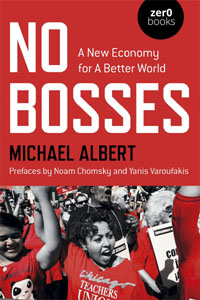
No Bosses. A New Economy for A Better World. By Michael Albert. Zero Books. 2021. 220 pages. £13.99.

Another book by Michael Albert arguing for his blueprint for a future economic and social system that he calls ‘participatory economics’, or ‘parecon’. He presents it as an alternative buying-and-selling economy both to one where wages and prices are determined by the market and to one where they are fixed by the government. His blueprint involves your work and income being decided by your work colleagues and what you consume by your neighbours. It also involves numerous meetings and votes to decide what should be produced.

Yanis Varoufakis, in a politely critical preface, makes the point that it could turn out to be a dystopia rather than a utopia:
‘While I see how Michael’s proposed organisation would rid workers of individual bosses and market pressures, I fear they may end up being bossed around by tyrannical majorities.’
Yaroufakis is writing from the position of someone who thinks that giving the market a role would allow people a greater freedom of choice. We don’t agree with that of course but would make the same criticism on the ground that post-scarcity conditions make free access possible along with the application of the principle ‘from each according to their ability, to each according to their needs’.

Albert, however, insists that consumption should be linked to the ‘duration, intensity and onerousness’ of the work an individual does and is implacably opposed to ‘from each to each,’ devoting four pages to criticising it, or rather a caricature of it. Basically, he thinks that it would lead to people not working hard enough and/or consuming too much. He calls it ‘The Anarchist Objection’ and, indeed, Kropotkin and Alexander Berkman who he cites as among those who have influenced his blueprint, could both have answered his arguments. It is not just an objection made by some anarchists but also by us, as he knows since he has debated with us, both in person and in the columns of the Socialist Standard (April 2006).

There is nothing new in the book except for Varoufakis’s point.
Adam Buick

Wednesday, April 7, 2021

Letter: An Anarchist defence of private property (1927)

Letter to the Editors from the April 1927 issue of the Socialist Standard
The following letter has been received from an anarchist reader of the S.S. We append our reply.
There are two Socialisms, one based upon individual subordination and the absolute denial of private property (Marxian and Kropotkin Socialism), the other based upon individual sovereignty and the insistence upon private property (Proudhonian Socialism). Marx attacks liberty—Proudhon attacks privilege. Marx attacks capital— Proudhon attacks monopoly. Marx thought capital was one thing and labour product another. He would abolish wages by confiscating all capital to the State, that is the conscription of all wages and workers— Militarism, Bureaucracy ! Marx said value could not be determined, yet he says that the worker produces four and receives one. How did he find that out? Marx ignored the money question ; like Kropotkin, he was an absolute dud in finance. Marx thought profits, or that part of the product kept back by the employers, was the only means of exploitation worth mentioning, yet profit is simply the difference between what a man buys goods at and what he sells them at. I contend that competition in the supply of a currency divorced from its metallic or specie basis would abolish that difference ! Why, to-day the four hundred millions interest on the National Debt will admit of eighty thousand to live at the rate of five thousand a year, who need not own any means of production or engage in any enterprise, and who can look with philosophic calm on all your strikes and riots as long as the State remains intact ! Why, even Lord Rothermere, through his Daily Mail, has been clamouring for the Government to tax the Channel Islands because Mr. Houston and other millionaires were flying there to dodge Karl Marx, the old Tory tax collector. I shall insist that every trader shall, like the proprietors of theatres, state the amount of tax on each article, including beer, spirits, and tobacco. This will educate the workers and expose the cowardice, hypocrisy, and criminality of your Labour champions and all politicians and invaders. I will conclude with a few questions. (1) Are not the working classes deprived of their earnings by usury in its three forms—interest, rent, and profit? (2) Is not such deprivation the principal cause of poverty? (3) Is not poverty the principal cause of illegal crime? (4) Is not usury dependent upon monopoly, and principally the land and money monopolies? (5) Could these monopolies exist without the State at their back or the sanction of the Government?

Ground rent exists because the State stands by to collect it and to protect land titles rooted in force and fraud, otherwise the land would be free to all and no individual could control more than he could use. Interest and house rent exist because the State grants to their bankers the sole right to monetise the capital and securities produced by the workers, and to issue credits thereon to finance war and to create parasites by endowing churches, colleges, and hospitals, inspectors innumerable, presidents, chairmen and staffs for boards of trade commissions of enquiry, censors for cinemas to see that you get plenty of military and religious dope; staffs for wireless and for ratifying district agreements, with the Labour Party supporting Army and Navy officers as Parliamentary candidates whose interest is, like the lawyers, to increase taxation, and thus ensuring the slavery of the workers by pawning the future products of the workers and their children to the State ! So we have discovered our enemies—the financiers, the State bankers, the currency jugglers are the vipers sucking at the vitals of industry, and the State, the Government, the public trustees are their protectors and co-operators, which only free labour can detach and kill.

Give the workmen their economic independence by giving them free access to the means of life which come without labour, and they will produce and exchange their wealth. As for the usurers and their protectors, stripped of their power to steal, they will have to join the ranks of labour or starve. This is where I stand, and I invite any and all to meet me here and whip me if you can. I should close here, but I must tell you that the Labour Party is the last refuge for bankrupt aristocracies and broken down thrones; hence the riddle of their titled and military members !
T. H. Mahony.


Our Reply.

This is the third letter we have printed from Anarchist individualists, and it betrays the same vagueness and misconception as those from previous correspondents. There is no attempt made to deal with the economic development and tendencies of our time, and no effort is made to show how private property in the great means of production can exist without a rich owning class on the one side and a vast working and non-owning class on the other. The first accusation to be noted is that “Marx attacks Liberty” ! Where does not occur. The only Liberty Marx attacks is the Liberty to rob ! The sheer nonsense of our critic talking of “Kropotkin Socialism” is an example of the general confusion in his letter. Kropotkin opposed Socialism and stood for “absolute individual liberty”—whatever that might mean. Our critic is referred to the complete answer to Proudhon given by Marx in his work, “Poverty of Philosophy.” Monopoly is a direct result of competition and is inevitable under capitalism. The statements made about Marx in the above letter clearly show that Mr. Mahony has never read Marx. Marx shows in “Capital” that the product of labour becomes capital because the product of the labourer is the property of the capitalist and only a portion in the shape of wages is returned to the worker.

Marx did not propose putting capital in the hands of the State, but that the producers should own the means of wealth production in common, and with the abolition of private or class ownership the State would die out.

In the same sentence our critic accuses Marx of advocating the abolition of wages, and then says Marx advocated the conscription of wages !

Marx advocated neither. The gem in the above letter is the statement that Marx says that Value could not be determined ! Actually all Marx’s economic writings— “Value, Price and Profit,” “Wage Labour and Capital,” “Capital,” “The Critique of Political Economy,” and others—all state that value is measured by the amount of labour socially necessary to produce an article.

The joke of claiming that Marx ignored the money question is evident to the merest tyro in Marxian study, for, apart from the “Poverty of Philosophy,” the great three volumes of “Capital” and the “Critique” deal specifically and completely with the money question. Marx alone was able to demonstrate the secret of money and showed the actual part played by money in capitalist economy.

If there is any other source of exploitation but that occurring in withholding the product of labour from the producers, it would be interesting to have it stated.

The crude notion that a metal or specie currency is the cause of exploitation is completely answered by the facts of modern life wherever there is a paper currency. No tinkering with currency or allowing any person to issue it would touch the simple cause of slavery and poverty—the ownership of wealth by a section of the population, and the dependence of the rest upon that section for permission to work and live. If the National Debt was abolished, the workers would be no better off, because they do not pay for the debt, but interest and principal is paid for by the employing class out of the surplus values taken by them in production.

The fact of the Daily Mail clamouring for the taxation of millionaires who try to evade taxation by moving to the Channel Islands shows the truth of our position. The capitalists, having to bear the general expenses of government (out of the proceeds of exploiting the workers), are anxious to make all capitalists contribute.

Taxation does not concern the workers. If there were no indirect taxes at all, the causes of working-class poverty would still remain. The questions asked by our correspondent are easily answered.

(1) Rent, interest and profit are three parts into which the surplus taken by the industrial capitalist is divided. These three forms result from private ownership and can only be abolished when the producers own the means of production.

(2) The cause of poverty is stated in answer to Question 1. Rent, interest and profit are not the fundamental causes, but these three forms of stolen wealth are effects of capitalist ownership of the means of production.

(3) Modern crime is due to the material conditions resulting from class ownership.

(4) Interest is a result of private ownership and is legalised by all capitalist Governments as a useful means of carrying on trade and commerce for them.

(5) The State is not at the back of the Capitalists. The State is the Central Committee of the capitalist class and carries on the executive affairs on their own behalf. All private property society needs a State to rule the subject class and to conduct and regulate the affairs of government in the interest of the ruling class.

Economic independence for the worker depends upon their free access to the land, factories, workshops, machinery, etc., and all other means of production.

But as the modern methods of producing involve large-scale production and associated labour, the means of wealth cannot be owned individually by each worker. They are too vast and beyond the means of any producer. As they must be co-operatively worked, so they must be commonly owned. There is no other solution. Individual ownership by the few rich non-producers, with the resulting poverty of the many—or common ownership by the producers themselves for their own comfort and enjoyment. That is the position our critic has to face.

The evading of this important fact of economic evolution by our Anarchist critics, and the calm assumption that we are living back in the days when means of production were small enough to be owned individually by the producers—these two points make all attempts at much discussion with them futile.
Adolph Kohn

Tuesday, September 15, 2020

Socialism and Human Nature. (1922)

From the April 1922 issue of the Socialist Standard

Among the many objections that have been levelled against Socialism, the one concerning human nature strikes the writer as providing not only a lop-sided view of human nature, but at the same time an indictment of capitalist society unconsciously made by our opponents.

We are informed that "human nature being what it is, Socialism is quite impossible," or, as it is sometimes put, "you will have to change human nature."

This remarkable point of view was formulated in another way only a few days: ago by the Rt. Hon. Winston Churchill, who, in a speech delivered in Loughborough Town Hall, stated :—
  "A great mistake the Socialists make is that they follow a lot of logical and symmetrical theory, and forget all about human nature."—Sunday Express, 12/3/22.
Far be it from us to suggest that Mr. Churchill follows any theory that could be called either symmetrical or logical, or, when commenting upon his famous "gamble" at Gallipoli with the lives of thousands of our fellow-workers, that he had forgotten about human nature.

However, we are not so much concerned here with Churchill as we are with those of the working class who seriously entertain the objection stated above. Before proceeding to deal with this objection, we will state what the Socialists have to say of existing society, and how their theory corresponds to reality.

We assert that present-day society is based upon the private ownership of the means of living by the capitalist class, with the consequent enslavement of the working class, by means of whose labour wealth is produced. It follows, then, that, as the capitalist class do not work, they must obtain their wealth from the workers; in other words, they steal it from the working class. Of course, the means, employed are not the same as those of the common thief or burglar, which are quite illegal, but by virtue of their "legal" ownership of the means of life, which is secured to them by their being in control of the political machinery, including the armed forces of the nation. To illustrate this point.

Let us assume that a small body of workers decided to "take and hold" some of the machinery of production for their own benefit, we should at once witness the operation of the power that is in the hands of the capitalist class. The police force, in all probability, would be the first to appear on the scene, and, if this was not sufficient, the Army and Navy would be brought to bear upon the takers and holders, to teach them that "Britons never will be slaves," and in every large industrial dispute this armed force is ready at hand to teach the workers the lesson taught the school-child, "You must not touch; it isn't yours."

The armed forces are controlled through Parliament, for, though they act in the immediate upon the instructions from the Government Departments, such as the War Office and the Admiralty, they are ultimately under the control of the majority in the House of Commons, as this majority is responsible for the conduct of the various Departments. But the capitalists have not voted themselves into Parliament. The workers outnumber them by millions at the ballot-box. The tragic irony is, that the workers have handed over to the ruling class the very power by which they art kept in subjection. What follows as a consequence of the working class, being a subject class is that the workers must operate upon the various tools of production to obtain a living. But the wealth, when produced, does not belong to them, but to the capitalists, who hand back a fraction of this wealth in the form of wages to the workers, to enable the latter to renew their energy, and thus repeat the performance of producing wealth. In modern society, on account of man's triumph over the forces of Nature, there is produced all over the civilised world an abundance of wealth sufficient to ensure a comfortable existence for all. But, as every worker is painfully aware, poverty and insecurity of existence is the lot of his class. We have to record the fact that, in spite of the productive power of to-day, we witness the anomaly of starvation in the midst of plenty. The Socialist, after analysing society and viewing all this, proposes to the workers that they should organise into a political party for the purpose of obtaining political power in order to change society from Capitalist to Socialist; that is, alter the basis of society from one of private ownership into one of the common ownership of the means of life, to be democratically owned and controlled by the whole community.

This being the proposition of the Socialist, we ask, What is there about it that in any way conflicts with what we know of human nature ? The objection of our opponents merely begs the following question : What is human nature ? The answer, that, in the opinion of the present writer, covers the ground fairly well, is the one met somewhere in his reading as "the manifold activities of man in general." This definition should meet with the approval of our opponents, for when they use the phrase "Human Nature," they generally refer to the actions of certain persons as a proof of their position.

A glance at history will show that the activities of man have changed with every alteration in the form of society, for, just as there has been change within the domain of the biological world, so there has been changes in the forms of society. At a very early period of man's history cannibalism was very often resorted to as a means of food supply., and was thought no more objectionable than eating the flesh of an ox or a sheep. The sex relationship of primitive man, although being quite in conformity with the current morality of the age, would shock the civilised person, and if anybody proposed their revival in modern society, either a prison cell or a lunatic asylum would greet their efforts. But, while there is a vast difference between the primitive savage and civilised man, the distinction lies in the fact that, while the former had but crude implements at his disposal to obtain the means of sustenance, the latter has inherited the results of the accumulated experiences of man's long and painful journey from savagery through barbarism to civilisation.

But, while the outlook and surroundings of modern man are different from those of his primitive ancestor, nevertheless, as far as the qualities that make up human nature are concerned, there is a similarity between both. For instance, we eat when we are hungry, and roar when we are angry. We seek the greatest amount of pleasure, and avoid pain and discomfort as much as possible, and the same qualities characterise the savage. The difference lies in the means employed to procure the food and the kind of pleasure sought; consequently, viewing human nature from this angle, we say that there is a sense in which human nature changes and a sense in which it is always the same. The change of conditions, whether it be a change in the form of society or a change in the conditions of existing society, does not change the man , they only direct his natural qualities of adaptation into a different path. To illustrate this, we may take the recent war. Here we find the "peaceful citizen," who, while he shudders at the mention of a social revolution, because to him it means bloodshed, was converted from a man of peace into a man of war, and the greater the amount of blood of his opponents he shed, the more his conduct was commended.

The worker may notice how, when one of his mates has fallen upon more evil times, the helping hand of the shop-mates has been extended towards the victim. In the most poverty-stricken slum the same factor of mutual aid can be observed in various directions. The daily Press reports frequently the news of some gallant act performed without hope of reward. It is a fact, as Kropotkin says in his book, "Mutual Aid," page 292 :—
"Neither the crushing powers of the centralised state, nor the teachings of mutual hatred and pitiless struggle which came adorned with the attributes of science, from obliging philosophers and sociologists could weed out the feeling of human solidarity, deeply lodged in men's understanding and heart, because it has been nurtured by all our preceding evolution."
As we have already indicated, human nature is a complexity of qualities that can either be expressed harmfully or beneficially ; it depends upon the conditions of its existence; and, as we have shown, that, with the change of conditions, there takes place a corresponding change in man's activities, we assert that with the change from Capitalism to Socialism, those various qualities which go to make up human nature, will be directed into different paths, and the workers, free from capitalist bondage, will thus enjoy the fruits of their labour and live a life of security and happiness.
Robert Reynolds

Tuesday, February 18, 2020

Debate: Is there common ground between socialists and anarchists? (1988)

Letters to the Editors from the February 1988 issue of the Socialist Standard
  The article "Socialism versus anarchism" which we published in the Socialist Standard of October 1987 provoked an interesting response. The theme was, briefly, that the article did not deal thoroughly enough with its subject and that there is much common ground between anarchists and socialists on which both viewpoints can be profitably debated. We publish two letters, with our comments.  First, John Crump argues that to attack anarchism is to give credence to a mirage; the only thing all "anarchists" have in common is their opposition to the state.
Dear Editors,

In the October 1987 issue of the Socialist Standard, there appeared an article by LEW on "Socialism versus anarchism”. Might I make one or two comments?

First, on a purely factual level, can LEW kindly provide evidence for his statement that Kropotkin "supported the Bolshevik revolution until his death in 1921"?

Second, I would suggest that in attacking anarchism. LEW is giving credence to a mirage. Those who are popularly regarded as "anarchists" have only one characteristic in common opposition to the state. Mere opposition to the state does not constitute an "-ism", however, particularly when supposed "anarchists" can range from supporters of capitalist laissez-faire to advocates of a communist social organisation. This point can best be illustrated by considering "statism", as the opposite of "anarchism". Would it make sense to label indiscriminately all who see a role for the state as "statists"? Since such a category would range from defenders of capitalism, such as Margaret Thatcher, to advocates of communism, such as the SPGB. it would clearly have no more value than LEW’S catch-all rubric of "anarchism".

Third. LEW devoted the overwhelming majority of his article to Stirner. Proudhon and Bakunin. Yet the most important characteristic these three shared was not their "anarchism", but the fact that their ideas were compatible with capital accumulation and the wages system. Of course, it is a question of "socialism versus anarchism" when "anarchism" is represented by such a selection of pro-capitalist ideologues, but LEW then extends the argument (quite unjustifiably. in my view) as follows:
  Even with "anarcho-communists" like Kropotkin, the apparent similarities between his view of anarchist society and socialism should not blind us to the differences of approach.
What is "apparent" about these similarities? Kropotkin, like the SPGB, stood for a new society without money, wages, classes, or the state. Not only do such similarities seem a good deal more real than apparent, but in an article which makes frequent reference to Marx, would it not be appropriate to mention that on some questions which the SPGB regards as crucial, Kropotkin had a clearer understanding than Marx? For example, did not Kropotkin's criticism of Marx's ideas on labour vouchers in the “first phase of communist society" (see The Conquest of Bread, chapter 13) precede the SPGB's similar rejection of this method of distribution by several decades?

Finally, LEW argued that:
  . . . unless anarchists recognise the necessity for democratic revolutionary political action based on socialist understanding, they will never achieve a stateless society.
As far as achieving a stateless society is concerned, all we have to go on is the empirical evidence. The SPGB's parliamentary approach has brought it scant success after more than 80 years, and the anarcho-communists have equally little to show for their efforts after more than 100 years. My own view is that the question of how we achieve the new society will be settled by the millions of men and women who will be the architects of the new world. It is just as pointless to attempt to lay down a blueprint now for the means of achieving the new society as it is to formulate a blueprint for the precise workings of that society. Our task here and now is to play our part in winning people over from a capitalist way of looking at the world to a communist way. The SPGB has a role to play here — and so have the anarcho-communists. I know this from personal experience, since both these currents influenced me on my way to becoming a communist.
Yours for communism.
John Crump 
University of York
 Second, PC objects that our article failed to deal with the range of anarchist thought and that there is such similarity between the viewpoints of socialists and anarchists that we should be debating with each other rather than standing in opposition.
Dear Editors,

Your article in October's Standard entitled "Socialism versus anarchism" does little to dispel the misunderstandings that seem regularly to accompany a discussion on the subject of anarchist ideology. The writer of the article made little effort to deal with the vast range of anarchist thought on his chosen subjects, nor did he make reference to any developments in ideas that have taken place since 1876. when the last of his "victims" died; nor is he apologetic — indeed, his denial that his discussion is "not over dead men's bones" leads one eventually to conclude that it is precisely so, for the sake of his argument.

The three anarchists he deals with — Stirner. Proudhon and Bakunin — are all open to criticism and the author points this out with example and justification. However, while these three have had an undeniable influence on anarchist theory over the years, they certainly cannot be said to be necessarily representative of anarchists today.

Anarchists, like socialists, are imaginative people, and it requires little speculation that their beliefs and theories are as numerous as they. Books on anarchism by Miller, Guerin, Woodcock and Joll concede that their subject defies definition. As Miller says:
  Of all the major ideologies confronting the student of politics, anarchism must be the hardest to pin down. It resists straightforward definition. It is amorphous and full of paradoxes and contradictions.
Yet there is one main thread that runs through all anarchist thought — the love and pursuit of freedom. From it springs all the ideas that are most readily associated with anarchy: the abolition of authority and property; along with an unjustifiable reputation for violence born of the means by which a well-publicised minority have pursued their cause.

This century, however, has seen a number of anarchists developing theories as to the means of attaining freedom that have not been mentioned by your author.

For example, in contrast to Stirner's egoism, a line of anarchist thought stretching beyond Stirner's time has considered indispensable the need for social organisation and solidarity among all people. The train of debate includes Voline, who wrote: "Of course, say the anarchists, society must be organised. However, the new organisation . . . must be established freely, socially and, most of all, from below". And Malatesta, who said:
  Social solidarity is a fact . . . it can be freely and consciously accepted and in consequence benefit all concerned, or it can be accepted willy-nilly, consciously or otherwise, in which case it manifests itself by the subjection of one to another, by the exploitation of some by others.
The author's remarks on Proudhon's weak reformism of property is justifiable. But are Proudhon's ideas on the subject representative of anarchist thought? Again the number of anarchists who utterly oppose all property and its attendant wage-labour is far more significant. The anarchist school that springs from Kropotkin's "libertarianism", which includes Malatesta and Elisee Reclus, have long been arguing the horrors of capitalism. Kropotkin himself said: "When we observe the basic features of human societies . . . we find that the political regime to which they are subject is always the expression of the economic regime which stands at the heart of society". Malatesta's conclusion from this observation is that:
  The basic function of government everywhere in all times, whatever title it adopts and whatever its origin and organisation may be, is always that of oppressing and exploiting the masses, of defending the oppressors and the exploiters: and its principal, characteristic and indispensable, instruments are the police agent and the tax-collector, the soldier and the gaoler — to whom must be invariably added the trader in lies, be he priest or schoolmaster, remunerated or protected by the government to enslave minds and make them docilely accept the yoke.
This cannot be said to be a "dislike of certain aspects of capitalism" which “lacks rigour" as your author suggests. Besides, as Miller points out: "Much anarcho-communist writing (such as the above) starts with an attack on capitalist society not readily distinguishable from that found in Marxist literature. A vivid assault is launched upon the exploitative relationship between capitalist and worker, resulting in poverty, drudgery and the constant threat of unemployment for the latter, and idle luxury for the former".

The debate on revolutionary action — democratic or otherwise — which is the instrument by which the author dismisses Bakunin, is still to run its course for anarchists and socialists alike. But rather than tie up the argument neatly and somewhat divisively as your author does, so perpetuating unnecessarily an enmity embodied in his title "Socialism versus anarchism" would it not be more rewarding to acknowledge the rich debate that both ideologies are able to present? For. in spite of your author's sentiments. anarchists and socialists are not as divided as he would make out, and certainly not so irreconcilable that debate and the exchange of ideas is impossible. Have both sides made their final statements on all matters? The frustrations of inflexible dogma were expressed vividly by Bakunin when he said of Marx:
  As soon as an official truth is pronounced — having been scientifically discovered by this great brainy head labouring all alone — a truth proclaimed and imposed on the whole world from the summit of the Marxist Sinai, why discuss anything?
Is it not more constructive to build on those ideas that both ideologies have in common? Malatesta was convinced that "anarchy. as understood by the anarchists and as only they can interpret it, is based on socialism", while Adolph Fischer claimed that "every anarchist is a socialist, but every socialist is [not] necessarily an anarchist".

So long as both sides are dismissive of the other, misunderstanding and mistrust can be the only outcome. It is not enough to have parallel sentiments: they never seem to meet. Surely there is still both the time and the need for informative and educative debate, not just between these two groups, but with all people of all political and social persuasions?
PC


Our comments are as follows:
The debate between socialists and anarchists has tended to be a rather sterile one. based far too often on a re-enactment of conflicts originating in the First International. The anarchists have quite mistakenly abused socialists-Marxists as being statists. This is nonsense. Marx was the first and most coherent political thinker to elaborate a theory which advocated a stateless society.

The Socialist Party stands in this tradition of seeking the abolition of all states, including government, the armed forces, national frontiers, prisons and all the other obscene features of an authoritarian, property-based society. We have never ceased to explain that those leftists who pose as socialists and then seek to establish state capitalism are enemies of all that socialists stand for. Anarchism is also a term which has historically been used in many ways. It has described the foolish antics of bomb-throwing and riot-supporting advocates of mindless rebellion against the state and so too has it described those individualists who have sought to take on the power of society by abstractly wishing themselves away from society.

In fact, these two types of anarchist outlook are far more representative of those who have called themselves anarchists than our correspondents might concede. Even today most of those who might describe themselves as anarchists have little more than a vague notion of fighting the establishment (whatever that may be) and smashing the state (however that might be done) and creating a free society (whatever freedom might mean). The same is true about many who call themselves socialists: there is no copyright on the term and it is used by all sorts of people in all sorts of confused ways. The difference between The Socialist Party and our correspondents is that we contend that socialism can only logically and scientifically mean one thing, whereas their concept of anarchism is so vague as to be meaningless.

For example. PC tells us that anarchism is a term which "defies definition". Terms like "ghost" and "heaven" and “soul" tend to be of the same nature and therefore it is hardly surprising that they are not treated with great seriousness by scientific thinkers. John Crump states that what is popularly called anarchism is a "mirage" and that the only characteristic uniting anarchists is "opposition to the state". Even that vague definition is misleading: some Russian anarchists gave full support to the Bolshevik seizure of state power in 1917 and played an active part in smashing the democratic Constituent Assembly in 1918 when the Bolsheviks lost the election. In Spain in the 1930s anarchists actually took part in the running of government. Let those who seek to defend anarchism tell us precisely what it is that they are defending and let them also tell us which "anarchists" have no right to call themselves anarchists. That is what The Socialist Party is required to do in relation to the term "socialism" and anarchists will be treated with little credibility unless they treat ideas with the same rigour and honesty.

Many anarchists have argued, and still do argue, in favour of a classless, propertyless, moneyless world society. Kropotkin is an example of a thinker in the anarchist tradition who held many ideas which socialists could agree with. His pamphlet, The Wages System, provided an acceptable refutation of the ideas being put by those who attempted to turn into a sacred dogma Marx's mistaken ideas about the existence of exchange by labour vouchers in a socialist society. Kropotkin's Mutual Aid is a fine work in the battle against those who insist that "human nature" is a barrier to socialism. But let us have no illusions about Kropotkin. He supported the slaughter of workers when war broke out in 1914; in 1917 he supported the revolution in Russia and, whilst not a supporter of Bolshevism until he died, was still able to commend the Bolsheviks for introducing greater equality in Russia — in his letter to Lenin as late as 1920. In the light of this, how much credence should we attach to PC's quotation of the assertion that "every anarchist is a socialist"?

John Crump is closer to the truth when he says that "opposition to the state" is what defines an anarchist. This included the so-called anarcho-capitalists of the Libertarian Alliance which is currently enjoying some popularity as a novelty act on the youth wing of the Conservative Party. The anarcho-capitalists argue that the state should be abolished so that capitalism can be run without any political interference: let market forces struggle in unrestrained freedom. What comes out of this extreme example is that it is not enough to simply oppose the state. To attack the state, and to demand that authority ceases to be used in society, without attacking the basis of the state or its authority is an example of the philosophical idealism which differentiates anarchists from historical materialists —from socialists. The idealist asserts that "authority is bad" and "co-operation would be a good idea". The materialist is not opposed to authority but to the state machine which is a coercive instrument of the authority of class over class. Materialists do not advocate co-operation as "a fine idea", but as the historically necessary next stage beyond class antagonism. Materialists do not oppose all authority but call for democratic control, the only form of authority which can be acceptable to the majority. So, even though some anarchists agree with socialists that we need to live in a stateless society, our reasoning is crucially different.

The anarchist seeks to abolish state power from which comes all social inequality, whereas the socialist seeks to abolish the existing material conditions (capitalism) which makes state power necessary. PC's comment that a "main thread that runs through all anarchist thought" is "the abolition of authority” exemplifies this simplistic idealism. In a book review written by Marx and Engels in 1850 they dismiss the idealistic notion of abolishing state power without dealing with the material basis of such power:
  For Communists, abolition of the state makes sense only as the necessary result of the abolition of classes, with whose disappearance the need for the organised power of one class for the purpose of holding down the other classes, will automatically disappear. (Neue Rheinische Zeitung, 1850)
Without democratic authority (socialists prefer to speak of "democratic control") no social organisation would exist. Now some anarchists — the individualists like Stimer who deride social organisation — can quite consistently support this opposition to the principle of authority. Why should these individualists care whether society organises itself or not? But anarchists who claim to favour the co-operative organisation of the world community are indulging in mere sloganising when they call for "the abolition of authority".

Anarchists have traditionally opposed the need for political action in order to transform society. Socialists contend that the only way society will be materially transformed is for there to be a majority of workers who understand and want socialism. These workers must take away power from the capitalist minority. Just as workers give social power to the master class through the ballot box, so the ballot box can be used to show that a majority rejects capitalism and those who seek to run it. The ballot box will only be one part of the revolutionary process, the far greater part being the development of majority class consciousness and the building of an active movement by the revolutionary class. Unless political power is taken from the minority it will be used against the majority.

Of course, the precise details of the revolutionary change will differ from country to country depending on the political conditions (where legal ballots do not exist or cannot be trusted the workers must create our own) and it will also differ in accordance with different creative ideas about what needs to be done before the establishment of socialism which will emerge as the socialist movement grows. In this sense John Crump is quite right to say that "the millions of men and women who will be the architects of the new world" will decide the exact means by which the revolution is to occur. But. as we pointed out in the article in October 1987 Socialist Standard, the revolutionary process cannot avoid democratic political action and still produce socialism. Without democratic action there will be no democratic society: without political action the state will be used to crush a non-political "socialist" movement. Again. PC tells us that the debate as to whether revolutionary action is to be democratic or otherwise is still to run its course for both anarchists and socialists. This is untrue. Socialists can conceive of no way in which a socialist system of society will be established except by democratic means.

We agree with PC, that it is worthwhile for anarchists and socialists to engage in "informative and educative debate". We should build on whatever ideas we have in common. It is pointless for workers who share a vision of a stateless society based on the uncompromised principles of socialism to be endlessly squabbling over the texts of the nineteenth century. If the ranks of the revolutionary movement can be swelled on the basis of principled unity it would be wrong for anyone to delay the process. Unfortunately, anarchists tend to be rather elusive characters and on those few occasions when we do encounter active anarchists they are reluctant to engage in open debate. When the few debates between The Socialist Party and anarchists have taken place such as those against Albert Meltzer, who told us in our last debate with him in Islington that anarchists must be involved in the struggle to reform capitalism because "that's where the workers are" — most anarchists in the audience disowned the speaker. Which is all very confusing when one considers the claim that anarchism is so revolutionary that it cannot even be defined.

Tuesday, November 26, 2019

Kropotkin on the French Revolution. (1910)

Book Review from the March 1910 issue of the Socialist Standard

Kropotkin’s work on the French Revolution, just issued in its English edition, professes to be written from the point of view of the “common people”. The author says: “The Parliamentary history of the Revolution, its wars, its policy and its diplomacy, has been studied and set forth in all its details. But the popular history of the Revolution remains still to be told. The part played by the people of the country places and towns in the Revolution has never been . . . narrated in its entirety.” (Page 4.) Kropotkin claims that his work, to a certain extent, fills the gap which previously existed. “the people,” he says, “long before the Assembly, were making the Revolution on the spot; they gave themselves, by revolutionary means, a new municipal administration.” (Page 108). Further: “The Assembly only sanctioned in principle and extended to France altogether what the people had accomplished themselves in certain localities. It went no further.” (Page 125.) Again, the middle-class Brissot said: “It is the galleries of the Convention, the people of Paris, and the Commune, who dominate the position and force the hand of the Convention every time some revolutionary measure is taken.” (Page 357.)

We know to-day that the French Revolution was a bourgeois revolution, that from the assembling of the States General to the days of the Directory there was a succession of bourgeois assemblies, and that, above all, fear drove the Royalist party to cede first one point and then another, and further, that the bourgeoisie, once in unstable control of the State, was compelled, in order to keep the allegiance of its own lower ranks and the help of the incipient proletariat, to grant measures of relief, of political and legal reform. And, of course, a plentiful crop of promises. As Meredith puts it: “The rich will not move without a goad – I have and hold – you shall hunger and covet – until you are strong enough to force by hand.”

The French revolution was, then, a bourgeois revolution, made by a wealthy class, a class which, having gradually attained a position of economic advantage, determined on the grasping of political power as the proper safeguard of its interests. There can be little doubt that the English Revolution of 1640 and the great French Revolution were enacted by such.

But Kropotkin does not adopt the Marxian view that the root of historic change is to be found chiefly in economic development. He says that “It is always ideas that govern the world”, and he contends that two currents made the French Revolution. “One of them, the current of ideas, concerning the political reorganisation of States, came from the middle classes; the other, the current of action, came from the people,  . . . who wanted to obtain immediate and definite improvements in their economic condition.” (Page 1.)

There have been many attempts to explain the French Revolution in other than economic terms. Kropotkin thus largely attributes it to the work of the philosophers and teachers who preceded the Revolution, but after all his concept differs but little from that of Louis the Sixteenth, who, when he encountered the works of Voltaire and Rousseau in the library of the Order of Malta, referred to them as the source of all his misfortunes. Other historians have spoken of the whimsical and unbalanced character of the French people as the cause of the great Revolution, and this is surely as plausible as an explanation as the “idea” hypothesis of Kropotkin. Frederic Harrison, in his essays on the Meaning of History, gives a long and remarkable list of economic changes which the Revolution made, and Kropotkin himself recognises this when he says: “Before all this (i.e., the Revolution) could be realised they (the bourgeoisie) knew the ties that bound the peasant to his village must be broken. It was necessary that he should be free to leave his hut, and even that he should be forced to leave it, so that he might be impelled towards the towns in search of work.” (Page 8.) “As to the real authority, that was to be vested in a Parliament, in which an educated middle class, which would represent the active and thinking part of the nation, should predominate.” (Page 7.)

I remember once seeing an advertisement in an American magazine puffing up a well-known brand of revolvers. It was illustrated with a picture full of meaning. A paymaster stood behind a wire screen doling out wages. A few dozen piles of coins were laid in a row, and behind the screen were a few dozen rough looking men waiting for their wages. Within easy reach of the paymasters’ hand lay a revolver; one, as the advertisement grimly said, reputed for quick, accurate work at short notice. The revolver was emblematic of force, but here is the rub – what was there to prevent the men themselves likewise possessing these weapons celebrated for quick and accurate work? I think we can safely say that in the majority of cases it was the “idea” deeply imprinted on the minds of the men that the paymaster had a right to his piles of gold. Not that the illustration stops here, or we should be idealists; but this servile idea that property is sacred, a test of virtue and ability, had been sedulously instilled into the minds of those men by the paid orators and quibblers of the capitalist class. It is our work, we who are conscious of the working of class society, to combat that idea, and in this work we are aided by economic conditions; whilst the economic environment existing at the time of the great French Revolution was not adapted to the social ownership of the means of production and distribution. We Socialists, just as much as the hired hacks of the capitalist class, are products of our time. We move along the line of the law of things; to-day insecurity of existence for the many, production concentrating into monopoly, our vigorous propaganda, these are the elements which make for Socialism.

Kropotkin, however, gives us some acute criticism. He deals with the Communistic conception of Babeuf in a manner which is capable of application to our would-be sociologists of the I.L.P. Altogether Babeuf’s conception was so narrow, so unreal, that he thought it possible to reach Communism by the action of a few individuals who were to get the Government into their hands by means of a conspiracy of a secret society. He went so far as to put his faith in one single person, provided this person had a will strong enough to introduce Communism and thus save the world! (Page 491.) And so to the “Socialists” previously named it seems possible to reach Socialism by anticipating the workers’ class-consciousness, by “giving” the proletariat something; promising them amelioration with their enemies in power, and being so near sighted as to imagine that the crux of the problem lies in getting the suffix M.P. at the end of their leaders’ names, whilst the Socialist democracy is still in the making.

Kropotkin, on page 391 says: “Either there will be in the revolution (of the future) a day when the proletarians will separate themselves from the middle-class  . . . or this separation will not take place, and then there will be no revolution.” Now Kropotkin gives a detailed account of the position of Maximilien Robespierre. Robespierre was the tool of the third estate, the instrument of the newly wealthy, who were satisfied with the position they had obtained. He was not their hypocritical, conscious tool, for he was noted fir his rectitude and sincerity. But he was doing their work, nevertheless, when he was annihilating the Herbertists and Montagnards; for during the Terror, Louis Blanc tells us, out of 2,759 executions only 650 were wealthy people. Robespierre guillotined his “more advanced” co-workers. Then the “more conservative” of the bourgeoisie soon despatched Robespierre.

Liebknecht, in his short treatise No Compromise, says that the German Social Democrats have used opponents against opponents, but have never allowed their opponents to use them. Whether that be true or not, Kropotkin shows how during the French Revolution the proletariat were used by the bourgeoisie. At critical moments the poor were brought into the streets to fight and terrify the royalists. But when the terrifying was done they were sent back to their hovels to be patient and starve, and when the royalists had been beaten, the bourgeoisie did all that was possible to destroy the proletarian organisation in the sections. When the armies returned from the frontiers the men of the Faubourgs were surrounded and disarmed.

Kropotkin also brings out beautifully the work of the unknown toilers in the Revolution, the unknown organisers in the sections, of the type of the Communard of eighty years later, who died fighting at the barricades shouting, “For the solidarity of Humanity”. The Positivists set aside a day for the worship of “All the Dead”, of all those heroes by whose efforts and sacrifices, hopes and ideals, a better world has been made possible. Is it too sentimental to suggest that we also, amidst times of hoper and gloom, should give more than a stray thought to all those unknown comrades whose individual minute but collectively massive efforts have made Socialism something more than a Utopian dream?
John A. Dawson