Showing posts with label Industrial Workers. Show all posts

Friday, April 11, 2025

The Proletariat (The Working Class). By Karl Kautsky (1907)

From the November 1907 issue of the Socialist Standard

Specially translated for The Socialist Party of Great Britain and approved by the Author.
5. The Industrial Reserve Army.
The introduction of the labour of women and children into industry is, as we have seen, one of the most powerful means for forcing down wages.

But at times other means have an equally powerful effect: the importation of workers from localities backward in economic development, where the population have but few wants, but possess labour-power that has not yet fallen under the ban of industrial enterprise. The development of large industrial enterprise, especially of machinery, not only makes it possible to use unskilled in place of skilled workers, but also affords the opportunity of obtaining them cheaply and quickly. Development of the methods of transit proceeds hand in hand with the development of production ; transit on a large scale develops side by side with production on a large scale, transit not only of commodities but of persons. Steamships and railways, these highly praised bearers of culture, not only carry rifles, whisky, and syphilis to the Barbarians, but they also bring the Barbarians to us and with them their barbarism. The migration of agricultural labourers into the towns is assisted by this development; and from ever greater distances swarm the persevering masses, who have but few needs and little power of resistance. Slavs, Swedes, and Italians go to Germany and drag down wages; Germans, Belgians, and Italians go to France; Slavs, Germans, Italians, Irishmen and Swedes to England and the United States; Chinamen to America and Australia, and perhaps in the not too distant future they will to Europe. On German ships Chinamen and Negroes are already taking the places of white workers.

These foreign workers are, partly, expropriated small peasants and petty bourgeois, who have been ruined and driven from hearth and home by the capitalist mode of production. Gazing at the numberless crowds of imigrants we may well ask the question whether it is Socialism that thus makes them homeless and is responsible for men and women leaving their native land.

By expropriating small peasants and petty bourgeois, by importing crowds of workers from distant countries, by the development of woman- and child-labour, by shortening the term of apprenticeship (which becomes merely a period of initiation) the capitalist mode of production effects an enormous increase in the number of workers at its disposal. Hand in hand with this increase proceeds the ever growing productivity of human labour in consequence of the uninterrupted progress in technical improvements and inventions. And not alone this, but capitalist exploitation increases also the power of utilising the labour-power of the individual to the utmost degree, partly through extending the hours of labour, but also by speeding up the workers, especially in those cases where the organisation of the workers or legislation prevents the former course being pursued.

And at the same time machinery has the effect of reducing the amount of manual labour required. Every machine displaces labour ; if that were not so there would be nothing gained in having the machine. In every industry the change from manual labour to production by machinery causes the greatest suffering among the manual workers affected, who, whether they be handicraftsmen or factory workers, become redundant, and are turned into the street. It was this effect of the machine which the workers felt first of all. The numerous instances of revolt in the first decades of the nineteenth century showed the great suffering and despair which were caused by the introduction of machinery. The introduction of machinery, and every subsequent improvement thereof, is always detrimental to the interests of certain sections of the workers : sometimes, of course, other sections may benefit—as, for instance, those employed in the engineering trade. But this knowledge will hardly be a consolation to the displaced workers faced with starvation.

The effect of the introduction of every new machine is that as much as before is produced with fewer workers, or more than before with the same number of workers. If, therefore, the number of workers employed in one country is not to diminish, in consequence of the growing development of machinery, then the market must be extended in the same proportion in which the productivity of labour increases. As, however, economic development causes at the same time the quantity of labour performed by the worker to grow and the available labour-power to increase rapidly—and much more rapidly than the population—it is necessary, if unemployment is to be avoided, that the market be extended much more rapidly than in a ratio that would merely keep pace with the growing productivity of the workers owing to the introduction of machinery.

Such a rapid expansion of the market has scarcely ever taken place under the domination of capitalist industry on a large scale, certainly never for any considerable period in a large field of capitalist industry. Hence, unemployment is a permanent feature of capitalist industry on a large scale, the one being inseparable from the other. Even at brisk periods, when the market experiences important extension and trade is flourishing, industry has not room for all the unemployed. In periods of slackness, when trade is dull, their number grows immensely. They, together with the workers of the superfluous petty undertakings, form a whole army—the Industrial Reserve Army, as Marx called it—an army of labourers always at the disposal of capital, from which the latter is always able to draw its reserves as soon as the industrial struggle shows signs of becoming animated.

The reserve army is invaluable to the capitalist. It serves him as an important weapon to keep in check the army of the employed and to make them more submissive. Since the overwork of some causes the unemployment of others, the unemployment of these latter becomes the means for sustaining and intensifying the overwork of the former. And yet in face of this fact it is asserted that we are living in the best of all possible worlds!

While the expansion of the industrial reserve army fluctuates with the fluctuations of commercial life, its general tendency is to move in an upward direction; for the technical revolution proceeds ever more rapidly, extending continually to wider spheres, but the expansion of the market on tbe contrary becomes ever more limited. We shall have occasion to refer to this point again in another connection. It suffices here to have drawn attention to it.

But what does unemployment mean ? It not only means want and misery for its victims, not only intensified slavery and exploitation for those in employment, but it means also insecurity of existence for the entire working class.

Whatever the fate of those exploited under former systems of exploitation may have been, they were certain of one thing—security of livelihood. The sustenance of the slave or the serf was assured at least so long as the existence of his master was secure. Only the ruin of his master could deprive him of his security of livelihood.

The misery or want that under any former mode of production was at times experienced by the population was not the consequence of production, but a disturbance of production through bad harvests, cattle plague, floods, invasion by hostile armies, etc.

The existence of the exploiter is not bound up with that of the exploited. The worker and his wife and children can at any moment be turned into the street, with starvation staring them in the face, without causing the slightest change in the position of the exploiter who has fattened on him.

And the misery of unemployment is to-day rarely the consequence of disturbances in production through external, overpowering influences, it is now in fact the natural consequence of production itself. Disturbances in production under present conditions often increase the opportunities for work instead of lessening them: one need only call to mind the consequences of the war in 1870 to the economic life of Germany and France during the immediately succeeding years.

Under the domination of petty enterprise the income of the worker producing on his own account grew larger the more industrious he proved to be. Laziness ruined him and caused his unemployment. To-day the longer the workers work the more unemployment increases. The worker causes his unemployment by his own work. Like many another maxim from the world of petty enterprise, the one that the worker’s good fortune depends upon his being industrious has been changed to its opposite by the large capitalist enterprise. And another maxim still mouthed to-day by many a Philistine, presumably for the benefit of the worker, has become an untruth, namely, that anyone willing to work can find work.

Just as little as a small property is a sure protection against want and misery, so is possession of labour-power. While the ghost of bankruptcy is continually hovering over the peasant owner and the handicraftsman, the ghost of unemployment haunts the wage-worker all his life. This continual insecurity is, of all the evils of the present mode of production, the most tormenting, and also the most atrocious, the evil that stirs up the feeling of the worker unspeakably and scatters completely to the winds all his conservative notions. This eternal insecurity of his own position undermines his belief in the security of the existing state of things and extinguishes his interest in its retention. And he who continually dreads the existing state of things finally loses all fear for new conditions.

The capitalist mode of production brings in its train overwork, unemployment, and dissolution of the family for the working-class, and it has at the same time the effect of forcing proletarian conditions upon further sections of Society, thus visibly making these conditions the general conditions of the great mass of the population.


Blogger's Note:
It was the German SPGBer, Hans Neumann, who translated Kautsky's writings from the German into English for the Socialist Standard.

Wednesday, February 21, 2024

Is the working class still the agent of socialism? (2002)

Book Review from the February 2002 issue of the Socialist Standard

If You’re an Egalitarian, How Come You’re So Rich? By G A Cohen. Harvard University Press, 2001.

In 1978 Cohen wrote a basically sound (if tedious) book called Marx’s Theory of History: A Defence. In this series of lectures given in 1997 but only published as a paperback last year he explains why he now thinks Marx was wrong after all.

He claims that Marx’s agency for the socialist revolution was the “industrial” working class which would form the majority of the population but that this has not come about because of the rise of modern technology which has resulted in the “industrial” working class forming a shrinking proportion of the working population. However, Marx was well aware that the development of the division of labour and specialisation would lead to the development of a section of the working class not involved in direct factory work.

When workers are trained to perform certain tasks for example, they have to be taught and instructed, and this involves teachers and instructors. The teacher or instructor can teach or instruct inside the factory or outside it in a school or college. It is absurd to regard the teacher as an industrial worker when employed inside the factory but a “middle class” professional when employed in a school or a college. The function they perform is exactly the same and so also is their relationship to the means of production – they are still teaching or training future workers and they are still reliant on a wage or salary in order to survive.

As industry becomes more complex and as technology develops there is a need for an increasing army of educators, organisers, researchers and the like. As a result the proportion of “front line”, factory workers shrinks. This change in the composition of the working population does not alter one iota their relationship to the productive wealth of society, nor does it alter the fact that it would be in their interest to overthrow capitalism. There is no justification for regarding factory workers as being exploited whilst teachers, lecturers, organisers, researchers, etc are able to escape this exploitation. It is true that most of these “white collar” workers would deny that they are being exploited but so also would most factory workers.

Cohen claims that workers in advanced industrial countries are no longer exploited (not that he defines what he means by exploitation). His claim is that exploitation now takes place in the factories and sweatshops of underdeveloped countries and that only these fit Marx’s description of the industrial proletariat. However, he goes on, these again cannot be regarded as the agents of revolutionary change as they do not constitute the majority of the population in these countries because they are swamped in a sea of peasants. He does not pay any attention to the fact that the “exploitation” of his workers in the underdeveloped world has led to the undermining of the incomes of factory workers in the advanced countries.

He concludes from this that there is no hope of a revolutionary transformation of capitalist society and that only a development of altruistic attitudes can usher in a better and different world. He can only come to this pathetic conclusion by either ignoring or not understanding the capitalist system.

Most liberal political philosophers who claim to strive for “a just and equal society” view modern society as being stratified from top to bottom into different income and status groups (“social classes”) and that it can only be a question of redistributing wealth more “fairly” within these groups. Other political philosophers see this as posing a potentially serious problem in that it could lead to a slacking of effort on the part of the top strata as this could affect their efficiency and effectiveness “in the pursuit of the general good”. In other words, that there is still a need for some inequality in order to provide an incentive for those able and willing to take on demanding, responsible positions in society.

Volumes and volumes are written on this theme and writers like Cohen demonstrate their learning and cleverness by finding loopholes in each others’ theories and developing their own irrelevant versions of the same. What they have to say and write has no bearing on what is happening in the real world. For the real world is not merely made up of a population stratified into different income groups. It is true that the working class can be divided into different income groups. But between these groups there is no direct opposition, tension and conflict – they are just groups of people having different characteristics in terms of income, education and status.

The real world is a world in which the population is divided into two main groups obtaining their incomes in distinct and completely different ways. One group obtains its income from the ownership of the productive wealth of the world and the other group obtains its income from the sale of its labour power to the owners of productive wealth. The first group has to attempt to continually increase the productive wealth its owns by continually revolutionising their productive techniques and by attempting to reduce or limit the income of the non-owners. To do this they have to accumulate as much wealth as possible under given market conditions. The whole system depends upon, and is defined by, this compulsive need of capitalists to accumulate wealth. To think that it is possible to intervene or halt this process through any system of redistribution of incomes – either through taxation or “rich” egalitarian political philosophers foregoing part of their incomes – is unrealistic nonsense. The social system such philosophers wish to reform bears no resemblance to the social system they conjure up in their analyses.

Nowhere is Cohen’s pathetic position more clearly demonstrated than in his belief that he and his fellow philosophers are “rich”. They are not rich even by comparison with other salary earners; when compared with the incomes of the capitalist class their incomes are pitiful. What is more, like most workers they have to consume their incomes in order to survive at the prevailing standards of comfort of their peers. The individual consumption of the capitalists, on the other hand, although often colossal when compared to the individual consumption of workers, is normally only a small proportion of their income as they are compelled to accumulate most of it in order to survive as capitalists.
Lewis Hopkin

Blogger's Note:
Karl Marx’s Theory of History by G. A. Cohen was reviewed in the August 1979 issue of the Socialist Standard.

Monday, April 11, 2022

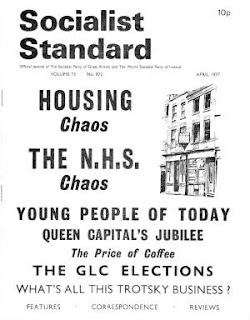
So They Say: People in Glass Houses (1977)

The So They Say Column from the April 1977 issue of the Socialist Standard

People in Glass Houses

When a leading authority on a subject makes a judgement, it is an important one. On February 28th Mr. Eric Heffer described the entire Conservative Party as hypocrites. He was taking part in a mutual exchange of hot air in Westminster Palace on the question of the British Leyland toolmakers’ strike.
It was hypocrisy for the Conservatives to say there should be higher incentives for the higher paid but when workers sought incentives they were accused of being disruptive.
Daily Telegraph. 1st March 77
This is a part of what is romantically referred to as the cut and thrust of debate, which in reality resembles nothing so much as the moronic lowing of cattle. It does not strike Labour MPs as odd that their own Minister for Industry, Mr. Kaufman, advances the argument that the Leyland strikers have brought the company into “danger of bleeding to death”, while two days later their Industry Secretary, Mr. Varley, was informing his cronies that “the effect on profits was critical.”

How is it possible for workers to bleed a company to death by withholding their labour-power? That is putting the cart before the horse. One certain effect a strike will have is to prevent the workers’ own life-blood being pumped in to emerge later as the profits so dearly sought by the Labour Party. Where has the accumulation of capital now vested in British Leyland come from, if not from the “bleeding” of surplus-value from previous generations of workers? That is the process which the Labour Party wishes to continue.


Marx, out of date ?

As Heffer pointed out, the Conservative backwoodsmen have emerged wanting to back it both ways by condemning Leyland workers on the one hand, while claiming that the “erosion of pay differentials” is to blame on the other. Mr. George Gardiner, Conservative MP for Reigate, added his tuppence worth in a Sunday Express article of March 13th. “There is nothing praiseworthy about suicide”, he decided in reference to the strike. With a little twisting and turning, two paragraphs further on he is commenting on the size of wage differentials between skilled and unskilled workers. On behalf of the toolmakers he asks: “Was all that early training worth it?” 

Aware of the fact that he has to produce something more “praiseworthy" than this, he goes on to argue that “squeezed differentials” have taken the edge off what he calls "our national competitive ability”. The Conservatives will change all that.

More powerful influences than Mr. Gardiner or his Party however will determine the levels of differentials, and the Labour government will be unable to keep the lid down for long as the laws applying to the value of labour-power begin to be felt. No doubt the Conservatives would be horrified to think that something which they are now promoting as a policy, was outlined by Karl Marx as one of capitalism’s economic laws, more than 100 years ago.
Upon the basis of the wages system the value of labouring power is settled like that of every other commodity; and as different kinds of labouring power have different values, or require different quantities of labour for their production, they must fetch different prices in the labour market.
Wages, Price and Profit, Chapter 7.
It is doubtful that the Conservatives will refer to this passage when proclaiming their “policy”, but then they would happily take the credit for restoring the law of gravity should the Labour Party try to ignore it.


More from Mr. Gardiner

Once warmed to his theme, the MP for Reigate is a hard man to stop. He gushes: “Let us not only recognise differentials, but positively welcome them.”
For virtue lies not in enforced equality, but inequality, provided it is founded on merit and not on privilege.
Sunday Express, 13th March 77 (His emphasis)
From a working-class point of view the above is pure humbug. The ownership and control of the world's resources, the means of life, rest in the hands of a privileged minority of men and women. They have taken the inequality which Mr. Gardiner sees as so desirable to its logical conclusion—they have left the members of the working class with nothing except the ability to work. If Mr. Gardiner seriously wishes to question the “virtue” of the situation, the first thing he must do is to leave the Conservative Party and look around him.

The News of the World of the same date published their “Wills of the Week” column—their equivalent of the last rites—and the gross value of tho three wills reported came to just under £l.5m. The three deceased must have indeed been meritorious workers by any standard to have accumulated an average of £500,000 each. The answer is that all the talk of merit is a carrot (or a stick) and applies only to members of the working class. The answer to workers’ problems does not revolve round the question of pay differentials within capitalism, but on a clear understanding of the need to abolish the wages system itself.
Higher productivity would help solve some of our problems, but it will only help employment if it is reflected in higher profitability. The union leaders can be forgiven for not knowing this, for it is a branch of economics outside the mainstream of thinking on which British economic management has been based.
Sunday Times, 13th March 77
And he has proved it all with the help of “coefficients of determination of a regression equation”, so it must be official. Union members previously labouring under the misapprehension that employers were in business primarily to provide employment will now see that there is something in it for the governors after all.


There's no fool  . . .

Now that Harold Wilson is trying to assume the mantle of “an elder statesman” he feels at liberty to speak with even more ambiguity than we had previously thought possible. Addressing the Financial Times conference on the future of Europe on 11th March, he discussed political problems in Britain.
The Communists presented no political problem apart from marches and demonstrations. Britain’s problems were on the one hand Fascists and the National Front, and on the other the various kinds of what were usually lumped together as Trotskyists, the International Socialists, the Workers Revolutionary party, the Socialist Party of Great Britain, and various others.
Daily Telegraph, 12th March 77
Wilson does not say that he is doing the lumping together, but as he is the only one in sight it is difficult to avoid the conclusion. However, be he as pure as the driven snow in the matter, we have some useful advice for him so that he may not compound the error. Read our Object and Declaration of Principles published on all our literature. They will appear unfamiliar at first and that is because they are Socialist principles. Pay especial note to principle number 7—that applies to the Labour Party and all the other non-Socialist organizations referred to.
Alan D'Arcy

Saturday, November 16, 2019

Who are the Marxists? (1966)

Book Review from the June 1966 issue of the Socialist Standard

A Socialist Review, International Socialism, 18s.

This book is a collection of articles from a now defunct journal, Socialist Review. Its former followers are now grouped around another journal, International Socialism. It is one of the many trotskyist offshoots which claim to be Marxist, yet which depart radically from Marx’s basic ideas on many points.

Marx argued that only the working class can free itself from wage-slavery. By working class he understood all those who, having no property, had to sell their working abilities for a wage in order to live. Today this class, composed of managers, clerks, factory workers, labourers and so on, run society from top to bottom. The Socialist Party of Great Britain, with Marx, holds that only they, acting as a united class, can be the agent of the social change from capitalism to socialism. IS sees the agent as only a section of this class, those who work in the factories, mines, railways and docks. In fact, it would be no exaggeration to say that they idealise this section of the working class. Seeing that most of the members of groups like IS are not themselves workers in these sorts of jobs their attitude verges on the condescending, of doing something for the poor, down-trodden workers. This attitude is a left-over from their Leninist past. Lenin, in contradiction to Marx, held that the workers were incapable of becoming socialists by themselves; they had to be introduced to socialist ideas by an enlightened vanguard. This vanguard would lead them against capitalism.

The IS group, like similar groups, has a reform programme which they call a "transitional programme." This is a programme designed to create a socialist understanding and to be realised as a transitional stage to Socialism. When these reforms are examined, for example, nationalisation of banks, national planning, State monopoly of foreign trade, it becomes clear that IS is saying that State capitalism is a necessary stage to Socialism. More than this, in fact, many of their members including some writers in this book clearly don't understand the difference between State Capitalism and Socialism; they really believe that nationalisation is Socialism and that wages, buying and selling, money, etc., will exist in Socialism. In their day-to-day propaganda the emphasis is on State capitalism rather, than Socialism as the solution to workers’ problems. The Socialist Party of Great Britain holds that capitalism has outlived its usefulness and that Socialism is possible as soon as the workers want it; there is no need for any State capitalist stage.

Finally, there is the inevitable r-r-revolutionary romanticism, the dreaming of mass strikes and street battles (read Cliff on the Belgian General Strike of 1960). This leads IS to dismiss with contempt the historically-evolved means to freedom—the vote. But at election times we witness the spectacle of people who dismiss the vote as “a scrap of paper" and Parliament as a “gas house" eagerly working for, and urging workers to vote for, one of the major capitalist parties in this country. This devotion to the Labour Party is maintained even when, as in Hampstead at the last election, they were faced with a socialist candidate. Not understanding the significance of the vote they use it and urge others to use it, to give political power to the owning class. Are they really Marxists?
Adam Buick

Saturday, February 10, 2018

The Decline of Coal (1968)

From the September 1968 issue of the Socialist Standard

Coal played a great part in the development of capitalism in Britain. Wood used to be the main fuel but in the 18th century coal mining was stepped up as coal was needed for smelting iron. Many mines were in fact owned by the ironmasters. Coal was also used for steam-raising and, with the expansion of steam driven locomotives, ships and machines, in the second half of the 19th century, production increased from about 50 million tons in 1851 to over 240 million in the first decade of this century. The peak year for the British coal industry was 1913 when 287 million tons were mined, of this nearly 100 million were exported or went into bunkers for ships sailing to overseas ports. In the nineteenth century coal had no serious rival as a source of fuel and power. Coal was and still is used to raise steam for electricity generation and also in the manufacture of town gas.

Because of its importance as a source of fuel and power for modern industry, coalmining was particularly hit by industrial depressions, as our graph shows. It also placed coalminers in a strategic position. The miners played a major role in the development of the working class movement in Britain. Their history was one of continuous struggle against rapacious mine owners, often involving bloody clashes with the military. The first working class MP’s, elected for the capitalist Liberal Party, were miners. The Miners Federation of Great Britain, set up in 1889, was at one time the largest trade union in the world. The General Strike of 1926 was called by the TUC in answer to a lock-out of miners. Although the strike was called off after nine days, the miners heroically held out for nine months before being defeated by hunger. Between the wars, and specially at the beginning of the thirties, almost the whole adult male population of many mining villages was out of work. It is probably fair to say that, as a result of their experiences and of living in their own communities, the miners reached the highest degree of industrial class consciousness of any group of workers in Britain; at least this is true of the South Wales miners. 

Coalmining was an industry in whose efficiency all capitalists were interested as they wanted the cheapest energy they could get. The old owners were notoriously inefficient so that nationalisation was advocated by many besides the Labour Party and the MFGB. The Tories nationalised the coal before the war, and Labour the mines after. On vesting day, 1 January 1947, every one of the thousand collieries displayed a large notice proclaiming: THIS COLLIERY IS NOW MANAGED BY THE NATIONAL COAL BOARD ON BEHALF OF THE PEOPLE. Many miners thought that this was Socialism or at least a step toward it but it was only state capitalism. The miners remained exploited wage-workers even though nationalisation allowed an improvement in working conditions. There has been no official strike in mining since nationalisation; so-called unofficial strikes have been frequent however. The main union is the National Union of Mineworkers (NUM), as the MFGB became in 1946. The NUM has rivals organising clerks in the Clerical and Administrative Workers Union (CAWU) and various underground supervisors in the National Association of Colliery Overmen, Deputies and Shotfirers (NACODS). Management grades are in the British Association of Colliery Management (BACOM).

For the first ten years of nationalisation the miners never had it so good. They were in a strong bargaining position as the demand for coal far exceeded its supply. Industry wanted every ton that could be produced but it was not until the early fifties that pre-war output and productivity levels were reached. As a useful reminder that even militant unionism is based on sectionalism, it is worth quoting from an agreement reached in 1947 between the NCB and the NUM on the employment of Polish workers. This agreement, after reasonable provisions about any Polish workers being employed on the same terms as everybody else and on union membership, went on:
  In the event of redundancy Polish workers shall be the first to go. They shall be transferred or dismissed wherever their continued employment at a particular pit would prevent the continued employment or re-employment of a British mine-worker who is capable of and willing to do the work on which the Polish worker is employed and who might otherwise be displaced by redundancy at that pit or at another pit.
Then, in 1957, the bottom dropped out of the market for coal. The change was dramatic. In its report for 1957 the NCB declared:
  Total coal output in 1957, including that from opencast sites, was 223.6 million tons. This was 1.4 million tons more than in 1956 and the highest annual output since 1952.
But in 1958 it was a different story:
  Total coal output in 1958 was 215.8 million tons, including 14.3 million tons from opencast working. For the first time, the Board had to take steps to restrict production to meet a decline in demand; the years output was 7.8 million tons less than that of 1957 and was the lowest for eight years.
The following table illustrates the change:


What had happened, then? The table shows that consumption fell drastically in 1957. It had in fact been falling since 1955 and this represented increasing competition from oil. But an event at the end of 1956 hastened the switch to oil. Britain, France and Israel attacked Egypt and the Suez was blocked. Oil supplies from the Middle East could not get through to Europe. The oil companies opened up new sources to meet the shortage so that, when the canal was cleared, they found themselves with a surplus. They brought down their prices and were able to beat coal. Coal production has fallen every year since 1957. It has been the same story in France, Germany and Belgium. Oil use as a proportion of total fuel rose in the period 1957-67 from 15 per cent to over 37 per cent. The government’s Fuel Policy White Paper, published last November, foresees that this trend will continue though oil will be under pressure from natural gas and nuclear energy. By 1970 coal production, they guess, will be down to 155 million tons; still nearly 50 per cent of fuel use in Britain though. Lord Robens has gone further: he says it will be 120 million by 1975 and perhaps only 80 million by 1980. This coupled with increasing mechanisation will mean a huge reduction in manpower. The areas worse hit by the closures are and will be the older coalfields in Scotland, Cumberland, Durham, Northumberland and South Wales. Already there are workers in these areas who have been unemployed for over a year and so are on “supplementary benefit” (the old National Assistance) being subjected, perhaps for the second time in their lives, to a means test. The government has announced fairly generous, by capitalism’s standards, redundancy payments for those who have lost their jobs since July last year—this of course is a reflection of the strength of the workers organised in their unions.

The post-war history of coal-mining in Britain bears out the socialist case: trade union action, though essential, cannot do much more than work with or against market trends. For the first ten years of nationalisation the demand for coal exceeded the supply; for the next ten the position was reversed. All the NUM is doing now, and of course it can do no more, is “retarding the downward movement, but not changing its direction” as Marx put it in another context.
Adam Buick

Saturday, February 27, 2016

What the class struggle is and is not (1977)

From the June 1977 issue of the Socialist Standard

Paradoxically, the militants and intellectuals who preach class struggle with the utmost vigour appear not to know what it is. Their position transferred to a military war would be careering round the battlefield, declaring strategies, uttering heroic cries and calling on all right-minded men to follow them — without knowing what the war is about, or who the sides are.

The impression given by the majority of “left-wing” writers is that there are many class struggles, some more important than others. If a major struggle underlies them, it breaks out sporadically and is confined to productive industry. Some examples are:
On this rising curve [1911-1914], working-class militancy swept into a series of titanic struggles.
   The first effect of the process . . . was a recession of the revolutionary tide in September, leaving militants still struggling forward on the water-mark. Gramsci called the proletariat to battle on 7 June 1919.
(G. Williams, Proletarian Order, 1975)
   During the 1920s there were mass struggles . . . though none with the revolutionary potential of the wartime shop stewards’ movement.
(Hinton and Hyman, Trade Unions and Revolution, 1975)
   Money wages in fact fell 38 per cent between the winter of 1920-21 and the winter of 1923-4; and many of these cuts were not secured without the most fierce class struggle.
(Glyn and Sutcliffe, British Capitalism, Workers and the Profits Squeeze, 1972)
In the musical play Wreckers by David Edgar, performed at the Half Moon Theatre in May 1977, a depiction of the “five dockers” episode of 1972 leads to a song with the refrain “This is class war”. What such statements convey is that some workers, chiefly in factories and docks and mines, find a war has broken out for them in particular circumstances from time to time.

Definitions
The capitalist system is based on the ownership of all the means of production and distribution by a minority of the population. The majority therefore are non-owners, and their only way of living is to go to work for wages. There are no alternatives; these are the two classes of capitalism. The wage may be called a salary, and wages — the price of labour-power — vary as do the prices of other commodities. Nevertheless, all those who do not live by owning are in the same position: the working class.

Contrast this with the type of statement found in Raya Dunayevskaya’s Marxism and Freedom, a work which argues a theory of militancy. The writer says:
At the point of production, Automation has compelled two fundamentally different class attitudes, depending on which side of the machine you stand . . . the machine is always on top of you and keeps you isolated from your fellow-workers. In addition, you feel more isolated as more and more of your shopmates are displaced by the monster machine. If, on the other hand, you are the one who drives the men and counts the production for management, you praise the machine to the skies.
This is playing to the gallery as regards the machine operator’s sentiments; but it also implies that those who are not machine operators are not workers, have no such problems and belong in the capitalists’ camp. In reality the factory worker who accepts this has swallowed capitalist teaching which aims at dividing the working class.

Certainly many wage- and salary-earners believe they belong to “the middle class”. It is a legacy of the period when the capitalist class had not become dominant and were a section between the feudal ruling class and the lower orders. In capitalism the idea is an anachronism which helps conceal the basis of the class struggle. The question is not simply knowing which class is which and leaving it there. Classes must willy-nilly pursue their interests. The capitalist class has to try to secure its profits; the working class likewise does what it can for its living standards. This is the workaday trade-union aspect of the struggle, and by itself makes nonsense of the idea that machine operators and white-collars are different classes. “Professional” workers have to organize and threaten strikes over pay and redundancies just as if they were dockers — because their position is the same.

It is not a sporadic but a continuous struggle; it is also, in that aspect, a restricted one. Obviously it will go on as long as the wages system lasts and will not stop the system. The more important side of the struggle is working-class interests pressing for a change in society. Throughout history, the classes identified with the forces of production have found themselves shackled by social systems which have gone on too long. When they are aware of their position they move to put themselves in possession of the means of production and distribution. This is the vital struggle for the working class in the twentieth century.

Misleading
The most pernicious word in politics is a plural: “struggles”. Under its influence, any clamour is supposed to be a bit of the class struggle. Thus, the Solidarity pamphlet As We Don’t See It (undated but recent), after pointing out that under “the mindless slogan ‘Support for people in struggle’ ” several left-wing groups support the ira and reactionary National Liberation Fronts, says of other groups: “For instance, when they (correctly) support struggles for limited objectives, such as those of squatters or Claimants’ Unions, they often fail to stress the revolutionary implications of such collective direct action.” What revolutionary implications?

The Nuclear Disarmament movement of the early nineteen-sixties was the first of a series of band-waggons on which the militants claimed to be for “struggles”. It was followed by demonstrations against the Vietnam war, support for civil rights, squatting and tenants’ campaigns, Women’s Liberation, protests against the Industrial Relations Act (curiously, not the “social contract”), demands to fight racism and for the right to work; and there are the “struggles” against hospital closures, education cuts and town-planning schemes. The motive for the political egging-on is said to be “people are changed by struggle”. At the time of the last and biggest anti-Vietnam demonstration in October 1968, the leaders asserted this publicly: that, thrust into conflict with the police, ordinary people would learn first-hand the violence of the state. Less dramatically, it is argued that participation in small struggles “raises consciousness” and gives an appetite for greater ones — even, that it is a preliminary to Socialist consciousness.

All this is quite untrue. If struggle per se does change people, what direction does the change take? The most likely outcome of a whack on the head from a policeman, for a person who does not understand the situation anyway, is a decision not to risk it happening again in future. Beyond these absurdities, incitement to “struggles for limited objectives” does not contribute to consciousness of class interests. It does the opposite. To the extent that people regard (and are encouraged to regard) their grievances as tenants, women, blacks etc. as “special”, they are drawn away from realization of their standing as members of the propertyless wage-working class. What the “struggles” provide is a mirror-image of the idealism of capitalism: that “human problems” precede class relationships. Yet the difficulties of groups and sections all stem from the basic class division. Consciousness of it can illuminate all the other problems — but not the other way round.

Action
Political parties stand for class interests. The major parties all claim — the Tory Party has made it a slogan — that they represent “all the people”. Obviously in a class-divided society that is not possible, and it would be better put that the Tories are wedded to capitalism but have to try for the favour of the electorate. The Labour Party is also wedded to capitalism, but it is seen by a large number of people as somehow embodying working-class interests: it is supported by the big trade unions, and the most poverty-stricken industrial areas have always provided its safe seats. The left-wing parties and militants unanimously become advocates for Labour at election times, on those grounds.

Of course the militants do not consciously set out to give capitalism a hand by recommending Labour to run it. They would say they are against capitalism and want some substantial change. On the surface they are misleading members of the working class by calling on them to struggle against the régime and at the same time to support it via the Labour Party. However, the matter goes deeper than that to non-comprehension of the class struggle. In some cases the doctrine of “day-to-day struggles” leads inevitably to embracing Labour reformism. For example, opposition to the Industrial Relations Act was bound to become vested in getting a change of government; groups demanding this and that have to look for promises of legislation. If it is believed that any and every “struggle” counts, that some workers are more working-class than others, that “class war” is periodic local outbreaks against Tory legislation or the perfidy of trade-union leaders — the outcome will be not only confusion but action which, whatever the intention, cuts across the interests of the working class.

There is only one struggle. The industrial part of it has to and does go on all the time. It is to the political part that working men and women must attend to solve their overriding problems. The solution must be to end the wage-labour relationship: the abolition of capitalism and the establishment of a classless social system, Socialism. Since it must be based on common ownership of the means of living, the movement for it can only be a political one. The state is the key to class rule, and hence to its overthrow. This is the vital struggle. “Struggles” get in its way.
Robert Barltrop