Showing posts with label April 1957. Show all posts

Tuesday, April 12, 2022

War on the Wage Front (1957)

From the April 1957 issue of the Socialist Standard

Is  the Time Opportune?
Along with the shipbuilding workers who came out on strike on 16 March, millions of workers in the engineering, building, railway and other industries have claims awaiting settlement. The newspapers and politicians urge the workers to be moderate and to submit their case to arbitration and they profess to be shocked that a trade union official, Mr. Hill of the Boilermakers, should say "No arbitration. We are going to fight" and that Sir William Grant chairman of the Engineering and Allied Employers, West of England Association, should declare:—“This time we do not want government interference. That is quite positive. We want to fight it out ourselves. We have got to stand firm and prove to these fellows that things are not done so easily." (Daily Mail, 13, March, 1957.)

In the same quarters tears are shed because there should be a hold-up of industry “just now,” the idea being that strikes are all very well in the past or in the future but not (as the Daily Mail puts it) “just as Britain is coming out of the Suez squeeze and the gold reserves are climbing up again." This is humbug and is a line of argument that should be totally ignored by workers considering strike action. If at any time conditions are relatively favourable for workers to strike be sure the Government and the employers and the Press will find reasons why it should not take place then. But workers with long memories will recall the many times past when they have been lulled into delaying action while the employers prepared for battle. It happened in 1922 with the engineers in a dispute over an overtime agreement. Negotiations broke down in April, 1921, but the employers waited seven months before they delivered their ultimatum that led eventually to a weeks long lock-out—they were waiting for the heavy unemployment to undermine the resistance of the workers and to deplete the funds of the Unions through payment of unemployment benefit.

Are the Employers Bluffing?
The present engineering dispute is being fought against a background that is very different from the lock-out of 1922, and the difference is not that, because of the so-called “Welfare State,” the wages war has changed its nature or that arbitration has made strikes unnecessary. The difference lies in the state of industry and of unemployment, the factors that workers do need to study closely. Strikes are not won by bull-headed bravery; the employers, with the Government behind them, if they regard an issue as vital, cannot be starved into submission, and in a long-drawn-out battle of that kind are bound to win. But if trade is good and employers do not want to have profitable production interfered with their first blunt refusal to make an offer will prove to be bluff. That may well be the situation now and short sharp strike actions may be successful.. A few months ago with motor car and ancillary plants on short time many employers may have contemplated a show-down over wage claims but with the motor trade recovering and engineering and shipbuilding profits and exports on a high level it is more likely that employers generally will be prepared to pay a wage-increase rather than have plant shut down and contracts interrupted.

The Daily Mail in a leading article (13/3/57) has admitted that “there is little question that the shipbuilders could afford higher wages . . ." They were doubtful about some engineering firms but it is rather surprising that they should have gone so far as this.

The Labour Party and Strikes
Labour spokesmen have attacked the Tory Government for their handling of wage disputes and in particular have blamed the Government for allowing the cost of living to rise. But no one should be deceived into thinking that things were any different when the Labour Government was in power. In 1948 there was also an engineering wage claim, which likewise the employers turned down. The engineers then too threatened strike action and their case was based on the rise of the cost of living and the general inadequacy of pay. But far from the Labour Government giving them encouragement, this was the time of the “wage-freeze” policy and the workers were being told that they should not ask for more pay although prices were rising.

But the engineering workers persisted and their threat to strike brought results, for a court of inquiry specially appointed by the government recommended a wage increase, though it did so with the explanation that it was only because of “particular circumstances" in the engineering claim and was not to be a precedent for other workers and so upset the Labour Government's “wage freeze" policy. It did in fact open the way for other workers to claim.

Don’t worry about the Germans and the Japs
The workers who demand more pay and threaten to strike are being told, as they always are on such occasions, that British export prices will be pushed up and foreign manufacturers will capture all the markets. The obvious working class reaction to this factor ought always to be that of strengthening international trade union organisation so that workers in all countries can act together on wage claims, this time some sort of all-round movement is in being for wages are rising fairly generally in Europe, U.S.A. and elsewhere. In Germany it is the engineering and shipbuilding workers who are leading the way and Japanese workers also are striking:—
“In Germany, organised labour is growing steadily more militant; Its appetite has been whetted by the success of the 16 week strike of engineering and shipyard workers over sickness payments and annual holidays, and similar claims are expected from other branches of the Metal Workers Union. In Japan, this year's labour troubles look like being worse than last year's. . (Financial Times 14/3/57).
Nonsense abort Nationalisation
Some engineering and building workers are deceiving themselves with the notion that the long-term way out of their wages difficulties and the threat of short-time or unemployment when sales fall off, is to press for nationalisation of their industries. They should think again and drop this nonsense. Nationalisation has solved no problem for the working class and they have before their eyes a striking example in the railways. The railwaymen are among the worst paid industries. They have just rejected a miserly offer of a three per cent. increase and appealed to arbitration for more. And at that arbitration on 26 February of this year the spokesman of the Transport Commission, opposing the claim, gave the same reason as does every group of employers, “the duty" of the Commission to resist the claim on the ground of their financial difficulties, the fact that they are making a loss instead of a profit (Daily Telegraph, 27 February, 1957).

Nationalisation is not deserving of working class support and to raise the issue in relation to a wage claim is worse than useless.

But that is not to say that workers should go on year after year imagining that there is no other way except to strike for higher pay when trade is good and go down fighting when trade is bad. The way is open whenever a socialist working class wants to use it. It is to take democratic political action to get rid of capitalism and establish socialism in its place. Then there will be the certainty, through the ending of the destruction and waste of capitalism, of bringing about a vast increase in the production of useful things and no propertied class to stand in the way of that so much promised and never arriving "higher standard of living.”

The suicidal action of the workers every few years at general elections is of far greater and more lasting importance than the strikes for higher wages that occur in between. At elections the working class places in power the Tory or Labour politicians who use their office to keep in being the social system which makes the workers a propertyless class producing wealth and profits for the capitalist minority. Given this situation, with the government in the background safeguarding the position of the propertied class, the industrial struggle over wages and conditions of work can go its up and down way indefinitely without ever settling anything. Socialism is the only way to end it and open up a new horizon for society.
Edgar Hardcastle

New Pamphlet (1957)

Party News from the April 1957 issue of the Socialist Standard

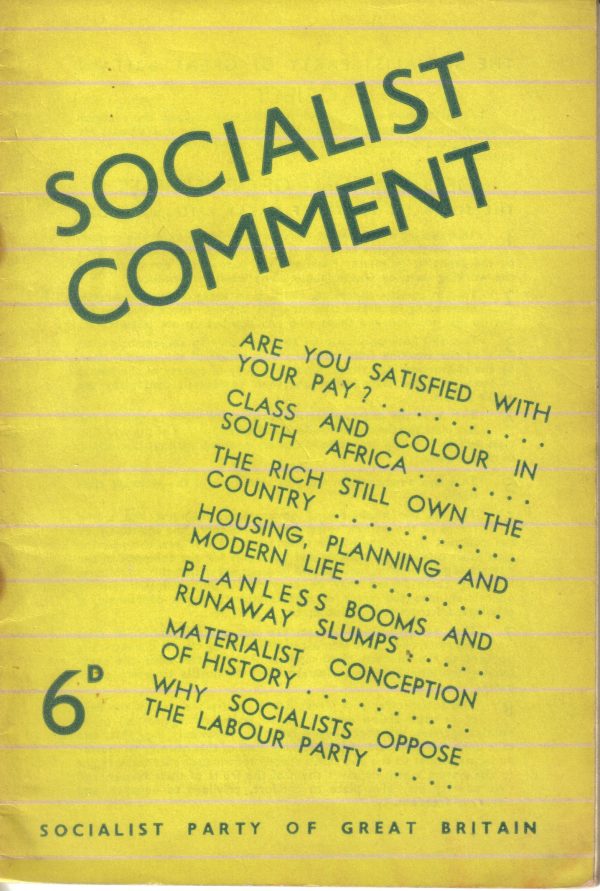
A pamphlet Socialist Comment, is now on sale (40 pages, 6d., post free 8d.) It contains seven articles reprinted from issues of the Socialist Standard during the past year or two. It deals with the colour problem in South Africa; why Socialists oppose the Labour Party; Housing; boom and slump; the ownership of property; and the workers’ ideas about their pay.

Hints on Civil Defence (1957)

From the April 1957 issue of the Socialist Standard

What are you doing about Civil Defence? Busy sealing your windows with sticky paper, learning how to bandage a cut finger, and how to dig grandma out of the rubble? If so, we’ve got news for you. Hiroshima and Nagasaki are ancient history—civil defence methods being taught today are likely to be as effective against future nuclear weapons as stone-age implements would be against tanks.

And what authority have we for taking this rather pessimistic view? None other than Mr. Val Peterson, who is the Federal Administrator of Civil Defence in the United States. His department was set up in 1951, and his conclusions are, therefore, by no means hasty speculation, but the outcome of six years' study of a subject vital to American government policy. According to an article by Mr. Alistair Cooke in the Manchester Guardian (20/2/57) “He (Mr. Peterson) has refused to admit that any plan of civilian defence no matter how grandiose in conception or how faithfully executed, can cope with the destructive power of modern weapons, any more than a teacup can bale out a sinking liner.”

Tut! Tut! We trust that the appropriate authorities over here will give the lie to this defeatist philosophy, even though it comes from such an expert as Mr. Peterson.

Mr. Peterson is pretty gloomy about the protective value of air-raid shelters, even if there will be enough of them left for us poor workers after the needs of service chiefs, cabinet ministers, captains of industry, etc., have been met. To quote Mr. Cooke again: “Mr. Peterson said that if the whole 170 million Americans had air-raid shelters, at least 50 per cent of them would die in a surprise enemy attack.” In the final analysis, he said: “There is no such thing as a nation being prepared for a thermo-nuclear war.”

In an emergency Mr. Peterson’s office would be responsible for dispersing the American government, evacuating the cities, and commandeering transport, utilities, and hospitals. But would we have any warning that an emergency existed before the first hydrogen missiles began to fall like the gentle dew from heaven?

However given three hours’ notice Mr. Peterson thinks that about half the population of the inland cities in the United States could possibly be saved by totally evacuating them. But where could the population of the inland cities of Britain go? There just are not the wide open spaces here as in the U.S., and one or two strategically placed hydrogen bombs. . . but there, it does not do to be too morbid. Unfortunately, according to Mr. Peterson, the inhabitants of coastal cities in the U.S. would not fare so well as the inlanders because of unheralded atomic shellings by submarines suddenly popping up out of the sea: we will suppress any remarks about British seaside resorts in case the good mayors of Brighton and Margate blame us for any decreased attendance of holiday-makers this Summer.

The interest in Soviet air power is misplaced, according to the New York Herald-Tribune (also quoted in Mr. Cooke’s article), because long-range submarines could be used as launching platforms for nuclear missiles having ranges up to 5,000 miles; the great industrial centres deep in the heart of the U.S. “ are within range of this potential terror streaking out of the Atlantic, the Pacific, and the Gulf of Mexico.” Submarines streaking out of the North Sea (long or short range) could deal very effectively with the closely concentrated industrial centres in Britain.

So it looks as though we must abandon the sticky paper those nice shiny tin helmets, etc., and take to the hills. But wait a minute, that awkward Mr. Peterson has objections to that idea as well. To quote Mr. Cooke: “Mr. Peterson thought that, even to rescue half the population, the United States would have to start at once plans for housing most of its city populations underground in the mountain ranges of the East and West. He piled on the misery by warning the committee that even such drastic plans foresaw only an attack by hydrogen weapons. Within a year or two, by 1966 at the latest, he was convinced that the inter-continental ballistic missile, with an atomic or hydrogen warhead, would be the prime weapon. When that was perfected, he said, the Government's recommended plans for evacuation would be 'out the window.' ”

But the worst is yet to come! Mr. Cooke’s stimulating (but rather gloomy article) ends by quoting the New York Journal-American, which has revealed that U.S. military scientists are working on an inter-continental missile with an “anti-matter” warhead that “would make the hydrogen bomb look like a fire cracker.” According to Mr. Cooke “one gramme of 'anti-matter' could trigger a weapon as powerful as the Hiroshima bomb; and the expert guess is that a portable warhead could ’conceivably blow the Soviet Union off the map.' ”

Our rulers tell us that we must have the latest (and therefore most devastating) nuclear weapons because they are “deterrents” to potential aggressors; it is never Britain which is the potential aggressor, but always “the other side.” Of course, the governments of the United States, Russia, France, Germany, etc., are busy telling their own workers the self same story. No government wants war, and yet all are preparing for it.

Socialists know that war is the final arbiter in the bitter struggle between rival capitalist groups. So long as capitalism remains, the threat of war with or without thermo nuclear weapons is ever present, casting a dark and dreadful shadow over the happiness and peace of mind of millions of human beings.

The only effective civil defence measure would be the rapid growth of Socialist knowledge among the workers of the world, so that capitalism may be replaced by socialism, and international rivalry abolished.

One final hint: read our pamphlet The Socialist Party and War (price 1/-). which contains a detailed socialist analysis of the cause of wars: there is more practical advice and cause of optimism contained within its 100 pages than in all the mass of civil defence literature published by governments which at the same time are planning more efficient means of destruction.
Michael La Touche

The Irish Elections (1957)

From the April 1957 issue of the Socialist Standard

"The main problem now confronting the people is to discover by what defect in our system it has come about that the nation, while never better equipped in knowledge and machinery to produce all its needs, is forced to see so much of that knowledge wasted and the machinery lying idle, while thousands of willing workers are unemployed and in need of the necessaries of life."

Thus spoke Senator James Hickey, Chairman, at the Irish Labour Party’s annual conference in Athlone, less than a year ago. At the time, Labour was the second largest party in a Coalition Government, which had been pledged to discover and remedy this defect along with all the other problems of the Irish working-class, who had elected them. They failed to do this and as a consequence. must now try to fill the opposition benches, with depleted ranks, while the task of administering Irish capitalism passes to Mr. De Valera and his colleagues in the Fianna Fail party Speaking at an earlier Labour Party conference, shortly after being elected to power, Mr. B. Corish (A Labour Minister) said: "Workers could look forward to the day when the spectre of emigration would have become a bad memory . . . it remained one of the fundamental aims of the Labour Party to see that every person who was willing to work would find decent employment in his own country.” (Dublin Evening Mail, 30/9/49). Yet, in a statement issued on the 26th January of this year, explaining why he could no longer support the Government, Mr. S. McBride, ex-Minister for External Affairs pointed out that the unemployment figure was now 100,000 and that in the five year period 1951-6, over 200,000 people had been forced to emigrate. So much for Labour Party promises. In Dublin, where unemployment is most acute, the unemployed put up a candidate of their own and succeeded in capturing a seat at the expense of the party who claimed to have the solution to their problems! Work hard, they were told, and prosperity is yours. “If our national income becomes stagnant, if we refuse to work hard and produce more, social security becomes merely a delusion and a deception, said John Costello, the Prime Minister, in 1948, but the man who was Minister for Social Welfare (plus the portfolio of Deputy Prime Minister), Wm. Norton (Leader of the Labour Party) had told the workers ten years before, that “Under our' present social system, greater productivity means a lower wage for the worker and higher profits for the owner of industry.” (Labour News, Dublin, 29/1 /38). Though Costello could claim in the Dail (20/7/49) that the 1948 volume of production for all industries was 28% above the 1938 volume and the United Nations Statistical Bulletin issued on 6 November, 1947, included Eire among the countries showing monthly production averages higher than 1937, the International Labour Office in its cost of living findings for February, 1947, picked out Eire for special mention among four countries where “real wages have actually dropped below 1937 levels.” Little wonder that the tide has again turned in favour of “ Dev.”

If however the working class of Ireland believe that their problems can be solved by Fianna Fail, they are in for a rude awakening; for the record of that party is a record of service to the only class which can be served under capitalism—the capitalist class. It was they who introduced the most repressive anti-working class legislation in the history of the State. The Wages (Standstill) Order, the Trade Union Bill, the Industrial Relations Bill (which set up the now notorious Labour Court), all measures designed to hinder the efficacy of trade-union action, in the interest of Irish employers. After sixteen years of Fianna Fail rule, the Medical Superintendent of the Dublin Fever Hospital stated that: “Until the Dublin wage-earners and their wives and children were decently housed and fed, more beds in sanatoria and tuberculosis hospitals would be needed.” (Irish Independent, 24/6/49). That was Fianna Fail before; may we expect a change now? The answer is an unqualified “ NO ” and to prove that he is consistent in his concern for the class he represents, Mr. De Valera’s first statement after his election success was— yes, you guessed it—a clarion call for harder work! “One great, combined and sustained effort and the task will be done.” (Irish Times, 8/3/57). And the “task?” To put a very shaky native capitalist class back on its feet again, while Irish workers continue to live in poverty and go to Mass on Sundays.

There is, however, one bright spot in this otherwise murky picture; the tiny (as yet) Socialist Party in Ireland, continues, with the limited means at its disposal, to point out to Irish workers the message of Socialism, that until the machinery referred to in the first paragraph is commonly held by ALL, it will continue to lie idle, however willing a non-owning class may be to use it. This wonderful world can be OURS when enough of us really want it AND KNOW HOW TO GET IT.
F.

Party News Briefs (1957)

Party News from the April 1957 issue of the Socialist Standard

Annual Conference is being held once again at Conway Hall, Red Lion Square, London, on Friday. Saturday and Sunday, April 19th, 20th, and 21st, commencing 11a.m. (Sat. 2.30 p.m.) Every effort is being made to ensure that a good delegation is present to discuss the work of the Party during the past year. Apart from work to be done and plans for future Party activity discussed, members have a good opportunity of meeting Comrades from the Provinces and other London Branches and making Conference a social venue. A dance and social will be held on the Saturday evening; a good dance band has been engaged and it now rests with Comrades and friends to enjoy themselves at this annual Party event.

#    #    #    #

Lewisham Branch has organised a series of four meetings to make known in greater detail the “Socialist View on Four Burning Issues,” the plan for a European Common Market; the South African Racial Problem; the Rent Bill and the Cost of Living. Not a week goes by but that these issues the subject matter of thousands of words, both printed and spoken through Press and Radio. These meetings will set those problems in their true perspective, evaluating carefully the interests at stake, and stating plainly what action is necessary to bring about a lasting solution. Although the meetings do not commence until May, the Branch Organiser and Branch members are anxious that members should know well in advance in order that they may advertise the meetings among their friends.

#    #    #    #

Comrade T. P. Gibbs. We regret to learn that this Comrade from Tottenham Branch died at the end of January. Comrade Gibbs had been an active member of the Branch until his death, having joined the Party in 1908. He was always relied upon to undertake any Branch work that was within his powers, helping to build up and maintain the regular sales of the Socialist Standard. He was also the Dues Secretary of the Branch.

#    #    #    #

Comrade R. C. Walker, of Vancouver, Canada, is recovering from a serious illness and is at present unable to supply his Vancouver contacts with Party Literature. We understand that other Comrades are being contacted to carry on this work and meanwhile we wish Comrade Walker a very speedy recovery to good health.

#    #    #    #

At the time of going to press, the Wood Green and Hornsey Branch were discussing the question of contesting the Hornsey bye-election. In any case a publicity drive is under way in the area. Members, especially speakers, living near enough to help, should call at the branch on Thursday evening or contact the Wood Green and Hornsey Organiser at Head Office on Tuesday evenings.

Members are urged to give the fullest possible support to this campaign as from this activity we hope to build an organisation to co-ordinate North London publicity that will make our aims familiar throughout this area.

#    #    #    #

Sunday Evening Film Shows at Head Office. The last two meetings of this season are being held. The Organisers report that the series has been most successful and they look forward to “ bigger and better ” shows next Autumn. The meetings have been well attended and good discussions have taken place after the showing of the films.
Phyllis Howard

Odds and Ends: Wicked Materialists? (1957)

The Odds and Ends column from the April 1957 issue of the Socialist Standard

Wicked Materialists?

Speaking recently (News Chronicle, 22/2/57), as chairman of the Church Assembly, Dr. Fisher, the Archbishop of Canterbury, said: “On so many bodies I belong to, really the business is ruined by these constant discussions about salaries, stipends, and superannuations, and all the rest. . . . I have come to the conclusion that it is an insidious form of pure materialism. It is a disease running through the community.”

Poor Dr. Fisher! He seems so upset at those wicked materialists, i.e. parsons, with average pay, £650 a year: and, of course, all those railwayman, clerks, dockers and the like, who all seem so materialistic in their desire for a better life—in this world. But then our dear Archbishop need not worry himself unduly about his own material well-being. He only receives £7,500 a year as Archbishop of Canterbury.


£400 for a Slave

Fairly recently King Saud of Saudi Arabia visited “the land of the free’’—the United States of America, where he was fêted by President Eisenhower, and other American politicians. Little is known of his country except that there is sand—and more important—oil, in Saudi Arabia. But a recent United Nations report (News Chronicle, 22/2/57) gives us some idea just how “free” and democratic King Saud’s oil-soaked land is. According to the report Saudi Arabia has 450,000 slaves— just 20% of the population. Prices on the Jeddah slave market were said to be between £200 and £400 for a girl under 15; £150 for a man under 40 and £40 for an old woman.

Like Christian Archbishops who also live quite well, Moslem Kings, such as King Saud, do not condemn slavery—chattel slavery in Arabia, and wage-slavery in Britain 1


Human Nature ?

A most startling recent discover was a tribe of Honest Men! It goes without saying that they were not found in Christian lands. They were found in the jungles of Venezuela by Prof. Tenton, an ethnologist. He reports that these uncivilised people never lie, never make war, never kill and never rob.

They have no politicians, no advertisers, no crooks, and are so used to each other’s honesty that they have no locks and keys, no monetary systems and don’t even wear clothes.

All that remains is to protect these Maora Indians from the Christian missionaries, with their civilising influences.” (Freethinker, 14/12/56).


Women in Antiquity

"Women In Antiquity" by Charles Seltman (PAN Books, price 2/6d.), is quite an interesting and provocative little book, although the author has a number of axes to grind. Much of what he has written of women “in antiquity” will be challenged. For example, in his first chapter on Palaeolithic and Neolithic society he sees a situation where from 20 to 50 people live “comfortably” in a cave owned by the biggest male. And, further, after dealing with the activities of the women (such as scavenging for nuts, roots and fruit), he writes:—
“When one tries to imagine the structure of such a cave-family, one can think of two possibilities : firstly, the senior male (whose property the cave was) might have a series of wives from the oldest at twenty-four to the youngest at twelve, among whom there would inevitably exist a kind of harem-like jealousy productive of much unhappiness; secondly, the whole cave-family group may have lived in what zoologists call a 'clone,' in which the women were shared in common by the men." (p. 14.)
Of course, all of this, is purely speculative, and in contradiction to the findings of other anthropologists, who often see an absence of jealousy in primitive communities and who write not of a dominant male but of sexual equality—"sexual communism”—and “group marriage” during this early period of pre-history. Seltman’s ideas on this period seem to be much akin to those of Freud with his dominant father, the jealous sons and the “Primal Horde.” Still, in the main our author is on the side of the women! He generally sees the position of women “in antiquity” as a favourable one compared to their position m some countries today. And he has little sympathy for the Church’s views on women and sexual relations in general. 


“Freedom's Foe—The Vatican"

This book is by a "free-thinking” protestant, and is a counter-blast to Catholic Action. In the main it reiterates the views put forward in greater detail by Avro Manhattan in The Catholic Church Against The Twentieth Century.

Adrian Pigott, the author of Freedom's Foe, deals with the Catholic Church’s alleged former collaboration with Fascism and Nazism, with the “evils of priest craft," the misdeeds of some of the Popes, the "cruelty of the Catholic Church," the extreme poverty to be found in some Catholic countries such as Spain and Ireland (he tells us that “Protestant countries have little discontent or poverty .. ."!!) and the activities of the Church in Britain and the United States.

No doubt many of his criticisms are valid—but what can the Protestant critics of Catholicism, such as our author, offer the working class of Britain and elsewhere? The Church of England, of whom Marx once said, that it would rather give up its Thirty-nine Articles of Faith than give up one thirty-ninth of its property? Neither Protestants nor Catholics, Moslems or Buddhists, have a solution to the problems confronting ordinary people. Only Socialism has an answer to those problems. All the same this little book is worth l/6d.

Freedom's Foe—The Vatican, is published by the Wickliffe Press, Fleet Street.


Are you Fed-up ?

Do you dislike the Foreman or the Chief Clerk? And when you get home from work at night, do you feel tired, frustrated and fed-up?,

Do you find life worrying, insecure and purposeless?

Do you find it a job to "make ends meet" to save enough money for a holiday, or a new suit?

Do you get fed up with the threat of war with the promises of the politicians?

Do you? Well, then, isn’t it about time you did something about it. No!—don’t take ". . .'s ” little liver pills, or "H. . .’s" just before you go to bed, because, ten-to-one, whilst this present system of society remains you will fed much the same the next day. So why not get to grips with society itself ? Begin to study the world m which you live. And when you understand it, your position in it, the causes of the problems that worry you, and make you insecure, join with others who know about our present system—capitalism—and with them help to change it to a society free from insecurity, poverty, the threat of war; to establish a Socialist wood—a classless, moneyless system of society. Why not start now?
Peter E. Newell.

Letters: The Profits of Building Societies (1957)

Letter to the Editors from the April 1957 issue of the Socialist Standard

The Profits of Building Societies

A reader (M. H., Monmouthshire), asks about the profits of building societies:—

"The Marxian Socialist position is that Rent, Profit and Interest is derived from Surplus Value. In toe case of Building Societies, however, the Interest paid to their shareholders is obtained directly from the extra monies, over and above the cash purchase price of the property, paid in by the buyer from his wages or salary. How then can it be said that Building Society Profits and Interests are derived from Surplus Value."

Reply:
The answer is that the three items, interest on borrowed money, rent and profits, all come out of surplus value and all surplus value arises out of the exploitation of the workers, the wages they receive being less than the value their labour adds during the production of commodities.

If the individual Capitalist worked entirely on his own capital, owned his own land and did his own wholesaling and retailing he would not have to share the surplus value with the landlord, the banker, the merchant. As he cannot in any event realise the surplus value in the commodities he owns until they have been sold it often suits him to make use of these other agencies, in which case they receive a return on their capital more or less proportionate to the size of their capital; and what they receive is in fact part of the surplus value created in production.

The building society is an intermediary between the builders of houses who want to sell them, not let them, and house buyers who cannot afford to put down the purchase price. The building society makes it possible for the builder to sell his property and get paid at once, and for this the builder gives up to the building society some of the surplus value created in toe building industry. The owners of houses that are not new can also sell with the aid of a building society.
Editorial Committee


Slow Progress of the Socialist Movement

A reader (M. H., Monmouthshire), asks the following:-

If the S.P.G.B. concept of Socialism and Socialist organisation is the correct one and is thus the view which will eventually have to be embraced by workers in all countries, if they are to achieve Socialism, how is it that no other country in the world can show an organisation based on the same Socialist principles as the S.P.G.B.? The questioner is aware of the existence of the "Companion Parties" but notes that these flourish in English speaking areas only, and at best these bodies seem to be no more than tiny discussion groups adhering to the S.P.G.B.

Reply:
It is not easy to understand what exactly our correspondent is driving at. Socialism can only be achieved by the organised political action of a Socialist working class and the factors making for the growth of the Socialist movement operate in all countries. But nobody has ever suggested that all conditions (economic, political, climatic and geographical) are identical in all countries and therefore the growth of Socialist parties must be at identically the same rate everywhere. These present variations are of little importance, and as the Socialist movement grows stronger they will probably decrease since the numerically stronger sections of the international Socialist movement could help the others to overcome some of the difficulties.

Our companion parties are not “tiny discussion groups," but political organisations carrying on propaganda for Socialism and based upon the same principles as the S.P.G.B.


The Socialist Labor Party of America

A correspondent (M. H., Monmouthshire), who is a seaman just back from U.S.A. notes the S.P.G.B. view in an article in the November Socialist Standard that the American workers had no interests at stake in the recent Presidential and other elections and asks:—

Why does this article ignore the existence of a Presidential Candidate put forward by the Socialist Labor Party of America? Since this candidate, together with the other candidates put forward by "the S.L.P. stood for a programme free from social reforms and one which called for the abolition of the wages system and its replacement by a society based on common ownership of the means of living, such a society to be inaugurated by the democratic method and by a class-conscious proletariat, what advice would the S.P.G.B. have given to American workers who felt that their votes should have gone to the S.L.P.?

Reply: 
The article did not refer to any but the Democratic and Republican candidates, for the reason that it was based on reports in the English Press which did not give information about the candidates of small organisations.

Our correspondent gives his version of what the S.L.P. candidates stood for in such terms that the reader of his question may conclude that here were candidates fighting an election on S.P.G.B. principles. With due respect for our correspondent's choice of words in which to describe the S.L.P. platform we, knowing the past activities of the S.L.P., do not suppose for one moment that it really was identical with the S.P.G.B. position. We await from our correspondent (or anyone else who can help) copies of S.L.P. election literature from which this can be verified.

In the meantime may we point out that the S.P.G.B. does not “give advice" to workers how to vote. Those who are Socialists will know how to vote and those who are not Socialist could only vote for a Socialist by mistake and we naturally would do our best to prevent that mistake being made.
Editorial Committee.

The Economics of Rent Control (1957)

From the April 1957 issue of the Socialist Standard

The Socialist’s task is to preach Socialism and work to bring a Socialist society into being. This involves understanding and explaining the nature of the present social system; that it is a class-divided system in which the workers, in their own interest, need to struggle on the wages field and to take any favourable opportunity to press for higher wages.

Social reformers, including the members of the Labour Party disregard (or explicitly reject) the class- struggle. They see instead a world in which, as they suppose, it is possible bit by bit to gain benefits for the workers and thus progress towards a new social system. It is a deceptively plausible argument; but it rests all the time on a great illusion. The argument runs like this, "Would it not be a good thing if on top of his wages the worker with children received children's allowances? And if his wages remained the same and food prices were reduced by Government subsidies? And if his wages remained the same and his rent were reduced by rent restriction and housing subsidies?" It looks good, too good. It is too good to be true. The catch in it is the assumption that these “benefits" are added to wages and that wages can look after themselves. In truth the reforms mentioned, along with others of the same kind, have had the effect of undermining and weakening the working-class struggle for higher wages—and they were designs for that purpose.

Advocates of children’s allowances urged their adoption to avoid a general raising of wages; incidentally setting the married against the single workers. Food subsidies under the war time Coalition and under the 1945 Labour Government were used to manipulate the cost of living index in order to mask the real rise in the cost of living and fob off wage claims. And rent control was devised for for purpose of discouraging foe workers from fighting for higher wages at a time when low unemployment gave them a favourable opportunity to do so. It, too, has divided the workers paying restricted rents from the others, in high rented houses.

The final answer to the whole argument of the reformists is the fact that it was the Labour Government (following foe example of Tories and Liberals before them) that pursued the policy of the “wage-freeze," thus knocking the bottom out of their own case. They demanded of the workers that, in face of a rising cost of living, they should be content with “social services" in place of wage increases: and asked employers not to give higher wages.

The late Sir Stafford Cripps, Chancellor of the Exchequer in foe Labour Government, defined this policy in a speech in the House of Commons on 27 September. 1949, when dealing with the White Paper on "wage restraint" issued foe previous year:—
"The White Paper must . . . be observed strictly, and it is only in the exceptional and genuine cases where some wage survives which, together with all the subsidies and social services, is insufficient to provide a family a minimum standard of living, that there can be any possible excuse for going forward for an increase" (our italics).
The occasion of the speech was the devaluation of the pound, which Sir Stafford had denied for months that he intended to enact but which he had just announced. He knew that this would raise the cost of living still further but again he warned the workers that they must not expect wages to rise:—
“Especially and specifically there can, in our view, be no justification for any section of the workers trying to recoup themselves for any rise in the cost of living due to the altered exchange rate."
So the reformists who promised social reforms and low rents and prices to be a form of wage increase, ended up by asking the workers to put up with higher prices and a wage freeze!

The Curious History of Rent Control
Anyone who judges the present dispute over rents merely by what Labour Party leaders say about the Tory bill to free large numbers of houses from control and to raise the rents of those still under control will gain the impression that it is a clear issue between Tories, who are against low rents, and Labourites, who favour them. Yet the history of rent restriction shows that this does not fit the facts. It was a Tory Government that reimposed rent restriction when the war broke out in 1939 and a Tory Minister of Health, Mr. W. H. Long, in a Coalition Government, who started it all in 1915. What has to be explained therefore is why the Tories who began it, later on wanted to wipe it out. The explanation is really quite a simple one. The Tories (and Liberals) introduced it in 1915 and again in 1939 to deal with a particular problem arising out of war and when that emergency was over and new conditions arose they saw no point in keeping it in existence. What the MacMillan Government is doing now, through its new legislation, is, though on a restricted scale, what the Tory Government wanted to do in 1923. In that year the Onslow Committee, set up by the Government, recommended that rent control be entirely abolished and rents left to the free play of supply and demand. It was to be carried out in three stages so that by June, 1925, the last vestige of the war-time legislation would have been removed and landlords would be legally entitled to get what rents they could, as had been the situation before 1915. But this was so unpopular that the Government got cold feet and decided to make minor relaxations only so a large proportion of working class houses still had controlled rents when, in 1939 (again because of war) rents were pegged at their existing level.

Parallel with legally restricted rents was the policy of Government subsidies to enable new houses to be built and let at rents below the amount required to cover the full cost. This, too, was not a Labour Party invention but was started in 1919 by the Liberal-Tory Coalition Government. Recently the Tories sharply reduced the amount of subsidies and Mr. Butler, who was then Chancellor of the Exchequer, announced that the intention was to abolish these Government subsidies entirely (House of Commons, 26 October, 1955).

Why the war-time Governments Restricted Rents
As soon as the war broke out in 1914 the building of new houses was curtailed, and later on brought almost to a standstill, because men and materials were wanted for the armies and munition making. The result was that rents began to rise along with the rise in toe prices of food and clothing and other necessities. As there was little unemployment and a great shortage of skilled workers, the members of trade unions began to press for higher wages. The Government (and the employers) wanted to prevent the workers, especially the skilled men who were very favourably placed, from taking advantage of the labour shortage by striking. The Government appealed to their patriotism, with the help of Labour leaders; promised to keep the cost of living down; and took the drastic step of making it illegal for landlords to raise rents above the 1914 level. At the same time they fixed maximum wages for many workers. This policy of “wage restraint” succeeded almost beyond expectation and throughout the war wage rates, particularly those of engineering craftsmen, were kept far behind the steady rise of the cost of living. The following comment was published in the Labour Year Book, 1919 (published by the T.U.C., Labour Party and Labour Research Department):—
“By the spring of 1915 the skilled engineers would have been able, if they had acted without consideration for the national position, to demand a monopoly price for their labour—a situation which had not occurred in this century since the Black Death of 1381. And just as the government of that day had met the situation by a statute fixing the maximum price that must be paid for labour, so in 191$ the government passed the Munitions Act, which had substantially the same effect. Compulsory arbitration and the Leaving Certificate clauses combined to prevent the engineer from getting better terms for his labour by withdrawing that labour, either collectively or individually” (p. 235).
The article in the Labour Year Book went on to point out that at the end of 1916 engineers wage rates were only 20% above the 1914 level. By the same date the cost of living had risen by 65%. And just after the end of toe war (in January. 1919), while all industrial wage-rates had, on average, risen to about 100% above the level of 1914, the cost of living had gone up by 120% in spite of the freezing of rents at the 1914 level.

This policy was followed again in the second world war though the true picture was obscured by the falsity of the Govemment's cost of living index. On a real estimate of the rise of the cost of living during the war large numbers of skilled craftsmen (as well as most clerical workers) had increases of wage rates below the increase of prices. “Wage restraint” was continued after the war by the Labour Government and Mr. Richard Crossman, Labour M.P. and member of the Executive of the Labour Party, afterwards admitted how restricted rents and other factors were used by the Labour Government to keep wages down.
“The fact is that, ever since 194$, the British trade unionist could have enjoyed a far higher wage packet if his leaders had followed the American example and extorted the highest possible price for labour on a free market.

“ Instead of doing so, however, they exercised extreme wage restraint. This they justified by pointing out to the worker the benefits he enjoyed under the Welfare State—food prices kept artificially low by food subsidies: rents kent artificially low by housing subsidies; rent restriction; and, in addition, the Health Service “ (Daily Mirror, 15/11/55).
Rent Control not a Working Class Issue
In 1915 the Labour Party supported toe Govemmenfs decision to peg rents at the 1914 level and the Labour Executive in its report to their annual conference in 1916. claimed that “assuredly this Bill was a very big step against certain class interests.” The implication was— and every Labour Party supporter firmly believes it still— that a victory had been gained by the working class against, the Capitalist class. It was nothing of the kind. It was a measure for the safeguarding of capitalism taken at the expense of one section of the propertied class, the landlords. It was not a victory for the working class though then, and since, it may seem to have been in the interests of those individuals who happen to live in a house with controlled rent. It was intended as a means of dissuading the workers as a whole from pressing for the higher wages they could have got, and in this it succeeded.

Not only is this shown by what happened to wages and the cost of living in Britain during the two world wars and under the 1945 Labour Government, but it was demonstrated also by experience in continental countries, including Austria and Germany.

Low Rents, Low Wages, High Profits
The effect of rent restriction on workers' wages was inquired into more than once between the wars by the International Labour Office. One of their reports was The Workers Standard of Life in countries with Depreciated Currencies. (ILO, Geneva, 1925). Dealing with Vienna it showed that, because the Government had prevented rents from rising,
“the item of expenditure on rent in working class budgets was reduced to practically nothing in July, 1923, it was barely 1 per cent, of the total expenditure of a working-class family, whereas before the war it might be estimated at about 20 per cent. The change, however, directly benefited certain classes of workers only. But this applied only to unskilled wage earners in a few industries. Most of the workers were in the same position as those of Germany; they had practically no liabilities under the heading of rent, but the corresponding amount was not included in their wages. The actual gain was thus nil."(p. 97).
The Report went on to say that the real gainers were the employers, because they were able to reduce wages to the full extent of the missing item, expenditure on rent. 

Of course the losers were the landlord section of the propertied class.

Tory and Labour both now favour Higher Rents
Though the landlords had to put up with the sacrifice of their interests during the two wars they naturally used all the influence they had to set rid of rent restriction and thus restore the value of their investments when war ended. A number of factors helped them, including the remorseless economic law of capitalism that if there is no profit there is no production. If investors cannot get something like the normal rate of profit on house property they don't invest money in house-building or in repairs. So both the Tories and the Labour Party are agreed that the mere perpetuation of rent restriction is not wanted and must go. In 1923 the Labour Party members on the Onslow Committee recommended that rents should be reduced below the level then permitted under the Acts but no Labour Party spokesman advocates this now. Their main new proposal is that all rent-controlled houses occupied by a tenant be taken over by local authorities, repaired and improved and, as the Labour Party frankly admits, “there will inevitably be some increase in rent." (Labour Party “Talking Points,” No. 15, 1956).

The Tories on the other hand intend to free a large number of houses and raise the permitted rent in others, with the certainty that many rents will go up and the promise that some of the existing very high decontrolled rents will come down. In their view the private landlords, sure of a higher return, will look after the condition of the houses. Both parties agree that the present situation, with a great number of slums, and other hundreds of thousands of houses deteriorating fast into a slumdom, cannot go on.

The Wages Front in 1923 and 1957
The Tories wanted to get rid of rent control in 1923 because it had served its war-time purpose of discouraging wage increases and because by 1923 there were so many unemployed that the trade unions were not in a position to win wage-claims by strikes. They dropped the plan then because it was unpopular and they needed workers votes in elections.

In the past few years the situation has been different from that of 1923. There has been little unemployment and the Tories tried to carry on after 1951 the Labour Government's policy of wage restraint, but with increasing lack of success.

Whereas under the Labour Government from 1945 to 1951 wage-rates lagged behind the rising cost of living, since the Tories came in in 1951 a more aggressive attitude on the part of the workers has played its part in causing wage-rates to rise faster than the cost of living index.

In these changed circumstances the policy of “wage-restraint” by persuasion from above is on its way out, and with it goes any remaining belief by the Government and the employers that it is worth their while keeping widespread rent control in being as a means of discouraging wage claims. Far too many workers are already in decontrolled houses (including the high rented Council houses) or furnished apartments, for the workers as a whole to be as much influenced in that direction as they used to be.

It may be asked what, in face of this situation, is the Socialist Party's policy for the rent and housing problem. ( The answer can be brief. The workers' housing problem will not be solved while Capitalism remains. It is as old as capitalism—the first legislation to solve it was over 100 years ago—and it will last as long as Capitalism, whether the Government be Tory or Labour. It is just a part of the problem of working class poverty, for which neither of those parties has any solution whatever.
Edgar Hardcastle


50 Years Ago: Mr, Dooley on Capital and Labour (1957)

The 50 Years Ago column from the April 1957 issue of the Socialist Standard

At Christmas time Capital gathered together his happy family around him an' in th' prisince iv th’ ladies iv th' neighbourhood gave thim a short oration. “Me brave la-ads,” said be, “we've had a good year (cheers). I have made a millyon dollars (sensation). I attribute this to me supeeryer skill, aided by ye’r arnest efforts at th' bench an' at th' forge (sobs). Ye have done so well that we wont need so many iv ye as we did (long and continyous cheerin'). Those iv us who can do two men's wurruk will remain, an' if possible do four. Our other faithful servants” he says, “can come back in th' spring ” he says “if alive” he says. An’ th' bold arty sans tossed their paper caps in th' air an' give three cheers f'r Capital.

They wurruked till ol' age crept on thim, an' thin retired to live on th' wish-bones an' kind wurruds they had accumylated.

Mr. Dooley in "Capital & Labour.

From the April 1907 issue of the Socialist Standard

Monday, June 24, 2019

Further Reflections on Crises (1957)

From the April 1957 issue of the Socialist Standard

Because the pattern of a particular crisis is influenced by the concrete circumstances of the time no crisis is merely a repetition of those which have preceded it. While there are elements common to all crises we cannot say in advance how these elements will interact in a specific situation or what is the relative strength of other factors associated with it. Consequently to understand all the relevant details of a particular crisis, we can only be wise after the event.

Nevertheless we can say that all crises are intimately connected with two fundamental features of the system, viz., “anarchy of production” and “disproportional industrial development.” These two features are again intimately bound up with each other.

By anarchy of production we do not infer economic chaos, on the contrary capitalism is a system ruled by laws and compulsions of its own. What is meant is that Capitalism is not a system consciously regulated by social aims. Capitalists do not meet beforehand to harmonise production in accordance with social ends. Capitalism being profit motivated production, capitalists invest in industry for no other motive and without regard for and little knowledge of other investments being carried out at the same time. But capitalist production is social production and the different branches of industry form an interlocking whole. It can be seen then that the different yet integrated industrial spheres, governed as they are by autonomous decisions being made simultaneously, there exists in the system an inherent bias towards uneven development between the various branches of industry. When this disproportionality reaches a certain level the possibility of a crisis emerges.

To put the matter concretely we can begin by saying that the market for any product is dependent on the volume of production in other spheres and therefore cannot be accurately gauged. Now if we assume that Capitalists in a particular industry have over-estimated the demands for their product and so produced more than the market can absorb at a remunerative price and if we take it that other industries have not similarly expanded, then it can be said that this particular industry has over-expanded relative to other industries, i.e. a disproportionality of industrial development has taken place.

This relative over-expansion of industry will, however, generate cumulative effects. Not only will the industry affected cut investment and hence production but in doing so it reduces its demands for commodities, including labour-power, to those industries linked to it. They in turn will cut their orders to other concerns and so on. As a result a widespread decline in production will occur.

If the initial over-expansion is big enough it may permeate the entire economy and precipitate a crisis. Large scale unemployment will appear, purchasing power suffer a sharp decline and surplus products will then begin to appear on the market as a matter of course.

It can be seen then that over-production in one branch of industry brings elements of over-production in other branches of industry, and by rupturing the conditions of equilibrium, initiates relative over-production, which is indistinguishable from general over-production. All crises then are crises of relative over-production. An industry can only over-expand in relation to other industries although the effect which this produces is, as has been already stated, indistinguishable from general over-production.

Crises, as Marx pointed out, do not arise through a lack of paying consumption of the mass of the population. They arise because disproportional development in one industrial sector leads to a curtailment of investment (and so production) which by upsetting the balance of the different industrial branches brings about a general slowing down of production. It is this disproportional development which starts the downward spiral of wages and employment with its corollary of shrinking purchasing power. The lack of paying consumption is then a consequence not a cause of crises.

To elucidate the point further we might add that the effect of a boom is to generate rising levels of purchasing power, and further that wage payments seem to increase more rapidly in the latter stages of the boom than at the beginning. But rising wages tend to reduce profit margins. Further, when an over expansion of one industrial sphere has been big enough to start a downward spiral of investment, and profits, there comes into existence a volume of capital investment too great to be consistent with former profit levels. As Marx says, “Since production depends on investment [such a situation] constitutes an over-production of capital which takes the form of an over-production of commodities.”

From the standpoint of the employers one of the prime factors for ending boom conditions is that wages are too high to make increasing investment desirable. Any return to a new stage of profitable investment depends then on labour-power becoming cheap enough to increase profit margins to the point which makes an expansion of production worthwhile.

A crisis is made possible in Capitalism not because the workers have too little purchasing power—in fact as already stated their purchasing power is at its height prior to the boom breaking—but because of the antagonistic class distribution of income inherent in a system of antagonistic class relations of production. Capitalists cut back investment because there is an unsatisfactory income distribution for them, in that profit margins are too small and wage levels too high. They are not concerned with some abstract purchasing power but in the concrete fact that the purchasing power in the form of wages is too high for the existing volume of capital to earn a given return.

To say, as under-consumptionists say, that crises are caused by too much of everything being produced is not in accordance with the facts. A crisis does not mean there is a total deficit of purchasing power unable to buy back an absolute over-production of consumers goods. The decline in purchasing power of the workers in a crisis situation is the outcome of an unfavourable distribution of income as the result of the system failing to expand proportionally and so bringing about elements of over-production in the various sectors of industry whose net effect is general over-production. It is this that originates a falling spiral of wages and employment and makes inevitable the appearance of market “surplus stock” in the shape of articles consumed by the working class. There is still, nevertheless, plenty of purchasing power in the pockets, holdings, banks, etc., of the Capitalists, to buy this surplus stock but of course they do not choose to spend their money that way.

Muddle-headed theorists have argued that crises could be assuaged and even cured, if at the first sign of a slump, the Capitalists went in for increased personal consumption, buying more Rolls Royces presumably and having nightly champagne parties. But it is forgotten, or is not known by these theorists, that boom or slump, the accumulation of capital i.e. the self-expansion of capital is still the basic urge of the Capitalists. At least the Capitalists are realists who know that they must husband their resources and even increase them as far as conditions permit, if they are to successfully ride the crest of the next boom wave. Like the workers they tighten their belt’s even though the belts are larger and the stomach more capacious. In more theoretical language it can be said that the primary motive of Capitalists is the expansion of exchange value not the production of immediate articles of consumption.

Marx himself took the view that the system in relation to human needs does not produce too much but too little. He held it to be a system of organised scarcity. In Vol. 3 of Capital he states, “It is not a fact that too much wealth is produced. But it is a fact that there is periodical over-production in its capitalistic and contradictory form.”

Which brings us to Mr. Strachey again. In the 1930’s he wrote a much hailed book, The Nature of Capitalist Crisis. Nowhere in it did he provide any coherent account of crises. One could detect, however, the over-tones of an under-consumptionist view of crises. Thus on (p. 248) we are told “that the essence of every capitalist crisis is that the population is unable to purchase the ever-growing quantity of consumers commodities which come pouring on to the market.” One page 289 he adds, “the under-consumptionists were not wrong in one sense but they were wrong in thinking that the payment of high wages was the solution to crises.” All of which shows the confused nature of Mr. Strachey’s thinking on the subject of crises.

What was more serious was his attempt to link what Marx termed the tendency of the law of the falling rate of profit to crises and to establish it as the crucial cause. It is true that Marx had listed a number of tendencies which worked in an opposite direction and Mr. Strachey dutifully enumerated them. But in The Nature of Capitalist Crisis he contended that ” they can check but not overcome the main downward tendency of the rate of profit.” P. 264).

This view that the tendency of the law of the falling rate of profit is the main agency for encompassing the downfall of capitalism can be briefly stated. It is held that the rate of profit falls in a continuous downward curve and finally reaches a point which provides no further impetus for capital accumulation, just as the steady drop in potential of a power source would reach a point where it could no longer supply a driving force to machinery.

Not only would the falling rate of profit as it reached a new low level precipitate a crisis but as a result each crisis would become more catastrophic. Bound up with this view is the belief of some ultimate breakdown of the system. This mechanistic and fatalistic view of capitalism was fashionable for years among Communist theorists and Mr. Strachey fashionably followed it.

Marx’s own formulation of the tendency of the falling rate of profit can be briefly enumerated, Marx divided capital outlay into two parts, one part he called constant capital, which consists of tools, machinery, etc. The other part he termed variable capital constitutes wage payments in order to buy labour-power and set it to productive activity. It is this active labour power which alone produces value and a value greater than its upkeep. It is thus the sole source of surplus value and hence profits.

Nevertheless, a marked trend of capitalism is the increasing mechanisation of the process of production. This means that as capital outlay grows, a proportionally greater amount will be spent on means of production than on wage bills. But as we have seen, variable capital provides the sole source of value and hence profit. It follows then that as capital grows and with it the ratio of constant capital to variable capital, then less value and profit is produced in a given unit of capital. And the rate of profit which is computed on the total capital outlay must fall.

We can illustrate this by assuming that a given capital outlay of £10,000 is divided into £5,000 constant and £5,000 variable and that the rate of exploitation is 100%. In that case the profit will be £5,000 and the rate of profit 50%. If, however, the capital grows to £30,000, of which £20,000 is laid out in constant capital and £10,000 in variable capital and the rate of exploitation is 100%, then the profit will be £10,000. Thus proportionately less value—and profit has been produced on the larger capital and the rate of profit has fallen from 50% to 33½ %

But Marx was quick to enumerate counter tendencies for keeping the rate of profit up. The main ones being, increasing productivity of labour due to the increasing efficiency of mechanisation. The cheapening of the elements of constant capital, resulting from increased productivity, which means that although the physical volume of constant capital increases, the value composition does not increase at the same rate. Then there is the existence of an industrial reserve army which acts as a reservoir of cheap labour-power and stimulates the setting up of new industries with a low ratio of constant to variable capital and hence a high rate of profit. The averaging in these higher profit rates with the lower profit rate of the older industries raises the overall rate of profit.

Thus the tendency of the rate of profit to fall is merely a tendency among counter tendencies. Marx’s own analysis of the matter gave no grounds for supposing which, if any, tendencies would prevail. Indeed for Marx to have advanced some economic law in abstraction to which capitalism must conform would have been contrary to his empirical method. For him such tendencies or counter tendencies could only be relevant to the concrete circumstances of any given stage of capitalism. It was left to Communist theorists and the facile Mr. Strachey to elevate this mere tendency to some law of social gravity.

In actual fact there is no direct evidence of some steady decline in the rate of profit over a long period. There are, of course, several profit rates in capitalism and a decline or drop in one of them is not necessarily a cause or even a factor for precipitating a crisis. And even if there did exist a tendency for the rate of profit to fall due to growth of the ratio of constant to variable capital, over a long period, it would be very slow and could not account for the sharp decline in profit levels and the widespread curtailment of investment associated with crises. Again the idea of what constitutes a profit norm for capitalists can undergo change and the norm of one period might be lower than the preceding one. Thus a lower rate of profit would constitute no disincentive for investment which is characteristic of a crisis situation. There is not the slightest reason for supposing that some alleged long term tendency of a falling rate of profit is organically connected with crises and ultimately the demise of capitalism. Such views are not propositions of Marx but projections of Communist politics.

Mr. Strachey in combating the false assumptions he once held, believes he is combating Marxism whereas it is the present Mr. Strachey quarrelling with the past Mr. Strachey without understanding what the quarrel is really all about.

We might add Mr. Strachey makes no reference in his latest book to his past errors. To these “errors” it seems we must also add, sins of commission and omission.
Ted Wilmott

Should We Join the Labour Party? (1957)

Editorial from the April 1957 issue of the Socialist Standard

When it was decided to form the Socialist Party of Great Britain fifty-three years ago those who made that decision did so against the advice of many individuals and groups that claimed to know a better way of getting Socialism—by joining the mass organisation, the Labour Party (known at that time as the Labour Representation Committee). The L.R.C. was, they frankly confessed, not a Socialist Party in any sense, only a trade union organisation formed to look after trade union interests in Parliament, linked up with a number of people anxious to push their pet schemes of social reform. All the more reason, our advisers said, why genuine Socialists should get inside where they would have a wide and receptive audience for Socialist propaganda. Some of those who said this did so with tongue in cheek—all they wanted was an excuse to further their careerist ambitions. Others could not preach Socialism in or out of the L.R.C. for they knew nothing about it. But there were some who meant what they said and tried to do what they promised. And for some time events gave the appearance of justification to their view. It was possible in those days to talk and write about Socialism within the ranks of the Labour Party and to argue the Socialist case with Labour supporters who were at least familiar with the works of the Socialist pioneers. They didn’t accept the Socialist case but they were aware what that case was. Their most plausible line was to argue that Socialism is the only worth-while aim but that, the workers being what they were, the only practical policy was the triple one of making capitalism better through reforms and through eradicating war; of introducing nationalisation as an administrative stepping stone to Socialism; and of preaching Socialist principles to raise the level of understanding among the workers.

They builded worse than they knew
And what has it all achieved apart from the carving out of dazzling careers for many Labour leaders? Has it raised the level of knowledge in Labour Party ranks? In a not-intended sense it has. In and around Labour Party headquarters and among the M.P.s there is now a vast accumulation of knowledge and experience. They know all about winning votes and influencing electors. They have an encyclopedic knowledge of some of the intricacies of government and administration. They can compare with the Tories in a grasp of the pros and cons of joining the European free trade area, they can discuss income tax and purchase tax with the experts, they can hold their own in the wire-pulling and double talk at United Nations, and have proved in a series of wars that they can organise destruction as to the manner born. In short they have passed their apprenticeship and become so statesmanlike as to be barely distinguishable from their opponents the Tories. But where, oh where is the Socialist influence that was to permeate the ranks of the Labour Party?

Where are the “Pinks” of yesteryear ?
The Daily Mail (8/3/57) had an editorial of a kind that is becoming more and more frequent in the capitalist Press. Its theme was that things are in a mess, that the features of the mess change but it is just as much a mess as that between the wars, that literally everything has been tried but without success, and nobody can understand just what is wrong and how to put it right.

Any Labour Party supporter will say that he is not a bit surprised that a Daily Mail journalist should write in this vein, but what has it to do with the Labour Party and Socialism? It has quite a lot to do with it. When the Daily Mail says that everything has been tried, forgetting that Socialism has never been tried, it does but echo what is written in the Daily Herald, Tribune, and other Labour journals. They are full of ingenious schemes for settling Capitalism’s problems but never on any occasion do they put the Socialist alternative to Capitalism or show a Socialist understanding of the nature of the problems.

Challenge to Labourites
And if any member of the Labour Party thinks this is not true let him meet the challenge and show us when he has seen the Socialist case in the columns of the Daily Herald or the other journals, or heard it on a Labour Party platform (except from an S.P.G.B. opponent of the Labour Party) or at a Labour Party Conference.

The Socialist case is not heard in Labour Party ranks and if it were the man who put it would be regarded as a crank or an oddity not to be taken seriously. Far from being influenced by Socialist propaganda inside its ranks the Labour Party has now forgotten what little it once knew. It cannot now even argue against Socialism for it does not know what Socialism is. It no longer possesses what was once its sole attractive quality, an aimless but enthusiastic spirit of revolt against the iniquities of Capitalism. It is now a highly organised political machine for handling the affairs of British capitalism in between Tory administrations.

We still receive the same advice, as was given to the S.P.G.B. when it was formed, “get inside and influence the Labour Party.” Then it was sufficiently plausible to merit argument; now it is a bad joke.

Thursday, October 26, 2017

The Road to Peace (1957)

From the April 1957 issue of the Socialist Standard

A film with the above title was shown at our Head Office, 52, Clapham High Street, on January 6th. The meeting was part of our indoor winter activities where first a documentary film on some topic of current importance is shown, then a Party speaker gives the Socialist point of view, after which the audience takes part in questions and discussion.

On the evening in question the film, which ran for about 20 minutes, showed some of the horrors of war, including faces shrivelled up by napalm bombs. It then gave a glowing account of the activities of the World Peace Council leading up to its 1954 conference.

Pictures of large demonstrations in many countries all with banners demanding peace and the banning of H-Bombs were shown, and in the emotional excitement worked up in the film with the aid of a choir, we were told that the common people everywhere wanted peace. War can bring only suffering and destruction, the crowds in their demonstrations stood for peace. Friendship and negotiations are put forward as the Road To Peace.

A film which shows the ugliness of war and comes out as the champion of peace might well receive the acclaim of everybody, that is. everybody who does not look beneath the surface. Since the 1954 conference of the World Peace Council there have been countless negotiations, including the Geneva Conference of 1955, but none of the powers including those which sponsor the World Peace Council have stopped making H-Bombs or any other preparation for war.

Our speaker had to explain the cause of war as being rooted in the Capitalist system of international rivalry for trade routes, markets and natural resources as the film left this out of account.

Having explained that wars arise from the very nature of Capitalism our speaker went on to show the futility of mass demonstrations of people who did not want war but who, from lack of understanding, supported the conditions which cause it to occur. He went on to say that when the demonstrators went home and became once more individuals, each of them knowing no alternative to capitalism, helped to make up the millions who vote Labour, Conservative or so-called Communist, thus retaining the system from which war is inseparable.

The stand of the Socialist Party of Great Britain during both world wars and in the minor conflicts between and after them, including Korea, Suez, and Hungary, was stated clearly as flowing from our class objective recognising the world working-class as one with no interest in the employers profits.

Socialism was defined by our speaker as a world system where flags, nations, buying and selling, wages and profits would not exist but where common ownership of the natural and industrial resources of the earth would mean production for use and because their CAUSE had been removed, crises and wars could not occur.

Leadership, supported by the film, was condemned in favour of understanding.

The signing of petitions was stated to be futile whilst the Capitalists know they can count on the national feelings of the vast majority to support them and their wars; in fact a majority of those who signed the petition to “ban the bomb" voted for and helped to elect the very politicians they presented it to.

The question and discussion period showed the audience to be interested in how distribution would take place under Socialism without money and also how we could be sure we would have no dictators under Socialism. One contributor said money gives people “freedom of choice.” These and other points raised were dealt with in the winding up and the meeting was in every way a success. How about coming to our next one?
Harry Baldwin

Friday, May 20, 2016

The Carmarthen Election (1957)

From the April 1957 issue of the Socialist Standard

This election, coming after previous Government defeats in other parts of the country was considered to be of extreme importance to the Labour Party. They, accordingly, went into action with everything they had. Their campaign, carefully planned, began with a softening up process—a constant hail of propaganda by local leaders. This was followed by the sending down of the heavy artillery, Attlee, Bevan and the ex-Labour Minister of Agriculture (Carmarthenshire being predominantly agricultural it was absolutely necessary to get the farmers vote).

Attlee came, bleated in the usual Attlee manner, and went; Bevan (the chief “star”) arrived and, as is usual with “ star turns ” prices of admission were raised. For the privilege of listening to a man, who among other things created such a mighty fuss about “the bob on the bottle,” many were induced to pay a bob to listen to a lot of wind. There is in this instance something to be said for paying a shilling for getting rid of it!

Megan (pardon us, Lady Megan!) captured the seat by virtue of the poor quality of the opposition and (such is the glamour of a title) by being the daughter of Lloyd George and a Lady. Poor little “Jenny,” the Welsh Nationalist, despite a decidedly more attractive appearance, could only manage to increase her vote by a few thousand. Her policy proving more attractive to students, “intellectuals” and younger people generally. .

The Liberal, fighting what was formerly a Liberal seat, lost undoubtedly because, bad as is the Liberal case, his manner of putting it over was profoundly worse. The general comment regarding him was “ dim personoliaeth ” (no personality).

Nevertheless the campaign was not without its humour. Some students created quite an innovation by walking into one of Megan’s meetings, completely silent. They sat throughout the meeting—completely silent and walked out in file at the end—completely silent—all the while with their jackets on inside out

The Nationalist candidate, speaking in one of the many rural villages, wound up (so we are told) by stating that Wales required three immediate changes, whereupon a wag shouted “ Yes, my gel—two wings and a centre!”

The election was indeed lively, and humorous. The candidates were called upon to speak mostly in Welsh, Lady Megan not quite being able to disguise a certain “ Mayfair ” accent despite speaking in her native tongue. The Liberal and Labour candidates were both in opposition to their respective party’s policy in regard to the demand for a Welsh Parliament. Whilst the Welsh Nationalist probably lost much support from the chapels, and Pacifist Nonconformity generally by declaring support for Welsh Armed Forces!

On the whole one can say. as in other elections, it would have made no difference if each had said each others “piece” and the lot had got in.
"Socialaidd."