Showing posts with label Scottish Referendum. Show all posts

Thursday, March 5, 2020

Scottish Independence : Tartan Delusions (2020)

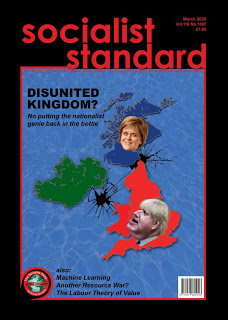
From the March 2020 issue of the Socialist Standard

On the 31 January the blue Euro-banner was hauled down at Westminster and the Union flag raised in its stead. In Edinburgh, though, the self-awarded gold stars flag was pointedly left fluttering in place next to the saltire.

The SNP are making a none too subtle point. The antidote to the referendum they don’t like is to be… another referendum. It would seem the political ‘logic’ is that the best way to counter leaving a union is to leave a union.

It is somewhat ironic that the clash between Holyrood and Westminster stems from a single shared source, nationalism, be it competing nationalisms. The cause is perceived sovereignty, as if Scotland, or England, or Britain can stand alone, or at least break away from a power portrayed as inhibiting its freedom.

However, what would the SNP do in short order should they achieve independence? Give it up to the EU of course. Similarly, should Britain shake off the last vestiges of EU influence, then treaties will be sought and signed with such as the USA.

Not only will the USA want untrammelled access to the NHS for its big pharma, for example, there will be a demand for any arrangements to be subject to America’s legal system. For the USA substitute any other major trading nation/bloc and something similar will apply.

This is what ‘independence’ means in a global capitalist world. Significant change cannot be achieved by a binary vote in a referendum. At best there is some reordering of the arrangements, but essentially, adjustments made, capitalism continues unhindered other than by its own contradictions.

The SNP has previously stated its intention of retaining the monarch as their country’s head of state, continuing the use of sterling and joining NATO. Presumably unaware of any contradiction, they also want to be rid of the Trident submarine bases.

Do they really think that if capitalism degenerates to the point where international warfare results in the use of nuclear weapons, the removal of Trident bases will somehow insulate Scotland from the consequences?

Should the SNP decide the monarch was not to be their head of state, then a president or some such would fulfil that function. Has being a republic lessened the grip of capitalism, with its extremes of war, inequality and crises, on the USA?

If Scotland was denied the use of sterling presumably that would mean embracing the euro with all its financial hazards and, more importantly, subservience to, not independence from, the European Union. If sterling is retained, then economic policy would, ultimately, continue to be determined in London.

The formation of Britain enabled the industrial revolution to create a dynamic economy in which Scots, Welsh and English played full parts. This also led to the formation of the working class with interests transcending those of constituent regional and national parts. Workers in Scotland faced the same exploitative capitalism as they did in England and Wales and expressed their voice through their own organisations, the trade unions.

And nothing has changed. Workers on any side of a border, wherever it is drawn, all face the same fundamental problem, capitalism. To exist, capitalism must exploit workers to make profit. Painting your face blue with crossed white stripes alters this not one iota.

Whatever the outcome of another referendum the people of Scotland will continue to live under a parliamentary system designed to preserve the interests of capitalism. If they have opted for ‘independence’ they will find ‘sovereignty’ surrendered to the EU.

The parliamentary system has evolved to serve the interests of capitalism, not democracy. It does not matter if a parliament is situated in London or Edinburgh, nor if its benches are upholstered in tartan and populated by nationalist MSPs, it will remain subservient to the needs and preservation of capitalism.

Referendums are designed to give apparently simple solutions to complex problems, they are the chosen way of despots and demagogues attempting to garner some semblance of popular support of their self-serving programmes.

The ballot box can indeed be part of the response of the working class to taking economic and political power away from the capitalist class. But this will have to be just one element of a much wider movement in which the working class consciously acts for itself.

No referendum can solve problems for the working class, not in Scotland, not in Britain via Brexit (or re-joining the EU at some point), not anywhere. There is no Tartan alternative to socialism.
Dave Alton

Wednesday, December 12, 2018

Editorial: SNP Hypocrisy (2012)

Editorial from the February 2012 issue of the Socialist Standard

Politicians on both sides of the border are getting worked up over a referendum on Scottish independence and the media are encouraging the rest of us to get involved. But why should we?

It is of no concern to workers in Scotland whether they are governed from London or by a separate independent government in Edinburgh. This is because the cause of the problems they face is the capitalist economic system of production for profit, not the form of government. And the capitalist economic system would continue to exist in a politically independent Scotland.

The only people to benefit from Scottish independence would be the local politicians, who would be able to award themselves grander titles and grander salaries. For workers on these islands there is a precedent in Ireland, which broke away from the UK in 1922. Can anyone claim that this has made any difference to the position of workers there?

In Scotland’s case not even the local capitalists would benefit. An independent Scotland would have no choice but to stay in the EU and so could not erect tariff walls to protect its capitalists as the Irish government did for a while to try to protect the fledgling capitalist class there.

The fuss, however, does illustrate two general political points. First, about how referendums can be manipulated to try to get the result the organisers want. Wily politician that he is, SNP leader Alex Salmond knows that if the vote is a straight yes or no on independence, the chances are that he will lose. So he wants to put two questions to the electorate,. One on independence. The other on increased powers for the Scottish Parliament, which he knows would have a better chance of being carried. UK Prime Minister David Cameron has made the same calculation and so is seeking to impose a vote on independence only.

The second point is about the relationship between declared goal and immediate aims. It’s a question that concerned the pre-WWI Social Democratic movement too. As well as having socialism as their ‘maximum’ programme they had a ‘minimum’ programme of reforms to be achieved under capitalism. As a result their support came to be built up on the basis of these reforms rather than socialism, and they ended up becoming, in practice, capitalist reform parties, with socialism as a mere desirable long-term aim. Eventually that was dropped too.

The SNP has got itself into a similar situation. Its long-term aim on paper may be Scottish independence but it has built up its electoral support on the basis of being a better administrator of political affairs in Scotland than the Labour Party. Its voters will not have voted for it because they want Scottish independence – which is why Salmond lacks the courage of his convictions.

We don’t want or care about Scottish independence (any more than we care or support a “United Kingdom” or an “independent Britain”) so it’s not our business to advise those who really want this how to best go about getting it. But we do want world socialism and do know that the way to further this cause is to advocate it and it alone and not seek support on any ‘minimum’ programme of reforms.

That way, support for a socialist political party will be support for socialism and not for something less. When a majority for this has evolved, socialists would have no fear of a referendum on the single question of “Capitalism or Socialism?” and would not want, would in fact indignantly reject, a fall-back, second question on, “Do you want a reformed capitalism?” Unlike Salmond, we’d say bring it on.

Wednesday, October 1, 2014

Editorial: The Scottish Referendum (2014)

Editorial from the October 2014 issue of the Socialist Standard

Whatever the outcome, capitalism was going to continue and with it the problems it inevitably generates as a system that puts, and has to put, profits before meeting people’s needs. Whether this is done from London or from Edinburgh makes no difference. An independent Scotland would be capitalist just as much as if it remained part of the UK.

Nevertheless, from a purely political point of view, the Yes campaign was demanding a far-reaching change, well beyond the mere change of government or local council that’s usually at stake in elections. It was demanding the break-up of one of the longest-established capitalist states and one that had once been the dominant power in the world. So it was a decision that could be described as “historic” in the sense that if could have affected the future course of history. People in Scotland realised this. Which is why 8 out of 10 of the population aged 16 and over came out and voted.

As socialists, who advocate the use of the ballot box in the course of the socialist revolution, we are comforted by this as it bears out our contention that when there is perceived to be something really important at stake, people will vote.

To continue for a moment the analogy between the Yes campaign and the movement for socialism. The Yes campaign did represent a threat to the interests of the British ruling class. A breakaway by Scotland would weaken them in the struggle between states over economic issues that is built-in to the capitalist world system. Capitalist Britain would not only be diminished in size but also in diplomatic status and clout.

Some argue that, faced with a threat like this, a ruling class will resort to force as the British ruling class did when Ireland tried to break away in 1919. This time they pursued a different strategy. When it appeared that, despite their earlier calculations, the Yes side might actually win they bent over backwards to offer more powers to the Scottish parliament in a bid to buy off the movement.

We suggest that this is the more likely reaction of a ruling class to a growing socialist movement committed to using the ballot box and enjoying widespread support. Not that it would work. In fact it didn’t work in Scotland. Those supporting Yes refused (as the socialist movement would) to be bribed and change their intended vote. Those in the No camp continued in their resolve to vote No, largely no doubt because they felt that there was no point in taking the unnecessary risk and disruption that a Yes victory would involve.

That was understandable. The partisans of independence were painting an unbelievable picture of how life would be so much better if Scotland was no longer ruled from Westminster. A social democratic paradise was to be established in Scotland. Reformism, despite failing to do so on every previous occasion it has been tried, would somehow be able this time to make capitalism work for the benefit for wage and salary workers and their dependents. Socialists didn’t believe this either.

The trouble is that politics is now going to be as boring as before as the professional politicians, North and South of the border, wrangle over purely constitutional matters while capitalism and the problems it causes continue.

Thursday, September 4, 2014

The Socialist Party and the Scottish Referendum (2014)

From the September 2014 issue of the Socialist Standard

Most of us don’t own a single square inch of Scotland. It doesn’t belong to us: we just live here and work for the people who do own it. In or out of the Union, that won’t change.

In Scotland, society is run in the interests of those who own the wealth. They argue among each other over billions of barrels of oil, GDP rates, profits and exports, because where the borders lie matters to them. Every border is an opportunity to wring cash out of other property owners.

Scotland will remain dependent upon their whims and interests whatever the outcome of the referendum. 

They’ll try to sway us one way or another with crumbs (or the promises of crumbs) but we’ll only get what they feel they can spare to protect their privilege and wealth. We will remain dependent upon their investments, making a profit for them before we can get our needs and interests met.

The only way to stop this dependency would be for us to take ownership and control of the wealth of the world into our own hands. We could, together, use the wealth of the world to meet our mutual needs and gain the true independence of being able to control our work and our lives in a free and voluntary association of equals.

Though the outcome of this referendum is irrelevant, it is an opportunity for us to tell our fellow workers that this is what we want. We don’t have to suffer in silence, we can go to the polling stations and put ‘NEITHER YES NOR NO BUT WORLD SOCIALISM’ on the ballot paper. Then join The Socialist Party to fight for an independent world.