Showing posts with label Parecon. Show all posts

Wednesday, January 26, 2022

Nothing New (2022)

Book Review from the January 2022 issue of the Socialist Standard

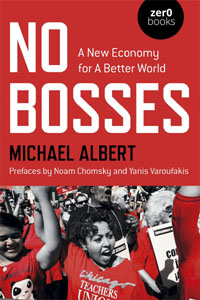
No Bosses. A New Economy for A Better World. By Michael Albert. Zero Books. 2021. 220 pages. £13.99.

Another book by Michael Albert arguing for his blueprint for a future economic and social system that he calls ‘participatory economics’, or ‘parecon’. He presents it as an alternative buying-and-selling economy both to one where wages and prices are determined by the market and to one where they are fixed by the government. His blueprint involves your work and income being decided by your work colleagues and what you consume by your neighbours. It also involves numerous meetings and votes to decide what should be produced.

Yanis Varoufakis, in a politely critical preface, makes the point that it could turn out to be a dystopia rather than a utopia:
‘While I see how Michael’s proposed organisation would rid workers of individual bosses and market pressures, I fear they may end up being bossed around by tyrannical majorities.’
Yaroufakis is writing from the position of someone who thinks that giving the market a role would allow people a greater freedom of choice. We don’t agree with that of course but would make the same criticism on the ground that post-scarcity conditions make free access possible along with the application of the principle ‘from each according to their ability, to each according to their needs’.

Albert, however, insists that consumption should be linked to the ‘duration, intensity and onerousness’ of the work an individual does and is implacably opposed to ‘from each to each,’ devoting four pages to criticising it, or rather a caricature of it. Basically, he thinks that it would lead to people not working hard enough and/or consuming too much. He calls it ‘The Anarchist Objection’ and, indeed, Kropotkin and Alexander Berkman who he cites as among those who have influenced his blueprint, could both have answered his arguments. It is not just an objection made by some anarchists but also by us, as he knows since he has debated with us, both in person and in the columns of the Socialist Standard (April 2006).

There is nothing new in the book except for Varoufakis’s point.
Adam Buick

Thursday, April 30, 2020

Parecon or socialism? (2006)

Michael Albert
From the April 2006 issue of the Socialist Standard
 There are few political debates currently occurring of any real significance to the majority of the world’s population. The debate concerning the nature of a post-capitalist economy ranks as the most important on the revolutionary agenda. Thus, we present recent correspondence between ourselves and the author of the book Parecon: Life After Capitalism.
The review of Parecon: Life After Capitalism, appearing in February Socialist Standard, was troubling. The review says the economic system proposed in the book called participatory economics, or parecon for short, permits profits, just not excessive profits. But in parecon there are no owners. In fact there are no classes. More, no one earns income based on ownership of any kind. There are, therefore, no profits – none.

Yes, society produces a social product. Yes, some plants produce a total value of output greater, and in some cases even much greater, than the total value of their inputs, including their labor. But, no, this does not enrich anyone associated with those plants relative to the incomes, say, of people working at plants that are far less productive. Remuneration is uncorrelated to value of output save that people must do socially valuable labor to be remunerated for labor at all. What the reviewer says about profit affecting wages, etc., in parecon, is simply about some other system . . . unless the reviewer is saying, if total output for a parecon is lower, average income is lower, which is, of course, a truism, having zero to do with profits, which don’t exist in a parecon.

The reviewer says, incredibly, that getting rid of private ownership of production, markets, top down decision making, the corporate division of labor, and remuneration for property and power, the core economic institutions of capitalism, and replacing them with self managing workers and consumers councils, balanced job complexes, remuneration for duration, intensity, and onerousness of labor, and participatory planning, the core economic institutions of parecon – is correcting political dimensions, but not economics. I doubt the reviewer read the book. It is confined to addressing economic dimensions, not the polity.

I suspect that this reviewer thinks that because in parecon there are income, wages, and valuations – prices – it must be capitalism. This marks a major confusion. A letter I received from the host periodical signed off, “Yours for a moneyless, wageless world of common ownership.” This too, is troubling.

In this world you desire to attain there is, I presume, production. Likewise, I assume you agree that people will consume. More, beyond production and consumption, is there some regulation of what is produced and in what quantity? The alternative would be that anyone can produce anything, with no concern other than that they wish to. This is nonsense, but if there is regulation of how resources, energies, and labor are allocated to generate outputs, does that regulation reflect the preferences that both producers and consumers have and especially a full valuation of the relative contribution to well being and development of different choices? If it does, then to that extent it includes “money.” The valuations are prices, albeit not necessarily as we have known them in market and centrally planned systems.

In turn, do people receive a share of the product? Obviously they must if they are to survive, much less attain their capacities. So, that being true, is there any correlation between the share one gets and what one does as one’s work? If not, anyone can take anything, in any amount, and do no work – which, of course, is absurd, since demand would exceed supply. If there is a correlation, however, then there are to that extent “wages” according to some norm, even if the correlation is due to people collectively and responsibly establishing their own incomes. In parecon, these are the reasons why there are “money” and “wages.” The task becomes having this limited money and wages, which is to say valuations and shares of income, inevitably present in any economy, in accord with our full aspirations and values.

Money – more importantly, relative valuations of products and processes – exists in a parecon, therefore, so that people might make choices in light of full and true social costs and benefits. Participatory planning facilitates the determination of true and full values as decided by the self managing population.

Wages – more importantly, shares of social product allotted to citizens – exists in a parecon so that, of course, we can all equitably benefit from the social product, and specifically so that choices regarding such things as how long people work, how hard we work, producing what items, and what we justly consume, can be determined by the population, again, in accord with true social costs and benefits and, as well, with attaining equitable outcomes and self management.

I would claim, and the book does claim, that parecon is not only a serious economy able to meet needs, develop potentials, incorporate true self management, and be not just profitless but, beyond that, classless – but is also as close to having no money and no wages as is possible without incurring immense damage. That is, it has valuations and it has income shares, like any economy, but not the pejorative aspects of either – distinguishing it from all capitalist, market, or centrally planned economies.
Michael Albert, 
ZNet / Z Magazine


Reply:
The gist of your complaint is that, contrary to the claim made in the review of your book Parecon in the February Socialist Standard, you maintain that there are no profits in parecon because “no one earns income based on ownership of any kind. There are, therefore, no profits – none”. But this is only because you have defined profit as a property income. It’s still there, however, as you admit in your second paragraph above: “. . .  some plants produce a total value of output greater, and in some cases much greater, than the total value of their inputs, including their labour”. For profit to exist – or more generally “surplus value” (rent, interest and profit) – it is not necessary that these accrue to individuals through their ownership of property. Profit is simply the difference between expenditure and income and derives from the unpaid labour of the workers. Profits therefore existed in the former state-capitalist USSR and exist in the present-day Vatican – even though there is no individual ownership.

On page 132 of your book the rate of profit appears under the guise of “benefit cost ratio”:
 Each round of planning, or iteration, yields a new set of proposed activities. Taken together, these proposals yield new data regarding the status of each good, the average consumption per person, and the average production ‘benefit cost ratio’ per firm. All this allows for calculation of new price projections and new predictions for average income and work, which in turn lead to modifications in proposals … http://www.zmag.org/books/pareconv/parefinal.htm (Chapter 8, subsection: Proceeding From One Proposal To Another)
You say the “benefit cost ratio” has nothing to do with profit because the “benefit cost ratio” will only benefit parecon society as a whole and not any individual. But as we have seen, this is based on a misunderstanding of what profit means. Moreover, you also claim on the same page in your book that:
…workers’ councils whose ratios of social benefits of their outputs to social costs of their inputs were lower than average would come under pressure to increase either efficiency or effort…
Or go bust, presumably, unless profits were redistributed from workers’ councils with above average ratios. This shows the limits of planning in “parecon”, for in their planning considerations they must maintain profit rates. And while planning might be based on past or current profit rates, profits themselves are inherently unpredictable and this may scupper plans for the future. There is also the antagonism between wages and profits. Parecon society would need to maintain a positive rate of profit or lurch into crisis. This means that workers could not push up wages to the level that stopped profits being made, and this again sets definite limits to what can be planned.

Of course production and consumption will be regulated in a socialist society. That’s an essential part of it, but this does not require recourse to money either as a means of exchange or for costing products and production. Calculation – and “costing” – in socialism will take place in kind (in tonnes of steel, kilowatt-hours of electricity, person-hours of work and so on) without having to put a monetary value on anything and everything. Socialist society will decide – through democratic discussion and from what people indicate they want by what they take from the common stores – what it needs to satisfy individual and collective consumption, and to replace and expand (if need be) the productive apparatus and then will bring together the physical and human resources to produce this. This will be done in the most technically efficient way, after taking into account good working conditions and environmental considerations.

In implementing the long-standing socialist principle of “from each according to their ability, to each according to their needs”, socialist society breaks the link between work done and consumption. Rather than being “allotted” what to consume as under “parecon”, people would be able to take from the common store of wealth set aside for individual consumption what they judged they needed to live and enjoy life, irrespective of what they had contributed to production. Every able-bodied person would be expected to contribute something, but we don’t share your bleak view that, in this event, not enough would be produced to satisfy people’s needs (that “demand would exceed supply”, as you put it) – and that therefore, not just profits, but the wages system too would have to be retained as a means of both obliging people to work and of limiting their consumption. Just like under capitalism.

Hence our original description of “parecon” as “post-capitalist capitalism”, i.e. not post-capitalism at all. We would be prepared to refer to it as a “utopian blueprint for an ideal society” if you prefer.– Editors.


Rejoinder:

By any definition I have ever encountered, surpluses are not profits per se, though they may become profits under certain social relations, of course. Definitions aside, Parecon people’s income, in any case, is not correlated to output, or to revenues minus expenditures, but to effort expended in socially valued production. No class takes income based on unpaid workers labor. No one does, other than those infirm and unable to work, that is. On the other hand, society and each of its members very much benefits if the total social product per time worked and inputs used up, is more, rather than less, socially valuable.

Saying that if a firm produces things of greater social value than it uses up, that means there are profits and the system is capitalist, is, honestly, absurd. In any economy, from now until the sun burns out and beyond, one will want workplaces of humans to actually generate more worth than they use up, of course. How the social product is then dispersed among the population is a very important issue, to be sure. Doing it according to effort, having also eliminated not only private owners above workers, but a coordinator class above workers, by balancing job complexes and instituting self management, is equitable.

Our real difference is probably best encapsulated in your calling the old Soviet Union state capitalist, and my saying that since it didn’t have private owners of means of production, and it didn’t have markets, but it did have a ruling economic class composed of those monopolizing empowering tasks in the economy, it is far more sensibly called not capitalist, not socialist, but coordinatorist, after its ruling class.

I share your desire that a future desirable economy involve workers and consumers co-operatively negotiating economic activities and their distribution. That is what parecon accomplishes. Given space limits, I guess for now we just have to agree to disagree about a lot, beyond that desire, however.
Michael Albert


Reply:
It is only under capitalism that the social surplus takes the form of a monetary surplus value and, as you admit, this is what will exist in “parecon”. And this is what will be the imperative guiding and limiting its planning decisions. The institutional changes you advocate (no legal individual ownership of means of production, self-management, etc.) are inadequate reasons for claiming that capitalism has been overthrown.

We agree that the former Soviet Union did have a ruling class, but not that there were  no markets there. Even the regime’s ideologists admitted that there was “commodity-production”, i.e. production for sale, and that buying and selling relationships existed between state enterprises. While there was no individual legal ownership of the main means of production (though there was of some things: dachas, works of art, state bonds, bank accounts), these means of production were not owned by society as a whole but effectively by a class which monopolised them, via the state, and which lived a privileged life from the surplus value extracted from the wage-labour of the workers. That is why we think the best description of that and similar societies was state capitalist.

Your attitude towards the former Soviet Union is revealing in that it shows that you had nothing against the continued existence there of the key features of capitalism that are production for sale, money, wages, profits, etc but only to the fact that the economic system involving these was controlled by a privileged ruling class and not democratically by the workers. “Parecon” is thus revealed to be the idea of the economic system that existed in Russia “self-managed” by the workers. A sort of “self-managed capitalism” that could only exist on paper.

Socialism will break free from the financial bureaucracy of capitalist calculation. It will treat people as ends in themselves. It will produce directly for human needs. It will break the link between individual effort and individual consumption. That’s what all those who consider themselves to be anti-capitalist should be aiming at. – Editors.
Monday, December 31, 2018

Not anti-Marx (2018)

Book Review from the December 2018 issue of the Socialist Standard

Radical Political Economy – Sraffa versus Marx’.  By Robin Hahnel. (Routledge, 2007. 110 pages)

Piero Sraffa (1898-1983) was an Italian economist at Cambridge University, best known for his attempt to revive the approach of Classical Political Economy, as represented by Adam Smith and in particular David Ricardo, whose concepts Marx also employed in his criticism of them for assuming that capitalism was the natural way of organising the production and distribution of wealth rather than just a passing historical phase.

Sraffa’s main work, The Production of Commodities by Means of Commodities, was published in 1960. The title itself was already a revival of Classical Political Economy as he was using the word ‘commodity’, also inherited by Marx, to mean an item of wealth produced for sale; and capitalism is precisely an economic system in which commodities are produced by means of other commodities. What Sraffa was aiming to do was to settle some questions, left unresolved by Ricardo and Marx, about how to square a labour theory of value with an economic system where there were profits and which therefore meant that commodities did not exchange at their labour-time values, i.e., the amount of labour required to produce them from start to finish.

Critics of Marxian economics interpreted Sraffa’s book as showing that there was no need for any labour theory of value to explain how the (capitalist) economy worked and began to use it as a stick to beat Marx. Hahnel (one of the co-architects of the Parecon scheme) is in this tradition. But to see Sraffa as a critic of any labour theory of value is absurd – how could someone dubbed a ‘neo-Ricardian’ reject this when a labour theory of value was central to Ricardo’s economic analysis?

Sraffa’s book is based on assuming that commodities ‘contain’ labour and how the amount of this could in principle be calculated when there are profits. He explicitly states that the labour theory of value as a theory of selling price (exchange-value) is only valid when there are no profits, when the whole product of labour goes to the producer. This was Marx’s view too in an economic system he called ‘simple commodity production’ where all commodities were imagined to be produced by independent self-employed producers. Marx was well aware that, under capitalism, commodities did not sell at their labour-time values but at what he called their ‘price of production’ (a term Sraffa also used) as their cost of production + a mark-up for the going rate of profit. Sraffa goes into this in more detail than Marx was able to in his unfinished notes.

In any event, to counterpose Sraffa to Marx, as in the title of this book, is not justified. There is no evidence that Sraffa was hostile to Marx. Just the opposite in fact, as can be seen from Appendix D on ‘References in the Literature’, Sraffa had as much respect for Marx’s as he had for Ricardo’s earlier work on his subject.

Hahnel gets Marx wrong on a number of points. He commits Marx to a biological/calorie subsistence theory of wages whereas Marx recognised that there was a varying historical and social element in wages (as set out in chapter 22 of Volume I of Capital on ‘National Differences in Wages). Using such terms as ‘total breakdown’ and ‘inevitable collapse’ he attributes to Marx the view that capitalism will eventually mechanically breakdown. He accuses Marx of not identifying a flaw in capitalism that sometimes capitalists do not adopt the most efficient production methods if wages are low, whereas Marx makes this very point, regarding a stone-breaking machine invented and used in the US but not used in Britain, at the end of section 2 of Chapter 15).

Clearly Hahnel doesn’t know his Marx. He also contradicts himself when he insists that profit does not derive only from the labour-power capitalists hire while at the same time explaining ‘profits as the result of denying workers in a productive economy all the surplus goods they produce’.

This said, his book is well-presented and, despite the algebra, very readable. The final chapter in which the capitalists are put on trial accused of being parasites on the producers and their various lines of defence (abstinence, waiting, risk, etc) refuted, ending in them being found guilty as charged, is amusing and to the point.
Adam Buick

Friday, September 14, 2018

Anarchist economics (2012)

Book Review from the June 2012 issue of the Socialist Standard

The Accumulation of Freedom: Writings on Anarchist Economics. AK Press. 2012

Anarchists have a reputation for being weak in economics. This collection of articles is an attempt to refute this. It doesn’t succeed entirely and in fact tends to confirm that most modern-day anarchists get their economic ideas from Marx (as did Bakunin who was once going to translate Capital into Russian). Some of the writers don’t seem to be anarchists at all, in particular Robin Hahnel and Michael Albert, the inventors of a blueprint for an ideal future society they call “parecon”. Hahnel seems to be a Keynesian, advocating more state intervention (yes!) as a way out of the present crisis and of avoiding future ones. Albert is a supporter of President Chavez of Venezuela, and urges people to vote for him.

Even so, the book does give a view of the range of opinion amongst anarchists. Some – the modern-day followers of Proudhon – are “market anarchists” who hold that there is nothing wrong with production for the market, except that the competitors should be worker-cooperatives rather than capitalist corporations and there should be no state to interfere in it. This is a minority view these days (though well represented in the US), but there are other anarchists who are against full, free-access communism (known as “collectivists” rather than “communists”) who favour instead relating people’s consumption to the amount of work they do.

Marx himself sort of endorsed this for the very early days of post-capitalist society and some in the Marxist tradition still argue for labour-time vouchers. We don’t. Neither do some anarchists. In fact, two contributors to this book describing themselves as “libertarian communists” – Deric Shannon and Scott Nappalos – argue against this in the same terms that we do. Nappalos even quotes from our pamphlet Socialism As A Practical Alternative.

Nappalos says that, as a libertarian communist, he stands for “a society based on the abolition of remuneration in the form of wages and democratic control” and “an economy based on the destruction of the wage system, and a de-linking of the value of labor in production from the distribution of society’s wealth to its members.” He makes the valid point that it is not possible anyway to measure an individual’s contribution to production. He writes “in our time, production is largely social. The contribution of an individual is very difficult to isolate from the contributions of countless others that make work possible”. Any such attribution can only be arbitrary, as in the parecon blueprint, of which he says: “having co-workers judge each other’s work would turn gossip and infighting at work presently from an annoyance into a system of power over wages.”

Shannon’s criticism is directed more at “market anarchists”. He quotes another libertarian communist, Joseph Kay:
  “The assets of a co-op do not cease being capital when votes are taken on how they are used within a society of generalised commodity production and wage labour. That is to say there remains an imperative to accumulate with all the drive to minimise the labour time taken to do a task this requires, even in a co-op.”
Other articles describe anarchist economic practice such as factory occupations, setting up vegan cafés and campaigns directed at particular capitalist firms (called PEDCs or “political-economic disruptive campaigns”). However, these are not specifically anarchist activities, only activities in which some anarchists engage.
Adam Buick

Sunday, April 2, 2017

Democratic scarcity? (2013)

Book Review from the April 2013 issue of the Socialist Standard

Remaking Scarcity: From Capitalist Inefficiency to Economic Democracy, by Costas Panayotakis. Pluto Press, 2011

Economics, as taught in schools and colleges, defines itself as the study of the allocation of limited resources amongst competing wants where these are greater than resources and teaches that markets and prices arose as the best way to do this. In fact, since it assumes that human wants are infinite, it teaches that scarcity – and markets and prices – will always exist.

Panayotakis rejects the traditional socialist argument that ‘scarcity has been conquered’ because ‘the problem of production has been solved.’ He sees scarcity as a fact but argues that free market capitalism is not the most efficient way to deal with it. Naturally, he has no difficulty in showing that capitalism does not allocate resources efficiently to meet human needs.

This, he points out, is due to the fact that ‘the true goal of capitalist economies is not to satisfy the wants of consumers, but to pursue profit and a never-ending accumulation of capital.’ This ‘logic of capital accumulation escapes people’s control and subordinates them to its imperatives,’ including even the owners and top executives of capitalist firms:
‘... the pressure of capitalist competition means that, even to preserve their capital and continue enjoying the privileges, prestige and power associated with their class position, capitalists must tirelessly pursue profit and capital accumulation.’
This makes them essentially ‘functionaries of capital,’ who don’t have a free hand to do what they might want, but only a greater power than the rest of society ‘to influence the terms under which they and all other socio-economic groups are subordinated to the logic of capital.’ So far, so good.

Panayotakis’s thesis is that capitalism fails to deal with the problem of scarcity efficiently because it is an economic oligarchy. The alternative to capitalism is, then, an ‘economic democracy’ where everybody would have an equal say in how scarce resources are used. He recognises that this implies that the means of production should no longer be owned and controlled by a minority but seems to favour particular productive units being run by workers’ co-operatives or councils.

The two models of ‘economic democracy’ he discusses in detail are so-called ‘market socialism’ (as in David Schweickart’s proposal) and Michael Albert’s ‘Parecon.’ He can see the drawbacks of retaining production for the market, but doesn’t make the point that, with market competition, workers’ co-operatives too would be forced to behave as ‘functionaries of capital’ if they wanted to survive.

He is more favourable to ‘Parecon’ but mentions one critic’s description of it as an ‘off the shelf utopia.’ As indeed it is, though ‘off the wall’ might be a better description given its endless form-filling and voting to try to fix prices and pay that conform to some ideal allocation of scarce resources.

Panayotakis and the others have got themselves into this position of discussing how to calculate prices and pay because they reject the traditional socialist view that, given the abolition of capitalism, enough to satisfy people’s needs could be produced and that therefore a socialist society would not have to price or ration goods but could implement the principle of ‘from each according to their ability, to each according to their needs’.
Adam Buick


Wednesday, October 20, 2010

Post-Capitalism: Parecon or a World without Money? Which way to a classless society?

SPGB debate with Z Magazine's Michael Albert at Conway Hall this coming Saturday:


POST-CAPITALISM: PARECON OR A WORLD WITHOUT MONEY?
Which way to a classless society?
Debate with Michael Albert (founder member of ZCommunications and author of "Parecon: Life After Capitalism") and Adam Buick (World Socialist Movement) about the alternative to capitalism.
PARECON
- form of money economy featuring workers' self-management and consumer councils, price-setting, and personal incomes based on effort and sacrifice not property or heredity.
"In the world you desire to attain there is, I presume, production. Likewise, I assume you agree that people will consume. More, beyond production and consumption, is there some regulation of what is produced and in what quantity? The alternative would be that anyone can produce anything, with no concern other than that they wish to. This is nonsense, but if there is regulation of how resources, energies, and labor are allocated to generate outputs, does that regulation reflect the preferences that both producers and consumers have and especially a full valuation of the relative contribution to well being and development of different choices? If it does, then to that extent it includes "money." The valuations are prices, albeit not necessarily as we have known them in market and centrally planned systems".
Michael Albert (ZCom)
SOCIALISM
- the abolition of the property-based money economy including markets, profits, rent and wages, with all land and goods owned and democratically controlled by the whole society.
"In implementing the long-standing socialist principle of “from each according to their ability, to each according to their needs”, socialist society breaks the link between work done and consumption. Rather than being “allotted” what to consume as under “Parecon”, people would be able to take from the common store of wealth set aside for individual consumption what they judged they needed to live and enjoy life, irrespective of what they had contributed to production. Every able-bodied person would be expected to contribute something, but we don’t share your bleak view that, in this event, not enough would be produced to satisfy people’s needs (that “demand would exceed supply”, as you put it) - and that therefore, not just profits, but the wages system too would have to be retained as a means of both obliging people to work and of limiting their consumption. Just like under capitalism.
Our description of “Parecon” is “post-capitalist capitalism”, i.e. not post-capitalism at all".
Adam Buick (SPGB)

Saturday, April 1, 2006

Post-Capitalist Capitalism (2006)

Book Review from the February 2006 issue of the Socialist Standard

Michael Albert:
Parecon: Life After Capitalism. Verso, £9.

Participatory economics, or parecon for short, is a vision of life after capitalism favoured by many in the anti-capitalist movement. The author of this particular vision helped to establish Z Magazine and its web site Zmag, including its subsidiary page devoted to parecon, which debates the issues raised by this book.

Parecon opposes "corporate globalisation" and argues for its replacement by "equity, solidarity, diversity and self-management." For Albert, capitalism means "private ownership of the means of production, market allocation, and corporate divisions of labour." Life after capitalism is said to combine "social ownership, participatory planning allocation, council structure, balanced job complexes, remuneration for effort and sacrifice, and participatory self-management with no class differentiation." The council structure involves workplaces, neighbourhoods, and "facilitation boards" which co-ordinate planning.

So-called "market socialism" is rejected because the market and class differentials would remain, as would buyers and sellers of labour power (capacity to work). In Albert's account, because class differentiation disappears in parecon, "you cannot choose to hire wage slaves nor to sell yourself as a wage slave." Parecon permits workers to assess their own pay and conditions in their decision-making by inputting their preferences via councils. It apportions income in accord with effort and "does not force or even permit people to try to maximise profits, surplus, or even revenues."

Notice however that Albert is specifically talking about prohibiting profit maximisation, not profits as such. Profits are acceptable; "excessive" profits are not. In the procedure envisaged, individuals and councils submit proposals for their own activities, receive new information including new indicative prices, and submit revised proposals until they reach a point of agreement. This process is open-ended and in Albert's book a hypothetical example is discussed which reaches a seventh planning cycle, or as Albert calls it "planning iteration." In reviews of this book much has been made of the potential for bureaucracy in this procedure, but a more telling criticism would be its unquestioning acceptance of the profit system. Wages cannot rise to the point which prevent profits being made; and a fall in profits will put a downward pressure on wages. This is called the class struggle.

"Parecon is basically an anarchistic economic vision", admits Albert, and it shows. Like many on the left, the difference between capitalism and post-capitalism presented here is essentially political, not economic. As indicated by the title, the crucial factor is participatory planning. The capitalist economy would remain substantially the same in parecon: the accumulation of capital out of profits produced by the unpaid labour of the working class.

Lew Higgins