Showing posts with label Old Labour. Show all posts

Friday, September 1, 2023

Editorial: Neither Starmer nor Old Labour (2023)

Editorial from the September 2023 issue of the Socialist Standard

After Keir Starmer had said in an interview with the BBC on 16 July that he didn’t object to being called a ‘fiscal conservative’ (presumably with a small ‘c’), Mick Lynch of the RMT commented on Sky News that ‘at the minute many people can’t spot the difference’ between Labour and the Conservatives’, but spoilt it by adding ‘and that’s a shame for somebody who’s probably as talented as Keir Starmer is’ and calling on him to ‘show that he’s on the side of working people.’ That would be difficult because he’s not on our side.

Lynch went on:
‘He should be saying something about workers’ rights. He should say stuff about the NHS, looking after people who are struggling in the housing market, council houses for the masses, controlling rents, addressing all sorts of stuff about what’s going to happen in the imbalance in our society. He’s not saying any of that. He won’t dare mention the word socialism’ (tinyurl.com/463ranbn).
Who does he think Starmer is? Jeremy Corbyn, the man Starmer stabbed in the back? Lynch is nostalgic for the Labour Party of yore – workers’ rights, council houses, rent control – but it’s a couple of generations since Labour advocated that sort of thing. That workers should want better conditions is normal but this was never going to come through the Labour Party; a little through trade unions perhaps but dependent on labour market conditions. The ‘imbalance’ between those who own and those who work is built into ‘our society’ and nothing can be done to reduce it. The whole basis of society needs to be changed from class to common ownership before production can be geared to meeting people’s needs properly.

The present ‘labour unrest’ is a reaction to rapidly rising prices putting pressure on workers’ living standards and so is essentially defensive, running fast to try to stand still. If it leads to a revival of a bit of class consciousness in some workers that can’t be bad, but defensive, trade union consciousness is not enough. What is required is the socialist consciousness that there is no solution under capitalism but only through socialism.

Lynch chides Starmer for not daring to mention the word socialism. It’s a good thing he doesn’t. We don’t want Labour leaders claiming to be socialist. The Labour Party doesn’t stand for socialism — everyone can see that now — but never did. It’s just another capitalist party and always has been, even in the pre-Blair days when it had a paper commitment to full-scale state capitalism (nationalisation). Which is probably Lynch’s idea of what socialism is.

The alternative to Starmer is not to go back to Old Labour and its reforms that didn’t work but forward to socialism where productive resources are commonly owned and democratically controlled so that they can be used to turn out what people want and need, instead of as now (and under Labour governments) to make profits for the few.

Monday, July 3, 2023

The times they need a-changin’ (2023)

 
From the July 2023 issue of the Socialist Standard

At the recent first public meeting of the newly formed Yorkshire Branch, a Socialist Party speaker presented a well-informed and powerful case against capitalism and for socialism as the only viable alternative for the meeting of all people’s needs.

As a social element the folk trio of which I’m one third played a selection of ‘Celtic’ tunes. As the other two thirds of our group are members of other political parties, Labour and Green, they gave me some insight on the drive home, into the effectiveness of the talk. The Green Party member is from what might be termed the Old Labour tradition. He feels the Labour Party has betrayed its socialist past which is why he joined the Greens. Interestingly, his expressed political views are in many ways similar to those espoused by us.

He is vehement about capitalism being the root of the world’s ills, be that poverty, climate change and related issues. For him it’s not just love of money that’s the root of all evil, but money itself. Unsurprisingly he found himself in virtually complete agreement with all the speaker had to say. However, despite referring to himself, even before the meeting, as a socialist he continues to support the Green Party. While disavowing money he continues to advocate a basic income scheme as a palliative to the difficulties the money system causes. Similarly, he supports environmentalist actions as a response to the climate crisis even though he accepts that capitalism cannot be changed from pursuit of profit with all that entails, to meeting needs.

The reforms enacted by the post-Second World War Labour government remain for him socialist markers that have been, and are still being, undone to some extent by recent Labour policies, and all the more so by pernicious Conservative administrations. This is someone who, despite residual illusions about previous Labour governments, has grasped the socialist case, but cannot take the next step, away from the lure of immediate reforms, the need to feel he is taking action now that might garner electoral support.

The disconnect is a deep-seated disbelief that it is actually possible to motivate people on a world-wide scale to act in concert to profoundly change the way the world is for the common good. For him the principles of the Socialist Party are correct, but in theory only. To stand by them may be principled, but unlikely to be acted on in the foreseeable future. In the meanwhile, and who knows how long that meanwhile may be, what could be done to make life a little better in the present, rather than some unspecified future?

My Labour Party colleague again had no disagreement with the spokesman’s critique of capitalism. Yet, for all its flaws, which he accepts are real, he continues to see Labour as a more benign alternative to the iniquitous Tories, for all the failings of the Starmer leadership. Labour, for him, is the only alternative, in the practical sense, of removing the Tories from office, his primary political objective. It is irrelevant how correct the Socialist Party may be because the party is in no position to actually change anything.

If, very hypothetically, the Socialist Party were to win an overwhelming majority of MPs in a general election, his point is that unless this was repeated simultaneously throughout the world, those MPs would have to compromise to deal with the immediate situation, or stand aside. As that hypothesis is unlikely to be realised, there is no prospect of any realistic change in the foreseeable. There is a disconnect between the analysis of society’s present structure and any impending practical solution.

He felt as if he was being asked, by implication, to not participate come the next election. This, for him, would be tantamount, if it became widespread amongst Labour supporters, to leaving the door to 10 Downing Street wide open for the Tories to stroll through again.

While none of this is novel, it does illustrate an abiding conundrum for socialists. That is, while the case for socialism may well be more widely acceptable than it presently appears, the personal may be a huge block against it becoming a mass movement. A casual conversation is not scientific evidence, but still it seems to me that they expressed views that are commonly articulated. The apparent size of the task overwhelms sustained engagement.

After all, no matter how large or widespread a mass movement becomes, its component parts are individuals, and their personal perspectives, whether profound, petty or both, are significant. The influence of capitalist ideology through mass and social media weighs heavily on personal concerns. There is also the not inconsiderable conservatism of preferring to stick with what is known, however disagreeable some of it is.

Socialists are going to have to find ways of dealing with this. Making the case for socialism is difficult enough as large numbers of people do not come into meaningful contact with socialists or their sources of information. It may well be some factor beyond just the general case for socialism, such as the increasing climate crisis, that begins to focus general thinking to consider and act to bring about profound change. This may especially be so if the main political parties are perceived to be powerless in increasingly urgent circumstances.

While socialism may seem a better alternative to what presently exists, it remains in the view of all too many merely an idea that’s attractive but uncertain, lacking in anything other than the broadest of outlines. For socialists there remains the painstaking prospect of continuing to make the case, the steady erosion of the ideological wall built by capitalism. Because of the public meeting in a South Yorkshire pub, a few more, including my two band mates, have looked over that wall.

They have seen beyond and like the look of the prospect. Now the challenge is to get them to start demolishing that wall so they can take steps beyond it towards a truly democratic society that meets need not greed.
Dave Alton

Monday, September 26, 2022

. . . and of Old Labour economics (2000)

Book Review from the December 2000 issue of the Socialist Standard

Money, Markets and the State: Social Democratic Economic Policies since 1918. By Ton Notermans. Cambridge University Press.

In the camera obscura of capitalist ideology, it seems that ideas make the world, instead of the world making ideas; and that it is the determining will that guides the course of history. The result of applying such a theory to the world can be found in this book. Ostensibly a broadsweep history of the implementation of Social Democratic policies in Sweden, Norway, Netherlands, Germany and the UK since 1918, it is also an attempt to vindicate the premises and potential of those politics. Asserting that unemployment is the main scourge of capitalism, Notermans contends that currency policy combined with the requisite social structures can be used to sustain full employment.

Notermans qualifies his support for economic reforms by placing all policies within a "paradigm" that he claims lies beyond the control of politicians. Essentially he suggests that all economic policies operate within either an inflationary or a deflationary context. He states at the very beginning of the book that he considers inflation is any rise in prices, rather than the classical view—and the Socialist Party's view—that inflation is a decline in the value of money. This means that Notermans regards price rises due to a changing supply/demand ratio during an economic boom as "inflation". Further, his notion of "inflationary paradigms" is based on his subjective approach to economics—if investors have expectations of continuing profits then they will pour more money into production, and thus create "inflation", and if they feel that economic and political conditions are against profitability they will withhold. Notermans frequently contrasts this view with Marxist "fatalism".

He further extends this voluntaristic view of economics by asserting that the Great Depression was a result of government policy, and that recessions are deliberately instituted by governments as a means of combating excess inflation. The problem for Social Democratic parties, he explains, is that if they try to implement their macroeconomic policies in conditions of an expanding inflationary context, then eventually wage-inflation will cause investment to run out of control, and cause a "paradigm change" (he suggests that precisely this happened in 1968 at the end of the post-war boom).

Notermans concentrates on currency policy as having a determining role on investor confidence, consequently government economic priorities must be oriented towards growth, regardless of political hue, the form of the policies being dependant upon the context within which they operate. In times where inflation is the threat, he asserts, the aims of full employment for social democrats are in conflict with the essential economic paradigm, where deflation is the threat then the Social Democrat policies work. Hence, he asserts, after the deflationary spiral of the thirties, the massive state intervention for full employment across Europe was successful.

Claiming that wage increases cause price increases, Notermans identifies "wage moderation" (i.e. workers taking less wages than market conditions would allow them to) as being the key to Social Democrat success in an inflationary context. This is in contrast to the neo-liberals who rely on high unemployment to restrict wages. He notes how Keynes promoted inflation as a way of reducing real wages, so as to get around the downward rigidity of nominal wages. His examination, thus, looks at the differences between the trade union movements in his object countries, and the way in which their degree of centralisation was used to promote "moderation".

The value of this book lies mostly in the insight into the mind of capitalist economists: the dogged determination to show that the market system works, and the unshakeable belief that the consequences within the market economy are the result of mistaken or otherwise conscious decisions of the actors within the economy. Further, it gives an insight into the mindset of the political milieu around New Labour and European Social Democratic parties. If Notermans is to be believed, it is the government tale that wags the capitalist dog.
Pik Smeet

See also:

Saturday, May 21, 2022

May Day Manifesto (1998)

Book Review from the July 1998 issue of the Socialist Standard

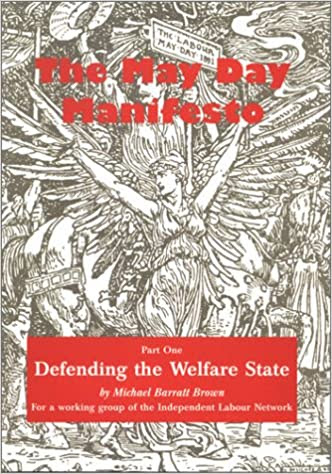
The May Day Manifesto. Part One. Defending the Welfare State by Michael Barratt Brown. Spokesman. £6.99.

Last year two Labour MEPs, Hugh Kerr and Ken Coates, were expelled from the Labour Party. They have formed an Independent Labour Network which (with money from the European Parliament) has published this pamphlet.

It is unashamedly Old Labour, proposing to extend the welfare state, restore full employment by Keynesian techniques of increased government spending, and to tax the rich so as to create a more equal society. It’s all pie-in-the-sky of course since such policies, which imply that capitalism can be reformed so as to work in the interest of the majority, have been tried and failed, most recently under the Callaghan Labour government in the late 1970s and under Mitterrand in France in the early 80s.

New Labour, Kerr and Coates complain in the introduction, has abandoned what Labour used to stand for:
“Redistributive policies, and planned public intervention to create jobs and uphold higher social standards have now gone. Instead, the new Government defends an economic strategy based on ‘the enterprise of the market and the rigour of competition’, a philosophy of deregulation, and ‘a partnership with business . . . that puts industry first’. It seeks ‘to enhance the dynamism of the market economy, not to undermine it’. It is determined ‘to extend the flexible labour markets to the rest of Europe, not to import Euro-sclerosis’. These engagements are linked with a policy of less direct taxation, and refusal to ‘impose burdens on business’ . . .”
All this is very true, but in the argument between them and Blair as to what is possible within capitalism today—and this is where this particular argument is situated—Blair is right: capitalism is incapable of offering the reforms Kerr and Coates are campaigning for. The alternative to New Labourism (the management of capitalism on its terms and according to its rules) is not reformism but socialism.
Adam Buick