Showing posts with label Annual Conference. Show all posts

Friday, May 8, 2026

A Letter from Vienna (1948)

From the May 1948 issue of the Socialist Standard
Amongst cables and letters of greeting and good wishes received by our 44th Annual Conference in London at Easter, was the following letter from an early member of the Party now in Vienna.
16th March, 1948.

“Please convey to the Conference a salute and good wishes from a number of comrades and sympathisers in this city.

“If the promises and hopes held out in previous messages to Conferences have remained unfulfilled— which no one regrets more than I do—let us find consolation in the fact that we have at least survived bombs and totalitarian terrorism so that we can still kindle the light that must eventually pierce the dark clouds and penetrate the hearts and brains of the workers. Greater efforts in these past years might very possibly have led to the extinction of even these few torch bearers in this tortured Continent. Remember we are not in England, but East of it. As it is, we can still watch our opportunity, and opportunity is a fine thing for us also. So, when the stock taking is made at the Conference, delegates might be justified in booking even this weak point of contact as a small asset for the movement.

“The existence of the scientific and solid instrument of the S.P.G.B. has always been a strong ray of hope and comfort to me. It seems to shine brighter and brighter as the world situation is deteriorating and increasingly menacing, and confusion in the labour movement is growing apace. As the bankruptcy of ideas, policies, and the general helplessness becomes glaringly more evident, can it be doubted that when the third crisis approaches, the party’s message will at last be heard and taken up in wider circles as the only possible way out of an appalling dilemma?

“I am forever grateful for the education received at the S.P.G.B. University, which puts people on the track of understanding and explaining social phenomena when every other theory and action has failed and events leave men utterly bewildered. The scientific outlook on and attitude to life which Socialism gives, has enabled me, too, to steer clear of all vicious temptations and avoid the pitfalls of quackery and confusion.

“As long as I live, you can always count me amongst the most ardent and steadfast upholders of the cause. My work has in the past had to be on a very limited scale, but who can say whether even the humblest of us will not sooner or later become the medium of quickening the pace of progress and find his hands strengthened and forced by events? At this juncture, we cannot, of course, escape the vital importance of seeing at least Democracy maintained as against the renewed evil onslaughts that are being made in many quarters, including the country from which I write.

“With renewed good wishes for the success of your Conference, I remain, Yours fraternally……”
Rudolf Frank


Although the Socialist message penetrates to and finds acceptance in many parts of the world, the points of contact are small and limited, hut we definitely assure our Viennese comrades that we regard our contact with them as a real asset to our movement. We can also assure all our well-wishers in other lands, that if hopes held out in messages to this Conference remain unfulfilled by the time we hold our next one, it will be our misfortune and not our fault.
Overseas Secretary.

Friday, April 3, 2026

Editorial: Our 28th Annual Conference. (1932)

Editorial from the April 1932 issue of the Socialist Standard

The Annual Conferences of the S.P.G.B. are not at all like the conferences of other political parties. Nothing ever happens at them that a press representative would regard as “news.” Nobody makes passionate speeches about the suffering’s of mankind, or the wickedness of political opponents. We have no window dressing. No resolutions are passed calling upon governments, over whom we have no control whatever, to do this that or the other thing because we say so—as is the practice of the so-called Labour organisations. Delegates do not call each other rogues or anti-Socialists. Most amazing of all to our opponents we have no faction fight between left, right, and centre wings. We have no wings, for we are all Socialists, all agreed about the end and the means. What then is there for our conference to do? We meet to review the work of the past year, to revise rules where necessary, to exchange views on methods of propaganda and possible improvements, and in general to make our party a more effective instrument.

This year the delegates met in a happy frame of mind. In each of the past 3 or 4 years some part of the load of difficulty under which the Party works has been lifted from our shoulders. More new members have come in, funds have been more adequate to our needs, our removal to larger, premises has justified itself, and all because the tide is slowly and almost imperceptibly turning in our direction. The year 1931 was, in regard to membership and in other respects, a record year, and the confidence of the delegates reflected this. Our propaganda was on a larger scale, the sales of the Socialist Standard and of pamphlets increased, and in one way or another the Party is becoming known to a larger circle here and abroad. From several countries we have encouraging reports of the headway made by our companion parties.

This does not mean that the Conference was self-satisfied. On the contrary there was a noticeable anxiety, particularly among provincial delegates, lest our immersion in the tedious and back-breaking work of past years should have made us slow to appreciate the changing conditions around us. So the Conference pressed for more new pamphlets without delay, and special consideration of the task of training new members, and views were expressed on the possibility of increasing the size of the Socialist Standard, a matter that will be fully gone into in the near future. Steps will also by taken to extend the advertising campaign through which we have gained many new supporters during 1931.

There is every reason to expect that the coming propaganda season during the summer months is going to be the best we have ever had, and that our Conference in 1933 will be a milestone in our history.

Monday, July 28, 2025

Fourth Annual Conference of the S.P.G.B. (1908)

Party News from the March 1908 issue of the Socialist Standard

The Fourth Annual Conference of the S.P.G.B. will be held on Friday and Saturday, April 17th and 18th, 1908, at the Communist Club, 107, Charlotte Street, London, W.C. All Branches should send their full quota of delegates ; while members generally should make a point of attending. The outside public will also be admitted.

Sunday, June 22, 2025

Photographs and illustrations from the 70th anniversary issue of the Socialist Standard (1974)

From the June 1974 issue of the Socialist Standard

Blogger's Note:
This special 70th anniversary issue of the Socialist Standard carried a number of historical photographs within its pages. Some of the photographs tied in with specific articles, but a number appeared as standalone images illustrating aspects of the history of the SPGB. I thought it best to place all the images in one separate post. For certain images that tie in with a text, I've provided a link to the article where they originally appeared.


The handbill below was issued by the Watford Branch of the SPGB in 1905. This image appeared within Robert Barltrop's article, "Seventy Years for Socialism".


#    #    #    #

The undated photograph below is of the party headquarters in Great Dover Street, which was located in the Southwark area of South East London. This was the party's head office from 1929 until it was hit by a bomb - and partially destroyed - in 1941.

'Gilmac' mentions Great Dover Street in his September 1954 article, "Our Many Head Offices":
In 1927 Fitzgerald, with the aid of map and compass, succeeded in proving to a majority of the E.C. members that the Elephant and Castle was really in the centre of London. Anyhow we moved over near there to 42, Great Dover Street. We took an old house with three floors and a basement. One of the members made fittings for keeping the S.S. and literature in proper order in one basement room. The other basement room ( a very small one) had tables and chairs, and a stove on which a woman member cooked for those who wanted a meal. The smoke and heat in the little place was stifling, and getting out when one had finished was a problem.

The ground floor front room was used for selling literature and packing. There was a small shop front in which literature was displayed. The first floor consisted of one good sized room in which meetings were held as well as an occasional social—when the place shook as if it was about to collapse. E.C. meetings were also held in this room. Here we had some interesting discussions on the Spanish Revolt and at the beginning of the last war. In the room above lectures were given on many subjects during the winter months.
I know 'Gilmac' mentions 1927 in the excerpt above but Great Dover Street is first listed in the Standard as the Party's Head Office in its June 1929 issue.

I've always wondered if the young woman front and centre in the photograph was May Otway. I guess I'll never know.


#    #    #    #

The text accompanying the photograph below from the Standard was 'Conference photograph, 1928. at Fairfax Hall. Harringay, where Party Conferences were held from 1910 to 1936.' 

There's a strong chance that the bald man holding the board at the bottom centre of the photograph was Ted Kersley.


#    #    #    #

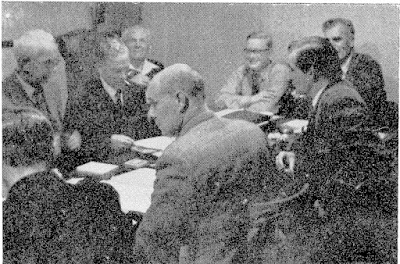
The text accompanying this photograph was 'No leaders: The Executive Committee in session, 1956.' It was part of the article "This is Socialism !'" I believe the younger man with the darker hair in the right of the photograph was Robert Barltrop, and the older, bald man to his left was Harry Young. ('Horatio')


#    #    #    #

Clifford Groves contested the Paddington North constituency for the SPGB at the 1945 General Election. He also stood in the same seat in the 1946 by-election. The July 1945 issue of the Standard carries the Party's election manifesto.


#    #    #    #

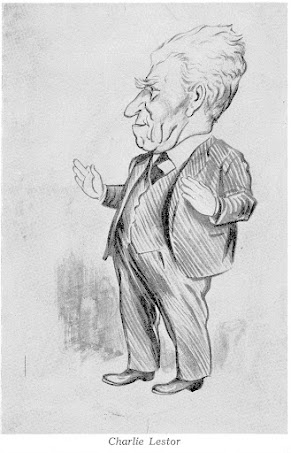
Both the photograph of Jack Fitzgerald and the cartoon caricature of Charlie Lestor were part of the "Some Members" article. I'm guessing that Robert Barltrop drew the image of Lestor.


#    #    #    #

The Metropolitan Theatre was located in Edgware Road, and was used on many occasions in the 1940s and early 1950s when the SPGB were contesting parliamentary seats in Paddington, but also when the Party held mass rallies. By all accounts these mass meetings had upwards of two thousand people in attendance. This photograph accompanied the "Early Election Campaigns" article.


#    #    #    #

No name for speaker on the platform. This photograph illustrated the "On the Platform" article.


#    #    #    #

Sadly, no names are listed but members of Walthamstow Branch in the late 1920s included, amongst others, Mr and Mrs Francis Brooks, Maurice Cole, Thomas Davis, C. Elliott, A. J. Godfrey, A. McDermott, May Otway, L. Otway, Jane Robinson, Frederick Wellavise, J. Wilkinson, S. E. Williams, Byron Young and Percy Young.

Surely May Otway is in this photograph? I know I keep mentioning her but she was one of my favourite Socialist Standard writers in the interwar years.


#    #    #    #


So, here's the conundrum: The June 1974 Socialist Standard states that the Conference photo below dates from 1950 but when it was included in the June 2004 Socialist Standard, the text said the photo was from the 1951 Annual Conference. I demand a recount.

As a point of interest, the September 2004 issue of the Socialist Standard carried a letter from Richard Botterill, identifying two of the delegates from Dartford Branch in the photo. (Spoiler alert: one of them was his dad.)


With regards to the June 2004 Standard already mentioned above, that was also a special anniversary issue  and it also carries a number of photographs relating to the history of the SPGB. I recommend you check it out. It serves as an excellent companion to the June 1974 issue.

Sunday, June 8, 2025

Pakistan’s power élite and the working class (2001)

From the June 2001 issue of the Socialist Standard
A comrade from Pakistan was due to attend our Annual Conference in London over Easter but was refused a visa by the British High Commission in Islamabad. This is the speech he would have delivered
I hail from an extremely conservative region in Pakistan, indeed in the lap of Taliban, where there exists no tolerance as far as dissent of opinion is concerned. Dissenting against the prevailing view is simply blasphemous. This makes our work more difficult. Coupled with this you always have this fear from the state and agencies sleuths who might take you for an enemy agent or some one involved in subversive activities. Anyhow this is not something to deter us. Before joining I knew what it means to be a socialist. I have not had any great trouble over the past four or five years that I have been a member. But you hardly find people agreeing to your views. One has to have steel nerves to cope with such a situation. 

Recently the whole of Pakistan and the NWFP in particular have been swept by a wave of religious militarism and fanaticism. The religious maniacs openly display arms and recruit youth to fight a holy war against the infidels. In such a scenario one has to be very cautious lest one should fall a victim to their wrath. I was glad when five of my friends and colleagues expressed their willingness to join the party. Of course there are people who think differently but because of the intensive propaganda and power at the hands of the militants very few dare to speak otherwise. Pakistan is a country where extreme luxury and riches and extreme poverty exists side by side. As everywhere the teeming millions have been made hostages to the lust and greed of a few lords, nawabs and petty feudal. The power or ruling élite consists of these very people whose grip on the country’s resources and people is as hard as can be. Come election time and these millions of poor are herded into polling stations to elect their so-called “representatives”. The game is repeated after every two or three years, as the assembly does not last long, with either the president or the ubiquitous military dismissing the government for being too “corrupt”. 

Now that the country is in the strong grip of the military with no intention to go back to the barracks, no matter how much Robin Cook or the Commonwealth secretary cry themselves hoarse, the people of Pakistan are more than ever dissatisfied and worried about what they should look for or turn to. The country’s economy is in a mess and more loans from the IMF means more punishment for the poor in the shape of price-hike and taxes. Actually Pakistan’s power élite has a clash of interests among themselves. The discredited former Prime Minister Nawas Sharif, now in exile in Saudi Arabia, had been a blue-eyed of the military and establishment. The moment he meddled with the military he was thrown out in a coup. The same corruption scandals, Swiss banks, and so on and so forth. There is also a nexus between the military, bureaucracy and political élite who safeguard each others interests and rule the roost. 

Fifty-two years after the British left the sub-continent and Pakistan appeared on the map of the world, the ordinary Pakistanis are still groping in the dark. They still have to learn that they will suffer at the hands of those who promise them heaven on earth but turn it into a hell once they come into power. But at elections they do not have a choice and alternative. They either have to vote for one of the rogues styled as a leader or have to stay at home. In both cases they are losers. For them more elections means more trouble. The problem persists as one looks at literacy rate in the country, which is not more than 30 percent. Mass illiteracy makes people follow their leaders blindly. Not aware of their rights they are simply led the way they are asked to. A lot could be said on how people are systematically brainwashed about the country’s priorities. Watching the state-controlled media, one gets the impression that Kashmir or fighting a war with India are the most pressing issues facing the country. Behind the smokescreen of Kashmir the need to address education, health, sanitation, environment and access to clean drinking water is washed down the drain. Such have been the priorities of the government’s recent and past, with the result that people – the hapless poor – commit suicide because they cannot feed themselves or their families. The rich realising that Pakistan is getting barren pack up with their money and leave for greener pastures in Europe or Canada or US. The rest are just left to burn in a cauldron. Capitalism does this to every region and country in the world. The need, however, is to approach those who understand the workings of the system and join them in a campaign that promises a world entirely different than what they had seen so far.
AH

Tuesday, April 1, 2025

SPGB April Events (2025)

Party News from the April 2025 issue of the Socialist Standard


Our general discussion meetings are held on Zoom. To connect to a meeting, enter https://zoom.us/wc/join/7421974305 in your browser. Then follow instructions on screen and wait to be admitted to the meeting.

Wednesday, March 12, 2025

SPGB Meetings (1974)

Party News from the March 1974 issue of the Socialist Standard


Blogger's Note:
There is actually an audio recording of the advertised Annual Conference meeting, featuring Hardcastle and Barltrop, available on SPGB website. Though I believe there are earlier recordings of SPGB meetings out there . . . somewhere, this is the earliest recording on the website. Enjoy!

Tuesday, September 17, 2024

The Powers of Government (1975)

From the September 1975 issue of the Socialist Standard

Marx called the State “the concentrated and organized power of society”, and the society he was speaking of was of course capitalism.

Among the factors which gave rise to the organized Socialist movement in the 19th century, a considerable one was the growth of State power and the consequent conviction — which also animated reformers of every kind — that through Parliament anything might be achieved. A marked difference is seen between the attitudes of those who formed the SDF and the Fabian Society, looking keenly to the use of political power, and the attitudes of men who are thought of as pioneers of Socialism before Marx — for example Thomas Hodgskin and Robert Owen — who paid no attention to the idea of using Parliament.

In further contrast, the “new left” of recent years has largely rejected parliamentary methods. But what this conveys is not the shortcomings of those methods but the inanition of the Left past and present. Socialists continue to advocate parliamentary action as the only means to change society.

At the beginning of the Socialist Party’s existence the trade unions were seeking political expression, and this was a question on which the founders were anxious to formulate and declare their attitude as quickly as possible. What must be understood is that this attitude was not simply to the trade unions as such, but to the whole question of capitalism and the State and the attainment of Socialism. The importance of taking such a position can be seen if it is compared with that of the then-strong ILP. One of the objects of the ILP from its foundation in 1893 was to secure trade-union representation in Parliament; but see the attitude to the class struggle put forward by the ILP’s leading spokesman Keir Hardie. In a main article in the Labour Leader in September 1904 — shortly after the SPGB was founded — he said:
I claim for the ILP that its Socialism is above suspicion, and its independence unchallenged and unchallengeable; and yet in the platform speeches and in the writings of its leading advocates the terms “class war” or “class conscious” are rarely if ever used.
The early members of the SPGB saw clearly that the unions’ “politicization” in the Labour Party would compel them to support other parties and compromise wherever possible to obtain concessions; and this has been the history not only of the Labour Party but of other attempts at political action by the unions.

At the same time the founders of the SPGB used in their principles the comprehensive-sounding phrase “machinery of government”, but they very quickly made it clear that this meant Parliament and local councils and nothing else. Up to about 1910 questions were sometimes sent to the Socialist Standard putting hypotheses such as what would be the Party’s strategy if Socialists found themselves in a country with no parliament, or if representation and suffrage were abolished in Britain. These questions disappeared simply because the many new nations which have come into existence have all established for themselves parliaments, making plain that this legislative machinery is essential to capitalism. Indeed, this is so firmly planted in people’s minds now that the question is replaced by another one which says Socialist society would not work without a government.

To illustrate the point about the need for parliamentary machinery, the late John Strachey gave an account of being in Poland in 1956 at the time of rioting and a change in the government. He was taken aside by a politician and asked: “You, Mr. Strachey, are a well-known democratic theorist. We require your advice. We are extremely anxious to conduct absolutely free and democratic elections in our country. But if we do so, how can be ensure that the Government’s candidates will be at the top of the poll?”

It may be of interest to mention another matter concerning Parliament which arose in the SP’s early years. The members of that period were full of optimism and expected quite rapid progress towards Socialism, and one question they considered was what would happen when the first Socialists were elected to Parliament and were faced with the Oath of Allegiance to the Crown before they could take their seats. The Party Conference was hard-headed about this and said we were not going to let meaningless constitutional forms stop us carrying out our intentions, but some members immediately left — convinced that the Party was on the slippery slopes of compromise and confusion. Events in the 65 years since then have shown the good sense of the attitude taken, and the meaninglessness of that particular constitutional form. In 1937 a Parliament which had sworn allegiance to the King unanimously sacked him for disobliging them.

Fundamentally, the State is an executive for the ruling class, and this is what it was literally in its early days (comprising only well-established members of the ruling class). The different sectional interests of the ruling class produced (as they continue to produce) a division of parties within the executive. And, still at a relatively early stage, governments found they must have the consent of the ruled to some degree. The alternative would have been the permanent risk of civil disorder and the need to maintain too big a burden of suppressive legislation and force. Therefore democracy was pressed on the working class — to become eventually its invaluable weapon because it offers the means to control of the governing machinery.

Differences between parties remain, to a large extent as differences over how the money collected by taxation to finance the State is to be obtained and used. The Socialist Party’s unique long-standing attitude to taxation is that, despite all the appearances, it is not a matter of any consequence to the working class. Where the main form, direct taxation, is concerned workers are in one sense aware of this, in that they correctly see their wages not as the theoretical gross payment but as what they actually get after deductions. In practice taxes are collected not from the workers but from the capitalists and, as has been said, the pro-capitalist parties are in dispute largely over the most fruitful methods.

In speaking earlier of the growth of State power, what was meant was not that the State has been more and less strong at different times but the widening of what it has to deal with. Since the 1890s all governments have had to legislate and provide for an expanding education system, housing, road traffic, town planning, and innumerable other fresh things; and this is all effected and controlled through local government. As the needs have changed and grown, local government has had to be reorganized repeatedly, including the very recent alterations. It is natural to pooh-pooh local councils as puny beside the might of central government, but in fact they are its branches; their function is simply to execute the policies of central government. Their position is formulated by the Acts establishing them — they have no other powers and are further connected to central government by the system of financial support.

Those engaged in this machinery have then no choice but to comply with what is in the interests of capitalism. The two standard excuses of government reflect this — first that they were “having to clean up the mess”, i.e. put right the errors of their predecessors, and second that "public money” (or “the taxpayers’ money”) has been used for the wrong purposes. One other point often raised reflects a built- in safeguard to the British parliamentary system. It is often asked why experts, i.e. people with a specialist knowledge and lifelong interest, are not put in charge of the appropriate departments. The answer is that they have to function as members of the government as a whole and a special concern or passion would mean an imbalance.

During the Socialist Party’s lifetime our case about government has been confirmed again and again. Parties and individuals who were going to engage in running capitalism but try to do so in the working class’s interests instead of capital’s have failed without exception, and there have been continual let-downs for the workers who believed them. In times of crisis — wars and major depressions — the parties have flown to their common ground and united to defend capitalist interests. There has also been agreement on types of legislation — e.g. welfare-ism — and economic theories — e.g. Keynesianism — which appeared to support capitalism’s interests best.

Our case has been confirmed also by the history of those who set themselves against the State, refusing to accept that its coercive force backed by the electorate was firm. Examples are the direct-actionists at various times, the Angry Brigade, and “rebel” councils who have refused to apply legislation as directed.

Reform movements have by their nature continually to apply to governments for concessions and improvements, and we are often urged to support them. Part of our case about reforms is that what has to be judged is not the broad appeal at the outset but the legislation eventually formulated. The fact is that governments legislate not for theoretical — i.e. moral or humanitarian — reasons but for practical ones, and this is why reformers are so often disappointed and the realization of their hope turns sour.

Finally, it must always be realized that the powers of government are coercive. Behind the clerks and administrators and the most inane politicians stand prisons and armed force as the ultimate sanction for the capitalist system and what it thinks it needs. Majorities of the electorate give their consent and support because they support capitalism. (Even dictatorships require majority support.) A movement to change society through the use of Parliament is realistic only when it begins by realizing that support, and seeking therefore to muster an electorate which no longer supports capitalism but wants it abolished. Such an electorate can send its representatives to parliament with a new kind of mandate, not to run capitalism but to abolish it. We are often told that the capitalist class would not let that happen. This is the whole point — for the Socialist working class to go to where the coercive machine exists and is controlled, so that no other will than that of this conscious majority can prevail.

The above article is from the Party Conference Lecture given at Conway Hall at Easter, 1974.


Blogger's Note:
Though this article/transcript was unsigned, according to the March 1974 issue of the Socialist Standard, Robert Barltrop and Edgar Hardcastle were listed as the speakers at the 1974 Annual Conference Friday Night Meeting . . . and the title of their meeting? The Powers of Government.

Thursday, July 18, 2024

Party Notes. (1907)

Party News from the March 1907 issue of the Socialist Standard

The Third Annual Conference will be held on Good Friday and Saturday, March 29th and 30th respectively, at the Communist Club, commencing each day at 10 a.m.

* * *

On Good Friday evening a Social and Dance will be held. Admission by programme, to be obtained from branch secretaries or direct from Head Office.

* * *

Enquiries have been made as to whether membership of Clarion Cycling Clubs is compatible with membership of the S.P.G.B. Were the clubs merely social there would, of course, be no difficulty about the matter, but in point of fact one of the rules of the N.C.C.C. adopted last year at Warwick, specifies “The propagation of principles of Socialism as advocated by the CLARION.”

* * *

The “Principles of Socialism as advocated by the Clarion” are the principles of rate-saving municipal capitalism, and state industry on the lines of the Post Office; the transference of capital and the function of the capitalist from the individual to the Public Body.

* * *

A member of the S.P.G.B. would, then, clearly be wrong in joining a Clarion Cycling Club.

* * *

In some walks of life a man is compelled by economic necessity to become a member of an organisation which devotes a small portion of its funds to a political policy as a side line. But there are plenty of purely social clubs, and the member of the S.P.G.B. consequently finds that he need not support a club that is run to advertise a confusionist journal and to propagate an “ism” that is inimical to his class, while in so far as the cycle can be used as an auxiliary to political activity the S.P.G.B. wheelers fill the bill.

* * *

The economic and speakers’ classes meet every Thursday evening at the Head Office.

* * *

Our comrades, “the two revolutionaries,” are pushing the sale of the Party Organ in the Northern industrial centres, thus performing services to the organisation that will, no doubt, be of material service to us in our endeavour to enlarge the scope of our political activities.

_____________

Now that the propaganda season is upon us comrades should throw redoubled vigour into the work of pushing the sale of the Party Organ and other Party literature. No more effective work can be performed for Socialism.

Wednesday, July 17, 2024

The Late Dispute in Islington. (1907)

From the February 1907 issue of the Socialist Standard

Statement by the E.C.
R.B. (Goodmayes.)—The matter stands thus—A number of members of the Islington Branch were found guilty, by a party vote, of action detrimental to the interests of the organisation and injurious to the cause of Socialism, and they were expelled therefore. They now refuse, we understand, to accept the Party’s decision, and still pose as members of the Islington Branch. This is ludicrous enough, but when at the same time that they are asserting their membership, they proclaim to the world that the Party is rotten and corrupt, the matter becomes sheer farce. We regret exceedingly that our late comrades should place themselves in so deplorably ridiculous a position, but that is their business, not ours. Our business is to warn everybody concerned against the false pretence they make of membership of the S.P.G.B.
The above paragraph which, in answer to a correspondent, appeared in the Socialist Standard of December, 1906, caused several other enquiries to reach this office, and in reply to them we publish the following statement in accordance with the notice which appeared in the January issue. The facts of the case are as follows : A certain branch—the members of which have since been expelled and the branch dissolved—submitted a certain resolution to an annual conference of the Party. The resolution after being discussed was defeated. A vote of the Party was afterwards taken as to whether the conference was in order in discussing the matter at all. The Party vote ruled the conference out of order, and this decision was submitted to and accepted by every branch of the Party. The Islington Branch was not content to leave the matter thus ; it first of all requested a formal withdrawal of the resolution in question. The E.C. answered that as the branch concerned had accepted the finding of the Party vote it was unnecessary to proceed any further in the matter. The Islington Branch was not satisfied with this, however, but instead of requesting the E.C. to take a vote of the Party as to whether the branch in question should be asked to rescind the resolution complained of, or endeavouring to obtain the support of five other branches to compel the E.C. to do so— both of which alternatives were open to it within the constitution of the Party—the Islington Branch, because the E.C. would not insist on “the removal of the said resolution from the books of the branch concerned” (which would have involved the falsification of the branch’s records), accused the E.C. of criminal neglect, and forthwith stopped all propaganda work, thus violating the Party’s rules, which reserve to the E.C. the supervision of the work of the Party. It then proceeded to endeavour to depose the E.C., but signally failed to get the necessary support from the Party membership. 

The E.C. meantime could do nothing but place the matter before the Party. Our rules do not allow our E.C. to expel any member or any branch, but provide for the Party members settling all disputes themselves.

The E.C., therefore, under the only rule of the Party’s constitution governing disputes between E.C. and branches, (Rule XIX) placed the matter in the hands of the Party. In accordance with this Rule the case came on for hearing at the next Delegate Meeting of the Party. Islington was officially represented by its own delegate, and six of its members were present. No delegate of any branch had instructions to vote for Islington’s expulsion, but when the case for the E.C. was heard and Islington’s delegate would not even try to defend the branch’s actions, and when the six members who were present were asked to speak either for their branch, or on their own behalf, and further when one of them (Mr. Lehane) was told that he was the prime mover in, and cause of, all the trouble, and was challenged to deny it and defend himself and his branch, and when he and the others were unable to say a single word in defence either of themselves or their branch, or in support of the charges they had made against the E.C., the delegates present took their silence as evidence of their having no defence, and as an insult to the whole Party.

Acting under rule XXII, the only rule in the Party’s constitution governing Delegate Meetings, the delegates proposed a resolution calling for a vote of the Party as to whether the members of the Islington Branch supporting its attitude should be expelled the Party. Every delegate present voted for this except the Islington delegate. The resolution was submitted to the Party vote and an overwhelming majority voted for expulsion.

The E.C., therefore, had to declare them expelled the Party.

Even this did not satisfy them, and. refusing to accept the majority vote of the Party, they proceeded to “expose” the Party to the general public, and. while declaring the Party to be rotten and corrupt, etc.. still claimed and boasted of membership in it.

Two pamphlets, compiled by Mr. Lehane, have been issued to expose the “rottenness” of The Socialist Party of Great Britain. These pamphlets carry their own refutation, and as we have no intention of lowering the tone of the Socialist Standard—a tone Mr. Lehane was justly proud of when he was in the Party—to the level of the “Political Comic Cuts” or the “Penny Prevaricator,” nor any desire to insult the intelligence of our readers, we respectfully decline to treat seriously the garbage served up in those productions. This much only need we add : Mr. Lehane was for a considerable time our general secretary. In office he proved a good servant to a party which, however, could not and cannot tolerate a master, good, bad or indifferent. Being, however, in that position, Mr. Lehane knew the Party thoroughly from its very centre, and therefore we can only accept the weakness of his “exposure” as a glowing-testimony to our strength. The whole dispute was as unfortunate as it was unnecessary, and we have no wish to prolong the agony or embitter personal feelings in the matter. It has, however, proved that the membership of the S.P.G.B., much though it may appreciate and love its public champions, loves the Principles of Socialism more, and that hero worship, or on the other hand, personalities, can have no place in its propaganda.

Knowing this, we are confident that many of those with whom we have had so recently to differ will soon be with us again, fighting in the ranks where all are fighters but none are leaders.

Tuesday, February 6, 2024

Party News Briefs (1950)

Party News from the February 1950 issue of the Socialist Standard

Hackney Branch has received short notice to vacate its present meeting place at the Co-op Hall in Mare Street, Hackney, owing to a scheme for re-building. Future branch meetings will be held at the Bethnal Green Town Hall on Friday evenings until further notice. The Mile End Baths have been booked for a debate with the Conservative Party candidate for the Mile End (Stepney) Division, on Monday, February 13th, at 8 p.m. Application has also been made for a further booking of the same hall to hold a Social and Dance sometime early in March.

The Manifesto of the S.P. of Ireland is at the printers. We are expecting copies to be available before the next issue of this paper.

The W.S.P. of U.S. has moved its National Headquarters from Boston to Detroit. The address is now World Socialist Party of the United States, 3000 Grand River, Detroit 1, Michigan, U.S.A. The previous headquarters at 27 Dock Square, Boston, Mass., will remain the centre for publication of The Western Socialist, and all matters concerning that journal should be addressed there. All matters for the National Executive Council should be sent to Room 307 at the first-mentioned address.

The Report of the 45th Executive Committee to the 46th Annual Conference (1950) is now in the hands of the branches. The Conference will be held at the Conway Hall, Red Lion Square, W.C.l, on Friday, Saturday and Sunday, 7th, 8th and 9th of April. The report is a very detailed one covering 22 foolscap pages. From it we learn that membership figures are still slowly increasing. At 31st December, 1949, we had 1,071 members. The Executive Committee, acting on a 1949 Conference resolution, agreed on a procedure for enabling members of our Central Branch (comprising those members who reside in an area where no branch of our Party is established) to vote at Annual Conferences. The procedure is being implemented. The Central Organiser reports on a series of meetings held in the provinces at Derby, Nottingham, Edinburgh and Bristol, and says: —
“ At the. moment it is difficult to assess the value of these meetings, but they must contribute to the ultimate formation of branches in the areas mentioned. In 1950 attempts will be made to hold meetings in other parts of the Provinces and it is hoped that our increased speaking strength will make this a practical possibility."
Since the increase in the size of the Socialist Standard from its war-time 12 pages to its present 16 pages, our Head Office has suffered a loss with the publication. Figures are given in the report which show that the normal monthly deficit is approximately £18 10s. 0d. and this does not take into account the expenditure connected with posting and packing of library copies, free issues, etc. Objection is raised to any increase in the price of our paper to offset this deficit. It is suggested that increased sales are the remedy. A 1949 Delegate Meeting resolution recommended that the cover design of the Socialist Standard be changed. This matter, together with proposals for a new lay-out, is receiving attention.

Detailed statistics of the year’s propaganda meetings are included in the report. The total number of outdoor meetings reported to Head Office during 1949 was 950. Other figures are as follows: Indoor meetings, 108; Debates, 14; Addresses to other organisations, 21. Total for all meetings, 1,093. Not included in the report, but for readers who are interested, we give comparative figures for the past few years. These are for meetings that have been reported to Head Office. It has been estimated that approximately 33 per cent, are not reported.


Under the heading “Education” the Executive Committee makes a statement in reference to a 1949 Conference resolution calling for the setting up of machinery “ . . . to more effectively utilise the energies of those members who have passed through the tutorial classes at Head Office.”
“The view of the Executive Committee is that it should be borne in mind that the production of speakers, writers and tutors is not simply a matter of attendance at classes. These kinds of Party work, like others, produce themselves, as always, by doing work and keeping on with it and this would happen, better or worse, if there were no classes. What the classes do provide (in addition to a general survey of Party theory) is a more systematic training and encouragement They also help to sort out Party members leanings, and provide refresher experience for older hands, and their existence as a permanent part of organisation helps to maintain the general level of Party work in various fields.”
The report then reviews the work of the Introductory Class, the Speakers' Class, the Writers’ Class and Special Classes together with the arrangements for an Advanced Economics Class.

The difficulties experienced by the Committee that was to inaugurate the Research Bureau are reported. It had been hoped to publish a regular publication composed of the material produced by the Research Committee, at least once a quarter and possibly once a month. Unfortunately plans did not materialise, not because the response by branches was lacking or that the matter was insufficient, but mainly because the members of the Committee, for reasons of employment and pressure of other work, could not continue the job. Under “Electoral Activity” we are informed of the nomination of G. McClatchie as prospective Parliamentary candidate for North Paddington by the Paddington Branch and of H. Young for East Ham South by the West Ham Branch. Following a Delegate Meeting resolution calling for a new procedure in the manner of appointing Parliamentary candidates, the Executive rescinded the two previous candidate appointments. The new nominations from the two branches concerned were approved (C. Groves being unable to stand for health reasons and W. Waters expressing a desire to withdraw).

It is not possible to deal with all the matters covered by the report. It must be sufficient to say that it is a clear statement of the condition of our organisation, containing no false encouragement, but a plain explanation of what has been done, what has been left undone, what it has not been possible to do and what it is intended to do in the future. Altogether it is good reading and gives one a feeling of satisfaction with the progress made.

The Publicity Committee reports that the Star has declined to accept an advertisement for the Socialist Standard. No reason given.
W. Waters

Monday, January 8, 2024

Editorial: Rampageous "Reynolds's." (1906)

Editorial from the April 1906 issue of the Socialist Standard

With regard to the splutteringly splenetic comments which Reynolds’s Newspaper appears to think the action of our Party in this matter merits, we need only observe that they do not unduly depress us. Curiously enough, we did not expect Reynolds’s to appreciate our protest. We did not suppose, even, that Reynolds’s would understand it. If the hard, cold truth must be told we confess that it was not in our mind that, even presuming Reynolds’s capacity to understand and appreciate a stand for principle, it would have been delighted that the stand should have been made in this particular case. Because if our action secures a wide publicity, and our view obtains a similarly extended endorsement (as we make no doubt it will from those who accept the principle of the class struggle), Reynolds’s stands exposed as merely the capitalist journal it is. This, of course, would not suit Reynolds’s book. It relies largely upon its ability to maintain the fiction that it is a desperately “advanced” organ, at whose voice Re-action halts tremblingly.

So far, therefore, from being abashed by the somewhat subtle sarcasm of its references to “a body calling itself The Socialist Party of Great Britain,” whose secretary, “a Mr. Lehane” etc., or by its crushing denunciation of us as “an obscure sect of Socialist malcontents,” we are almost inclined to hilarity. We cheerfully admit that we are a body calling itself The Socialist Party of Great Britain. We presume to call ourselves that because as a matter of sober fact we are The Socialist Party of Great Britain ! Our secretary is “a Mr. Lehane,” who, as Reynolds’s will be interested to know, we call Comrade Lehane. Also we are Socialist malcontents because there is no other way. If Reynolds’s knows a Socialist who is not a malcontent we should be glad to see him. He would be worth going a long journey to view.

Having gone to this trouble to assure Reynolds’s on these points, perhaps we may now venture to ask a favour for ourselves. That it will be quite an easy request for an organ like Reynolds’s to comply with we are quite ready to believe, although there does seem to be an incomprehensible number of apparently insurmountable difficulties in the way of other, less eminent, organs and persons satisfying our small requirements in the same regard. All we ask is that Reynolds’s will be good enough to slightly abbreviate a few of its Divorce Court reports so that it may find an inch or two of its invaluable space for the publication of the evidence in support of the allegation it has made against us of having sent a misleading letter to Bebel and of largely occupying ourselves with abuse. We should be so much obliged for proof of either or both charges. Would, for example, the extracts from this paper which Reynolds’s has often reproduced with approval contain the abuse? We are sorry to say that we cannot accept, such allegations even from Reynolds’s without some proof.

As it is we are compelled to admit that a complaint of abuse from Reynolds’s comes as refreshingly humourous to us as its rather lumbersome essays in irony. Reynolds’s protesting against abuse is as if the Prince of Darkness protested against the heat !

Editorial: The Second Annual Conference. (1906)

Editorial from the April 1906 issue of the Socialist Standard

The Second Annual Conference of The Socialist Party of Great Britain will gather at the Communist Club at Easter, to review the work of the year and draw from it the lessons which will enable us to avoid any mistakes of the past and perfect our organisation for the future. The delegates will find the Party stronger numerically than it ever was, and growing rapidly. The propaganda work being confined in the main to the metropolis, our progress has, of course, been made principally in the metropolitan area. Nevertheless, in most of the large and many of the small provincial centres we have now either members of the Party or subscribers to our official organ, THE SOCIALIST STANDARD, and we think we are quite justified in saying that without being extravagantly sanguine over the matter, we have no doubt at all that the near future will show branches forming around the existing nucleus in those districts. At present Watford to the North and Bexley to the South stand as our Branch outposts. A year hence, with the maintenance of that enthusiasm and determination which have endured unabated with our membership during the two years of our existence—and may therefore fairly be regarded now as constant and even an increasing quantity—and we shall surely be heard of further afield. We are young, but in our short two years of life not one single fact, not one isolated incident, has inspired a doubt in our mind as to the correctness of the attitude we have assumed in opposition to all other parties. On the contrary, everything has confirmed us in our faith, and demonstrated the dangers that, attend even the slightest deviation from the line rigidly dictated by the conditions of the class struggle. We have seen how the most honest of men may only traverse these side-tracks and seeming shortcuts at the imminent risk of danger from the pitfalls and gins that beset them. We do not know of an instance where an honest man has escaped unscathed. Knowing therefore what we know, we may go forward with added confidence, satisfied that if our honest man remains honest he will, directly he has discovered his error, make all haste to extricate himself from the difficulties of the political cul-de-sac into which he has unwittingly strayed and follow after along the path of our progress. Let those who gibe at our youth (as though truth had any relation to old age) take what measure of poor consolation they may from their own decrepitude. Let those who sneer at our size (as though truth and bulk were interchangeable terms) make as merry in their hearts as they may. Time, whose inexorable advance none may stay, will cure us all too speedily of our youth, as it will cure our sneerers and gibers of their delusions. For them there is nothing but a painful awakening or—dissolution. The future is with us. Therefore, Comrades of The Socialist Party of Great Britain, let us utilise the opportunity presented by our second Annual Conference to cement again our resolve to follow the straight track at whatever cost, and may our gathering together serve to inspirit us, and nerve us, and strengthen our arm for the work which remains to be done before the last entrenchment of capitalism is rushed, the last rampart scaled, and the forces of Labour, so long held in subjection, come into their own.

SPGB Meetings. (1906)

Party News from the April 1906 issue of the Socialist Standard


Saturday, May 6, 2023

Our Conference. (1905)

From the May 1905 issue of the Socialist Standard

We should be less than human if we did not congratulate ourselves upon the success which has attended the holding of our First Annual Conference, and the vigour and promise displayed thereat.

When, in June of last year, those of us who felt compelled to secede from the S.D.F., on account of its inconsistent and compromising policy, decided, after very careful consideration, to found a new party, whose aim it should be to raise the Standard of Revolutionary Socialism out of the capitalist mire in which it was being dragged, we fully recognised the seriousness of the step we were taking and the difficulties we should have to encounter.

But the result has exceeded our most sanguine expectations. With one or two exceptions, where personal ambition has been stronger than the desire to act loyally to the Party, the original members have worked strenuously and harmoniously to maintain our “clear and unmistakable principles, interpreted in plain and unequivocal tactics,” as the Chairman of the Conference so ably expressed it.

Not the least notable of the achievements of our Party since its formation less than twelve months ago, has been the inauguration of the Socialist Standard, which occupies an unique position amongst journals claiming to speak on behalf of Socialism or Labour, in that it is neither the private property of individuals nor owned by any limited liability company. It is owned and controlled by our Party,—hence its fearless advocacy of our principles and its unflinching criticism of all who stand in the path of Socialist progress.

Ours has been termed a position of “splendid isolation.” It is, and we look hopefully to the future to justify us, recalling the words of our comrade Wilhelm Liebknecht: “This separation of our party from all other parties—this essential difference—is our pride and our strength.”

The First Annual Conference of The Socialist Party of Great Britain was opened on Thursday, April 20th, at 7.45 p.m., at the Communist Club, London. Twenty-one delegates attended, representing thirteen branches.

E. J. B. Allen was unanimously elected Chairman, R. H. Kent and L. Boyne, Stewards, and W. St. John Dillon, W. Gifford and J. H. Crump, Standing Orders Committee.

The Executive report, printed copies of which had been distributed among the delegates, was adopted after a few points had been raised. H. C. Phillips and H. W. Belsey questioned the right of the E.C. to include in their report suggestions for the alteration of rules which had not been submitted to the branches. Phillips asked whether the unemployed members of the Party were included in the number reported as lapsed. The General Secretary stated that all were counted as lapsed for whom cards for the current year had not been applied, and if Branch Secretaries did not renew the membership cards of their unemployed members, the Central Office could only assume that these members had lapsed. Belsey criticised the action of the E.C. in publishing a certain article by a non-member of the Party in the Official Organ, and Dumenil raised the question as to the propriety of selling at Party propaganda meetings pamphlets with S.D.F. advertisements on them. Pearson enquired why the E.C. had not decided to hold a meeting on the 1st of May, and it was pointed out that the Party was not yet strong enough numerically to hold a successful demonstration.

Belsey and Dumenil moved :
“That any article appearing in the Socialist Standard which has been contributed by a non-member of the Party be prefaced by a statement to the effect that the writer is a non-member and that the Party does not necessarily endorse the opinions therein expressed.”
This was defeated by 14 to 3.

C. Lehane and A. J. M. Gray were declared elected General Secretary and Treasurer respectively, and H. Neumann and D. R. Newlands were elected auditors. The Conference then adjourned.

The Conference resumed at 10.30 a.m. on Friday. The chairman, E. J. B. Allen, stated that many questions of importance would be discussed, and he felt assured that they would be dealt with in a manner becoming the delegates to the First Annual Conference of the Party. That Conference represented practically the beginning of the modern revolutionary movement in England. Capitalism had developed to an extent previously unknown. All the inventions that Science had been able to bring forth, every fresh extension of the domain of man over nature, had under the prevailing conditions only increased the army of the property-less workers and thinned the ranks of the exploiting class. Side by side with this development there was a ripening of the workers to full class-consciousness, and the establishment of the British wing of the International Socialist Party was an event fraught with a great and glorious significance. The Socialist Party of Great Britain stood on the revolutionary principle, and was the only party of the workers in this country. It rested on clear and unmistakable principles interpreted in plain and unequivocal tactics.

The Stewards reported the votes for the Executive Committee as follows: Elected—J. Kent, 98 ; A. Anderson, 94 ; J. Fitzgerald, 88 ; E. J. B. Allen, 86; H. Neumann, 82 ; F. C. Watts, 81; T. A. Jackson, 72 ; T. W. Allen, 57 ; J. Crump, 57 ; A. Jones, 52; F. S. Leigh, 47 ; H. C. Phillips, 42. Not elected —R. H. Kent, 40; A. Barker, 37 ; Kate Hawkins, 36; A. W. Pearson, 32 ; R. Kenny, 31; L. Boyne, 28; W. Gifford, 26 ; H. T. Davey, 21; J. J. Humphrey, 20 ; A. V. Sparks, 10.

The amendments to rules were next considered, including the recommendations of the E.C. regarding some technical alterations they thought necessary. Phillips and Belsey moved:
“Whereas the alterations to the rules as proposed by the E.C. have not appeared on the final Agenda, and taking into consideration the exceptional circumstances, resolved that the discussion of such alterations shall not be taken as a precedent at any future Conference.”
Carried nem. con. The proposals of the E.C. were then adopted, with the exception that the E.C’s. definition of the method of taking a referendum of the Party was referred to the Branches, and that the establishment of relations with the Socialist Parties of other countries shall continue as one of the functions of the E.C.

The Party's attitude on Trade Unions.

E. J. B. Allen moved :
“That whereas in the struggle for existence it is essential that the working-class be organised on the economic field, but whereas Trade Union organisations unless based on Socialist principles are a snare to the workers : resolved, that The Socialist Party of Great Britain does not recommend its members to belong to any Trade Union unless such Union is organised on definite Socialist lines with the Social Revolution as its object, and this Conference hereby pledges the Party on attaining a 5,000 membership to organise Socialist Trade Unions where necessary.”
The Mover said that the political aspect of the Trade Union question was dealt with in the Declaration of Principles of the Party, but these organisations must be dealt with quite apart from the political position. The existing Unions were, without doubt, a stumbling block to the progress of Socialism, because they did not unite the workers—on the contrary, in their capacity as job trusts they divided them,—and because they were used as tools in the hands of the master-class. While fully agreeing that industrial unionism should be an essential feature of working-class organisation, he held that the Unions as they knew them to-day were useless and a source of danger to the revolutionary movement.

The motion not being seconded fell through.

Phillips and Belsey moved :
“That any resolution adopted by the Conference be sent round the Branches as only the expression of the opinion of the Conference.”
Carried nem. con.

Belsey and Dillon moved:
“Members of the S.P.G.B. shall not voluntarily participate in the political action (i.e. action in relation to or dealing with social and economic problems) of any other party or organisation to which, by the unavoidable compulsion of obtaining or retaining employment, or other necessity arising out of capitalist conditions, they may belong: the payment of a compulsory inclusive contribution to any such organisation, part of which is devoted to political purposes, shall not be regarded as participation in such political action, but no member shall seek or accept office in any party or organisation which takes political action.”
Belsey said that attempts had been made to draw a distinction between economic and political action, but in his opinion there was no economic action that was not also political. All working-class action taken outside The Socialist Party of Great Britain was absolutely void, and while members may belong to Trade Unions when compelled by the force of circumstances, he thought it would be well if they were prohibited from taking any office in Trade Unions under any condition. This, he held, was the only logical position.

F. C. Watts moved the following amendment:
“Whereas the Trade Unions, while being essentially economic organisations, are nevertheless in many instances taking political action either to safeguard their economic existence or for other purposes and,

Whereas any basis of working-class political action other than that laid down in the Declaration of Principles of The Socialist Party of Great Britain must lead the workers into the bog of confusion and disappointment; be it therefore

Resolved that this Conference of The Socialist Party of Great Britain recommends that all members of the Party, within Trade Unions, be instructed to actively oppose all action of the Unions that is not based on the principles held by this Party.”
Watts said that up to the present nothing had been done in the Unions to reveal to their members the true basis of working-class action. The members of the party were few, but they must actively resist all unsound political action on the part of the Unions. It was impossible to form Socialist Unions at present, but the better way was to give the Party members in the Unions a definite lead, and in doing this the Conference would be doing all that was expected from it. G. R. Harris seconded,

H. Neumann said that it was impossible to separate economic from political action, for economic action was a thing of the past and the Unions were to-day taking political action. The Trades Councils and the local Labour Representation Committees were trying to get members into the local bodies and into Parliament, and the economic action of the Trade Unions was subordinate to the political. The Party could not say to its members “do not belong to the Trade Unions,” because a man to get a living must very often belong to a Union ; but there was a vast difference between compulsion for the sake of a livelihood and voluntarily going and helping the Unions in their unsound political action. All the political actions of the Trade Unions resulted only in the support of the capitalist-class. Our Declaration of Principles was not sufficient to cover the activity of Party members in Trade Unions, and when they were called upon to take part in the work of the Unions they should be compelled to refuse, whether the office was paid or not. The Party should prevent its members from going astray by laying it down definitely that they shall not take office nor do anything to help the Unions in their unsound position.

Watts denied that the Unions were primarily political organisations, or that the economic action was subordinate to the political. Economic action took place in the workshop, not at the ballot box.

J. Fitzgerald said that if it were true that there was no difference between political and economic action, then it was equally true that there was no difference between the animal and the vegetable kingdoms, no difference between the solid and the liquid. A thing should always be judged by its essential features, and this was the safe and scientific method, If there was no difference between political and economic action, why had it been discussed? An economic organisation fights on the industrial field alone. A political organisation concerns itself with the political or governmental machinery of the country. These were the essential features of economic and political aotion, and these two fields were separate and distinct notwithstanding the fact that there existed a borderland where they intermingled. There was not a Trade Union in the country that paid a tenth or a twentieth of the money towards political purposes that it did for economic action. The miners, for instance, will spend more in one strike than they will spend for generations in political action—sending representatives to Parliament. The very conditions of capitalism forced the workers to form Unions. The duty of the members of the Party was to fight against the unsound position of the Unions to-day. Craft divisions would have to be broken down, skilled and unskilled, brain and manual workers, have to join hands. The tendency of economic evolution should be pointed out, and the changes rendered necessary in the economic organisation. Trade organisation must exist to bring about Socialism, and industrial organisation would be necessary under Socialism itself. Let the members of the Party put their shoulders into the Trade Unions and carry on their work of educating straight and uncompromisingly. In this way better work could be done than by remaining outside.

The amendment was carried by 11 to 3.

Upon being put as a substantive motion, Phillips moved the following amendment:—
“Delete all after ‘Resolved’ and substitute ‘that this Conference recommends that no member of the Party shall hold any official position whatsoever in the Trade Union movement, and moreover recommends that all members of the Party within Trade Unions be instructed to actively oppose all action of Trade Unions that is not based on the principles held by this Party.’”
This was defeated by 9 to 2.

A. W. Pearson moved a further amendment:—
“That this Conference reaffirms the previous declaration of the Party.”
The Mover said that the position of the Party was very clear on the matter. If the Party were to oppose Trade Unions, it should also oppose the Co-operative Societies when they take political action. The Friendly Societies may also go in for political action, and then to be consistent the Party should not allow its members to join them.

F. Craske seconded the amendment, which was defeated by 8 to 6.

The resolution moved by Watts and Harris was then carried by 11 to 3.

Should the Party take part in municipal and parliamentary elections ? If so, upon what basis ?

Gifford was of the opinion that the elections were the best time for propaganda, because then the people took a greater interest in public questions than they did at any other time. He suggested that an electoral programme be drawn up by the E.C., explaining the position of the Party and criticising the reforms proposed by other parties.

Belsey and Dillon moved :—
“That the Party do not take part in any Parliamentary or municipal elections during the next twelve months.”
Allen thought that very little could be done either in Parliament or on local bodies until the Party had a majority of delegates on them. Meanwhile, however, the representatives of the Party on those bodies should do their best in the interests of the working-class.

Neumann said that it was entirely impracticable to mention any time within which the Party should not take political action. If in any constituency there were sufficient workers to demand a representative of class-conscious principles, the workers themselves would come forward and ask for such a representative. With regard to what the members of the Party should do when elected on governing bodies, this was shown in the Declaration of Principles, and they should support only the measures in accordance therewith. The principal thing was to get behind them a class-conscious proletariat, not Radical votes, and then their representative would be backed up in his action by those who elected him. They should be revolutionists all the time.

A. W. Pearson considered that it would take a long time before a Socialist Party man would be returned to Parliament or a local body, but when he got there he would know what to do. There were certain measures which a revolutionist could support, and he instanced the case of the Municipality of Brest which voted money to the strikers. Even when they did not put up a candidate themselves they could issue literature calling upon the workers not to vote.

Belsey explained that his resolution was not intended to prevent the issuing of literature, but aimed only at deferring direct political action by the Party for a period of one year.

Fitzgerald said that Parliament was the power that politically dominated the rest of society, and so long as it was a question of Parliamentary action there was no need for any programme at all. But it was different with regard to municipal action. The Party should contest municipal elections because it would be good propaganda, because during the elections the people took a greater interest in politics, and because the Party was out for the capture of the whole of the political machinery. The local bodies were very limited in their powers, and the Socialist position should be laid down clearly pointing out that even with a majority in power much could not be done. The capture of a municipality would, however, be a means of educating the other municipalities. Money should be voted for all possible purposes in the interests of the working-class, and the wages of municipal employes raised as high as possible, but no doubt the ruling authorities would come down on the municipality and some of its members would be imprisoned.

The resolution was defeated by 14 to 2.

The International Congress and representation thereat.

Jackson said that if they examined the British delegation to the Amsterdam Congress they would discover that it was the largest and was composed largely of non-Socialists. The I.L.P. voted for the class war resolution at the Amsterdam Congress, and afterwards scoffed at it as an obsolete Marxian dogma in their official organ.

Pearson was of opinion that the International Socialist Bureau was composed of persons opposed to the principles of this Party. The rule at the Congress was that each country must verify its own credentials, and if the delegates of the Party had refused to go into the British section they would not have been admitted to the Congress at all. They were in a minority and would have to present their credentials at Stuttgart in 1907 to the British Section.

Fitzgerald said the Conference was an International assembly composed of men of different nations, customs, and languages, and the difficulties surrounding such an assembly were very large indeed. Before it would be possible to break down the national system of representation a better education of the working-class of the world would be necessary. Different systems of representation could be adopted based upon (1) the number of members of Parliament, (2) the parties in a country, (3) the membership of the parties. The Bureau had decided that each nationality should have two votes, and when there was a dispute between two sections of the nationality they were to split the votes between them. When this was done another section in France claimed a third vote. Who is to decide and where is the question to be raised as to the rights of the parties to representation? The matter should be raised on the floor of the Congress itself. They should keep steadily fighting at the Congress for the principle that only Socialist parties should be admitted to the Congresses. When this had been done for two or three Congresses many of the other parties would adopt that view.

F. Sator thought that a manifesto ought to be issued to the Socialist Parties of the world explaining the Party’s position.

C. Lehane, General Secretary, submitted to the Conference the following questions : —
  1. Shall the Party become affiliated to the International Socialist Bureau and pay subscriptions thereto?
  2. Shall the Party demand its own delegate on the International Socialist Bureau?
  3. Shall the Party demand independent representation at the International Socialist Congress and verify the credentials of its own delegates ?
On the motion of Phillips and Belsey it was resolved that the questions be sent round the Branches for a poll of the members. Phillips and Jones moved :
“That the E.G. be instructed to draw up a series of resolutions embodying the following points:
1.—That only Socialist organisations recognising the class war in theory and practice should be represented at the International Socialist Congress.
2.—That disputes between the various parties in each country as to the genuineness of their respective organisations be settled by the Congress itself.”
After a few remarks from the Chairman the Conference closed at 8 p.m. with the singing of the “International” and cheers for the Social Revolution.