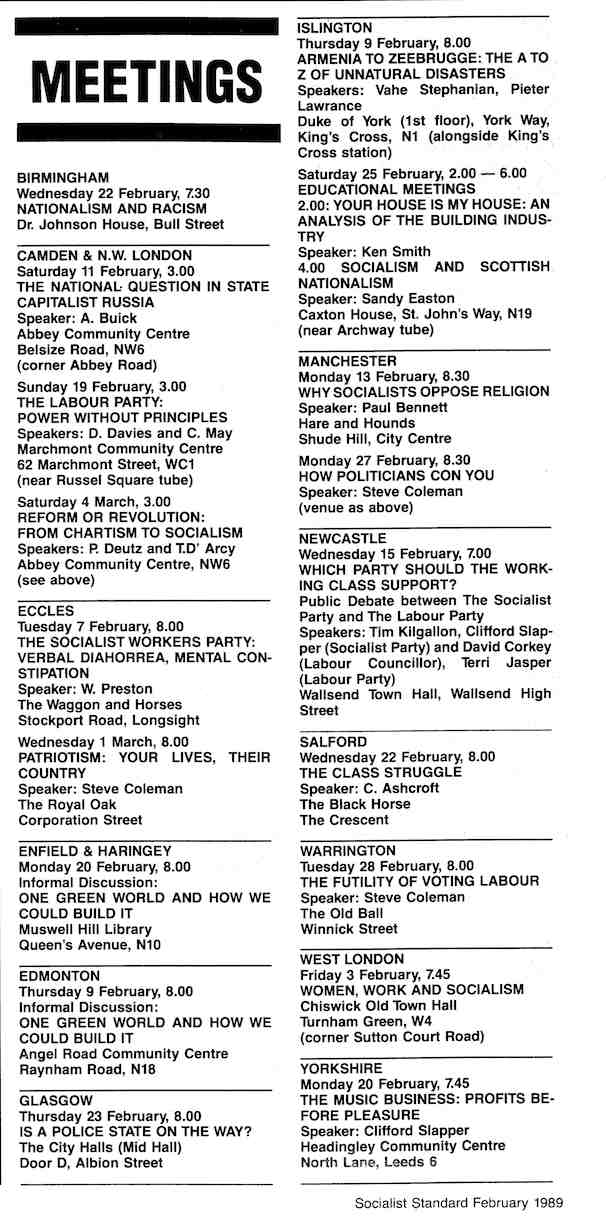
Party News from the November 1994 issue of the Socialist Standard
Showing posts with label Pat Deutz. Show all posts
Monday, April 6, 2026
Sunday, March 29, 2026
Letter: Squaring the family circle (1975)
Squaring the family circle
The article on “The Future of the Family” in the February Socialist Standard gave me food for thought, and I’d like to make some comments.
First, about social groupings in Socialism. P. Deutz says — “People . . . belonging to the community does not have to mean living cheek-by-jowl in an undifferentiated mass! Rather, a mixture of private and communal life in accordance with individual choice.” I think she carries over into the new society the distinction between “private” and “public” life which exists in capitalism.
“Private” life in the nuclear family is often restricting and isolating, but it does have some human qualities — continuity, personal relations etc. — which are lacking in the even more manipulated and alienating forms of “public” life, such as the mass political meeting. In both, workers are kept separated from one another and dominated. No doubt people in a Socialist society will want different degrees of privacy at different times, but there is no need to fear that either the more or the less communal parts of their lives will bear any resemblance to the present-day family or mass events. People will want to break down the huge factory and office work settings into smaller and more friendly workshop-type teams. Discussion and decision-making will most conveniently be done in quite small meetings, linked together by delegate congresses and telecommunications. This will be made possible by automation and computer technology. On the other hand, people will have gained the security, material and emotional, that may enable them to extend their intimate relationships at the same time as improving their responsibility to one another’s needs.
Just as people will want to combine the most satisfying aspects of urban and rural life, so they’ll want to combine the most satisfying aspects of “public” and “private” life. At any rate, I’d want to.
I’m glad that P. Deutz recognizes that men and women will both take a full part in childcare, and whatever housework cannot be eliminated, as well as in production and so on. Finally, don’t the family and lack of Socialist understanding have some connection with one another? (I mean the family as it exists now.) In terms of restricted horizons and concerns for both men and women, the illusions of sex rĂ´les, and all those people in little boxes staring at the goggle-box? Don’t we have to start thinking about the effects that different social institutions have on consciousness, and what we can do about it?
Stephen Stefan
London N2.
Reply
The history of the family shows that its form has adapted to suit prevailing economic conditions and not the other way round. Modern families may be preoccupied with their own affairs but they do not exist in a vacuum. Or do you seriously suggest that people are impervious to any influence from outside their family circle? (Many parents might wish it were so). Even television, as well as puerile slop, beams into workers’ homes pictures of the latest technological success which contrast starkly with other scenes of human deprivation and misery.
The view on the blend of private and public life assumed that in a harmonious society human individuals will still have varying personalities and needs. However congenial the communal life we may still wish to relate to, and live with, others on a more individual basis.
We have always stated that under Socialism men and women will, in accordance with their ability, co-operate to perform the tasks necessary to that society. You have never read anything to the contrary in this journal!
Editors.
Sunday, November 30, 2025
SPGB Meetings (1986)
Party News from the November 1986 issue of the Socialist Standard
Blogger's Notes:
So many meetings and, sadly, not enough space in the label section to list all the speakers featured. I even had to omit the branches from the label section this time around. Just not enough *cough* characters.
Despite all the meetings listed, it looks like only one of them is featured on the audio page of the SPGB website. The debate in Newcastle with Bill Etherington of the NUM — later a Labour MP — is available at the following link:
Debate between Clifford Slapper (SPGB) and Bill Etherington (Gen. Sec. of Durham Mechanics, N.U.M.)Venue: The Printers Pie, Newcastle upon Tyne 1986
I wonder if Harry Young's meeting in Chiswick under the title of 'A Socialist's trip to Siberia' covered the same ground as his article, 'Escape to Happiness (or drama on the Trans-Siberian Railway)', which appeared in the October 1986 issue of the Socialist Standard, and which generated some controversy at the time.
Thursday, October 30, 2025
Saturday, October 18, 2025
SPGB Meetings (1986)
Party News from the October 1986 issue of the Socialist Standard
Blogger's Note:
There were so many meetings advertised in the October 1986 Standard that I had to split the party news post into two. And I still didn't even get to include everyone listed in the label section. Apologies to Janie Percy-Smith, Cliff Begley, Steve Coleman, Pieter Lawrence, E. Hardy, Carl Pinel, Ralph Critchfield, Enfield & Haringey Branch, Islington Branch, Doncaster . . . did I leave anyone out?
Monday, September 29, 2025
SPGB Meetings (1986)
Party News from the September 1986 issue of the Socialist Standard
Blogger's Note:
The January 1987 issue of the Socialist Standard carried an article by Janie Percy-Smith giving an overview of the Women and Socialism meetings that took place in the autumn of 1986 to help promote the SPGB pamphlet of the same name.
Monday, September 1, 2025
Saturday, December 21, 2024
Monday, December 16, 2024
Letter: Zionism (2006)
Letter to the Editors from the December 2006 issue of the Socialist Standard
Zionism
Dear Editors,
I agree with Howard Moss that the aim should be for articles to give the socialist perspective (Letters, November Socialist Standard). However it is not so unusual for articles to outline some aspect of history or current events and only give reference to the socialist aim in the concluding comments. As socialists we wish to be as well informed as possible. I found Susan Nathan’s book The Other Side of Israel (now available in paperback) both moving and informative.
My concern is that the article (intended as a review) may not fairly represent the book as it only refers to some aspects of its content. For example it does not mention the author’s background. Her father was born in South Africa, the son of Jewish refugees from Lithuania. She is thoroughly aware of Jewish history, including the discrimination suffered by her great-grandfather in Lithuania, and had first hand experience of apartheid in South Africa. The book does not claim that conditions in Israel are identical to those that formerly existed in South Africa – the “petty elements” are absent. As stated in the article the term ‘apartheid’ is applied in a specific sense and its use is only emotive if you do not agree that Israeli Arabs are treated as second class citizens.
Pat Deutz
Saturday, December 7, 2024
From poverty to power (2008)
How Active Citizens and Effective States can Change the World by Duncan Green (Oxfam Publishing 2008)
Duncan Green defines an effective state as one that “can guarantee security and the rule of law,” and has an effective strategy “to ensure inclusive economic growth”. Such a state should be accountable to citizens and able to guarantee their rights. Active citizens are linked to the state by a “combination of rights and obligations”: making use of these rights to improve their conditions.
He argues that it is the combination of poor men and women and their national governments that provide the main actors in the fight against poverty and inequality. Case studies are given to illustrate how even the poorest people have by their organised and persistent actions brought about beneficent change in their circumstances. Like the Chiquitanos people of Bolivia who after 12 years of “unremitting and often frustrating struggle” won legal title to the 1m-hectare indigenous territory of Monteverde.
He is aware that the scales are weighted against the poor in all areas. For example, research is dominated by the private sector: in agriculture 5 large multinational corporations spend $7.3bn per year on agricultural research on high value, high profit products while the staple foods of poor communities are “likely to be overlooked.” In biotechnology the picture is the same with GM crops being genetically engineered to meet the needs of large scale farms. There is no serious investment in the five most important semi-arid and tropical crops.
Half of the world’s population lives in the countryside and the majority of people in absolute poverty live in the rural areas. OECD (Organisation for Economic Co-operation and Development) sources are given for the claim that over the past 20 years aid donors and governments have effectively withdrawn from the countryside. Mention is made of the well known ‘structural development programmes’ which imposed a ‘radical free market’ on debtor countries.
Agricultural growth, Green argues, reduces poverty but is most effective when small farmers are able to capture a fair share of the benefits. Local farmers, he says, should be helped to improve the quality of their produce so that for example retail giants like McDonalds and Pizza Hut use local produce instead of importing produce from the USA. Here his ‘active’ citizens would be small farmers “organising their ability to negotiate a fair deal”. However when it comes to buying fertilizer or seeds, or selling produce or their labour, small producers are dominated by the large corporations. Small farmers are “de facto employees”.
In Green’s view efficient states should take the environment and the enhancement of the daily lives of the poor as prime considerations. Global governance (the “web of international institutions, laws regulations, and agreements”) could help, and the 8 main ways he lists include managing the global economy, redistributing wealth through aid or international taxation, averting health threats and avoiding war. However global governance fails to live up to its ideals. “The WTO is frozen, regional trade agreements are proliferating and introducing profoundly unfair trade and investment rules, the G8 is failing to keep its promises on aid…”, then there is the threat of climate change and “a looming financial crisis”.
The book is well sourced with a 24-page bibliography and three further pages listing background papers. There is much useful information covering more areas than can be dealt with in a review. However Duncan Green takes a moral stance whereas under capitalism the prime consideration cannot be the welfare of citizens active or otherwise, but sale and profit; this drives development (forget sustainable) – and can also inhibit it. And the state that in his view is supposed to facilitate change will only do so to the extent that the interests of the owning class are served.
Pat Deutz
Friday, November 29, 2024
Saturday, November 2, 2024
SPGB Meetings (1982)
Party News from the November 1982 issue of the Socialist Standard
Blogger's Note:
Audio recordings of the following meetings from the November 1982 Standard are available on the SPGB website.
YES – Steve Coleman, SPGB
NO – Monty Johnstone, CPGB & ‘Marxism Today’
Venue: Islington Central Library, London
Date: 11th November 1982
Part of the series Socialist Thinkers – People Who History Made
Date: 21st November 1982
Speaker - Steve Coleman
Part of the series Socialist Thinkers – People Who History Made
Date: 28th November 1982
Speaker - Steve Coleman
Thursday, February 1, 2024
SPGB Meetings (1974)
Party News from the February 1974 issue of the Socialist Standard
Blogger's Notes:
- 'S. Stefen' was the pen-name/party name of Stephen Shenfield.
- Howard Weaver's obituary was posted elsewhere on the blog.
- Stephen Bodington was the author of the 1973 book, Computers and Socialism. He was associated with the Labour Left.
Monday, November 20, 2023
The Russian Revolution recalled (2008)
Even 90 years after the Russian revolution there are still some who claim that the event shines as a beacon for socialism. We were able to say at the time that whatever was happening in Russia it was not a socialist revolution.
In August 1918 the Socialist Standard pointed out that, while there were industrial towns in Russia, the country was largely agricultural with about 80 per cent of the population still living on the land. The answer to the question whether “this huge mass of people” (about 160 million), which indeed included some industrial and agricultural wage slaves, was “convinced of the necessity and equipped with the knowledge requisite for the social ownership of the means of life?” was “No!”; beyond the fact that the leaders in the November movement claimed to be Marxian socialists there was no justification for terming the upheaval in Russia a Socialist Revolution.
Our analysis of the situation was based upon Marx’s definition of capitalism as a relation of wage-labour and capital and on the conditions necessary for that relation to be ended and replaced by socialism. Before “the Communistic abolition of buying and selling, of the bourgeois conditions of production”, as the Communist Manifesto put it, can happen, there must be a sufficient development of the productive forces, and the class which has to sell its labour power in order to live – the working class – must fully understand what is involved and be ready to take the necessary political action.
The conditions envisaged by Marx to be necessary for the ending of capitalism and establishing socialism did not exist in Russia in 1917, so why have the events been claimed as socialist?
Russia in 1917
The country had suffered huge losses during the war against the more heavily industrialised Germany, the economy was in a mess and there were food riots. The Tsar had been forced to abdicate in March 1917 – while both Lenin and Trotsky were out of the country – and the situation was confused. There was a provisional government which included capitalist and landowning representatives. In July Kerensky became leader with support from the Committee of the Duma (the Russian parliament) but with increasing support from the councils of Workers and Soldiers – the Soviets. However he continued with the war despite its unpopularity.
There was widespread discontent with soldiers, workers and peasants reacting against the adverse conditions, which the Bolsheviks were able to take advantage of the discontent. They gained control of the Soviets using slogans like “All power to the Soviets”, and crucially “Peace! Bread! Land!” In other words, this was what the war-weary, hungry workers and peasants wanted – they were not after socialism. That there was not a majority ready for socialism would not have concerned Lenin. The situation fitted his vanguard theory that the working class by its own efforts is only able to develop trade union consciousness and needs to be led by professional revolutionaries. There were enormous difficulties including the backward state of the country and the civil war; also the expected uprisings in other European countries did not take place. The development of capitalism was all that could happen and the Bolsheviks as the new rulers would have no choice but to do their best to aid it.
That it was a minority revolution is illustrated by the way in which Lenin dealt with the political situation. The All-Russia Soviet Congress had met in November 1917 and had passed resolutions in favour of peace, ending landowners’ rights to possession of the land, and the setting up of a ‘workers and peasants’ government, headed by Lenin and dominated by the Bolsheviks, pending the election of a democratic ‘constituent assembly’.
However when the Constituent Assembly was elected the Bolsheviks did not have a majority and it was dissolved. Trotsky’s excuses for this are instructive – the election had taken place too soon after “the October Revolution” and news of what had taken place spread only slowly. “The peasant masses in many places had little notion of what went on in Petrograd and Moscow. They voted for ‘land and freedom’”. Precisely, for that, not socialism. So, not only did the Bolshevik takeover not have majority support, majority support for socialism not present either.
By the middle of 1918 the Communist Party (as the Bolsheviks were now called) had firmly established its dictatorship and freedom of the press and assembly were restricted. The All-Russia Soviet Congress had ostensibly taken all power to itself but this was a façade. The Congress elected the 200 members of the Central Executive Committee but the credentials of delegates to the Congress were verified by Communist Party officials. Lenin claimed that what he called “Soviet Socialist Democracy” was “in no way inconsistent with the rule and dictatorship of one person; that the will of the class is at times best served by a dictator” and this was approved by the Central Executive Committee in 1918 (Martov The State and the Socialist Revolution, p.31).
Labour discipline
Raising the productivity of labour was a priority. In an address before the Soviets in April 1918 (The Soviets at Work) Lenin declared that not only was it necessary to halt ‘the offensive against capitalism’, they also had to employ capitalist methods which included strict discipline at work. They should immediately introduce piece work and measures which “combine the refined cruelty of bourgeois exploitation and valuable attainments in determining correct methods of work.” The previously stated aim of equal wages for all was abandoned and a “very high remuneration for the services of the biggest of the bourgeois specialists” was agreed. State control was seen as the “means to establish the control and order formerly achieved by the propertied classes” and he chided those who considered the “introduction of discipline into the ranks of the workers a backward step”.
In January 1920 the Bolshevik government abolished the power of workers’ control in factories and installed officials who were instructed by Moscow and given controlling influence. Democratic forms in the army had also been abolished.
The need to use capitalist methods to control and discipline workers in order to increase production, illustrates the absence of the absolute pre-requisite for socialism – the conscious participation of the majority of the working class.
State capitalism
In 1921 the Bolshevik government adopted a New Economic Policy. In proposing it Lenin argued that permitting some private industry and allowing peasants to keep surpluses were not dangerous for socialism. “On the contrary, the development of capitalism under the control and regulation of the proletarian state (in other words ‘state’ capitalism of this peculiar kind) is advantageous and necessary in an extremely ruined and backward peasant smallholder country…in so far as it is capable of immediately improving the state of peasant agriculture.”
Our criticism of Lenin, Trotsky and the Bolsheviks is not that they did not achieve what was not possible at the time, i.e. socialism. It is rather that they adjusted theory to suit the circumstances: seeing the necessity for capitalist development they claimed that state-monopoly capitalism was socialism. In Can The Bolsheviks retain State Power? Lenin wrote about the “big banks” as the “state apparatus” needed to bring about socialism. “A single state bank…will constitute as much as nine-tenths of the socialist apparatus”.
It was also Lenin who said in The State and Revolution in August 1917 that the first phase of communism was usually called socialism, when Marx made no such distinction between the terms. (In the 1888 Preface Engels refers to the Communist Manifesto as the most international of all Socialist literature). In Marx’s conception of the first phase of communism there was still common ownership, an end to buying and selling, and no money. (Marx mentions the possibility of labour time vouchers despite their obvious drawbacks). What happened in Russia did not qualify even as a “first phase of communism”.
Contemporary Trotskyists still call their aim of state capitalism socialism. The former Militant Tendency (now called SPEW) think that nationalising 150 big corporations would express in today’s language the demand in the Communist Manifesto for the “abolition of private property”. They also support Lenin’s vanguard theory that a revolutionary minority can by their leadership turn protest movements into a ‘socialist’ revolution. So it is hardly surprising that they claim the events in Russia in 1917 to have been a socialist revolution, blaming the backward state of the country, civil war and Stalin for what went wrong.
Both Lenin and Trotsky thought that democracy was not appropriate to their situation. Having taken power in a minority revolution they had to rule by force. This included the use of secret police – the Cheka. Trotskyists excuse Lenin’s red terror on the grounds that it was the outcome of civil war necessity, likewise with the measures taken to deal with the problems of production. However, it was precisely the conditions and the absence of a majority for socialism that made capitalism the inevitable outcome.
The rule of Lenin supported by Trotsky paved the way for Stalin. The legacy of the Russian Revolution, of Lenin and Trotsky, is that socialism/communism has come to be identified with state capitalism. It was not a victory for the working class, but a tragedy since it brought socialism into disrepute and diverted attention away from the vital need to reject capitalism in whatever form.
Pat Deutz
Friday, November 10, 2023
Letters: Conspiracy? (2006)
Conspiracy?
Dear Editors,
I was astonished that the article “Reflections on a somewhat unusual act of war” (Socialist Standard, September) accepted hook, line and sinker, the official version of events to explain the attacks which took place on the 11th September, 2001. The contributor rightly draws attention to the document “Rebuilding America’s Defenses” where the authors observe that a programme of increased military spending to preserve US global pre-eminence will be politically impossible unless there is “a catastrophic and catalyzing event, like a new Pearl Harbor” but does not make the rather obvious link when this event actually occurs just a year after this document was issued, particularly when there is a mountain of evidence to support the view that the 9/11 attacks were orchestrated by dark and shadowy forces very close to the Bush administration. Just another conspiracy theory? I don’t think so.
Space does not permit me to outline many of the seemingly incontrovertible facts which compel one to consider an alternative scenario to that which has been peddled by the capitalist media for so long and now apparently in the Socialist Standard. There are many web-sites dealing with this and related subjects, one worthy of a visit being….. www.whatreallyhappened.com/
Allow me to refer briefly to the attacks on the twin towers. That flights 11 and 175 crashed into the towers is beyond dispute; whoever or whatever was responsible is another matter. The official version that the planes were piloted by ‘terrorists’ simply does not hold water. It is true that two of the supposed hijackers, Mohammed Atta and Marwan Al-Shehhi, received basic flight training at a private avaiation school in Florida but neither men could fly a 2 seater Cessna 150 without an instructor let alone a Boeing 757 or 767. Even an experienced 727 pilot has to take over 70 hours of simulator time just to be able to navigate a 757 or 7671
The twin towers were very strongly constructed and designed to withstand temperatures of up to 2000 degrees Celsius. The core column of each tower comprised 47 huge steel box columns embedded in solid concrete. Each floor was separated from the other floors by thick steel plates to avoid the propagation of any type of fire. Before 9/11, not one steel framed building in the world ever collapsed as the result of any type of fire.
The heat generated by kerosene-based aviation fuel cannot exceed 825 degrees Celsius even in an oxygen-rich environment, so why did the towers collapse? In the basement of the fallen towers, where the support columns were anchored to the bedrock, ponds of molten steel were found several weeks after the attack. What could be responsible for such persistent and residual heat, 70 feet below the surface, in an oxygen-deprived environment? One school of thought is that an exothermic explosive, such as Thermite or Ametol, was placed at the base of each tower. With these substances temperatures above 2500 degrees celsius are often reached so melting of the steel box columns is perfectly feasible. This would explain the many eye-witness reports of explosions heard just before the collapse of each tower. Unexplained tremors were also recorded on a seismograph 21 miles away 14 seconds before the collapse of each building.
Judging by another article which appeared in the same issue of the Socialist Standard, the views of Michel Chossudovsky are well respected. His opinion on this subject is unequivocal: “September 11th (was) a hoax. It’s the biggest lie in US history”.
Steve Prince,
London N7
Reply:
On balance the hypothesis that the attacks of September 11, 2001 were organized by Osama Bin Laden’s network is more plausible than any other hypothesis that has been put forward. This is not to deny that the exact role played by Bush is open to debate. He may have connived at the attacks by refusing to act on intelligence warnings that he believed, although his inaction could also be attributed to an unwillingness to accept unpleasant news.
Without examining in detail the discrepancies that you see in the Bin Laden hypothesis, it should be noted that many engineers do not share your high opinion of the design of the Twin Towers. See, for instance, the report of the National Institute of Standards and Technology, summarized in New Scientist of 6 April, 2005. Thus the steel sheets were strong but very thin; they did not have to reach melting point before starting to give way.
Just what is the alternative explanation that you find more convincing? You refer to orchestration by “dark and shadowy forces very close to the Bush administration”. What on earth does this mean? This is the kind of mystical language beloved of those who believe that the world’s problems have their origin not in visible institutions but in occult conspiracies ultimately controlled by the Prince of Darkness himself. Exploring the site that you recommend (www.whatreallyhappened.com), we learn that figures ranging from Bush and Kissinger to the Pope as well as the CIA, Mossad, and MI-6 are all in the service of “Illuminati bankers” (Jews, of course), working to undermine society by means that include homosexuality and feminism. (The Illuminati were an 18th century revolutionary secret society and are long defunct).
The question of conspiracy theories, and their current popularity, was dealt with in an article in the July 2002 Socialist Standard to which we would refer you. It pointed out that “the conspiratorial worldview is certainly not helpful in promoting an understanding of modern society and is itself, in large part, a product of the times we live in. The organisation of society as it currently exists – capitalism – is certainly not a conspiracy, even if its structure means that conspiracies exist from time to time within it. And for those interested in overthrowing the system which now seemingly leads to secrecy and paranoia almost like night leads to day, a more fundamental approach is needed than that exhibited by the conspiracy theorists” – Editors.
Zionism
Dear Editors
Haven’t we got enough of a problem with capitalism, without adding Zionism to the list of “things sent to try us”? Surely you know that Israel is a much more complex problem than is shown by your simplistic and extremely misleading article (October Socialist Standard). Stick to the class war!
H. G. A. Hughes,
Corwen, Wales
Dear Editors,
I read Pat Deutz’s article, ‘Zionism: myth and reality’ in the October 2006 Socialist Standard and wondered what was the point of it. The article tells of the reactions of a British Jew, Susan Nathan, who emigrated to Israel only to be repelled at the treatment of the Arabs living within its boundaries. This she recounted in a book, The Other Side of Israel.
My problem is not the veracity of what Nathan writes (though the emotive use of the term ‘apartheid’ as in ‘apartheid state’ is obviously misleading) but your failure to cast a socialist perspective on the whole situation. While it’s true that ‘the price of creating a homeland was to inflict the Jewish story of disposessions and wandering on another people – the Palestinians’, this kind of event was not unique in the Middle East in the 20th century. Indeed during that century the whole map of that region was redrawn, the whole geopolitics transformed, causing dispossession, population shifts and suffering on a massive scale.
The nearest you come to mentioning this is to say that ‘Socialists never supported Zionism but opposed it as yet another nationalist delusion’, but you never actually refer to the other nationalisms in the region, many of which, as you must know, are just as virulent and often far more savage and racist than what is practised in Israel. Finally you fail even to draw from your analysis the point fundamental to the socialist view of capitalism that the ‘democracy’ the system has to offer is inevitably superficial and that, when put under pressure, even the most apparently ‘democratic’ of states will, if it knows it can rely on widespread support, resort to repression of minorities and opponents.
Howard Moss,
Swansea
Reply:
We certainly don’t single out Zionism for special criticism (and our first correspondent does not say in what way the article was supposed to be “misleading”). We are opposed to all nationalism and just happened to use the example of Israel, and the treatment meted out to its “non-national” minority, to show just what a danger it is to working class unity.
We accept that other capitalist states and factions in the Middle East have pursued policies that are nationalist and anti-socialist and the article should not be construed otherwise. It was basically a review of a book about Zionism and could not reasonably be expected to comment more widely on the intricate policies of the Middle East in any developed way. – Editors
Monday, October 9, 2023
Zionism: myth and reality (2006)
Zionism misled many Jewish workers with its promise of a “homeland for Jews”. A recent book examines the fate of the million or so non-Jews in the state Zionism established.
In 1999 when Susan Nathan went to live in Israel under the Law of Return her head was “full of romantic notions of Zionism and the Jewish state.” Some three years later she moved from Tel Aviv to live, as the only Jew, in the Arab town of Tamra in the Galilee. Her book, The Other Side of Israel (published by Harper Collins last year), tells the story of her “journey across the Jewish-Arab divide”, and gives a rare insight into the Jewish state from the perspective of the Palestinians who are Israeli citizens.
The journey began when she was a patient in the Hadassah hospital in Jerusalem, where she was surprised to find Israelis and Palestinians sharing the same ward, and Palestinians who were Israeli citizens: Israeli Arabs. The real shock came when an Orthodox woman was visited by her husband who had “a pistol on one hip and a rifle slung casually over his shoulder” – no one else seemed surprised by the presence of an armed civilian. He told Susan Nathan in a strong American accent that he had requisitioned an Arab home in East Jerusalem and never left home without a weapon. The reply to her suggestion that he would be better off in the Jewish Quarter of the Old City was “All of East Jerusalem belongs to the Jews.”
More questioning came a few months later when she was invited to help with a student organisation – Mahapach, in connection with their work for disadvantaged communities in Israel, “particularly the indigenous Arab population and the community of Jews of Middle Eastern descent . . . the Mizrahim.” She knew of the latter but where did the Arabs live? Why had they been invisible to her during her first two years in Israel?
She was to learn that one million Arabs share the state, and that about a quarter of them are internal refugees. She was “profoundly shaken” by her first visit to an Arab area – the town of Tamra, made as part of the research for Mahapach. It was strikingly different from any Jewish area she had seen, with obvious, chronic overcrowding.
At the home of Dr Asad Ghanem (head of politics at Haifa University) she heard about the discrimination exercised against the Arab population “in all spheres of Israeli life.” In Arab communities there are thousands of homes judged illegal by the state and under the threat of demolition: in Tamra there are 150 such homes. The authorities’ version is that the widespread illegal building is the act of law breakers, people squatting on land or not wanting to pay for a licence. So the police bring bulldozers “at crack of dawn” to destroy illegal homes. 500 hundred Arab homes were destroyed in 2003.
Arab families are forced to build illegally because the state refuses to issue them with a building permit. Even when, as in Dr Ghanem’s case, the home is built on land owned by his family for generations the permit is still refused: he pays regular heavy fines to ward off demolition. He asked Susan Nathan if she had made Aliyah, and it was difficult to answer. Her privileges as a Jewish immigrant were at the expense of his people, “sitting in his home the reality finally hit me. The intoxicating power trip had come to an abrupt halt.” And the task of becoming informed had begun: the unlearning of her “lifelong Zionist training.”
The Zionist myth is that the “Jews had reclaimed an empty, barren land – ‘a land without people for a people without land’- we had made the desert bloom, we had filled an uninhabited piece of the Middle East with Kibbutzim, the collective farms that were the pioneering backbone of the state in its early years.” Prior to 1948 there had been aggressive colonising of the land by Jewish immigrants, and a campaign of land purchases funded by the Jewish National Fund, but only 7 percent of Palestine had been purchased.
The other side of Israeli Independence in 1948 is for the Palestinians the Nakba (the catastrophe) the loss of their homeland to the Jewish state. 750,000 Palestinians were driven from their homes and country. A map in the book marks the position of the 400 villages which were emptied and then destroyed by the army. The Kibbutzim were built on the land of destroyed villages. Around a hundred villages survived, as did Tamra because it was not on the main route of the Israeli army and was a small community providing “a useful pool of cheap labour in the area.” The original village had a population of 2,000 the number was swelled by refugees cleared from other villages. Photographs exist from 1948 which show “a sea of Red Cross tents” in which the refugees were housed for some years. One third of the present inhabitants of Tamra are internal refugees. A sizeable number of the 150,000 Palestinians who remained in the country and became Israeli citizens (“by accident rather than design”), were classified as “present absentees”, and had their homes, land and bank accounts appropriated by the Custodian of Absentee Property. There is no instance of any property being restored to former Arab owners or compensation paid.
Apartheid
Dispossession still continues in various ways. Planning laws restrict Arab communities both in number – to the 123 listed in 1965 – and in area, even though the population has increased. Israel is an apartheid state which enforces policies of ethnic segregation. Dr Uri Davies a Jew who, like Susan Nathan, lives in an Arab town is quoted as applying the term apartheid in a specific sense to mean “the regulation and enforcement of racism and xenophobia in law.” He defines the core element of an apartheid state as “the structure of laws that allows the colonising population to exploit the resources of the state – mainly land – to the disadvantage of the native population.”
Though it is not publicly admitted “racist employment practices and the exclusion of Arabs from wealth generating sectors of the economy are the bedrock of state planning policies.” Most computer systems do not list Arab communities. Arabic is the second official language, yet people are not allowed to use it at work – a woman was sacked from McDonalds for doing so.
There are two separate school systems, with much less money spent on Arab children. There is intensive surveillance of the Arab education system, teachers are effectively “banned from teaching about the Nakba . . . or about their people’s connection to Palestinians in the West Bank or Gaza” and the refugee camps in other countries. In Haifa the Arab Parents’ Forum failed in an attempt to register their children at Jewish schools for 2004: Arab pupils are in a separate registration area.
Susan Nathan believes that what happened in the 1948 war is at the root of conflict in the Middle East. The price of creating a homeland was to inflict the “Jewish story of dispossession and wandering on another people – the Palestinians.” She makes a distinction between making a comparison, quantitative judgements about the degree of suffering, and drawing a parallel which suggests “one set of events can echo another.” Zionist organisations, she says, like the Jewish National Fund and the Jewish Agency should be disbanded and the apartheid system ended; there should be equality between all citizens.
An old man told her of the time when it was possible to travel by train from the Galilee to all of the region’s biggest cities “when the borders existed as no more than the lines on maps produced by the area’s British and French rulers.” Socialists never supported Zionism but opposed it as yet another nationalist delusion as what we aspire to is a world without national frontiers in which free movement is possible and where all people live together as equals.
Pat Deutz
Thursday, August 3, 2023
Tuesday, April 25, 2023
Where Women's Liberation fails (1973)
At the beginning of this century women had a life expectation of only about 45 years; women passed their prime in reproduction and the main cause of death in the 25-to-35 age group was childbirth. Now marriages tend to start at a younger age and women are able to exercise some choice over the size of their families. The Pill has not led to a postponement of maternity; in fact the tendency is for babies to be born at the beginning of marriage. This means that a mother may now have some forty years in front of her when the youngest child starts school.
Still, for most girls, getting married and having a family is considered sufficient ambition and this is reflected in their education. Three times more girls than boys leave school at the age of 15, and 75 per cent. of all 18-year-old girls do not receive any higher education or training. Household chores are easier now than they were even twenty years ago, even if we do not have all of the latest labour saving gadgets. Whether housework is menial or not may be open to argument but it is certainly not a lifetime's vocation.
Work and Wages
Unfortunately, most wives cannot take advantage of easier housework and less time involved with infants. Those in the Women’s Liberation movement may decide whether or not married women gain some advantage from taking part in socially productive work, but for most of us the discussion is hardly relevant. For despite the myth that women work outside the home in order just to find companionship, or escape from the boredom of housework, in this consumer-orientated society there is no real choice. How else can the family take a holiday, buy that modern home equipment or simply make ends meet? One might also ask just what the "starlight” shift, popular with mothers of young children, does for companionship in the home.
Selma James is among those who have seen through the notion that women gain some kind of liberation by working outside the home as well as in it. However her suggested demand in her pamphlet Women, the Unions and Work for "wages for housework” seems a little naive. Wages are the price for which workers sell their labour power. That price will be generally sufficient to keep a worker, and his family, at a socially accepted standard. Payment made for housework, like family allowances or free transport, would act as a brake on wages. When a wife first takes a job there may be an improvement in the family living standard but her income soon becomes an integral part of the family budget.
Question of Cash
But when it is only the husband’s income which endeavours to meet the family expenses it is hardly surprising that conflicts arise about just how, or by whom, the money should be spent.
"It is a class thing, really, money is power in a husband-wife relationship where there is only one weekly wage packet”: according to Mr. Nicholas Tindall, of the National Marriage Guidance Council. (The Sun, 16.10.72)
In her pamphlet, Selma James makes a comment about a woman earning enough money "to avoid having to degrade herself by asking her husband for money for tights”, which speaks volumes on the blighting effect that money can have on personal relationships. The decision to supplement the family income, or achieve a degree of financial independence, means joining the majority of working women who are used as "little better than cheap labour, doing low-grade repetitive jobs, with rates of pay to match.” (TV Times)
Women are conditioned and, for the most part, educated for stop-gap jobs —to fill in time until getting married — and yet they form 38 per cent. of the work force. More than half of the women who go out to work are married. Many women accept the idea of getting lower pay than men and in the past few of them have joined unions. Out of 9 million working women only two million are union members.
Complaints about the type of work available to women give the impression that all male work is skilled, creative and interesting; that men do not get involved with their children or ever give help (unpaid) in the home. Of course the constant round of childcare and housework can be frustrating but what do most men, and women, get out of their employment? Only the pay packet (or salary cheque)!
Dissatisfaction with women’s rĂ´le in society has led to some discussion of the shortcomings of the social system itself, but what a pity most members of the Women’s Liberation movement seem prepared to settle for so little. The movement, which began in this country in the late sixties, is broadly based and lacks a coherent policy. Emphasis is placed on the continuous development of ideas supposedly by learning through struggle.
Struggle for what? Despite the use of much revolutionary-styled rhetoric, members of the movement essentially seek equality with men in capitalism. When men and women compete for jobs on equal terms and the Equal Pay Act (1970) is fully implemented, plus, of course, the provision of more nursery education and free contraception, their aims will be achieved.
For women to join in one organisation because they are women is about as logical as the idea that all black people have common cause because they are black. The oppression of different groupings within the working class varies in intensity and in form. It is this variation which tends to mask the common factor which applies to all of the groups: women bringing up children alone, immigrants, the homeless, pensioners, etc., etc.
The Working Class
The common denominator which applies to about 90 per cent. of the population is their alienation from the means of production. The only viable definition of the term “working class” includes all those who, because they possess only their ability to work, must sell their mental and physical energies to an employer in return for money (wages or salary). It makes no difference whether the price for their labour and job-status is high or low. The class which owns the factories, land etc. is at an opposite pole. Its members do not need to compete for jobs. Not even for better-paid jobs in management, administration and the professions. Neither will old age or lack of employment throw them on the Social Security scrapheap.
Justification for an autonomous women’s movement is largely based on giving women’s claims priority over the achievement of Socialism, even where it is the alleged aim.
Marx and Engels both saw that when women took a decisive part in large-scale production, and were only occupied by domestic chores to a minor degree, their emancipation became feasible and that furthermore the foundation was laid for “a higher form of the family and of the relations between the sexes”. They plainly knew that, though the pre-conditions for the emancipation of working-class men and women have been met within capitalism, we cannot in fact be set free without a revolutionary change to Socialism. This revolution the world has yet to see.
True Liberation
What will the position of women be in Socialist society?
When the means for production are the common property of the worldwide community, production for use will have replaced the outmoded system of market production. We will contribute to the well-being of society as free individuals and will, without exception, have free access to those goods and services required to fulfil our own needs. (Wages for housework! Who wants wages?)
Though we cannot know exactly what form the family will take, we can say that the “nuclear” family will no longer be the economic unit of society. Men and women will live together because they mutually wish to do so, the bonds between them and their children being neither legal nor financial. Children will be a social responsibility and even a chance pregnancy will not be cause for alarm.
The working class is already armed I with the only weapon a politically- aware majority will need to abolish capitalism and replace it with Socialism. Whether or not we are in unions, or in employment, we have the vote!
A Single Aim
Women’s Liberation is yet another movement dividing the working class. This time with the absurd notion that female oppression is caused by male domination, while in fact but a special aspect of human oppression under capitalism. Even when the end of capitalism is recognised as the only demand “not co-optable” it is dismissed in favour of a reformist struggle.
The movement is largely anti-capitalist and as such assumes the distortion of everybody’s life and potential today. But such generalities are moral, not political, and though everyone wants liberation for all (men and women) this cannot but be Utopianism unless at this stage, we organise around specific oppressions. (Women’s Estate, by Juliet Mitchell, p. 58)
We in the Socialist Party of Great Britain have but one object because the demand for Socialism is of itself a call to end specific oppressions. The demand for Socialism is of itself a protest against war, against poverty and against the frustration of millions of lives only half lived. But more than that, the demand for Socialism recognizes that we can only solve these problems by ending the social system which causes them.
We will not settle for less.
Pat Deutz
Friday, April 7, 2023
Wednesday, April 27, 2022
Subscribe to:
Posts (Atom)


.jpg)