Showing posts with label April 1947. Show all posts

Wednesday, April 6, 2022

Inflation (1947)

From the April 1947 issue of the Socialist Standard

There is a lot of talk by Labour Ministers and others about the possibility of inflation and it may be well if we have some inkling of what to expect in this connection.

The money in circulation has been increased without a corresponding increase in the quantity of goods placed upon the market. Lord Teviot, in an article in the “Recorder” last year, struck an alarmist note.
“Mr. Dalton has reduced public expenditure by 30 per cent., tax reductions amount to only 10 per cent. Civil Service expenditure has increased from £550 million to £2,000 million, i.e., by 300 per cent.

“The continued shortage of consumer goods is reducing the velocity of money in circulation, and there is almost a complete absence of investment for the purpose of capital development or the purpose of capital equipment Mr. Dalton is endeavouring to draw off the unspendable surplus possessed by the public by the stimulation of National Savings, thus creating a capital accumulation not for industrial expansion nor for the production of consumer goods but for the financing of administrative projects. Thus money is used in large quantities for no productive purpose whatever. The control of investment is already leading to the inflation of share values in the stock market. When the time comes to redeem loans, where is the money to come from? It cannot come from a stagnant [industry under-producing and under-equipped. It can only come from increasing the fiduciary issue. This increase will be dictated not by policy but by need and at that moment which is not far distant we shall be in the grip of uncontrolled inflation.” (June 29th, 1946.)
There is something in what he says, but methinks he goes too far, and anyhow we are only interested in the matter from a Socialist standpoint. Capitalists' worries are not our problems except as their struggles reveal more and more clearly that the barrier of capital must be removed before the world becomes a place fit for human habitation. Capital is the power that exploits. In the hands of the Capitalist the means of production function as the means of exploitation. The “money trick” enables our masters to conceal the method of obtaining profit by the employment of wage labour. There is only one way at present for the Capitalist class to prevent inflation and that is to intensify the exploitation of the worker, who must be cajoled or tricked into producing more for less. The worker’s real wages must be made relatively smaller without him getting wise to how it is being done.

He is ready to strike, in spite of the efforts of most trade union leaders to keep him on the job, whenever he realises that prices have risen, and his money wages have remained stationary.

His exploiters, supported by the ‘‘Labour” Government, want him to get down to it, to put his back into it, but he fails to respond wholeheartedly,, and the difficulty of applying pressure is apparent when the unemployed have not yet reached the number that enables the wages of those working to be kept down to that low level suitable to Capitalist interests.

Oscar Hobson stated the problem of the capitalists in the News Chronicle (July 6th, 1946).
“The suppressed inflationary potential can only be overcome by increased willingness to save. The hope of a return to a free economy depends upon a reconversion of the national psychology.

“Meanwhile the main current danger lies in the acceleration of the wages spiral which is calculated to increase both active inflation and the suppressed inflationary potential, and against which the ordinary controls are powerless."
The working class are no longer as patient as they were, they are becoming more difficult to deal with and if capital is to be served something drastic may be attempted and we hope resented.

The change-over from the production of war material to the production of consumption goods has taken place here more smoothly than was expected, the Capitalist class have to thank the present Government for this. The working class have stood more from the Labour Party than they would have from the Tories, but the mask is slipping off.

Wealth is not produced in a bank or in the mint, and certainly not in the halls of legislation. It comes into being at one place only, and that is where work is done. All exchange values are the result of labour being applied to the natural resources of the earth.

The paper currency now in circulation gives those who possess it a claim on what the workers produce.

The claims have been printed in too great a quantity and the result is a rise in prices because production has not increased so rapidly as the claims made upon it If the workers obtain higher wages by strikes, etc. more claims may be printed and! if production is not increased prices go up again and so on indefinitely.

Some of the Capitalists fear inflation, they call upon the workers to work harder to save, etc., but one thing they never do and that is to work themselves. The exploiter is not a producer. He claims the right to consume and succeeded in getting a really good living, even in war time, at the wage slaves' expense. His one object is to prevent his victims finding out how he really does it. Our object is the opposite, for we are workers ourselves. The class struggle cannot he exorcised by a Labour Government, it is a fact that no power at the disposal of capital can eliminate.

Let our rulers deal with problems of the present system, we refuse to help them. We are with our class, we are glad to see them kicking and we hope they will continue to do so until a consciousness of what causes the conflict between Capital and Labour enables them to see the necessity of joining with us to put an end to it.

The implements of Labour must not be allowed to remain in the category of Capital.

The people must own in common all those things upon which they in common depend, so that wealth may in future be produced for the use, benefit, and the enjoyment of mankind.
Charles Lestor

Housing in Merry Sweden (1947)

Book Review from the April 1947 issue of the Socialist Standard

Unable to deceive themselves about the social charms of the country of their birth, many people take to holding forth on the attractions of other lands. In her book "Europe Re-housed,” Miss Elizabeth Denby reveals herself as being one of these. In a chapter on Sweden she opens up with the following:—"Peaceful, merry, hospitable Sweden with its wooded shores, quiet lakes, houses gay with paint and flowers; well arranged, clean and prosperous towns; summer colonies on the islands; fleets of little boats darting about waterways; friendliness, security, ease and dignity of life—all combining to create an atmosphere of happiness which is not dispelled, however often acquaintance is renewed. Democratic, with no great extremes of riches or poverty to distress the mind; alive, alert, eager, full of fun, its inhabitants seem to be well on the way to attaining full life ” (page 48).

It would be quite easy to quote sources to disprove all this. Funnily enough it is not necessary to look further than "Europe Re-housed.” A few pages later appears the first culprit of a sentence: "Also among the working classes, large young families having least money to spare for rent, necessarily take the cheapest dwellings which are also the smallest or the least healthy.” Miss Denby dismisses this admission with the glib comment that the paradox is European and not peculiar to Sweden. On the same page and with one short illuminating sentence she makes mincemeat of her opening statement that extreme rich or poor do not exist in Sweden—"In cases of extreme poverty the family rent is paid as part of poor relief, in addition to the cash subsistence allowance of at most 5 Sw. Kr. a day per family ” (page 56). Stringing together the two quotations one logically assumes that people exist in gay, merry Sweden who can’t even afford the rent for the smallest, cheapest and least healthy shelter.

That Sweden has its slums is shown by the fact that in 1935 a Commission of Inquiry into slum conditions was appointed and recommended the Government to build special dwellings with at least two rooms and a kitchen with rent rebates for larger families (page 57). What a solution for slums! Out of the frying-pan into the fire.

There are of course those wonder-workers the Building Societies, under various names. One novel feature of these is that the prospective mortgagee instead of putting down the usual hundred pounds or so deposit, contributes this with his own labour. Miss Denby quotes a municipal leaflet which shows that this idea is something more than novel and makes it quite clear that hard labour must be done at the end of the day’s work. "The home-builder has not only to do heavy work, he is in many cases forced to lead a regular camping or settler’s life which, however, is not altogether devoid of the charm of such an existence. This charm is perhaps not quite so apparent to the eager home-builder who rushes out to dig in his plot before the frost has left the ground and the chill April blasts sweep over the still bare fields. Even in May the poetry of the enterprise may not touch him very keenly while trudging around ankle-deep in the wet clay at the bottom of his foundation-pit . . . ” That even this way of paying in toil and on the "never-never” for a roof over one’s head is limited to a certain section of the working-class is revealed with "demand has been so greatly in excess of the possibility of satisfying it, that families with young children and with incomes between 3,000 and 5,000 Sw. Kr. a year have been given preference over the applicants ” (page 74). (5,000 Kr. a) year is roughly £5 a week.)

It is true that housing in Sweden compares favourably with the European countries. This is due in the main to the comparatively small and late industrialisation of Sweden. The influx of country people into the cities has not been on the gigantic scale which has occurred in countries like Great Britain or America. However Miss Denby constantly shows the fact of poverty in Sweden and its reflection in the suffering and privation caused by bad or non-existent housing. Like many more comfortably off, intellectual “planners” she usually refers to the existence of poverty coldly and without feeling. The solution is always through technical improvements in the planning of "cheap little homes” for the workers. It is high time that all the workers, Swedish included, realised that they could live in houses they now build for the rich, that is the finest, the most spacious and most attractive in every way. It is high time' they realised that the great barrier in their way, the great barrier to their enjoyment of all the nice things they make, is the fact that they don’t own the means of producing them, the land, mines, factories and transport systems. For the workers to wipe out this great barrier something far different to Nationalisation is implied. They will have to democratically take over industry and transport and run it for the benefit of society as a whole. They will have to abolish the wages system and achieve the organisation ofi a society in which all things are made for use only, and are freely distributed to all.
PROLLY.

Something for Nothing (1947)

From the April 1947 issue of the Socialist Standard

We saw in the previous article that exchange itself is not the cause of capitalist profit, and we posed the question—from whence comes this profit?

Let us take again the example of our capitalist who has purchased raw material, machinery and workers’ energies. Obviously the inert material and machinery cannot enhance their own value, they are factors which are constant. Furthermore our capitalist has paid the proper market price for them, thus ruling out any gain in exchange, and he now wishes to transfer their value into the fresh product, together with the new labour of the workers he has employed.

Here lies the crux of the question—does our value for value proposition—hold good here? Do workers get the value of their ability to work? All through we have presented Capitalism as a system whose whole activity centres around the production and sale of commodities and the plain answer to the question is that the workers’ abilities prove no exception to the rules of capitalist production.

The worker appears on the labour-market offering his abilities for a price or wage, his offer is taken up by the capitalist who has use for them, paying in exchange the price then ruling on the market. Thus the power to work, or labour-power, takes on qualities of a commodity—it is produced for sale—it has no use-value to its owner, and it will be a use-value to the consumer or buyer.

But labour-power has a characteristic unlike any of the inert purchases bought by our capitalist, for this living thing can produce value over and above its own. The problem is solved. The value of labour- power is based on the labour-time spent on the food, clothing and shelter necessary to produce it, which value finds its monetary expression in wages. If we therefore subtract the value of these “means of subsistence” from the total value that the worker produces, there is a surplus of value left over to be realised by the capitalist when he markets the product.

Our use of the term labour-power arises because the worker does not—as is usually supposed—sell his labour to the capitalist. The labour expended by the worker goes into the products of the employer and in these the worker has neither ownership nor right of disposal. Actually the owner claims the right to all labour performed within his control during the time that the worker “contracts” over to him the use and disposal of his labour-power. Another aspect of the sale of labour-power is that the worker usually credits the capitalist with a week’s labour-power before being paid for it, the capitalist thereby having a week’s labour in hand before being called upon to settle the wage-bill.

We earlier on said that the value of the workers’ means of subsistence is the labour time necessary to produce it; we can therefore divide the working-day into “necessary labour” equalling the value of the workers’ labour-power, while the rest of the day is surplus-labour. In effect the worker produces value equal to his day’s wage in say, three hours, the remaining time being spent producing surplus-value for his employer. The ratio of necessary-labour to surplus-labour tends to become progressively smaller as the means of production increase and more wealth is turned out with the same or less labour, in other words, the gap between the workers’ subsistence and the “rake-off" taken by tho boss, becomes increasingly greater. As subsistence is in money terms, the worker must keep incessant watch on his ’’real wage," i.e., its purchasing power, be his “nominal wage” what it may. A general rise in prices, for instance, will tend to leave him selling his labour-power below its value, and this, if for no other reason is why he must unite with others in a union with the withdrawal of labour-power as his final weapon, to hold his nominal or money-wage in line with his real-wage, for he and his like are the sport of the market in which a change of price level affects immediately the standard of living.

Whilst the slave of old was owned outright by his owner, the modern worker affects to be a “free man,” selling, like any other trader, a commodity for which he asks but a fair price in line with its value. As such he suffers all the vicissitudes of the market; he must accept as inevitable, overwork during the boom, unemployment during the slump, along with the regimentation of himself and his family in times of crises when even the right to bargain the price of his commodity is withdrawn by law. Machinery, which should lighten his labours, becomes his rival when installed to “save labour"—his labour and his job—whereupon more often than not, his wife plus children of "working age" are—to balance the family budget—thrust upon the market as his competitors in cheap labour-power.

There is no escape from this market in labour-power, even where it comes under the control of the planners of state capitalism, for the relationship of wage worker-employer, is not thereby abolished. In truth the worker is the slave of capital, a unit of the living labour force which enters the process of commodity production as part of the capital costs necessary to gain for the capitalists—something for nothing. How the capitalists share the gains of the workers’ exploitation will be sketched in our next article, “The Division of the Spoils."
Frank Dawe

Editorial: The Powers and their Armed Forces (1947)

Editorial from the April 1947 issue of the Socialist Standard

When Mr. Bevin reached Moscow on March 8th to attend the Four-Power Conference on the settlement of German and Austrian Peace treaties he said
“We have come here to work harder together to hammer out a just and durable peace" (Sunday Express, March 9th, 1947).
Stalin had just written of his “constant belief in Anglo-Soviet-American co-operation in peace as in war,” and similar peaceful protestations were made by U S.A. and French spokesmen.

We have heard all this before, in the years between the end of World War I and the beginning of World War II. How little has changed. Different men, with different party labels continue the same capitalist struggle for power. The U.S.A. announces its intention of asking for exclusive “strategic trusteeship” over the 623 former Japanese mandated islands in the Pacific (Manchester Guardian, February 28th, 1947); and the Secretary of the U.S. Navy explains that the U.S. Navy “will continue to operate in the Western Pacific . . . The Navy,” he said, “ had more or leas inherited from Britain the job of keeping the sea lanes open and stabilising areas from which exports came ” (Times, March 1st, 1947).

Then, in response to a request by the British Government for financial aid in propping up the Monarchist regime in Greece, President Truman “told the Congress leaders to-day of a new U.S. foreign policy, under which the U.S. must intervene in Near East politics with the full weight of its economic power. It is confirmed that Mr. Truman will ask for a £62,500,000 direct loan to Greece as a substitute for Britain’s financial aid ” (News Chronicle, March 11th, 1947).

A day earlier it was disclosed in Washington that “Turkey has now asked for U.S. help to guard her frontiers against Russia ” (Daily Mail, March 10th, 1947).

The Manchester Guardian reported (February 28th, 1947), that the Russian Government (much to the consternation of the American Communists) had given its consent to the American claim for the Pacific islands; a move interpreted as indicating that Russia hoped to get U.S. approval for some of its own annexations. Meanwhile the Russian Government is trying to get Norwegian consent to set up military bases in the Spitzbergen Peninsula and has just made a new agreement with Poland, giving a £7 million loan and arranging for the supply of military equipment and armaments for the Polish army. Examples could be multiplied, and of course the British and French Governments are engaged in similar manoeuvres in areas deemed to be vital to their imperial interests.

Behind the peaceful words of the politicians are the armed forces they keep to back up their demands. The American budget for 1946-47 provided expenditure on defence of about £4,000 million.

The British Government in 1946-47 spent about £1,000 million, equal to 28 per cent of the total budget expenditure (News Chronicle, February 22nd, 1947), and announcement was made on that date of the Russian budget for 1947. The Communist Daily Worker analysed the figures as follows:—
”The Budget anticipates a surplus of 20,100,000,000 roubles (about £1,310,000,000 at the current rate of exchange) providing for an expenditure of 371,400,000,000 roubles during the year. Armed forces expenditure is down to 18 per cent. of the total expenditure, compared with 24 per cent. last year.” (Daily Worker, February 22nd, 1947).
From this it will be gathered merely that Russian expenditure on the armed forces is a smaller percentage of total expenditure than it was in 1946. If, however, the reader takes the trouble to work out what 18 per cent. amounts to at the rate of exchange used by the Daily Worker he will find that it means £4,457,000,000 to be spent on the armed forces. Figures do not lie but it is certainly true that the coy use of percentages can hide a very interesting piece of information.

From all of which it is evident that though private capitalism in U.S.A. and the State varieties of capitalism in Britain and Russia may talk about lasting peace they none of them neglect to give paramount attention to capitalism’s foremost industry, war industry.

Capitalist View of Workers' Sport (1947)

From the April 1947 issue of the Socialist Standard

The Daily Express (March 8th, 1947), had an editorial opposing the suggestion that mid-week sport should be prohibited. It did so because it anticipates more unemployment and sees the need “to find some way to keep the unemployed reasonably contented.” 
“People in high places should never forget that the masses lead humdrum lives of dreary monotony. An occasional escape does good, not harm.”

Friday, October 13, 2017

Socialism and Nationalisation by Paul Lafargue (1947)

From the April 1947 issue of the Socialist Standard
  This article written by Paul Lafargue in 1882, was translated and published in the Socialist Standard in February and March, 1912. 
Some of the details are now out-of-date, but the criticisms of Nationalisation are as applicable to-day as when they were written 65 years ago. The passages (towards the end of the article) in which Lafargue proposes steps to be taken “on the morrow of the revolution” to increase the wages of railway workers do not represent the views of the S.P.G.B. We would, however, point out that although Lafargue mistakenly considered that the wages system would continue for a short period, his proposal is fundamentally different from what is now being done by the Labour Government under its nationalisation schemes. He assumed the elimination, not the compensation, of shareholdings; and he particularly stressed the need to improve the conditions of the lowest paid workers, not the creation of fat jobs at the top for members of the managerial boards.
Editorial Committee.
At the present moment a kind of Socialism for the capitalists is being created. It is very modest. It contents itself with the transformation of certain industries into public services. Above all, it does not compromise one. On the contrary it will rally a good number of capitalists.

They are told: Look at the Post Office, that is a Socialist public service, functioning admirably to the profit of the community, and more cheaply than if it were entrusted to a private company as was formerly the case. The gas supply, the railways and the building of workmen’s dwellings must also become public services. They will function to the profit of the community and will chiefly benefit the capitalist class.

In capitalist society, the transformation of certain industries into municipal or national services is the last form of capitalist exploitation. It is because that form presents multiple and incontestable advantages for the bourgeoisie that in every capitalist country the same industries are becoming nationalised (Army, Police, Post Office, Telegraphs, the Mint, etc.).

Certain monopolised industries, indeed, delivered up to the greed of private companies, become instruments for the exploitation of other sections of the capitalist class, and so powerful that they disturb the whole bourgeois system.

Here are a few examples. The electric telegraph, on its introduction into France, became a state service because the political interests of the Government required it. In England and the United States, where the same political interest did not exist, the telegraphs were established by private companies. The English Government was compelled to buy them out in the interests of all— particularly the speculators, who in the transaction found means of obtaining scandalous profits. In the United States the telegraph service is still in private hands. It is monopolised by a gang of speculators who control the entire Press of the country. Those speculators communicate telegrams only to newspapers in vassalage to them, and which must pay such a heavy tax that many, being unable to bear such a burden, do without telegraphic news altogether. In America telegrams are the most important part of the newspapers; to deprive them of these dispatches is to condemn them to languish and die. In that republican Republic, which individualist Liberals take as the ideal of their most daring dreams, the liberty of the Press is at the mercy of a handful of speculators, without government force and without responsibility, but in control of the telegraph service.

The railway monopoly is so exorbitant that a company can ruin at will an industry or a town by differential or preferential tariffs. The danger to which society is exposed by the private ownership of the means of transport is so keenly felt that in France, England and the United States, many capitalists in their own interests demand the nationalisation of the railways. In capitalist society a private industry only becomes a State service in order to better serve the interest of the bourgeoisie. The advantages which the latter obtain are of different kinds; we have just spoken of the social danger created by the abandonment of certain industries to private exploitation, dangers which disappear or are attenuated as soon as the State directs them but there are others.

The State, by centralising administration, lessens the general charges; it runs the service at a smaller cost. The State is accused of paying everything more dearly than private enterprise; nevertheless, such is not always the case when there is a question of the establishment of means of communication, one of the most difficult and complex enterprises in modern society. Thus the tramways constructed in France have, with rare exceptions, cost an average of 250,000 to 300,000 francs per kilometre as a first establishment charge. The railway from Alais to the Rhone has eaten up per kilometre of line a sum of about 700.000 francs. M. Freycinet, who is not a bourgeois director for fun, has established upon positive grounds that the State could construct railways at a cost of 200,000 francs per kilometre. The State can therefore sensibly diminish the prices of the services it exploits. It is the capitalists who profit by the reduction, because it is they, principally, who make use of them. Thus, what a number of workmen only use the postal service once or twice a year! And how very numerous are the commercial houses and industrial concerns which send out over ten and twenty letters a day!

State services become a means to politicians for placing their tools or dependants, and for giving good, fat sinecures to the sons-in-law of the bourgeoisie. M. Cochery has accorded lucrative posts to Orleanists; among others, to the son of Senator Laboulaye, the man of the inkpot.

Militants of the "Parti Ouvrier" may and must in their polemics against the public men and the politicians of the capitalist class, make use of this transformation of one time private industries into State services, to show how the bourgeoisie themselves are led by the logic of events to attack their own principles, which demand that society, represented by the State, snatch no industry from private initiative. But they must not desire, and still less demand, the transformation of fresh industries into national services, and that for diverse reasons.

Because it is to the interest of the workers’ party to embitter the conflicts which lacerate the capitalist class, instead of seeking to pacify them — these antagonisms quicken the disorganisation of the ruling class; because nationalisation increases the corruptive power of capitalist politicians; because State employees, like workers in private employ, strike and engage in a struggle with the exploiters.

The only Socialist reason that one might put forward for that transformation is that perhaps it might simplify the revolutionary work of expropriation by the workers’ party; we will examine this on another occasion.

Part II
In the last issue we were saying that the only Socialist reason that might be given in favour of the transformation of certain private industries into services administered by State or Commune, was that the transformation would simplify the revolutionary task of expropriation to be accomplished by the workers’ party when masters of political power. But this reason has not a leg to stand on. The advantages of the changes would be far from balancing the many dangers presented, which we have already briefly mentioned.

The first great revolutionary effort of the workers will be to seize the central power. So long as this capitalist stronghold will not have been captured, all proletarian measures will be refused — even urgent ones — or if accorded, it will be in such a form that they become illusory, and only benefit the capitalist class.

When the bourgeoisie are dispossessed of political power, then only will the workers’ party be able to commence their economic expropriation; but those who demand the nationalisation of certain industries — even under present conditions — say that the task of the workers’ party will be lightened because the bourgeoisie will already have been dispossessed of a portion of the social means of production.

Not at all.

The great organisations of communication and credit (such as the railways, the Bank of France, the Crédit Foncier, and the like), which it is desired to put in the hands of the State, are already so admirably centralised that, in order to seize them, it would be necessary to give a kick to their directors and burn a few bundles of paper. It would be just as easy to take possession of the Bank of France and its provincial branches as it would be to take over the General Post Office and its branches. It would be needful to send four men and a corporal, and to put the high officials under lock and key, in order to paralyse their intrigues and obtain information, if need were felt even for this.

It would be the same with the railways. Under the Commune it should have been seen how Mr. Rothschild and all the chiefs of the railway screwed up their mouths. They became quite humble when they spoke to a delegate of the Commune. It was quite a pleasant sight. I happen to know something about it.

Nationalisation would not facilitate the revolutionary task; but it would give rise to financial swindles, and a fearful deterioration of the Exchequer. In the second number of "L’Egalité " and in the "Revue Socialiste" I have pointed out some of the scandalous robberies of public funds which took place on the State purchase of the smaller railways. All the political jobbers — the Freycinets, Gambettas and Wilsons — their appetite whetted by the repurchase of the small lines, demand the purchase of the trunk railways.

Although in a less degree, the expropriation of the great organisations of production (iron-works, mines, textiles, etc.), will still be an easy matter. It will only be a question of displacing and confining if needful, a few administrators or owners. But expropriation is only a part of the historic task of the workers’ party.

Those who busy themselves with State-Socialism, that is to say, those who demand the nationalisation or municipalisation of certain services, do not trouble at all about the lot of the workers engaged in them; but even admitting that they sought to improve the lot of those employed would they be able to do so? If they can, let them prove it; let them begin by improving the conditions of the underpaid workers in the Post Office, in the State tobacco factories, railways and State ironworks. The workshops of the State and municipality are prisons quite as bad as private workshops, if not worse.

The toilers are more greedily exploited in them than in private enterprise; they are bent beneath an authority that is more powerfully hierarchic; they can neither combine nor strike. And it could scarcely be otherwise, the State and municipality being only the official representatives of the capitalist class.

But the revolutionary power which will socialise the instruments of labour taken from the capitalist class, will have to mount guard over the general interests of society served by the socialised industries, and in particular over the interests of those directly engaged in them.

Suppose the party of the proletariat had sent Mr Rothschild to Jericho to look for records of his ancestors, and had seized the Northern of France railways: and let us further suppose that it either would not or could not establish gratuitous transport at the outset; it could arrange matters somewhat in this way. Out of each 100 francs of receipts, 10 francs are set aside for depreciation and general expenses, and 30 francs are distributable to share and debenture holders. Now shares and debentures being suppressed, the revolutionary government could divide the portion taken by the shareholders for doing nothing into three parts. One third could be left to the workers, one third go to cheapen freight, and one third go as revenue to the State.

Thus the revolutionary government could immediately increase the remuneration of the employees by nearly 16 per cent. It would have to ensure that the remuneration were distributed in quite a different way from the present where the less an administrator or high official works, the more he is paid. To remedy this it need only leave those interested to apportion the amount according to services and talents. The revolutionary Government would also have to obtain guarantees that the workers to whom it confided a social instrument, possessed all the requisite qualities for its good working; and that it did not become a means of exploiting certain grades of workers, as co-operative workshops have become in present-day society.

This method of utilising the social means of production could only be a passing one, imposed by the difficulties amidst which the workers’ party will have to struggle on the morrow of the revolution. But we can perceive a period wherein, with the needs of consumption and the powers of production scientifically calculated, consumption as well as production will be free. There will be neither wages nor market prices. Human society will then once more enter the period of communism.

Indeed, only a “possibilist” professor, ignorant of social conditions and steeped in bourgeois prejudices, could offer the nationalisation of public services as the Socialist ideal.
(Translated for the Socialist Standard by F. C. Watts.)

Thursday, August 3, 2017

News items about other Labour Governments (1947)

From the April 1947 issue of the Socialist Standard

AUSTRALIA.
  “Australia’s industrial unrest has come to a head with the decision by 76 federal trade unions representing virtually all union members in the nation to hold a general strike on May 1st unless their claims are met. This will be a one-day affair as the opening shot in a "direct action” campaign to enforce demands for higher wages and better conditions.”
   "The conference also favoured complete abolition of wage-pegging regulations, an investigation of commodity prices and action against black marketing in essential commodities. It resolved that its decisions regarding wages should again be placed before the Government as the minimum demands of the trade unions.”
(“Sunday Times,” February 9th, 1947.)


NEW ZEALAND.
    “A strike on the waterfront, lasting a few days, was ended by agreement with the Government and the Federation of Labour, but the cause of the strike remains—a claim by waterside workers’ unions for a five-day week—and trouble may recur any time. If it does, and the threatened split in the Labour front comes to pass, Labour may well be thrown out of office at the next election. As it is, the Government has a bare majority—42 to 38 in a House of 80. . . . The poll was heavy and so evenly divided between the parties—half a million or so each—that Labour had only about 30,000 majority in the million."
("Manchester Guardian,” February 17th, 1947 )


FRANCE.
   The French Government is a coalition of several parties, including the Labourites and Communists, under a Labour Prime Minister.
   Recently a strike of civil servants, post office workers and the police took place. The sequel is related below by the "Daily Telegraph" (February 19th, 1947):—
  “Declaring that the assembly must enact laws to limit the right to strike, he (Prime Minister Ramadier) announced that the Cabinet would shortly present the draft of such a law to Parliament. 'The first French anti-strike law which will ever have been enacted must limit in a precise manner the right to strike of employees on which public security depends'."

Sunday, June 5, 2016

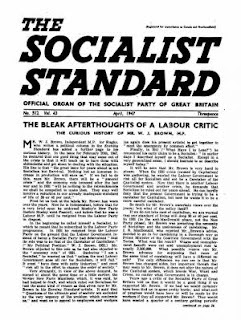
The Bleak Afterthoughts of a Labour Critic (1947)

From the April 1947 issue of the Socialist Standard

THE CURIOUS HISTORY OF MR. W. J. BROWN. M.P. 

Mr. W. J. Brown, Independent M.P. for Rugby, who writes a political column in the Evening Standard has added a further page to his curious history. In the issue for February 20th, 1947, he declared that one good thing that may come out of the crisis is that it will teach us to have done with shibboleths and get down to dealing with the situation. His line is that “ the great issue for years ahead is not Socialism but Survival. Nothing but an immense increase in production will save us.” If we fail to do this, says Mr. Brown, there will be a "general crisis” and the economy cuts imposed after the last war and in 1931 "will be nothing to the retrenchments we shall be compelled to make then. They may well involve a reduction in our already inadequate standard of life of 30 or 40 per cent.”

First let us look at the labels Mr. Brown has worn over the years. Now he is Independent, before that for a very brief span he endorsed Mosley’s New Party (before Mosley went Fascist), and before that he was a Labour M.P. until he resigned from the Labour Party in disgust.

In the beginning he called himself a Socialist, by which he meant that he subscribed to the Labour Party programme. In 1931 he resigned from the Labour Party on the ground that the Labour Government instead of being a Socialist Party had determined "that its role was to be that of the Caretaker of Capitalism.” (“My Political Position.” W. J. Brown, 1931.) Mr. Brown objected to this role as he had also objected to the ‘‘economy cuts” of 1931. Declaring “I am a Socialist,” he warned us that “unless the next Labour Government goes all out for Socialism, it will fail.” It must “have done with petty tinkering:,” and must "risk all in the effort to chancre the order of society.” 

Very strangely, in view of the above demand, he signed at about the same time or a little earlier, the Mosley New Party Manifesto which, it was said, he had helped to draft, and which ruled out Socialism for just the same kind of reason as that given now bv Mr. Brown in his Evening Standard article. It said that "Questions of the ultimate goal of society are excluded by the very urgency of the problem which confronts us,” and went on to appeal to employers and workers  (as again does his present article) to get together to "meet the emergency by common effort.”

Finally, in 1941 (‘‘What Have I to Lose?”) he renounced his early claim to be a Socialist: "In earlier days I described myself as a Socialist. Except in a very generalised sense, I should hesitate to so describe myself today.”

It will be seen that Mr. Brown is very hard to please. When the 1931 crisis (caused by Capitalism) was gathering, he wanted the Labour Government to risk all for Socialism and not be a Caretaker of the Capitalist system. Now that there is another Labour Government and another crisis, he demands that Socialism be ruled out for years ahead. He can hardly deny that the present Government is trying to be a caretaker for Capitalism, but now he wants it to be a more careful caretaker.

So much for Mr. Brown’s uncertain views over the years; hut what of the policy itself?

If we do not take care of capitalism, we are warned that our standard of living will drop 30 or 40 per cent. In 1931 (in the anti-MacDonald phase, not the New Party phase), Mr. Brown was preaching the necessity of Socialism and the uselessness of caretaking. Mr. J. R. MacDonald, who rejected Mr. Brown’s advice, decided to go in for caretaking in a thorough way as Prime Minister of the Coalition Government with the Tories. What was the result? Wages and unemployment benefit were cut and unemployment rose to nearly 2,500,000. What possible reason can Mr. Brown advance for supposing that more of the same kind of caretaking will have a different result? The only difference we can see is that Mr. Brown has changed sides, but important though that may seem to Mr. Brown, it does not alter the nature of the Capitalist system, which breeds War, Want and Crises, no matter what Government is in charge.

Years ago a critic of the Socialist Party of Great Britain told us that it would be a good thing if we supported Mr. Brown. If we had we would certainly have been tied un in some pretty knots; and what sort of progress would have been or will be made by the workers if they all supported Mr. Brown? They would have wasted a quarter of a century getting periodic bouts of aggravated hardship in crises, on top of the continuing hardships of Capitalism in its “prosperous” times, and all Mr. Brown can now offer is the choice between “our already inadequate standard of life ” and 30 or 40 per cent, less even than that. What a prospect! and what a blind guide!

The history of the past 25 years, and the history of Mr. Brown strengthen the Socialist Party of Great Britain’s conviction that for the workers of this and all other countries the only cure for the evils of Capitalism is to get rid of it, including the form known as State Capitalism that the present caretakers believe to be an improvement, and which we find no more attractive than, as it happens, does Mr. Brown.
Edgar Hardcastle