Showing posts with label Local Elections. Show all posts

Friday, September 4, 2026

Spoiling for choice (2026)

Party News from the September 2026 issue of the Socialist Standard

WHY WOULD ANYONE BOTHER WITH VOTING?

Can’t be bothered with voting?

Fair enough.

So let’s do this instead!

We know, they’re all rubbish. Red, blue, yellow, green, whatever colour that other lot are this week. They all want the same thing: to keep things ticking along for the people who own everything while the rest of us graft for a living.

Not voting will look like you don’t care and these career politicians will use that as a mandate when the election is over.

Get down to the polling station. Take the pencil. And write SOCIALISM right across the ballot paper.

Why bother? Spoilt ballots get counted and published. Sitting on sofas doesn’t. It tells them you’re not apathetic. It tells them you want the whole lot replaced, not just the faces at the top.

What we actually want: No bosses. No buying and selling of people’s lives. The factories, hospitals, land, the lot; owned by all of us, run for all of us. That’s socialism. Not state control. Not more welfare. Not reformism (tweaking the system) and hoping for the best. Actual common ownership.

None of the parties here are offering it. So don’t pick one. But don’t be silent either!

SPOIL IT PROPERLY. WRITE SOCIALISM.

Leaflet distributed during the election of the new Mayor of Greater Manchester in July.

Tuesday, June 2, 2026

Party News: Local Election results (2026)

Party News from the June 2026 issue of the Socialist Standard

Here are the results in the wards of the London Borough of Lambeth which we contested:
Brixton North: Labour: 1415, 1365, 1189; Green: 1388, 1304, 1169; Independent (Shake It Up): 372; Conservative: 261, 252, 167; LibDem: 215, 200, 186; Reform: 189; SPGB: 77; TUSC: 53.

Clapham Common & Abbeville: LibDems: 1331, 1195; Labour: 1116, 789; Green: 441, 423; Conservative: 347, 331; Reform: 194, 173; SPGB: 14.

Stockwell West & Larkhall: Labour: 1438, 1301, 1244; Green: 1234, 1211, 1098; Conservative: 420, 358, 265; LibDems: 377, 348, 273; Reform: 374; Independent (Shake It Up): 351; TUSC: 72; SPGB: 68.
The Greens replaced Labour as the largest party and are likely to be running the council for the next four years. They are making ambitious promises. Here is the new leader of the Green group on the council:
‘We will put power in the hands of residents, workers and the community. Things can, and will, get better.’
And one of his deputy co-leaders:
‘Again and again, residents told us the same story – a political elite, locally and nationally, is prioritising the needs of developers, big business and themselves over the needs of people and planet. We will do things differently’.
Power in the hands of workers; not giving priority to the profits of big business. They sound like Labour politicians in the olden days before they learned the hard way that under capitalism priority has to be given to profits and not to making things better for workers.

Thursday, May 7, 2026

"National liberation is a trap" (2026)

Blogger's Note:
The following text is from the SPGB discussion forum, and is in connection to the SPGB contesting the local elections in Lambeth.
"The campaign group, Vote Palestine 2026 "asked candidates if they would sign a pledge, the first point of which was to: “Uphold the inalienable rights of the Palestinian people.”  [The BrixtonBuzz website has published a list of those who agreed to sign the whole pledge.] 

Our candidate added a published comment explaining why he couldn’t:
“I did request a better wording of the pledge at the campaign launch but those running the campaign didn’t take my advice so this, regrettably, must be my answer.

I can’t help but feel those who have a vested interest in passing off national liberation wars as somehow socialist had a hand in this."

“I did request a better wording of the pledge at the campaign launch but those running the campaign didn’t take my advice so this, regrettably, must be my answer.
I can’t help but feel those who have a vested interest in passing off national liberation wars as somehow socialist had a hand in this.
Reply from Anya Krycek

Dear Vote Palestine 2026,

Thank you for your email. I must respectfully decline to sign.

As an anti Zionist Jew and socialist standing in Brixton North, I share your horror at the suffering in Gaza and the West Bank. But I cannot endorse a pledge framed around national self determination.

The nation state, whether Israeli or Palestinian, is a prison house of nationalities. It tells workers to wave flags and forget they have no motherland to defend. Israeli and Palestinian workers alike are exploited by the same global system of wage labour and capital.

National liberation is a trap. A new state means new masters under a new flag, while wage labour, property rights, and class rule stay intact. Council divestment treats symptoms, not the disease.

My goal is not another state but the abolition of the state itself: a classless, stateless, wageless, moneyless world community where people cooperate freely. Real self determination means workers recognising their shared enemy across all borders.

I stand with working people everywhere. I cannot sign a pledge that reinforces the nationalism keeping them divided.

Yours sincerely,

Anya Krycek
Socialist Party Candidate for Brixton North, Lambeth”


Another candidate, Eduardo Salgado, who is standing for Shake it Up in the same ward, also commented, expressing a “Marxist-Leninist” (Maoist) point of view:
“I think historically, things happen in stages. According to Marxism-Leninism (ML), national liberation often must precede, or be strategically aligned with, workers’ liberation because imperialism makes national independence a necessary first step to create the conditions for a successful socialist revolution. Lenin viewed the national struggle in colonized or oppressed countries as a key component of the overall world socialist revolution. The core reasoning is that national liberation acts as a necessary step to “clear the decks” for direct class struggle, as it removes the foreign oppressor and allows the working class to battle its local bourgeoisie. Lenin says on this issue:
* Support the national liberation struggle against imperialism unconditionally.
* Maintain independent working-class organization and leadership within that movement.
* Use the liberation struggle to raise demands for socialist transformation (land reform, workers’ rights).”
There is also a Trotskyist candidate standing in Brixton North but he has not intervened yet.


Here is our candidate’s reply to Eduardo Salgado:
The stageist model, national liberation as a necessary prelude to socialist transformation, is not merely strategically mistaken but theoretically incompatible with the abolition of capitalism. The historical record of national liberation movements demonstrates a consistent pattern: the “stage” of national liberation does not clear the decks for proletarian revolution it institutionalizes a new form of capitalist state. The foreign colonizer is replaced by a national bourgeoisie that maintains wage labour, commodity production, and extraction. The nation is not a proto political reality waiting to be liberated, but a category produced by capital itself a way of organising populations into manageable units. To prioritise national liberation is to reinforce the very abstractions; nation, citizenship, the state that capital requires to function.

“The working men have no country. We cannot take from them what they have not got.” The Communist Manifesto (1848)

The Socialist Party (GB) position is that the proletariat has no stake in which bourgeoisie administers its exploitation. Anti-imperialism that stops at the nation state leaves exploitation intact. The state form itself prevents the direct social relations that would constitute a break with capital. Socialism cannot proceed through stages it must begin immediately in the content of struggle, as the practical activity of breaking with wage labour, money, and the state. National liberation changes the flag and people in government, it does not interrupt the reproduction of capital. To make it a “necessary step” is to permanently defer the only act that could end exploitation: the immediate social transformation of society by and for the working class. We don’t seek the people’s commodity production we seek abolition of the proletariat.
Anya Brixton North SPGB candidate

Meet the Candidates: Socialist Party of Great Britain – abolishing capitalism since 1904 (2026)

Blogger's Note:
The Socialist Party is contesting three seats in Lambeth, South London, in the 2026 Local Elections. The following article appeared on the Brixton Buzz website, which is "Brixton’s biggest and most comprehensive news, features and listings site."
LAMBETH COUNCIL / NEWS

Meet the Candidates: Socialist Party of Great Britain – abolishing capitalism since 1904

Wed 6th May, 2026 - by Phil Ross

Founded in 1904, the Socialist Party of Great Britain (SPGB) is one of Britain’s oldest socialist parties, and one of its most uncompromising. Unlike Labour or the Greens, the party does not seek to reform capitalism – it seeks to abolish it, along with the state and money itself.

The SPGB is standing three candidates in Lambeth’s 7 May council elections – Anya Krycek in Brixton North, Jacqueline Shodeke in Clapham Common & Abbeville, and Cesar Sotillo in Stockwell West & Larkhall.

Brixton Buzz put four questions to the candidates, and in keeping with the party’s non-hierarchical principles, they answered collectively:

What does the SPGB offer a resident of your ward right now, today?

We do not offer false promises that Lambeth Council can abolish poverty, solve the housing crisis, or fix underfunded public services under capitalism.

Other parties will tell you that with the right policies, the right leadership, or the right ‘progressive coalition,’ things can be made tolerable. We say: capitalism cannot be reformed into a humane system. It is a system of production for profit, and profit will always come before human need.

What we offer immediately is a vote for socialist consciousness.

Every Socialist Party (GB) vote is a declaration that you recognise the present system has failed and must be replaced. It is a signal to other workers that they are not alone in wanting something fundamentally different.

We do not promise to manage capitalism better than Labour. We promise to use any position gained to expose its limits and advocate for revolutionary change.

That said, if elected, we would vote for any measure that genuinely improves working class conditions – since we are not opposed to reforms as such.

[Jacqueline Shodeke]

The SPGB vision is a moneyless, stateless society of common ownership.

Brixton has a thriving culture of independent businesses, market traders and community enterprises.

In that world, what happens to them?

They become part of the common ownership of the means of production. Not state-owned, there will be no state. Not privately owned, there will be no money, no buying and selling.

But democratically controlled by the community of producers and consumers.

Market traders are workers. Independent business owners are typically small scale exploiters of their own labour, often struggling under the same pressures as wage workers.

In socialism, they would contribute their skills and labour directly to meeting social needs, without the constraint of profitability, rent, or competition.

Brixton Market would not disappear, it would transition to a place of free distribution, where the produce of collective labour is available to all without exchange.

The ‘thriving culture’ that people value is not dependent on capitalism and in fact is stifled by both alienation and homogenisation.

Capital constantly undermines through gentrification, rising rents, and the displacement of working-class residents. Socialism would preserve and extend that culture by removing the economic pressures that destroy it.

[Cesar Sortillo]

Where does the SPGB fit in a broader left coalition?

Nowhere. We do not join coalitions with reformist parties, including the Greens or any ‘progressive’ alliance.

Our position is not sectarianism for its own sake, it is a recognition that these organisations operate on fundamentally different principles.

The Greens, like Labour, seek to administer capitalism more humanely. They believe that with better regulation, greener technology, and more ethical consumption, the system can be made sustainable. We disagree.

Capitalism is inherently destructive, of the environment, of human wellbeing, and of any possibility of a rational society. No amount of green washing changes its basic drive for accumulation.

As for ‘working alongside’ others on specific local issues: we support any group of workers in struggle, regardless of political affiliation, for immediate defensive gains.

But we do not enter electoral pacts, shared platforms, or coalitions that imply common political objectives. Our objective is the abolition of capitalism. Theirs is its reform. These are incompatible.

[Anya Krycek]

What is your assessment of Labour’s record in Lambeth, and what would genuinely left representation look like in its place?

Labour has administered capitalism in Lambeth for decades, and the results are visible: gentrification, displacement, privatisation of housing, underfunded services, and a council that acts as a local manager for central government austerity.

They are not a failed alternative to the Tories. They are a reliable partner in managing the same system. ‘Genuinely left representation’ would not mean a more radical Labour council.

It would mean representatives who use their position to tell the truth: that local government under capitalism has no real power to change the fundamental conditions of working class life.

It would be refusing to implement cuts, refusing to collaborate with property developers, and using every platform to argue for the common ownership of the means of production.

That is what Socialist Party (GB) representation would look like.

Not better management of decline, but a clear voice for revolutionary change, starting with the recognition that the working class must organise politically, democratically, and consciously for socialism.

Anya Krycek, Brixton North Jacqueline Shodeke, Clapham Common & Abbeville Cesar Sotillo, Stockwell West & Larkhall

More Info

Wednesday, April 1, 2026

London borough council elections (2026)

Party News from the April 2026 issue of the Socialist Standard
The Socialist Party is standing candidates in three wards in Lambeth.
Want something better?
Capitalism, the system we live under, is divided into two classes: the privileged few who own the places where wealth is produced and services provided; and the rest of us who have nothing to sell except our working skills and which economic necessity compels us to sell to an employer for a wage or a salary.

In Lambeth this division is written plainly in the things you need but can’t afford, in the strain on services, and in the constant worry that is part of life under capitalism.

The other candidates say that these hardships can be remedied by new councillors, new policies or new regulations. But governments and councils exist to administer the capitalist system. So long as the places where wealth is produced remain the property of a minority, so long will production be carried on for profit and not for use, and so long will the needs of the many be sacrificed to the interests of the few.

We are standing not to manage capitalism but to make the case for replacing it with socialism: a system of society based on the common ownership and democratic control of the means and instruments for producing and distributing wealth by and in interests of the whole community.

Socialism means production solely for use and not for profit and free access to the wealth produced. It means the abolition of class domination and privilege and the production for profit and working for wages that goes with them. It is not state-run capitalism, but a world system of cooperative production for human need.

No leader or politicians can bring this about for you. And we are not offering to. It is something that you have to do yourselves by organising to win political control, not to run capitalism, but to end it.

If you agree with this, vote for our candidates in Brixton North, Clapham Common & Abbeville, Stockwell West & Larkhall.

In the other wards, write ‘SOCIALISM’ across your ballot paper.

We stand for the many
We want to send a message to the establishment: Lambeth is one of the most unequal boroughs in London. High rents, insecure work, and overstretched services exist alongside great wealth and profits. This division is not caused by poor local management. It’s exactly how a system based on profit is supposed to operate.

The career politicians of other parties offer slightly different ways of running the same system but we seek real change.

We stand for SOCIALISM: ‘The establishment of a system of society based upon the common ownership and democratic control of the means and instruments for producing and distributing wealth by and in the interest of the whole community’. That is no private landlords, no wages system, and no buying and selling.

Our candidates do not seek power or privilege. If elected, they will act as mandated delegates, using their position to oppose policies that harm your interests and to argue openly for socialism.

If you want more than cosmetic change, Vote Socialist.

Housing for use, not for profit
Lambeth’s housing crisis is not the result of poor council management or the wrong policies, but of a system that treats homes as commodities. Rents and house prices are far beyond what most workers can afford, tens of thousands are on housing waiting lists, and thousands of families are stuck in temporary accommodation. Developers, landlords, and housing providers profit from scarcity, while workers are forced to compete with one another for somewhere to live.

Schemes labelled ‘affordable housing’ do not solve this crisis. Rents set at a percentage of the market are still unaffordable, and shared ownership and housing association homes tie people to lifelong debt. Poor conditions, overcrowding, and insecurity persist because housing under capitalism is built, allocated, and maintained according to cost and profit, not human need. Local councils, including Lambeth, operate within these limits and cannot abolish rents, mortgages, or homelessness.

The Socialist Party stands for a different solution: the abolition of the market in housing altogether. We argue for common ownership of land and housing, production for use not profit, and free access to homes based on need. In a socialist society there would be no landlords, no rent, no housing registers, and no homelessness.

Socialism: freedom, equality, solidarity
Socialists are against authoritarianism, privilege and division. We are for freedom, equality, and solidarity. These can only be achieved in a society based on common ownership and democratic control by the whole people.

Freedom means genuine freedom of thought and expression as well as freedom from having to work for wages. We are fully committed to defending open debate and independent thinking. No government or corporation should silence the voices of working people or control how people think and live.

Equality means that every human being is of equal worth regardless of ethnicity, gender, or sexual orientation. We stand for a society of social coexistence based on mutual respect.

Solidarity is the shared commitment to live together with respect, cooperation, and collective responsibility. We stand with working people, defending unity over division and cooperation over conflict.

Capitalism works against these principles. We oppose this economic system that concentrates wealth and power in the hands of a few whilst exploiting the vast majority and that puts profits before people. We oppose the wars it inevitably generates over markets and resources.

We are not standing to manage capitalism locally. If elected, we will be an uncompromising voice for workers in every decision that affects them, making the case for a social revolution to replace capitalism with a society based on common ownership, democratic control, and production directly to meet people’s needs not profits.

Saturday, December 20, 2025

Tooting elections. (1912)

Party News from the December 1912 issue of the Socialist Standard

In the recent Borough Council Elections the Tooting Branch ran three candidates for Tooting Ward. The result was gratifying, the figures showing an increase of 80 per cent. over those for our last effort, in 1909.

The branch intended concluding the campaigu with a demonstration at one of the L.C.C. schools, and had made all arrangements for same, hut although we had paid for the use of the school, we were precluded from holding our meeting by being informed at the last moment that the room would be required for polling purposes.

The other candidates included three “indepen­dents,” whose independence consisted of claim­ing to be the People’s candidates. They will, no doubt, now they are elected, demonstrate how they represent the people by supporting any and every measure brought forward in the in­terest of capitalism and to the detriment of the working class.

Another candidate was a Municipal Reformer, and the decrease in the number of votes polled for him was doubtless largely due to the active Anti Socialist Union propaganda carried on in this district

The other candidates were Labourites, whose programme consisted of reforms none of which, had they been elected, could they have carried into effect. Reforms will be passed by the capitalist class when they think fit, and not at the dictation of “Labour” candidates. Minorities do not usually rule the roost.

Besides, they had the assistance of that notorious misleader, Ben Tillett (who, by the way, does not believe in political action), and possibly that accounted for the decrease in the “Labour” poll.

It added to the gaiety of things to find that the Tooting Branch of that party of “unity,” the B.S.P., supported the “Labour” candidates, while the Battersea Branch of the same organi­sation were actually in opposition to the “Lab­our” candidates there.

All the foregoing should act as a tonic and give renewed energy to carry on the propaganda for Socialism. We feel confident that the truth will ultimately prevail.
W. T.


Blogger's Note:
'W.T.' would have been the Tooting Branch secretary, W. Thomas. Sad that the neither the names of the SPGB candidates nor the actual voting figures are listed in the article. Maybe those details are buried away in the SPGB EC minutes. Bob Ambridge does mention an earlier Tooting Branch election campaign in the September 1954 anniversary issue of the Socialist Standard:
"About the same time Tooting Branch put forward Comrades Cooper, Joy and Barker for the Tooting Ward, the result being 60, 58 and 56 respectively. The Socialist Standard’s comment was: “We think we found fifty six supporters for the Revolution, and are encouraged in the hope that it is not altogether hopeless to appeal to the Electorate on the straight issue—Socialism."

Saturday, July 26, 2025

Correspondence: Electoral Tactics in the Potteries. (1908)

Letter to the Editors from the February 1908 issue of the Socialist Standard

Electoral Tactics in the Potteries. 

Sir,—Can a worse case of faking and compromise be found than the following ?

At the recent Municipal elections the A.S.R.S. put forward a Mr. Robinson for the South Ward, and his candidature was endorsed by the North Staffs Trades and Labour Council. He is a member of the I.L.P., but did not mention that fact in his election address. Another member of the A.S.R.S., an ex-signalman named Leese, an expelled member of the I.L.P., who poses as a “Labour” man and who has acted as election agent for Mr. John Ward, M.P., undertook to serve in a similar capacity for Mr. Robinson. The Mayor, who was also running in the same ward, called upon Mr. Leese, threatened that he should be opposed next election, reminded him that his (the Mayor’s) class gave liberally to the Widows’ and Orphans’ Fund of the A.S.R.S., that he (Leese) did not altogether depend upon the working class for his livelihood, and also that the railway companies were objecting to their servants contesting elections. The result was that a notice appeared in the Sentinel the following evening stating that Mr. Robinson had withdrawn, as he did not wish to oppose the Mayor !

In the Wellington Ward of Hanley, Mr. J. Lovatt, member of the S.D.F., and secretary of the Potters’ Union, was put forward by his union as a Labour Candidate, although as he won Justice claimed the result as an S.D.F. victory. At an indoor meeting Mr. Lovatt said he was a Socialist but was putting that on one side and was running simply as a Labour candidate in order to be at peace with the non-Socialists in his union. On Oct. 30th he was supporting Mr. A. Stanley, M.P., an anti-Socialist, at a public meeting !

Thus do the place-hunters obscure the issue.
Yours faithfully,
J.T. Skelton.

[Do figs grow on thistles ?—Ed. T.S.S.]

Tuesday, June 17, 2025

Party News and Election Results (2003)

Party News from the June 2003 issue of the Socialist Standard

Local Elections
The Socialist Party contested 3 seats in the local elections in May, all in the North East. The results were:

South Tyneside Borough Council, Primrose Ward:
Labour 1658, Conservative 594, Socialist 316.

Easington District Council, Deneside Ward (3 councillors):
Labour 527, 492 and 479; Socialist 242.

Seaham Town Council, Deneside Ward (5 councillors):
Labour 390, 386, 372, 367 and 333; Socialist 216.


Leaflet distribution:
Over the past six months Socialist Party members have distributed some 50,000 leaflets at demonstrations and other events. The response has been up on recent years, perhaps reflecting a modest revival of political interest.

If any Socialist Standard reader would like leaflets for distribution in their area, write to Campaigns Dept, 52 Clapham High St, London SW4 7UN.


Blogger's Note:
The SPGB candidates are not named in the party news but my educated guess is that it was John Bissett in South Tyneside and Steve Colborn in Deneside.

Of those 50,000 leaflets mentioned above, I distributed a fair few.

Sunday, June 1, 2025

Why we contest elections (2025)

From the June 2025 issue of the Socialist Standard
We stood 4 candidates in the local elections on 1 May. Why?
Capitalism, the system of society we live under, is based on the means for producing what society needs to survive being owned and controlled by a small section only of the population. We’re talking about the land on which food is grown and from which natural resources are extracted, the factories where these resources are fashioned into useful things, the power stations that provide the energy, the ships, planes, trains and lorries which transport the raw materials and the finished products, the warehouses and retail outlets where the products are stored, the media and communications. In short, all the natural and industrial resources needed to produce and distribute useful things and services.

This results in the division of society into two classes, those who own and receive an unearned property income and those who don’t and who, to live, have to work for a wage or salary. Useful things are not made and useful services are not provided to directly satisfy people’s needs but to be sold to make a profit which goes to those who own the places where the work takes place. The interests of the two classes are completely opposed as the profits of the one come from the work of the other.

Capitalism is a profit-making system that can only work for the few who own, not the many who work. It can only be run in the interest of capitalists, the tiny minority who invest money for profit and enjoy a privileged lifestyle on the proceeds.

That’s why the needs of the majority are never met properly and why for them there are always going to be problems over housing, health care, schools, and public services. The politicians blame each other but profits coming before needs is not something any government can change.

All the other parties that stand in elections support the profit system and are squabbling over which of them should run the administrative side of it. They think the profit system can be made to work in the interests of the majority. But it can’t be and, if they win office whether at national or local level, they end up having to do the system’s dirty work of saving money on public services so that taxes on profits can be kept down. At local level, Labour, Tories, LibDems, Greens, and Scots and Welsh nationalists have all done this. They will now be joined by Reform UK after its gains in last month’s county council and mayoral elections.

Profits first, people second (even third after military spending), that’s the only way the profit system can work. Despite the politicians’ promises, it can never be made to work for the majority working class whose income comes from working for a wage or salary.

But if nothing changes…

But, if changing governments changes nothing, why do we in the Socialist Party contest elections? Some people think that the government serves the rich because the rich own the means of wealth production. But, in fact, it is the other way round — they own the means of production because they control the government. And they control the government because, currently, when there is a general election, the vast majority of voters vote into control of political power — the power to make and enforce laws — parties that don’t challenge their legal right to own the means of wealth production.

The capitalists don’t own the land, the factories and the rest in the same way that people own their personal possessions. They don’t physically possess them. They own them because they have a legal right to own them, a right granted and enforced by the state. In fact, today very few means of production are even owned by individuals. They are owned by companies and corporations which are fictitious individuals created by law.

The conclusion to be drawn from this is that the way to end minority class ownership of the means of wealth production is not to directly take these over physically and kick out the bosses but to win control of the political power which granted and backs up their owners’ legal right to own.

To abolish capitalism, what is needed is to first win control of political power. In theory this could be done by seizing the central state in a violent insurrection but, unless this has majority support, the result would merely be a change of rulers — and, if it does have majority support, would be unnecessary as there is another, easier way to win political control — through the ballot box.

If a majority wants to abolish capitalism, it can use the electoral system to send to the central law-making body delegates mandated to end all private property rights, dissolving all companies and corporations and declaring all stocks and shares null and void. The means of production would then become the common property of society under democratic control. Capitalism will have been abolished. This will allow the socialist-minded working class majority, self-organised democratically outside parliament, to get on with managing the change-over to socialism at ground level through workplace committees, local councils and other associations, while the central administration, transformed from being an instrument of class rule, deals with wider issues.

So, the main reason why we say socialists should contest elections is an understanding that the capitalist few own the means of producing because the state grants them the right to do so and that the working class needs to win control of political power so as to be in a position to annul that right.

It is why we say workers should not vote for any party that supports capitalism as that is to leave political control in capitalist hands and so endorse their ownership of the means of production. That’s why when there is no socialist standing we don’t vote for them and either abstain from voting or cast a write-in vote for socialism.

Of course, today, as the results of elections show, only a tiny minority want socialism — the vast majority of workers still accept or at least acquiesce to capitalism — so when we contest elections now we are showing that we think that the working class, once they want socialism, should take political action to bring it about. We are also showing that we think that the electoral system, imperfect as it is, is still sufficiently democratic as to enable a socialist majority to win control of political power. And, of course, using the occasion to further publicise the case for socialism.
Adam Buick


Election results
Kent County Council Folkestone West: RefUK 1748, Lab 1152, Green 996, Con 852, LD 414, Soc 47.

Kent County Council Folkestone East: RefUK 1712, Lab 1076, Con 513, Green 509, LD 233, Homeland 50, Soc 38.

Gloucestershire Count Council Stroud Central: Greens 2166, Lab 799, RefUK 697, Con 309, LD 195, TUSC 49, Soc 25.

London Borough of Lambeth Herne Hill and Loughborough Junction: Greens 1,774, Lab 1,459, Con 183, RefUK 135, LD 121, TUSC 30, Soc 16.

Thursday, May 1, 2025

Socialist election activity (2025)

Party News from the May 2025 issue of the Socialist Standard
The Socialist Party stood four candidates in the local elections at the beginning of May. Below are their election addresses
Kent County Council Election Folkestone

Human needs or profit first?

We live in an economic system, capitalism, that ensures nothing gets built or created unless someone, somewhere expects to make a handsome profit. Human needs come very much second.

That is why Folkestone’s stunning harbour is going to be submerged in ugly blocks of concrete and glass. They are built, not for the needs of local people, but to make a profit for the developers and the owners of the land. No surprise there. That is how capitalism works.

All around us everything crumbles, from schools to libraries and social services, even as the vast wealth of a tiny minority continues to increase. And this will go on so long as we keep voting for political parties which think this absurd and cruel system can be reformed.

The Socialist Party of Great Britain has for the last 120 years advocated a quite different society built on the common, democratic ownership of the planet and its resources. A society in which every one of us gets to participate in decisions like the building of new houses, the planting of crops, how we get our energy. A truly human society where sustainable decisions are made based on human needs and the need to maintain a healthy planet.

At current levels of science and technology the earth can easily provide an abundance of resources for everyone to live a happy and fulfilled life. Then there will be no need to artificially ration the necessities of life with money. We will contribute our physical and mental labour freely and take freely from the common store.

That will need a world revolution. And every revolution starts somewhere. Why not Folkestone?

If you agree VOTE SOCIALIST.


Gloucestershire County Council elections Stroud

Capitalism or Socialism?

This might be the last Gloucestershire County Council Election. The government seems intent on reorganising the County and District Councils. This will result in fewer representatives and a concentration of strategic power in the hands of a regional Mayor.

This is democracy in the capitalist system: a choice between candidates for office with only marginally different sets of policies. Once elected those in office can tinker with the system but not the rules of capitalism: those without wealth are beholden to those who do, profit comes first not human needs, and can’t pay – can’t have.

But what can we do? Unlike the architects of local government devolution, socialists believe not that there is too much democracy, but that there isn’t enough. The rules of capitalism have not been in place for all of human history and we don’t need them in future. Getting rid of the rules of capitalism and creating a real democratic future can’t be brought about from above. It has to come from a majority of people.

You can show support for real democracy, socialism, by voting for the Socialist Party of Great Britain on May 1st.

Socialism is a classless, stateless, wageless, moneyless society or, a democracy in which free and socially equal men and women co-operate to produce the things they need to live and enjoy life, to which they have free access: ‘from each according to their abilities, to each according to their needs’.

The Socialist Party is like no other political party in Britain. It is made up of people who have joined together because we want to get rid of the profit system and establish real socialism.

Our aim is to encourage others to become socialist and act for themselves, organising democratically and without leaders, to bring about the kind of society that we advocate.

We are solely concerned with building a movement of socialists for socialism. We are not a reformist party with a programme of policies to patch up capitalism.

If elected, Piers Hobson will work for socialism at every opportunity, vote on issues according to the democratic decisions of his branch of the Socialist Party and always be for socialism and nothing else.


Lambeth Council by-election London

Real change, not damage limitation

Fellow workers,

They call it democracy but it’s nothing of the sort.

Labour didn’t even want this by-election. They’d rather stitch it up behind closed doors than face a real challenge. This isn’t about serving the people, it’s about protecting their grip on power. Councillors are parachuted in, selections are stage-managed, and decisions are made long before you ever see a ballot paper.

Meanwhile, rents rise, wages stagnate, benefits are cut, food banks multiply and estates are handed over to developers. Labour’s record in Lambeth is clear enough.

Now they ask for your vote again. So do the Greens, Lib Dems and others who promise change but only offer better management of a system built on exploitation. They won’t end your problems. They won’t challenge the class system. They won’t stop capitalism — they serve it.

No confidence in their system. No votes for our bosses’ parties.

Until we end capitalism, nothing changes.

That’s why the Socialist Party is standing in this election. Not for tweaks or token reforms, but for real change. Common ownership, democratic control, production for need not profit.

If you want that, you can show it by voting for the SOCIALIST CANDIDATE.

Tuesday, April 1, 2025

County Council Elections (2025)

Party News from the April 2025 issue of the Socialist Standard

We are standing 3 candidates in these elections on 1 May. Folkestone East and Folkestone West in Kent and Stroud Central in Gloucestershire.

To help the campaign, in April, for Stroud, email stroud@worldsocialism.org or text or phone 07853965473. For Folkestone, email spgb.ksrb@worldsocialism.org or text or phone 07971715569.

We are also standing in the by-election in Herne Hill & Loughborough Junction ward in Lambeth, London, also on 1 May. Offers of help to spgb@worldsocialism.org

Thursday, February 13, 2025

London By-election' Write In' (2025)

From the Socialism or Your Money Back blog

Below is the text from leaflets that The Socialist Party will be distributing in three London local by-elections.

On this occasion The Socialist Party will not be putting up candidates but is encouraging voters to cast a ‘write in’ vote.

What matters – profits or people?

All the parties standing in this by-election support capitalism (the profit system) and are squabbling over which of them should run the administrative side of it here at local level. So, there’s no real choice.

They think the profit system can be made to work in the interests of the majority. But it can’t, and they end up having to do the system’s dirty work of saving money on public services so that taxes on profits can be kept down.

Profits first, people second, that’s the way the profit system works. It’s the only way it can work. Which is why Socialists say it must go. Support for any of the parties that want to run the profit system is a vote for more of the same: more insecurity, hardship and cuts, while the rich can afford the best of everything.

What’s the alternative?
If we are going to put an end to this we must act for ourselves, without professional politicians or leaders. We’re going to have to organise ourselves to bring about a society geared to meeting people’s needs – without a price tag – not profits.

But the only basis on which this can be done is common ownership and democratic co-operation. In a word, socialism.

The Socialist Party is not contesting this by-election but you can still say NO to a system based on profit, privilege and competition and YES to one based on equality, co-operation and meeting needs by writing “I vote for socialism” on your ballot paper.

Friday, February 7, 2025

"Practical Socialism" in Harrow. (1909)

From the February 1909 issue of the Socialist Standard

Although one of the schools of the master class dominates us from the hill above, yet among the members of the working class who live in the mean streets stretching out upon all sides at its base, a considerable amount of activity in the “Socialist movement” is evident.

Unfortunately, the inverted commas are necessary ; for the only organised bodies are a group of the Fabian Society and a branch of the I.L.P.

As regards the former their activity has been confined to a series of four lectures delivered by Alderman Sanders, L.C.C. As might be expected from the lecturer, the usual Progressive, municipal gas and water “Socialism” was preached. Fortunately, the audience was made up mostly of I.L.P’ers, so no great harm may be expected. It is, however, with the political activities of the I.L.P. that I intend to deal.

The local I.L.P. number among their fifty members a well-known novelist, an artist, a son of the local vicar, commercial travellers, and so forth. Now the antics of some of these “practical Socialists” are very interesting, seeing that they are members of that “great national party” whose discipline and organisation, and whose scientific knowledge of and street corner adherence to the principles of Socialism, are so renowned. A writer in the Socialist Review urges that their watchword should be “Practical Socialists, close up your ranks,” and one has only to give a casual glance at the condition of the I.L.P. to see that it was never more necessary.

Let that be as it may, the following will speak for itself. Last Autumn when the unemployed agitation was revived, when the “practical Socialists” were giving forth a flood of spoken and written nonsense, with a view to persuading the capitalist class to abolish itself (for that is what solving the unemployed problem means), this district was in the throes of a local election. Two of the candidates were non-party, parish-pump reformers ; the third was an avowed Tariff Reformer. But Eureka ! he actually advocated the solution of the unemployed problem by planting trees along the streets. Here was a chance for the “practical Socialists” ! Several of their most prominent members fell over each other in their eagerness to “do something for the unemployed.” The artist, of course, was the most enthusiastic of them all, for could he not foresee the time when the dreary streets would be turned into avenues of verdant trees, beneath the leafy boughs of which the inhabitants of Harrow would rusticate, making pictures worthy of a Watteau’s brush ? Result: the “practical Socialists” took the chair for the practical Tariff Reformer, enthusiastic to do something—or somebody.

The branch, however, was a little apathetic, so it was waited upon, and attempts were made to either cajole or cudgel it into giving official support. This the branch was not prepared to do (although only a bare majority voted against) but it left the matter to the discretion of the members on the principle that although independent in Imperial politics, locally they could do what they liked.

Several of the members attended an open-air meeting at which their artist comrade acted as chairman, and when asked for their support, would not pledge themselves because the Tariff Reformer’s answers were not satisfactory. Which shows that the latter was not “wide” enough to bait his hook properly. I asked them afterwards what was their intention re the action of these members; would it be officially and publicly disavowed ? No, they could not do that, they replied : it would give offence, and they were such good fellows !

What blissful felicity ! What mutual admiration ! And what organisation and discipline in that “great national organisation of practical Socialists, the I.L.P. !” May all their guardian angels defend them next summer if they hold outdoor meetings, for the Liberals and Tories are waiting for them, to say nothing of the lone member of the S.P.G.B. who writes this.

I will give one other instance. In the local “Parliament” there is a Labour Party. One of its members is rather “extreme,” and attacks the Liberals, his comrades think, rather too bitterly. As a result an open meeting was held to discuss the following resolution. “Shall we (the I.L.P.) fight the Liberals with the object of smashing them ?” (By the way, the chairman pointed out in extenuation of the “extreme” nature of the resolution, that it was only “an academic resolution, made extreme to provoke discussion.” The oratory that followed perfectly scintillated with gems of I.L.P. thought. My poor “impractical Socialist” eyes were dazzled ; in fact I saw stars. When it came to the voting six or eight of the most prominent members voted against—against fighting the Liberals ! Enough ! What a rod in pickle there is for them.

These, then, are the men who make up the I.L.P. These are the “practical Socialists” who sneer at the members of the S.P.G.B. as “insignificant impossibilists.” They claim to be the army of Labour, the hope of the working class. They are a mob, with an ignorant rank and file, led mostly by knaves. The hope they put before the workers is a will-o’-the-wisp. They are those who, disguised as friends, inflict the gaping wounds that drain away the precious energy and life-blood of the working-class movement.

The Socialist Party of Great Britain, small in numbers though it be, can rest content in the knowledge that with its scientific, revolutionary class consciousness, working in conjunction with economic evolution, it is always able to attack, and will finally overthrow, this party which, posing as the friend of working-class emancipation, is in reality one of its most deadly foes.
F. Hesley.

Sunday, June 30, 2024

Passing the parcel (1995)

TV Review from the June 1995 issue of the Socialist Standard

Election nights are almost exciting, and Local Elections ‘95 on BBC 1 last month proved to be no exception. There was David Dimbleby with a twinkle in his eye and a Mars bar in his pocket. Peter Kellner looking studiously professorial next to a bank of computers. Anthony King thumbing through his mental book of historical precedents and the ubiquitous Peter Snow arms flailing like a whirling dervish in conversation with Magnus Pike. "Just a bit of fun” is Snow’s catchphrase. and of course it all is just that, at least for him.

For the politicians it is different—election night is akin to a life-or-death prognosis. John Selwyn Gummer had seldom looked glummer as the news trickled in of the most humiliating Conservative defeat in local elections on record. Frank Dobson chortled like a Father Christmas on Prozac and the Liberal Democrats' spokesman was there as well, popping up like Chad over a wall occasionally in the hope that nobody would forget he was there too. But it was Labour's night, and if all Frank Dobson's Christmases had come at once. John Prescott beamed as if his political marriage to Tony Blair had just been consummated in spectacular style. He opened a bottle of champagne at Labour Party headquarters and thrust the spray orgasmically at the cameras, adjectives tumbling over one another just as the Moet tumbled out of the bottle.

It was indeed touching that the working class could have had such an effect on their fellow human beings. Touching, though not altogether surprising, as it is the workers who put the politicians in their exalted position to start with.

If local election night demonstrated anything it was that the Labour Party . . . pardon me. New Labour, is on a roll of gigantic proportions and that the Tories are digging themselves further into a hole and not out of it. Labour, on this performance seems set to win a General Election and they will be aware at this time like at no other that dangerous talk costs political lives. During the election campaign itself they showed themselves cognisant of this fact, fighting the battle on presentation, managerial abilities, sharp suits and white teeth. "Policies" has become the most dangerous word in their vocabulary. When tackled about this by Dimbleby. Frank Dobson shrugged his shoulders and gave a "what can we do" look. Local government, he said, is hamstrung by government subsidies and capping, and so even if Labour wanted to spend more on education or local services, it couldn't.

At this point John Gummer intervened to claim that you could not blame the Conservative government for the belt-tightening consequences of the world recession and that in any case things were getting steadily better under the foresighted stewardship of John Major. But then came the pièce de résistance—Sir Teddy Taylor. Tory rebel, beamed in via satellite or some such device to tell the panel that they were all wrong as the real problem was Europe. "I know I'm being a bore . . ." he said, and of course he was right. And right about something else too. He went on to say that just as it didn't matter which of the parties controlled the councils, neither did it matter much which party controlled Westminster, as they were all prisoners of the system, the headquarters of which he identified as being somewhere in Belgium. Now he might have been misplaced about the importance of the last bit. but his substantive point, of course, has a lot going for it.

Travel with Teddy
Travel round Britain and can you tell where a Conservative council ends and a Labour one begins? Travel around Europe or any other part of the world and try doing the same with governments. It is very difficult indeed, and Sir Teddy has obviously noticed. Given all this, quite what his function is as a politician must be in some doubt, his obsession with Brussels notwithstanding. If he thinks politicians are as impotent as this (and they generally are) then it cannot be long before he packs it all in forever and takes to the stage.

But have some sympathy for him. Sir Teddy showed that he had grasped, in his own hamfisted way, a fundamental truth of capitalist politics, even if he lacks the full explanation for it. And this is that, in reality, election nights at present are momentary interludes in a mind-numbingly tedious and pointless exercise. They are the time when the two rival but otherwise identical brands of cola release their sales figures, when two bluebottles climb up a wall to see who can reach the ceiling first. Pointless, though at the same time mesmerising if your life is empty enough. And if the phrase "get a life" should be directed anywhere, the BBC studios on election nights are as good a place as any to aim. 
Dave Perrin

Wednesday, June 1, 2022

Party News: Local Election results (2022)

Party News from the June 2022 issue of the Socialist Standard

We made no apology for raising the nature of the present world economic system – capitalism – in a local election. Local councils have to run things inside the framework of capitalism and that restricts what they can do. They are also restricted in that most of their money comes from central government.

The priority under capitalism is profit-making. Having to respect this priority means that what the central government can make available for local social services and amenities takes second place. That’s why they are never as good as they should be, in spite of the efforts and promises of the other parties. Capitalism simply cannot be made to work for the benefit of all. Only a society based on the common ownership and democratic control of productive resources can do that.

The results in the two wards we contested were:

Lambeth, Clapham East ward (2 members): Leigh (Lab) 1,127; Collins (Lab) 1,073; Hattersley (Green) 411; Williams (LD) 224; Freeman (Con) 215; Hindson (Con) 193; Cranney (TUSC) 38; Lambert (Socialist) 31.

Tunbridge Wells, Pantiles & St Mark’s ward: Barras (LD) 1386; Delman (Con) 715; Hurst (Green) 132; Blackmore (Lab) 130; Kennedy (Socialist) 11.

Saturday, May 21, 2022

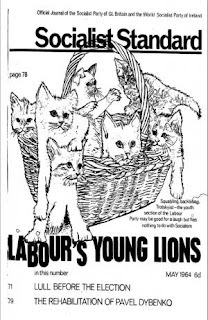
News in Review: The Budget (1964)

The News in Review column from the May 1964 issue of the Socialist Standard

At Home

The Budget

Many of the professional economic forecasters came out rather better than usual from Mr. Maudling’s second Budget. The heavier taxes on alcohol and tobacco had been widely tipped and so had some extension of the betting tax. But the Chancellor upset many predictions by not altering the standard rate of income tax, the tax on petrol and National Insurance contributions and benefits.

There is always plenty of advice and prognostication from the financial experts before a Budget. Experience does not encourage us to regard this as very valuable. Said The Economist of April 11th:—
. . . the surge in demand and productivity during this last financial year . . . . has looked astonishingly similar to that in the financial year 1959-60 . . . (when) most economic commentators urged Mr. Amory to raise taxes by between £100 million and £200 million in his Budget . . . but . . . from that first quarter of 1960 demand and productivity suddenly ceased to grow and, apart from minor fluctuations, remained at about the same level for two years. Modern economic computers can sometimes badly overestimate the exact amounts of tax increases that are really desirable in times of boom, because nobody has yet devised a science for gauging the way in which a boom mentality among consumers can quite suddenly be deflated.
This last admission did not, of course, prevent The Economist from offering its own advice to Mr. Maudling.

It is a widely held assumption that tax alterations are bound to affect prices. But the facts show that this is not the case. There have been plenty of recent examples—cinema seats, lawn mowers, some types of confectionery—in which a change in tax has not been responsible for a change in price.

Prices must move as the market allows them to. At one time the market may allow a manufacturer to recoup a tax increase by putting up his price—or perhaps even to over-compensate by putting the price up by more than the rise in tax. At another time selling conditions may not allow such an increase and the manufacturer will have to yield up some more of his profit to the government.

Whatever happens, the government are only interested in raking in the taxes to help pay for the upkeep of the State machine and all its ramifications.

This year’s Budget will probably be unpopular among the working class, who seem to get a real kick out of the couple of shillings a week extra which some Budgets may bring them—and who can be cast into deep depression by a Budget which goes the other way. In this confusion and ignorance, Mr. Maudling may have done enough to set the seal on his party's fate in the Autumn.


A Labour London

The Labour victory in the elections to the new Greater London Council was widely forecast, although even so in some of the contests they were surprisingly successful.

The government at the moment is in very heavy weather and the dissatisfaction with the Conservatives at national level was bound to influence local affairs as well.

It was not so long ago that the Tories were saying that politics were better kept out of local government. The Town Hall was, apparently, the place where local men good and true did their level best for the locality. To introduce party labels into this was ungentlemanly.

The father of the present Duchess of Kent, in an interview with The Observer, once gave a typical expression to this attitude. He was at the time a prominent member of an urban council in Yorkshire. Sometimes, he said, some Labour fellows tried to get on the council, but in most cases they soon learned to drop that stuff and to work for local interests.

Officially, this is no longer the Tory line. None of their candidates for the G.L.C. stood under the old labels of Ratepayers, or Municipal Reform, or anything like them. They were all Conservatives. “I hope," said the leader of their candidates, Sir Percy Rugg, “ there is no Conservative who thinks his vote does not matter."

This taking off the gloves has helped in the notion that the local elections are a sort of primary for the general election which is to come in the Autumn. Certainly, the Labour Party are hailing their victory as a precursor of what is to happen when Sir Alec finally names the day. The Tories, as we may expect, are analysing the voting figures again and again, looking for evidence that they prove exactly nothing at all.

Nobody was anxious to draw attention to another way in which the G.L.C. election resembled a general election—in the glowing promises which were made to the voters. Sir Percy Rugg offered “. . . humane and personal administration as well as efficiency . . . a realistic housing target ”

His Labour counterpart, Mr. W. Fiske, was promising cheaper land for housing and a lower interest rate for house building loans. Council mortgage rates were, indeed, the big electioneering point of the campaign.

Labour are cock-a-hoop at their win and are waiting impatiently for the day when they take over the government. But their chickens are by no means yet hatched.

One of the depressing features of the G.L.C. election was not simply the fact that once again the working class made it known that they are satisfied to choose between alternative ways of running capitalism. It was the simple, almost incredible, ignorance and naivety of the reasons which the voters who were interviewed on radio and television gave for voting as they did.

At the moment these people are largely being fooled into voting Labour. Come the Autumn they could just as easily be fooled into voting Conservative. And while everyone in going up and down on the see-saw capitalism goes grimly on.


Politics

Powell speaks out

Mr. Enoch Powell, who is supposed to be a very clever man, and the conscience of the Conservative Party, has been a source of embarrassment to his leaders for a long time. They must shiver, now, whenever he opens his mouth for fear of what uncomfortable revelation he will make.

But Mr. Powell is the sort of politician whose ideas have little relevance to the hard realities of administering capitalism. In this he is rather like the pacifist in the Labour Party. His speech at the beginning of last month to the East Renfrewshire Unionist Association, in which he attacked the government's attempts to direct industry to the development areas, showed what a dreamland this one time professor of Greek lives in.

If labour were perfectly mobile, said Mr. Powell, if the market were theoretically perfect, the level of unemployment would be precisely the same everywhere.

These are the sort of “ifs” which capitalism has long ago ruled out of the reckoning. Mr. Powell has said more than once that profitability should be the only motive for productive activity. The rulers of capitalism have come to realise that the profit motive is best served by a certain amount of interference with Mr. Powell’s “theoretically perfect” market.

Mr. Powell himself, indeed, appears to have seen the need for this. For some time he was Minister of Health, running the National Health Service, which is anything but a “theoretically perfect” market for, say, the labour power of the doctors and for the hospital services which patients require.

Mr. Powell has yet to say that he favours a health system in which hospitals charge patients as much as they can and in which the patient is free to take his custom to the quack up the road.

Nor has he said whether he is in favour of free enterprise armed forces and local authorities.

All political parties, of course, have their wild men whose ideas, especially when they are out of office, seem extreme enough to rule them out of all chance of ever getting to the top. Aneurin Bevan is one who was once in this category. Yet if he were still alive, he would probably now be the leader of the Labour Party—and perhaps the next Prime Minister. It is certain that, if he had ever made Number Ten, he would have been a different Bevan to the man who once made the Tories' blood go cold.

By the same token we may yet see Enoch Powell at the top, complacently administering the very things which he now denounces.


Abroad

Cyprus

Anybody who is surprised at the continuing struggle in Cyprus ignores the fact that the Treaty which closed the last bout of trouble there was almost bound to break down.

The Treaty took little account of the political complications involved and, like so many of its kind, ignored the nationalistic prejudices of the island's people. Years of guerilla warfare against the British rulers, accompanied by all the usual hate propaganda and brutality from both sides, succeeded in fanning these prejudices to a dangerous temperature.

It would have taken more than a few signatures on a piece of paper to remedy this situation. So the Treaty, as is usual, simply pretended that it was not there.

But certain things are there. The age old clash of interests between Greece and Turkey, over who shall dominate the eastern Mediterranean, is there. So is the British interest in the oil and the Suez Canal and the other strategic potential of the area. And so, in the background, is the American resolve that nothing shall threaten their standing in the Middle East.

The United Nations has shown once again how ineffectual it is when it is up against the confusion of capitalist interests. As in the Congo, it has taken a long time and a lot of argument to get the pale blue flag into Cyprus. Contrast this with what happened in Korea, and later in the Lebanon, when the United States moved in against what it saw as a powerful threat and was determined to have no nonsense about keeping the peace.

The climate of Cyprus, and the eradication of the mosquito there, have made it one of the healthiest spots in the world. It is the inevitable conflict of capitalist interests, and the hate and strife which this arouses, which makes the island a place of such unpleasant memories—and promises to do so for some time in the future.


Business

City & Labour Party

It is a popular misconception that a Labour victory in the Autumn will be bad for the capitalist class; that production, investment, and so on, will be less profitable and that business will, therefore, be in the doldrums.

It is true that the City generally prefers a Conservative government, but this is not to say that their professed fear of a Labour government is sensible. Business men, after all, are as capable of misjudgement as anyone else. And, anyway, there are plenty of industrial and commercial tycoons who support the Labour Party.

Robert Heller, the Business Editor of The Observer, has polled what he calls “influential City men” on their reactions to a possible Labour government. He reported the comments of seven of them on April 12th last.

Two of them thought that a Labour victory would be bad for business; two thought that it would have little or no effect. The other three thought that the policies of a future Labour administration would depend upon the conditions under which it took power—in particular, on the size of its majority.

Three said that investment was being held back by the prospect of a Labour government. The other four said that this prospect was having no real effect on investment.

One thought that the Stock Exchange had not adequately discounted the risks of a Labour victory — had not, in other words, sufficiently rearranged its interests so that they will remain just as profitable when Labour policies are in action. One gave no opinion on this question, but the other five were of the opinion that whatever risk there may be had been adequately discounted.

What this means is that the attitude which the capitalists arc adopting to the prospect of a future Labour government is much as we might expect. Some Labour policies, they think, may be bad for some types of business. In the same way, some of them probably think that some policies of the Conservative government have been bad—the R.P.M. Bill, the attempt to join the Common Market, and so on.

But, as Robert Heller comments: -
With certain extremely forthright exceptions, they don’t regard the prospect as very dreadful. . . . Some top boardroom names not only hope but expect to carry on business as usual. (Under a Labour government).
A Wilson administration may bring some superficial differences in the overall pattern of commercial, industrial and investment affairs.

But the City still expects to be able to carry on and to show some nice profits for the shareholders.

And the City is right.

Because under a Labour government capitalism will still be there.


Two giants

Two of the world’s industrial giants reported last month.

General Motors claimed that world sales of their vehicles were 14 per cent. above the 1962 record. Their total sales were worth nearly $16,495 million; they paid out almost $2,245 million in taxes and $4,313 million in wages.

There are many GM subsidiaries in this country, among them Vauxhall Motors, which, it is claimed, plays a “ significant part . . . in the British economy.” Another way, this, of putting the old crack about what is good for GM being good for the U.S.A.

Imperial Chemical Industries are now in process of writing off a lot of their old plant at the pace demanded by the developing technology of the chemical industry. Their total sales last year were £508.5 million (£10 million of them to the U.S.S.R.). They plan to spend £100 million this year on capital projects.

These figures may not mean much to the people who daily commute to a £15 a week job. But they reflect something which should be obvious to everyone.

It does not take much knowledge of industry to realise that the productive processes of plants like those owned by G.M. and I.C.I. are extremely complicated and require an enormous co-operative effort to keep them flowing.

In their way, they are a testimony to man’s ability to provide for himself. At the moment that ability is restricted by the anarchy of capitalism's commodity production. In a free world, in which all men’s interests were the same, the ingenuity which is evident in modern industry would make its contribution to the common good.

The tragedy today is that it goes to preserve a shareholding minority in their privilege.

When capitalism’s industrial giants trumpet their achievements abroad, what they are really saying is that the skill and the co-operation of their workers has once more done its best and been exploited to the full.


Postscript
B.B.C. European News
“Mr. Krushchev has said that as well as the moral stimulus of Communism, workers in the Soviet Union also need the material stimulus of being able to earn more when they work harder. He told a special agricultural committee of the Communist Party Praesidium that the more workers on state farms turn out, the more they must receive. ’We must struggle resolutely against wage-levelling,' Mr. Krushchev declared, 'and advance boldly along the path of material encouragement for quality and quantity produced ’.”

Sunday, May 1, 2022

May Council Election Statements (2022)

Party News from the April 2022 issue of the Socialist Standard
The Socialist Party is standing two candidates in May’s local elections, one in Clapham East ward of Lambeth Borough Council and one in the Pantiles & St. Marks Ward of Tunbridge Wells Borough Council. Here are the election statements.
End Capitalism

The other candidates in this election don’t want change. Instead they will be wittering on about how they propose to fix the faulty system we live under – capitalism – so it’s maybe a tiny bit better for you and yours. But every politician says this. In every party. In every election. And they never really fix anything.

The reason they can’t fix capitalism’s problems is because capitalism IS the problem.

Why? Because it only works for the tiny minority who own most of the wealth.

Capitalism has revolutionised our science and technology so that we can now produce enough for everybody worldwide. That means we could make everything free if we take the world back from the rich and run it collectively as a communally owned resource.

What’s causing poverty, inequality, wars and global warming is that we have a 21st century planet being trashed by an obsolete 19th century economic system that puts profits before meeting needs.

The natural and industrial resources of our planet Earth are the common heritage of all humans.

Universal free access would be simpler, faster, and smarter. And it’s an upgrade the world badly needs, so show your support by voting for the Socialist Party (World Socialist Movement) candidate, Danny Lambert.

Offers to help in the campaign: 02076223811 or text 07922025764.


Fit for Purpose? Or fit for Change?

Democracy can seem abstract when your ability to make changes to your community feels limited to choosing between a small number of political parties every few years. And how can any winning party really represent the needs of all 119,000 residents in Tunbridge Wells borough?

Party politics will always get in the way of local residents being able to make changes that help build a better community for all. The main parties are limited by decisions and views made centrally, and conflict between them distracts from the need to work for improvements that benefit the greatest number of people. Two councillors this year alone have resigned from their parties for failures in both local administration and at the very top of government. Whether Liberal Democrat or Tory, it is not the party but the political system they wish to maintain which causes these issues. We must strive to create a political system that ensures all members of society are listened to and can contribute. And this must start at the very grass roots of politics, not the top.

In Tunbridge Wells, there has been a disturbing number of cases of women’s drinks being spiked in bars and clubs. This problem won’t be resolved until every woman is safe and secure while out at night. We should ask what leads some people to violent and antisocial behaviour, and aim for a culture which treats everyone with respect.

Community projects which work to safeguard and support our community never have enough funding, part of a wider problem of neglected public services which has led to problems such as the lack of NHS dental care. Capitalist society is shaped by money, with most wealth ending up with the elite and the majority left to cope with dwindling resources and high prices.

The Green Party would have you believe capitalism can be managed to mitigate the effects of industry on the environment. Locally, efforts to maintain and protect our green spaces, stop developments outside of brownfield sites, reduce traffic, and efficiently renovate properties are constrained by the economic system. The main parties merely attempt treatment of the symptoms; we propose treating the cause by advocating for a socialist society built to satisfy everyone’s needs, and those of the planet.

Shannon Kennedy, the Socialist Party candidate, Pantiles & St. Marks Ward.

Offers to help: Phone or text 07971 XXXXXX