Showing posts with label Harry S. Truman. Show all posts

Friday, April 10, 2026

The Jamaica Plan for World Peace (1952)

From the April 1952 issue of the Socialist Standard

The Socialist Standard has received a circular from the United Nations Association of Jamaica containing details of yet another plan for world peace, which the Association thinks we must strive to attain by means of a world peace referendum, in which the peoples of the world could declare that they want peaceful settlement of differences by negotiation, reduction of armaments, and a ban on the use of the atom-bomb, hydrogen-bomb, germ-warfare and other weapons of mass destruction.

This kind of plan is not new. There were a number of them before the second world war. Two that spring to mind are the Peace Ballot of the Peace Pledge Union and Canon W. H. Elliott's League of Prayer, to which belonged five and a half million people all praying that the nations might be guided "as one family into the ways of peace.” Since the last war we have had Communist-sponsored Peace Conferences; a rival non-Stalinist peace conference is reported as planned in Yugoslavia; the publisher Victor Gollancz has been trying to get people together with the object of "halting the drift" to a third world war; and now the Jamaica plan has appeared.

These attempts failed to stop the second world war.

And our experience teaches us that they will also fail to prevent yet other wars. No one questions the sincerity of the people who sponsor them and take part in them. And it is undoubted that people will support them in large numbers. This is not surprising. For if a hundred people are asked if they prefer peace or war, at least ninety-nine of them will say that they prefer peace; and therefore they are willing to sign petitions for peace, or vote for it in referendums. This general desire for peace among the peoples of all countries is well known; so much so as to render almost ludicrous the solemn statement made by a Russian in the new English language paper published in Moscow: she said, referring to a recent visit to England, that "there is no doubt that the average man is very much concerned about peace.” (News, July, 1951.) Why is it that this general desire for peace has such little effect on world affairs?

The reason is that the simple question, "Are you for war or for peace? ” never in fact arises outside the pages of the latest peace pamphlet. For what the organisers of these petitions and referendums ignore is that the world to-day is divided into a number of separate states, which all have capitalist economic systems, whether the private-enterprise brand or the State-owner- ship brand is more in favour in any particular country. And these states, by virtue of the fact that they are capitalist, have interests at variance with those of other states. They must all safeguard their sources of raw materials; they must safeguard their markets; and they must safeguard and improve their strategic position in the world so that they may be able to defend themselves successfully when the next war comes. Now there are not enough raw materials in the world to satisfy all the states at the same time; more important still, there are not enough markets (other than government buying of armaments) to be able to take up continually all the products of capitalist industry when it is going at full blast; and in the all-pervading atmosphere of insecurity^ and mistrust which arises from these continual conflicts' in the economic sphere, two or more states often find themselves contending with each other over the control of some small country or island which both sides consider is vital to its safety in a future war. Each state, then, filled with suspicion at the activities of other states, tries to defend itself by building up more and more armaments. Finally there comes a time when a state sees its interests so clearly threatened by another state that it has to resort to arms to defend them, and history has to record the outbreak of yet another war.

This is half the answer to the question, “Why is the general desire for peace ineffectual in preserving it?" The other half is to be found in the fact that in each state the organs of propaganda—press, cinema, radio—are in the hands either of private capitalists, who naturally support the interests of their own state, or (in the more recently organised capitalist systems) in the hands of the state itself. And when war becomes imminent, the press and the radio do not pose the simple question, “ Peace or war? ” to the populations whose opinions they influence; they put the question in the form, “Are we tamely to submit to the enemy aggressors and imperialists, and allow our friends and ourselves to be attacked, or are we to defend ourselves and our interests in other countries?” And the effectiveness of the organs of propaganda is seen in the fact that at any rate at the beginning of a war, the great majority of the population of any country is wholeheartedly behind its government.

In peace time, no one is more vociferously peace- loving than are the heads of states. “ Our main purpose,” said Mr. Morrison in the article which Pravda printed on August 1st, “is to avoid war, to preserve peace.” Pravda replied that the real champions of peace are the Russians. But in reality there is no state, on either side of the Iron Curtain, whose main purpose is to avoid war and preserve peace. All states believe that there are some things more important than peace. For example, in the “Short History of the Communist Party of the Soviet Union (Bolsheviks),” the author (Stalin) distinguishes between two kinds of war:
“ (a) Just wars, wars that are not wars of conquest, but wars of liberation, waged to defend the people from foreign attack and from attempts to enslave them, or to liberate the people from capitalist slavery, or, lastly, to liberate colonies and dependent countries from the yoke of imperialism; and
“ (b) Unjust wars, wars of conquest, waged to conquer and enslave foreign countries and foreign nations.”
The definition of "just wars”—wars of defence against attack or to liberate dependent countries— could be stretched to cover any and every war any country was engaged in. And” just wars” are preferable to peace, if the choice has to be made, according to them.

President Truman, though going into less dialectical detail, comes into the same conclusion. “President Truman said tonight that ‘freedom and justice are more precious* to the American people than peace.” (Daily Express, 11/1/1951.)

Events would show us this even if the speeches and writings of the leaders of states did not. When war broke out between North and South Korea, the U.S.A. thought it more important that South Korea should be kept within what it calls “the free world” than that peace should be preserved. And when the North Koreans were retreating rapidly before their enemies, China thought it more important that North Korea should be kept within what it calls “the democratic world” than that peace should be preserved. Whatever Mr. Morrison may say, all states have ends which to them are more important than the preservation of peace.

The Jamaica Plan for World Peace, and all other plans of the same kind, ignore all these facts. The Jamaican circular calls on the peoples of the world “to deliver an irrevocable mandate for peaceful negotiation of differences between nations.” This rather reminds one of the people in a tropical village delivering “an irrevocable mandate” that the tigers in the nearby jungle shall settle their differences peacefully by negotiation. One can stop the danger of fights between tigers by shooting the tigers; and one can stop the danger of war by getting rid of the capitalist system. Until we do that we will have wars. If you support these schemes which leave out of account the great central fact of the existence of the capitalist system, you are wasting your time. The only way to put an end to war is to bring about the establishment of a socialist society.
Alwyn Edgar

Sunday, November 30, 2025

The Passing Show: A sad, sad story (1966)

The Passing Show Column from the November 1966 issue of the Socialist Standard

A sad, sad story

A week or two ago a four-page leaflet fell out of a laundry parcel. I read it later the same day in snatches, between mouthfuls of food at lunch time. It was a lament — in black, white and brown printing—by a group of launderers and dry cleaners, over the new taxes and other hardships they are having to bear under the present government. Did you know, for example, that the Selective Employment Tax will add another £7 million a year to the launderers' labour costs?

But the amusing note is struck in a paragraph on the prices “standstill”. The launderers have found a loophole (one of many) which allows them ‘‘some latitude" because their costs are affected by government action. "So you can see," they wail, ‘‘that our dilemma lies in balancing co-operation against financial suicide." A neat turn of phrase, coined to sugar the pill, because the local laundry has now slapped on a surcharge of a penny in the shilling.

Can you imagine yourself approaching your employer right now for a wage increase, and using the same sort of talk? Try moaning to him about balancing this against that, and see how far you get. He'll probably look at you as if you’ve gone mad, murmur something about the pay freeze, and bring the interview very effectively to a close. No good telling him you’re going to make a surcharge. He just won’t pay it to you. and that’s that. Your position is radically different from that of the launderers or any other capitalists. You have only your labour power to sell, and the government is determined that you are not going to get a pay rise for at least six months, but as far as price control in general is concerned the whole thing is just a very bad joke.

We have dealt with this situation elsewhere, so perhaps just one last thought is all that is necessary here. Were you one of those simple folk who believed what this and other governments have told you about being much better off if only you’d curb your wage demands? By that logic, then, you should be a lot better off by next spring. Perhaps you don’t believe it any more? No, and neither does the government.


Korea—some of the story

General MacArthur was sacked from his command because, among other things, he was pressing for the Korean war to be carried into China and for atom bombs to be used there. There was a sigh of relief from left-wingers when he went, and perhaps a murmur or two of applause for President Truman’s action.

Not long after that, Eisenhower became U.S. President and from his recent television talk (September 18) it seems that pressures to extend the “police action” did not all originate from MacArthur. In fact Eisenhower wielded the atom bomb as a strong diplomatic weapon in his armistice talks with the North Koreans and let them and the Chinese know that America was ready to use it if negotiations were protracted much longer.

It is only now, when the truth begins to trickle out in very small quantities, that people can begin to guess how perilously close to the brink of another big shooting war the capitalist world was drifting in the early .1950s. War is not fought to Queensbury rules; practically anything goes if one side or the other thinks it can get away with it. And nuclear weapons must have been a sore temptation to the U.S. authorities, whatever President Truman may have thought. 

The television interview was in the first of a series of programmes called The Struggle For Peace—surely a gigantic misnomer. Accordingly Eisenhower, the American forces alone sustained 135,000 casualties. Some “police action”; some “peace”.


The naked truth

You can be alternately bored and amused for an hour or two if you go and see one of the rather corny nudist films on in London's West End just now. 1 saw one called World Without Shame, and its plot, if such it can be called, is heavily laden with the delightfully naive message that if only we’d all take our clothes off, spend most of the day sunning ourselves and generally “get back to nature,” the problems of the world would be solved.

The story starts with a young man winning about £26,000 on the pools. He and his wife chuck up their jobs in London and go to live with a few chosen friends on a quiet Mediterranean island. “We’ll get away for good from the rat race. We’ll be completely self-supporting,” enthuses our young man, fingering the pools cheque in his pocket. So off they go. There is even the political hint in another of his reasons when he talks of “some maniac pressing the H Bomb button and blowing us all to hell.” Someone ought to have reminded the producers that the Mediterranean would hardly go unscathed in such an event.

Never mind. They settle on the island in their birthday suits, dividing their time between sleeping, eating, some work and a great deal of sunbathing. The sun always shines—someone seems to have forgotten that the weather can often be cold and wet even in those parts—and presumably we are to believe they all live happily ever after. The scenery is .beautiful, the direction and acting embarrassingly poor (you often find yourself laughing in the wrong places), and the pathetic naivete of the whole proposition glaringly apparent.

We have never thought much of the idea that you can buy yourself out of the rat race, although a few thousand pounds can of course make things a lot easier for you. But the effects of the scramble are all around you, and the notion of an oasis of self-sufficiency in a desert of capitalism is a non-starter. Even the film has to concede this in part when one of the characters, a painter, runs out of canvas, and gets fresh supplies by sailing to the mainland and selling some of his pictures.


Gaspers

“The new strategy demands a great increase in fertilizer production, which can only be achieved if foreign capital can be induced to invest heavily and quickly." (The Times correspondent on Indian food production, 19.9.66).

Dr. Seretse Khama, who was exiled from his homeland by the last Labour government after his marriage to a white woman, was yesterday created a Knight Commander of the British Empire.” (Guardian, 21.9.66).

“This is our socialism: assertion of social responsibility for our economic welfare and for the welfare of the individual family." (Harold Wilson Purpose in Power, quoted in Nova magazine interview, Sept., 1966).

“The Prime Minister, I understand, has no intention of involving himself in doctrinal arguments about the true meaning of socialism which he believes has done enough harm to the party already. (Nora Beloff in The Observer, 2.10.66).

Sir Isaac Wolfson reports that because of the freeze, dividends which could have been 36½ per cent will be held at 32½ per cent, the same as last year.” (Daily Express, 11.10.66).

There is nothing in Mr. Wilson’s present policy which a Tory Prime Minister, faced by a comparable crisis, would necessarily reject. (Peregrine WorsthorneConservatism Today).
Eddie Critchfield

Wednesday, August 6, 2025

Remember Hiroshima? (1965)

From the August 1965 issue of the Socialist Standard

When the aircraft carrying the atomic bomb appeared above Hiroshima early in the morning of 6lh August 1945, the people of the city were not especially alarmed.

They assumed that it was the reconnaissance ‘plane which every day reported on the weather over a nearby lake, used as a rendezvous point by the American bombers. For months, the B-29’s had been hammering at one Japanese city after another; in August 1945 there were only two of any importance which had not suffered a heavy raid. One of these was Hiroshima.

Uneasily, the city was organising its defences. Every home was required to have a concrete water tank readily accessible for fire-fighting. Many houses were being torn down to make fire breaks. But the Super-Fortresses kept roaring past to the lake, and swung away to other targets. The people of Hiroshima became convinced that the Americans were saving something especially horrible for them.

All these fears came to a head, at eight-fifteen that morning, when the bomb flashed in the sky and the blast roared down and out and eighty thousand human beings died in a way which nobody had ever known before. More than four square miles of Hiroshima was destroyed; within a year the death roll had reached one hundred and forty thousand.

The effects of the bomb were gruesomely strange, and this gave rise to panic rumours about what had happened. Some people said the Americans had sprayed petrol over the city and set light to it. Others thought that a cloud of magnesium had been dropped, and ignited by high tension wires. Unfamiliar and menacing things were happening to the survivors of the bomb. Their hair fell out, their gums bled, trifling cuts stayed open and festered for weeks. Pregnant women suffered miscarriages and premature births; countless babies were born dead. People who had no visible injuries or burns quietly and simply died. And as if in mockery at this, weeds and wild flowers of all sorts flourished under the bomb’s rays and grew in profusion over the wreckage of the city.

President Truman announced that the weapon he had launched against Hiroshima had “. . . more power than twenty thousand tons of T.N.T. . . . more than two thousand times the blast power of the British Grand Slam, which is the largest bomb ever yet used in the history of warfare.” Although the people who were dying and suffering at Hiroshima did not appreciate it, history had been made at their expense.

In the United States, the New Yorker added its own little bit of history by devoting its entire edition, for the first time in its life, to a single feature. This was a report by John Hersey on the experiences of six people…..a German Catholic priest, an office girl, a Protestant Minister, two doctors and a windowed housewife—who had lived through the destruction of Hiroshima. Hersey’s story was immediately famous, and in November 1946 it was published in this country as a shilling Penguin (Hiroshima, by John Hersey—Penguin Books).

Here was the reality behind the politicians’ statements and the statisticians’ tables and the scientists’ measurements. These people had been crushed and wounded and frightened by the bomb. They had seen inexpressible horrors. Hersey told their story with restraint and sympathy, leaving the enormity of Hiroshima to speak for itself. Only once did he stand in judgement, and that was when he was telling what happened to the office girl when the bomb went off:
“. . . the bookcases right behind her swooped forward and the contents threw her down, with her left leg horribly twisted and breaking underneath her. There, in the tin factory, in the first moment of the atomic age, a human being was crushed by books.”
For the rest, the tragedy of Hiroshima is laid out in clean and compassionate English. All the horror is there, in the description of the wounded peoples’ macabre procession into the Red Cross Hospital:
“Dr. Sasaki worked without method, taking those who were nearest him first, and he noticed soon that the corridor seemed to be getting more and more crowded . . . Before long, patients lay and crouched on the floors of the wards and the laboratories and all the other rooms, and in the corridors, and on the stairs, and in the front hall, and under the portecochere, and on the front stone steps, and in the driveway and courtyard, and for blocks each way in the streets outside. . . . Dr. Sasaki lost all sense of profession and stopped working as a skilful surgeon and a sympathetic man; he became an automaton, mechanically wiping, daubing, winding, wiping, daubing, winding.”
The twenty years which have gone by since that nightmare have been full of the lies and evasions of the official propaganda machines. The allied governments excused Hiroshima on the grounds that there was no other quick way of ending the war. They have never successfully explained why it was necessary to show the bomb’s power on a virtually undamaged city, when there were plenty of other places where it could have been demonstrated without killing over a hundred thousand people.

Then they fed us with the deterrent theory, which began with the argument (remember?) that so long as the United States was the only power to have the secret of the Bomb no other country would dare to start a war. The other capitalist powers, however, did not see it in this light; many of them said that the best way to preserve peace was for them also to have the Bomb and so restore the balance of power in the world. And while they have been arguing, and while the disarmament conferences have been droning on, and while the official lies have been flowing out, nuclear weapons have spread and become more powerful. If one of today’s hydrogen bombs had been used at Hiroshima, none of Hersey’s six people would have lived to tell their stories; they would all have been well inside the first fireball.

The important question now is what effect the establishment of nuclear armaments has had on the world. There is no evidence that the six people of Hiroshima, among the luckiest alive, learned anything from their experiences. The widow, for example, descended into destitution, and placidly accepted it. The office girl relapsed into bewildered despair. The priest had his own consolations:
“If your God is so good and kind, how can he let people suffer like this?” She made a gesture which took in her shrunken leg, the other patients in her room, and Hiroshima as a whole.

“My child, Father Kleinsorge said, “man is not now in the condition God intended. He has fallen from grace through sin.”
And of course there were always the delusions of blind patriotism:
“. . . I never heard anyone cry in disorder, even though they suffered in great agony. They died in silence, with no grudge, setting their teeth to bear it. All for the country!”
This was not unusual. In every city and in every land, in 1945 the war-weary working people could see no reason to abandon their support of the social system which had brought them to atomic warfare. All over the world, capitalism ruled on. Eventually there came the anti-nuclear movement, but that was a protest not against capitalism, nor even against war, but against a particular method of waging war. The nuclear disarmers were no different from the other movements which have protested against capitalism’s problems without understanding why they exist.

The atomic bomb was a refinement of the high explosive bombs—like the Grand Slam—which were becoming increasingly cumbersome, because the only way of stepping up their destructive power was to increase their size. High explosive bombs were an extension of the artillery shell, which in turn was a development from small arms fire. The refinement and the increase in the power of armaments is a continuous process, spurred on by, and inseparable from, the ever-present possibility of war.

All the time, the powers of capitalism are in conflict—over the right to exploit the places where they can sell goods and over access to the places where they can find the raw materials to make the goods. Singly or in alliance, they dispute over oil, tin, rubber—which means that they dispute over the Middle East. Malaya, the Congo. They dispute over trade routes and the ports and bases which serve and protect them—which means over Suez, Cyprus, Gibraltar. Here is the basic reason for armed forces, for the arms race and for the build up in weapons which now holds the possibility of a future too terrible to imagine.

It is time now to remember Hiroshima, but not in protest against the Bomb, nor against the men who made it or who dropped it, nor even against the men who sanctioned its use. The only effective protest is against capitalism, against the social order whose conflicts have brought us to the stage where human society can almost wipe itself out. Remember, then, Hiroshima—but not as a beginning nor as an end, only as an incident in a terrible story.
Ivan

20 years ago (1965)

From the August 1965 issue of the Socialist Standard

One August morning twenty years ago an atom bomb exploded on the town of Hiroshima. It was shortly after 8 o’clock local time that a U.S. bomber dropped the new weapon. An estimated 80,000 people died; and more than that were injured. Together with the attack on Nagasaki a few days later, about six square miles of built up area were completely destroyed. President Truman mentioned the figure of 2,000,000,000 dollars spent on the research and production involved in the manufacture of the bomb.

Despite six bloody years of mechanized slaughter, the devastation resulting from this single raid was on a sufficient scale to penetrate the minds even of those resigned to a world constantly racked by war. Throughout the capitalist press the need for a new morality was preached and, here and there, voices were raised in humanitarian protest,

To consider the protests first; these generally took the line that the atomic bomb was such a terrible weapon that it should never have been used. But the A-bomb is just as “legitimate” as any other weapon. There is no distinction between methods of warfare which are “acceptable” and others which are not. If the stakes in any capitalist dispute are sufficiently high then every available resource is thrown into the struggle, and pious condemnation of this makes not one iota of difference.

Yet this emotional reaction to nuclear war still finds its adherents in CND and similar organisations. It is based on a refusal to face up to the reality of this capitalist world where brute force is a not inconsiderable factor in securing and maintaining a share in the world’s markets. When the permanent bickering over trade periodically flares up into open warfare no power is prepared to fight with one hand voluntarily tied behind its back. Speaking three days after the Hiroshima bombing, Truman’s double-talk made quite clear the purpose of the second world war, which culminated iu the use of a nuclear weapon:
“The U.S. wants no territory or profit or selfish advantage out of this war; we are going to maintain the military bases necessary for the complete protection of our interests and of world peace.” (Our emphasis).
However, in August 1945 the bulk of the press was unanimous in its support of the allied bombing but cautioned its readers on the threat involved to mankind. This took the form of sermonising on the “new world” which was to be ushered in with the coming of “peace” and which had to be a world free from the danger of war. The Daily Express advised:
“Everything turns on the wisdom and goodness of the peoples and their rulers.”
The Daily Telegraph felt that:
“Unless we now so bear ourselves that the power of war-making is stamped out and peace among men of good will is securely established, the human race must go down to ghastly ruin.”
The pacifist Peace News cried from the heart:
“The latent moral crisis of the world has now become evident and palpable. The invention of the atomic bomb imposes upon mankind the necessity of a new behaviour-pattern.

Henceforward, there is only one form of security for Russia or any other great power. That is moral security.”
The Daily Mirror took refuge in the thought:
“Basic power is moral power.”
Originality seemed to have gone by the board. The sum total of this wisdom amounts to this: that wars in the past have been the result of the wickedness of men but if mankind now decides to embrace the good, wholesome life than (God willing) we can all live in peace and plenty.

In Britain, amid this deluge of rubbish, Socialists raised their voices in a common sense analysis of the situation. They explained that man is not innately evil and warlike and that, in a world dominated by production for profit, it is the mad scramble for economic advantage that causes war. Conflicts between nations are the result of friction between their rival economies in the struggle to obtain or keep foreign markets and supplies of raw materials, trade routes and spheres of influence. The decision before mankind of war or peace presents itself as the wider choice between capitalism or socialism.

J. B. S. Haldane, writing on nuclear energy in the Daily Worker, had the cheek to declare:
“Marxists should be the first to realise that with a complete revolution in war and production the principles of politics will also change. What was right last week may be disastrously wrong this week.”
On the contrary, Marxian socialists realise that as long as capitalism: lasts nothing fundamentally changes in the relationship between the property-owning class and the working class; the class struggle continues. The advent of nuclear energy is no reason for socialists to desert their principles. The only effect of nuclear weapons is that the task of the working class—to establish socialism—is now even more urgent. As the Socialist Standard pointed out in October, 1945:
“Your choice is as simple as it is vital! On it rests the future of humanity.” 
If this were true in 1945, how much more so these twenty years later?
John Crump

Thursday, February 2, 2023

He gave us Hell! (1973)

From the February 1973 issue of the Socialist Standard

Among the myth-shrouded images of capitalism’s politicians — the image of rich man, strong man, clever man and so on — there exists a place for common man, the one who climbs up from simple origins and thereby proves that buried somewhere beneath the privilege and suppression of capitalism there is a streak of essential hope.

Such a man was Harry Truman, who was President of the United States between 1945 and 1952 and who died in the last days of 1972. Truman, who came of an unpromising family background, was a failed mine prospector, oil man and haberdasher before he went, surrounded by cronies, into Kansas City politics in the Twenties. He was aided in this venture by the patronage of fearsome Boss Prendergast, who dominated the Democratic Party in Kansas City and Prendergast helped Truman to become first Judge and later Senator. Clearly, Truman was a fast learner and a slick worker; Prendergast however was not famous for a reverence for the legal niceties and his record of bribery and corruption was halted in 1939 by a 15-year prison sentence for tax evasion. Truman adroitly managed to avoid any of the Prendergast mud sticking to him.

In the Senate Truman soldiered on until in 1944 he emerged, as the saying goes, as a compromise between Henry Wallace and James Byrne as Vice-Presidential candidate to run with Roosevelt. By that time Roosevelt’s rule over the massive war machine of American capitalism was of great political importance. All over the world, workers who thought it their duty to fight and to die in the interests of their masters regarded Roosevelt as a great, comforting father figure. When he died, and Truman was thrust into the Presidency, a tremor of unease ran through the workers of the Allied countries. Who was this little man, known till then only for posing for a leggy picture with Lauren Bacall? Was he strong (in other words ruthless) enough to keep up the war? Would he be willing to kill enough workers on the other side? There was not long to wait for the answer.

Within months of taking over Truman had played his part as one of the victorious jackals of Potsdam, tearing up the carcass of Europe and the Far East and redrawing the frontiers to make the focal points of future conflicts. And he had ordered the use of the atomic bomb on the cities of Japan — upon live, warm, feeling human beings who turned into dust beneath the new horror weapon unleashed by the little man in the White House. Truman said later that he had cleared it all with Stalin. In this country the Attlee government set its course as the first majority Labour government in British history by also approving this act of cold-blooded mass murder.

Fortified, Truman gave the order for the manufacture of the American H-bomb — again approved, and copied by, the Labour government. He rushed America into the Korean war, and arranged afterwards for his side to be called the United Nations, which presumably was meant to make everyone feel better about it. It is said that he did not realise the possible consequences of these decisions — as if there is anything unusual about that. His sacking of the fabulously popular General McArthur was a calculated risk in which the calculations came off.

In 1948 the Republicans made the most of Truman’s difficulties in trying to control American capitalism, fighting the election on the slogan “Had Enough?” Truman, urged on with the battle cry “Give ’em hell, Harry”, fought a peppery campaign and secured his historical place as the little man made good when he upset all predictions by beating the smooth New York lawyer Dewey. In fact his was a shrewdly judged campaign. Truman gave up in 1952, just in time to avoid the Eisenhower landslides.

When he died Truman was widely described as a “great” American president. Presumably the word means that he was always ready to do whatever dirty work capitalism required of him. In the system’s long history of trickery, suppression and butchery no leader will deserve a more prominent place.
Ivan

Wednesday, April 6, 2022

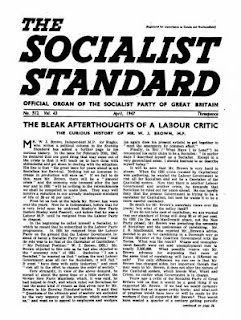
Editorial: The Powers and their Armed Forces (1947)

Editorial from the April 1947 issue of the Socialist Standard

When Mr. Bevin reached Moscow on March 8th to attend the Four-Power Conference on the settlement of German and Austrian Peace treaties he said
“We have come here to work harder together to hammer out a just and durable peace" (Sunday Express, March 9th, 1947).
Stalin had just written of his “constant belief in Anglo-Soviet-American co-operation in peace as in war,” and similar peaceful protestations were made by U S.A. and French spokesmen.

We have heard all this before, in the years between the end of World War I and the beginning of World War II. How little has changed. Different men, with different party labels continue the same capitalist struggle for power. The U.S.A. announces its intention of asking for exclusive “strategic trusteeship” over the 623 former Japanese mandated islands in the Pacific (Manchester Guardian, February 28th, 1947); and the Secretary of the U.S. Navy explains that the U.S. Navy “will continue to operate in the Western Pacific . . . The Navy,” he said, “ had more or leas inherited from Britain the job of keeping the sea lanes open and stabilising areas from which exports came ” (Times, March 1st, 1947).

Then, in response to a request by the British Government for financial aid in propping up the Monarchist regime in Greece, President Truman “told the Congress leaders to-day of a new U.S. foreign policy, under which the U.S. must intervene in Near East politics with the full weight of its economic power. It is confirmed that Mr. Truman will ask for a £62,500,000 direct loan to Greece as a substitute for Britain’s financial aid ” (News Chronicle, March 11th, 1947).

A day earlier it was disclosed in Washington that “Turkey has now asked for U.S. help to guard her frontiers against Russia ” (Daily Mail, March 10th, 1947).

The Manchester Guardian reported (February 28th, 1947), that the Russian Government (much to the consternation of the American Communists) had given its consent to the American claim for the Pacific islands; a move interpreted as indicating that Russia hoped to get U.S. approval for some of its own annexations. Meanwhile the Russian Government is trying to get Norwegian consent to set up military bases in the Spitzbergen Peninsula and has just made a new agreement with Poland, giving a £7 million loan and arranging for the supply of military equipment and armaments for the Polish army. Examples could be multiplied, and of course the British and French Governments are engaged in similar manoeuvres in areas deemed to be vital to their imperial interests.

Behind the peaceful words of the politicians are the armed forces they keep to back up their demands. The American budget for 1946-47 provided expenditure on defence of about £4,000 million.

The British Government in 1946-47 spent about £1,000 million, equal to 28 per cent of the total budget expenditure (News Chronicle, February 22nd, 1947), and announcement was made on that date of the Russian budget for 1947. The Communist Daily Worker analysed the figures as follows:—
”The Budget anticipates a surplus of 20,100,000,000 roubles (about £1,310,000,000 at the current rate of exchange) providing for an expenditure of 371,400,000,000 roubles during the year. Armed forces expenditure is down to 18 per cent. of the total expenditure, compared with 24 per cent. last year.” (Daily Worker, February 22nd, 1947).
From this it will be gathered merely that Russian expenditure on the armed forces is a smaller percentage of total expenditure than it was in 1946. If, however, the reader takes the trouble to work out what 18 per cent. amounts to at the rate of exchange used by the Daily Worker he will find that it means £4,457,000,000 to be spent on the armed forces. Figures do not lie but it is certainly true that the coy use of percentages can hide a very interesting piece of information.

From all of which it is evident that though private capitalism in U.S.A. and the State varieties of capitalism in Britain and Russia may talk about lasting peace they none of them neglect to give paramount attention to capitalism’s foremost industry, war industry.

Tuesday, March 29, 2022

Power ! Atomic or Political? (1948)

Pamphlet Review from the March 1948 issue of the Socialist Standard

The charge is made in certain quarters that, since the dropping of atom bombs on Japan, there has been deliberate damping down on discussion, particularly of the danger to life and health of the workers in the atomic plants. One of those who make the charge is Mr. J. C. Thomson, of Edinburgh, who puts in strong terms his own views and those of writers from whom he quotes. If there is an answer to his charges we do not know it.

Our Expanding Atomic Stupidity” is a sixpenny pamphlet by James C. Thomson of the Kingston Clinic, Edinburgh. It is a strongly-worded exposure, not only of atomic bombs, but also of its extravagant promises for use in industry and therapy. Mr. Thomson collects a mass of evidence to show that the production of atomic energy in nuclear plants is, in itself, a menace to all forms of life, animal and vegetable. As a matter of fact, it would appeal from the statements of those intimately acquainted with the subject, that the rot has already started and is well on the way, that the radio-active material released by bombs or escaping from factories, has got beyond the control of man.

On the bomb tests at Bikini he quotes Vice-Admiral W. H. P. Blandy, U.S.N., who witnessed the tests, as saying: “The atomic bomb is a poison weapon.”

Mr. Thomson says that the ships from Bikini are still contaminated, the Atoll remains uninhabitable, and the radio-active cloud blown into the upper atmosphere still coheres and continues to move around the world. Early in May, 1947, it was claimed that the “death cloud” was circling the world for the sixth time. According to Dr. Rebman of the University of California, “The danger from the cloud was so great, that during its passage over U.S.A. planes were warned to stay below 17,000 feet to avoid it.” Dr. Stafford L. Warren, chief radio safety officer at the bomb tests, and Dean of the Medical School of the University of California, describes it as: “A blast that grows more and more sinister the longer scientists study its results . . . But that second one at Bikini really ties this business up in a knot. . . Literally astronomical quantities of radio-active materials had become intimately mixed with the sea water, mist and spray which accompanied the formation of the giant mushroom of water which rose from the lagoon. Such atomic mist will deposit huge amounts of radium-equivalent; anywhere from a ton to 100 tons. When this mist moves in over a city you have to evacuate the people right away or they will die from gamma radiation. You couldn't clean the area. The fissionable material would get into the water—into everything. It would get into next year’s crop. I'm not so worried about the killing of 50 to 75 million people as I am about the wiping out of resources.”

But bombs are no longer required, says Mr. Thomson: “More slowly, but quite as efficiently, the same result is being achieved through the fumes given off from atomic fission factories. Every wind that blows through such a factory comes out radio-active. The screening devices used in atomic factories slow down the spread of radio-activity, but even these absorbent and reflecting materials present danger. No matter how much, or what particular substance is used, it gradually acquires radio-activity, and a point comes when it must be broken up and dispersed. Not that dispersal solves all difficulties. It merely takes the danger to a new area. At the American factories the isotope garbage is placed in concrete chests and dumped in the sea or into swamps.”

But it is not only the screens that become radioactive. The scientists and workers in the factories become affected; though this is denied by Professor Mott, President of the Atomic Scientists' Association, who says: “Protection of these workers is so easily and strictly applied that it is inconceivable that workers could be affected.” in reply to this Mr. Thomson says:

“I wonder if Professor Mott has heard of the great hospital built to accommodate the damaged workers from the Manhattan Project? And how soon it was filled to overflowing? And of how a great annexe was hurriedly constructed to be likewise filled to capacity? And of how still another annexe had to he improvised to keep the radio-active workers from filtering back home to contaminate their families and neighbours? (And, incidentally, to prevent them from talking).”

According to Mr. Thomson the bodies of the victims remain radio-active. Cremation does not quench it. And grave yards can be affected. While the Daily Graphic (8/4/47) mentions a notice in a New York paper offering “atomic burial vaults with concrete walls, interlined with lead, ready for delivery in May. That, at the moment is the insoluble problem of the U.S.A. morticians (undertakers to you); how to dispose of their radio-active clients without exposing themselves to danger.”

In some sections of the press there have appeared strongly-worded attacks on scientists as a body. They have been blamed, not only for Hiroshima and Nagasaki, but for all the indications of worse to come in the future. The truth is that those who control the political machinery of the state are alone responsible. It was the heads of the capitalist state who saw, in the splitting of the atom, the promise of a new force that would revolutionise war and industry in their class interest. In the early days they could not foresee the dangers, though scientists, with experience of radium, knew that precautions would be more than ever necessary. The press could see nothing but benefits for mankind. The press is still registering that opinion. When the dangers appeared; a mysterious sickness, lassitude, danger of contagion to families and friends, and sterility; the entire industry was sworn to secrecy. What mattered a few thousand wage-slaves with this colossal power within their grasp? But the demand goes on, and must increase because of wastage of manpower in these factories. "There is to be a training school for boys and girls of 15 and over, who have studied chemistry at school, to be opened by the Ministry of Supply at the Government atomic energy factory at Springfields, near Preston ... the first course would begin in August. . . Salaries will start at £140 a year at the age of 15, rising to £276 for men and £257 10s. for women by the age of 26.” (Scotsman, 5/5/47.)

On this Mr. Thomson comments as follows: "Is It possible that nobody at the Ministry of Supply knows of the biological disruption awaiting the majority of these youngsters? Not one word of warning appears. Just an alluring offer of free training to be followed with good wages.”

All this applies to the rank and file workers. As in most industries there are supervisors, and others, known as high-ups. Mr. Thomson's records do not present them in a favourable light. He has been at some pains to collect evidence of their callous indifference to the sufferings of atomic victims. He says:
"As James Cameron reported (Express, 25/9/46) "The most scared man in the world today are the atom-splitters.’ But Cameron also provides an indication that not all workers in the fission field are sensible of their communal responsibilities: ‘Many of the atomic scientists arc honest men already somewhat stricken by the fruits of their energy. But—one of them I met on the island of Bikini—was, I am sorry to say, British, and so far as I am concerned he has no name. But he spoke in terms so crude and heartless, propounded a doctrine so pernicious, held the happiness of his fellow men so low, that he sent away even a bunch of shellback American newspaper men, revolted and appalled'." The same James Cameron also said: “Let us not be too kind to the scientists. They have a tendency to protect themselves as the reluctant tools of a relentless military, forced . . . to debase their knowledge to barbarism. In actual fact, a few weeks before Hiroshima a poll of more than 150 scientists working on the project was taken . . . More than half of them voted for demonstration in an inhibited area.”
No doubt these scientists were the high-ups. Never-the-less it was not their votes that decided the fate of Hiroshima; that decision was made by someone with real power. Mr. Thomson says: "One authority is quoted as stating that the decision to drop the bombs on inhabited cities ‘was made by the Army and Navy.’ That is a direct contradiction of President Truman’s claim that he alone made that ‘least objectionable choice'. "

Whatever attitude the scientists adopt the ultimate power always rests with the political heads of the state. Mr. Thomson presents his case against atomic bombs and fission factories with admirable precision, but on this side of the question he is indefinite. He says:
“With more and more stations and factories coming into action, a steady poisoning of our atmosphere is already taking place. Unless the public become enlightened enough to force our rulers to call a halt, the sum total of radioactive 'dew' in the atmosphere must slowly increase until life as we know it—vegetable, animal and human—can no longer exist on this planet.”
If Mr. Thomson holds that our rulers must be forced to call a halt, he should have indicated the nature of the force that would be equal to the task. He has not done so. So-called public enlightenment today rests on the capitalist press, and is merely enlightenment on matters affecting the capitalist way of life. At the moment capitalist interests determine that atomic factories shall continue, and that all criticism of the work must he discouraged.; hence there is no question of the press being divided on the subject. There is no opportunity for a study of the facts for and against. The factories are State-owned. They may never pay dividends, but they are experimenting in the capitalist interest. They are capitalist property, part of the means of wealth production owned by that class. The only solution is to make them the common property of the people, along with all the other means of life; to be democratically controlled by the people as a whole. Under such a system poison factories would be eliminated; while the people would operate the rest for the satisfaction of their needs. The working-class alone can do this by organising for control of the political machinery that capitalist control may be superseded by the Socialist way of life.
F. Foan

Tuesday, January 11, 2022

Why they dropped the bombs (2005)

From the October 2005 issue of the Socialist Standard
Richard Headicar concludes his analysis of the reasons why the US dropped atomic bombs on the Japanese cities of Hiroshima and Nagasaki in August 1945. 

Link to Part 1

Understandably Allied servicemen involved in the Pacific war, many of whom experienced the unspeakable horrors of Japanese prisoner of war camps, welcomed the atomic bombs as a “miracle of deliverance”. With a few notable exceptions, even those historians who conclude that dropping the bombs was not necessary to obtain Allied victory – that it would not even have been necessary to invade Japan – generally accept that using the bombs probably shortened the war. Even if only by a few weeks. In the grim reality of war, the life of a single comrade saved is worth a thousand enemy slain.

But what would such men think if they knew that, far from shortening the war, the atomic bombs actually prolonged it? That for all the crocodile tears shed about the “terrible plight” of the captives; for all hollow praise heaped upon the “heroic sacrifices” of the armed forces they were, after all, merely expendable pawns in the unrelenting hostilities of power politics? That “bringing our boys back as soon as possible”, was not actually the first order of business?

Did the US want Russian intervention?
By the time the atom bombs were dropped, Allied victory through overwhelming military superiority was virtually assured. Also, at Potsdam in July 1945, Stalin had confirmed his intention to enter the war on 15 August. As President Truman, writing in his private journal, noted at the time: “Fini Japs when that comes about”. In fact Russia declared war on Japan on 8 August and the following day – just hours later in Far East time – Russian troops attacked in Manchuria and Korea. The rapidity with which they penetrated against the cream of the Japanese army is convincing evidence for many commentators that Japanese surrender would have swiftly followed. Surely such a potentially decisive intervention would have been welcomed by those pledged to “bringing our boys back as soon as possible”? Surely every effort would have been made to encourage the speediest possible participation of the Russian military as a matter of utmost urgency? Not so!

The attitude of the US policy makers regarding Russian intervention, even though initially positive, was never entirely free from fear-fuelled ambivalence. And, corresponding with increasingly encouraging reports from the Manhattan project, that attitude eventually hardened to become actively negative. Well-founded mutual suspicion governed every move; trickery and deception concerning their respective intentions was extensively employed by both sides. And, once again, American Secretary of State, James F. Byrnes, unashamedly declared his hand. He thought that it would be “regrettable” if Russia became involved in the war. He was desperately worried that if Stalin knew about the awesome power of the atomic bomb (he did) he might “immediately enter the war”. So Byrnes sought to delay Russian entry. That his attempts were unsuccessful is largely irrelevant and hardly the point, which is that the US leaders did not want Russian intervention. Firstly, because they were intent on using their atomic bombs before the war in the Pacific ended and, secondly, they were reluctant to share their prospective economic and political influence in the Far East with anyone else, friend or foe.

Although Stalin had no qualms about rescinding the Neutrality Pact with Japan, the likelihood of Russia entering the Pacific War any earlier than it did, even had it been urged to do so by America, was extremely remote. Yet there were two other avenues through which the US administration, had it had the slightest inclination to pursue them, could almost certainly have succeeded in shortening the conflict. Instead, to serve their own agenda, they approached these avenues with sufficient circumspection to frustrate every overture; each manoeuvre calculated to obstruct the least chance of any kind of rapprochement.

Was Japan really suing for peace?
The evidence that it was is overwhelming. Astonishingly, Japanese diplomats initiated peace feelers as early as late summer 1944. They continued to do so – through Sweden, Switzerland, Russia and even the Vatican. Particular efforts were made via Moscow in the (mistaken) belief that the Neutrality Pact that existed between Japan and Russia made it the most viable channel. Despite the fact that Stalin had previously declined to renew the pact, Japanese fears were somewhat mollified (but by no means quelled) by his assurance that it would continue to inform his decisions until its expiry in April 1946. But by the end of 1943 he had already made known to Allied leaders his intention to enter the war against Japan and signed an agreement confirming it, at Yalta in February 1945.

On the day following the collapse of Okinawa (21 June 1945), Emperor Hirohito told the Supreme Council for the Direction of War to reverse their “Basic Policy”, urging them to seek peace by diplomatic means: “You will consider the question of ending the war as soon as possible”. It was the specific mission of the new cabinet of Prime Minister, Baron Kantaro Suzuki (appointed 7 April 1945), to seek peace. But neither the US nor Russia were interested in Japan’s efforts for peace; the US wanted to wait until it could drop the atom bombs and Russia until it was ready to declare war. Not one of the messages imparted to Moscow by the Japanese ambassador was passed on to America. This made little difference, however, since all Japanese codes – diplomatic (“Magic”) and operational (“ultra”) had long been broken. An extract from “Magic” Nº 1205 (13 July 1945) deciphering a cable from Foreign Minister Togo to Ambassador Sato reads: “His Majesty the Emperor, mindful of the fact that the present war daily brings greater evil and sacrifice upon the peoples of all belligerent powers, desires from his heart that it may be quickly terminated”. The same transcript further states: “It is the Emperor’s private intention to send Prince Konoye to Moscow as a Special Envoy . . .” And so he did, but Moscow would not receive him. Later President Truman “thanked” Marshal Stalin.

Stephen Harper, in his book Miracle of Deliverance, subtitled ‘The Case for the Bombing of Hiroshima and Nagasaki”, writes, with commendable honesty: “Ways could have been found to explore the Japanese peace moves had there been any desire to do so, but it seems clear that the doctrine of unconditional surrender . . . had become compulsive thinking – an Allied blindspot”.

Was it unconditional surrender?
On 21 July an ultimatum – the Potsdam Declaration – was given to the Japanese government. It was issued on behalf of the President of the United States, the President of Nationalist China and the Prime Minister of Great Britain; but not Russia. Its language was uncompromising as these extracts show:
“Following are our terms. We will not deviate from them. There are no alternatives. We shall brook no delay.

“There must be eliminated for all time the authority and influence of those who have deceived and misled the people of Japan into embarking on world conquest . . . We call upon the government of Japan to proclaim the unconditional surrender of all Japanese armed forces . . .”
Despite the inclusion of phrases such as : “We do not intend that the Japanese shall be enslaved . . .”, “Freedom of speech, of religion and of thought . . .”, “. . . fundamental human rights shall be established” – the single non-negotiable concession, repeatedly demanded by Japan, was noticeably absent: a guarantee of the Emperor’s position. A crucial paragraph offering just such a guarantee was deleted by the US Secretary of State James F. Byrnes. Consequently, the Declaration was deemed unacceptable by Japan – just as the US hoped it would be.

Much discussion has ensued concerning the nature of the Japanese response. Some analysts consider it to be an outright rejection; others no more than a pause for breath. Confusion was sown by the use of the Japanese term “mokusatsu”, which can mean: “take no notice of”; “treat with silent contempt” or (most probably) “withhold comment”. Some writers have emphasised the jingoistic and defiant statements trumpeted in the Japanese media, but these were obviously face-saving propaganda exercises designed to boost national morale. Other compelling evidence makes it abundantly clear that, so far as Japan was concerned, negotiations were still very much ongoing. And that the US was aware of it.

“Magic” intercept Nº 1218 (26 July 1945) revealed the text of another message sent from Foreign Minister Togo to Ambassador Sato. This was a reaction to a broadcast made to the Japanese on 21 July, on behalf of the US. The broadcast was made by Captain (later Rear Admiral) Ellis M. Zacharias, later to write an article for Look magazine (6 June 1950) entitled “How We Bungled the Japanese Surrender”. Part of the “Magic” summary stated: “It is impossible for us to accept unconditional surrender, no matter in what guise, but . . . there is no objection to the restoration of peace on the basis of the Atlantic Charter”. But once again Byrnes intervened and claimed that it was best to refrain from designating the broadcast as “official”.

That the issue of “unconditional surrender” was the primary stumbling block to the achievement of a peace settlement had been recognised long before. A Joint Intelligence Committee in March 1940 commented: “The crux of the political situation will lie in the all-important status of the Japanese Emperor”. After the war was over, both Secretary of War Stimson and the President recorded their conclusions. “[H]istory might find that the United States, by its delay in stating its position [on the surrender terms] had prolonged the war” wrote Stimson in his memoirs. Or as Truman succinctly remarked during the compiling of his: “It was because of the unconditional surrender policy against Japan that Hiroshima and Nagasaki were wiped out”.

Two days after the Potsdam Declaration, Prince Konoye was still making frantic efforts to make contact with Russian diplomats, contradicting the generally accepted notion that the Declaration had been dismissed out of hand by Japan. In any event, the decision to drop the bomb had already been taken: finally confirmed on the same day as the Declaration.

On 10 August, the morning after the second bomb was dropped, an offer of surrender from Japan was received in Washington. Once more it stipulated that any agreement should “ . . . not compromise any demand which prejudiced the prerogatives of His Majesty as a Sovereign Ruler”. Stimson favoured its acceptance; Secretary of the Navy James Forrestal suggested a compromise; Byrnes opposed it. For once, Byrnes had to give way but, nevertheless, he was the one who drafted the reply, the key phrase of which permitted that vital Japanese proviso: “From the moment of surrender the authority of the Emperor and the Japanese Government to rule the state shall be subject to the Supreme Commander of the Allied Powers”. It was enough. The bombs, apparently, had not persuaded Japan to drop its proviso concerning the Emperor.

Byrnes’s reluctance to bend, even at this juncture, is hard to fathom precisely. What is seldom mentioned in popular accounts of the bombing of Hiroshima and Nagasaki, however, is that a third bomb would have been delivered and ready to drop by 17 August 1945.

Why were the bombs dropped?
A complex labyrinth of reasons lay behind the decision to drop the atomic bombs. Once the vastly expensive machinery of production had commenced, and the original purpose of its instigation forgotten, sufficient resolve not to use it ceased to exist. The astronomical investment of public funds needed to be justified; the widespread public antipathy of the American population towards the Japanese following the Pearl Harbour attack, demanded revenge – a mood of which the American leadership was acutely aware. As Secretary for War Stimson subsequently observed: “No man, in our position and subject to our responsibilities, holding in his hands a weapon of such possibilities could have failed to use it and afterwards look his countrymen in the face”.

A number of ‘revisionist’ historians confidently assert that the primary motive was to gain diplomatic advantage: a powerful political lever allowing the US to dominate future negotiations with the Soviet Union. They make a powerful case and undoubtedly this was a major consideration in the formulation of atomic policy. But this could have been accomplished with just a single bomb and, surely, not necessarily on a heavily-populated city.

The fact that two bombs were dropped, however – without warning – on specifically targeted and crowded locations which had been spared aerial bombardment; the fact that each bomb had different technology (one uranium-explosion; one plutonium-implosion), each with different yields, dropped at different heights but both resulting in prolonged and deadly after-effects of which little was understood, suggests the conclusion that the primary motives might have been the seldom mentioned (almost unmentionable) one of “scientific” experimentation. A conclusion that seems to be confirmed by the grim recommendations of both the Interim and Target committees detailed in the first part of this article (last month).

The terrible war in the Pacific, in common with all wars between capitalist states, had its origins in the protection and expansion of economic interests. There seems to be no limit to the degradation and cruelty utilised to protect those interests. Anyone visiting the Hiroshima museum would be able to view the leaflets that were dropped warning of an atomic attack. In an act of macabre cynicism that almost defies belief, those leaflets were not dropped until 9 August – three days after the bombing. Things improved for Nagasaki – they were only one day late.
Richard Headicar

Blogger's Note:
The following correction appeared in the November 2005 issue of the Socialist Standard:
Two mistakes found their way into the article "Why They Dropped the Bombs" in the October issue. The date of the Potsdam ultimatum to Japan was 26 July not 21 July as stated and there was a reference to a comment of the Joint Intelligence Committee in "March 1940". Readers will have realised that this cannot have been since the US and Japan were not even at war at that point. It should of course have read "March 1944".

Tuesday, September 8, 2020

Why they dropped the bombs (2005)

From the September 2005 issue of the Socialist Standard
  Last month saw the 60th anniversary of the dropping of atomic bombs on the Japanese cities of Hiroshima and Nagasaki.  The media mostly contented itself with repeating the myth that this was the lesser evil to continuing the war by conventional means.  In a two-part article Richard Headicar uncovers the real reason for the bombings: to test the destructive power of a new weapon for use in future wars.
A common charge levelled at those who challenge the (still largely believed) established myth concerning the dropping of the atomic bombs on Hiroshima and Nagasaki, is that they do so from the comfortable perspective of hindsight. This view was most elegantly formulated by Albert R. Hunt, writing in the Wall Street Journal on 3 August 1995: “The critics view the situation through the prism of today and side-step both how the situation looked to decision-makers in 1945 and the political realities facing them”.

At first glance a not unreasonable observation but one which, upon closer examination, is revealed as somewhat disingenuous. Firstly, because, given that such a vast amount of crucial and enlightening information was for many years kept secret (much still is), anything other than hindsight concerning many areas of knowledge would have been pure speculation. Secondly, because there existed a number of contemporary critics. Many of these were closely involved in the production of the bomb, others from the military and some, even, close to the president.

Before proceeding to disentangle the web of lies and deception surrounding this subject, it is important to emphasise that, whatever the reasons for the decision to drop the bombs, it was a consequence of a brutal and ruthless conflict between warring capitalist states. A British First Sea Lord once put it: “Moderation in war is imbecility”. Today there are few military ‘conventions’ and any that remain are almost sure to be violated. Rest assured, had any one of the main protagonists in the Second World War obtained an atomic bomb before the United States, they would almost certainly have used it with a similar alacrity and disdain for human life.

Who took the decision to drop the bomb?

Although, of course, it was President Harry Truman who had to give final approval (British consent, a formality required by agreement, was readily granted) he was the new boy on the block relying heavily on his advisors. General Leslie Groves, director of the Manhattan Project to manufacture the bomb, famously described Truman as “a little boy on a toboggan”. Once the decision had been made to produce the atomic bomb and the process of manufacturing it had begun, it was always assumed by the military and politicians that it would be used. In that sense no actual decision was ever a real necessity.

Nevertheless, formalities and procedures were prudently followed and, in order to work out the practical details and make suitable recommendations, various committees were established. The two most important of these were the Interim Committee (political, plus a co-opted scientific panel) and the Target Committee (military and scientific). General Groves headed the Target Committee and although not a member of the Interim Committee, was always present at its meetings. He was an unswerving advocate for deployment of the bomb. As he bluntly explained: “It would not have looked well if I had been appointed to serve on a committee of civilians. But I was present at all meetings and I always considered it my duty to recommend that the bomb be dropped.”

The chairman of the Interim Committee was the Secretary of War Henry L. Stimson. On 3 May 1945, he proposed a further member who was to have a most significant influence on events: James F. Byrne, soon to become the Secretary of State to President Truman. His views on the dropping of the bomb were as rampantly in favour of those of Groves and together they formed the irresistible force that, more than any other, led to the final cataclysmic devastation of those two unlucky Japanese cities. As the physicist Arthur H. Compton put it: “The Scientific Panel was not called to decide the question of whether the bomb should be used, but only how it should be used . . . it . . . seemed to be a forgone conclusion.”

Minutes taken at the meeting of the Interim Committee on 1 June 1945 recorded:
  “Mr Byrnes recommended and the committee agreed, that . . . the bomb should be used against Japan as soon as possible; that it be used on a war plant surrounded by workers’ homes; and that it be used without prior warning.”
On 25 July 1945 a directive approved by the Secretary of War, but which had been previously composed by Groves, manifested US intentions and confirmed previous assumptions in its first two sections:
“(1) The 509 Composite Group, 20th Air Force will deliver its first special bomb as soon as weather will permit visual bombing after 3 August 1945 on one of the targets: Hiroshima, Kokura, Niigata and Nagasaki . . .
“(2) Additional bombs will be delivered on the above targets as soon as made ready by the project staff . . . “
Whether or not that directive constituted a decision and whether Stimson and Truman or Byrnes and Groves bore most responsibility for it remains a matter of some debate. The theory of the “forgone conclusion” gains some credibility from the response given to Groves when, in January 1945, he suggested to his immediate superior, Army Chief of Staff General George Marshall, that detailed plans should be drawn up for the employment of the bomb in war. He was told “see to it yourself”.

Were they military targets?
 “The world will note that the first atomic bomb was dropped on Hiroshima, a military base. That was because we wished in the first instance to avoid, in so far as possible, the killing of civilians”. President Harry S. Truman (9 August 1945).
All of the cities on the target list (like most reasonably sized cities in time of war) were of some military significance. Five of them, with the agreement of the Air Force, were to be spared any further aerial bombardment from May 1945 onwards. These were Hiroshima, Kyoto, Yokohama, Kokura Arsenal and Niigata. On the express orders of the Secretary of War, Stimson, Kyoto – considered to be the cultural centre of Japan and a beautiful city that Stimson had once visited – was removed from the list and Nagasaki took its place. The truth is, of course, that the US Air Force could have destroyed any military target that it chose to. Japanese air defences were practically non-existent and of Japan’s sixty-six largest cities, fifty-nine had been destroyed; the seven remaining partly so. By the summer of 1945 only two cities with populations exceeding a quarter of a million had not been assailed by incendiary raids.

Since Hiroshima was designated as a major port and home of Regional Army Headquarters and the northern sectors of Nagasaki contained the Mitsubishi Steel and Arms Works, why did they remain largely untouched (Hiroshima hardly damaged at all and Nagasaki comparatively unscathed)? The answer is provided by the proposals of the Target Committee, 27 April 1945:
  “To enable us to assess accurately the effects of the bomb, the targets should not have been previously damaged by air raids.”
Nagasaki had been bombed to some extent but it was only a late addition to the target list and was not first choice even on the day the bomb was dropped on it – that had been Kokura Arsenal.

Further recommendations made by the committee were that “ . . . the first target be of such size that the damage would be confined within it, so that we could more definitely determine the power of the bomb”. Then from a further meeting on 10 and 11 May came the clear (and fortunately documented) instruction: “ . . . to neglect location of industrial areas as pin point target . . . [and] . . . to endeavour to place first gadget in center of selected city; that is, not to allow for later 1 or 2 gadgets for complete destruction.”

To erase any lingering doubts a subsequent Bombing Survey Report stated: “Hiroshima and Nagasaki were chosen as targets because of their concentration of activities and population”.

Was it necessary to drop the bombs?

One of the most commonly accepted beliefs is that, horrific though it was, the bombing of Hiroshima and Nagasaki saved millions of lives – Japanese as well as American – by bringing about a swift end to the war and forestalling a bloody invasion. We are reminded about the massive casualties already suffered by both sides in the Pacific War. Particularly about the fanatical defence by the Japanese of Iwo Jima, Luzon and Okinawa. But although there were plans for an invasion they were contingency plans.

The first stage – “Olympic” – was to land at the island of Kyushu on 1 November 1945. No assault on the main island, Honshu, – “Coronet” – was scheduled until 1 March 1946. In the light of what we now know, it seems doubtful that the need for any kind of invasion would ever have arisen. Japan was certainly not defenceless. It still had an army of more than two million troops, many prepared to fight to the death for their Emperor. Also, as well as conventional planes, there were thousands of kamikaze, mines, beach fortifications, etc, and the remnants of the navy. Their problem was one of deployment. But as the US Strategic Bombing Survey concluded, less than a year after the bomb had been dropped:
  “Certainly before 31 December 1945 and in all probability before 1 November 1945, Japan would have surrendered even if the atomic bomb had not been dropped, even if Russia had not entered the war, and even if no invasion had been planned or contemplated.”
Some historians argue that the bombs were unnecessary precisely because Russia intended to enter the war, so the conclusion of the Strategic Bombing Survey was all the more remarkable. Less so, however, when the reality of the Japanese military situation is properly examined. Their navy was virtually finished; their army was described by Hanson W. Baldwin as consisting of “Green conscripts and second rate troops”; communication lines were in disarray; fuel was in extremely short supply; roads were in a poor state of repair; transport and transportation could be bombed at will; ports were becoming paralysed; food was scarce; illness through malnutrition was an increasing problem and (not surprisingly) public morale was diminishing by the day. In marked contrast to this, the US armed might remained immensely powerful.

All of this was known to the US administration and military and the ludicrous estimates of projected invasion casualties – ranging from “hundreds of thousands” to “millions” – were post-war exaggerations designed to contribute to the successful establishment of a public justification for the dropping of the bombs. Major General Curtis E. LeMay expressed the truth quite bluntly a few weeks after formal surrender of the Japanese Emperor. “The atomic bomb,” he stated, “had nothing to do with the end of the war”.

But the reasons were not merely military ones.

(To be concluded next month)
Richard Headicar

Monday, July 20, 2020

Passing Comments: General Election (1951)

The Passing Comments Column from the July 1951 issue of the Socialist Standard

General Election

A review of “The British General Election of 1950,” by H. G. Nicholas, was published at the beginning of this year by Macmillan and Co. for 21s. Mr. Nicholas calculates that the Socialist Party spent more per vote on the election than did any other; and he also describes some of the propaganda put forward by the Party during the election. “‘One thing we must warn you about,' they told their followers. 'Do not trust in leaders, trust in yourselves alone. Unless you understand the cause and the solution of your miserable condition no leader can help you, no matter how honest and sincere he may be; if you do understand, then you do not require leaders; you will know what you want and how to instruct your delegates to get what you want.'  "


Candidates

Recently this column quoted a survey about the Conservative candidates at the last election made by the magazine “Comment." Now the more authoritative survey of Mr. Nicholas has appeared, covering the candidates of all parties. In the Conservative ranks, as might have been expected, the businessmen had preponderance. Of the 621 candidates, 168 were employers or company directors; 30 were concerned in business finance as stockbrokers or bankers; of those who had private means, 39 had done nothing to justify their inclusion in any other category; and there were 12 farmers and 21 landowners. The total is thus 270. It is tempting to include in this group those 39 candidates for whom a company directorship was a subsidiary occupation, as well as the 16 whose subsidiary occupation was farming; but they might also have been included in some of the other categories already counted within the group. Nevertheless, the real total is somewhere between 270 and 325—the latter figure being over half the total number of candidates. For the rest, the Law accounts for 114, the Services for 62, and there are 30 salaried managers. Other professional and well-to-do people number 137, and four white-collar and seven manual workers bring up the rear.


Socialists?

The Labour Party put forward 617 candidates; and it is worthy of note in a party which claims to be a socialist one that no less than 92 of these candidates were engaged in business or agriculture at the profit-making level, including 40 company directors. There were also 78 engaged in the Law, 8 from the Services and 21 salaried managers. In the other middle-income groups there were 180 candidates; 43 were white-collar workers; 92 were manual workers; and 91 candidates had been manual workers, but had now moved up into the white-collar group (the great majority of these being trade union officials).


Liberals

Of the Liberal Party's 475 candidates, some 143 belonged to the employing profit-making group, including 85 company directors. It is significant that, as Mr. Nicholas puts it, "of persons owning their own small businesses, small retailers, etc. (a category hardly worthy of separate mention amongst Conservatives or Labour), there can be listed 23.” There were also 71 Liberal barristers and solicitors, 39 salaried managers, and 16 from the Services. 188 others were in the middle income groups, and there were 16 white-collar and 13 manual workers.

Apart from the large petty bourgeois representation among the Liberal Party’s candidates, the companies with which the party’s business-men were connected “were in most instances of modest size, what in the U.S.A. would be called 'small business.' Moreover, the emphasis throughout the business group fell on the export, transport or retail trades, often in the form of family concerns or private companies run by their owners."

This analysis of the Liberal candidates would appear to confirm those conclusions as to the class-backing of the party which one would draw from the fact that it receives most support in the small-farmer areas of North Wales and North Scotland.


The Stick and the Carrot

It is a common assumption that the chief domestic issue in this country at the present time is that of Capitalism versus Socialism. But so far from a Socialist government having been in power, Socialism has never even been put before the electorate by any party with the resources to ensure that it would get a fair hearing. To adapt a famous saying, Socialism has not been tried and found wanting; it has never been tried.

The real quarrel is between two schools of thought, both of which accept explicitly or implicitly the foundations of the capitalist system. The first school is represented by those who think, privately or publicly, that a certain amount off unemployment is a good thing because it drives the workers, by fear of the dole, to increase production; that business should be left to the individual owner or joint-stock company; and that expenditure on social services should be restricted. The second school has insisted, ever since the days of Robert Owen and his new-style cotton mills at New Lanark, that the worker would produce more if he were given reasonable security and good conditions; and that laissez-faire was generally to be frowned upon because open competition deprived the worker of security. Since, as Robert Owen found, few individual factory- or mine-owners were willing to accept and put into operation these new theories, those adhering to the second school have called for state-intervention in industry and a measure of state-ownership. But the fundamental problem over which the two schools differ is that of how to get the worker to produce more; is the stick or the carrot more effective?


"Socialists" on Nationalised Boards

But though the Fabian society and the other theorists of the second school made only a few conversions among the upper class, they found allies in the trade unions, which naturally approved of a theory which aimed at giving security and reasonable conditions to the worker. Just as the donkey, if questioned, would doubtless favour the carrot method, so did the workers accept the Fabian nostrums. And as the Labour Party built itself up into one of the largest parties in the country, domestic debate began to centre round the “welfare state” and state-ownership. But the issue of Socialism versus Capitalism was never raised on a national scale; the Labour Party was first called a socialist party by the conservative press, intent on rallying the propertied class round the Conservative Party.

The difference between the Labour Party on the one hand and the Socialist Party on the other has been emphasised once more by Mr. Harold Roberts, President of the National Union of Railwaymen (Carriage and Wagon Grades). He is reported to have said (Sunday Times, 20-5-51) that each nationalised board should have at its head "a Socialist of unquestionable integrity with a deep-rooted conviction of the correctness Socialist policy.” It is symbolic of the widespread misuse of the word “Socialist” that a trade union leader can talk in apparent seriousness of an industry run on wage-labour and profit-making lines having a “ Socialist ” at its head.


Due Reward

Another quotation from the same paper illustrates again the gap between the private- and state-capitalist parties and the Socialist Party. The Rt. Hon. Richard Law, M.P., reviewing a book by Mr. George Goyder which advocates a change in company law “to make management explicitly responsible to the worker, the community and the state, as well as to the shareholder” (whatever that may mean) can go on to say that under such a system “the absent shareholder will get his due reward, but no more.” Those who want state intervention, those who want laissez-faire, all join in agreeing that there is such a thing as a “due reward" for a shareholder, and yet the Labour Party is still regularly called the Socialist Party.


Six of One

Recently there was a military parade in Prague past President Gottwald and Marshal Konev. Reviewing his armed forces, the President said that “the creation of a strong and efficient army and people's militia was in no way contrary to the purposes of peace. He said the stronger Czechoslovakia defence forces became the stronger would be the world peace front.” (News Chronicle, 7-5-51).


And Half-a-dozen of the other

On the other side of the Iron Curtain, in Yorkshire, we find Mr. Strachey saying that “we must push on with our defence programme. He was convinced that every new division of the Army, squadron of the R.A.F. and ship of the Navy which we could make available increased the chance of keeping the peace. And to keep the peace, to prevent a third world war, was the supreme object of all our endeavours.” (Observer, 20-5-51.)


Preserve Them From War

Another adherent of the curious theory that the best way to keep the peace is to produce more weapons of war is President Truman.

The News Chronicle (25-5-51) tells us that "in a memorable message sent to the Capitol, and at a press conference just before the message was read to Congress, the President set forth in simple and moving words a majestic aim that lies behind the policy the U.S. government is pursuing. It is to bring about peaceful conditions in which 'the century in which we live could become the brightest man has yet known on earth.’ ”

How are we going to bring about peaceful conditions? Why, by getting Congress “to vote another £3,000 millions to give free countries throughout most of the world weapons, raw materials, machinery and other aid to preserve them from war and conquest.”


Consoling Ourselves

Continuing the campaign to persuade the public that atom-bombs are not so bad after all, the Times leader-column recalls that a hundred years ago it used the phrase “perhaps the most terrible implement of destruction ever delivered into the human hand,” to describe the latest repeating pistol brought to this country by Samuel Colt. It goes on comfortingly to say that “to-day, surrounded by more formidable weapons, we may perhaps be forgiven for consoling ourselves with the realisation that in other ages, too, men have stood in awe of their own inventions” and remarks that “the man who had visions of blazing his way to glory with a smoking gun in each hand soon found how elusive a stationary target at fifteen paces could be.” (29-5-51)

The implied comparison between the atom-bomb and the Colt revolver, and the hint that the former may fall short of expectations as the latter did, is unworthy of the Times. Exactly how elusive would a modern city be when faced with a raid by a fleet of jet-bombers, or bv guided missiles? How elusive were Hiroshima and Nagasaki to the already out-of-date bombers used in the now old-fashioned year of 1945?

Not very.


Lord High Admiral

Spare a thought for Mr. Bernard Le Strange. Hereditary Lord High Admiral of the Wash. Finding himself in debt, he agreed last May to live on only £10 a week until his debts were paid off; and he moved “to an inexpensive harbour-front hotel” in St. Helier, Jersey. Now his creditors have been paid off, and Mr. Le Strange will doubtless be able to resume a manner of life more fitting to his station. But it is an interesting commentary on Mr. Le Strange's normal standard of life that a year living on the sea-front in Jersey with an income of £10 a week represents the crash which follows a financial crisis.


Drinks on the House

Another figure who claims our sympathy this month is the Lord Mayor of London. The Sunday Express (20-5-51) remarks on his princely hospitality. Apparently he has an allowance of £12,500 a year— £250 a week; but the Express envisages him having to pay an extra £20,000—£400 a week—for the entertaining he is doing during the current year.

Who said the rich had been almost destroyed by the tax-collector?
Alwyn Edgar