Showing posts with label February 1927. Show all posts

Friday, April 8, 2022

Editorial: The Class Struggle. A Lesson from Germany. (1927)

Editorial from the February 1927 issue of the Socialist Standard

There are large numbers of people who believe that discontent and social upheavals are caused by the propaganda of “agitators,” and conversely that they can be prevented by counter propaganda. For them Czarism was overthrown by Lenin, the miners’ strike was the work of Cook and the class struggle was created by Marx. They are unable to distinguish between the observation of facts and their causation. Marx did not preach the class war in the crude sense of desiring class hatred, either for its own sake or for any other purpose. What he did was to observe that in society as it existed before his eyes there was an employing, property-owning class and a propertyless employed class. No-one disputes this as the statement of an obvious truth, but for Marx it was not only interesting but also historically important. And having observed and examined the class division and consequent class struggle Marx rightly urged the need to apply this knowledge to current political movements. The workers must, he said, recognise that at bottom their movement, like the preceding movement by capitalists to establish and promote capitalism, is a class movement. It must eventually define clearly its class aim of transferring the means of production from private hands to the community. Marx never supposed that he, or other Socialists, “invented” the class struggle or the idea of Socialism. Socialism is the product of Capitalism in that the facts of the existing system gradually force themselves upon the notice of the workers. The task of the Socialist propagandist is to hasten recognition of the facts of social development by directing the workers’ attention to them.

The Socialist could not hope to propagate Socialist ideas outside of capitalist conditions or before the existence of capitalism. The propagandist with the Socialist idea is himself only the product of those conditions. A handful of Bolsheviks, intelligent and devoted though they may be, cannot build Socialist society in a country—Russia—which is overwhelmingly peasant in composition and organisation. They can and are doing the good work of speeding up development on modern industrial capitalist lines. Similarly unlimited capitalist propaganda in industrial Germany and England cannot prevent, it can only delay, the growth of Socialist ideas in the minds of the workers. It is with great pleasure that we read of an enquiry undertaken by the International Catholic Labour Unions “into the sentiments of those German workmen who are organised in the Roman Catholic ‘Christian Trade Unions’ which have a total membership of more than 600,000.” The enquiry is reported fully in the Manchester Guardian (January 1st, 1927) from which the following is reproduced :—
“INDUSTRIAL PEACE” IN GERMANY.
Views of Catholic Trade Unionists.
(From our Berlin Correspondent). 
“The idea of “industrial peace” and of “reconciliation between workmen and employers” has been promoted with as great energy, skill and sincerity in Germany as in any other country. Leading German industrialists, even when they themselves are Conservative, have publicly declared that Germany cannot be governed without the help of the working class, and that Germany should have a coalition Cabinet in which the Socialist party is represented.

What German workmen themselves think of “industrial peace” has been rather a mystery, to which the Labour Press has given no satisfactory clue. But members of the Roman Catholic Centre party have, on behalf of the International Catholic Labour Unions, made an inquiry into the sentiments of those German workmen who are organised in the Roman Catholic “Christian trade unions,” which have a total membership of more than 600,000.

The result is of extraordinary and universal interest. The Christian trade union, which have been criticised as “unrevolutionary,” as subservient to the Church, and as hostile to the class war, form the moderate right wing of the German Labour movement.

The inquiry has been conducted with that complete honesty which the German Centre party always shows when it tries to establish facts that are important to itself. Questionnaires were circulated amongst the Roman Catholic clergy throughout the industrial districts of Germany as well as amongst the officials of the Christian trade unions. The following is a brief summary of the main subjects of the questions, as well as of the answers that were returned. Many of the answers are detailed enough to fill a book, and many were after long discussions with the workmen. In every case the questions relate to Roman Catholic workmen organised in the Christian trade unions.

I. — RELATIONS BETWEEN WORKMEN AND EMPLOYER.
The general tendency of the answers is to record growing enmity. The mildest expression used is “cold neutrality.” Other answers mention “estrangement,” “distrust,” “opposition,” “tension,” or speak of downright hostility. One answer says that the employers “have no soul and no conscience,” and another that “the purely capitalist attitude of most employers does not allow trustful co-operation to grow up. . . . In the factory the workman feels that he is not treated like a human being. … In public and political life he sees that the employers are, for the most part, on the side of reaction, and hostile to democracy.” The possibility of any improvement is denied. Some of the answers show that the industrial peace overtures made by German employers have aroused nothing but suspicion. Those employers who are themselves Roman Catholics are criticised with special severity. One answer says that “there is bitterness over the fact that Roman Catholic employers limit their Catholic ethics to their private lives and are anxiously concerned not to allow these ethics to appear in their business activities.” Many complaints are made about the “soullessness” of the big industrial concerns. Complaints from smaller factories and workshops, where a more personal relationship between employer and employed is still possible, are, on the whole, less acrimonious.

II.— THE CLASS WAR.
Intellectually and as a Christian the Roman Catholic workman condemns the class war. But, as many of the answers show, hostility towards the possessing classes has a deep emotional influence upon him. Workmen who have no property of their own and are entirely dependent on their wages are filled with a sense of insecurity and dependence. They feel an ever-deepening resentment, “especially when wealth is displayed before their eyes by the propertied classes. It is their daily experience that the propertied treat the non-propertied classes as beings of a lower order — nothing, indeed, embitters a workman more than this.”

III. — THE INTELLECTUALS.
A common fate in the years of revolution and inflation created some fellow-feeling between workmen and intellectuals, but almost all traces of this have vanished. It is only “in an occasional priest or an occasional physician that the workman sees a true friend nowadays.” Generally speaking he likes and respects the clergy who are engaged in welfare work, but the clergy and the Roman Catholic Church as a whole are losing their hold upon him. An answer from the Rhineland states that “one must be blind in both eyes not to see that the authority of the clergy is dwindling.”

IV. — SOCIALISM.
There has been a great change; for whereas Roman Catholic workmen in Germany used to be hostile to Socialism, they are now no longer so, except in a purely theoretical manner. Almost all the answers agree on this point, although they vary in their attempts to explain it. In the economic struggle there is practically no difference between Socialist and Roman Catholic workmen. If the Church were to wage war on the Socialist movement, it could not, so the answers emphasise, expect the Roman Catholic workmen in Germany to show the slightest enthusiasm for such a war.

V.—COMMUNISM.
On the whole the prestige and the persuasive power of the Communist movement have diminished. It still takes a hold on those who think that Socialism is not coming quickly enough. Its influence on young and undeveloped workmen is considerable. The attempt to make Communism attractive to Roman Catholics by representing it as a kind of primitive Christianity has met with some success.

VI.—THE YOUNG GENERATION.
Youthful Roman Catholic workmen on the whole show great mental independence and an inclination towards Radicalism. They observe the formalities of the Catholic faith but without religious enthusiasm. There is a broad tendency amongst them to strive for a united trade union movement, irrespective of faith. Considerable numbers are attracted by the semi-military organisations of Fascist Right and Communist Left.”
Here we have extraordinary evidence of the truth of the materialist view of history. The highly organised, richly financed and skilful propaganda of the Roman Catholic Church is helpless against the educational effect of the actual conditions of working class life. Marx truly described religion as the “Opium of the People,” but to misquote a Biblical saying, “Man cannot live by opium alone.” In the long run he demands material comforts, and rejects the social system with the religious apologists for it, because they offer him the opium of religion when what he needs is bread.

The Monistic Conception of History by G. V. Plechanoff (part III) (1927)

From the February 1927 issue of the Socialist Standard

[Plechanoff’s Famous Work now translated.]


Chapter II.
“One of the most important conclusions to which one must come through the study of history is that the government is the most potent cause in shaping the character of the people; that the qualities and defects of nations, their strength or their weakness, their talents, their education or ignorance, are almost never due to climate or racial peculiarities; that nature gives everything to everybody, and the governments preserve or destroy the gifts of nature that constitute the common possession of the human race.” In Italy there were no marked changes either in climate or in race; “nature was the same for the Italians of all times; the only thing that did change was the government—and these changes always brought with them, or came together, with changes in national character.”

Thus argued Sismondi against those who tried to make the fate of nations dependent upon their geographic environment. His arguments contain some truth. Geography can really not explain much in history, especially because it (geography) is part of history, and because, as Sismondi says, governments do change, though the geographic environment remains the same. But this is only by the way ; we are interested in an other question. The reader must have already noticed that the fluctuations of the historical fate of nations is opposed to the stability of geographic environment. Sismondi knows of only one factor that can explain these changes : government—that is, the political order of a given country. The character of a nation is wholly determined by the character of its government. It is true that after dogmatically stating this theory, Sismondi tries later to soften it. Political changes, he says, come either before changes in national character or after them. That means that the character of the government is sometimes determined by the character of the people. Sismondi then has before him the same contradiction that the French “Enlighteners” had. The character of a nation is determined by the character of its government; the character of a government is determined by the character of the nation. Sismondi could just as little solve this contradiction as the French “Enlighteners.” He was therefore compelled to take as foundation for his discourse at one time one, at another time, another, member of this antinomy, But, as long as he has once taken the view that the character of a government determines the character of a people, he had to exaggerate out of all proportions the concept of government. It meant for him the whole social environment, all peculiarities of social relations. It would be more correct to say that for him, all peculiarities of a given social environment are affairs of government, the results of the political order. This is the stand point of the eighteenth century. When the French materialists wanted to express, in a short and vigorous manner, their convictions as to the all-powerful influence of the environment on man, they said : “C’est la Législation qui fait tout”—and whenever they spoke about legislation, they always meant political legislation, political order. Vico has a small article called Essays on a System of Jurisprudence in which the Civil Rights of the Romans are Explained by Their Political Revolutions. Though this essay was written just at the beginning of the eighteenth century, the ideas expressed in it, on relations between civil rights and the forms of government, were the accepted views until the restoration period. The “Enlighteners” reduced everything to politics.

But since the activity of a legislator, though not always teleological, is invariably conscious, and the conscious activity of a man is always dependent on his “opinions,” we come again to the thought then, that opinion is above everything else, although we set out to prove the supremacy of environment. The younger set of French historians took an entirely different view of this problem.

The course and results of the French Revolution, with its numerous surprises, was in itself a flaring denial of the power of “opinions.” Many had become entirely disappointed with “reason,” and others, who did not succumb to disappointments, became more and more inclined to the view that environment is all-powerful, and the investigation of its development became all-important. But their views on environment were also changed. The great historical happenings have demonstrated the weakness of legislators and political constitutions to such an extent that to declare them as the determining historical cause was ridiculous. Political constitutions began to be viewed not as a cause but as a result that is to be explained.

“A large number of writers, learned historians and publicists,” says Guizot in his Essais Sur L’histoire de France, “tried to explain the given state of society and state of civilisation through the prevalent political order. It would be far wiser to begin with the study of society itself in order to understand its political institutions. Before these institutions can become causes they are results ; society creates them before it begins to change itself under their influence. Instead of judging a people according to its political institutions, we must first study the people to find out what sort of a government it must of necessity possess. Society, its constituents, the life of its individual members, their dependency on their social positions, the relations between various classes of men—in short, the civil life of men (L’etat des personnes), these are the problems that should first engage the attention of the historian who wishes to know how people lived, and the publicist who wishes to know how they were governed.”

This view is just the opposite of Vico’s. The latter would explain civil laws through political revolutions; Guizot, on the contrary, would explain political institutions through civil life, that is, through civil laws. But the French historian goes even further in his analysis of society. According to him, the civil lives of all nations that entered the historical arena after the fall of the western Roman Empire, are strongly tied to their land relations (état des terres). The study of their land relations must therefore precede the study of their civil life : “In order to understand political institutions, it is necessary to study the different groups that constitute a given society, and their mutual relations.” In order to understand these groups, it is necessary to know the nature of their land relations. From this standpoint Guizot studies the French history of the first two dynasties. For him it is the history of a struggle between various groups of society. In his history of the English Revolution, he goes a step further, describing it as a struggle of the bourgeoisie against the aristocracy, and thus silently admits that in order to explain the political life of a country, it is necessary to study not only the land relations, but their property relations in general.

This view was not only held by Guizot, but was also shared by Mignet, Thierry and others.

In his Vous des Révolutions d’Angleterre, Thierry represents the history of the English revolution as a struggle between the bourgeoisie and aristocracy. “All those whose ancestors belonged to the conquerors,” he says in speaking about the first English Revolution, “deserted their castle for the King’s camp. At the time it could be said that the armies assembled—one in the name of leisure and power and the other in the name of labour and freedom. All those who did not work, all those who looked to life only for the pleasures that they could get without working for them, assembled under the King’s banner, to protect their common interests; all the descendants of the conquerors that were drawn into commerce fell in with the party of the people.”

The religious movements of that time were, according to Thierry, only reflexes of real life interests : “Both sides fought for real interests. All the rest was only for pretext. Those who were on the side of the subjects were mostly Presbyterians, that is, they did not want any subjection even in religion. Those who fought on the other side were Anglicans or Catholics, that is, they strove for power and taxes, even on the religious field.” Thierry quotes from the History of the Reign of James the Second the following words : “The Whigs looked on all religious opinions as politicians ; even their hate of the Pope was caused not by the prejudices and idol-worship of that unpopular sect, but by their desire to make the power of the state absolute.”

In Mignet’s opinion “social movements are determined by ruling interests. These proceed to their goals, stop as soon as the goal is achieved, and make place for other movements which are unnoticed at first but which grow to be predominant in time. This was the way of feudalism. Feudalism exists in the needs of men—but not yet in practice—this is the first epoch; in the second epoch it existed in practice, slowly ceasing to correspond to man’s needs and finally ceased to exist entirely. No revolution was accomplished in any other way than this.” In his history of the French Revolution Mignet interprets these events from the standpoint of the “needs” of different social classes. The struggle between these classes is for him the mainspring of what happened. Of course this standpoint did not find favour in the eyes of the eclectics of that time. The eclectics accused the new historians of fatalism, and the spirit of system. As it usually happens in such cases, the eclectics did not see the really weak points in these new theories and energetically fought against its strong points. At all events this conflict is old and at present uninteresting. It is more important to note that these views were defended by the St. Simonist, Bazar, one of the most brilliant representatives of socialist thought of that time.

Bazar did not think that Mignet’s book on the French Revolution was perfect. As one of its defects he considered the fact that according to Mignet the French Revolution was a thing in itself, without any connection with “that long chain of efforts which, after destroying the old social order, were to make the introduction of the new order easier.” He knows, of course, that the book undoubtedly has its good qualities. “The author strove to characterize those parties that led the Revolution consecutively. He wanted to show us the connections between those parties and the interests of certain social classes, to show how the development of events put first one party and then another at the head of the movement and caused them to disappear entirely afterwards. The spirit of system and fatalism, for which these historians have been so severely criticised by the eclectics are, in Bazar’s opinion, most valuable assets.”

If one should have asked Thierry, Guizot or Mignet whether the character of the people determines the form of its government, or the form of the government determines the people’s character, every one of them would have answered that in spite of the fact that between these two there is always a strong mutual influence, they must, nevertheless, both be explained by a third, more important factor : “by the social life of the people and their property relations.” And the contradiction that could not be solved by the French materialists of the eighteenth century, could thus be solved now.

(To be continued.)

Letter: The Single Tax and Socialism. (1927)

Letter to the Editors from the February 1927 issue of the Socialist Standard

The Editor,

Sir,—In various articles which appear in the Socialist Standard stress is laid on what the S.P.G.B. declaim a fact, that the working class can expect nothing under capitalism, only their upkeep, i.e., food, clothes and shelter.

It is also claimed by the S.P.G.B. that the standard of living of the working class tends to the downward grade.

This statement is true, but it does not follow that the standard of living cannot be raised instead of sinking. I claim that the single tax will raise the toilers’ living—by taxing the owners of land and compelling them to pay economic rent for land in use or not in use. This would solve the unemployed question, because the land will be open for anyone desirous of using it on conditions of paying the economic rent. The toilers working in factories, etc., could increase their wages, because there would be no competition for jobs. A. MacLaren, M.P. for Burslem, is regarded an expert on the land question, and I have heard him challenge all opposition, either in set debate or by questions, but S.P.G.B.ers have been conspicuous by their absence or silence.

The S.P.G.B. are flippant in abuse of Labour M.P.s and ought to be prepared to defend their position in debate.

Henry George spoke of Socialism as a noble ideal, which was sure to be realised.

I have no desire to write a lengthy letter, because space is needed for your own writers, but perhaps you will be kind enough to print my letter and also your reply.
Thanking you in anticipation,
Single Taxer.


Reply to “Single Taxer.”
The position of the working class in relation to taxes—single or compound—has been dealt with on numerous occasions in the pages of the Socialist Standard, but as our correspondent does not appear to have seen these articles, we may deal with the point again.

“Single Taxer” admits that our statements that the workers only receive, on the average, sufficient for maintenance and reproduction, with the standard of living tending to fall, is correct. But we need to know why this is so to meet “Single Taxer’s” claims.

The various things necessary for producing wealth—land, factories, machines, railways, etc.—are owned by one class in society—the capitalist class. The working class only possess their power to labour. Before they can apply this labour-power to either the land or the instruments of production, they must obtain permission from the capitalist class to do so. The latter class only give this permission when they calculate that they can sell the things produced at a profit. The fact that individual calculations may sometimes be erroneous does not affect the main point. Moreover, the capitalists are not concerned whether the articles are used for necessities, comforts, or even vices. If they can be sold at a profit the uses to which they can be put does not matter.

Another important point to bear in mind is that when the articles are produced they belong to the capitalists—not to the workers. Thus the workers are without any means of living—even after working—until a share of what they have produced is handed back to them in the form of wages. The share left to the capitalists, after paying wages and replacing the value consumed in production, is called surplus-value. Out of this surplus-value various charges such as advertising, rates, taxes, etc., are paid. “Single Taxer’s” theory is that by placing the whole burden of taxes upon the landowner the unemployed problem would be solved, “because the land will be open for anyone desirous of using it on conditions of paying the economic rent.”

The first point to be settled here is what does “Single Taxer” mean by “economic rent”? He does not say. Various definitions are given by different writers, but the one in general use is “the price paid for the use of land apart from any buildings or structures upon it.” How would this rent be fixed? Again, “Single Taxer” does not tell us. Generally single tax theorists claim that it will be settled by competition among those desiring the land. It is easy to see that this is how the bulk of such rent is decided to-day. For instance, a wealthy oil firm bought some land in the City of London a year or two ago upon which they built their offices. Now this land was “open for anyone desirous of using it on conditions of paying the economic rent,” and it may be asked why some labourer, suffering from lack of house room, did not take up this land and use it for himself. The answer would be “he could not pay the economic rent.” It thus is quite evident that the only people who could hire the land under the single tax scheme would be the same as those who hire it to-day— namely, those wealthy enough to pay for it. This would leave the working class exactly where they are now—unemployment and all.

“Single Taxer” may argue that the position would be different because the “economic rent” would be taken by the Government for the purposes of taxation, thus relieving industry of a burden it bears to-day. This may be granted, and from this point of view, the single tax is the ideal form of taxation for the capitalist as it would be placing the tax where it would be the least trouble to him. But “Single Taxer” cannot show how this would alter the position of the workers. They would still remain slaves to the capitalists and still receive, on the average, a maintenance wage. How the capitalists have to divide up the surplus value they have robbed from the workers is of little concern to the latter. Their interest and business is to abolish the robbery by taking control of political power for that purpose.
Editorial Committee.

Letter: A discussion of the Money Question. (1927)

Letter to the Editors from the February 1927 issue of the Socialist Standard

To the Editor,

Socialist Standard.”

Dear Sir,

In reply to A.W.S. in the December issue of the Socialist Standard, on the question of currency, you deny that inflation had taken place during the war period, and, presumably during the years immediately after. In support of that contention you employ a formula which, as you insist, requires for its validity, “any given period under normal conditions” (italics mine).

2) It would be interesting to know by what line of reasoning, or by what stretch of imagination, the war period, and the post-war period up to the resumption of the gold-standard by this country, could be regarded as normal, and treated as such by you.

3) Gold was at no time during the actual war period allowed to function freely as a commodity. The whole supply of the British Empire representing upwards of 60 per cent. of the total gold output of the world, was commandeered by the Government for the use of the Bank of England. Consequently the possibility of measuring the depreciation of paper-currency, relative to gold-currency, which obtains during normal times, by the excess of the market-price of gold over its mint-price, was denied us.

4) No person was permitted to melt or export gold. Those who defied the law were known to make large profits; and thus the depreciation of the paper-pound could be gauged roughly by inference.

5) During the sterling exchange slump in 1915, the Bank made a gallant attempt to maintain the sanctity of the gold-standard and exported a considerable quantity of the metal over a short period. The pace was found too hot, however, even for a Bank that could monopolise for its exclusive use the major part of the newly mined gold, in the world, and the Government was compelled to come to its assistance and by the mobilisation of American securities held in this country, and by their subsequent sale abroad, managed to peg the dollar-exchange at a rate that made it more profitable to settle adverse balances by the purchase of bills, or drafts, than to export bullion.

6) The phenomenon of rising prices preceding the increases of currency during the war period you cite as proof evident that inflation could not have been the cause of high prices. A little consideration, however, will convince one that such precedence is quite in harmony with excessive issues of bank credit. The total credit-units, i.e., legal tender—currency, plus cheque currency, operating at a given time being conditioned by, and strictly limited to, the mass of credit entered on the books of the banks.

7) Thus in the sense that currency is merely an effect, the terms inflation, and deflation, of currency, are meaningless. The amount of currency employed being that needed to allow commodities to circulate at their prices ; which may, however, be paper prices.

The war-time inflation was a credit inflation which in its turn necessitated additions to the currency to give effect to it.

8) For example, as late as 1920 the Government still owed the Bank of England the sum of £400,000,000, which it had borrowed from time to time on “ways and means” account. Is it reasonable to suppose that when the Bank created that mass of credit (purchasing-power) goods of a gold value equivalent to the nominal amount of the loans, were actually available for exchange? And if not then rank “lawism” was being indulged in.

9) It is a matter of common knowledge that on the unpegging of the exchange in 1919, and when gold was again permitted to function freely on the open market it immediately commanded a premium ; thereby pricking the bubble of pretence of non-inflation.
I am, sir,
Yours faithfully,
William Nicholls.


Reply to W. Nicholls. 
For ease of reference we have numbered our correspondent’s paragraphs, but before dealing with his letter in detail it may be as well to note that the only place where he attempts to deny, definitely, our case is in the last line of his letter. All his other objections are in the form of suggestions and inferences.

1) This paragraph reads rather strangely. Mr. Nicholls introduces an emphasis not to be found in our reply to A.W.S., when he says we “insist” upon a certain formula, We did not “insist.” We merely stated the facts in ordinary terms. Why does Mr. Nicholls introduce the emphasis? Perhaps the second paragraph will supply the answer.

2) Neither in the reply to A.W.S., nor anywhere else, have we stated that the war period, or the post-war period, could be regarded as normal. This is a deliberate misrepresentation of our statements. When this is noticed the emphasis of his first paragraph may be explained as a stepping stone to the misrepresentation of his second.

3) This paragraph is just journalistic claptrap. For some time after the war had started gold was still in use as currency, but neither then, nor at any subsequent period would a sovereign purchase more commodities in the ordinary market than a £1 currency note. The two circulated as equals, proving there was no depreciation of the paper currency here.

4) This paragraph displays an ignorance of the economic basis of money. Outside of currency, gold is a commodity—a paper note is not. The only place where they can be compared accurately is in the country issuing the paper. (See June, 1922, S.S.)

5) This paragraph shows the confusion that arises from merely looking at the surface. The Government had to make huge purchases abroad, chiefly in America, and, with the issue of the war in doubt, the paper of every belligerent country was either only accepted with reluctance or entirely refused. But this has nothing to do with “inflation” here. If the amount of paper currency had been reduced to one tenth of the quantity then existing, it would have made no difference to the reluctance to accept this paper abroad. Hence the paying for the goods ordered by the securities called in.

6) Here Mr. Nicholls has to abandon his case. The careful reader will notice that he does not deny our statement of the facts. Neither does he say that the rise in prices was due to excessive issues of bank credit. He only suggests it by a non-sequitor. The question is not whether a rise in prices could
result from an excessive issue of bank credit, but whether the particular rise we are dealing with did so result. Mr. Nicholls does not definitely claim that this was the cause.

Although it is a side issue in the present discussion we may point out that there is no such thing as “cheque-currency.” Currency consists solely of legal tender. Cheques are not legal tender and therefore cannot be currency.

7) This paragraph gives us our case once more. That the wartime inflation was a “credit inflation,” we had already explained in our June, 1922, issue. But a credit inflation is not a currency inflation. Neither are additions to the currency necessarily inflation, as we have already explained.

8) This paragraph really has nothing to do with our case, but it shows once again how Mr. Nicholls has missed the essentials of the problem. For what purpose did the Government borrow the £400,000,000 “from time to time”? Firstly, for munitions of war. Secondly, to pay interest falling due on the loans. In the first case it is not only “reasonable to suppose,” but an actual fact, that goods of a gold value to the amount of the loans were available—and delivered—to the Government to be consumed in war operations. In the second case it is simply an alternative to raising taxes to pay this interest. Ultimately these loans will be liquidated by operations with the taxes.

9) This paragraph mixes two things—the so-called unpegging of the exchange, a Government manipulation—with the restoration of the gold standard. Gold was not permitted to “function freely” until the gold standard was restored in 1925 and only then if the “bull” may be permitted, under certain restrictions. That there was no such thing as “the bubble of pretence of non-inflation,” was shown by the fact that neither then nor now will a sovereign purchase more than a £1 currency note. And this despite the enormously important fact that, along with the so-called restoration of the gold standard, the £.l currency note was, for the first time, made inconvertible.
Editorial Committee.

Thursday, April 7, 2022

Party Activities. (1927)

Party News from the February 1927 issue of the Socialist Standard

Two splendid indoor meetings have recently been held in the Town Hall, Battersea. On December 5th Comrade Fitzgerald lectured on “Socialism and the Anti-Parliamentarians” to a very crowded audience. A large number of questions were answered and the opponents who took part in discussion completely showed the mental bankruptcy of the Anti-Parliamentarians.

On January 16th Comrade Kohn spoke on “The Socialist Case against Communist Policy.” The Hall was again crowded and many questions were answered. The position laid down by our speaker was carefully evaded by those taking part in discussion.

* * *

Manchester Branch.
A branch has been opened at Manchester. Members and sympathisers are invited to get in touch with W. Addison, 111, West Park Street, Salford.

Letter: Mussolini and Parliament. (1927)

Letter to the Editors from the February 1927 issue of the Socialist Standard

W. H. Kett (Kilburn) sends us the following inquiry. Our reply follows :—

“Does Mussolini rule as a dictator? Again has all opposition in Italy been squashed? I have Engels’ Socialism, Utopian and Scientific before me and on page 38, paragraph 2, of the introduction he, speaking of the working class movement of England, France and Germany, says, “In both the latter countries (France and Germany) the working class movement is well ahead of England. In Germany it is even within measurable distance of success.” Was Engels right when he stated that? Even now I don’t think there are any Socialists in the German Parliament. At least as far as I know. If Engels’ statement was correct Germany by now should have a very strong Socialist Party, but it is not the case.

Answer to W. H. Kett.

Mussolini obtained power by being returned to Parliament with a majority of his supporters. This majority, with Mussolini at its head and as its leader, has ruled through Parliament by passing the various laws that have so severely repressed open opposition, and driven the more reckless of his foes into secret societies and intrigues.

But it is significant to note that, despite all his bluster and bounce, he is intensely uneasy about this majority continuing to support him. This is shown more particularly in his alterations of the constitution, designed to retain power in the hands of a minority. Such an act is a policy of despair. The fact that Italy is less developed industrially than the leading capitalist countries may enable Mussolini to hold office for a while, but the rise of any serious crisis will see the collapse of his present support and his overthrow. In certain respects his position is similar to that of Napoleon III. before the coup d’etat—a position splendidly analysed in Marx’s “Eighteenth Brumaire.”

The Statement in Engels’ book must be considered in relation to the circumstances of the time when it was written. Socialist propaganda was making more headway in Germany than in France or England, while the less stable political conditions in France allowed Socialist propaganda there to move ahead of England. “Revisionism” was of very small account, and the German movement had dealt sucessfully with its anarchists. It was not until after Engels’ death that the paralysing policy of capitalist reform, followed by the absurd colonial policy, side-tracked the German Social Democratic Party into what was mere Liberalism.

Unfortunately there is no country with a “strong Socialist Party” but the progress in England at the present stage compares favourably with any other nation.
Ed. Com.

How we civilise the ‘heathen.' (1927)

From the February 1927 issue of the Socialist Standard

A correspondent asks for authoritative evidence to refute the suggestion that the introduction of Christianity and western civilisation into “backward” countries provides the benefit of a higher moral code. Our correspondent realises with us that this aspect is relatively a minor one subordinate always to the dominating fact that the lust which took white traders and factory owners to the lands of the black and yellow races is the same as that which governs their relations with white workers at home—the lust to exploit. The results, though they may vary in certain respects, are much the same and include in both cases the use of the whip of poverty to compel working-class women to sell their bodies for the pleasure of their masters.

During 1924 a question was raised on many occasions in the House of Commons as to the system of maintaining officially registered brothels in Hong Kong. Thus in reply to Lady Astor the Colonial Secretary, Mr. J. H. Thomas, stated (Hansard, July 15th, 1924) “the total number of registered brothels in 1923 was 296, but I am not aware of the dates at which any of them were opened.”

Earlier in the year (Hansard, March 17th), Mr. Snell asked Mr. Thomas “whether he is aware that it is part of the duties of a Government official in Hong Kong to pass young girls into the various classes of brothels in that colony ; and whether he proposes taking any action in the matter?”

To this plain question Mr. J. H. Thomas returned the following evasive answer : “The object of the practice to which my Hon. Friend refers is purely protective,” and on March 24th when again asked if he would abolish the system Mr. Thomas replied “We have to deal with it in a commonsense way.” On that day he also disclosed the fact that our Government carried on the same State enterprise in Malaya.

It is an old story but perhaps in this connection it may not be out of place to refer to the activities in this direction of the late Lord Roberts of infamous memory.

In 1886 he sent out to every quartermaster in the Indian army a circular memorandum containing the following instructions :—
“In the regimental bazaars it is necessary to have a sufficient number of women, to take care they are sufficiently attractive, to provide them with proper houses, and above all to insist upon means of ablution being always available.

“If young soldiers are carefully advised in regard to the advantage of ablution and recognise that convenient arrangements exist in the regimental bazaar they may be expected to avoid the risks involved in association with women who are not recognised by the regimental authorities.”
(It may be remarked in passing that the results for the young soldiers were almost as deadly as for the unfortunate women.)

Full particulars of this practice in India are contained in The Queen’s Daughters in India, from which the above and the following quotations are taken :—
“The orders specified were faithfully carried out under the supervision of commanding officers, and were to this effect. The commanding officer gave orders to his quartermaster to arrange with the regimental official to take two policemen (without uniform) and go into the villages and take from the houses of these poor people their daughters from fourteen years upward, about 12 to 15 girls at a time. They were to select the best looking. Next morning they were all put in front of the colonel and quartermaster. The former made his selection of the number required. They were then presented with a pass or licence and then made over to the old woman in charge of this house of vice under the Government. The women already there who were found diseased had their passes taken away from them and were then removed by the police out of the cantonment and these fresh, innocent girls put in their places—to go the same way home.”
In conclusion it only needs to be pointed out that this particular expression of the higher Christian morality is not the monopoly of Great Britain.
Edgar Hardcastle

Monday, October 14, 2019

The Principles of The Socialist Party. - Part 4 (1927)

From the February 1927 issue of the Socialist Standard


Part IV
Beneath the workers there lies no further class. Neither from above nor from below can we look for assistance in the hour of social revolution. Labour is the most fundamental of social functions; consequently, the emancipation of the labourers will free every social function from the character of prostitution which clings to it under the regime of Capital.

Science and art to-day are the hired mistresses of Capitalist interests. Adulteration and advertisement of articles of sale, these are their most obvious functions. The elaboration of instruments of murder and plunder, and the idealisation of such processes on a national scale, are others.

With the freeing of the workers, science and art will acquire new meanings; they will become vested with a social purpose. Knowledge and beauty will be embodied in the actual material environment as well as the brains and bodies of mankind.

Women will no longer be under the necessity of providing heirs for property nor embryo hirelings for the labour market. Secure in a social heritage they will no longer need to offer their sexual attractions in return for the means of subsistence. Common property in the means of production will involve, therefore, the disappearance of both vice and virtue, dull respectability and its garish complement, monogamy and prostitution.

Thus every human being from birth onward will acquire a new social status. His or her own development will provide the basis for the maximum degree of social efficiency. The interests of society and individual are only antagonistic under a system based upon private property. Consequently the ethical conflict which forms the basis of moral codes will likewise disappear. Where the interests of each and all. are identical, abstract moralising will be simply so much waste of time. The object of existence will be to be happy, the place to be happy will be here, and the means of happiness will be to hand for all. Hence none will need to seek in the realm of shades for the forces with which to guide their lives. A life hereafter will no longer offer consolation for non-existent misery; while ghosts and gods will become as meaningless as fairies and hobgoblins. A rational outlook will accompany a rationally-ordered social life.

There remains to be considered the central power of the Capitalist, i.e., the State; its seizure by a revolutionary working-class cannot fail to alter its entire character. From an instrument for maintaining private property it will become the agent of its abolition. Wrenched from the control of their present masters, the armed forces will be reserved only so long as any danger of counter-revolution remains. As the reorganisation of society proceeds, the need for repression of anti-social elements, the relics of the dying order, will gradually disappear. The political character of society, that is, its organisation for the purpose of government, will give way to economic functions. The administration of things in the interests of all will render unnecessary the constant supervision of personal relations by the public power. Once these personal relations lose their pecuniary basis and become purely voluntary, their arbitrary regulation by an outside force becomes absurd. Hence it is clear that the entire organisation of society as we know it to-day will be sprung into the air with the uprising of the working-class. What will take its place we can only express in the most general terms. The mission of the workers is to destroy the existing obstacles to their own development. For that purpose we call upon them to organise into a political party in opposition to all forces assisting to maintain the present social order.
Eric Boden

THE END.

Sunday, October 7, 2018

The Paddington Revival. (1927)

Party News from the February 1927 issue of the Socialist Standard

There is no more depressing district in the western suburbs of London than that mostly lying between Harrow Road and the High Road, Kilburn. Its streets have lost their character and the houses have seen better times. They were put up for the snobbish bourgeoisie family, but nowadays these dilapidated residences shelter at least four proletarian families, with lodgers and lice complete. The poverty is heavy and demoralising, and in the dingiest part of this smutty region, that part which flanks the muddy banks of the filthy canal, ugliness and squalor reign supreme. The drab dens display the endless fierce struggle for existence, and in the gutters the health and innocence of children are wasted and killed. It is a veritable plague spot, “a land not fit for negroes to live in.”

Prior to 1914 there was a ring of propaganda stations stoutly maintained in this area, and with the sound branches of Paddington, Kilburn and Kensington in active service, the Socialist Party and its principles were well supported. The “war to end war” brought about the suspension of these activities, and when this military holocaust was ended for the time being, an attempt was made to broadcast the Socialist Party’s message at the street corner. The temper of the heroes was not inclined towards Socialist education and organisation. The aftermath of the war had left them at a loose end in the political arena and the crafty Communists made play with it. They went in for heroics and for unemployed stunts. In North Paddington the working class had been so soddened with capitalist dope that they actually threw away 6,000 votes on a worthless Liberal candidate, and this was done AFTER he had been publicly denounced as an impostor exposed and repudiated by both the local Tory and Liberal associations as an adventurer. He was destined to occupy a cell at Wormwood Scrubs instead of a seat at Westminster.

With this display of lightheadedness to remember, efforts were again made to restart Socialist propaganda, and at last the branch has been reopened. A perfect resuscitation has to be recorded. Will old members get busy and take their place again in the ranks? We have a clear aim and a policy which is on the right lines. If you still agree with us in this propaganda, then have no hesitation in joining and help us to build up a political party for the emancipation of labour. The party welcomes into its ranks everyone who sincerely believes in the establishment of the Socialist commonwealth as the only means of evolving order from the present social chaos. We exist to convert the great mass of workers to the Socialist point of view. We are the English section of the International workers of the world, and our great mission is to trail the way to economic freedom, our business is to end wage slavery.

Come in and help us.
Ben Carthurs.


Sunday, October 22, 2017

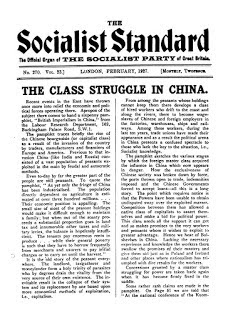
The Class Struggle in China (1927)

Pamphlet Review from the February 1927 issue of the Socialist Standard

Recent events in the East have thrown once more into relief the economic and political forces operating there. Apropos of the subject there comes to hand a sixpenny pamphlet, “British Imperialism in China," from the Labour Research Department, 162, Buckingham Palace Road, S.W.l.

The pamphlet traces briefly the rise of the Chinese bourgeoisie (or capitalist class) as a result of the invasion of the country by traders, manufacturers and financiers of Europe and America. Previous to that invasion China (like India and Russia) consisted of a vast population of peasants exploited in the main by feudal and autocratic methods.

Even to-day by far the greater part of the people are still peasants. To quote the pamphlet, 
  “As yet only the fringe of China has been industrialised. The population directly dependent on agriculture is estimated at over three hundred millions. . . . Their economic position is appalling. The small size of most of the peasant holdings would make it difficult enough to maintain a family; but when out of the scanty proceeds a substantial proportion goes in land tax and innumerable other taxes and military levies, the balance is hopelessly insufficient. The tenants pay enormous rents in produce . . . while their general poverty is such that they have to borrow frequently from merchants and usurers to pay initial charges or to carry on until the harvest.”
It is the old story of the peasant everywhere. The landlord, tax gatherer and moneylender form a holy trinity of parasites who by degrees drain the vitality from the very source of their own existence. The inevitable result is the collapse of their system and its replacement by one based upon more economical methods of exploitation, i.e., capitalism.

From among the peasants whose holdings cannot keep them there develops a class of hired workers who drift to the coast and along the rivers, there to become wage-slaves of Chinese and foreign employers in the factories, warehouses, ships and railways. Among these workers, during the last ten years, trade unions have made their appearance and as a result the political arena in China presents a confused spectacle to those who lack the key to the situation, i.e., Socialist knowledge.

The pamphlet sketches the various stages by which the foreign master class acquired the influence in China which now appears in danger. How the exclusiveness of Chinese society was broken down by force, the ports thrown open to trade, indemnities imposed and the Chinese Governments forced to accept loans—all this is a long story. The point which requires notice is that the Powers have been unable to obtain undisputed sway over the exploited masses. Competition between them has allowed a native class of capitalists to assert themselves and make a bid for political power. This class needs all the support it can get and so makes promises to the very workers and peasants whom it wishes to exploit to greater advantage. Hence we hear of Bolshevism in China. Lacking the necessary experience and knowledge the workers there swallow the promises of their masters and give them aid just as in Poland and Ireland and other places where nationalism has triumphed with dire results for the workers.

Concessions granted by a master class struggling for power are taken back again when it has become firmly fixed in the saddle.

Some rather rash claims are made in the pamphlet. On Page 61 we are told that “At the national conference of the Kuomintang held in February, 1924, a sharp divergence appeared between the right wing representing native merchants and capitalists, and the left wing based on the trade unions and led by Sun Yat Sen. The right wing stood for a nationalist party which should include all classes; the left wing for a revolutionary party . . . with a programme which clearly aimed at destroying the capitalist system. (Italics the present writer’s). The left was victorious."

On Page 59, however, we are told that “The new programme of the Kuomintang ” contains among other items the following! Under the heading of “Economic" “To establish a National Bank for issuing loans at the lowest rate of interest to develop agriculture, industry and commerce." Under the heading "Workers," "To enact labour laws safeguarding the right of labourers to organise and to strike. To limit working hours to fifty-four per week and to establish health and unemployment insurance. To support the workers in the organisation of Consumers' Co-operative Stores." Experience in this and other countries shows that capitalism is quite capable of surviving such "revolutionary" shocks.

In this connection a column of the Manchester Guardian of December 30th, 1926, contains items of interest. It is headed, "Sun Yat Sen’s Gospel,’’ and gives a digest of a book by the late leader of the Chinese Nationalists. Under the heading “Nationalism" (one of the “ three principles of the people "), we are told that “In order to save our country we must first recover the nationalistic spirit!" Under the heading “Democracy," "Our people have had too much personal freedom." "All we can do is to give our people political equality." Finally under "Socialism" (the third principle) we are told that "Before using Socialism as a means to solve our social problems we must first find out the focus of all our problems. Many people in the West have taken material problems as the central point in human history. We must reject that false idea." "None of the forms of Socialism developed in the West are fitted for our country." "Our commerce and industry have not yet been developed. All we need now is to prevent rather than to remedy the evils arising from modern industry and commerce." “Our great and immediate problem is not a fight against capitalists but the prevention of the rise of capitalists in the future. Our method of solving this problem is to develop State industry. Since we do not have enough experience and capital to develop that, it would be wise for us to employ foreign specialists and to borrow foreign capital to help us."

From the above extracts it is fairly clear that the situation is not so simple as our facile pamphleteers would have us believe. On their own showing the economic position in China is such as to make any destruction of capitalism and establishment of Socialism out of the question. That the peasants and small property owners will endeavour to free themselves from the grip of the money-lenders and resist the growth of large capitalists is only to be expected. That, however, is mere reaction, not revolution, while in order to achieve this end they appear to look to the foreign capitalists to assist them ! A case of out of the frying pan into the fire.

In any event it is clear that the workers of China and elsewhere have nothing to gain by supporting either party in this capitalist and property-owners' struggle. The business of the Socialist is to destroy, not to build up the faith of the workers in .Nationalism and the promises of political leaders.

The emancipation of the working class must be the work of the working class itself.
Eric Boden

Monday, January 25, 2016

Does Socialism mean Free Love? (1927)

From the February 1927 issue of the Socialist Standard

A correspondent complains of his inability to understand the attitude of the Socialist Party towards “free love.” The following is an attempt to make matters a little plainer to him and possibly to others.

"Free love” is one of those terms like Atheism, Republicanism, etc., which are used by the professional anti-Socialists as a means of arousing the prejudices of their listeners, or readers, as the case may be, and rendering the calm and intelligent consideration of the subject more difficult on their part. As a rule the anti-Socialist has only to deal with the so-called “Socialist” who supports the Labour Party and who meets his opponent either with a mere denial of their charges or with a retort upon the lines of “You’re another!" For nothing is easier than to show that there are supporters of capitalism, naked and unadorned, who claim to be Atheists, Republicans, Free Lovers, etc. This, of course, merely dodges the issue; but the Socialist Party has, necessarily, something more to say on the subject.

Marriage as we know it to-day is a legal contract whereby the man assumes the responsibility of maintaining the woman and acquires certain rights over her person. The State enforces the terms of the contract where possible, but its ability to do so depends,' in practice, upon the social position of the couple concerned. In the case of members of the capitalist class who possess definite and relatively secure means of livelihood, all is plain sailing. The woman, if necessary, can obtain effective security and the man can proceed for divorce and damages against the usurper of his rights.

In the case of members of the working-class, their economic circumstances alter the position, although in theory the same law applies to all. The working man’s wages are, in numerous cases, quite insufficient for the maintenance of a wife and family, and even where they are sufficient, their permanence is uncertain. Hardly any sections of the workers are free from the haunting menace of unemployment. Under such circumstances it is obvious that the legal regulation of marital relations becomes a mere matter of form. Married or unmarried, the woman of the working-class has to work in order to maintain herself and her children; while the latter are also under the necessity of contributing to the family income as soon as possible.

Modern industry has wiped out the property of the peasants and the handicraftsmen, and has therefore wiped out the economic basis of marriage as far as the workers are concerned. Property and security are concentrated in the hands of the capitalist class, and as a consequence it is only among them that the legal contract retains its meaning. This, of course, does not prevent the religious and moral sentiments associated with the institution continuing to influence the minds of the workers.

Just as the workers accept the guidance of their masters in the political sphere, so in the realm of domestic life it is left to the Socialist to strip the veil of illusion from the hideous reality.

The parsons, and other hirelings of Capital, pretend that marriage is necessary for the protection of women. They have never yet explained, however, how it is that thousands of women of the working-class, married and unmarried, have had recourse to some form or other of prostitution in order to supplement their inadequate earnings or to escape for a time from the foul and squalid environment in which they have found themselves entrapped. Nor have they shown how the institution of marriage helps the girl who is confronted with the unwelcome attentions of her foreman, manager or other superior who holds her livelihood in his hands.

Sexual servitude is, in fact, but one of the inevitable aspects of the servitude of a class. Its form has changed with the changing of the forms of society. The feudal knights of the Middle Ages who played the part of gallants towards the women of their own class regarded the womenfolk of their serfs as legitimate prey. The patriarchs of ancient times were not content with numerous wives, but took to themselves concubines from among their slaves.

These various forms of sexual relationship | took their rise from the property basis of society prevailing at the time. In more primitive times, however, before property had developed and assumed basic importance, other forms of the relationship existed in which women enjoyed a position of equality. Morgan, in his “Ancient Society,” for example, has shown how the institution of marriage arose and developed along with the changing conditions of obtaining a livelihood.

The effect which the social revolution will have upon marriage can, of course, only be dealt with in a general way. We are not prophets and do not profess to know just exactly how the men and women of the future will order their lives. It is not for slaves to make plans in advance for those who will be free.

This much, however, is plain. When the means of life become the common property of society, every individual will enjoy economic security which they will inherit from society as a whole. The present-day dependence of individuals upon others for their subsistence will disappear. As a consequence, the relationship between the sexes and between parents and children can then only be based upon mutual feeling.

We can, therefore, only surmise that the legal contract will vanish along with the economic necessity upon which it is based. The distinction between married and unmarried mothers or between legitimate and illegitimate children will simply become meaningless, along with all other distinctions which arise from the institution of private property.

Socialism, in short, will provide for the free development of each and all. 
Eric Boden


Tuesday, June 16, 2015

Scottish Home Rule. (1927)

From the February 1927 issue of the Socialist Standard

One of the favourite futilities of the Clyde group of Labour M.P.s is to advocate Scottish independence. It has never been explained in what way capitalism administered by Scots from Edinburgh will be better for Scotch workers than capitalism administered from London. Mr. Kirkwood has, however, now learned by experience that it may even be worse.

At an Independent Labour Party meeting in Edinburgh he spoke as follows: -

Referring to a deputation to the Secretary of State for Scotland on behalf of the starving children of Dunbartonshire, he said "the officials of the Scottish Office were harder to deal with than those of the English Office."—Manchester Guardian, January 15th.

The simple truth is that capitalism will be just the same as far as the working class are concerned. What is required is another system of society, not new administrators for the old one.