In March this year
Michael Kidron, a former editor of
International Socialism, the theoretical magazine of the group of the same name that later became the Socialist Workers Party, died. In an obituary published in
Socialist Review in April, Tony Cliff’s successor as leader of the SWP, Chris Harman, described Kidron as “probably the most important Marxist economist of his generation”. This is a gross exaggeration, even if Kidron does have a minor place in the history of the ideas discussed amongst Marxists for the explanation he offered for the period of capitalist expansion that followed the Second World War as being due to government spending on arms.
Kidron first expounded his ideas in an article in 1967, then incorporated them into his most widely read book Western Capitalism Since the War, published the following year. Although he can’t really have thought that this period of expansion would go on for ever, he still chose to call his theory “the permanent arms economy”. We in the Socialist Party never accepted this as an explanation for the post-war boom and, as the columns of the Socialist Standard in the 1960s bear witness, were severely critical of it. As it happened, within five years of the publication of his book, events were to prove Kidron wrong and us right. The post-war boom came to an end in 1973, despite arms spending continuing at previous levels, thus ruling it out as an explanation both for the boom and its eventual end.
Our main opposition to Kidron’s theory was that it set out to explain a non-existent problem: why capitalism’s supposed built-in tendency to collapse into permanent slump and stagnation did not manifest itself after the war. In 1932—in the middle of the great depression of the Thirties—the Socialist Party published a pamphlet
Why Capitalism Will Not Collapse which we regard as one of our contributions to Marxian economic theory. The argument put forward in this pamphlet was that, while capitalism was an unstable system in the sense that economic activity under it proceeded in fits and starts, constantly swinging between booms and slumps, there was no reason to conclude that it had some economic flaw that would cause it to some day break down permanently. No slump would be permanent, because a slump itself sooner or later created the economic conditions for a subsequent recovery. Capitalism would not collapse of its own accord; it would have to be done to death, by the conscious political action of the working class.
At the time there were others who took a different view: either that capitalism was in the process of collapsing because productive capacity had come to permanently outstrip paying demand (underconsumptionism) or because the rate of profit had irreversibly fallen to too low a level.
The Thirties depression was followed by the Second World War, which both schools of collapsists saw, for different reasons, as a direct consequence of the slump and the only way out of it under capitalism. Most of those placing themselves in the Marxist tradition (including, if the truth be told, ourselves) thought that the war would be followed by another slump, just as the First World War had been. It wasn’t. In fact, it was followed by a long period of expansion punctuated only by relatively minor recessions. How was this to be explained?
We tended to explain it in terms of the specific facts of the period, such as post-war reconstruction and the expansion of the world market through the lowering of trade barriers. The Keynesians claimed that it was due to government intervention to manage the economy on the lines their founder had advocated. The collapsists had to think up a reason why the tendency to collapse into permanent slump and stagnation that they felt was built-in to capitalism had failed to operate. One such explanation was the “permanent war economy”. The underconsumptionists argued that it was government spending on “defence” that had made up for the supposed chronic lack of purchasing power. But arms spending was also offered, strangely, as an explanation by the fallen-rate-of-profit school.
It fell to Kidron to explain, on behalf of the Trotskyoid group to which he belonged (Tony Cliff’s), precisely how state spending on arms offset and even overcame the supposed tendency for capitalism to collapse due to the rate of profit falling to too low a level. Since the state had to obtain the money to spend on arms through taxes which ultimately fell on capitalist profits and other property incomes this theory was counter-intuitive, and so Kidron’s arguments had to be pretty tortuous.
In his article,
“A Permanent Arms Economy”, which appeared in
International Socialism 28 (Spring 1967), and which is trumpeted by the SWP to this day, Kidron started from a collapsist position:
“Common to most explanations of western capitalism’s stability and growth since the war is the assumption that the system would collapse into over-production and unemployment were it not for some special offsetting factor… This article shares the assumption”.
He went on to argue that the special offsetting mechanism was “a permanent arms budget”. His basic thesis was that, in government arms spending, capitalism had found a way of engineering growth without this leading to the drastic fall in the rate of profit that he believed, on a misreading of Marx, should normally have occurred. Government spending on arms constituted “a net addition to the market for consumer or ‘end’ goods” while, on the supply side, arms production, as non-productive consumption, was “the key, and seemingly permanent, offset to the tendency of the rate of profit to fall”.
Marx’s argument on the rate of profit had been different: that, since living labour is the sole source of profit, if it falls as a proportion of total capital, then, mathematically, the ratio of profit to total capital, i.e. the rate of profit, will also fall, unless offset by other factors. Marx was in fact aware that there would always be such ‘other factors’, so that for him any tendency for the rate of profit to fall for this reason would only be a very long-run and by no means continuous tendency.
That the capitalist market had expanded since the end of the war was an undeniable fact. The question was whether or not this was due to government spending on arms. The Keynesians argued that it was due to government spending as such, whether on arms or anything else. On the other hand, some economists were beginning to realise that the Keynesian argument that the post-war expansion had been caused by government spending was not true: the world market was expanding anyway due to other factors. Thus the Socialist Standard noted in November 1971, in an article “The End of Full Employment”:
“An examination of the causes of low post-war unemployment in Britain was made by Professor R. C. O. Matthews, himself broadly a supporter of Keynes, and published in the Economic Journal (September 1968). His conclusion was that, starting with the stimulus given by making good war damage of all kinds, a major cause was a prolonged investment boom and that ‘the decline of unemployment as compared with 1914 is to a large extent not a Keynesian phenomenon at all’”.
In seeing a species of government spending as having saved capitalism from its supposed tendency to collapse, Kidron had placed himself within the Keynesian framework. Which is why the theory of the “permanent arms economy” is better seen as a Leftwing Keynesian rather than a Marxist theory, as in fact Kidron himself was later to recognise (this theory has been revived today under the more accurate name of “military Keynesianism”). Kidron therefore had to face fellow Labour Party reformists (he, along with Cliff, was a paid-up member of the Labour Party at this time) who, basing themselves on Keynes, argued that a “permanent social reform budget”, with government spending on housing, education, hospitals, pensions, etc., would have the same effect.
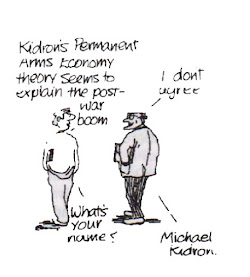 |
| Cartoon by Phil Evans from ‘More years of the Locust’ |
Kidron conceded that this was theoretically possible, but argued that this was not going to happen since any state that did this would put itself at a competitive disadvantage, as it would be diverting profits from being reinvested in the more efficient and up-to-date machinery and methods of production that would allow production costs to be reduced. This was true, and is in fact one reason why reformism within the framework of a single national state is never going to work. But it equally applies to state arms spending. This, too, is a diversion from productive investment that places states which spend more than average on it at a competitive disadvantage.
Kidron tried to get round this by arguing that arms spending was different from spending on social reforms in that, if one state spent more on arms, other states were forced to follow suit, so that none of them would be at a particular disadvantage. But he never could explain satisfactorily why this should be. While it was clear that America and Russia, struggling for world domination, were involved in an arms race, and that states like Britain and France that had pretensions about playing a world role had made a political decision to spend more on arms, there was no reason why all states should get into an arms race with each other. In fact, Germany and Japan did not spend the same proportion on arms as America, Britain and France, which gave them a competitive advantage and led to them being the “economic miracles” of that period; a fact we employed at the time to help us expose the fallacious theory of “the permanent arms economy”.
Today, the SWP likes to claim that the theory of the “permanent arms economy” did not imply that capitalism had found a permanent way of avoiding big slumps, but there was nothing Kidron wrote in the 1960s that suggested that the post-war boom he then believed had been caused by arms spending was going to come to an end in the 1970s. This was something added after the post-war boom had finally come to an end in 1973 (thus proving the theory wrong)—and it was added by Cliff and Harman not Kidron himself. By 1977 Kidron had come to recognise that he had been wrong to attribute the post-war boom to government arms spending; he now attributed it to the emergence in the West of “state capitalism”, by which he meant the state acting as a single national capital. And he concluded by admitting what we had always argued, that state spending on arms was a burden on capitalist expansion not a stimulant to it:
“ . . . it is hard to sustain the view that it was the permanent arms economy that fuelled the long boom. On the contrary, such expenditure must have worked towards stagnation. And if in reality heavy spending on arms coincided with an unprecedented expansion of capital, it can only be because the effects of arms spending were overpowered by the effects of something much more fundamental.” (“Two Insights Don’t Make a Theory”) .
So, in the end, Kidron did redeem himself from going down in history as a simple Leftwing Keynesian. The same cannot be said of IS and its successor, the SWP, which still clings to this discredited theory.
Adam Buick
Blogger's Note:
Kidron's
Western Capitalism Since the War was reviewed in the
October 1968 issue of the
Socialist Standard.


