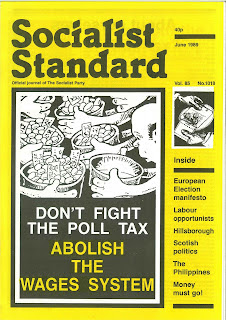
From the April 1986 issue of the Socialist Standard
It is tempting in politics to see things in stark black and white terms: if a regime is obviously "bad" then those who oppose it are necessarily "good". This tendency to reduce complex situations to simplistic terms has nowhere been more evident in recent times than in the Philippines. Marcos was so evidently "bad" that Aquino must be "good".
The Philippines is a cluster of islands in the Pacific Ocean with a total population of 54 million. Formerly an American colony, it achieved independence in 1946 although the United States maintained strong economic and military ties with the new state. Immediately after independence the Philippines was ruled by a coterie of the landed aristocracy. Ferdinand Marcos was elected in the mid '60s when he was seen as a radical, reforming politician, especially by progressive industrialists and businessmen. He received considerable support from the Americans, who were at this time extending their war in Vietnam and therefore concerned to maintain a strategically important foothold in the area. Although Marcos did not keep his election promises he secured re-election in 1969 and began to develop what came to be known as "crony capitalism", members of his own family, business associates and political supporters were granted favours and allowed to build up monopolies at the expense of economic efficiency. At the same time Marcos installed his own supporters at all levels of government and administration.
Under the terms of the constitution Marcos was ineligible for a third term as President, and so he decided to abandon any pretence of democratic government. In 1972 martial law was imposed and justified by the need to deal with armed rebellion by the "communist" New People's Army (NPA). Marcos continued to rule in this way for a further nine years, during which time opposition politicians (including
Benigno Aquino) were arrested and imprisoned. Torture and inhumane treatment of those deemed subversive became common. In 1981 martial law was lifted and Marcos secured re-election for a further six year term.
By this time, however, his failure to implement the promised reforms, the evidence of economic and political corruption and mismanagement and the inhumane treatment of political opponents had lost him the support of many industrialists and professionals who had backed him in the 1960s. Increasingly he was forced to turn to the Americans, who were willing to ignore his corruption and human rights violations so long as their bases in the Philippines were secure. However, as opposition increased and the NPA began to attract popular support, American backing began to weaken.
This year, Marcos called a snap election in the hope that he could demonstrate to the Americans that he still commanded popular support. He had, however, under-estimated the degree to which the previously fragmented opposition groups had united after the assassination of Benigno Aquino on his return from exile in the United States, and the subsequent acquittal of leading members of the army elite who, it was widely assumed, were guilty of his murder. The opposition united behind Corazon Aquino, widow of Benigno Aquino, whose lack of political experience and aspiration was viewed as positively advantageous. A devout Catholic, she also had the support of at least the most conservative elements of the immensely powerful Catholic hierarchy, who deplored what they saw as the moral degeneracy of Marcos and his wife, Imelda.
While Cardinal Sin, the leader of the Catholic church, called for divine intervention to ensure a free and fair election, Marcos relied on the physical activities of his political henchmen: ballot boxes were stolen, voters intimidated, Aquino supporters subjected to physical violence and, finally, attempts were made to "cook" the voting figures. It was becoming obvious that Marcos' final political gamble had not paid off, but the American government was still unwilling to give him the "kiss of death''. Clearly concerned over the fate of their bases and unsure to what extent Aquino would protect their interests, they were unwilling to declare the election fraudulent. In fact Reagan pathetically asserted to a press conference that there had probably been an element of fraud on both sides.
By now sections of the army had staged a rebellion and Aquino returned to Manila and called for a campaign of civil disobedience. The Americans sent an envoy, Philip Habib, to discover what they might expect from Aquino and, having got a satisfactory response, decided to cut their losses and run. Marcos and his family were "advised" to leave, which they did with gold worth $240,000 and crates containing $1,179,000 in cash.
As the new President, Cory Aquino is unlikely to have an easy task. Although the opposition was united against Marcos it is doubtful whether Aquino has a political programme which can hold together all the different factions. Indeed, the mere announcement of her cabinet was sufficient to threaten the political marriage of convenience between herself and her Vice-President, Prime Minister designate and Foreign Minister, Salvador Laurel. Laurel had originally stood as a presidential candidate for his Unido party, but was persuaded to join forces with Aquino so as not to split the anti-Marcos opposition. However, in the post-election carve-up of political jobs it was felt that Unido was not being given sufficient recognition.
Laurel is by no means the only problem that Aquino faces from within her own ranks. She came to power on the back of what was called "People Power" — a populist desire for changes not dissimilar to those pledged by Marcos in the '60s. She promised land reform — the majority of Filipinos are poor, landless peasants who work for subsistence wages on large plantations, provision of agricultural support schemes to permit small-scale peasant farms to be developed, an end to "crony capitalism", and to seek more favourable terms for the Philippines' $26-30 million international debt.
The problem for Aquino is that she has promised what she almost certainly cannot "deliver". She will need to negotiate loans from the lMF, who will probably demand curbs on public expenditure in return, thus restricting her ability to offer much in the way of support for peasant farms. Her ability to control the direction of economic reconstruction is also likely to be hampered by the fact that much of Philippine industry is owned by American multi-nationals, which have been only too happy to exploit cheap domestic labour. If Aquino fulfills her promise to free the trade unions from the draconian controls imposed in the Marcos years, then there is also the likelihood that cheap labour will become organised labour engaged in industrial action against low wages and poor working conditions. If that occurs the multinationals may decide that Filipino labour power is no longer such a bargain and move their operations elsewhere.
Politically, Aquino faces opposition not only from Laurel's Unido faction but also from the New People's Army, which has been waging a guerrilla war in an attempt to bring about a state-capitalist, anti-American regime. So far she has sought to placate them (to the alarm of the Americans who fear that Aquino may turn out to be "soft" on communism) by releasing those held as political prisoners. But if Aquino does not move fast enough in the direction of land reform and the removal of the American bases, they may step up their activity once more.
The American bases — Clark airfield and Subic Bay — are crucial to an understanding of contemporary Filipino politics. At a time when the Russians are thought to be developing their bases in Vietnam — at Cam Ranh bay (ironically a former US base) and in North Korea at Wosan — the Americans are anxious to retain their strategic foothold in the Philippines. This has become even more pressing given that their other allies in the area are beginning to look less secure there is increasing opposition to the authoritarian, American-backed dictatorship in South Korea; tension exists between America and Japan over trade (in any case, there is no way that Japan would permit strategic, offensive US bases in the country); and controversy with Australia and New Zealand over harbour rights for American ships carrying nuclear weapons. Aquino could placate the NPA by not renewing the lease for the American bases which expires in 1991, but this is unlikely given the strength of the opposition and the economic sanctions that this would inevitably provoke from the Americans.
Aquino's government is also likely to be pulled in opposite directions by the National Democratic Front — an illegal confederation of radical clergy, left-wing trade unions, students and single issue groups, and reformist businessmen and church moderates like Cardinal Sin who played an important part in bringing Aquino to power.
Finally, Aquino faces opposition from the rump of loyal Marcos supporters who still hold crucial positions in the judiciary, civil service and local government. It will not be easy to replace such officials quickly and in the meantime they are weIl-placed to sabotage attempts to introduce reforms. It should also be remembered that the Philippines parliament contains two-thirds Marcos supporters who are in power until 1990. The army, too, remains a problem for the new President: the "rebels" — Enrile and Ramos — were both architects of martial law. Enrile worked for Marcos for twenty years, and although Ramos is depicted as the new "professional" soldier who finally lost patience with corrupt political appointees in the army (notably Marcos' right-hand man, General Ver), in fact he was head of the Philippines constabulary — notorious for atrocities like the shooting of 18 sugar cane workers on a plantation in Negros last September. Both men have nevertheless been incorporated into the new administration.
The Aquino family owns one of the world's largest sugar cane plantations and is part of the landed aristocracy that has dominated Filipino politics since independence. While the new President enthuses about "People's Power", it is significant that her cabinet contains not one single representative of "the people" — they are all businessmen and members of the political elite. Her regime may be more humane but, given her commitment to capitalism, the free market and private property, any hopes that the lot of the majority will improve should soon prove to be misplaced. And if, having flexed their political muscle once, "the people" realise that Aquino cannot deliver the reforms and decide to flex it again, it will be interesting to see how long she retains her political innocence. Among capitalist politicians "Peoples Power" is supported so long as it is tending in their direction; if it is not, it is just as likely to be condemned as subversion.
Janie Percy-Smith