Showing posts with label Low Pay. Show all posts

Friday, October 31, 2025

Children in labour (1988)

From the October 1988 issue of the Socialist Standard

The traditional view of child labour is summed up in a Low Pay Unit pamphlet:
"Child Labour" conjures up images of the pauper apprentices of Tudor times and the rag and dust sifters and mill children of the early industrial revolution. Its heyday was during the late eighteenth and early nineteenth centuries, when industrialisation drew upon the labour of children in new and more wholesome ways than had been customary in the family economy of earlier years.
(Working Children 1985)
Newspaper reports in recent years however. suggest that child labour is neither a thing of the past nor confined to delivering newspapers, baby sitting or similar chores normally associated with children's work. "Scandal of pin money Pupils'' was the headline in the Daily Express on 12 December 1977; "Slave Labour ", screamed the Daily Mirror, 20 October 1982. In April 1973 The Times reported that three schoolboys, all aged thirteen, were employed in a factory operating highly dangerous, defective power presses for 17 pence an hour.

Child labour does of course have a long history. In an agrarian economy, where there was no distinction between employment in the home and other labour, men, women and children each had a task to perform tending crops and providing for everyday necessities. Children also played a role in industrial labour. The daughters and sons of artisans frequently helped in the manufacturing process or were apprenticed in the trade of their parents. Children of weavers had a staged career of tasks given to them according to their age and abilities, ranging from fetching and carrying to treading cotton, winding bobbins and spinning. Life for these children was hard and often involved long hours of work.

In the late sixteenth century children orphaned due to the death or poverty of their parents became the responsibility of the parish in which they lived. A system arose of apprenticing orphans to local craftsmen or placing them in special workshops to learn a trade. This was administered by local justices whose main concern was to rid the parish of any unwanted burden. The treatment of orphans varied from employer to employer but cases of cruelty and sadism were not unknown.

With the coming of the industrial revolution the parish workshops evolved into factories and the exploitation of children as slave labour was common. The practice of apprenticing orphans continued as late as the 1840s, when boards of guardians in Staffordshire, Yorkshire and Lancashire were found to be
. . . still getting rid of pauper boys of six. seven and eight by apprenticing them to colliers with a guinea thrown in "for clothes".
(E.P. Thompson: The Making of the English Working Class)
Child labour in modern times is seen as one of the unacceptable features of capitalism. Apologists for the system moralise about it but at the same time seek to convince us that a society in which a majority are economically coerced and treated as mere factors in the profit-making machine is the best the human race can hope to achieve. Workers are employed because they produce an economic surplus over and above their wages, which are inevitably very low for a large section of the workforce. According to the Low Pay Unit, figures for April 1986 show that 17 per cent of full-time workers were being paid less than £2.40 an hour, while over a third were receiving less than £3.00. Of the women who work part-time, 50 per cent were earning less than £2.40 an hour and 75 per cent received less than £3.00 an hour. In total, around 2 million women part-time workers and 1.6 million full-time workers. both men and women, received less than £2.40 an hour, including overtime pay. (Low Pay Unit: Britain's False Economy. 1987.)

When confronted by the exploitation of child labour socialists reply that the only answer is to end the system where a majority of men. women and, in many cases, children are treated as economic units. This can only be done by establishing, by democratic political means, a world-wide system where the means of production are owned in common and production takes place solely to meet the people's needs. In such a society the exploitation endemic in employment will be replaced by voluntary co-operation to produce the things people have democratically decided they need. All will have the right to take part in decisions about what is to be produced and how production is organised. Let's take a look at what the alternative — doing "something now" — has achieved in the last 180 years in the area of child labour.

One of the earliest pieces of legislation was the 1802 Health and Morale of Apprentices Act. Its aim was to limit children's working hours and its main concern was with pauper apprentices. It sought to abolish night work and limited the working day of apprentices in cotton mills to twelve hours. There were also provisions made for school on Sunday and proper clothing and sleeping arrangements. [To]  make sure that employers complied with the act, four independent factory inspectors were appointed to enforce the law among the 3,000 textile manufacturing establishments of the time.

Apart from the low standards set by the act, its major flaw was that enforcement depended on magistrates who were in most cases mill owners themselves. Similar problems affected another act passed in 1819 and sponsored by Sir Robert Peel, which outlawed employment in cotton mills for children under the age of nine. As it had no independent inspectorate it was largely ignored by mill owners.

Next came the Factory Act of 1833, which was based on the evidence of the Sadler Committee of 1832 and the Factory Commission of 1833. It outlawed the employment in all textile factories of children under the age of nine; between nine and thirteen no child was allowed to work more than 48 hours a week; for those aged thirteen to eighteen the limit was sixty-nine hours and anyone under twenty one years was prohibited from night work. Such was the concern to [missing text]

In 1840 a further factory commission investigated employment in the mines, discovering even worse conditions than those existing in the mills. Small children were used to operate ventilation traps which involved sitting in the dark, sometimes thirteen to fourteen hours. Other children were used to hurry coal down shafts, pushing great loads for miles with their heads while bent double. Soon after the commission published its report in 1842, the Mines Act was passed which prohibited the employment underground of children under ten and women. It also restricted the number of hours and types of work performed by children.

An important turning point in controlling child employment came with the Elementary Education Act of 1870. This provided elementary education on a national basis and set up an administration system of local school boards to keep track of attendance. The 1880 Education Act made school attendance compulsory for the first time and a child could only leave school at ten if he or she satisfied the attendance requirements. Children with poor attendance records were not allowed to leave until the age of thirteen. Prior to the 1880 act. the Factory and Workshops Act of 1878 had extended the 1833 Act to all factories and raised the minimum age of employment to ten. which also limited the hours children under fourteen could work to half the normal working day.

In 1920 the International Labour Organisation and the League of Nations met in Washington to draw up a convention on the employment of children binding on all ratifying nations. In Britain it was embodied in the Employment of Women. Young Persons and Children Act of 1920, which tied together past legislation and provided a list of types of employment which were prohibited to children under a minimum working age.

Subsequent acts such as the Children and Young Persons Act, 1933, the Factory Act of 1961 and the Infants Children and Young Persons Act. 1963 form the basis of modern child labour law. The most important aspects of these acts are the prohibition of child employment in industrial undertakings, a minimum age of thirteen for part-time employment, restrictions on hour and times of work done by children and the provision for local authority bye-laws which can set higher standards than the minimum requirements. There exists a wide variation between local authorities as to the extent of provisions under these bye-laws and the degree of care that is taken to see that they are enforced.

As with the nineteenth century act the major problem with more recent legislation concerns enforcement, responsibility for which falls mainly on three bodies — the Health and Safety Inspectorate. Local Authority Health Officers and the Education Welfare services. All of these bodies have other tasks apart from discovering the illegal employment of children and all are massively understaffed. It is estimated that the Health and Safety Inspectorate has only 750 general factory inspectors to cover 730,000 manufacturing establishments. Much of the education and welfare surveillance work on child labour is done by educational welfare officers through voluntary overtime, patrolling the streets outside normal hours of work.

Due to this understaffing routine inspections are more frequent in large firms or those where the risk of accident is considered high (for example, chemical plants). Less visible firms may never see a factory inspector. As a result "back street firms" — most likely to employ child labour illegally are least likely to be visited. In addition, educational welfare staff have no specific right of entry. As the Inner London Education Authority states:
The more serious kinds of illegal employment in factories, restaurants and building sites tend not to be detected because educational welfare staff have no specific right of entry.
(Working Children, pp. 12-13)
In 1973 an attempt was made to reduce the uncertainty surrounding the legal protection given to working children. The Employment of Children Act received the Royal Assent on 23 May of that year but as yet it still remains on the statute book and has never been fully implemented.

It is therefore not surprising that child labour is still widespread in modern Britain. A survey carried out by the Low Pay Unit and Open University in 1982-3 estimates its extent. Interviews of 1,700 children in the London, Luton and Bedfordshire areas found that, apart from newspaper delivering, children were employed in a wide range of jobs including retailing, catering and cleaning. Close to one in ten children in the survey had more than one job and half of these had more than two. While newspaper delivery accounted for one third of all children working, shop work accounted for one in five and farm work and cleaning both accounted for 13 per cent. A variety of other work performed by children included hotel and catering. painting and decorating, sewing machining. modelling, clerical work and work in street markets. More than one in five children were employed in manual jobs, cleaning, furniture removals, construction labour and garage work. The findings confirm that a majority of these children were in one way or another working illegally. An analysis of the data for London found that four out of five were illegally employed, either under age, working illegal hours or working in jobs they should not have been doing.

It does not require a degree in economics to appreciate that children are forced to work because of the financial position of their families. The survey indicated that there was a definite relationship between the socio-economic position of the families and child labour. The highest proportion of working children in the survey were from manual working class backgrounds (51 per cent) and the unemployed (52 per cent).

Neither is it any mystery why employers use child labour. It is of course a source of cheap and easily disposable labour power and savings can be made not only directly on wages but also indirectly. Children are invariably paid "cash in hand", do not appear on employers’ records and therefore are not subject to national insurance contributions. They are not members of a trade union even where the company is unionised. Neither have they any of the rights of adult workers, such as the right to claim unfair dismissal, the right to an itemised pay slip and, as they pay no national insurance, they have no right to sick pay. Furthermore they are not classified as employees under the Health and Safety at Work Act. If injured at work children have no right to compensation unless their parents can prove in court that the employer has been negligent in some respect. Since most children are employed illegally, taking such cases to court could result in the parents being deemed parties to such negligence.

Despite the large number of health and safety regulations applying to the employment of children, a large minority of those surveyed reported having accidents while in their current jobs. One third of all boys and 29 per cent of girls reported some accident or injury. The main causes were heavy weights, broken glass, slipping or falling and injuries from materials and machinery. Of all the children at work only 19 per cent of boys and 18 per cent of girls were given uniforms or any kind of protective clothing by their employers.

Apart from accidents, the health of working children suffers in other ways. In 1970 a group of teachers in Tynemouth conducted a survey of pupils to discover why so many were falling asleep in class. They discovered that of the 390 interviewed over one third were working illegally and many of them were being grossly overworked and underpaid. As the Low Pay Unit pamphlet suggests, these findings illustrate the fallacy of the view that employment is good for children's health and education. An official of the National Association of School Masters stated:
Children are late to school, fail to do their homework, fall asleep during lessons and are unable to take part in any out of school activities such as sports because they have to report to work.
(Working Children, p.32)
The exploitative use of child labour is not a thing of the distant past. Reform via legislation has failed. The enactment of new laws may give the illusion that something is being done but this is merely a surface appearance; the problem remains because its root cause has not been treated. Doing something now may sound appealing but the reality is that nothing changes because a system unfit for men. women and children remains firmly in operation.
Ray Carr


Blogger's Note:
Sadly, the original text was garbled in places. It looks like there was a typesetting/proof-reading mishap. I couldn't see any notices of corrections in later Standards.

Saturday, September 14, 2024

Running Commentary: Myths of equality (1981)

The Running Commentary Column from the September 1981 issue of the Socialist Standard

Myths of equality

Do not believe the common myth that we are no longer living in a class-divided society. Class is not about being “classy”. It is not something you can take on or reject. While there is still the institution of property in human society we are all born into families who either do or do not possess it. The Low Pay Unit has just produced Low Pay Review 4, which shows that the lowest paid workers today are relatively worse off than the lowest paid in 1886, when figures were first collected. More wealth is produced today than a century ago, but those who are born to no property and are therefore forced to go out and work, producing that wealth, now receive proportionately less of it.

Mr. Chris Pond, director of the Low Pay Unit, comments: “The government’s assertion that workers could protect their jobs by cutting wages is a cruel deception. It is in those industries in which wages have fallen furthest, precisely because of the reduction in demand for the goods and services produced, that have faced the biggest job losses” (Guardian, 2/6/81). And do not forget the Royal Commission on the Distribution of Income and Wealth, which reported in 1979 (after five years of Labour government) that the richest one per cent in Britain own more wealth than the poorer eighty per cent.

Against this background, which is based on a minority class owning stocks and shares and other property, and deriving a vast unearned income from employing the rest of us, the “European Socialists” tell us to pull in our belts still further. On 28 April this year, an Amsterdam conference of the “Socialist International” agreed unanimously that “the time had come to promote wage controls firmly linked to economic democracy” (Guardian, 29/4/81).

Are you trying to escape from this wage-slavery which is imposed upon us? The Pearl Assurance Company has recently been advertising what they call the Capital Accumulator Plan. Basically, this means workers struggling to save up their hard-earned cash for them to spend on a few trinkets just before they die. We can be sure than Pearl shareholders, among others, will be profiting from the process.

But don’t they know there is a far more reliable “Capital Accumulator Plan”? It works like this. You inherit a few million pounds (be sure to choose the right parents) or, perhaps rob a few banks (be sure not to be caught and incarcerated). Then you employ (exploit) a few thousand workers (who chose the wrong parents) and accumulate a few million more. At the moment, there are dozens of annual Company reports being published which illustrate the process. Just take one example. Mothcrcare. Profit after tax: £8,634,000. Earnings per share: 13.39p. Dividends per share: 5p. Mr. S. Zilkha and Mr. E. Zilkha, both on the Board, have between them 11,478,776 shares. Their dividend will be £573,938.80. Their earnings will be £1,537,008. They are not employees, they are owners. They do not produce, they possess. “Profit per employee” is declared to be £4,422 for the year. Each worker, then, was paid just enough to keep them fit to work, and produced about as much again on top for the benefit of their masters. That is what is known as “Civilisation”.


Take power

The Child Poverty Action Group has produced a report. Poor and Powerless, showing how the gas or electricity is being cut off in more than 770 households each day because the families concerned cannot afford to pay the bills. This is in spite of the fuel industry’s Code of Practice introduced in 1976 supposedly to reduce the hardship of those very people. The reductions in the real value of child benefit, unemployment benefit, sickness and industrial injury, and maternity benefits together with cuts in the real value of wages, have contributed to worsen the situation since the onset of depression, For example, [ . . . ] disconnected 37,648 people last year, more than three times as many as in 1978. The report quotes particular cases, such as one low-paid family of six children, one of whom had just been discharged from hospital after a bone marrow operation, who were cut off for a gas debt of £17.

The piecemeal suggestions of the CPAG, such as forcing the fuel industries to obtain court orders for such cases, or raising benefits to low-income families, will not remove the problem. As long as people are dependent on employers or the state for a meagre income, poverty will remain an integral aspect of society. Only in a classless society, where everything is owned in common, and resources are freely available to all, will we be able to feel properly secure. As long as the profit system is retained, workers’ living standards will be cut down to the minimum that the employers can get away with it.

American fuel companies have a mechanism called a service limiter adapter. In most parts of America, it is illegal to cut off consumers’ power supplies, so they have found this simple way round it. The adapter can reduce the supply in varying degrees, so that particular appliances cease to function one by one. One New York official has said: “The great attraction is that defaulters face an uncomfortable time without lives being put at risk in freezing weather conditions”.


Sick society

The Office of Health Economics have reported that work days lost through sickness for March 1981 are 21 per cent below the average for the same month over the past four years. The drop coincides with a one million rise in unemployment and the report suggests that high unemployment has made people so afraid of losing their jobs that they may be going to work even when ill.

If not, however, perhaps they can become ill once they get there. The CBI, the Chemical Industries Association and the Association of British Pharmaceutical Industries have mounted a vigorous campaign against proposed regulations to protect workers from dangerous chemicals. Section Six of the Health and Safety at Work Act, if it is passed, would prescribe the testing of certain chemicals used in industry, such as Dioxin, used in pesticides, which causes miscarriages and deformed births. “Tightening controls will involve the chemical and pharmaceutical industries in added cost, and this is the core of their objection” (Guardian, 10/8/81). In a confidential memo to members in June, the CBI stated: “CBI is likely to challenge the philosophy underlying the new controls . . . Industry has consistently opposed over-regulation and unnecessary bureaucratic controls by governments in the field of harmful substances”.

In a society of common ownership, production would be solely to satisfy human needs, and not for the profit of a minority. Under democratic control, work can become a pleasure in itself. But when it is owned and controlled by the likes of the CBI, the slogan is wealth before health.


Housing

Speaking of wealth, the Daily Mail did an interesting profile of Michael Heseltine on 17 July. It showed how the man who was sent to Liverpool to work out for his Prime Minister the puzzle of why people living in slums are frustrated, has four houses himself. One in Belgravia, worth £600,000, a country estate in Oxfordshire worth £750,000, a £100,000 “hideaway” in Exford, and a smaller place in Swansea, “not for personal occupation”.

He took some of his fellow capitalists on a bus-trip round Liverpool to see how the other sort live, and to work out how to buy off their discontent. The same issue of the Daily Mail reported on the court case involving Per Hegard, the “man who could buy everything”. His ownership of several companies allows him to live off the work of thousands, riding on their misery. He has six Rolls Royce cars, three yachts, two jet planes, half a dozen mansions and a £15,000 cigar bill.

Those who work to create Hegard wealth for him have least and suffer most, and it is in defence of the property of such people that millions die in wars fought over the control of markets; and his grasping need for profit causes pollution, industrial danger, poverty, destruction and waste.

The World Bank's World Development Report for 1981 refers to the millions living and dying in extreme poverty, and contains two predictions, one “optimistic” and the other less so. The optimistic forecast is that by the end of the century the number on the verge of starvation will fall from 750 million to 630 million. On the other hand, they say, it may rise to 850 million. But it is in our hands to make it fall to nought immediately, and to end all poverty and war, if we combine to end the profit system and create a community where wealth is produced freely for direct use according to needs.
Clifford Slapper

Wednesday, October 25, 2023

The Great 
Minimum Wage Swindle (1995)

From the October 1995 issue of the Socialist Standard
The Labour Party's support for the concept of a minimum 
wage is not based on its concern for low-paid workers, in fact, Labour's real aim is to cut the expenditure, in the form of 
benefits, of the capitalist state it hopes to inherit.
The Labour Party went into the 1992 general election committed to introducing a legally enforced national minimum wage which, they said, would eventually amount to two-thirds of the level below which half all wage and salary earners fall (or the “median wage”, as the statisticians call it):
“Labour will introduce a national legal minimum hourly wage, starting at a level of 50 per cent of the mid-point of men's earnings (the median) . . . Four million people will benefit form this minimum wage. Over time, Labour will increase the minimum wage as a proportion of earnings to a point where no-one is paid less than two-thirds of the median male hourly rate ” (Looking to the Future, 1990, p. 37).
In today’s money this would give an hourly rate of about £5.50, or a minimum wage for a 39-hour week of £214.50, or over £ 11,000 a year. Of course there was never any chance that this was going to happen. You can’t legislate into being wage increases of this order, amounting in some cases to over 50 percent. Capitalism just does not work that way. Its economic mechanism responds not to government decrees but the realities of profit-making in competitive markets. The government could indeed pass a law aimed at ordering employers to pay a minimum wage at this level but, as this would cut into profits, the result in an economy based on the economic law of “no profit, no production” would be an economic downturn and a growth in unemployment.

Shrinking figures
The Labour leaders—who are nothing these days if not economic “realists”— were well aware of this. Which was why they proposed to reach the goal of two-thirds of the median only gradually, starting by introducing a law to fix the minimum wage at half it. This is the £4.15 or so to which Bill Morris and the T & G and other unions are still committed. But even this is pie-in-the-sky which will never come about, and wouldn’t have come about even if Neil Kinnock had entered Number Ten in May 1992. The economic mechanism of capitalism just won't wear it.

Since Kinnock went, Labour, first under Smith and then under Blair, has backtracked even further. It is still committed to the concept of a national minimum wage but not to any specific amount. This, they now say, is to be fixed by a commission made up of employers, unions and others and, we predict, would amount to about the same as the old Wages Councils, abolished by the Tories in 1993, used to come up with: about £3 or so an hour (in today’s money).

In other words, the most Labour would do would be to restore the pre-1993 situation, extending it to all industries and services so as to be able to call it a “national” minimum. This latter will only be window-dressing since most industries pay their workers above this hourly rate, otherwise they would have been covered by a Wages Council.

But why does Labour—now under arch-realist Blair—want to keep to the idea of a minimum wage, especially as it is going to earn them a lot of stick from the Tories? Since they now take the support of active trade unionists for granted, it can’t be a sop for their benefit. The reason lies elsewhere: it is part of their plan to reduce spending on welfare benefits as their contribution to trying to solve the fiscal crisis of the capitalist state.

A bit of theory
The basis of capitalism is the wages system, under which the work of production is done by people selling their particular ability to work to an employer in return for a wage or salary. Wages for particular types of skill are fixed by market forces at the amount of money workers require to buy the things needed to maintain their particular skill, plus an element to cover the cost of raising a family to replenish the labour force when they retire.

In the long run workers must get paid this amount, otherwise they won’t be able to maintain their skill, and their employer will begin to suffer in terms of absenteeism, increasing labour turnover, shoddy work and lower productivity.

So, in a sense, market forces—aided by pressure from unions—already tend to ensure that wages don’t fall below a minimum level: that below which the workers wouldn’t have enough money to maintain their skill adequately. However, there have always been some kinds of work—those requiring little training or experience and performed for a mass of small employers—where, because supply permanently exceeds demand, and because trade union organisation is difficult, market forces bring about a wage that is below this level.

What this means is that, in the terminology of Marxian economics, these workers get paid less than the value of their labour-power. They don’t get paid a “fair” wage even by capitalism’s standard of fairness, i.e. the full value of what they are selling.

This creates problems both for their immediate employers and for the employing class as a whole which has to foot the bill for the increasing ill-health and destitution that result from paying workers over a long period less than the value of their labour-power.

The problem for their immediate employers is that, even if they wanted to be a “good” employer and pay their workers the value of their labour-power as a means of getting their money’s worth in terms of work done and profits made, they can’t because of competition from other employers. None of them dares make the first move for fear of losing business, indeed of going out of business.

The solution that has been adopted in Britain has been two-fold. First, to introduce minimum wages in the trades concerned and, second, to introduce Family Allowances.

It was the Liberal government in 1909 that took the initiative and set up trade boards, later called Wages Councils, in the “sweated trades”, such as the retail trade, hotels and catering, and the rag trade, where workers tended to be persistently paid a wage below subsistence level. Under this system the employers, the unions and government officials met to fix a minimum hourly rate for the particular trade. It was an offence for an employer to pay below this rate. There was no national minimum wage, only different minimum wages for the different trades.

Subsidising employers
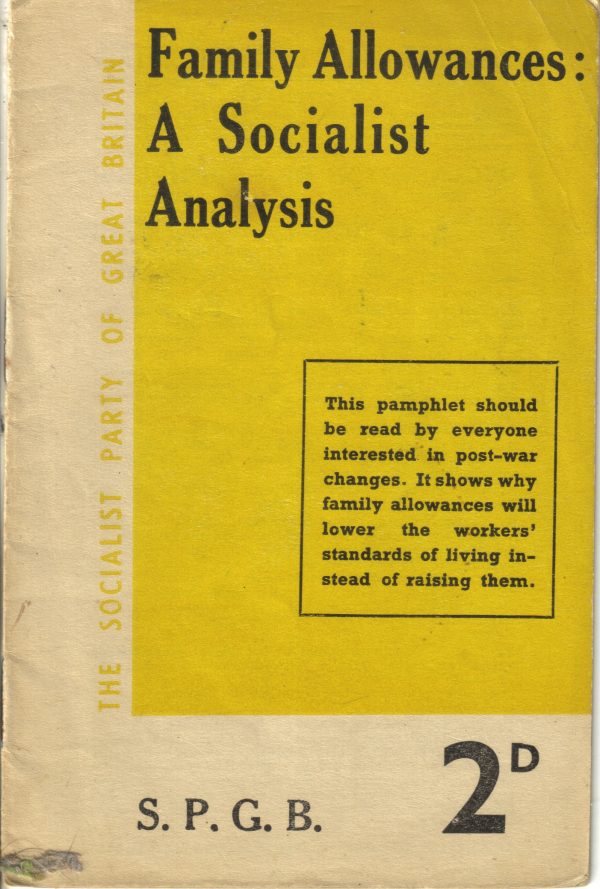
Family Allowances (now called Child Benefit) were introduced by the wartime coalition government in 1945. But, as the pamphlets Beveridge Reorganises Poverty and Family Allowances: A Socialist Analysis which we in the Socialist Party brought out at the time explained, this was not at all what it appeared to be: a money payment by the capitalist state which would leave all those with two or more dependent children better off by that amount.

Under capitalism and its wages system any regular payment received by workers in employment is going to have an effect on wage levels. This is because, as explained, wages tend to be fixed at a level which provides workers with enough money to buy what they need to maintain their particular skill in working order and also to bring up a family to take their place in the labour force when they are too old to work. If the state makes a contribution towards these costs, this means the workers’ immediate employer doesn’t have to.

The effect of any generalised state payment to workers in employment will be to depress, not necessarily the standard of living, but the wages paid by employers. This was why, in fact, Family Allowances were for a long time opposed by the trade unions. As we pointed out at the time:
"The real issue is not that certain unscrupulous employers may seek to save out of wages amounts paid in Family Allowances, but that once it is established that the children (or some of the children) of the workers have been ‘provided for' by other means, the tendency will be for wage levels to sink to new standards which will not include the cost of maintaining such children ” (Family Allowances, pp. 11-12).
In 1971 the then Tory government of Edward Heath breached a hitherto sacrosanct principle of the welfare state that no means-tested benefits should be paid to any worker in employment. They introduced a new benefit called Family Income Supplement (now called Family Credit), in effect a means-tested Family Allowance, payable to workers in employment whose income was below the poverty line, i.e. more or less what they would have got had they been on what is now called Income Support.

The logic behind this was to provide an incentive for people to take a job, however miserably paid. The result has been unsatisfactory from the point-of-view of the capitalist class as a whole. The cost of all state benefits payable to workers in employment (housing benefit, council tax benefit as well as Family Credit) has spiralled to over £2 billion a year.

Some employers—those in the modern sweated trades—have benefited. Knowing that the state will bring workers with children up to the poverty line they have been enabled to pay these workers below-the-poverty-lines wages. As Labour's deputy leader John Prescott has put it:
“Family Credit is now part of wage negotiations, with employers offering £1 an hour and saying: ‘I know you can‘t live on that, but if you nip down to Social Security, they’ll make up the difference (Observer, 28 August 1994).
Family Credit and other in-work benefits have, in other words, acted as a subsidy to these employers. This has caused resentment amongst other sections of the employing class who have to pay this subsidy out of taxes that, in the end, fall on their profits. This is where the Labour Party has come in with a proposal to help.

Labour to the Rescue
In their July 1995 campaign pack Low Pay. A Tory Failure, the Labour Party repeats again and again that their minimum wage is designed to reduce state benefits paid to workers in employment: 
“A minimum wage will not only act as a floor for pay. It will also ensure that in-work benefits do not act as a subsidy for low-paying and poor employers. ”

"Taxpayers would benefit because a floor under wages would reduce the need for tax handouts to low paying employers. Today employers have an incentive to lower wages at the taxpayers' expense." 

"Every taxpayer is now paying £100 a year for in-work benefits for people in low-paid work. People who have no protection against exploitative pay rates are forced into dependency on the benefits system whether they like it or not. And employers have no incentives to raise wages because they know the benefits system will subsidise the poor wages that they pay by what is, in effect, a tax handout to employers. ”
What Labour is proposing (and are rumoured to want to do over maternity pay) is what the Tories did over Sickness Benefit: to cut back on state payments by shifting a part of the cost on to employers in the form of statutory sick pay. Labour’s aim is to shift some of the burden of maintaining workers on low pay at the subsistence level on to the employers who have been benefiting from the present system.

But what about the workers? The low-paid workers existing on the poverty line. It’s not going to make much difference to them since the argument is about who is going to pay their subsistence income and in what proportions not about its level.

As far as the low paid are concerned what will happen is that what the right hand gives away in the form of a slightly higher minimum wage for some the left hand will take away in the form of reduced Family Credit. People on Family Credit get their benefit reduced by 70p for each £1 by which their income increases. So if their hourly wage was increased from, say, £2.50 to £3 they would only be 15p an hour better off not 50p. And if the increase lifted their income above the qualifying level for Family Credit they would find themselves worse off through losing the accompanying entitlement to housing benefit and free prescriptions and dental treatment.

Labour’s national minimum wage is not a genuine reform in the sense of a measure to bring about some improvement in working class conditions. It’s an economy measure designed to save the capitalist state money. They don’t fool us. Let’s hope that they don’t succeed in deceiving too many of the low paid either. 
Adam Buick

Tuesday, May 31, 2022

Voice From The Back: Capitalist profits (1998)

The Voice From The Back Column from the October 1998 issue of the Socialist Standard

Capitalist profits

From December 1, when the second stage of this year’s pay award is implemented, a D-grade staff nurse will earn a basic of between £12,855 and £14,705. Starting salaries for teachers are £14,500 and for police constables £15,500. Guardian, 6 August.


Full Marx!

Karl Marx’s theories may not be much appreciated in police forces, but his observation that under capitalism everything eventually becomes a commodity may strike a few chords in the Los Angeles police department: it is registering its initials LAPD as a trademark. Guardian, 6 August.


Value for money

Barbara [Corcoran] says that in Manhattan, where she lives, her annual £45,000 investment in her looks is de rigeur. There, she says, “looking good is more important than being good . . .” “People judge you down to the tiniest detail, the cut of your suit shoulder, the size of the pearl in your earring, even how you apply your make up.” Express, 20 July.


This secret society

Gun Mart, a magazine for shooters, has a particular concern about the confiscation of the majority of private hand guns following the Dunblane massacre. In its August issue it draws attention to the fact that the police report on Thomas Hamilton, made to the Procurator Fiscal before the mass shooting of the school children, will not be put into the Library of the House of Commons. In fact, Lord Cullen, for the government, has recommended that a 100 year closure be placed upon this and related documents. Not even most war secrets are suppressed for this long. What are they hiding? Gross negligence is one possibility. A real excuse for the banning of guns is another.


Political starvation

“The country’s [Sudan’s] 15-year civil, war has uprooted millions. The UN World Food Programme predicted the food emergency last September. But a worsening drought, lack of interest in the international community, widespread fighting and a ban on relief flights by the Sudanese government have resulted in a much worse crisis today . . . people are dying, at an average of 50 a day in Wau, one of the hardest hit areas.” Catherine Bertini, Executive Director, UN World Food Programme.


Feelgood factor 1

Keith Bradley, Professor of international management at the Open University Business School was doing his bit for the class struggle in the Financial Mail on Sunday, 16 August. He said, “Chief secretary to the Treasury Stephen Byers touched a raw nerve last week when he hit out at ‘greedy’ power and water bosses whose massive pay rises of up to 70 percent fuel anger amongst ordinary workers. But while fat cats are easily pilloried, there is little doubt that huge pay disparities are here to stay. Indeed, the rich are likely to get richer-and deservedly so . . . In today’s world there is a massive difference between winning and coming second. Nearly winning a legal battle, nearly scoring a goal, or nearly completing a business deal are all worlds apart from actually achieving these things.”


Feelgood factor 2

Earlier this year, when he was anticipating, and perhaps trying to influence, the Labour government’s budget, Martin Taylor, chief executive of Barclays Bank, told the Commons social security Select Committee that the working families tax credit (WFTC), which was expected to replace the in-work family credit, would have “important psychological effects on the way people feel about work”. Delivered through the pay packet rather than the benefits system, it would change the attitudes to living on welfare by associating state aid with work, said Mr Taylor. “If welfare to work succeeds, and I expect it will, there are going to be a lot more people in relatively low paid jobs . . .” “It’s important that they should feel good about that and that society as a whole should feel good.” Mr Taylor was doing his bit for the class war—on behalf of his class.


Feelbad factor

In May, the Boston Sheraton hotel in Massachusetts had to pay $200,000 (£120,000) in a lawsuit in which employees said they were videotaped in a changing room, and a California trucking firm’s employees discovered a video camera in the men’s toilet. Every aspect of employment becomes disputed territory in the class war.


Pollute and be damned

Asbestos pollution is one of the biggest environmental health problems in the world, according to the Johannesburg Star, and South Africa is the global epicentre of asbestos-related disease (ARD), in particular mesothelioma, which is a cancer related specifically to asbestos exposure. It was estimated that 30 to 40 percent of people who worked in SA’s asbestos mines for more than 20 years developed ARD. A study of the town of Mafefe in Northern Province revealed that half the adult population of 12,000 had ARD.

Saturday, April 2, 2022

Answers to Correspondents (1939)

Letters to the Editors from the April 1939 issue of the Socialist Standard

The Wages of Agricultural Workers

A correspondent writes as follows: —

Wickford,
Essex.

Dear Comrade,

In the January issue of the Socialist Standard you state that it has been estimated that as many as twenty-five per cent. of agricultural workers are being paid less than the minimum wage legally applicable to them. Will you please explain how this information was obtained and why it has not been used to enforce the law?
Yours fraternally,
T. R. V. Andrews.


Reply.
Minimum rates of wages are fixed in the various districts, and it is an offence under the Agricultural Wages Act to pay less than the minimum. But there is a great gap between specifying a wage and enforcing its payment. In 1937 the Minister of Agriculture instituted 83 prosecutions of farmers for non-payment of the minimum. The Courts imposed £314 10s. 0d, in fines and awarded. £2,020 as arrears of . wages to the workers concerned (see Reply by Minister of Agriculture, Hansard, February 21st, 1938). These few cases are, however, only those which came to light. The difficulty faced by the Ministry’s inspectors, and by the National Union of Agricultural Workers, always is that when agricultural workers are faced with the risk of losing their job, and perhaps being turned out of their cottage as well, they are most reluctant to disclose the fact that they are underpaid. Any estimate of the extent of underpayment is necessarily based on inadequate information. The figure 25 per cent. was given some years ago by a writer on agriculture, but the source of the information has for the moment been mislaid. The general problem, however, of workers who are underpaid; but will not risk taking action is well known to trade union organisers.
Ed. Comm.


Is the S.P.G B. afraid to criticise Trade Unionism

A correspondent, who gives no address because he is “on tramp,” asks an unusual question. His letter and our reply are given below : —

Dear Sir,

I have become a reader of the Socialist Standard, but I am told by a great many people that the S.P.G.B. are afraid to criticise Trade Unionism, because the Party would become unpopular., I do not know the S.P. view concerning this. I maintain that if Trade Unionism were universally adopted it could only result in failure because of the fact that wages are adjusted to the cost of living and vice-versa, therefore wages, however high, would not raise the standard of living. I fully admit that the Trade .Unions as they stand at present do benefit their members, but only at the expense of the community, as increased costs raise the cost of living. These facts prove the fallacy of Trade Unionism. If there is any truth in the statements made by some people as regards S.P.G.B. members all being staunch Trade Unionists, then the Party will have a hard job in trying to explain these facts away.
Yours truly,
J. B. Marshall.


Reply.
Our correspondent’s question is unusual, because a very frequent complaint made by critics of the S.P.G.B. has been that we are unduly critical of trade unionism if not actually hostile.

The truth is that the S.P.G.B. recognises the value of trade unionism in resisting the constant pressure of the capitalists on the workers’ standard of living, but. recognises, too, that trade unions are in the main concerned with the day-to-day struggle within capitalism and not with the task of overthrowing capitalism. This is necessarily the case because a trade union has to accept to its ranks all workers who are willing to join for its limited purposes. A trade union which restricted its membership to those who seek the overthrow of capitalism and the establishment of Socialism would—in present circumstances—be a very ineffective body, because it would be excluding a majority of the workers.

While supporting trade unionism, the S.P.G.B. need not, and does not, support or defend those speeches and actions of trade unions and their officials which are contrary to working class interests and Socialism.

Our correspondent is advised to read the Socialist Standard regularly. He will see the Socialist attitude to trade unions frequently explained and elaborated.

Our correspondent argues that trade unions are to be condemned because higher wages mean higher prices and are at the expense of the “community.” This is an error which has on occasion been used by the capitalists to dissuade workers from joining trade unions or taking part in strikes. The attitude of the employers is sufficient to show that they at least are under no such illusion. If employers thought that higher wages can simply be passed on in the form of higher prices they would not resist trade union demands. The employers know better. They know that higher wages are a direct cut into profits—hence their resistance to such demands.

Although wages are affected by changes in the cost of living, the relationship is not an automatic one. Workers have to struggle to raise wages when prices rise and have to struggle to prevent wages from falling when prices are stable or falling.

For an illuminating discussion of the economies of the problem our correspondent should read two pamphlets by Karl Marx, “Wage-Labour and Capital” and “Value, Price and Profit."
Ed. Comm.


Mr. Edgar Paul (Northiam).—We have your inquiry about class-consciousness, but are not quite sure what is your point. The more class-conscious the workers are the more inclined they are to reject open and disguised propaganda for capitalism and the more ready they are to put up intelligent resistance to capitalist pressure. It is quite true that workers with little understanding of Socialism will often put up a spirited defence against capitalist exploitation, but a defiant attitude alone will not suffice to get rid of capitalism.

Perhaps you will elaborate the point.
Ed. Comm.

Replies to many correspondents are unavoidably held over, owing to pressure on space.
Ed. Comm.

Thursday, March 31, 2022

Running Commentary: How much are you worth? (1979)

The Running Commentary column from the March 1979 issue of the Socialist Standard

How much are you worth?

Have you ever thought about the man who emptied your dustbin having the power to bring Civilised Life As We Know It to a halt? Or the woman who washed the floor in the hospital ward? Or the person who unlocked your child's school in the morning?

We only ask these questions because of the hysterical denunciation in what is politely known as the media—but which was once, more healthily, called the gutter press—of the recent strikes as acts of crass irresponsibility which would lead to millions dying or being unable to read and write or something similarly dreadful.

It is, of course, perfectly true that a disruption of hospital services, or an accumulation of garbage, or an interference with the water supply, could quickly produce a number of serious problems.

But so far the gutter press has not followed up its flash of insight into the value of these workers by concluding that this very fact must make them worth a very high wage indeed.

Of course this does not apply to everyone. Incensed by the strikes. Spike Milligan, described as a comedian, threatened to go on strike himself, which means he would stop telling jokes—something discerning people thought had happened already. Then there are people like the Royal Family who receive more in a month than the strikers will get in a lifetime and who could threaten to stop making silly speeches and trying to live in half a dozen palaces at once.

Or Roddy Llewellyn could really put the pressure on by refusing to lie in the sun in the West Indies or trying to sing.

In fact, if the entire capitalist class went on social strike tomorrow, by ceasing to exist as a class, the world would not notice the difference except that we would be free of a dead weight of parasitism and could get on with building a society where everyone stood equally.

This is one thing the gutter press will hold its silence over. The useful people in society are the working class; they have only to learn to run the world in their interests and not in that of the parasites.


A Cry For Help

Does this latest Pope really see himself in the role of King Canute, persuaded to try to hold back the inexorable tide?

For some time now religions of all sorts have attempted to disguise the fact that their theoretical justification (if it could ever be said to have existed) has been destroyed, by involving themselves in social problems.

The Salvation Army is perhaps the best known example of this, dispensing their own brand of nonsense along with shelter for drunks, battered children and the like. (The drunks may argue about the description of what they are offered as shelter.)

Other groups have followed the same line; in the more developed countries even the Roman Catholic Church has been able to contain priests who, making their own interpretation of their dogma, have seemed almost as interested in homelessness and vagrancy as in the catechism.

To do this, they have usually needed to put a pretty selective slant on what was allegedly said and done by the person known in certain writings as Jesus Christ. As the pressure of problems in modern society has built up the quasi political priest has become an increasingly evident spectacle.
Now. it seems, the Pope has had enough of this nonsense. On a recent tour of Latin America, he spoke out against those Catholics who are intellectually nimble enough to somehow relate Christianity with "Marxism” and to conceive Jesus Christ as a sort of Che Guevera.

The facts need to be stated. Religion remains, as when it was so described by Marx, the opiate of the people. It aims to divert workers from the immediate priority, of changing the social order here on earth, persuading them instead to accept the chaos of capitalism in the hope that there is a supernatural something after death reserved for those who have done so, with humility

This theory is constantly battered by reality. Can—or should—someone who is starving, or someone degraded and poverty stricken, accept this as natural and tolerable? Religion tries to make this adjustment, to have the best of both worlds. It tries the dishonest, the insupportable, the impossible.

Clearly, it was very unkind of the Pope to be so blunt to those of his followers who, in their desperation, are driven to try this trick. They are in need of help rather than criticism.


Is It Catching?

Whenever a City Editor is stuck for something to fill his column, he can always run off a few paragraphs on something he calls the British Disease.

This Disease takes different forms at different times but one unvarying symptom of it is that it is caused by British workers' unmanageable greed and laziness; another is that it damages British industry in its efforts to compete with that of other countries.

As we all know, the British Disease is at present characterised by inflation which, as all City Editors are agreed, is caused by workers who are greedy, lazy, etc., etc. . . .

This theory, popular as it may be. is not supported by the facts. Inflation, apart from not being caused by workers getting higher wages, is not peculiar to British capitalism.

President Carter recently took himself along to the Capitol to tell the American people (his speech was televised) all about the State of the Union. Some of his speech was devoted to a catalogue of America’s nuclear armaments and of how they can wipe out “every large and medium-sized city in the Soviet Union".

Apart from this joyful news, Carter also has a lot to say (although he did not call it the American Sickness) about inflation in the United States. Inflation, he said, is his overriding domestic priority; he urged Congress to approve the Budget he had sent them which was designed, just like Healey’s, to end inflation for ever.

Carter also addressed himself to the American workers. Without actually calling them greedy, lazy, etc. etc. ... he admonished them: “We cannot afford to live beyond our means, to create programmes we cannot manage or finance, or to waste our natural resources."

So not only does America suffer from this same disease of inflation as Britain: it also has to endure the same fatuous “remedies” being mouthed by its politicians.

Anyone who worries about inflation being contagious, spreading like some virile baccillus across the Atlantic, can take heart. It is caused by a deliberate act of government policy, as a method of eroding wages which cannot be held back in actual monetary terms.

It leaves workers chasing their tails— which is what it is meant to do. At anytime, a government can stop inflation, and replace it with other policies also designed to hold back wages. Whoever heard of a disease which the patients inflict upon themselves?

Monday, January 10, 2022

Gate Gourmet — Another Union Sell-Out? (2005)

From the October 2005 issue of the Socialist Standard

For those given to circular reasoning, the announcement on 12 September this year of a deal for a redundancy package for sacked Gate Gourmet airline catering workers will be seen as yet another example of trade union officials selling out or even deliberately sabotaging the struggles of the working class. The case seems harsh and clear. On 10 August Gate Gourmet, which  provides airborne catering to British Airways passengers, sacked 667 workers – infamously, now – by megaphone. The employees had stopped work and had gathered in the canteen to discuss developments in ongoing redundancy negotiations – chiefly the management’s decision to take on 130 new temporary workers. This was clearly a provocative move to try and undermine the existing staff’s position. The staff were told to return immediately to work, and they refused.
  
There is clear evidence of deliberate provocation – security guards were on hand to control the situation; extra staff were bussed in immediately to replace the sacked workers; the following working day, all staff received dismissal letters, even those who had been off sick the previous day. The firm even went as far as to inform other companies they work with of the dispute in advance.

Clearly, management had chosen the best time to orchestrate this attack: the height of the holiday season, with the guarantee of headlines about holiday chaos and passenger misery from the uniformly loyal lickspittles in the capitalist press. This strategy was given a fillip when British Airways baggage handlers heard about this ruthless behaviour, and walked out to help defend people they work with daily, who are moreover in many cases their friends and neighbours. A wildcat solidarity strike. This spread the disruption and guaranteed more passenger misery, chaos and gangrene – or whatever other unpleasantness tabloids are attributing to strikes today.

The strike lasted for two days, grounding hundreds of flights. Eventually, the baggage handlers returned to work, and union officials from the Transport and General Workers Union began negotiations over the status of the sacked workers. Although for legal reasons the union had  been unable to support the either the wildcat or the solidarity strike they did established a picket of the company’s headquarters to continue their campaign.

Even this was too much for Gate Gourmet, and having successfully called out their allies in the press to their cause, they then sent in their reserves from the state. The High Court was asked to rule the picket unlawful – to protect those staff who wanted to continue working (as their devoted employers had it) from being intimidated by the people who had been sacked by megaphone and escorted from the grounds by gentle flower scented security guards. A shining display of concern for their staff.

Although the court ruled that the picket was ‘lawful peaceful assembly’ picketers were forbidden from blocking the route into work, taking photos of staff or even trying to talk to them, at all. Further, the T&G union was made responsible for the conduct of the picket – a move that directly threatened the assets of the union should any infractions of the courts injunction occur.

The role of the law has been significant in this case. Much of the press made hay from the ‘illegal secondary industrial action’. This is not strictly correct, secondary action – where workers for one employer strike in support of workers for another – is merely unlawful, not illegal (i.e.it is not protected by law, as striking is, but is not itself prevented by law). This merely means that unions who engage in the practice are liable for civil proceedings from employers for claims of restraint of trade. It was protection from such litigation – in the aftermath of the precedent of the famous Taff Vale case of 1901 – that spurred the growth of the Labour Party and the unions’ interest in it.

Calling the action illegal, though, has a significant symbolic and ideological role in giving the impression – to a generally law-abiding populace – that striking is criminal and by extension wicked. A great many comment pages on the internet were filled with people complaining about secondary action (note, not solidarity action) and bemoaning the return to the 1970s.

This dispute is being used by union leaders to renew calls for changes to industrial relations law in the UK, citing it as a hard case that justifies modification of those laws. At last month’s TUC conference the call went up that at least workers in firms with contracted out services – like BA’s catering – should be allowed to engage in solidarity action. This is incredibly unlikely, since the government is desperate not to look even remotely like it supports trade unions and seems, in fact, to be proud of the restrictive industrial relations law in the UK.

It is also unlikely, because such a course would utterly undermine the whole point of contracting out – especially in it Public Finance Initiate (PFI) form of contracting out state services. Outsourcing and contracting-out previously in-house services is meant to change the legal standing of union members so that they are officially working for different companies even if they work together to provide a service. It is classic divide and rule.

The downside of this tack, though, appears to have surfaced in the Gate Gourmet dispute. It turns out that the catering firm (or at least the Gate Gourmet part of a bigger holding company) is losing something like £25 million a year. These strikes have come when Gate Gourmet has been in the middle of trying to renegotiate their contract with BA. The seemingly provoked strike, then, works advantageously for them, because it means they can use the disruption from their cost cutting exercise to damage BA’s service and business. In effect, it seems they have taken industrial action to renegotiate their contractual terms.

Contracting out means handing over control of labour management to outside companies, and opens up a firm – seemingly – to damaging industrial disputes not of their making but in which they are snared.

All that aside, the workers have proven, yet again, that anti-union laws do not stop them taking action. It is, and always has been, the determination and consciousness of workers that guides their disputes. No law could stop people refusing to work. As in most of the recent unofficial action – other baggage handlers, Royal Mail strikes, etc. – management will not try and pursue the matter afterwards anyway – the damaging repercussions to their own business usually outweigh the benefits of hounding strikers or bringing legal action.

That is why Gate Gourmet pre-empted trouble by its union busting attack. It is negotiating from a position of its bottom line – making losses. It wants to shed around 700 jobs. The deal struck with the Union allows 300 of the workers – previously classed as sacked – to apply for redundancy at 2.5 times the statutory level.

In such a situation where saving jobs is clearly going to be impossible, pushing up the market price of cutting jobs is a rational course for the trade union. However, only half the sacked  strikers are likely to get that money, as Gate Gourmet wants to try and ensure that its union-busting sticks. The union continues to campaign to have the remainder reinstated, but this appears unlikely.

The employees were hardly living in the lap of luxury to begin with – catering assistants were pulling in something like £12,000 per annum and drivers around £16,000 – this in the London area with high housing and general living costs. Management even tried to get staff to come back to work signing a new contract on drastically reduced wages and conditions. When it came to the bottom line, they clearly felt they could ask their workers to stoop lower.

It is pointless to criticise unions for not immediately launching a revolutionary insurrection to protect jobs – they are tools for the workers to engage in the labour market, not revolutionary organisations. Their memberships are of many different political persuasions, workers banded together for the purpose of protecting their interests. If they have to adapt their outcomes to market realities that is the fault of the market, not the union. Wishing that union bureaucrats would be replaced with more radical leaders is no way forward; they, too, would only have to abide by the willingness to fight of their membership and the lie of the labour market, just as the hacks do now.

It is not necessarily personal malice on the part of employers that fuels industrial disputes. Both sides are actors on a stage set to determine their actions. The law of ‘no profit no employment’ means that these sorts of disputes will always occur. The remorseless impersonal logic of the labour market will ensure that. Workers need to understand that no amount of union secondary action – legal or otherwise – can banish this menace from their lives.

To end the evil of the wages system will take a revolution, though – and it’s not going to be started by a spark from a small industrial dispute. The revolution needs to be built in the hearts and minds of workers who can defeat both the force and ideology of the dominant class to remake society. Unions cannot make revolutions, only the working class themselves can. Through clear, determined political action, we can clear the way so that no-one need ever go through struggles like the Gate Gourmet workers again.
Pik Smeet

Wednesday, April 8, 2020

Homeworkers — reserve army of the half-employed (1979)

From the April 1979 issue of the Socialist Standard
With fingers weary and worn.
  With eyelids heavy and red,
A Woman sat, in unwomanly rags,
   Plying her needle and thread —
Stitch! stitch! stitch!
   In poverty, hunger and dirt,
And still with a voice of dolorous pitch
   She sang the 'Song of the Shirt!’ 
'Work — work — work
   Till the brain begins to swim.
Work — work — work
   Till the eyes are heavy and dim!
Seam, and gusset, and band,
   Band, and gusset, and seam,
Till over the buttons I fall asleep

   And sew them on in a dream! 
'O, Men with Sisters dear!
   O Men! with Mothers and Wives!
It is not linen you’re wearing out.
   But human creatures’ lives!
Stitch — stitch — stitch,
  In poverty, hunger, and dirt,
Sewing at once, with a double thread
  A Shroud as well as a Shirt

Whatever the outcome of this winter’s campaign by many union-organised low-paid workers, it will do little or nothing to improve the situation of homeworkers. These freelance, “self-employed” workers, mainly women, work in or from their own homes, some as envelope addressers, others putting toys, balloons or mottoes in Xmas crackers, while a great many are in the rag-trade. The Daily Mirror (Jan. 30, 1979) exposed some typically atrocious conditions:
  Mary Fabri gets paid 80p a dozen for making fashionable Broderic Anglaise petticoats which sell at £4.75 each. Her earnings are £20-£22 per week, out of which she has to pay about £1.30 for electricity to power her sewing machine. Rachel Tomlinson used to “slave away till two or three in the morning”. She machines trouser suits at 75p each, using a twentypart pattern: these suits are sold by mail order at £26. Pat Frolich and her friends, getting 4p for putting tassels on football supporters’ scarves, tried to get 1p increase, and on being refused they joined the General and Municipal Workers’ Union. “I didn’t get any more work which amounts to the sack, and the Union couldn’t do a thing.”
In the nineteenth century, before the factories superseded the domestic system, the lace-makers, milliners and spinners working at home, were all employed in much the same way. There was also then the notorious “rag trade”:
  One of the most shameful, the most dirty, and the worst paid kinds of labour, and one on which women and young girls are by preference employed, is the sorting of rags. It is well known that Great Britain, apart from its own immense store of rags, is the emporium for the rag trade of the whole world. They flow in from Japan, from the most remote States of South America, and from the Canary Islands. But the chief sources of their supply are Germany, France, Russia, Italy, Egypt, Turkey, Belgium and Holland. They are used for manure, for making bed-flocks, for shoddy, and they serve as the raw material of paper. The rag sorters are the medium for the spread of small-pox and other infectious diseases and they themselves are the first victims. (Capital vol. I.)
The homeworkers of today, as of Marx’s time, are part of a fluctuating pool of labour on the fringes of unemployment.

From the capitalist’s point of view the advantages of employing homeworkers are many. The main and most obvious is that their labour-power is cheap. As Marx observed of the “so-called domestic industries", “unlimited exploitation of cheap labour-power is the sole foundation of their power to compete” (Capital vol. I). Since there is not enough work to go round, each homeworker is competing against thousands of others, all equally desperate. Also, as unemployment has increased many housewives are driven to supplement the breadwinner’s inadequate paypacket by turning their homes into factory annexes. According to the Low Pay Unit, the number of full-time workers earning less than they would be able to get on Supplementary Benefit (the government-decreed poverty norm, on which families can survive) increased from 130,000 in 1974 to 290,000 in 1976 (Observer, 17 Sept. 1978). If we add to this figure the one-parent families where a mother struggles to bring up her young children on Supplementary Benefit, we can see how large a number of homeworkers there are on the fringes of the employment market.

Another advantage for the capitalist is that the homeworkers’ working hours and conditions are totally unregulated and unprotected: no Factory Acts, no National Insurance stamps, no income tax. The hours worked, and pay obtained, are entirely a private matter between the individual homeworker and his or her “employer". Homeworkers do not normally have any contract of employment so it is rare for them to get the sack: but if the “employer” just stops sending them any work they have no legal protection. Because they are isolated from one another, they seldom get the chance to organise and protect themselves from the imposition of harsh work norms. (Some Market Research firms go to quite extraordinary lengths to prevent their interviewers meeting up with one another: in such firms the only personal contact the interviewer has is with her supervisor, never with other interviewers.)

Because most of them are on piece-rates (inevitably extremely low) home workers have to work exceptionally long hours to obtain something like a wage. For instance, a hand-knitter made a complicated Fair Isle sweater which required 30 hours work. For that job she was paid £5.20. Employers take the cynical view that “very often women are grateful to us because we are paying them for their hobby” (Daily Mirror, 30 Jan,.1979). The same woman whose hobby is toiling at her knitting machine or typewriter for long hours at a miserable pittance is worth, as a housewife, £87.90 a week (Daily Mirror). At least, that is what she could get if she was paid for doing some one else’s household chores and caring for someone else’s children. Then consider some of the less agreeable jobs, such as delivering sales leaflets door-to-door in all weathers. In one typical area, women and schoolchildren who deliver a free local newspaper and sales material get paid £3 basic, a rate which has not changed in ten years. No one would describe this as a “hobby”.

Another advantage to the firms that exploit homeworkers is that, should their work-load fluctuate, as is the ease with Xmas crackers, market research and the rag-trade, the employees can be left high and dry without work (without pay) during slack periods, yet can be required to work almost round the clock in a busy season. There is absolutely no limit to the number of hours homeworkers may work in a week, other than their own physical limits. (Pit-ponies however are limited to 48 hours a week).

Homeworkers are a mere footnote in the economic history of our times. Yet their low rates of pay serve to depress those offered to factory workers in the same area. How else would Grunwicks be able to offer such low rates to women working part-time.

The reformers of British capitalism have introduced legislation to control the length of a working day, the conditions of work within factories, the protection of workers from “unfair” dismissal or discrimination, to provide paid holidays and sick pay, to insure workers from actual destitution when injured or unemployed, and to provide pensions and maternity leave. All these regulations are easily evaded by those firms which exploit the reserve army of the unemployed in their own homes. In addition this practice reduces the firm’s own overheads (power, light and heating, and in many cases depreciation of machinery).

In one of his novels, the Russian writer Dostoyevsky described a widow who stitched away all night. In his Autobiography, Charles Chaplin described how his mother slaved at shirt-making, starving herself to feed her children when there was not enough money coming in. Her reward was premature senility, caused by malnutrition.

Marx described the domestic industries as “the last resort of the ‘redundant population’ ”—capitalism’s safety-valve. So long as people can be made “redundant”, so long will this cynical exploitation of the very needy continue. Fashion firms will flourish while factory rates of pay will be depressed and women will be degraded to the point where to many prostitution seems preferable.

The wages system with production for profit is the root cause of all these social evils. Reforms of the law can do next to nothing. To end exploitation in the home, as in the factory, we must abolish the wages system. There is no other way.
Charmian Skelton

Monday, February 3, 2020

Cooking the Books: Boris’s Gift Nag (2020)

The Cooking the Books Column from the February 2020 issue of the Socialist Standard

‘Boris Johnson to raise minimum wage four times inflation’ was how news agencies reported the government’s decision, announced on 31 December, to accept the Low Pay Commission’s recommendation to increase the minimum wage for over-25s from £8.20 to £8.72 an hour from the beginning of April. What is this? The world turned upside down with a Tory government bringing in a 6.2 percent wage increase by decree?

Not really, as all is not what meets the eye. The Cameron Tory government had already adopted the long-term aim of reducing the wage subsidy to employers represented by the tax credit scheme that makes the income of the lowest-paid workers up to the poverty line. Shifting the burden back on to employers was to be achieved by gradually increasing the minimum wage since as a person’s income increases so their tax credit payment goes down.

Marx didn’t think much of minimum wage legislation. In 1880 some members of the newly-formed French Workers Party came to London to ask him to help draw up their election programme. It consisted of two parts, the long-term aim of socialism and a list of immediate demands. Afterwards Marx wrote a letter in which he said that the second part included ‘some trivialities which Guesde found it necessary to throw to the French workers notwithstanding my protest, such as fixing the minimum wage by law, etc (I told him: “If the French proletariat is still so childish as to require such bait, it is not worth while drawing up any program whatever”)’ (LINK). Presumably he felt that it went too far as a vote-catching bait as it was unrealistic and unenforceable.

Maybe it was at the time but nowadays most developed capitalist countries have such laws. In 1999 the Blair Labour government introduced a national minimum wage (previously this had existed only for some sectors such as for agricultural labourers). In 2015 the Tory government renamed the rate for over-25s the ‘National Living Wage’ (NLW). Probably it has prevented some workers in industries where it is hard to organise effective trade unions from being paid less than the value of the low-grade labour power their employers seek, even though it will have rendered some others unemployable.

In its report on the application of the law in 2019, the Low Pay Commission listed reactions by employers to increases in the NLW: taking a cut in profits, seeking to increase prices, introducing automation, and increasing work intensity. These are the same as to any wage increase, whether imposed by law, trade union pressure, or tight labour market conditions.

The Commission noted that ‘absorbing some or all of the cost of the NLW through a reduction in profits was often the most common response’. This would be a sign that competitive conditions didn’t allow a price increase; the Commission itself noted that some businesses ‘do not have this option, whether because of market structures or reliance on government funding’. So much for the myth that wage increases cause rising prices.

Worrying from a worker point of view, but par for the course, is the fourth option of work intensification:
  ‘Employers reported expecting more flexibility and effort from staff, adding tasks to job roles and raising performance standards. Workers told us of the increased pressure they have come under from such changes.’ (tinyURL.com/t77l89t).
The working for wages system is a trap from which there is no escape. What you get from one hand is often taken away by the other. No wonder Marx urged trade unionists to work for its abolition.

Monday, October 28, 2019

Poverty and the minimum wage (1984)

From the January 1984 issue of the Socialist Standard

It is, and always has been, a feature of capitalism that there are big differences in wealth and income between rich property-owners and propertyless workers, but also big differences in wages within the working class. The solution is to get rid of capitalism and establish socialism, in which there will be no incomes from property ownership and no wages system: all the members of society will have free access to the products of industry. At one time leading members of the Labour Party, including Sidney Webb and Bernard Shaw, endorsed that idea. The first chairman and leader of the Labour Party, Keir Hardie, declared that the Labour Party existed to achieve it. The Labour Party then abandoned the aim its leaders had once proclaimed (or, as they said, “postponed” it). They did so on the ground that it was essential to be “practical" and to deal at once with the pressing evils of capitalism.

One of the immediate problems that they were going to deal with at once was the existence of large numbers of workers on very low pay. All sorts of remedies have been tried but have been a total failure. Not only is the problem still with us but, according to an independent body — the Low Pay Unit — the lowest paid workers were relatively worse off in 1980 than they had been 95 years earlier when figures were first collected. The Labour Party's programme at the last General Election brought the failure story up to date:
 The next Labour Government will launch an offensive against low pay as part of our strategy for equality. The problem of low pay remains acute both in relative and absolute terms. If low pay at present is defined as less than two-thirds of average male manual workers’ earnings, there were 3 million full-time low-paid workers in 1982, of whom 2 million were women workers. Adding to these figures young workers, part-time workers and home workers, produces a total in the region of about 6 million — a great majority of whom are women.
One supposed remedy was more nationalisation and the expansion of local government services; but many of the “low-paid” are to be found in central and local government and the nationalised industries.

Another alleged cure for poverty was the Beveridge social security scheme after World War II and its accompanying pledge of “full employment” and no more depressions. It has failed in both respects. Along with 3½ million unemployed the depression has increased the number of “low-paid" workers. And this is the SDP-Liberal Alliance's verdict on the social security aspect:
  William Beveridge has been mutilated over the years. Instead of a basic benefit, which was to secure for the old, the sick and the unemployed a tolerable minimum standard of living as of right, we have a complex network of benefits dependent on 44 different means tests. Many people are dependent on benefits which are woefully inadequate.
So the Alliance sees the need for a new Beveridge scheme to remove the accumulated deficiencies of the old one, and to include a new feature, the payment of benefit to low-paid workers in addition to their wages.

Another remedy was to be the election of a Labour government. Their 1918 programme, Labour and the new Social Order, committed a future Labour government to introduce a “national minimum” wage to be applied by law in all fields — employment, unemployment, the sick and the pensioners. In 1935 the leader of the Labour Party, Clement Attlee, in his book The Will and the Way to Socialism, said that the next Labour government would create “an equalitarian society" — the rich and the poor would both disappear. "It would", he wrote, "work to reduce the purchasing power of the wealthier classes, while by wage increases and by the provision of social services it will expand the purchasing power of the masses". When he became Prime Minister in 1945 it was his government which introduced the first of the "incomes policies" designed, among other things, to prevent wages from rising.

At one time it was thought that the remedy for low pay was trade union organisation, but it came up against the problem of industries in which unions did not exist or were quite ineffective. In 1909 the Liberal government created “trade boards" (later renamed Wages Councils) for the industries with "sweated" wages. The councils, made up of representatives of employers and workers, along with “independent" members, were empowered to fix minimum rates which were enforced by law. Wages Councils still exist and it is among the workers in these industries that many of the Labour Party’s "low paid” are to be found. An extension of the Wages Council minimum rates for separate industries, is the proposal for a national minimum to apply generally. The 1983 Labour Party election programme included the statement "we will also discuss with the TUC the possibility of introducing a statutory minimum wage", and this has been taken up by Neil Kinnock.

The minimum wage schemes come up against the facts of life of capitalism. The capitalists are in business to make profit; from the capitalist standpoint the only productive worker is one who brings profit to his employer. If the capitalists cannot make profit by employing workers, they do not employ them. While many companies can adjust themselves to paying wages negotiated with the unions and still make a profit, there are others who can stay in business only if they can get workers at very low pay. If compelled to pay more, they fold up..

This situation was dealt with in 1973 in a report by the Prices and Incomes Board, who said that the enforcement of higher rates in certain low pay fields "results in unemployment among low paid workers whom employers no longer consider worth employing at the higher rates". Some advocates of minimum rates show a remarkable blindness to the realities of capitalism. Where it is a question of the criminal law they know, from the millions of crimes every year, that the enactment of laws against bank robberies, burglaries and so on, does not mean that those crimes do not happen. Where it concerns statutory minimum wages they think it is different, but it is not. The Low Pay Unit reported in 1976 about the Wages Council industries: "In 1974, the last year for which figures are available, 13.4 per cent of employers checked as a matter of routine, were paying below the legal minimum compared with 7.9 per cent four years before". In 1983 the Unit reported: "Last year 35.1 per cent of employers inspected were paying below the minimum compared with 31.5 per cent the year before".

What happens, particularly at times of heavy unemployment, is that workers receiving less than the legal minimum prefer to keep their jobs rather than report the underpayment. In the depression years of the Thirties the National Congress of the Agricultural Workers Union said that more than half the farm workers were being paid less than the legal minimum wage and cases were known of agricultural workers who, having received illegally withheld pay after an inspector had intervened, gave the money back to the farmer in order to keep their jobs.

Realising that the levels of minimum wages they wanted to enforce would result in workers losing their jobs, some advocates of statutory minimum wages have proposed to get over the difficulty by the government subsidising the industries concerned. This was in fact done under the Corn Production Act 1917. The Act guaranteed prices to farmers for their produce and introduced minimum rates for farm workers in order to meet the shortage of food caused by the German submarine attacks on shipping. The farmers did very well out of it, but farm workers' wages failed even to keep up with the increased cost of living. When the war-time emergency was over the Act was scrapped. Farming is heavily subsidised now and farm workers have statutory minimum wages, but it has not prevented farm workers being among the Labour Party's 6 million low paid.

All the schemes in three quarters of a century to solve the problem of “low pay” have failed, and further schemes promise no greater success. The Socialist Party of Great Britain was right in the first place in holding that this and the other problems of capitalism will not be solved while capitalism continues.
Edgar Hardcastle