Showing posts with label February 1998. Show all posts

Wednesday, May 11, 2022

Voice From The Back: Thought for food (1998)

The Voice From The Back Column from the February 1998 issue of the Socialist Standard

Thought for food

Back in the summer, the weather expert in the Guardian chatted about global warming and came to the conclusion that it was capitalism that would cause the problems, not carbon dioxide. She or he said: “[A] Deep Truth about world food supply . . . has been clear since the Science Policy Research Unit made an in depth analysis of climate and world food in the 1970s. There is no difficulty in growing enough food to feed even the increased population of the globe in the 21st century, however the climate changes. The reason why there are famines now, and will be in the future, is that food is not distributed evenly. On many scenarios, the overall effect of global warming will be to increase world food supply. But the haves are likely to have even more, while the have nots experience the droughts and famines. People starve because of politics, not because of the weather.”


It’s a business

As the law stands, dealers in illegal drugs can register their trade for tax purposes and tax officials will protect their identify from the police and other government agencies . . . A spokesman for the Inland Revenue said: “Tax law does not discriminate between profits made from illegal or legal activities. We only report taxpayers to the police if we suspect they are involved in murder” (Independent on Sunday, 16 November)


It’s a crime!

Magistrates in Wales have fined a woman £200 for possessing a tiny piece of cannabis with an estimated street value of 50p. The 23-year-old single mother pleaded guilty to have 0.2 grammes of cannabis at her home in Cernarth, Dyfed, and on top of the fine was order to pay £40 costs. Her solicitor, Mr Alan Lewis, said. “The drug seized was no more than the size of a grain of rice, barely enough to smoke. It was so small she could have brushed it off the table and no one would have known” (Independent on Sunday, 16 November).


New sweatshops

Automatic all distribution (ACD) and information and communication technology (ICT) have enabled call centres to become hugely powerful business machines, and the UK has proudly assumed the mantle of Europe’s “call centre capital”. With more than 250,000 people already employed in call centres, and around 1 million expected to join them by the end of the decade, it is the fastest growing employment sector of the economy . . . Call centres are all about cost reduction. If companies learned one lesson from the recession it was from Direct Line founder Peter Wood’s brainwave: slashing wage bills by replacing hundreds of high street outlets with a shed full of telephones . . . In several of the largest call centres, operators are virtually chained to their desks, even having to ask permission for toilet breaks . . . John Orsmond, chairman of Advertising Research Marketing, which advises advertisers on how to use call centres, says he knows of employers in Scotland paying rates as low as £2.35 an hour.


A grateful nation

An 81-year-old crippled war veteran who was refused a place in a care home by his local authority, threw himself under a train after his pleas for help were ignored, a Northern Ireland inquest heard yesterday . . . Mr McLarnon has been taunted by youths for being an ex-soldier, the court heard. On the day he died, he had visited his local British Legion club—as he usually did—and asked friends for help. He had only 63p in his bank book and did not have enough for his bus fare home. Elizabeth Thompson, nursing manager of the Somme home for ex-soldiers in Belfast, said she had recommended Mr McLarnon’s admittance but the health board has refused to fund it. Health chiefs had been “irate” about the pressure being put on them (Guardian, 13 November).


Giving thanks

As the service of thanksgiving for the life of billionaire Sir James Goldsmith entered its second hour at St John’s in London’s Smith Square on Thursday, the first of the 700-plus congregation began to leave. Baroness Thatcher, who was due at another memorial service, for Viscount Tonypandy, was followed by GEC boss Lord Weinstock and the Earl of Suffolk. In the event the celebration lasted more than two hours, something of a shock for Goldsmith’s widow lady Annabel . . . (Mail on Sunday, 16 November).

Letters: To vote or not to vote (1998)

Letters to the Editors from the February 1998 issue of the Socialist Standard

To vote or not to vote

Dear Editors,

In his article on Class War (Socialist Standard, October 1997) Paddy Shannon wrote that “so long as there are revolutionaries out there with the energy to act and the will to think, we want to talk to them”. Unfortunately when talking to revolutionaries, Socialist Party members are usually caught up in the debater’s tricks that have so characterised any debate with anarchist revolutionaries, that is, to wilfully misunderstand what we are saying, and then accuse us of a whole list of things that we have never said or done. Such was the case with a recent exchange with the Anarchist Communist Federation. First we were falsely accused of punishment beatings, and when we strenuously denied this, we were then told we were also guilty of advocating head-shaving, tarring and feathering, tying to posts, sticking notices on front doors, curfews and chasing people out of town. This cheapjack debater’s rhetoric is camouflage for the Socialist Party’s own failure to address the problem of the State, the police and crime.

Are the police merely “workers in uniform”—“not the real enemy” as Paddy Shannon says—who will continue to exist after the Socialist Party has managed to persuade the majority to vote for them and who will carry on doing what they were doing before the Great Socialist Vote? You have never seriously tackled the question of the police, the army and the other forces of repression organised by the State and the ruling class. When others attempt to develop ideas about how we can control our own areas without the police, you readily caricature us as advocates of vigilantism.

The forces of State repression are our enemy just as much as is the boss class. Of course all methods must be used to counter them—not excluding fraternisation, revolutionary propaganda aimed at them etc. But this leads to the dissolution of these forces not their control by some benign Socialist Party administered State.

You seem to think that you are revolutionaries. But you have consistently failed to take part in any mass actions—for example against the Poll Tax—preferring the safe isolation of your own sect. You have consistently argued against revolutionary action on every occasion. In actual fact you are good old-fashioned reformists. Wait till you have an electoral majority to vote in Socialism—of course the boss class and the State won’t lift a finger-and in the meantime do nothing but propagandise! But you can’t even get the votes of most social-democratic parties and you have been trapped in your sterile logic for the good part of a century!

Of course as Paddy Shannon correctly says: “The more violence is involved, the more likely the revolution is to fail outright, or to be blown sideways into a new minority dictatorship.” But most revolutions are remarkably non-violent, in their constructive phases at least. The violence comes when the boss class starts fighting back. That’s when armed self-defence of the Revolution is necessary. You criticise Nestor Makhno in the Ukraine for defending revolutionary gains there. What would you have done there? Call for an election and a vote for the Socialist Party? As White and Bolshevik armies attempt to destroy any revolutionary gains!

There are many fine and decent people in the Socialist Party. But if a real revolutionary movement emerges in Britain, you will be forced as individuals to come to terms with the dead end of electoralism. Then there may well be splits in your Party, as some see the need for revolutionary action and others remain trapped within an irrelevant sect.
Ron Allen, 
London E1

Reply:
1. Perhaps we are doomed to misunderstand each other. You accuse us of caricaturing your position yet immediately go on to caricature ours by talking about “some benign Socialist Party administered State”.

Anyone who knows anything about us knows that we regard the whole idea of a “socialist state” or a “socialist government” as a contradiction in terms and that we envisage the dissolution of the repressive state upon the establishment of socialism.

So let’s start again.

We have thought long and hard about the state and its repressive forces. Our reasoning goes like this. We want the useful majority in society (workers of all kinds) to take over and run the means of production in the interest of all. However, at the moment these are in the hands of a minority of the population whose ownership and control of them is backed up-and, when necessary, enforced-by the state and its repressive forces. The state stands as an obstacle between the useful majority and the means of production because it is at present controlled by the minority owning class. They control the state, not by some conspiracy, but with the consent or acquiescence of the majority of the population, a consent which expresses itself in everyday attitudes towards rich people, leaders, nationalism, money, etc. and, at election times, in voting for parties which support class ownership. In fact it is such majority support expressed through elections that gives their control of the state legitimacy.

In other words, the minority rule with the assent of the majority, which gives them political control. The first step towards taking over the means of production, therefore, must be to take over control of the state, and the easiest way to do this is via elections. But elections are merely a technique, a method. The most important precondition to taking political control out of the hands of the owning class is that the useful majority are no longer prepared to be ruled and exploited by a minority; they must withdraw their consent to capitalism and class rule-they must want and understand a socialist society of common ownership and democratic control.

Alternative ways of dislodging the owning class have been suggested, such as the head-on clashes with the forces of the state by a determined minority that you advocate. This is foolish, not to say suicidal: the state wins every time. The plain fact is that you can’t “smash the state” while it still enjoys majority support—and when those who control it no longer enjoy majority support there is no need to try to “smash” it: the majority can use the power of their numbers to take control of it via the ballot box, so that it is no longer used to uphold class ownership.

To do so they will need to organise politically, into a political party, a socialist party. This is what we advocate. We don’t suffer from delusions of grandeur so we don’t necessary claim that we are that party. What we are talking about is not a small educational and propagandist group, but a mass party that has yet to emerge. It is such a party that will take political control via the ballot box, but since it will in effect be the useful majority organised democratically and politically for socialism it is the useful majority, not the party as such as something separate from that majority, that carries out the socialist transformation of society. They neutralise the state and its repressive forces-there is no question of forming a government-and then proceed to take over the means of production for which they will also have organised themselves at their places of work. This done, the repressive state is disbanded and its remaining administrative and service features, reorganised on a democratic basis, are merged with the organisations which the useful majority will have formed to take over and run production, to form the democratic administrative structure of the stateless society of common ownership that socialism will be.

This is perhaps a less romantic idea of the socialist revolution than yours but a thousand times more realistic. Which is why we think this is the way it will happen. When the time comes the socialist majority will use the ballot box since it will be the obvious thing to do, and nobody will be able to prevent them or persuade them not to. At that time it will be anti-electoralists like you who will be irrelevant. Presumably you’ll be there on the sidelines (except, that is, for those who will have split off and joined the socialist majority) chanting “Don’t Vote”. It is doubtful if anyone will be listening.

2. Our differences on this point lead to different conceptions as to what is “revolutionary action”. Since you favour head-on clashes with the forces of the state, it is such actions that you regard as “revolutionary”, irrespective of what the clashes are about.

This is the only basis on which you can make the preposterous claim that the campaign against the old Poll Tax was “revolutionary”. After all, this was a campaign to reform the tax structure of the capitalist state. It is true that it did contain elements of resisting some people’s standard of living being reduced, but that still didn’t make it revolutionary but merely a defensive action within the capitalist system (and a sectionalist one in that not all workers were worse off with the Poll Tax compared to the previous system of paying rates).

Our individual members made up their own minds as to whether or not to pay the Poll Tax (some did, some didn’t) and it is true that, as a party, we didn’t try to jump on the anti-Poll Tax bandwagon and hijack it for some supposedly “revolutionary” end by trying to provoke confrontations with the police. A reformist campaign does not cease to be a reformist campaign because its partisans, or some of them, resort to riots and grappling with the police. Violence no more equates with revolution than non-violence does with reformism. It is the end not the means that decides.

At the moment it is the peaceful activity of undermining people’s support for capitalist ideas that is the most revolutionary and subversive activity that opponents of capitalism can engage in because it is precisely people’s pro-capitalist ideas, not the repressive forces of the state, that maintain capitalism in being. Yet you consistently dismiss such revolutionary activity as mere propagandising.

3. Finally, to return to your idea of forming a “real neighbourhood watch” to deal with “anti-social elements” in place of the police, we don’t think you’ve thought this through either. People resort to drug-dealing, mugging and burglary, not because they are evil, but because to live in a capitalist society you need money and this is one option that is open for workers to acquire some.

Chasing the police off some housing estate or out of some neighbourhood won’t change this reality; it then becomes someone else’s problem. You then take on the responsibility for trying to suppress what is undoubtedly anti-social behaviour but which some people will always resort to as long as capitalism exists-and your “no go” areas will continue to exist within the framework of capitalism.

We don’t think that we are being unfair in putting you on the spot over this. How precisely are you going to deal with drug-pushers, muggers and burglars? No doubt you would begin by warning them off, but if that didn’t work what would you then do? OK, you could bring popular pressure to bear on them-boycott them, “send them to Coventry”-but, if that didn’t work you’d have to resort to physical force in the end, to chase them away (not that that would solve the problem; it would be a typical not-in-my-backyard reaction; they would merely move to some other area and continue their anti-social activities there).

We find it strange that people calling themselves anarchists should want to get involved in trying to maintain “order” under capitalism, to in effect try to do the state’s job for it. It won’t work anyway since crime, being endemic to capitalism, cannot be suppressed by the police, or by vigilantes or by your vague “real neighbourhood watch”. It will always exist under capitalism and to get involved in trying to suppress it is dangerous for revolutionaries as it is to take on responsibility for running capitalism, which, as we know from experience, always ends in tears. A self-policed neighbourhood under capitalism is no more revolutionary than a self-managed firm producing for the market-which is another mistaken idea from the same stable.
Editors.


Ending Poverty

Dear Editors,

Thank you for publishing your review of my book To End Poverty (Socialist Standard, November). It was very good and would give your readers a clear idea of what it was, and is, all about.

I was only a little disappointed that you did not mention the key factor—the disproof of the Theory of Division of Labour. This theory says that all members of a firm benefit with higher wages if the firm succeeds. I say that the lowest paid don’t benefit because the unemployed outside are prepared to work for less. Conventional economic wisdom used to say that theoretically there can be no unemployment because production creates its own demand (Say’s Law), so theoretically there are no unemployed outside to depress wages. Say’s Law has now been junked by Keynes, and everyone else, so the Theory of Division of Labour has been disproved; so industrialisation impoverishes.
Richard Hunt, 
Oxford


Reply:
We don’t understand the point you are trying to make. The Theory of the Division of Labour says that more can be produced by people specialising in what they are best at than by everybody having to produce everything they need. It applies equally in an agricultural, and even a hunter-gatherer, context as in an industrial one. For instance, in a tribe of hunters, it is more efficient if some members concentrate on making arrows while others concentrate on actual hunting than if every hunter has to make his own arrows.

This is a technical point which has nothing to do with Say’s Law which is an erroneous (as Marx pointed out long before Keynes) theory about markets.

What your example shows is not that the industrial division of labour as such causes poverty but that it only does so where the means of industrial production are owned by one class for whom the rest have to work for wages. If the means of production were owned in common and used to produce what people require, as socialists advocate, there would be no need for anybody to go without adequate food, clothing, shelter and the other amenities of life. We don’t need to abolish industry to get rid of poverty, only the ownership of industry by a minority, privileged class.
Editors.

(To John Williams, Kimberly Ellis, John Loomes and Ian Synclere: we will be replying to your letters in coming issues.)

A familiar story from Japan (1998)

From the February 1998 issue of the Socialist Standard

In August of last year, analysing the Earth II Summit, we hinted that nothing much should be expected from the December 1997 Conference on Climatic Change which was to be held in Kyoto, Japan.

Judging by the pessimistic headlines that carried news of the Conference’s closure, it would seem we were again proved right.

The Guardian on 12 December, for instance, announced: “Kyoto Deal Leaves US Free to Pollute”, and the story was the dominant one to emerge from the talks.

After hundreds of hours of arguing, the 10,000 who attended the conference from 160 countries agreed to reduce global greenhouse gas emissions by 5.2 percent over the next 15 years. The compromise basically involved the cutting of such gases by 38 leading industrial countries—the developing nations being under no obligation to reduce emissions—the EU by 8 percent, the USA (the world's biggest polluter) by 7 percent and Japan by 6 percent.

Long before the compromise had been reached there was evidence of its hollow echo, with US congressmen, representing coal, iron and steel interests, intimating they would scupper any treaty by voting to oppose it when it comes up for ratification by Congress later this year.

Similar fears were echoed by Japanese officials who pointed out that the fuel lobby can assert considerable influence on Japanese governmental decisions.

Moreover, critics have pointed to one clause of the agreement—the trading of emissions quotas—which would enable the US to make no cuts at all, and perhaps even increase emissions. Impoverished countries would be all too tempted to sell portions of their quota on emissions to countries such as the US where powerful fuel interests care more for short-term profit than the long-term damage to the environment. In short, this clause—and one the US insisted was included before they would agree to anything—is a loophole designed to let Western corporate élites buy their way out of the obligation to cut emissions.

What becomes of the brave words spoken at Kyoto when the time comes for the promises to be implemented is anyone’s guess. One thing is certain. We can not expect obligations to be met so long as there are profits to be made.

Perhaps Michael Meacher, Environment Minister, said it all when he complained: “We in the EU cannot be expected to reduce our emissions more than our competitors” (Guardian, 10 December). Nice one, Michael. Need we say more?
John Bissett

Europe’s industrial reserve army (1998)

From the February 1998 issue of the Socialist Standard

Last November the leaders of the 15 member countries of the European Union met in Luxemburg for a summit on unemployment. At the last count there were about 18 million registered unemployed in the Common Market or 11 percent of the active population.

As was to be expected nothing spectacular was decided. Led by fellow conservatives Kohl and Blair, they limited themselves to endorsing measures aimed at helping the economy recover of its own accord. The buzzwords were “flexibility” (making it easier to sack workers), “competitiveness” (not placing any extra cost burdens on employers such as shorter hours with no proportionate loss of pay) and “employability” (sending people on training courses). Not only this but a public works programme, which even pre-Keynesian governments used to resort to in times of slump, was ruled out.

Marx called the unemployed “the reserve army of labour”, as a pool of workers which employers can draw on in periods of rapid growth and send back to in times of slump and stagnation. Changes in the size of this reserve army—the level of unemployment—depend on a number of factors. The growth of the working population obviously, but also on the rate at which jobs are destroyed by the rise in productivity (resulting in the same amount being produced with less workers).

So, for unemployment to fall, the economy must grow not just faster than the growth of the working population but faster than the rise in productivity as well. As Marx put it in a talk given to German workers in 1847, ironically enough in Brussels, “the most favourable situation for the working class” under capitalism is “the most rapid possible growth of capital” in the sense that “the more rapidly the worker increases the wealth of others, the richer will be the crumbs that fall to him, the greater the number of workers that can be employed and called into existence, the more can the mass of slaves dependent on capital be increased” (Wage Labour and Capital).

This basic fact of capitalism is recognised in a discussion paper “Long-term growth potential in the EU and its relation with employment and unemployment” produced by the European Commission’s Directorate-General for Economic Affairs. According to this, the working population in the EU countries is more or less static while productivity is growing at 2 percent a year. The rate of growth since 1990, however, has only been 1.4 percent, clearly not enough to reduce the current level of unemployment.

Defining full employment as 3 percent of the working population, the paper calculates that to get unemployment down to this level from its current 11 percent within ten years would require a sustained rate of growth of between 3 and 3.5 percent in each of the coming ten years.

That this could in theory happen is not the question (such rates have been achieved in the past). The question is: how likely is it to happen in practice? The European Commission itself clearly didn’t think it likely as the paper was not presented to the summit and remains a mere departmental discussion document. And the paper itself is not very confident either as its ideas are presented as a mere possible “scenario”.

It does not even offer any reason as to why the rate of growth should suddenly and spontaneously more than double from its current 1.4 percent to the required 3-3.5 percent. It merely mentions in passing increased exports (to where?) and expresses the hope that the currency stability, which it expects the Euro to bring, will give employers the confidence to invest more than up to now.

This is all pretty flimsy. Both the logic and the history of capitalism, which is a system driven by the accumulation of capital out of profits, show that the rate of accumulation only increases as a result of a sustained period of technological innovation (such as the application of the internal combustion engine to transport or the electrification of industry) which requires the stock of capital equipment to be renewed. It has never been consumption-led.

Increased consumption has always been a consequence, never the cause, of a sustained period of economic growth. So it is no good pointing, as reformists do, to the vast unmet need for better schools, hospitals and housing and for more food and clothing for the between 10 and 15 percent of the population living on or below the poverty line. That is not relevant since capitalism as an economic system is not geared to satisfying consumption but to accumulating capital, in the form of more and more productive plant, machinery and equipment.

So there is every reason to remain sceptical and to doubt that in ten year’s time unemployment will be down to 3 percent. Those who claim otherwise are either wishful thinkers or illusion-mongers.
Adam Buick

Crack Down On Robbery – Abolish The Wages System (1998)

From the February 1998 issue of the Socialist Standard

Much talk about crime and disorder fills the press. New Labour’s neo-Tories compete with one another to invent harsher ways of being “tough on criminals”. They speak as if they are opposed to robbery. But the fact is that they fully support a system which is based upon legalised robbery. Governments, be they Labour or Tory, are the robbers’ best friends and protectors.

There are two classes in present-day society: those who possess but have no need to produce wealth, and those who produce all the goods and services but do not possess the means of production. Between these two classes there can never be peace or stability. The one is enriched at the expense of the other.

According to the most recent United Nations Human Development Report (July 1996) “half the world’s wealth is owned by just 385 people”. The report gives figures to show how just 385 billionaires possess more assets than the collectives GDPs of countries containing 45 per cent of the world’s population. This staggering concentration of economic power is not the result of these billionaires working hard. (Most of the very rich inherit their wealth.) But it is the result of hard work–ours.

The capitalists of the world (by which we mean the millionaire and billionaire monopolisers of the means of wealth production and distribution, not the owners of corner shops or small businesses) are the beneficiaries of a system of organised robbery known as the Wages System.

How does this system work? Most people own little except their mental and physical energies. The one thing we have to sell is our ability to work – our labour power. We sell this for a price known as a wage or salary.

To whom do we sell our labour power? To those who possess the power to exploit it. In short, to the owners of the means of production (factories, offices, farms, mines etc.) who pay us money for producing wealth which they own.

The unique characteristic of labour power, which makes it a particularly valuable commodity for the capitalists to purchase, is that it can produce value greater than itself. In other words, even if workers are paid approximately the value of their labour power, the product of their labour is always greater than that value.

Let us take an example of how this robbery works. A boss employs a worker for £200 a week. For the worker to be profitable they must reproduce the price of his own labour power (£200) and transfer the costs of using capital, i.e.. machinery, electricity, raw materials. But still, having repaid the capitalist’s investment, the worker must produce a surplus: wealth over and above the value of his or her own purchase. This surplus value is the source of profit.

Now, let us imagine that a worker earning £200 a week realises that by Wednesday afternoon they have reproduced their wage: paid back the capitalist’s investment in them. And she has covered the investment in capital. So, they go into the boss’s office (is a boss is to be found in the workplace!) and say,”‘I’ve given you a fair exchange. I’ve received a wage and now I’ve repaid it. So I’m going home to take a rest.” The capitalist (or a managerial errand boy) would soon have to put this worker straight. For workers sell their labour power for a weekly wage or monthly salary and the deal is that they are only offered payment as long as the capitalist can reasonably expect to be able to rob them of the fruits of their labour.

The serious problem of mass unemployment of millions of able-bodied people in this and other countries is a direct result of the need for capitalists to be free to exploit workers for surplus value. A man might have great skill as a bricklayer or computer programmer, but if the wage or salary which they would receive as an employee is unlikely to be repaid by surplus value, then the skill is unused and the human doomed to idleness and hopelessness. No profit, no employment.

So, employment is in reality a system of legalised robbery. Deluded wage slaves have been taught to be grateful to employers for giving them a wage or salary. In fact, this payment is only a fraction of what they produce. It is they, the wealth producers, who are giving an income to the capitalists. It is an unearned income. And it is a thief’s income. For, like all robbers, the capitalists do not steal from the workers on an equal basis. Just as the mugger with a knife takes the purse from an old lady and pleads in court that she “chose” to part with it, so the capitalists maintain that working for them is a “voluntary contract”. And in a sense it is. The alternative to being an exploited wage slave is to starve or depend on the ever-diminished pittance of state charity. Some choice; some voluntary contract.

There is only one sense in which workers choose to be robbed, and that is the acceptance of the working class of the wages system. For most people, this is not an enthusiastic embrace of a wonderful system, but a resigned acquiescence to what seems like an inevitable way of running society. In short, the majority has been conditioned to believe that there is no alternative to being robbed. Just as slaves once believed that there was no alternative to being owned as chattel.

It is time to fight against robbery. The battle need not be wasted on those poor wretches who rob in order to feed their kids. Nor need we waste time on those workers whose robbery of other workers is anti-social and foolish, but only a reflection of their poverty and lack of hope. The war against robbery must begin and end with the system which allows the rich to prosper in privilege and affluence by robbing the vast majority of us. Declare war on the robbers. Abolish the wages system!
Steve Coleman

Greasy Pole: Learning a Lesson (1998)

The Greasy Pole column from the February 1998 issue of the Socialist Standard

It was not so long ago when no Labour Party rally was complete without a nostalgic reference to the likes of Keir Hardie and George Lansbury, those dead leaders whose spectres could be called up to prove that Labour was true to its faith. Whatever the Party—or sometimes a Labour government—might do, there was always the memory of people like Hardie and Lansbury to reassure the doubters that their party’s heart was in the right place, and that one day they would bring us all to the Promised Land. This usually provoked a few tears and lots of applause. It sounded good, stifled any awareness of reality with a blind faith.

There were some other Labour leaders who were never mentioned in those circumstances. Among these were Ramsey MacDonald and Philip Snowden, Prime Minister and Chancellor of the Exchequer in the Labour government of 1929-31. The reason these men were kept in the background was that, although holding the two most powerful jobs in that government, they had not made any progress towards the Promised Land; they did not inspire any confidence in the staunchness of Labour’s principles. After a short spell of confused impotence in the face of an economic crisis MacDonald had sacked all his ministers and taken back only those who promised to behave themselves in future—which meant join in a government with the Liberals and Tories, who until recently were supposed to be Labour’s sworn enemies.

That crisis sprang from the effects of an international slump on British capitalism, causing unemployment to climb steadily, up towards the three million mark. Due response was to set up Committee on National Expenditure, presided over by George May who (like Peter Davis, who now heads the Blair government’s drive to force welfare claimants into work) was a big noise in the Prudential. When the May Report came out, towards the end of August 1931, it recommended, among other measures, that unemployment benefit should be cut by 20 percent.

Laziness
This attack on the fragile conditions of the poorest workers was not in itself a new idea. Nor was it accompanying justification, that people who are poor and unemployed are like that because they want to be, through laziness or ignorance. It is exactly the kind of propaganda we are being subjected to now, as the Blair government push through their policies of depressing the living standards of the lowest and most vulnerable people. Those who accept these arguments, often on the flimsiest anecdotal “evidence”, have to explain why so many people, all at once, all over the world, become suddenly afflicted by this idleness and stupidity and why this always coincides with economic recessions—and why so many become energetic and sensible as the recession eases.

But for the moment the significant thing is how some elements in the Labour Party reacted to the suggestion that British capitalism’s fortunes should be protected by assaults on the unemployed.The two Labour members on the May Committee issued a dissenting report—which disappeared almost without trace. When the Cabinet met to decide finally to cut unemployment benefit and by how much (ten percent) they were almost equally divided, with ten of them opposing the cut and 11 supporting it. So it was that MacDonald became Prime Minister in a “National” government, supported by Conservatives and Liberals.

It is worth remembering that sorry example of Labour’s futility and cynicism in order to compare it to the conduct of the lot who now occupy the seats of power in the name of introducing a new, more humane and equal society. As the Blair government, through the hapless Harriet Harman, bulldoze through their plans to cut the benefits of single parents and the disabled (with much more to come) there is nothing worth the name of opposition in the Cabinet.

Cigarettes
There was, of course, one brief and feeble coded protest from David Blunkett but that soon died away and in any case, Blunkett was always careful enough to avoid making it a resignation issue. It was almost the same story among Labour MPs, with only the usual veterans of dissent like Livingstone, Skinner and Benn and a few others sticking their heads over the parapet. Among the new MPs, ecstatic at finding themselves in this new important powerful job, there was overwhelming obedience to the whips and the spin doctors.

Typical of this was the passionate advocacy of the cut in single parent benefit from one MP who just after May confessed himself astonished to be in Parliament, let alone with such a large majority and a dizzying swing. When the Parliamentary Labour Party met to discuss the proposed cut this MP distinguished himself—and perhaps booked himself a very minor government job—by ranting that the cut amounted to only the price of a packet of fags a day.

This contribution to the debate—if we can call it that—fulfilled a necessary condition for such arguments; to blame the poor for being that way. It used to be that the poor would not leave a bath unfilled with coal; now it is that single parents make themselves a present of struggling to bring up children on their own and simply can’t be trusted not to smoke their benefit away.

Friends
The odious creep who talked about the price of cigarettes had obviously learned his lesson because he was once a prominent and ardent member of a local council which in the 1980s supplied a lot of copy to the gutter press about their policies as so-called loony lefties. One effect of this was that the local Tory MP bounced back to Westminster with a hugely increased majority—and stayed there until he was defeated last May. Obviously, the point went home; to win votes it is necessary to be willing to say anything, at any time and to be flexible in what you say so that you always pander to every popular prejudice. It is a lesson which the Labour Party at large has absorbed, since those days of MacDonald and Snowden, and in Blair they have found a relentless teacher.

Blair’s support is not confined to the Labour Party. In a letter to the Sunday Times of 28 December last Madsen Pirie who is president of the Adam Smith Institute—which is a longstanding proponent of Thatcherite policies—said:
"Your leader last week supporting welfare reform was most timely . . . Tony Blair has shown commendable resolve by his insistence that the system must be changed . . . so far the signs are encouraging.”
With friends like that does Blair need enemies—especially among those whose lives are an endless grind on the lowest level of poverty—of hunger, sickness, despair?
Ivan

Party News (1998)

Party News from the February 1998 issue of the Socialist Standard

Former Pupil

When we reviewed The Long Johns by John Bird and John Fortune in the March 1997 Socialist Standard we mentioned that at one time political satirist John Bird had been a member of the Socialist Party. In a recent interview John Bird has himself once again confirmed this. Asked if his political consciousness had been awakened by meeting members of the ruling class at Cambridge University he replied:
"Actually. I was a member of something called the Socialist Party of Great Britain at school for a while. You had to pass an exam, you known. You could not just join" (Evening Standard, 3 December).

India

"GP: Letter 30/11/97 reporting about a scuffle with a Maoist fanatic in a train compartment wherein during a debate he commented that Lenin was an "imposter" in defining Socialism. The enraged Maoist attacked him but immediately resisted by other passengers”—Extract from Minutes of Executive Committee, World Socialist Party (India). 12 December 1997 Meeting.


George Watkins b. 1918 d. 1997

George came into contact with the SPNZ in the detention camp for conscientious objectors during WW2. There C.P. Furey was giving lessons in Marxian economics. The scientific socialism immediately appealed to George who joined the Wellington Branch of the SPNZ in 1950. Active in the party until his death, George convinced many of us of the case for socialism through his enthusiasm, patience, knowledge, writing and teaching abilities; his wonderful wit and humour bringing joy to our lives. George gained a tremendous boost and much hope for the future when the WSP (India) was formed and wrote many letters of encouragement to the Indian party. He will be sadly missed by wife Ngaire, family, and friends.


Donations to the Socialist Party

The Party’s ability to pursue its objectives, energetically and effectively, is prejudiced by lack of funds. We manage on shoestring budgets when, with more resources, we could accomplish so much more.

We invite members and sympathisers to donate money to the Party’s General Fund. Please send donations (cheques and postal orders made payable to "The Socialist Party of Great Britain") or, preferably take out a regular Standing Order in favour of the Party, by writing to the Treasurer, The Socialist Party. 52 Clapham High Street. London SW4 7UN, asking for details and a form.

50 Years Ago: In Commemoration of the Communist Manifesto (1998)

The 50 Years Ago column from the February 1998 issue of the
Socialist Standard

The working class movement from the date of the Manifesto followed two divergent courses; the first, the scientific course, remained a thin small stream, while the second, the reformist course, grew in volume until it reached torrential power. This is explained in part by the two aspects of the Manifesto—the theoretical and the practical. It was upon the practical side, that is the temporary and weaker side, that the movement concentrated more and more, as it grew in volume, until the theoretical basis became completely submerged in the “practical” questions of the day or, in other words, reformist policies and programmes.

We are no worshippers of leaders or "great men" but we recognise the magnificent work done by Marx, Engels and other contributors to the scientific socialist movement, which began with the publication of the Communist Manifesto. We stand on the shoulders of those past workers who have helped us up and we profit by what they have done to make our social vision clearer. We are members of the working class and hold, with the writers of the Manifesto, that “The proletarians have nothing to lose but their chains. They have a world to win "We hold further that this world can only be won by the workers prosecuting the class struggle unremittingly, spurning all attempts to seduce them into support of reform programmes, abandoning the worship of leaders and depending upon their own efforts alone.

The best tribute to Marx and Engels is to recognise what is permanent in their work and put aside that which was dictated by the confused and temporary circumstances of the time in which they wrote. It is in this spirit that we commemorate the publication of the Communist Manifesto of 1848 as one of the greatest events in working class history.

(From front page article by Gilmac,
 Socialist Standard, February 1948)

Monday, December 3, 2018

Obituary: Alf Atkinson (1998)

Obituary from the February 1998 issue of the Socialist Standard

Comrade Alf Atkinson died aged 80 at his home in Shrewsbury on 21 December last year. Most members will remember Alf from the period he served on the EC and as the Party's General Secretary. But in fact most of Alf's political activities took place in the Manchester area after the Second World War.

Alf joined the Socialist Party in 1946, influenced by his older brother Walter, after both of them had been open-air speakers for the Secular Society. He soon took to the Party's outdoor platform in central Manchester and combined his talents as an outdoor speaker and indoor lecturer with his outstanding abilities as an organiser, working tirelessly for the Party in what were, at times, relatively lean years.

In the late 1960s Alf was instrumental in the reformation of Manchester Branch. The next few years, during which he was branch secretary and organiser, became a particularly successful period for Manchester Branch. In the early 1970s his unstinting work in the North-West led directly to the formation of branches in Bolton, Liverpool and Lancaster. Always generous with support and guidance, his advice was frequently sought by members in the area.

On moving to East Grinstead, his hard work and attendance at meetings continued. He joined Guildford Branch and later helped to form Croydon Branch. Around this time Alf was elected to the Party's Executive Committee and when the post of General Secretary suddenly fell vacant in 1981 he stepped in to take over. He was then re-elected in subsequent years. All of Alf's talents were put to good use and he proved a most effective and popular General Secretary.

His interests in life included astronomy, anthropology and history. He loved poetry and would often recite favourite verses. He was also a keen gardener and wine-maker.

Alf's funeral was held in Shrewsbury, attended by family, friends and comrades. A moving final tribute was given by Comrade Ron Cook. Our sympathies go to his widow, Margaret Hopwood, and children Owen and Adele, all members of the Party.

Alf Atkinson's contribution will spread over many years. His enthusiasm and hard work was reflected in the number of members drawn to the Party and the number of branches that flourished around him. The Socialist Party has lost a dedicated, staunch and active member and a unique human being.
Hughie McLaughlin

Thursday, October 25, 2018

Editorial: Welfare cuts – the government’s austerity programme (1998)

Editorial from the February 1998 issue of the Socialist Standard

Many people are worried about the welfare state–and so they should be. The Labour government, like so many governments around the world, is attempting to cut back on social spending because the capitalist class can no longer afford to pay for it at its previous levels. In times of economic difficulty welfare spending is always the first element of state expenditure for governments to look to cut back. For the last two decades in particular governments across much of the industrialised world have been trying to cut back social spending–indeed, this was a project of the Tories in Britain when they were elected in 1979.

Cutting welfare spending, however, hasn’t been easy. Restructuring of the economy to bolster a sagging rate of profit has taken place alongside an ever growing welfare budget which government after government has pledged itself to tackle. Within weeks of his election Tony Blair made it apparent that his government was in reality (despite the rhetoric) further to the right than both Thatcher and Major because it was this government which was prepared to “think the unthinkable” and make the necessary “hard choices”. From a materialist point of view this simply meant that as the economic difficulties of the period have progressed, the austerity measures required to deal with them have also progressed, and that Blair is aware of this.

This reality is already filtering home to many of the working class. If they are unemployed, disabled, a pensioner or a single parent (in other words, a huge swathe of the population) it is difficult for them to rest in their beds easily. Government talk of the “stakeholder society” and of the “new deal” fools few of them now–workers do not even have to be very interested in politics to appreciate that the government is embarked on a classic austerity programme.

In France recently there have been riots over unemployment, and in Germany a few months ago angry steelworkers clashed with the police. As France and Germany prepare for the Euro (which will be used as an excuse for more austerity cuts, that’s even if it doesn’t directly lead to any) we can expect such expressions of class struggle to increase. And it is indeed a class issue. For however the capitalists and their mouthpieces try to divide us–employed against unemployed, the nuclear family against single parents–a united class struggle within capitalism but against it is our only answer.

Saturday, October 13, 2018

Stir Crazy (1998)

From the February 1998 issue of the Socialist Standard

A new prison has just been completed near where I live, on the site of an old psychiatric hospital. There is something remarkably symbolic and ominous about demolishing an asylum in order to put up a prison. Of course, the hospital didn’t close especially to make way for the prison (it had already become a victim of “care-in-the-community”), but the poignancy is undiminished. The unavoidable impression is that those who are dazed and confused in an incomprehensible world need not seek sanctuary, but should simply await retribution.

The philosophy of “detention” for offenders is one which is, at best, tenuous. It’s not just the incredible idea that incarcerating for long periods men and women who fall foul of the law, in a cramped and dehumanising environment, will result in them emerging as model citizens. No, there is something else which is even more incongruous about prisons. The paradox is, of course, that prisons house people, at great expense, against their will, while other “law-abiding” citizens are homeless. Those who behave themselves, follow the rules, and don’t attract the attention of the police, have no guarantee of a home; if you do get one, it’ll cost you an arm and a leg. But towards those who break the law, the state suddenly becomes very benevolent, and will give you not only a roof over your head but board too, for months or even years.

Prisons were originally conceived as places of “reform” and rehabilitation–in America they are often still referred to as “correctional” facilities–but for political and economic reasons the ethos rapidly changed to one of punishment and segregation. They are a relatively new idea, dating from the late eighteenth century, about the same time that capitalism first reared its ugly head. That is not to say that there were no sanctions employed against the dispossessed before that time; on the contrary, death and transportation were the sentences of choice, but juries were becoming reluctant to convict in capital cases and the ships bound for Australia were overflowing. With the concentration of workers in new towns and cities subordinate to the sanctity of private property, a more practical method of dealing with convicts was required. Thus, the prison was conceived.

Former Home Secretary Michael Howard, amongst others, insisted that prison works. This evaluation of course depends on what it sets out to achieve. If the intention is simply to punish the dispossessed for trying to gain a few more material goods, and act as a deterrent to potential offenders, then it could be said to be serving a purpose. However, the deterrent effect is questionable, because common-sense suggests that most criminals don’t imagine they will be caught, or they wouldn’t commit crimes in the first place. The likelihood of detection would surely be a greater deterrent. If, on the other hand, prisons are intended to rehabilitate offenders and reduce the incidence of crime, evidence shows they clearly do not work. Firstly, statistics reveal that once sent to prison, a person is far more likely to re-offend; and secondly, despite more people being imprisoned than ever before, the crime problem shows no signs of diminishing. The reason that politicians like Michael Howard, and even new Home Secretary, Jack Straw, continue to favour incarceration is that they are at a loss for solutions to the problem of crime, and there are always a few votes in “getting tough”.

Getting tough
What getting tough on crime has meant in the last decade or so is a nine percent increase in the prison population, and this is expected to continue rising from the current level of 51,000 inmates to almost 60,000 in 2004 (Home Office Statistical Bulletin, 4/96), although there is already talk of this figure being reached much sooner. As prisons are presently overcrowded, the building of several new ones will of course be necessary, financed entirely by central government. You’ll notice that there is no restriction on prison construction, unlike public housing. And when did you last hear of a prison being closed because it was no longer “economically viable”? Hospitals, of course, do not enjoy the same security. There is now even a prison ship, hastily imported because existing prisons are filling up quicker than new ones can be built. When prison ships begin weighing anchor and hauling their “cargo” off to the Antipodes, things will have gone full circle.

If Britain’s enthusiasm for locking up its citizens seems over-zealous, it is actually quite restrained compared with America, where building prisons is a major growth industry. Tougher drug laws and mandatory sentencing have combined to push up the number of inmates to almost 1.5 million, or 565 out of every 100,000 Americans (compared with about 100 in Britain). In California, spending on prisons has shot up from two percent to 10 percent of the state budget, and last year was more than expenditure on higher education. This at the same time as welfare benefits and health provision are being reduced. The US politicians have claimed that a fall in the crime rate in some areas is solely attributable to their lock-’em-up policies, but criminologists point out that other factors such as demographics and changing drug habits must also be taken into account. Even if the politicians are correct, there can only be one logical consequence of their strategy: virtually everyone will end up either an inmate in a prison, right down to those who don’t bring their library book back on time, or will be helping to run one.

If the idea of going to prison for something as trivial as failing to pay a fine seems unimaginable, then you may be surprised to discover that it is not an uncommon practice in Britain; over 22,000 people fell victim in 1994 alone. Here is another paradox, to add to the pile which accumulate around this subject. People who, for example, can’t afford a TV licence, are then fined more than the value of the licence which they couldn’t afford in the first place. When they fail to pay the fine, they end up in jail. And here’s the “double whammy” which would perplex even the Mad Hatter: the cost of imprisoning, say, a single mother for not buying a TV licence (yes, you with the blinkers on, they do put mothers of young children in prison) is likely to be forty times the cost of the licence. And they reckon that prison works?

What, then, does the convict learn from the experience of imprisonment? As illustrated above, for many the harsh lesson is that society is prepared to pay thousands of pounds to punish you, but not even a small fraction of that amount is forthcoming to prevent you turning to crime in the first place; in other words, punishing the poor for nothing more than their shortage of money. It is unlikely that many prisoners emerge from the experience with a more positive attitude to the iniquitous socio-economic system which first condemns them to a life of poverty, and then, when temptation gets the better of them, condemns them again to be punished. It’s no wonder that prison does little to discourage crime.

If all other things were equal, perhaps a case could be made for punishing transgressors, but as everyone knows, equality is not something that can be associated with capitalism. It’s bad enough that so many are trapped in a life of poverty, yet the arrogant pitiless free market has to constantly rub their noses in it. Conspicuous inequality is what leads the poor to try to obtain a little more by any means available. If politicians wanted to reduce crime within capitalism, they would establish a system to counsel, aid and attempt to rehabilitate offenders–alas, not politically popular and not many votes in it. On the other hand, if they were serious about eradicating crime, they would identify and attempt to remove the causes of crime. This, however, would raise questions about why we need private property, money, privilege, etc.–not likely to be tackled by most politicians, as the one thing they agree on is the continuance and support of a social system in which a minority owns most of the wealth and exploits the rest of us to maintain it.

The new Labour government, for all its claims to be “tough” on the causes of crime, is proving to be just as ready to cage people up in a way considered inhumane in zoos. Whichever side of the law you’re on, whether you’re in or out of jail, if you’re poor there is one sound-bite that will always ring true: Tough on you.
Nick Brunskill

Saturday, February 24, 2018

A Woman's Place? (1998)

TV Review from the February 1998 issue of the Socialist Standard
Last May saw the election to Westminster of over a hundred women Members of Parliament for the first time in British parliamentary history, trebling the previous total. The benches of the Commons— particularly the Labour benches, for that is the party the vast majority of the new women members represent—are no longer bedecked by the massed ranks of grey suits. There is now more than just a smattering of colour.
In a great many respects this is, of course, a good thing. That Parliament has not represented a wide variety of groups within society previously has been one of the factors undermining trust in Britain's supposedly democratic Institutions and procedures, a trust which has, in any case, always been somewhat fragile. Now it would seem, the House of Commons (if not the House of Lords) is more representative and therefore more democratic and worthy of respect.
Two programmes on BBC2 in January sought to pursue this theme. The first, Women At Westminster was an interesting meander through how the increased numbers of women in Parliament has affected the place, how they allegedly will affect it in future, and how Parliament In turn has affected the women themselves. Much of this concerned the facilities of the Palace of Westminster, an important enough concern to those affected directly but less so for everybody else.
The more compelling part of the programme was an analysis of how the culture of the Commons chamber itself is changing, for the better. It was alleged that there has been (and certainly will be in future) a decline in the "yah-boo" politics previously encouraged by a male dominated chamber. This has - most positively - been evidenced by new women members confronting the sexism of the older male MPs. Such sexism. at its worst, has involved sustained barracking and sexual intimidation of women MPs making their speeches, and has been typically directed at the massed ranks of new Labour women (though at some female Tory MPs too at times, as for instance recounted by Teresa Gorman in her book The Bastards). Unfortunately a number of the other instances of how women are allegedly changing the nature of the House were examples of wishful thinking or were trivial and superficial - like the claim that new women MPs asserted their independence from the stuffy conventions of the Commons when they clapped Tony Blair on his first appearance at Question Time (as clapping in the House is not allowed). This was a claim that was both entirely superficial - just like New Labour itself - and wrong too (ditto). Many new MPs clapped Betty Boothroyd on her election as the first woman Speaker in 1992 but soon learned not to do it again after a few quiet words from the Whips Office. History is likely to repeat itself.
We Begg to differ
BBC2s other effort on the new women MPs focused on Anne Begg, the Labour member for Aberdeen South who is not only a woman but disabled as well. In fact, Begg is the first MP to be allowed to sit on the floor of the House in her wheelchair. The difficulties engendered by her disability in a place like Westminster was brought across excellently in what was, in effect, a video diary of her first few months in the House. It was a programme which demonstrated that Anne Begg, like many of her new colleagues, is a very able and articulate woman. The tenacity she has shown in becoming the first ever wheelchair-bound MP has been tremendous. It was a programme which illustrated what, by and large, it was meant to illustrate, that having Anne Begg and all the other new women members in the Commons is indeed an advance, just as the election of ethnic minority MPs has been.
What was never mentioned is what all this is essentially a product of. It is a product of the shift away from feudal, archaic ideas of noblesse oblige, class and rank, and towards the meritocracy of capitalism. This is a meritocracy where "positive discrimination" is favoured for people who are disadvantaged "through no fault of their own" - women, ethnic minorities, the disabled, but where huge value judgments are still made about anybody else who may be disadvantaged—like the poor There is no special treatment for them, no closed shortlists to get them into Parliament or special sections in the Labour Party. They were the people who couldn't be bothered to do their exams at school, who don't want a job, or deliberately get pregnant so they can be given more benefits or a bigger council slum.
If you are of the view that there is nothing wrong with the system and that everyone but the "naturally disadvantaged" (or those clearly disadvantaged due to the persistence of outdated pre-capitalist ideas) is only disadvantaged because of their own indolence, then you end up like Anne Begg and most of the other new Labour women MPs. You end up voting to cut benefit from single mothers as nearly every single one of them did. If you can be persuaded of their indolence sufficiently, you could even end up voting to cut benefits to the disabled as well. After all, Anne Begg herself has demonstrated that the disabled can invariably do some work with sufficient "encouragement", so why should they be paid to sit at home lounging about on benefit?
It is armed with such thinking that the new women of New Labour aim to take the House of Commons by storm. Convinced - against all the accumulated evidence - that the promotion of "equal opportunities" within capitalism ensures a level playing-field, they go about their mean-spirited tasks with all the zeal of evangelist preachers. And just like evangelist preachers these are people who, underneath the rhetoric, represent a barely diluted danger to the working class and deserve the unremitting, principled opposition of socialists.
Dave Perrin

Saturday, March 7, 2015

Marx's Basic Theory (1998)

From the February 1998 issue of the Socialist Standard
Karl Marx and Friederich Engels wrote the Communist Manifesto 150 years ago. In this article we look at the basic theoretical position that Marx developed.
Any analysis of society and its problems must, according to Marx, start in an examination of its processes of production. All human societies have to be concerned, before anything else, with the production and distribution of the means of life. By using tools and instruments to effect changes in nature, humans are able to satisfy their material and other needs through productive labour. It is this activity which Marx saw as being at the base of all societies.
Before humans can do almost anything at all they must satisfy certain basic needs, they must feed, clothe and house themselves. Production is "the first premise of all human existence . . . men must be in a position to live in order to be able to 'make history'" (The German Ideology).This approach, called by Marx and Engels the Materialist Conception of History or historical materialism, was for Marx, as he put it in his A Contribution to the Critique of Political Economy, the "guiding thread" in his political studies.
Because humans produce their own means of life the means available to them to do so determines their level of existence. These are what Marx called the "productive forces" of society. The productive forces consist of means of production, and labour power. Means of production include tools, machinery, premises and infrastructure ("the means of labour"-what humans work with) and raw material ("the objects of labour"-what humans work on). Labour power (which enables them to work with means of production) includes strength, skill, knowledge and inventiveness.
It is the level of development of productive forces, and the way in which society organises their operation, which marks out the different stages of human development. It is "the multitude of productive forces accessible to men" which, Marx says, "determines the nature of society" (The German Ideology).
Marx took for granted that human beings are inventive and are continually improving the productive forces, and will not voluntarily give up advantages gained in the field of productive activity. This is the evidence of history. Productive advance is independent of the social form production takes. It is improvements in technology, improvements in the ability of human beings to win a living from nature, which cumulatively result in major changes in society. As an analogy we may take the invention of gunpowder making the reorganisation of armies necessary in the sixteenth and seventeenth centuries.
Marx had discovered that throughout history changes in the productive forces of society had made it necessary to radically change the organisation of human society. As a result of changes in the productive forces the economic structure of society (the "relations of production") had to change to accommodate the new situation. Because they were standing in the way of further development the old production relations had to make way for new ones.
Production relations
Production relations are of two kinds. Firstly there are those pertaining to ownership by persons, either individually or collectively, of productive forces. These regulate and control access to, and use of, the means of production. Secondly, relationships that structure the labour process but which are not that process. These depend on which type of ownership relations dominate a given society. In turn they regulate and control what is produced and when, in what quantities, and for what purpose. The economic structure of feudal society, for example, had to be changed because it had developed within it means of production that were being hampered from further development by the way that that society produced and exchanged wealth. The feudal relations of property "became no longer compatible with the already developed productive forces; they became so many fetters. They had to be burst asunder; they were burst asunder" (Communist Manifesto). It was at this point that feudalism gave way to capitalism.
Marx believed capitalism had reached a similar stage in its expansion of the productive forces. They could not be further developed without plunging world society into periodic crises of overproduction. "The conditions of bourgeois society are too narrow to comprise the wealth created by them" (Communist Manifesto). The production relations of capitalism had to be replaced by new production relations, namely common ownership of the productive forces-communism (or socialism). Private ownership (that is property in the means of production) which still regulates and controls access to, and use of, the means of production has become "a fetter". They are operated in the interest of profit-making only, and not simply to satisfy human needs. In terms of technological knowledge the means to produce abundance now exists. Capitalism has solved the problem of production, but it cannot solve the problem of distribution. More and more can be produced with less and less labour. There is a "monstrous disproportion between the labour time applied, and its product". As has happened in the past social relations must change to accommodate expanding productive capability.
This was the conclusion reached by Marx and outlined in a passage in the Preface to his A Contribution to the Critique of Political Economy in 1859. It explained his views on the development of human society:
In the social production of their life, men enter into definite relations that are indispensable and independent of their will, relations of production which correspond to a definite stage of development of their material productive forces. The sum total of these relations of production constitutes the economic structure of society, the real foundation, on which rise legal and political superstructures and to which correspond definite forms of social consciousness. The mode of production of material life conditions the social, political and intellectual life process in general.
It appears from this passage that historical materialism is deterministic in at least the following senses:
1. Human beings cannot develop apart from society, and as material production is social they enter into social relations that are "given" by society.
2. That the society in which people live is the outcome of historical development and is by implication changeable.
3. The economic structure of society depends on the stage to which the productive forces have developed, and by implication cannot be changed by individual acts of will that ignore or try to circumvent these stages.
4. That the ideas of society are "conditioned" by the mode of production.
5. That changes in the economic structure that is the base (the "real foundation") of society give rise to changes in the "superstructure" and to changed ideas about how society should be structured.
From capitalism to socialism
Marx's analysis revealed that developments in the productive forces of society are working in favour of change. Marx showed that capitalism had outlived its social usefulness. It had fulfilled its historic role-that of developing the productive forces to such a point that it was both feasible and desirable to end class society and exploitation. It had compelled "all nations, on pain of extinction, to adopt the bourgeois mode of production . . . to become bourgeois themselves. In one word, it creates a world after its own image" (Communist Manifesto). Capitalism itself was producing the conditions for its own destruction by implementing changes that constantly increase productive capacities on a world scale. But it is unable to cope rationally with the productive resources of the planet and is constantly lurching from crisis to crisis. In other words the "material productive forces of society [are] in conflict with the existing relations of production" (Preface to A Contribution to a Critique of Political Economy).
Marx's analysis shows that the socialist revolution must be world-wide and cannot be achieved in one country alone. Because capitalism has become a world-wide system the society to replace it must also be world-wide. Class emancipation must mean the "freeing of the whole of society from exploitation, oppression and class struggle . . ." (Engels's Preface to 1883 German edition of Communist Manifesto). Capitalism has made abundance a possibility, and made workable the "Communistic abolition of buying and selling . . . the moment when labour can no longer be converted into capital, money or rent, into a social power capable of being monopolised" (Communist Manifesto). As we in the Socialist Party predicted at the time of the Bolshevik insurrection it was not possible to have a socialist revolution in those countries in which capitalism had not yet fully developed and then to wait for the rest of the world to join in. The Bolsheviks had no possibility of introducing socialism. There is no "short cut" that can be implemented by a minority "vanguard" on behalf of the working class.
The change from capitalism to socialism requires the deliberate actions of men and women-it is not an automatic or mechanistic process. The task must be carried out democratically by those whose interests are most involved and who have the most to gain: that is, the working class. Changes to the economic structure of society have to be brought about through action on the political field. The owners of the means of production must be dispossessed by those who must first " . . . win the battle of democracy" (Communist Manifesto).
Before it is possible to have socialism a majority of the working class must understand what needs to be done. To be successful the socialist movement must be "the self-conscious, independent movement of the immense majority, in the interests of the immense majority" (Communist Manifesto). In addition to the struggle over wages and conditions at work, the working class has to contest with the owners of the means of production on the political field in order to change the economic structure. It must "thoroughly comprehend the historical conditions and thus the very nature of this act . . . and the meaning of the momentous act it is called upon to accomplish" (Engels, Socialism: Utopian and Scientific).
Marx's "guiding thread" had led him through his studies to the conclusion that capitalism had brought into being a class that would be able to free itself from exploitation without having to rely on leaders to do it for them. "We cannot therefore co-operate", said Marx, in a criticism of Leninism before its time "with people who openly state that the workers are too uneducated to emancipate themselves and must first be freed from above" (Letters to Bebel, Liebknecht and others, September 1879).
Gwynn Thomas

Sunday, December 28, 2014

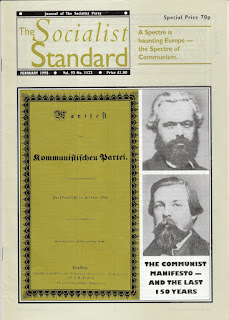
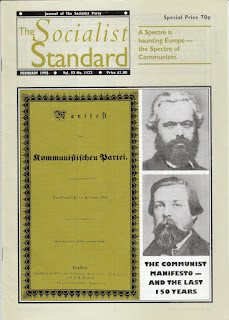
150 Years of The Communist Manifesto (1998)

From the February 1998 issue of the Socialist Standard
The Communist Manifesto remains a good introduction in their own words to the ideas of Marx and Engels. Here we summarise its contents and put it in its historical context.
It was not until the 1870s, when Marx gained some notoriety, that interest began to be expressed in his earlier works, including the Manifesto. It was first republished in German in 1872, then several other languages before the 1888 English edition. Marx refused to re-write it for the changed circumstances because, reasonably enough, he claimed that it had become a historical document which nobody had a right to alter. However, for the reader lacking an understanding of the context in which it was issued, it is all too easy to suppose that it was entirely a communist Manifesto. Yet if we are careful to distinguish the historically specific from the universal we can then see the communism (socialism) in the Manifesto.
It was translated into English by Samuel Moore (who had translated volume 1 of Capital) and "revised in common" with Engels for the "authorised" 1888 edition. However, this "authorised" version contains a large number of small but important alterations to Marx's original text. Compare the published version with translations of the original wording reproduced here, especially in section two. (See The Communist Manifesto, a Norton Critical Edition edited by Frederic L. Bender, 1988. Contains Prefaces, annotated text, sources and background information.)
The original title, Manifesto of the Communist Party, indicates that it was written for a particular organisation with particular purposes, at a particular time and place. Karl Marx (but not Engels) was commissioned to write the Manifesto by the Central Committee of the Communist League, a small London-based organisation of German refugees, in November 1847. The Manifesto was published in late February 1848, at about the same time as the revolutions of 1848 began-first in Paris, then in Berlin and many other European cities. The occurrence of widespread uprisings throughout Europe owed nothing to theManifesto, though members of the League were not alone in anticipating such an event. The contributory factors were food shortages and starvation brought about by the spread of potato blight, chronic unemployment and falling wages caused by recession, frustration at the feudal bastions of reaction in government, and revolutionary nationalism. In most cases it fell to members of the "petty bourgeoisie" (shopkeepers, artisans, small farmers) to organise revolution. They had suffered economic hardship in the previous few years, had the most to gain from a more progressive regime and potentially had the political clout to bring it about. The big capitalists had not as much incentive, having done well in the industrialisation sweeping Europe, and so often tended to ally themselves instead with the forces of conservative reaction. It was in this context that Marx and the League issued their Manifesto.
The famous opening declaration, "A spectre is haunting Europe-the spectre of Communism", was something of an exaggeration. Marx borrowed this already well-known imagery from Lorenz von Stein's book on communism in France, published in 1842. After the opening the Manifesto is then divided into four sections:
Bourgeois and Proletarians; Proletarians and Communists; Socialist and Communist Literature; Position of the Communists in Relation to the Various Existing Opposition Parties.
Bourgeois and Proletarians
The bourgeoisie (capitalist class) "historically, has played a most revolutionary part". They have pursued their class interest by gaining political control of the state, which "is but a committee for managing the common affairs of the whole bourgeoisie." The bourgeoisie, by pursuing its own self interest, has brought about great advances in technology and production. "The need of a constantly expanding market for its products chases the bourgeoisie over the whole surface of the globe." But the bourgeoisie has also created the proletariat (working class) and this class will in turn become the "gravedigger" for the bourgeoisie by recreating society in the proletariat's interests. "All previous movements were movements of minorities, or in the interests of minorities. The proletarian movement is the independent movement of the immense majority, in the interests of the immense majority" (original wording).
Proletarians and Communists
The Communists (meaning members of the Communist League) are distinguished from the other working class parties by the way "they point out and bring to the front the common interests of the entire proletariat, independently of all nationality."
The Communists are "the most resolute section of the working-class parties of every country" (original wording). Theoretically, "they have over the great mass of the proletariat the advantage of clearly understanding the line of march, the conditions, and the ultimate general results of the proletarian movement".
The Communist League wants to eventually abolish "bourgeois property" (private ownership of the means of production) and this also entails "the abolition of buying and selling." The bourgeois family must also be abolished ("prostitution both public and private") and nationality ("working men have no country"). The first step in the revolution by the working class is "to raise the proletariat to the position of ruling class, which is the struggle of democracy" (original wording). The proletariat will use its political power to take, "by degrees", all capital from the bourgeoisie, "centralise all instruments of production in the hands of the state" and "increase the total of productive forces as rapidly as possible".
The practical measures for achieving this "will of course be different in different countries." Nevertheless, "in the most advanced countries, the following will be pretty generally applicable." There then follows ten measures, including the "Expropriation of property in land and application of all rents of land to public purposes" (original wording), "a heavy progressive or graduated taxation" (original wording), "abolition of all right of inheritance", "centralisation of credit in the hands of the State, by means of a national bank with State capital and an exclusive monopoly", "centralisation of the means of communication and transport in the hands of the State", "extension of factories and instruments owned by the State", and "free education for all children in public schools".
When, in the course of development, class distinctions have disappeared, and "all production has been concentrated in the hands of the associated individuals, the public power will lose its political character" (original wording). Political power is merely the organised power of one class for oppressing another. When the proletariat, organised as the ruling class, "abolishes the old conditions of production" (original wording) it "will thereby have abolished its own supremacy as a class."
In its place we will have communism: "an association, in which the free development of each is the condition for the free development of all."
This second section of the Manifesto is controversial, with the measures at the end being mistakenly interpreted by some as communist (socialist) measures in themselves when clearly they are not. Two points should be made by way of clarification. First, the Manifesto was written with Germany in mind (though not exclusively). This was made explicit when the Central Committee of the Communist League issued its "Demands of the Communist Party in Germany" in late March 1848. This seventeen-point programme expands on the Manifesto's ten-point programme to the changed German conditions. It starts: "All of Germany shall be declared to be a single and indivisible republic." It adds at the end, above the signatories (which included Marx and Engels): "It is to the German proletariat, the petit bourgeoisie, and the small peasantry to support these demands with all possible energy." In short, Marx, the League and the ten measures in the Manifesto were encouraging a bourgeois-democratic revolution.
In the circumstances of the time it seemed logical to Marx and the League that they should accept that for the moment their interests coincided with those of the bourgeois democrats, until such time as the absolutist regimes had been overthrown, and should then continue their struggle against the new bourgeois regimes. It was assumed that "the bourgeois democratic governments" could be placed in the situation of immediately losing "all backing among workers" (Marx's address to the Communist League, 1850). Second, when the Manifesto was reprinted for the first time in 1872, Marx and Engels stated in the Preface that "no special stress is laid on the revolutionary measures proposed at the end of Section II. That passage would, in many respects, be very differently worded today." For instance Germany had become a unified bourgeois state the year before. In fact, many of the measures have since been implemented within capitalism.
Socialist and Communist Literature
In this section Marx discusses various other contemporary types of "socialism" and "communism". The Critical-Utopian Socialists (St. Simon, Fourier, Owen) are praised for revealing the class division in society, but are utopian because they refuse to advocate a class politics. This is understandable, given the level of development at the time the utopians wrote in the early nineteenth century. Nevertheless, their practical measures point to the abolition of class antagonisms: "the abolition of the distinction between town and country, of the family, of the carrying on of industries for the account of private individuals, and of the wage system, the proclamation of social harmony, the conversion of the functions of the state into a mere superintendence of production". The reference to the abolition of the distinction between town and country, and family, in the former case is evidence of an ecological critique of the way capitalism centralises and concentrates living space, in the latter case it is evidence of a critique of the gender roles imposed on women and men in a class society.
Position of the Communists in Relation to the Various Existing Opposition Parties
The Communist League fights for "the attainment of the immediate aims, interests of the working class; but in the movement of the present, they also represent the future of the movement" (original wording). The Communist League "turn their attention chiefly to Germany, because that country is on the eve of a bourgeois revolution." The Communist League "openly declare that their ends can be attained only by the forcible overthrow of all social orders up to now. Let the ruling classes tremble at a Communistic revolution. The proletarians have nothing to lose in this but their chains. They have a world to win.Working men of all countries, unite!" (original wording).
The final injunction to forcibly overthrow the old social orders was framed within the context of absolutist regimes with little or nothing in the way of a franchise. In such circumstances it did seem that force was the only way of bringing about change. Later in life Marx argued that the universal franchise meant that the working class might be able to bring about change peacefully by force of numbers.
The Manifesto was also written before Marx had sufficiently worked out his theory of value. A reference to wages tending to the bare physical subsistence level should not be taken as a theoretical proposition, but rather as a rhetorical flourish. The latter applies to some other phrases, such as the inevitability of workers' power.
Setting to one side the capitalist measures at the end of section 2, we can extract Marx's ideas on communism (or socialism, since Marx made no distinction between the terms as systems of society) which remain valid as a Manifesto for the twenty-first century:
  • Communists (Socialists) want to abolish private ownership of the means of production, buying and selling, the wages system, the economic enforcement of the family unit, the concentration and centralisation of living space and the state.
  • Communists (Socialists) want to replace this with democracy and a free association in which the self-development of each individual is the condition for the development of everybody.
  • Communism (Socialism) must be world-wide, because it is replacing a system which is world-wide.
  • It must be brought about by the revolutionary political action of the working class.
  • It must be brought about by the majority of the working class, not minorities.
  • Communists (Socialists) are the most determined and politically organised section of the working class, but they are not a vanguard leading the working class.
Lew Higgins