Showing posts with label SPGB Watford Branch. Show all posts

Sunday, June 22, 2025

Photographs and illustrations from the 70th anniversary issue of the Socialist Standard (1974)

From the June 1974 issue of the Socialist Standard

Blogger's Note:
This special 70th anniversary issue of the Socialist Standard carried a number of historical photographs within its pages. Some of the photographs tied in with specific articles, but a number appeared as standalone images illustrating aspects of the history of the SPGB. I thought it best to place all the images in one separate post. For certain images that tie in with a text, I've provided a link to the article where they originally appeared.


The handbill below was issued by the Watford Branch of the SPGB in 1905. This image appeared within Robert Barltrop's article, "Seventy Years for Socialism".


#    #    #    #

The undated photograph below is of the party headquarters in Great Dover Street, which was located in the Southwark area of South East London. This was the party's head office from 1929 until it was hit by a bomb - and partially destroyed - in 1941.

'Gilmac' mentions Great Dover Street in his September 1954 article, "Our Many Head Offices":
In 1927 Fitzgerald, with the aid of map and compass, succeeded in proving to a majority of the E.C. members that the Elephant and Castle was really in the centre of London. Anyhow we moved over near there to 42, Great Dover Street. We took an old house with three floors and a basement. One of the members made fittings for keeping the S.S. and literature in proper order in one basement room. The other basement room ( a very small one) had tables and chairs, and a stove on which a woman member cooked for those who wanted a meal. The smoke and heat in the little place was stifling, and getting out when one had finished was a problem.

The ground floor front room was used for selling literature and packing. There was a small shop front in which literature was displayed. The first floor consisted of one good sized room in which meetings were held as well as an occasional social—when the place shook as if it was about to collapse. E.C. meetings were also held in this room. Here we had some interesting discussions on the Spanish Revolt and at the beginning of the last war. In the room above lectures were given on many subjects during the winter months.
I know 'Gilmac' mentions 1927 in the excerpt above but Great Dover Street is first listed in the Standard as the Party's Head Office in its June 1929 issue.

I've always wondered if the young woman front and centre in the photograph was May Otway. I guess I'll never know.


#    #    #    #

The text accompanying the photograph below from the Standard was 'Conference photograph, 1928. at Fairfax Hall. Harringay, where Party Conferences were held from 1910 to 1936.' 

There's a strong chance that the bald man holding the board at the bottom centre of the photograph was Ted Kersley.


#    #    #    #

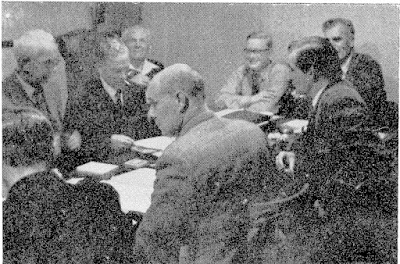
The text accompanying this photograph was 'No leaders: The Executive Committee in session, 1956.' It was part of the article "This is Socialism !'" I believe the younger man with the darker hair in the right of the photograph was Robert Barltrop, and the older, bald man to his left was Harry Young. ('Horatio')


#    #    #    #

Clifford Groves contested the Paddington North constituency for the SPGB at the 1945 General Election. He also stood in the same seat in the 1946 by-election. The July 1945 issue of the Standard carries the Party's election manifesto.


#    #    #    #

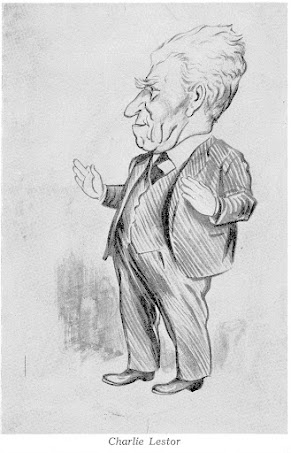
Both the photograph of Jack Fitzgerald and the cartoon caricature of Charlie Lestor were part of the "Some Members" article. I'm guessing that Robert Barltrop drew the image of Lestor.


#    #    #    #

The Metropolitan Theatre was located in Edgware Road, and was used on many occasions in the 1940s and early 1950s when the SPGB were contesting parliamentary seats in Paddington, but also when the Party held mass rallies. By all accounts these mass meetings had upwards of two thousand people in attendance. This photograph accompanied the "Early Election Campaigns" article.


#    #    #    #

No name for speaker on the platform. This photograph illustrated the "On the Platform" article.


#    #    #    #

Sadly, no names are listed but members of Walthamstow Branch in the late 1920s included, amongst others, Mr and Mrs Francis Brooks, Maurice Cole, Thomas Davis, C. Elliott, A. J. Godfrey, A. McDermott, May Otway, L. Otway, Jane Robinson, Frederick Wellavise, J. Wilkinson, S. E. Williams, Byron Young and Percy Young.

Surely May Otway is in this photograph? I know I keep mentioning her but she was one of my favourite Socialist Standard writers in the interwar years.


#    #    #    #


So, here's the conundrum: The June 1974 Socialist Standard states that the Conference photo below dates from 1950 but when it was included in the June 2004 Socialist Standard, the text said the photo was from the 1951 Annual Conference. I demand a recount.

As a point of interest, the September 2004 issue of the Socialist Standard carried a letter from Richard Botterill, identifying two of the delegates from Dartford Branch in the photo. (Spoiler alert: one of them was his dad.)


With regards to the June 2004 Standard already mentioned above, that was also a special anniversary issue  and it also carries a number of photographs relating to the history of the SPGB. I recommend you check it out. It serves as an excellent companion to the June 1974 issue.

Thursday, April 3, 2025

Party Notes. (1907)

Party News from the November 1907 issue of the Socialist Standard

The Quarter ending September saw a record in the number of new members. It is scarcely to be hoped that the winter quarter can see that record broken, but the opportunity of the winter season should be taken advantage of to inaugurate branch discussions and thus assist in turning out new speakers for next year.

* * *

On October 8th the E.C. passed the following resolution : That this meeting of the Executive Committee of The Socialist Party of Great Britain, in view of the public pronouncements of the British Constitution Association hereby challenges that body to appoint a representative to meet a representative of this, the only Socialist party in this country, to publicly debate the following proposition : That as Capitalism involves the exploitation and economic subjection of the working class, the only necessary and useful section of the community, it is necessary and desirable to speedily attain the Object of The Socialist Party of Great Britain, viz., the establishment of a system of society based upon the common ownership and democratic control of the means and instruments for producing and distributing wealth by and in the interests of the whole community.

* * *

As yet no reply has been received from the champions of capitalism.

* * *

Since this resolution appeared in the Press, Mr. H. M. Hyndman has written to the Daily Telegraph that the S.D.F. is the “only international Socialist Party in this country.” So that, not satisfied with their own brand new name, the S.D.F. wish to annex ours, and also our reputation.

* * *

An enquiry was received from Brighton, on the attitude of the S.P.G.B. to the question of National and Imperial Defence.

* * *

The reply contained the following: The object of the S.P.G.B. implies the assumption of political authority by the working class. Until that object is attained, the capitalist class will control the armed forces of the nation for the defence of capitalist interests. The attitude of the Socialist working class when politically supreme on the question of national defence (should such a question then remain for solution) will depend upon the deliberations of the Socialist Commonwealth in the circumstances of the time.

* * *

The Watford Branch of the S.P.G.B. questioned E. E. Hunter while speaking for the S.D.F. and challenged him to debate with a representative of this Party. He agreed, but referred us to the Watford S.D.F., who have not up to the present replied to our request.

* * *

It is surprising how the “sweet reasonableness” of those who are not “impossiblists” is sometimes manifested !

* * *

The speaker for the Wood Green I.L.P. was also challenged in a similar way. Again we are referred to the local branch, with, as .yet, a similar result.

* * *

Matters are shaping well in Burnley, and before the next issue is published, no doubt the branch will have been officially formed. Meanwhile sympathisers should communicate with C. H. Schofield, 77, Parliament St., Burnley.
Adolph Kohn

____________

Art, Labour, and Socialism should sell well. It can be obtained by branches and other bodies in the ordinary way on the usual terms : 9d. per 13. Half gross orders carriage paid.

Friday, December 27, 2024

Obituary: Eric Boden (1975)

Obituary from the April 1975 issue of the Socialist Standard

We regret to report the death in December last of Eric Boden. He joined the Party in 1912, and was already writing for the Socialist Standard before the first world war.

With some interruptions he continued to write until he dropped out of the Party in 1953, though his interest in Party work remained. At one period he went to East Africa and was conscripted to the army there. Old members will remember the articles he wrote about developments in East Africa, and he contributed many other valuable articles.

He became the branch secretary of our former Sheffield Branch, and at another time was a member of the Watford Branch. He spoke on the Party platform in Sheffield and Doncaster, and occasionally attended Conference as a delegate. His wife also was a Party member. Boden was a persuasive and knowledgeable speaker, and wherever he went he devoted himself to making the Socialist case known.

Friday, July 26, 2024

Apostles of Confusion. (1907)

From the April 1907 issue of the Socialist Standard

The last strains of the “Marseillaise” (it’s all right, Mr. Editor, this is not a tale of the French Revolution)—the last strains of the “Marseillaise” were being sung when two comrades of the Watford Branch and myself entered Clarendon Hall, Watford, on the evening of Friday, February 22nd. We found an audience of about 300 assembled to hear addresses by Hyndman and Gribble (of Northampton) on Social-Democracy. The meeting was being held under the auspices of the Watford S.D.F., I.L.P., Trades Council, and Labour Church.

To make speeches that would suit such a mixture of psuedo-Socialists, “Labour” men .and reformers as were here gathered together would tax the capabilities of the best S.D.F. speaker, and that is saying much. Anyway, Hyndman and Gribble tried, and whether they succeeded in tickling the ears of their audience or not, they certainly never gave a clear exposition of Socialist principles. At least, that was our opinion, but then perhaps we are “too scientific.” As we took our seats, the chairman, Mr. Gorle, who proclaimed himself the only working-class representative on the local bodies, was reading apologies for non-attendance from Lord Hyde and other class-conscious individuals.

The chairman then made a short speech intimating that an S.D.F. candidate would be run for the County Council. Gribble was called upon and proceeded to speak on “Social-Democracy and the Present Political Situation.” After a few preliminary remarks (including the usual compliments to Hyndman) he assured us “that it was never more necessary than it was to-day for Socialists to work along the straight path,” a remark that called forth loud “hear, hears ” from the S.P.G.B. men.

He then traced the evolution of the Socialist movement in England. He stated how the S.D.F. had fought alone for many years; told us how the I.L.P. came into existence as an independent political party only, but gradually evolved until it differed but slightly in its principles from the S.D.F. He told us of the desire for fusion that grew up in the two parties, of the vote taken and carried by a large majority, but did not tell us why the leaders refused to carry out the mandate of the members.

Briefly scanning the events that led to the formation of the L.R.C., he tried to make clear the S.D.F. position in regard to that, body. He said “it was a policy of friendly criticism and advice.” We (the S.P.G.B.) know where that policy has led.

He then told us how disappointed he was at the past year’s work of the Labour Party, and proceeded to criticise its members. He dwelt with bitterness upon those “Socialists” who opposed the adoption of a Socialist programme. The speaker complained of the way the decisions of the Labour Conference had been set aside by the Executive body, and of the way in which, after Quelch and others had by superhuman efforts managed to make the trades unionists swallow an “Universal Suffrage” resolution, the Labour members had disregarded that vote, and had allowed individual members a free hand to support or oppose any measure they liked during the coming session.

“They,” he said, “think that they alone are the Labour Party, and that the thousands behind them in the country are a mere nothing,” and he grew sarcastic about Shackleton’s withdrawal of the Old Age Pension amendment upon Mr. Asquith pointing out that it was a censure upon the Government. Then finishing up with the statement that the workers should put their trust in Socialists and disregard everything except the establishment of a Socialist Republic, Gribble sat down.

All this was very interesting. It might have been news to the audience, but it was merely what we had predicted come to pass.

Is Gribble’s feeling toward the Labour Party the feeling of the S.D.F.? Did his remarks please or offend the members of the local branch ?

As regards the S.D.F. as a body, we know that they occasionally utter a few criticisms of the Labour Party but all the time are supporting it. As regards the local branch, it is their duty either to repudiate Gribble or to repudiate and oppose the local Trades Council, I.L.P., and Labour Church.

But we know they will not do either. They will play the old game of being “all things to all men,” and nothing of any real value to the working-class movement.

The chairman then introduced the principal speaker of the evening, Mr. H. M. Hyndman, who started his speech by saying, as he usually does, that he never worked but lived upon those who did. We had heard this before, but the audience had not, and cheered in the usual way. It always fetches ’em.

The speaker then went on to show the desirability of certain reforms, dealing at length with the question of Free Maintenance. “After years of agitation,” he said, “we have at last got in the thin end of the wedge.” Afterwards in answer to a question, he admitted that this much desired reform would only produce better wage-slaves for the capitalist. He enlarged upon the benefit of Better Housing and Old Age Pensions. In stating that the opposition to Socialism arose largely from ignorance, he said that he had sufficient faith in humanity to believe that, did but the governing classes only know what benefits would accrue from Socialism, notwithstanding their desire to dominate others, they would join the Socialist movement !

And so his speech proceeded, “boxing the compass” politically, industrially and ethically, hinting vaguely at revolution, dealing in detail with useless reforms, but never giving his audience any real insight into scientific Socialism.

After the collection, questions were called for. Comrade Wilkins asked the speaker how he reconciled his statement that the capitalist class would welcome Socialism when they saw what benefits would come, with his supposed belief in the Class Struggle and the Materialist Conception of History as expounded by Karl Marx.

Mr. Hyndman answered that no reconciling of statements was needed, that although he believed in the Class Struggle, he believed that when the capitalists recognised the advantages of Socialism they would welcome it. Yet previously in his speech he had quoted Marx in agreement with his contention that, however much peaceful revolutions are expected, history always proves the expectations false ; that force is the deciding factor.

We sent up two other questions. One: was he in favour of economic organisation of the workers on a class basis, and if so could the present trade unions be altered to such ? To this he replied that the outlook in the trade unions from a Socialist standpoint was hopeful, and seeing that many of their officials were S.D.F. men the future should see a more Socialist position taken up. The other question was: The Watford S.D.F. claimed to be revolutionary Socialists : if they believed what Gribble said to be true, would not the proper attitude to be taken up towards the Labour Party, both locally and nationally, be one of hostility ?

But he would not have it. He could see the red light. “He wanted no rift within the lute” in Watford. So he said it was not his business. He left it to the local branch. He had never been a “Labour” man.

Of course it was not his business. Had he supported Gribble against the “Labour” crowd what a position the comrades would be in with an election coming on ! It would not have paid. “We are willing,” he said, “to work with those who go a little way with us and thus try and bring them in touch with Socialism.” And this is what Hyndman has spent twenty-five years of his life for.

. . . . . . . . . . .

Afterwards, when I had bidden my friends “good-night,” and braced myself for my four-mile walk home along the moonlit country lanes, the pity of it all came to me.

With machinery and industrial organisation rendering larger masses of men superfluous; with the intensity of production lowering man’s vitality; with the position of the workers becoming more precarious and the struggle for existence becoming keener ; with all the degeneration, poverty and hunger, with all the horror—there is no other word—of capitalism, yet they have no other message for the workers than this.

For two whole hours, having before them three or four hundred men, probably open to receive the truth, they had told them half truths that are worse than lies. Men who, properly guided, might have become members of a sound Socialist party, were deliberately led into the disappointing wilderness of reform.

What can one think of it?

Does Hyndman know the futility of these reforms he advocates ? Does he know he is misguiding the workers ? Has he not learnt the lesson that years of struggling for these things with no avail should have taught ? Can he not see that even if they were of any use the very best way to get them would be by the revolutionary method ? Does he not perceive that by side-tracking the working-class movement in this way he is delaying the day of the wage-slaves’ emancipation ?

If he does not see, then he is a blind leader of the blind, and should not be listened to. If he does see, then he is wilfully misdirecting the precious energy of the workers and should be exposed. Whichever way it is, we of the S.P.G.B. know our duty and are prepared to do it. We may be dogmatic—so is Science. We may deal with persons sometimes : but the act of any man that rivets the chains tighter upon the limbs of the workers is too tragic in its consequences to be lightly passed over. We may be small in numbers, yet we know that our efforts are exposing the misleaders of the working class and are teaching those principles that will help to bring about the abolition of capitalism in the quickest and surest way.
F. Hesley


Blogger's Note:
The Watford Branch member of the SPGB mentioned in the report of the meeting, Tom Wilkins, was the last living founder member of the SPGB when he died in 1970 at the age of 89. As his linked obituary states he was better known as 'Tom King', adopting the pseudonym during the First World War.

There is no record of a F. Hesley in the early SPGB records, so it was possibly a pen-name.

Saturday, January 20, 2024

From Our Branches. (1906)

Party News from the May 1906 issue of the Socialist Standard

West Ham.

West Ham is neither dead nor asleep, although so far as branch reports in our Organ are concerned some comrades might he justified in having come to that rash conclusion. Neither he “with lips of livid blue” nor his fraternal relative “rosy as the morn,” has been reigning here. The fact is we are poor, and have been experimenting on silence to see if it be golden. We have empirically demonstrated the hollowness of the platitude : all we can say in its favour is that silence seems to be cheaper than speech, seeing we are in debt for our branch advt. Like the bears, the dormice, and other sweet children of Nature, however, we must confess to a more somnolent attitude during the hybernating period than in the season of out-door propaganda. In Winter we can get no raw material on which to exercise our propagandist power; sensible men, the kind we want to convert, will not stand to be frozen, so all we can do is to drill, to sharpen our weapons, and otherwise get ready for the Summer campaign. We have done a bit of that, and are now in the streets carrying on the war. Several successful skirmishes have already taken place, and an assault in force was made on East Ham on Saturday 21, led by Comrade Anderson. Several supporters of the brewing section of the capitalist class turned up as usual and opposed in their usual undisciplined manner, but also some “bonnie fighters” appeared, and were bonnily fought. Anderson hits straight and hard. He is coming back : so are some of his opponents when they have recovered.

At our Forest Gate station we seem to have struck a better vein this year than last; and one of our apprentice-lecturers has drawn a strong opponent—a Mr. C. Quinn—who objects to our revolutionary attitude, claims to be a Socialist himself, believes and is prepared to demonstrate that Socialism is only to be established through a long series of reforms, only useful in their educational effect and as stepping-stones to Socialism. As this gentleman has signified his readiness to debate the whole question with a representative of our Party, the Branch is arranging a meeting.
G. C. H. Carter (Branch Reporter.)


Tooting.

Still young and still vigorous, going right out for Socialism as the only remedy for the condition of our class, carefully avoiding everything likely to mislead and confuse, what time we do all that we may to combat the influence of those who seem, deliberately and of malice aforethought, to adopt exactly opposite methods.

We have received an invitation from the local Trades Council to send delegates to a conference convened to draw up an ideal programme suitable to all sections of the Labour Party. We know those conferences and those ideal programmes and have respectfully declined to accept the invitation. Our members are quite satisfied with the Party programme as expressed in the Declaration of Principles, and from our intimate knowledge of the Trades Council gentlemen (whose ideal programme at the General Election consisted in an appeal to the workers to vote Liberal) the outcome of their earnest deliberations is not likely to embody an improvement upon our present position. For the same reason we are not drawn to assist “Clarion Van” propaganda. We prefer to remain Socialist propagandists all the time, thank you.
R.B.


Watford.

We promised ourselves that at the forthcoming Urban District Council Elections we would make ourselves heard and—it was so. We issued a manifesto, and pressed into it as simply and directly as possible a statement of the working-class position, and some of the reasons why we were obliged to deliberately range ourselves in opposition to every candidate standing for election, even those specially claiming to voice working-class interests. In the result the pseudo-labour gentlemen whose pretentions we particularly directed our argument against were all defeated by large majorities.

As to how far our Manifesto helped to this end we do not pretend to say, but we know that the possibility of the issue of such a document was regarded with much misgiving by some of the “Labour” candidates’ followers, who have not hesitated to lay the responsibility for their catastrophe at our door. We accept the responsibility. We would accept far greater responsibility if such were incurred by telling the truth that alone can make the workers free. We have no concern for “victories” gained by cloaking facts. Our business is to disseminate facts, all the facts and nothing but the facts. It was to facts that we confined ourselves in our manifesto. Therefore if the “Labour” candidates were defeated through our manifesto it was because the facts against them were too strong; because they were in conflict with the truth.

The incidents connected with the issue of our leaflet may be interesting. One is specially noteworthy. While our secretary was arranging with the printer, the editor of the little monthly sheet which the “Labour” party here issue, called. Subsequently the printer, who was also printer of the little journal mentioned, intimated that he had found he could not do our job. Why ? Because he had received instructions to keep the “Labour” journal “up,” and so could not use the type to print our manifesto ! Here was a predicament ! We had only a day or two to get it out. We tried half a dozen local shops. Only one could do it in the time, and the price asked was 100 per cent. higher than the first firm’s ! As a last resource we posted the MSS. to a London printer. It was turned out at top speed. We had no time to read a proof (which will account for one or two sentences reading awkwardly). We had the copies wet from the press and rushed them out the same night. It was a near thing.

We mention all this for two reasons. First to call attention to the act of the “Labour” journal’s editor which temporarily stopped our manifesto against the “Labour” editor’s party. Secondly, as an answer to those who, we hear, are alleging against us that we went to a “rat” shop for our printing. We don’t know whether our printers were trade union or not, although an objection of that sort coming from persons who are probably clad in sweated garments and certainly use some articles produced by sweated labour, does not perturb us. We only point out that even were our alleged offence as heinous as some of the “Labour” Party, for lack of other ground for criticism, would have it believed, they themselves by the act of their representative are responsible.

Heartiest thanks to all comrades and friends who lent us such ready assistance. No room for more this report.
The Branch.

Saturday, September 9, 2023

From Our Branches. (1905)

Party News from the September 1905 issue of the Socialist Standard

Romford Division.

Now that the East Ham Branch has commenced its useful career we can no longer claim the title of the Romford Division Branch, and this may be our last report under this heading. We who have been responsible for the hard slogging work in this Division have every reason to congratulate ourselves upon the results of our labours. Not only have the East Hammers been helped upon their feet, but considerable additions have been made to the membership of the parent branch. Since March, by dint of sheer hard work we have nearly trebled our membership, likewise our speakers, so that to-day this branch possesses five speakers capable of defending the Socialist position against all comers. We have lately extended our sphere of propaganda to Barking with every prospect of forming a local branch there before the outdoor season is finished, after which the market town of Romford will receive our attention. Sympathisers in district are invited to club premises any evening after 8 o’clock, when wre shall be glad to make their acquaintance, and to put them in the way of becoming members of the only militant organisation in the district.
H.C.P.


Islington.

The Islington Branch is well maintaining its stronghold in Finsbury Park, and we are steadily and surely convincing our audiences that we are the only party out for the entire abolition of the capitalist-class. Without in any way drawing the “long bow,” I can report that our Sunday meetings have been among the largest meetings held in the Park for some time past. The great interest shown by the audiences, and their inquiring attitude, foreshadow a large influx of class-conscious workers into our ranks in the near future. Within one month of the issuing of the Party Manifesto we sold 310 copies—we will soon have sold 500. The Party Organ is selling well. We sold 65 copies of No. 12 at our first Sunday meeting in August. We assure our comrades, especially the Paddington stalwarts, that they will have to look to their laurels as we intend to head the list in sales of Party literature.

Our comrades have successfully repelled the attacks of every other political faction who week by week congregate here. We have had a Mr. Wilson (Cobdenite) in opposition to Comrade Fitzgerald, while Comrade Lehane has knocked holes in Mr. Sansom’s (Tariff Reform League) facts and figures. Representatives of every party have an opportunity at these meetings of taking the platform against us and of showing where we fail to lay before the working-class a clear and logical position. Yet we still breathe !

At the corner of Highbury Fields, where we hold first-class meetings every Wednesday evening, there has just been erected a statue “In loving memory” of ninety-eight Islingtonians who died for their country in the last South African butchery. What of the memory of their widows and orphans ? Does the sight of this piece of cold statuary relieve their pangs of hunger ? Do their pinched and haggard faces light up with a “holy joy” when, instead of their bread-winner, they find a mass of comfortless bronze ? The little children cry for bread and are given a stone !

It is our mission to do what men may to usher in the glorious days of Socialism, in which oppression and butchery shall find no place, but a joyous existence for all shall be assured.
C. Thorp


Watford.

Fellow members of the Watford Working-Class,

We put it to you that the organization which, claiming to be democratic and to have a free platform, declines to answer questions relating to its political attitude and refuses to defend in public discussion the position it has taken up (although it is quite willing to discuss that position in private) is an organization that has something to conceal.

The S.D.F. is such an organization. What it has to conceal may be clearly seen by a reference to the Manifesto of The Socialist Party of Great Britain (price 1d.) obtainable at the Sunday evening meetings of the Party in the Market Place, or from the local secretary.

Can an organization be “democratic” and refuse to answer questions directly relative to its existence ?

And what is the value of its claim to the possession of a “free” platform if it closes that platform to discussion ?

What is the value of its claim that it educates the working-class when it refuses to use one of the best educational weapons it has—public debate ?

What is the value of its claim that it organizes the working-class upon the basis of its class interests in opposition to the capitalist class when time and again it gives its support to the capitalist interest ?

Can an organization support the capitalist interest and the labour interest when, on its own showing, those interests are absolutely opposed ?

Can any organisation, except it lack wisdom or honesty, hold that it is serving working-class interests by supporting avowed representatives of capitalism ?

An honest organization lacking only wisdom would readily champion its attitude in public discussion; but what of the organization which, having the evidences of its stupidity brought under its notice, refuses to discuss those evidences? Is it lacking wisdom or honesty ?

The local Branch of the S.D.F. was formed regardless of the existence of the local I.L.P., yet no member of the Watford S.D.F. can show a single point of material difference between the two bodies. What then is the value of the S.D.F. protestation in favour of what it calls “Socialist” unity?

These are a few of the questions we ask you to answer for yourselves and to insist upon the members of the local S.D.F. answering. They will doubtless endeavour to stave off your interrogations by irrelevant talk of “abuse,” “misrepresentation,” “vilification” and so forth. When we ask these questions they call it abuse ; when we ask you to note their replies they call it misrepresentation.

Do not, however, allow them to put you off the scent. Read the Manifesto of The Socialist Party of Great Britain and satisfy yourselves that we have sound ground for our impeachment of the S.D.F. as a working-class organization and then call upon them to justify their position or go.
The Watford Branch.

Thursday, August 31, 2023

Classic Reprint: At the conscientious objectors tribunal (1964)

A Classic Reprint from the August 1964 issue of the Socialist Standard

A Devine Comedy of the Watford Tribunal
Dramatis Personae

Lord Clarendon – Chairman.

Mister Hudson – Clerk to the Council.

Mister Longley – Draper.

Mister Clarke – House Builder.

Mister Solomon – Photographer.

Mister Gorle – Solicitor, Conscriptionist, Labour Leader and acquainted with the King of the Belgians.

Crowd of N.C.F Men, Comrades, Constables and attendants.
————–

The Bushey and Watford comrades did in the month of March appear before the local Tribunal with the now familiar result.

The chairman was the Lord and the Military Representative, symbolically enough, was on the left hand of the Lord. A Draper sat next to a House Builder and a Solicitor next to a Professional Photographer.

To the right of the Lord’s chosen people were portraits of two old-time councillors done by a Bushey painter, who, when he has no commissions from local legislators, will condescend to paint angels for church windows. These pictures were as interesting to artists as pathology is to humanitarians. No cantankerous sentiment could be detected on their placid faces, for when the local man took up his brushes there was no European War and all the Conscientious Objectors had been robbed of their telescopes and books and burned and decapitated many centuries ago.

But I must not digress now for I am come to the point when the Lord spoke. I had arrogantly suggested on my appeal paper that what was valuable and precious in Art and Science and Literature had emanated from intellectual research; and that militarism either supported or created all those things hostile to a free and secure existence. Before I came to these chosen of the Masters I had suggested that intellectual progress and military pursuits are antagonistic. Then when the Lord asked me if I was a Quaker I saw that my policy and sentiments still remained misunderstood, so I rose to explain that I had accepted the communistic principles of Karl Marx, and consequently believed that the world could not progress towards a beautiful ideal of society or a scientific one until the nations federated on an amiable basis. But while these words were yet unspoken the Solicitor, with prophetic acumen and godly insight, denounced them as “Propaganda”, while the Chairman said he was there to “elicit facts and not listen to speeches”.

This last indiscreet sentence must now pass as ignorance. This is the more lamentable as had it read, “elicit facts and not listen to the evidence” it would have passed with the public, not as bias and illiteracy, but as a decisive, rich, and becoming paradox. I had further evidence to show that the literature of Greece had done more for humanity than the wars of Greece; that Van Tromp, with all his magnificence did not do so much for Holland as Rembrandt and Discartis; that the Spaniards’ best day was not when the Armada was loosened but when Valasquez took up his palette. The Lord waved me down. How could I rise from my insignificance? I only had on my side the lessons of ancient decapitated scientists and charcoal heretics while the Tribunal were greatly inspired and strengthened by the methods of Torquemada. Their actions taught me that the man with estates was in the place of Democracy; the Camera Man in the place of the Artist; the Attorney in the place of the Economist, and the Draper of Bodies in the place of the Humanitarians. Before the Tribunals the appellant with artistic ideas is dismissed, the man with rheumatism postponed, and the wine merchant exempt from military service. Then after having stopped me speaking in my own defence one had the temerity to ask if I objected to bloodshed.

Our comrade Russ sat next before the Tribunal and his case was dealt with in the same clean and aristocratic spirit. They “elicited” genealogical facts about his grandmother and partly forgotten brothers; details which are most valuable to any analysis of scientific ideals or the individual conscience. But while on the side of lineage the examination was most wise and thorough, there are three small points to which the Tribunal was inexcusably indifferent. I admit that a consideration of the forgotten details would in no way have altered the result of the trail, for in all cases the conduct of the Tribunal showed great forethought and preparation. In no instance can I remember a hasty and spontaneous injustice being done to the appellant, for the Socialists were only dismissed after careful consultation with the versatile Labour Leader, while the Religionists were dismissed only after the Chairman’s chat with the Christian member. The first of these three unconsidered trifles in Russ’s case was that he wore a black scarf of crepe-de-chine, which should have been noted by at least one member of the Tribunal for its photographic possibilities; the second, that sometimes in the summer he slept in the open at night, which should have been elicited and condemned by the Builder; the third, that as a Socialist he would not fight in a capitalist war, which should have been considered by all, as in this assertion, all were alike equally implicated and condemned. But if we review the matter with a milder and less intolerant mind we will understand that if Russ did not know what parts of his Marxian economics were a heritage from his grandmother, his own statement of International Faith is, in the ten or twelve eyes of the Tribunal, robbed of half its value. But the trial ended well, for, as he declared he would not do medical work and assist the wounded, the Tribunal considerately gave him non-combatant duties in which he will only have to help the injured.

When our comrade Hudson sat next in the chair the modern God filled his pipe and the Clerk read the appeal. It was a reiteration of the communists’ ideal of Wealth Production. The Lord asked what denomination he belonged to. Now with myself, as I have a pale face, there was some pertinence in the Quaker question, but with Hudson it is different. He is not sickly or peevish; there is not a trace of suffering on his face. It would have been more relevant to have asked the noble Lord if he was the only support his wife had or ask a poet if he sold matches. Our comrade replied that he was an atheist. The Christian Draper sniffed. A man here who would not submit to Kitchener and denied the authority. “You are one of them who resent all kind of control then, eh?” he said. “Not all control”, our comrade replied, “only such as you have.” The Chairman was indignant to hear a youthful idealist give such a retort to a shopkeeper who has sold the best linen within a farthing of a shilling in the town; to a man who has distributed more bibles and advertisements and subscribed to more church organs in a year than the applicant would do in fifty years. In these days of heresy and commerce one can forgive a taunt to God, pass over a slight to Kitchener, but what Chairman of what Tribunal can pass over an Internationalist’s insult to a homely employer. He cautioned our comrade and later dismissed the case.

The next judgement was to be upon our comrade Wilkins. He too was an Internationalist. Had the first been the only one of the day the idea could have been discredited and regarded as isolated Quixotism and futile faith. The poor, bewildered master of the show moreover learned that this Socialist was a Monist. “What is a Monist?” Alas! My Lord, you have given Oxford over to ignominy; the hallowed pile is desecrated. In the past, we were told, much damage and havoc was done with the jaw-bone of an ass, but it was infinitesimal compared with that done to the gray and hoary university with the jaw-bone of our Tribunal Lord. Alas! Poor Chairman, you came, you told me, to “elicit facts” but you remain to complete your education. Although comrade Wilkins explained on his appeal paper that he could more effectively assassinate Rothschild with a new ideal or a new economic law than with an old hatchet—although unlike an Indian God he did not wear a necklace of human bones or a girdle of human skulls, they still enquired whether he was prepared to take life. He replied that he did not believe in the sacredness of the individual existence, only in the sacredness of humanity, and would therefore help to establish Socialism by the ballot if possible but by force if force was essential. “We dismiss your case, Mister Wilkins.” As the lordly judge spoke his loyal mouth pennies to the Escutcheon. “You may appeal to the County Tribunal”, he said. “To the County Press Gang”, our comrade retorted with such truth and emphasis that it became quite inaudible to the Newspaper Correspondent.

There was a long hush. The last of the pearls had been cast before the Tribunal.

The Draper demanded that the room should be cleared of the public. This was assented to by the Labour Leader, and endorsed by the Lord.

No one moved.

Then in this Earthly Paradise the Provincial God’s still, small voice with a slight Oxford accent, said “Let there be police”, and there were police. But this latter day Lord’s behests are not so instantaneously obeyed as formerly, for his wand is only a telephone and his angels wear thick-soled boots.

So there was still time left for further heresy and the “Red Flag” was sung, and just as it ended the Constables entered the room and faced the perplexed Tribunal and those pigment Councillors on the walls, whose pensive eyes are fixed on the distant utopian Watford when each of the ten thousand inhabitants was docile and diligent and none had dreamed of Marxian Economics.
H. M. M.

(Reprinted from the Socialist Standard, May, 1916)

Thursday, July 27, 2023

Party Notes. (1905)

Party News from the June 1905 issue of the Socialist Standard

Until further notice, the Executive Committee will meet on the first Saturday and third Tuesday in each month at 3 and 7 p.m. respectively, at the Communist Club, 107, Charlotte Street, London, W.

* * *

On. Sunday, 11th June, there will be held a Party demonstration at Watford, and on Monday, 12th June, will take place the first Anniversary Reunion in celebration of the establishment of the Party. Particulars of both meetings will be forwarded to the Branches in due course.

* * *

The reports to hand concerning our out-door propaganda are very encouraging, and excellent results will doubtless accrue to the Party. The idea ought to be not so much the holding of a great number of meetings as to see that a certain number of meetings are held regularly, so that the audiences may rely on hearing an address at the advertised time and place..

* * *

Socialist propaganda and unpunctuality have been largely synonymous in this country. The S.P.G.B. will change that.

*  * *

Each Branch, in addition to its regular Sunday meetings, should hold at least one week-day meeting, and the young speakers should be given every opportunity of developing. Active and vigorous propaganda is the need of the moment and all other work should be subordinated to the task of conducting meetings, pushing the Party Organ, and spreading the light.

* * *.

Many kind friends were of opinion that our organisation would not survive the  winter, but that was because they assumed the men and women who form the S.P.G.B. to be of the same calibre as the members of other organisations claiming to be Socialist. Those who rallied to the call when circumstances demanded the formation of our organisation were thoroughly cognisant of the nature of the task with which. they were confronted, and the efforts put forth during the first twelve months of its existence are but an earnest of what will be accomplished ere another summer goes by.

* * *

When obtaining handbills or other printed matter advertising meetings, etc., branch Secretaries should not fail to have included thereon an invitation to read the Party Organ. It is important that every possible opportunity of advertising the SOCIALIST STANDARD be seized.
C. Lehane.

 
Official Notice.

To all Party Correspondents. 

Branch Secretaries, members and others sending communications to the Central Office are requested to address them to C. Lehane, General Secretary, and to indicate such letters as are intended to be dealt with by the Executive Committee by writing the words “Executive Committee ” on the left hand top corner of the correspondence.
C. Lehane, 
General Secretary.

From Our Branches. (1905)

Party News from the June 1905 issue of the Socialist Standard

Watford.

Last month we were, according to a certain “organ of Social-Democracy,” financially ruined for months to come. We had also been “effectually disposed of” by—of all the good and harmless persons in the world—Mrs. Jarvis! who, together with other champions of irreconcilable and uncompromising class consciousness (S.D.F. brand), did their little best to help return candidates in whose programmes the eye of Faith, peering through the most perfect of microscopical appliances, would have failed to discover a distinctive labour characteristic, and who appealed piteously for votes on the ground that they would look after “the best interests of all”! Yet we have quite cheerfully commenced to financially ruin ourselves some more by running a series of meetings in the Market Place on Sunday evenings, at which we shall be pleased to welcome S.D.F.’ers or what-not, and to make clear how well Mrs. Jarvis (or whoever was responsible) has succeeded in deluding the writer of the note referred to into believing (if indeed he did believe) that we were disposed of. Nothing, says the report of the S.D.F. oracle, was spoken but undiluted Social-Democracy, Thus:—
We want the children brought up with wills free and strong in the image of God.
Socialism means the abolition of idlers at both ends of the scale.
Socialism means a fair return to the workers for their labour.
Etc., etc., ad nauseum. Samples of diluted Social-Democracy would be interesting.

We took the opportunity the elections presented to distribute some thousands of a special pamphlet dealing with the local situation. Of course the wrath of our “labour leaders” was aroused, but they will doubtless recover. We are quite ready to justify our action on the public platform as they well know, and that is probably why they give our public platform a wide berth.

The Raunds strikers passed through this town twice. The “Labour” Party supplied tea the first visit. The Liberal Party did ditto the second. Effect—confusion worse confounded.

And there are so few of us to clear the issue and keep it clear. But we go forward doing all a few men may, knowing that the future is with us ; that we hold the key to the door through which the workers must pass to their emancipation. And it is well.—THE BRANCH.


Islington.

We have emerged from winter-quarters and initiated our 1905 open-air campaign. On May 7th we had an excellent meeting in Finsbury Park, with plenty of questions and opposition, 50 copies of the Party Organ sold and a good collection. A local supporter of Mr. Percy Alden, Liberal and Labour Candidate for Tottenham, challenged us to debate. We at once closed with the offer, and on Sunday, 14th, the encounter took place. An ex parte statement that we had the best of it may scarcely be a fair way of putting it, but at any rate the meeting was large, so was our collection, and again we sold 50 copies of our paper. On the following Wednesday we engaged the enemy at Highbury Corner, and forced the representatives of the local I.L.P. to accept a challenge to debate, which comes off on Wednesday, 24th May. This will afford us a good opportunity of exposing the pretensions of those who are trying to resuscitate the I.L.P. in Islington, and of exhibiting in their true colours the mar-eadh Socialists. In Islington, as in other parts of this country, those who call themselves Socialists can be divided into two classes, viz., those who believe in Socialism and those who don’t. It is our business to get those who believe in Socialism to join the S.P.G.B. and to keep those who don’t outside until they learn something of the science of working-class politics. At Highbury Corner two men came forward to join our party. On Sunday, 21st May, we were again in evidence in the Park where we held a large audience for two hours. One new member handed in his name, 50 copies of our Organ sold, and a good collection taken up. It is only fair to mention that no other organisation claiming to be Socialist has held an audience in Finsbury Park for the last three Sundays, although they have held meetings. We don’t mind this in the least. Soon the workers on Islington’s heights will realise that the S.P.G.B. is the only party of the workers. Saoghal fada dho !CONCHUBHAU.


Romford Division.

We congratulated ourselves upon the result of our first Sunday morning meeting this season, but our success was also our undoing. We had a large audience, sold over two dozen Standards, and had many questions and some teetotal opposition. But the police discovered that the meeting was a danger to the electric trams, or that the trams were a danger to the meeting, or something to that effect, and when we again essayed to hold a meeting in Ilford Broadway on the following Monday evening, the “force” prohibited it, and we were perforce compelled to seek a fresh location. But we shall make a good station of this by sticking to it and not disappointing our audiences. There is no question about the interest displayed by the public in our position. It is to them a welcome change from the attempts to confuse Socialism with Christianity and the perpetual glorification of municipal profit-mongering to which the speakers of a local “Socialist” body mainly devote themselves, what time they are not supporting Liberals for municipal elections. We have held meetings in Romford and Barking, and hope in the latter town to revive that revolutionary spirit which the confusing tactics of the S.D.F. turned Labour Fakir politicians have almost crushed out. At the last General Election the S.D.F. supported the Liberal candidate in this division, but we have made it quite clear that we shall oppose them all. We are not of those who advise the working-class to vote for their class and then blame them for the result.
TEAR’EM


West Ham.

Enthusiasm is working wonders in West Ham. We are having good and attentive audiences, both here and in East Ham, in the former case drawn chiefly from those to whom it is necessary to break the news very gently that they also are of the working-class, but so far we have had no fatality. The worst of messing about with ink, worrying over details of profit and loss, and looking like bosses is that it leads to so many cases of mistaken identity. Many are wroth to find that the profits are somebody else’s while the losses are theirs. The local “squints” continue to shape their course by the rule of “don’t let ’em see any red, Sir !” but there are signs of mistrust of those who see round corners. Especially is this the case in East Ham, where we hope to establish a branch almost immediately.—A. E. Jacomb.

Wednesday, April 12, 2023

Watford Branch Report. Labour Misleaders and the Local Elections. (1905)

Party News from the April 1905 issue of the Socialist Standard

Since our last report two or three more labour organisations have been born, while some of the old ones have died or lapsed into moribundity. At any rate we never hear of them. Altogether we have now not more than a dozen bodies (mainly composed of very much the same people) all convinced that something really ought to be done for the working man but none very clear as to what should be done. Thus we had the organ of one body crying out upon the local Council that could not find anything better than a few hours in the gravel pits for the unemployed, and gravely suggesting that the Council ought to set them to work putting sand on frosty roads! (It is only fair to add that we have had at least 3 days upon which the roads were in a bad condition through frost).

Thus again the I.L.P. after threatening public meetings which are never held takes its courage in both hands and suddenly rushes into public life with a revolutionary proposal to obliterate the betting news in the public reading room. After which, flushed with the success of their maiden effort, they hold a public meeting upon the unemployed problem—this being the thing at the moment—and secure the services of an estimable and reverend lecturer, who admitted that he did not know much about the unemployed, or that he was expected to speak upon the unemployed, and who confined himself to relating his experiences among the poor dear fellows in the Belgium Labour Colonies or Penitentiaries—who have such a splendid time of it (according to the reverend gentleman) with their reading-rooms, smoking rooms, and other luxurious conveniences that the authorities have to dig a deep and wide trench all round the colony to prevent them running away !

And now the Trades Council are contesting the Urban Council elections and working-class support is asked for because the other candidates have no programmes worth talking about. A few short months since the Trades Council were running their candidates with no programme at all, and only adopted the present attenuated apology for a programme because their hands were forced by those who now form the Watford Branch of The Socialist Party of Great Britain. And these are the good and earnest but ill-informed and misguided folk who believe that they are remedying the evils under which the workers suffer ! And they seem to think that in a multiplication of societies is much wisdom. Instead of which of course it is a potent cause of working-class confusion.

How can the workers understand unless the issues are kept clear ? And how can the issues be kept clear when half a score of organisations persist in poking their petty programmes between the eyes of the workers and the real cause of the workers’ condition. What the workers of this town want in common with the workers of every other town, is a plain statement of the position as it affects them and clear reasons why nothing but Socialism will suffice. And there is no organisation in this district other than the Watford Branch of The Socialist Party of Great Britain presenting this plain statement and these clear reasons. All the others are engaged in deluding the workers into the belief that something less than Socialism will avail.

And so we ask that those whom this paper reaches in Watford before the elections take place shall refuse support not only to the capitalist candidates of the Tradesmens’ Association, but also to the Labour candidates of the Trades Council. The former cannot help the workers and don’t propose to. The latter, with their programme (!), are equally impotent. There is nothing for the workers of Watford to do in this or any other election other than to organise their forces for the capture of the Urban Council and all other political machinery, not with the object of securing a few absolutely inadequate and entirely useless reforms, but with the object or using their power to the best advantage by concentrating directly upon the only change that will affect them, viz., the transfer of the means of life from out the hands of those who at present control them (the capitalist class) into the hands and the control of the whole people. Join the Watford Branch !

Thursday, May 20, 2021

Socialism and Religion. Reply to a Vicar. (1924)

From the November 1924 issue of the Socialist Standard

A Reply to a Vicar's attack upon our pamphlet.
  The Vicar of Watford (Herts) recently took it into his head to attack Socialism, taking as his text our pamphlet “Socialism and Religion.” A member of our Watford Branch sent a reply to the Vicar for insertion in the “West Herts Post” (the paper reporting the Vicar’s address), but this paper could not find space for it. 
   The local Labour Party were highly indignant at the attitude taken up by the Vicar, and spared no pains in the endeavour to prove that “Socialism” and “Christianity” were practically synonymous terms. They imported an East End parson to defend them against the imputation of supporting anti-Christian doctrines, and even threatened to secure the aid of the Bishop of St. Albans. 
  As the matter may perhaps be of general interest we print below the letter rejected by the “West Herts Post.”—Editorial Committee, S.S.
Under the above title the “West Herts Post” for September 25th reports an address delivered at the Watford Parish Church by the Rev. Henry Edwards, the Vicar of Watford.

In this address a pamphlet entitled “Socialism and Religion,” published by the Socialist Party of Great Britain (of which I am a member); was attacked by the Vicar, and is the immediate reason for the following criticism of his address.
In his address the Vicar claims that:

Religion is the true remedy for the ills of humanity ;

The Church is just as keen as Socialism to see a better state of things;

The working men of to-day owe to Christianity their freedom, homes, education’ and hospitals ;

Socialism is essentially immoral and advocates free-love.
The word “Religion,” as used by the Vicar, is rather confusing. The religions of the world are countless, and each sect claims that it alone holds the true philosophy of life. I take it, however, that the Vicar is not speaking on behalf of Mohammedanism, Buddhism, or Shintoism, for instance, but only on behalf of the Christian Church. I will therefore confine my remarks to the attitude and activities of this Church.

Christianity and the Workers.

The Church has enjoyed for centuries a power over the affairs of men unparalleled by any other single organisation. During part of the time it was the largest land-owner in the world, owning one-third of the entire land of Europe and controlling the bulk of the educational facilities. This period is familiarly known as the “Dark Ages,” when persecution was rife, knowledge languished and almost died, and the poor suffered from oppressive and barbarous regulations. The Church taught but little beyond the singing of hymns, the saying of prayers, and the belief in miracles. Every step made by science then, and since, has been in spite of, and in face of, the bitter opposition of the Church. Galileo was persecuted by the Church for his scientific discoveries, and only saved himself from torture and death by recanting. Giordano Bruno was burnt for teaching that the earth goes round the sun.

From the time it became a State religion until the present day Christianity has supported the oppressors against the oppressed. The barbarities of the pagan empires were outdone by the barbarities perpetrated after Christianity became the ruling religion in the Roman Empire. The subsequent history contains records of vice on the part of the clergy that would be difficult to equal, as anyone can verify by looking into “The Life and Times of Machiavelli,” by Villari, or, better still, the book the Vicar recommends us to read, “The History of European Morals,” by Lecky. Lecky’s book contains multitudes of illustrations of murder, rape, and other crimes committed by the leading figures in the Church. For instance, on page 261 of Vol. II he points out that Constantine, shortly after his conversion to Christianity, put to a violent death his son, his nephew, and his wife.

The doctrines taught by Christianity are slavish and calculated to make the slave satisfied with his oppressed condition. On this point let me quote Lecky again :—
  “Slavery was distinctly and formally recognised by Christianity, and no religion ever laboured more to encourage a habit of docility and passive obedience.” (Page 66, Vol. II.)
  
  “Christianity for the first time gave the servile virtues the foremost place in the moral type.” (Page 68, Vol. II.)
Are not “docility” and “passive obedience” the ideas most opposed to working class improvement? As long as slaves are satisfied with their lot they will submit to wage reductions and all the other oppressive conditions imposed by their masters. Acting on these ideas, the workers would not have gained the limited advantages they now possess, such as Trade Union combination, factory regulations, “limitations” of the hours of labour, and the suffrage. All these, as a matter of fact, have been obtained against the opposition of the Church.

Christianity is, therefore, proved by its own supporters (Lecky was a Protestant) to be a religion favouring the continuance of slavery.

The Church of England itself has little of which to boast. It was the offspring of the Reformation movement. The Roman Catholic religion, with its numerous holidays, feastings, and taxations for religious purposes, stood in the way of the free exploitation of the workers by the rising commercial magnates of the time. After the Reformation the holidays and feast days were abolished, the workers were driven off the green fields into the factory hells, and their fearful sufferings there—under the control of Christian employers, backed up by Christian clergy—have been recorded on many a burning page in books written by Christian and non-Christian writers. The reports of factory inspectors, Shaftesbury’s “Diary,” Gaskell’s “Machine and Industry,” Gibbin’sIndustrial History of England,” and a host of other books provide illustrations of the depth of brutality Bright, Cobden, and other Christian employers of the time, sank to in their lust after profit.

Martin Luther, the leading figure in the Reformation movement, hated the peasants, the poor people of his time, and supported the savage repression exercised by the feudal lords of Germany. He is reported to have written the following exhortation :—
  “Crush them, strangle them, and pierce them, in secret and in the sight of men, he who can even as one would strike dead a mad dog.” (Encyclopaedia Britannica, 9th Ed. article Luther.)
That his suggestion was faithfully carried out appears probable, as the ”Harmsworth Encyclopædia” states that 130,000 peasants were slaughtered during, and immediately after, the revolt (page 4623, Vol. VI).

Religion and Slavery.
The Vicar quotes Wilberforce as an example of the Church’s work for freedom, but what was Wilberforce’s attitude towards the oppressed?

In the period following the Battle of Waterloo, when industry was changing over from hand work to machine work, children from six years of age and upwards were employed for long hours in factories, and girls and boys were working up to sixteen hours a day in coal mines. Wilberforce was deaf to all appeals for assistance on their behalf, and used his influence to support the Government in savage acts of repression against the overworked and starving workers. In 1818, when a peaceful meeting of working men assembled at Peterloo to protest against oppressive regulations, a body of militia set upon them and massacred numbers. Wilberforce opposed any enquiry into the matter, and, in the same year, voted £1,000,000 to build new churches ! (See “John o’ London’s Weekly,” September 6th, 1924, and also the “Diary” of Lord Shaftesbury.)

Lord Shaftesbury struggled for years to interest influential people in the terrible plight of factory children, but he failed to enlist the Church in the support of factory legislation. Those who shed tears over the condition of the black slaves in far-away America were blind to the anguish of the tiny white slaves at their door. Here is a brief extract from Hodder’s “Life of Lord Shaftesbury,” which will give a faint idea of the horrors prevailing at the time in the coal mines of this Christian country :—
  “A very large proportion of the workers underground were less than thirteen years of age ; some of them began to toil in the pits when only four or five; many when between six and seven, and the majority when not over eight or nine—females as well as males. . . .
 
  “From the time the first coal was brought forward in the morning, until the last whirley had passed at night, that is to say for twelve or fourteen hours a day, the trapper was at his monotonous, deadening work. . . . Except on Sunday, they never saw the sun. . . .

  “It sometimes happened that the children employed in the mines were required to work ‘double shifts,’ that is to say, thirty-six hours continuously, and the work thus cruelly protracted consisted, not in tending self-acting machinery, but in the heaviest kinds of bodily fatigue, such as pushing loaded waggons.” (Pages 221-222.)
Shaftesbury complains bitterly of the indifference of the clergy to the children’s sufferings. In his diary he makes the following remarks on the clergy :—
  “I find as usual, the clergy are, in many cases, frigid ; in some few, hostile. So it has ever been with me. At first I could get none; at last I have obtained a few, but how miserable a proportion of the entire class ! The ecclesiastics, as a mass, are, perhaps, as good as they can be under any institution of things where human nature can have full swing ; but they are timid, time-serving, and great worshippers of wealth and power. I can scarcely remember an instance in which a clergyman has been found to maintain the cause of labourers in the face of pew-holders.” (Hodder’s “Life,” page 378.)
I may add that Wilberforce and other Church dignitaries who were so concerned about negro slavery raised not a murmur about the indentured white labour, which was equally as bad, if not worse, that flourished in America at the same time.

Religion and Patriotism.
The Vicar urges patriotism, and blames Socialism for being unpatriotic. We had a good illustration of the patriotism of Christianity during the war. The Christian Churches of Germany blessed the arms of the German soldiers and wished the soldiers success in their endeavour to murder their fellow-beings of other lands. The Christian Churches of England likewise blessed the English soldier and prayed that he would be successful in the slaughter. Incidentally, I may mention that the English Church had thousands of pounds invested in War Loan ! The patriotism of the Church has been dealt with by Lecky as follows :—
  “Much misapplied learning has been employed in endeavouring to extract from the Fathers a consistent doctrine concerning the relations of subjects to their sovereigns; but every impartial observer may discover that the principle on which they acted was exceedingly simple. When a sovereign was sufficiently orthodox in his opinions, and sufficiently zealous in patronising the Church and persecuting the heretics, he was extolled as an angel. When his policy was opposed to the Church he was represented as a demon.” (History of European Morals, page 261, Vol. II.)
The financial interests of the Church are bound up with the continuance of the present system of profit-making. It has millions of pounds invested in railway and other securities, from which it draws dividends, so that it stands to workers in the relation of an employer to the employed. As such, therefore, it is in favour of wage slavery and against its abolition.

Religion and Education.
And now a few words on Education.

Christianity has been the prevailing religion among Western nations for two thousand years, and yet educational facilities were not provided for the mass of the people until comparatively recently. Every step in education has been opposed by the Church. It was “infidels” like Robert Owen and William Lovett who pressed forward the movement for elementary education, and the Church flung the same charge—“immorality”—against Owen that it has flung against every innovator. When National School Boards were established, the Church saw that its resistance was futile, so the clergy fought for control of the School Boards in order that religious teaching should occupy the main part of the curriculum.

Pestalozzi, who has been called the “Founder of the Elementary School,” met with opposition and indifference in his attempt to spread education among the poor. His biographer, Gabriel Compayre, writes :
 “In every time and country, fanatics have been found to decry innovators. He was accused of countenancing anti-Christian doctrines. . . Those of his colleagues who had remained orthodox Protestants were the first to cast stones at him.” (Peslatozzi and Elementary Education, page 57.)
Religion and Family Life.
The Vicar contends that the coming of Socialism will bring immorality and destroy family life. There is no need to look into the future, the evil is here in our midst to-day, and the source of the evils is the system in which we live. The introduction of the factory system long ago dragged the father, mother, and children from the home and set them in competition with each other in industry.

The streets of every large town in this country are thronged with women who are compelled to barter their bodies in exchange for bread. They must live, and the avenues of employment are already thronged to overflow with the unsuccessful. When women are assured of their bread they will be able to spend their affections freely upon those they love, and some of them will not have to adopt the sordid refuge of the streets. But it is not only on the streets that bodies are bought. The woman that enters into a loveless marriage, in order to obtain security of livelihood, is just as much a prostitute as her sister of the streets, the only difference of account being that one sells herself for a short while and the other does so for life. The boasted morality of to-day is a sham, as the ugly facts published in the divorce columns of the daily papers bear eloquent witness.

How much home life does the average worker get? In many instances the whole family are out at work all day trying to obtain the wherewithal to keep a roof over their heads. Their home is more of a sleeping and meal-snatching place than anything else. Overwork makes them irritable with each other, and the time they have together is too brief to enable them to thoroughly understand one another. Trying to make the meagre wages cover the needs of the family, crabs and twists the minds of all. Finally, it is surely idle to speak of home life to working people nowadays, when multitudes of them cannot even find, or pay the rent of, houses to live in, and have to pack themselves into rooms under unhealthy conditions and with the fear of eviction from even these poor shelters constantly haunting them.

Religion and Submission.
That the virtues extolled by Christianity are the virtues of submission is borne out by the statements of the Founder Himself. In his celebrated “Sermon on the Mount” Christ says :—
“ Blessed are the poor in spirit. . . .
“ Blessed are the meek. . . .
“ Blessed are they that mourn. . . .
“ Blessed are the peacemakers. …”
The following out of these ideals is a passive submission to the misery and oppression of this world for the sake of the happiness to be enjoyed in a mythical world hereafter. The true Christian is exhorted to “Resist not evil,” and, therefore, must not take any action to alter the existing order of society, in which the workers are a class of poor and oppressed slaves, subject to the laws and whims of a profit-seeking class of employers.

Socialism aims at taking from the masters the power they wield and the wealth they have stolen. Its object is to raise the workers from slaves to freemen. It is therefore opposed to Christianity.

I have now shown, by a few illustrations out of the multitudes that exist, that the ideals and attitude of the Church were, and are, opposed to the interests of the workers. Any real advance the workers make will have to be made, now as in the past, against the opposition of the Church. If the workers would cast off the chains of wage slavery, then they must cast off the slavish doctrines of Christianity, which counsel them to love, honour, and obey those who oppress them.
G. McClatchie