Showing posts with label R1925. Show all posts

Thursday, February 10, 2022

The Origin of Capital and the Rise of Wage Slavery. (1925)

From the December 1925 issue of the Socialist Standard

The Socialist Party proposes the abolition of capitalism; that is, of the private ownership of the means of social existence, land, machinery, etc. “But,” object our opponents, “that is unjust; you propose to rob a class of people of the savings of their forefathers.” Let us examine this objection.

Wealth, in any form (and capital is a form of wealth) is the product of human energy applied to nature; in other words, of work or labour. A little reflection will show that the draining, fencing and cultivation of land, the sinking of mine shafts, the construction of railways, docks, roads, etc., and the production of machinery such as exists at present could not possibly be the work of the small class which owns and controls these embodiments of capital, nor yet of their ancestors. These immense forces have been brought into being by the labour of the disinherited mass of society, the working class. Every day this class is busy maintaining, repairing and adding to these instruments, as well as using them for the production of every-day necessities, such as food and clothing, etc.

The owners of capital, as such, do not invent or discover, direct or manage, the process of production, but hand over to salaried experts (specialised members of the working class) these various essential functions. Any part that the ancestors of present-day capitalists may have played in production was as important, but not more so, than the part played by those whom they controlled and directed. One of the essential features of capitalist production is its social character, the element of co-operation involved in each factory, and expressed in the fact that no person can say that this or that article is the product of his or her undivided effort.

The savings which the capitalist class have accumulated have been derived then, not from their labour, but from that of society at large. From the sale of goods produced in their various establishments the owners derive money to pay wages, replace raw material and machinery, pay rent, interest and taxes, and then find a surplus to be divided into personal income for the capitalist-owner and revenue with which to increase the capital of the concern. The workers’ wages are based, not upon what they have produced, but upon the average cost of living of their class. The greater proportion of the produce of their cooperative labour is thus filched from them under cover of a legal contract by which they make over to their employers the use of their energy for certain periods, i.e., hour, day or w eek as the case may be.

It is thus obvious that the workers are unable to save up and become capitalists themselves, in spite of the fact that they spend their whole lives in toil. Here and there individuals climb from one class to the other, but their number is exceeded by that of capitalists who are ruined by competition.

The question inevitably arises how this division of society into capitalists and wage-slaves came about. How did the workers become separated from the means of production in the first place? For it is important to notice that capital cannot accumulate so long as the workers remain possession of an alternative mode of life to selling their power to labour. Where the workers, for instance, have sufficient land and tools with which to feed, clothe and house themselves, there capital howls in vain for a labour supply. It is restricted to the sphere of commerce.

This was, roughly speaking, the state of affairs in Britain in the fifteenth century. The peasants in the country and the craftsmen in the town, freed from the burden of feudalism to a considerable extent, tilled their land and plied their crafts as it suited themselves and enjoyed the greater proportion of the fruits of their labour. They were organised locally in guilds which supervised trade in the interests of their members.

With the spread of knowledge, the growth of inter-communication and the development of national and international markets, a new economic class arose, i.e., the merchants. In the circumstances of its origin this class had an important social function to perform. It broke down the isolation of the mediaeval cities, which was their principal weakness and limitation. It increased the articles of use available in different districts and countries by developing trade and stimulated the increase in social wants and the general standard of life ; but the ambition of this class was not to be satisfied with the comparatively limited returns with which purely commercial relations provided them.

The merchants saw that they had to live on the difference between what the workers could produce and what they were able to retain for themselves ; and they further saw that, so long as the workers remained in secure possession of their means of production, the share of the merchants would not be large.

The problem facing this enterprising class was thus : How to separate the worker from his tools and means of production, land, etc.

The solution of the problem was the result of the development of the elements of the problem itself. The growing demand for wool led to the big land enclosures and the forcible dispossession of a considerable portion of the peasantry, who had to resort to the towns in search for a livelihood. Thus was provided the labour market desired by the merchants, who set up small factories in competition with the craftsmen.

The process by which merchant capital eventually captured the whole field was a protracted one lasting from the sixteenth to the nineteenth century. The first means by which the merchants gained the advantage was by the introduction of division of labour in the workshop. The craft guilds laid down definite limits to the number of apprentices who might be employed by a master ; but these restrictions did not affect the new masters, and the larger number of their employees enabled them to split the work up into detail processes at which individual workers specialised, thus increasing the speed and quantity of work turned out.

The wealth produced no longer belonged to the workers; they were paid wages which by degrees were pushed down to subsistence level. The merchant sold the produce of his employees’ labour, whose share thus grew less as the total produced increased.

The handicraftsmen carried on the losing struggle in ever-worsening circumstances until the introduction of machinery finally terminated their misery along with their existence. The last obstacle to the industrial supremacy of capital was thus removed. Wealth grew by leaps and bounds, accumulating and concentrating in the hands of the few, while poverty spread over the lives of the many.

Those who wish to gather details of the change above described can hardly do better than read Thorold Rogers’ “Six Centuries of Work and Wages” and H. B. de Gibbins’ “Industrial History of England,” finally consulting “Capital,” by Marx, for a critical analysis of the whole process.
Eric Boden

Fifty Years of “Progress” ! (1925)

From the December 1925 issue of the Socialist Standard

The Economic Position of the Workers.

(Concluded from last issue)

We have now seen how pauperism has grown over the last 50 years and how the workers have become poorer during the latter half of that period, and it is time to ask whether the capitalist class have shared that poverty. On the contrary we find that in respect of the wealth produced this country has grown continually richer up to 1914. Sir W. Beveridge (Econ. Journal, Dec., 1923) gives the following figures of Real Income per head of the population, after allowing for the movement of prices. The figures represent, therefore, a statement of the production of “real” wealth, not merely money prices :—
1860 £26.0
1870 £29.6
1880 £34.1
1890 £40.0
1900 £45.9
1910 £46.9
He clearly explains that while more wealth was being produced it was only the workers who suffered, their loss being the gain of the propertied class.
“From 1900-1913 we lived on a rising tide. This also is an element favouring capital as against labour, profits, rather than wages.”
And again :
“The smooth development of Victorian days was broken, but the characteristic of the time was inequality of fortune rather than general misfortune ; discontent rather than poverty; a gain by capital in relation to labour, by profits in relation to wages, by some classes of workmen at the expense of others, even more than a check to our progress as a nation.”
Least of all was the poverty of the workers due to natural causes:
“Europe on the eve of war was not threatened with a falling standard of life because nature’s response to further increase in population was diminishing. It was not diminishing; it was increasing. Europe on the eve of war was not threatened with hunger by a rising real cost of corn ; the real cost of corn was not rising ; it was falling.”
A. L. Bowley (“The Change in the Distribution of the National Income, 1880-1913”) estimates the division of the national income as between “Property” and “Wages” at 37½ per cent, and 62½ per cent, respectively; and, further, that this percentage was nearly constant over the period. In this he differs from Mulhall (“Dictionary of Statistics”), who considered that in 1881 the percentage going to property was only 21 per cent. Sir Josiah Stamp (Statistical Journal, July, 1919) estimated the then percentage of “Property” at 32 per cent.

It is, however, necessary to point out how misleading is the classification used by all the above. An enormous number of workers are not engaged in the production and distribution of wealth at all, but are simply employed as personal servants or as profit “snatchers” out of the field of production proper.

Thus the services of the cook and the gardener and the valet are obviously enjoyed only by their employer, the property owner.

Yet in the above classification their wages go to swell the proportion of the “workers.”

If we follow the more useful method adopted by Sir Leo Chiozza Money, the picture is presented in another light. He shows how much of the wealth produced actually goes to the workers who produce it.

He estimates the wealth produced in 1913 at £2,150 millions, and says :—
“The manual workers, who, with their dependents, accounted for about two-thirds of the entire population, took about one-third of the entire national income, while the income-tax payers, with their dependents, forming only about 5,000,000 of the population, drew nearly as much as the remaining 41,000,000.” (Fifty Points about Capitalism, p. 13.)
The remaining portion went to the 4,000,000 clerks, shopkeepers and assistants, small farmers, etc. He considers that the division remained in 1924 approximately what it had been in 1913.

The exploitation of the workers is well illustrated from another angle by the statement made by Mr. Spencer. Liberal M.P. for Bradford, and quoted from the Daily News (New Leader, October 19th, 1923) : —
“If you look at the returns of the profits of this firm (Saltaire, Ltd.), you will find that by good management and skill they made a profit of £137 per head on each of their workpeople. Sir Isaac Holden,. Ltd., the woolcombers, made a profit of £140 per head of their workpeople last year. …”
Here we see how the workers’ wages could be doubled out of the wealth they produce.

We may notice here how the same process of declining real wages and increasing profits has gone on in America.
“In the period from 1897 to 1915, when real wages were falling in spite of an enormous increase in national production, business profits far outran the rise in the general price level. . . . From 1897- 1913 railroad and industrial stocks advanced about 100 per cent. . . . Moreover, this was a period in which huge corporate surpluses were being set aside out of profits.”—(American Economic Review, March, 1925.)
WHO OWNS “YOUR COUNTRY”?
As for the distribution of capital (as distinct from that of annual income), Professor Henry Clay (Times, March 24th,1925) wrote : “It is probably safe to say that over two-thirds of the national capital is held by less than 2 per cent, of the people.” As he also pointed out, such inequality was unknown in eighteenth century England.

WASTE OF WEALTH.
Last of all we come to the question of our wasted powers of production. While the workers grow poorer, it is becoming ever easier to produce the things they lack. Labour, land, machinery, etc., exist in excess of society’s needs, and only capitalism forbids the production of wealth for the use of those who do not possess legal rights to property in the means of life.

Sir Leo Chiozza Money estimates that 1923 production was from 15 per cent. to 20 per cent. less than that in 1913 (New Leader, January 4th, 1924), and shows (“Fifty Points,” p. 44) that in 1907
“counting as a man a male worker aged 18 years and upwards, there were only 4¼ million engaged in producing. . . . The remaining 10,000,000 workers were engaged in transport, or commerce, or professions. When allowance is made for the useful workers amongst these, it is clear that the nation has to support millions of persons condemned by the capitalist system to be non-producers.”
To this add the enormous increase in numbers of unemployed and the still greater increase in powers of potential production due to inventions, etc., and we can then realise how the workers’ actual position compares with what economic conditions would permit it to be under another system of society.

If we take a few typical industries we shall see how great the development is, and also what are the effects of greater efficiency under this system. Thus Mr. Coppock, giving evidence in March, 1925, before the Court of Inquiry presided over by Lord Bradbury, stated that whereas 3,000 million bricks were laid in 1914 by 73,671 bricklayers, in 1921 5,000 million bricks were laid by only 57,170 bricklayers. More efficiency and its accompanying less employment are threatened in still greater degree should a proposed bricklaying machine prove commercially profitable.
“The Triangular Construction Company, of Imber Court, Surrey, have given the first public trial to a simple piece of machinery, invented by Major W. H. Smith, its managing director, which, worked by one skilled bricklayer and a labourer, can erect the walling of houses at a rate equivalent to the laying of 15,000 bricks a day.”—(Daily News. October 21 si, 1925.)
In the agricultural industry of America, it is stated by T. G. Risley, Solicitor of the U.S. Department of Labour, that :—
“the American farm labourer produces an average of 12 tons of cereals per year, while the foreign farm labourer only produces 1½ tons of cereals per year. … In 1920 there were 1,500,000 fewer men on farms in America than in 1910, yet the crops produced were one-third greater in 1920.(O.B.U. Bulletin, Winnipeg, October 1st, 1925.)
In the automobile factories in the U.S.A. the following startling progress has occurred. The figures represent the average number of cars produced per worker per
annum in the various years : —
1899 1.66
1904 1.80
1909 2.47
1914 7.17
1919 8.97
1921 11.15
1923 16.11
They are taken from a report to the Department of Labour submitted by M. W. La Fever.

Almost every capitalist country and every industry could furnish evidence of like developments, and were the achievements of the most advanced countries applied all round, the task of producing all the reasonable requirements of the world’s peoples would be incredibly simple. Our powers of production are, in fact, as Sir Leo Chiozza Money puts it:—
“Our working power is not less, but far greater than our needs.”—(Triumph of Nationalisation, p. 18.)

ABOLISH CAPITALISM.
But these powers cannot be used to the full and freed from the hindrance of periodic crisis and depression, and the unemployed cannot be allowed to produce because the machinery of production is in the hands of the capitalist class or Governments and Municipalities controlled by them. Only the abolition of private ownership can remedy the evil for the workers. Failure to take this necessary step, and every year’s delay in doing so, leaves the workers faced with certain increase of unemployment, certain increase of insecurity, and certain worsening of their condition relative to that of the employing class, because of the inevitable growth of society’s powers of producing wealth. Although for a time, during the early expansion of capitalism, the workers were able to secure a rising standard of living, the tendency in all the leading capitalist nations, including the Colonies of the British Empire, has been for “real” wages to fall since the opening years of this century. While the level in this country may still be higher than that of 1870 (The L.R.D. figures would place it at about the level of 1880), there is no prospect of an improvement in any but the most backward areas of the capitalist world. Furthermore, unemployment and pauperism, “speeding up” and insecurity, have definitely operated to worsen the workers’ condition in relation to what it was fifty years ago. Lastly, and most important of all, while the workers have been getting worse off, the means of producing wealth have developed by leaps and bounds. If poverty in 1870 was a phenomenon which many well-meaning observers found incomprehensible, its existence in 1925 is a crime absolutely indefensible, and if only the workers realised, absolutely unnecessary.
Edgar Hardcastle

Editorial: Why Socialists Oppose Leadership. (1925)

Editorial from the December 1925 issue of the Socialist Standard

If we are without knowledge, as, for instance, in social affairs, we are at the mercy of those who say that they know, and who are endeavouring to persuade or drive us to follow out a course of action that they say is for our good.

There is a group of people who propagate the view that the working class are an ignorant lot, incapable of deciding what form of society is best for them, or, in the event of a new form of society coming into existence, running such a society in a proper businesslike manner. This group of people proclaim that it is necessary for a few intellectuals to apply their cultured brains to social problems, tell the workers what must be done, prepare the framework of a new society, and occupy all the important posts under any new arrangement of social affairs. To such people leadership is an essential idea, as democracy is supposed to be incapable of managing its own affairs.

Now, democratic methods may result in slow motion, may have many faults, but they are as nothing against the waste of effort, the sickening failures, and the empty achievements obtained by methods of autocratic rule, or rule by faction or clique.

The case for the capable man in the right job sounds plausible until we look at the results before our eyes. The temptation to stay in a good job, prolonging its lease of life, and blind the eyes of the trusting followers has, so far, been irresistible to the majority of the cultured that have sought a career in labour affairs. Once having got ahead of the crowd, they do their best to stay there and make the job as comfortable and lucrative as possible.

The weakness of the intellectuals’ position is apparent once we look at the matter, with a little attention. Let us take the case of a man we are entrusting with the carrying out of certain work. How can we judge of the capabilities of such a man unless we ourselves have a fair knowledge of the work he is to do and the results he is to achieve?

Knowledge is the only safeguard for the workers against trickery and false advocates, and it is also the only doorway through which society can pass to a society based upon common ownership. If the mass of those who are seeking a new arrangement of social affairs do not possess knowledge of what they want and how it is to be attained, then a new society can only be a new chaos, be the leaders of the people as cultured as they may.

The way of the intellectual is a curious one. He points out that the mass of the people are ignorant, but, instead of showing how they can obtain knowledge, he contends for the improvement in affairs according to his own plan, so that the people will, unconsciously, come into the new Jerusalem. Instead of seeing that it is possible for the people to be educated, he sets out with the assumption that such a thing is absurd.

The leadership group is composed of two elements; the one lays stress upon the “capable man” side, and the other lays stress upon the “trusted leader” of spectacular movements.

That modern society is a complex affair is a fact that should hardly need labouring, yet there are many who think that, like the prophet, they can blow down the walls of Jericho with a trumpet. This false idea leads to the enthusiastic and futile strike demonstrations and the like, that are much favoured by the Communists, although Russian example ought to have knocked such rubbish out of most people’s heads. However, it has not done so. It is still necessary to point out that the running of society requires a vast amount of technical and administrative knowledge. This knowledge the worker can obtain by study and taking active part in the work of a political organisation having for its object the establishment of Socialism and for its methods democratic principles.

It will not be by mob rule, nor yet by the rule of intellectuals, but the rule of educated democracy that the new society will be ushered in and its needs met. Educated democracy would adopt means to select the most fitting people for given occupations, and, having the knowledge themselves as to the general course to be followed, would see that those selected carried out their duties properly.

There is a tendency to confuse the appointment of capable men for a job with the appointment of leaders, and this confusing of the two is done by the intellectual type above mentioned.

Take a leaf out of the book of an ordinary capitalist business organisation. When a company is formed a Board of Directors takes charge of affairs and appoints managers and the like. Now, the Directors are, themselves, by no means necessarily capable managers and so forth, but they know quite well what they want and have a general idea how it is to be obtained. We are, of course, referring to the Directors who really act as such, and not to the ornamental figureheads who frequently figure on Boards. Above all, they want the business to pay, and, therefore, before the managers can embark on any enterprise they must first of all convince the Board that such an enterprise is a paying proposition. This analogy will serve to illustrate the point. The educated worker will have to be convinced by reason, and not emotion, before he gives his support to any proposition.

A man who can speak well and move an audience by emotional outbursts is usually lacking in the accomplishments necessary to perform work of any administrative nature, and yet, under the influence of the leadership idea, this is just the type of man who generally falls into the administrative vacancy.

Let us leave the intellectual and emotional leaders to take care of themselves, and conclude this brief article with a question and an answer.

How would society have to organise in the future, assuming te workers were in the seat of power?

The first consideration of society, in such circumstances, would be to provide a living equally for all its members and the second consideration would be that the living should be a comfortable one. First the hunger problem would have to be settled and the housing and clothing ; and then the aesthetic side of life could receive attention.

It is argued that if we were all comfortably placed, that life would be dull and drab, and that it is the ups and downs that make life interesting. It would be difficult to prove this point to the sleeper on the Thames Embankment, the dweller in the slum, the sufferer from lead poisoning, or the prostitute. It is small comfort to such as these, whose lives are made up of “downs,” to appreciate the delight of the alternating phases. It will usually be noticed that those who preach the gospel of the alternating phases are they who have been favoured with the “ups” ! It is equivalent to the moral sermon preached by the rich to the man who steals a loaf because he is hungry.

Most of us lead dull, drab lives from our earliest to our latest days, and yet we can end this state of affairs if we wish. The chief consideration is that the majority of us must do the wishing. The father to this wish is the acquirement of the knowledge of why we are poor, and how to end our poverty.

New Publications Fund. (1925)

Party News from the December 1925 issue of the Socialist Standard


Safety and Profits. (1925)

From the December 1925 issue of the Socialist Standard

The summoning of a motor-bus driver at Marylebone Police Court recently, for driving in excess of the speed-limit, gives one more illustration of the dangers that attend the running of industries for the profit of shareholders, instead of for the use of everybody.

The case was reported in the Observer (22/11/25) as follow’s :—

George John Hickling, when summoned at Marylebone Police Court yesterday for driving a motor-omnibus in the Bayswater Road at twenty-seven miles an hour—fifteen in excess of the speed limit—told the magistrate he was trying to make up lost time. He had since been dismissed, he said, for not going fast enough.

“What is to be done?” asked the magistrate. “The safety of the public makes it necessary that buses should go at a reasonable speed.” The magistrate then read the notice of dismissal, which stated, “I have tried you with two conductors of experience, and they both complain that they cannot earn money with you in the way you work the road, leaving us no option but to make a change.” ”I suppose,” said the magistrate, ”that means that you are not going fast enough?”

The Defendant: That is so.

The magistrate said it was “very hard,” and, instead of fining the defendant 20s., he ordered him to pay 10s., saying he must fine him something to protect the public.

It is curious that a case like this should come before the courts at a time when a certain amount of feeling is being stirred up by the frequency of road accidents. It suggests, to those who care to give the subject proper consideration, the real cause of many of the street accidents that occur in London, and other towns, where there is a good deal of road traffic, leaving aside for the moment the accidents caused by the rich pleasure seekers, who smash each other up as well as other unfortunate people, using the public roads as if they were private racing tracks.

When men are employed as drivers of this commercial motor vehicles, whether passenger or goods carriers, the job goes to, and generally stays with, the driver who is the most profitable to employ. Such a driver is the one who can get over the ground the fastest. Consequently, haunted by the fear of losing a job, the drivers tear through the congested streets as fast as they dare. If there is an accident, it is not the employers who are hauled before the courts, but the drivers, and consequently the outcry against increasing accidents is directed at the drivers, and not those who spur the drivers on to excessive speed. Here and there, to avoid responsibility, employers point out that they distribute certificates and good conduct stripes to the drivers who have the record that is clearest of accidents, but they omit to add that the drivers who cannot get through an average day’s work that is steadily increasing are sacked as incompetent drivers.

Motor drivers are in the same boat as other workers ; they must work at the very top of their capacity in order to compete successfully for jobs. The difference between them is only this, that when a driver has gone past the point at which bis capacities allow him to work properly, or when the strain has reached breaking- point, there is frequently an accident. Here as in other spheres of employment the cause of things going wrong must be sought in the same place. It is not the man who should be blamed when an accident occurs, but the system which compels men to endanger their own lives, as well as the lives of others,in order to gain a livelihood.
Gilmac.

Socialism and Local Government. (1925)

From the December 1925 issue of the Socialist Standard

A Reply to a Correspondent. 

Mr. Rimington, of Leicester, in writing to us on various matters, takes exception to the passage in the sixth clause of our Declaration of Principles, that states the working class must organise for “the conquest of the powers of Government, National and Local,” etc

He argues that while this passage is quite correct when applied to the Legislature, it is inconsistent and illogical where it refers to the local bodies, as he cannot understand ”a Socialist administering a Capitalist institution.”

Although this clause was drawn up thirteen years before-the upheaval in Russia in 1917, the latter event furnished a useful illustration of the necessity for a new party taking power being in control of “Local” as well as ”National” Governments. The confusion, delays, and. in many cases, acute sufferings caused to the workers by the deliberate wrecking and sabotage policy of those in charge of local administration, showed how important—if secondary—such control is to the new rulers.

Moreover, so far from leading to “Reformism,” as Mr. Rimington contends, the contesting of local elections, on the policy of the S.P.G.B., allows us to show up the absurdity of the claims of the Reformers. Our literature and speakers point out clearly the limitations of the local bodies, and when our candidates are returned they will use the wider platform of the Council to carry on the propaganda of Socialism and take the various instances as they arise to demonstrate the restrictions imposed by the Government. This propaganda will help to show more clearly the essential need of capturing the Governmental powers. Such “administrative” work as may be carried out would no more be illogical than is the acceptance and obeying of the regulations under which we carry on public meetings and sales of literature.

In brief, the capture of the Local bodies is necessary to render as smooth as possible the passage of the revolution, and in the meantime it is useful as a wider means of propaganda.​
Ed. Com.

Wednesday, February 9, 2022

Science and the Social Problem. (1925)

From the November 1925 issue of the Socialist Standard

A scientist died the other day while experimenting with gas. The event reminds us of the great amount of work done by numbers of scientists in different directions, and how often such work has brought about the death of those taking part in it, in the effort to control the forces of nature and to weed out disease from amongst us. We are tempted at times to enquire of what use is this vast expenditure of effort to the mass of the world’s population. Much talk there is of modern scientific progress, but the question is seldom asked whether this expenditure of effort is worth while, or whether the need for much of the scientific work is due to causes that can be removed.

The position may be looked at from more than one point of view. One may look at the wonderful results of microbe hunting; the fine buildings that have been put up; the marvellous results of the application of electricity to various purposes; the use and abuse of oil; the wonders of steam ; and so on, and standing appalled before the feats of the human brain, exclaim, “Yes, indeed, there has been progress, wonderful progress !” On the other hand, one may look at the festering slum ; the ill-clad and ill-fed thousands scurrying to work at the sound of the hooter; the lunacies from overwork and the suicides from underwork; the model dwellings that tremble at a blast of wind ; the miseries of the poor and the fatuities of the rich ; and seeing these things one might murmur, “Is this progress?”

Again, we might ask whether marvellous inventions are of any real service when the bulk of the people cannot take advantage of them ; or yet, again, whether discoveries are of any real value when the cause of the evils they deal with can be removed, thereby rendering the discoveries unnecessary.

Generally speaking, all work that involves the training and developing of the faculties has an element of usefulness, but if a similar result can be obtained by employing the faculties on work that is useful to society, then it is foolish to employ them on useless work. For example, the practice of the profession of burglary or company promoting stimulates mental activity and develops considerable manual dexterity, but a similar result could be obtained by taking part in work that was of real use to society.

Now let us examine two aspects of the matter more closely.

Over 90 per cent. of the population of this country does not get more than two weeks’ holiday at a time in one year; the majority of this 90 per cent. gets less than a week at a time. The average wage of this 90 per cent. is, at the best, only sufficient to provide the necessaries of life and a very modest holiday. This is taking an extremely favourable view of the state of affairs. Imagine, therefore, of what little value to such people is, for instance, the luxuriously appointed ocean-going liner, with its wonderful arrangements to meet every need of the traveller; or the marvellous feats of engineering in the Alps, the Andes or the Himalayas; the remarkable gadgets for the comfort and convenience of the owners of £6,000 motor cars; and hosts of similar marvels that are entirely out of the reach of the teeming populations of industrial areas who make up the bulk of the inhabitants of modern countries. It is interesting to know that at banquets of the wealthy, automatic carriers travel round the table, and guests can pick from them tasty morsels to suit their palates, but the information is of little value to a hungry man with a fat appetite and a lean pocket.

Thousands upon thousands of pounds have been expended, and investigators have used up a large part of their lives in the hunt for the microbes that are said to cause such diseases as consumption, typhoid fever, smallpox, and the like. If everybody lived in sanitary dwellings, worked under healthy conditions, ate unadulterated food, and got plenty of fresh air, the bulk of the illnesses would disappear. Flour, jam, and other things are produced for gain, and the goodness of the article is sacrificed for the gainful end. Cheapness of production is thought more of than good quality. If buying and selling were abolished profit would cease to be the incentive for production, and there would be no inducement to produce objects that are of inferior quality and harmful to the consumers.

Substitutes are produced instead of good quality articles for the same reason that food is adulterated.

The wage the average worker receives is small, and the housewife, or family buyer, is compelled to look for things that are cheap. Hence adulterated goods and cheap substitutes are purchased instead of the healthier, more nourishing, and better-quality articles. Much ingenuity is used, and many and wonderful are the inventions in the effort to provide such substitutes. At the moment of writing the papers report the formation of a company for the purpose of producing woolalose, as a substitute for wool. It is composed of 70 per cent. jute and 30 per cent. ordinary recovered wool. If there were a shortage of wool, then the production of a substitute would be a sensible procedure. But there is no shortage of wool, and the sole reason for the production of woolalose is the desire to obtain a cheap substitute that will allow of a good profit to the company and yet be within the purchasing power of those whose purses will not help them to reach the genuine article.

This business of substitutes and shoddy runs right through the heart of present-day society. Investigations have produced startling information of the wonderful things introduced into even the commonest articles to make their sale more profitable. Jam and bread are typical examples.

But rain falls on the innocent as well as on the guilty. The effects of adulteration are sometimes felt by the rich as well as the poor. A guide-book to Switzerland, giving advice to tourists, contains the following remarks on wines :—
“Travellers to France are generally advised when they drink vin ordinaire to take the white wine by preference, as from its colour it is less likely to be the subject of adulteration. In Switzerland, however, the adulterator shows great impartiality for colour, and exercises his craft with great liberality and fairness. Plaster of Paris is the principal ingredient, and Swiss wines have hitherto been largely plastered. With us plaster of Paris is used rather by confectioners than by wine merchants, and constitutes the principal adulteration for comfits and all opaque sweeties. The plaster of Paris is cheaper than sugar and does duty for it.”—(J. E. M., “Guide to Switzerland.” Introduction.)
The baneful effects of Plaster of Paris on the human constitution do not need pointing out.

The same writer sent samples of Swiss honey and genuine honey to an analyst for examination. The result showed that the genuine honey contained only 0.94 of cane sugar, whilst the Swiss article contained 30.27 of cane sugar, thus proving that Swiss honey was a manufactured article, and the bees were innocent of the crime.

These illustrations show the lengths to which modern producers will go when putting on the market an article that is produced mainly for sale, and also that the rich are not always sure of being exempt from the evil effects of the system that allows them to accumulate wealth.

The Executive Council of the Food Committee recently reported having had evidence given them that paper-bag manufacturers were being asked for heavier sugar bags, and that when sugar was weighed in these bags the retailers could afford to sell sugar at cost price and make their profit on the bags ! (“Daily News,” 16. 10. 25.)

These are the kind of things that have accompanied the advance of society, and they are the result of much time and ingenuity being spent in fighting preventable diseases, producing makeshift goods, and deceiving people with poisonous products and faulty measures. Are they signs of progress? They each have their source in the same central fact, the modern private ownership of the means of wealth production, with all that such ownership involves.

Taking this as one test of progress, compare modern times with the Middle Ages, swathed in medieval darkness. The peasant and the guildworker produced articles that were at least genuine and free of adulteration. Progress, in this direction anyhow, would appear to have headed backwards nowadays. In spite of the development of sanitation we have little to boast of on the score of disease. Whilst cholera and similar epidemics ravaged the Middle Ages, we are still in the grip of epidemics, as the statistics of smallpox, influenza and syphilis bear eloquent witness.

The problems of disease, shoddy goods, and the like are economic problems. They can only be solved and real progress made when the central economic problem has been solved. Disease and shoddy goods are bound up with poverty, each flows from the same cause. When the cause of poverty has been abolished the effects will cease to exist. Under the heading “A Puzzle for Progress” the “Observer” (16. 8. 25.) printed an article on some slums in Limehouse, the surroundings of which are described as “a soaring temple of gasometers, a railway embankment, and a dead-cat kind of canal.” The slum consists of 9¼ acres, which the Stepney Council has condemned as insanitary. The suggestion to clear the slum has been met by a storm of protest from the occupants. The following description is suggestive of the elevating nature of the circumstances :—
“A century and a half ago fish-curing started there; to-day there are half-a-dozen curing yards in the area supporting, directly and indirectly, probably not far short of a hundred families. The sheds are, literally, in the backyards of some of the houses. In the evening, when stoking-up for the night is going on, you may stand at your back door under a gas attack of acrid deal and oak sawdust fumes, with haddocks hanging before you all arow.”
Plenty of examples parallel to this can be found in dozens of other localities. The description continues with these words : “It may not be ozone, but at least it is livelihood.” There is the crux of the problem. Against the matter of livelihood and low wages sanitary attacks and town-planning schemes are constantly collapsing. Slums are cleared from one locality only to rise and flourish in another. Ideal cottages are built, and look very pretty and inviting until the lodgers in every room convert them into poverty-stricken hovels and withered flowers of slumdom.

We see then that the bulwarks of misery are profit-making, poverty and ignorance. These three in turn bring forth shoddy goods, overwork, disease, and the multitude of other ills that flourish to-day. But profit-making, poverty, and ignorance are themselves the product of the present private property basis of society. To attempt to deal with present evils by part amelioration instead of striking the root of the trouble, and to claim the result achieved as evidence of progress is hypocrisy, the shoddy product of an essentially shoddy society.

People will be free of disease when they can afford to live in well-built, hygienic houses in healthy surroundings, and work under sanitary conditions with plenly of leisure for healthy exercise and rest; they will be free of shoddy goods when the aim of production is to provide the whole of the members of society equally with articles of consumption and adornment that are of the best quality obtainable. They will be free of ignorance when they have leisure to learn and access to the best existing sources of knowledge ; and they will be free of poverty when the means of wealth production are owned by society as a whole and operated for the equal benefit of all.

All the scientific progress of ages will be of little advantage to the majority of the world’s population unless and until the barriers of capitalist private property are removed and the need for the microbe-hunter vanishes.

It has been said by a philosopher, whose name I have forgotten, that the progress of a society should be judged by the health and the happiness of the men, women and children composing the society. Judged by this standard, the progress of capitalist society is a sham that conceals a weltering mass of misery. Yet it need not be so. There has been a tremendous technical development that enlarges the capacities of modern production to an extent that makes easy the provision of what is necessary to meet the economic needs of all. Once the bulwarks are broken down the forces that exist will be released and the progress of the mass of the population become a reality instead of a fiction.
Gilmac.

Fifty years of “Progress”! The economic position of the workers. (1925)

From the November 1925 issue of the Socialist Standard

We have been asked to make a comparison between the present economic position of the working class and their position fifty years ago. Many considerations besides that of space compel us to confine the comparison within fairly narrow limits, and the complexity of the subject, added to the difficulty of obtaining sufficient authoritative statistics, makes it inevitable that the treatment shall be inadequate in many directions for more than a rough approximation to the actual facts. We shall be concerned mainly with the position of workers in this country except where light can be thrown on the general tendencies of advanced capitalism by bringing in illustrations from countries other than Great Britain. It will be desirable at the outset to indicate the numerous difficulties in the way of a full presentation. Statistics are necessarily incomplete even where they do exist, while large parts of our subject are not covered by reliable figures at all. Apart from this it is by no means easy to find even a satisfactory basis of comparison.

WHAT YOUR WAGES WILL BUY.
Mere changes in money wages mean little indeed. Correction must be made for changing prices, for increases or decreases in hours of work and holidays, for changing customs as to payment for wet weather and for “walking time,” and as to special bonuses like “harvest money” and allowances in kind, and above all, for the increasing intensity of work. It is plainly not sufficient to say that the American workers get higher real wages than those in Europe, unless allowance is made for the fact that the former have often to work much harder than the latter.

We have to allow also for the effect of increasing unemployment on the worker’s standard of living; the hourly rate of wages may show a marked increase, which is, however, more than offset by a reduction in the time of work owing to unemployment. Again, the habits prevalent in 1870 differ considerably from those of 1925. Foods, clothing, recreations have all altered, travelling expenses have to be added to the budget of most wage earners, deductions for health and unemployment insurance need to be reckoned; these and innumerable other favourable or unfavourable changes, some small and some great, have all to be taken into account in any comparison between one period and another nearly two generations later.

DIFFERENT STANDARDS OF COMPARISON.
There is a further cause of confusion which has to be kept clearly in mind. This has to do with the object of the comparison and the deliberate choice of factors on which to base it. We can say, for instance, that the workers in 1925 are able to purchase with their wages smaller quantities of food, clothing, etc., than they could in 1920, and that they are therefore worse off. This is one way of making a comparison, or we could say that out of the total wealth produced in one year the workers received a smaller proportion than in some previous year. Again, in this instance, we should be correct in describing the workers as worse off, but it should be noted that this means something essentially different from the first statement. It might take place in spite of the fact that real wages were rising; it is a comparison of the position of the workers with that of the non-workers.

Thirdly, we might introduce into our enquiry the development of the powers of production in a somewhat different way. It is, for instance, undeniable that our powers of production in 1925 are enormously greater than in 1875, yet pauperism due to unemployment has also grown. The productive powers are in fact not being used owing to the defective organisation which accompanies capitalism. Here, again, and in a third distinct sense, it could be said that the workers were worse off because of their greater degradation and dependence on the propertied class.

As we are to take as our starting point the years between 1870 and 1880, let us first consider what was the position then.

THE POSITION IN 1870.
It just happens that about that year the workers in this country were in a comparatively favourable situation. From 1846 to 1873 there was a phenomenal expansion of production and of foreign trade. Although prices were rising, the demand for labour caused wages to rise even faster. British exports which in 1855-59 averaged only £116,000,000, had by 1873 risen to £266,000,000; and between those dates the improvement in the worker’s standard of living was considerable, and more or less continuous. (See A. L. Bowley, appendix to “Dictionary of Political Economy,” p. 801). Sir William Beveridge (“Economic Journal,” December, 1923), estimates the increase in “real” wages in the ten years preceding 1870 to be no less than 12 per cent.

At the same time unemployment was at a very low level. While the ten-yearly average of unemployment among trade unionists was 5.2 from 1851 to 1870, the average for the next decade fell to 3.8, while in 1872 it was only 0.9 per cent., which is the lowest point it touched during the century (Bowley Elementary Manual of Statistics, p. 156).

On the other hand, the number of persons in receipt of poor-law relief averaged 31 per 1,000 for the years 1871-1879, a high level not reached again until quite recently (The Poor Laws : J. J. Clarke, p. 139.)

There is therefore no reasonable ground to doubt that, on the whole, the workers were much better off in 1870 than they had been during the prolonged depression after 1815 or in the ‘forties.

THE MOVEMENT OF WAGES BETWEEN 1870 AND 1900.
In 1873 a great change came over the scene. Trade depression set in, prices fell, business failures mounted rapidly and unemployment rose continuously year by year until in 1879 it reached 11.4 per cent. It declined to 2.3 per cent. in 1882, rose again to 10.2 per cent. in 1886, and averaged 5.6 per cent. during the ‘eighties, and 4.4 per cent. during the ‘nineties (Bowley : Manual, p. 156). Although prices were, with slight fluctuations, falling from 1873 right up to 1897, wages fell too, owing to the pressure of unemployment. Nevertheless, those workers who had more or less regular employment (after a period of 6 years to 1879 during which “real” wages were nearly stationary), again enjoyed a long period of general improvement which lasted to 1900 (“Manual,” 148).

Sir William Beveridge (Economic Journal, December, 1923) estimates the percentage increase of “real” wages over the thirty years from 1870 to 1900 at approximately 50 per cent. From 1897 the downward movement of prices was reversed, and factors causing prices to rise have been continuous right up to date. During the war years and immediately afterwards, abnormal conditions led to a great acceleration of the upward movement, but while these conditions have now practically ceased to operate, the more permanent movement has continued, and presumably would have had its effect had there been no war. Wages, as is usual during such periods, did not keep pace with prices. Bowley considers that the purchasing power of wages was declining from 1900-1910, and possibly stationary from 1910 to the outbreak of war. Sir William Beveridge estimates “real” wages to have been at best stationary over the period. According to the Board of Trade “Report on Changes in Rates of Wages, etc.” (1913, Cd. 7080) prices rose by 13.7 per cent. from 1905 to 1912, whereas wages rose only between 2 per cent. and 5½ per cent. Leaving aside the period of the war when other complicated factors make comparison still more difficult, we come to the present year. It is worth while noting here that it is habitual to compare the position now with what it was in 1914. Thus, the International Labour Office (see Ministry of Labour Gazette, June, 1925, p. 217) describes the present “real” wages of the British worker as being just a shade (1 per cent.) better than in 1914. This, however, obscures the important fact that wages in 1914 were at a level reached after 14 years more or less steady decline. A comparison with 1900 would give an opposite and materially different result.

Sir Leo Chiozza Money (People’s Year Book, 1924) writes as follows :—
“In the middle of 1923 it is probably true that a considerable proportion of wage earners are earning less, money’s worth for money’s worth, than they did in 1913.”
This guarded statement serves to correct the optimism of the International Labour Office, for they found that “real” wages have not risen but have slightly fallen since 1923.

UNEMPLOYMENT SINCE 1900.
The degree of unemployment is sufficiently illustrated by the following yearly average percentages among trade unionists. The years selected are the series of highest and lowest years from 1900—
1900 2.5 per cent.
1904 6.0
1906 3.6
1908 7.8
1913 2.1
1914 3.3
1916 0.4
1922 15.4
At present the percentage is about 11. Since 1920 the degree of unemployment has been greater than at any time before the war, and the depression has lingered without any signs of lifting ; as has been candidly admitted by Dr. Macnamara, M.P. (“The Times,” September 11th, 1923) the permanent unemployed army in this country can be anticipated to remain at a level
“three or four times as big as in pre-war times. … In those days … in times of trade prosperity, there were always, at best, round about 200,000 persons out of regular employment. ”
The effect of this unemployment on the workers’ standard of living must not be overlooked. As was pointed out above, it is one thing to say that the rate of wages in 1925 for an employed man is equal to that in 1914; it is quite another thing to say that the workers as a whole receive during a year a “real” wage as large as before. If the loss of time due to unemployment is equal to three months each year, then the “rate” of wages requires to be reduced by 25 per cent. to show the real position. A useful attempt in this direction has been made by the Labour Research Department (L.R.D. Monthly Circular, October, 1925. Their conclusions are published in pamphlet form.)

THE POSITION IN 1925.
By combining the yearly figures of rates of wages with the percentages of unemployment, and making a correction on account of the movement of retail prices of food (full cost of living figures are unobtainable for pre-war years) a result is obtained which shows approximately what “real” wages were worth from year to year after allowing for loss of time through unemployment. The table is given in full for the 23 years to 1923, accepting 1900 as a base year represented by 100 :—
1900 100 1908 89.8 1916 69.9
1901 97.8 1909 88.2 1917 62.0
1902 95.3 1910 88.2 1918 78.2
1903 92.5 1911 91.8 1919 93.2
1904 91.3 1912 89.7 1920 92.4
1905 92.1 1913 93.1 1921 94.6
1906 95.7 1914 90.7 1922 81.2
1907 95.1 1915 82.1 1923 81.3
It will be seen from this that the decline over the period of a quarter of a century to this year is nearly 20 per cent. There is, of course, one other small factor to be allowed for in recent years, that is, the effect of unemployment insurance. According to the L.R. Dept., however, the total amount paid out between November, 1920, and June, 1922 (less the workers’ own contributions) averaged less than 1/2 per week for insured persons.

THE GROWTH OF PAUPERISM.
The result of lower “real” wages and greater unemployment is a striking increase in pauperism. Unable to accumulate savings the worker is forced to go to the Poor Law authorities for meagre protection against one of the effects of capitalist owner¬ ship and production.

The number and percentage (in relation to growing population) had been declining from 1870 to about 1890, but an increase then began. According to the 12th Abstract of Labour Statistics (Board of Trade)—
“On every day throughout the year 1892 the average number of persons in receipt of Poor Relief was 953,719, this number rising steadily each year with but slight fluctuations to 1,103,724 in 1906, being an increase not only in the number but also relatively to the increase of population.”
It was this state of affairs which led Mr. Lloyd George to assert in a speech in Park Hail, Cardiff (December 29th, 1911), that
“To-day you have greater poverty in the aggregate in the land than you have ever had. . . . You have a more severe economic bondage than you probably ever had . . . that condition of things was foreign to the barbaric regime of the darker ages.”
Yet, despite the Old Age Pension scheme designed by Mr. George with the object of relieving the pressure on the Poor Law institutions and finances, it was not until the exceptional conditions of the war that the number of persons relieved (which was 694,036 in 1883) fell below 600,000. At June 30th, 1921, the number was 1,299,086, and in 1922 1,769,387, representing more than 45 per 1,000 of the population, as against 31 between 1871 and 1879.
“In October (1921) returns show the highest number of persons dependent on Poor Law relief since records were kept, namely, a period of 72 years. . . . The growth of expenditure . . . reaching in 1920 by far the highest level in our history. —(“British Trades Union Review,” January, 1922.)
In August, 1925, the number was 41 per 1,000 (see Ministry of Health Quarterly Report on Poor Law Relief).
Edgar Hardcastle

(To be continued.)

Wages. (1925)

From the November 1925 issue of the Socialist Standard

WHAT IS THE WORKING CLASS?

The great majority of the population have no property. They have no means of living except by working for others. They must seek out a master. They must find owners of factories, mines, farms, etc., willing to employ them.

The working class is that body of the population which does not possess wealth, and are therefore forced to work for employers in order to live.

They must get permission from the owners of raw materials, machines, etc., to enter the factories and begin work.

The working class can offer for sale only one thing—their ability to labour. They have no other possession to sell except the energy in their bodies. That force of muscle, nerve and brain is their power to labour.

When a member of the working class goes out to seek a job he finds others like himself equally anxious for work.

WHO ARE THE PRODUCERS?

The employers need workers to produce things which can be sold. There is only one way to make these things and that is to apply the energy of the workers to the raw-materials of nature. By altering the size, shape and place of raw materials, wealth is produced in its many forms, such as we see around us. Only one class does this work, and so we know that the wealth of the modern world is the product of working-class labour.

The employers, therefore, must hire workers. They may be hired by the day, week, month, etc. They will receive a certain sum of money called a wage. This is the price of the power of mind and body they sell to the employer.

THE WORKERS’ COMMODITY.

The perishable nature of the workers’ power to labour drives them to accept the terms of some employer or other. This labour force of the worker is like any other article of merchandise. It is offered for sale on the market. The labour market is like the meat market or wheat or egg market. The articles offered for sale have a price, which changes from day to day. Labour power varies in price according to the supply available and the demand for it from the buyers—the employers. If there are more wage workers seeking jobs than are needed by the masters, the price of labour power—wages—will fall. If there are few workers and many jobs, the price of labour power will tend to rise.

But, unlike most other articles for sale, labour power cannot be put on the shelf until a buyer is willing to pay the price asked. A chair can be stored, but labour power will suffer loss of vigour if the necessary nourishment is not obtained, and will cease entirely if the body receives no food or warmth.

REAL WAGES AND NOMINAL WAGES.

The wage is the money name for the working power of the individual. It may be 5 dollars per day in Winnipeg or three pounds per week in London. It may be 10s. a day at one time in London and 15s. a day at another time. This price or money name for the use of the flesh and blood of the worker is just the nominal wage. The real wage is what the money wage will buy. The worker may find that his 10s. daily wage to-day will buy less than his 5s. formerly did. How much of the necessaries of life the wage will purchase is, therefore, the real test that decides what the money wage is worth.

WHAT IS LABOUR POWER?

The wage worker does not sell the work he performs. He is not in a position to sell that. He does not own the work or labour he puts into the raw materials supplied by the employer. Immediately the worker begins to work in the shop he gives up to the employer his labour. He cannot claim any of his work. His labour no longer belongs to him. The wage, therefore, is not the price of the labour or work performed by the wage earner. The wage is the price of his capacity or ability to work. This is properly called labour power. For a certain wage he places this labour power at the employer’s disposal for a certain time. He uses his muscle, brain, and nerves to make raw materials more valuable by fashioning them to the useful forms required.

WHAT DETERMINES WAGES?

How are these wages regulated? What decides the price of labour power? The competition in the labour market only decides the changes in the price. These ups and downs in a worker’s wage centre round a certain figure. This real wage or price of labour power is decided just as the price of all commodities are determined—by the cost of production. The labour power of the worker is the power to use the body and mind, and is therefore inseparable from him. The cost of production of the worker’s labour power is the cost of producing the things necessary to his existence and with which he maintains himself.

The cost of production of labour power is the cost of the food, clothing, shelter, fuel, etc., upon which the worker depends for his life. It also covers the cost of bringing up his children to replace him in the labour market and secure a new generation of wage workers. It includes also the cost of the training of the “skilled” worker to cover the expense involved in the greater time needed to produce the skilled ability.

THE COST OF LIVING BASIS.

The money wages are different in different countries and cities and differ in one place from time to time. But all over the world the real wage of the worker, the buying power of the money wages, is based upon the cost of living. What it costs the worker to live, according to the accepted standard of living, will be the average wage. That is true of the workers whose standard of living is based upon a rice diet and is equally true of the workers here whose activity demands other food. That is why leading employers are pointing out to the workers of Britain that they must lower their standard of living in order to compete with France and Germany. This artful plea is an attempt on “patriotic” grounds to get the workers to accept less wages.

PAID AND UNPAID LABOUR.

The worker generally receives the value of his labour power. Its value being the time necessary to produce the necessaries of life to live upon while he works. But the worker produces a greater value than that represented by his wages. If he works eight hours per day, part of the time he will be replacing for the employer the wages he receives and most part of the time he will be performing labour for which he receives nothing. This unpaid labour is the surplus taken by the employer and is commonly called profit.

Whether you work in a private concern or for a nationally owned enterprise you will find the above to be the position of the wage workers.

THE RELATIVE WAGE.

Wages, therefore, represent only a portion of the wealth produced by the worker. If you compare the part paid in wages and the surplus taken by the employers, you can see the relation between the worker’s “share” and the total product. The proportion between them shows what the relative wage is, that is to say, what relation the wages of the working class bears to the total wealth produced by them.

Due to the introduction of machinery, the application of science to industry, more scientific shop management, speeding up, piece-work, and other methods, the “share” of the worker gets less and his relative wage falls. These same causes result in rendering “skilled” workers more and more unnecessary. The war showed how quickly “mechanics” could be made, and so the worker tends to become a machine-minder and no longer does his wage include the cost of the training of the skilled worker.

HOW THE WORKERS “SHARE” IS REDUCED.

Women and even children are continually used to displace men, and along with the greater use of machinery and weeding out of the less efficient, the competition for jobs grows greater and wage cutting becomes easy. The army of unemployed outside is used by the employer to reduce the wages of those inside, and so fear of being workless causes the workers to submit to wage reductions and to sign agreements. The workers have little choice. They do not enter into a free contract, for the menace of starvation for themselves and others prevents free bargaining. The wage contract is not an agreement between equals. It is a penalty enforced upon a propertyless worker by a propertied employer.

THE CEASELESS STRUGGLE.

Combination amongst workers is necessary and useful in the constant struggles of the workers. But most of these fights are attempts to make the worker’s wage cover the increased cost of living.

A wage is a badge of servitude and while the wage system remains the employers will act as they do to-day. They will use their wealth and political power to ensure the subjection of the worker and the smallness, of his “share.” The unions are trying to effect changes in wages, but not the abolition of the wages system. Even higher wages and shorter hours result in speeding up the workers more and the use of more and better machinery and the careful selection of the most efficient workers, so that the employers are compensated for the increased wages by greater output. The wage is the price of a commodity possessed by the worker, and in selling his labour power to the master the worker is really selling himself piecemeal.

His great trouble just now is that many employers won’t buy the workers’ “one ewe lamb “—his ability to work.
Adolph Kohn

Tuesday, February 8, 2022

Editorial: The real meaning of Revolution. (1925)

Editorial from the November 1925 issue of the Socialist Standard

False ideas about Revolution are being spread by every agency of reaction and confusion. The open defenders of capitalism as well as the so-called Labour Parties are active in distorting the meaning of Revolution. Flaring headlines in the press speak of the advocacy of violence as Revolution, whereas in most cases the advocates as well as the users of violence are the defenders of property. In “respectable” Labour circles the “right honourables” talk of bloodshed and revolution as interchangeable terms, thus soothing their followers in the belief that revolution is something horrible and chaotic as opposed to the quiet and peaceful policy of capitalism and reform.

These votaries of brotherly love ignore the fact that force and butchery have always been a part of the reign of private property. In war and in so-called peace times the property-owning class have never hesitated to use force to gain their ends. In fact, violence has often been promoted in the workers’ ranks by agents of capital to make the butchery or defeat of the workers easier. Labour Governments, too, have been active the world over in threatening and using force against the workers. The record of Labour Governments in Germany and elsewhere is clear evidence of this.

Hence the talk about revolution meaning violence is pure hypocrisy amongst the supporters and reformers of capitalism.

While stupid anarchists and direct actionists have also talked about force, the fact remains that those who seek to replace Capitalism by Socialism do not play the capitalist game of advocating violence.

Force and violence are not Revolution. Revolution to a Socialist means the complete change from Capitalism to Socialism achieved by the control of political power by an organised and informed working class. Not a rebellion of a section of workers; not a general strike for higher wages ; not a seizure of government by a few intent on dictatorship, but an organised action on the part of the majority of the workers who see the necessity of becoming politically supreme in order to transform the economic system. The revolution is made necessary by economic development, and it can only be successful if the working class understands the Socialist position. Therefore the educational work of the S.P.G.B.

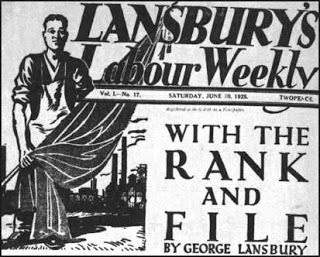
A dish of tripe. Selected from “Lansbury’s Weekly”. (1925)

From the November 1925 issue of the Socialist Standard

Although the dictionary does not mention it, there are two kinds of tripe. One is an article of food prepared from the stomachs of ruminant animals. Cooked in milk and seasoned to taste, it forms a light and nutritious meal—for those who like it. The other tripe is a euphemistic expression applied generally to soft and sloppy utterances, or expressions of unusually foolish opinions. Take Lansbury’s Labour Weekly, for instance. When we say ”take” it, we speak figuratively. Refrain from so doing if you doubt your ability to distinguish tripe from treacle. Only a particularly vindictive newsagent would deliver it in mistake for a newspaper. We have done him no harm that we remember. Fortunately he relented after the one deadly stroke and we have seen no more since the issue of September 26th.

The cover and get up are strongly suggestive of that other organ of culture, John Bull. The same buff cover, with a shockingly drawn carpenter holding a flag of some sort, instead of the tun-bellied, pugnacious dog-fancier who adorns the rival journal. Inside we find the same flamboyant headlines, the same “open letters” to selected public officials, many of the same advertisements, the same type, and the same printers. The reading is different, naturally, as a separate twopence is required for each journal. You may judge if the twopence would not be better spent on an ice-wafer after sampling the following spoonfuls. They are as typical as spoonfuls of such a dish can be.

Problems of Real Life are answered by “Martha.” They make one sigh for an “unreal” life, whatever that state might be. These are the problems that are racking the revolutionary readers of Lansbury’s Labour Weekly. Need an illegitimate child produce a detailed birth-certificate when obtaining a job? X.Y.Z. asks if she is still legally married after having given the wrong age. Answer : “Forget all about it and go and see your mother.” A Comrade writes that because he has not matriculated he cannot become a Sanitary Inspector. “Another example of Tory unfairness,” he says. “Not at all,” says “Martha,” “read Jack London’s books.” H.T.C., a miner, is horribly fed up with coal getting, writes poetry, and wonders if he will ever get out of the mine. “Yes,” says “Martha,” “you won’t stay in your mine. I think you will write some day. . . I have a suit in good condition that would fit a very big man. Send me a p.c. if you think you would fit it.” Another Comrade who has just married a man with four children, is appalled at the amount of food they eat. Answer: “Martha” knows that workers have more right to sirloins of the roast beef of old England than shirkers, but they simply can’t afford it. “Make good, nourishing stews,” says “Martha.” And suet pudding. It certainly has a “filling” effect. Lastly, we come to “Morning Sickness.” “Several husbands have written about this subject, saying how it distressed them.” Ye gods! Husbands with morning sickness. We have heard some in the Labour movement referred to as “old woman,” but never in our wildest dreams guessed it was so literally true. It is a painful subject, though, physiologically interesting. Let us hurry to Lansbury’s Editorial. He is pleased to inform his readers the number contains “two articles by myself. The second one you owe to the fact that on two Sunday evenings I sat at the feet of Dr. Annie Besant.” He does not say whether she stroked him or patted his head. The article itself is redolent of its origin. He should be old enough to know that no good writing is possible sitting at someone else’s feet. Seated, more rationally, at a table or desk, the blood gets a chance to flow to all parts of the body without hindrance, and may possibly even reach the brain. No one with a properly functioning cerebrum would pen such unqualified flatulence as “for me there is no better teaching than that we can all learn from the prophets and seers of all the ages” ; or, “Our great Movement . . . sometimes appears like a flock of sheep without a shepherd.” The other article, “Empire Trade” (in big letters on a background of soldiers, black men, colonists, and bales of goods), almost defies analysis. If we give it its true name we shall have to quote samples : and our space has some value, anyway.

There is the usual advertisement in Labour journals recently of the Co-operative Investment Trust, a company in which Emil Davies, the New Statesman’s financial tipster, is the guiding light. Dr. Williams’ Pink Pills find the “comrades” fruitful soil, as likewise does Sister Smith with her Massagene. The mind of the eager reader is safeguarded from congestion consequent on the high informative tone of the paper, by two very diverting tales—illustrated. Each of the illustrations depicts that dignified and ennobling spectacle, one man smashing another on the jaw. This should attract readers in great numbers, especially from those high-brow centres of classic learning where jaw-smashing is a regular nightly entertainment. You will be glad to learn that the first jaw-smasher eventually got the other man’s job, whilst the second face-batterer participated in a purse of £2,410. As Annie Besant is quoted : “There can be no peace, no real content without religion.” It is uplifting stuff.

Then Mrs. Leonora Eyles lets herself go on that well-tried topic: the slums. She has made some astonishing discoveries in the Potteries. There, one learns, there are slum houses, but no slum people. “Their Nonconformist consciences have kept them rigidly respectable and God-fearing as far as their homes go. Yet at the same time the illegitimate birth-rate is well above the average.” . . . One notes that the Nonconformist conscience is much like the ordinary conscience, and does not extend below the equator. Wherever Mrs. Eyles goes to-day she finds the workers talking revolution, she says. Our experience is that most of them are talking of rheostats and megohms. She observes that if you herd people in miserable hovels, revolution follows as a natural corollary. This is only very partially true, but Mrs. Eyles draws a curious conclusion from it. She wishes she could shout it in the House of Commons and in comfortable people’s drawing-rooms. What for? They would only start a new Labour Weekly. Numbers of earnest people have contracted “clergyman’s throat” in the House of Commons and many more have induced dyspepsia by drinking tea in comfortable drawing-rooms, airing the agony of the workers. The rich will do anything for the workers, except get off their backs. Shouting won’t shift them. We propose shaking them off.

We do not propose to go through the remainder of the paper seriatim, but hope enough has been given to dissuade any member of the working class from wasting his time and his money. As we have said in this journal with tiresome iteration, the working class has but one problem, and but one solution. All else is fustian and illusion. All other questions melt and dissolve into it. The working class is a slave class. It must end its slavery. There is one way, and only one way, to do it. The workers must grip and conquer the political power that holds them down. There is no “step-at-a-time,” there is no “something-now,” there is no “half-loaf,” that will or can satisfy them. They cannot even remain as they are, be they never so craven. Capitalism moves inexorably on towards the day when its overwhelming plethora will spell universal over-production and economic chaos. The beginnings are here. Who would have thought, seven years ago, that a highly developed country like Great Britain would carry an unemployed surplus of over a million for a period of years? What will happen when all Europe and America and then the at present backward races start producing wealth in immense quantities? When their only markets will he each other, and each has battered its working class down to the lowest practicable limit? When labour-saving machinery and devices have thinned the essential workers to still slenderer limits? We suggest that the workers do not wait until that time. We suggest it is not only desirable, but immediately possible, for the workers in this and every other well-developed capitalist country to inaugurate a new and higher system of society. They must abandon their Micawber attitude of waiting for something to turn up, and organise, definitely and at once, to capture the political power of the State. The next General Election would do, if the workers but understood. Once in possession of political power, the workers can re-organise society upon the lines we have so often sketched out. To the producers, all they produce. He that will not work, neither shall he eat. To each according to his need; from each according to his ability.
W. T. Hopley

Socialism is not Christianity. (1925)

Book Review from the November 1925 issue of the Socialist Standard

“Socialism is Christianity,” by John Shelburne. 2½d, post free, from the Author, at 6, Marlboro’ Hill, Harrow.

This is a pitiful pamphlet. It contains more confused thought and more misunderstanding of Socialism, of history and of the economics of capitalism than one would have thought possible in 16 pages. The author’s contentions are simple ones :— “Socialism is Christianity”—”Christianity is love”—and “By love, we can achieve all.” Mr. Shelburne is in ecstasy over his discovery of this solvent for all problems, but, sadly enough, after he has yearned and dithered soulfully about Love, for 15 pages, he has to confess that there is one thing he cannot achieve. To his question, “What is Love?” he can only answer enigmatically with another question, “Who can define it?” Not Mr. Shelburne, at any rate.

But we can leave this stuff and get down to the real purpose of the pamphlet—the defence of exploitation and a plea for its continuance. We are asked to look upon the question of the ownership of wealth as a “secondary purpose” (page 13), not to let ourselves be confused by such “subsiduary issues,” but to “Look with visionary eyes into the far distances” (page 16).

Rewards for following this course of action will duly be distributed :—for the workers the “Peace which passeth understanding,” and for the capitalist class “the current rate of interest” on their investments.

He is a Labour man, writing for Labour Party branches, and naturally, therefore, he is an advocate of that form of capitalism known as nationalisation. At present the capitalists live on the dividends resulting from investments. Mr. Shelburne will allow them to go on living without working, that is, living at the expense of the wealth producers, provided only that they submit to the epoch-making innovation of calling their profits “interest” instead of “dividends.” He proposes that the Government shall “use their capital . . . paying the shareholders interest according to the state of the money market” (page 10). Capitalists will invest their money in “Government and Municipal stocks and bonds,” which “is justified as it receives the current rate of interest ” (page 9).

Mr. Shelburne is enthusiastic about the late “Labour” Government, but omits to complete the picture of this party of “simple,” “innocent,” “pure,” “true,” and “beautiful” walkers on “the heights of love.”

He does not mention Mr. C. G. Ammon, Christian and pacifist, defending the flogging of boys in the Navy, or the Labour Cabinet permitting repeated shooting at strikers in India, or ordering bombing expeditions on Irak tribesmen.

But when a man has one “visionary eye” fixed on the “far distances” and the other on the “state of the money market” and the “current rate of interest,” he cannot be expected to see everything.
Edgar Hardcastle

Candid confession. (1925)

From the November 1925 issue of the Socialist Standard

Sir William Joynson-Hicks is a politician who frequently embarrasses his own party and class by making indiscreet disclosures of things which a ruling class finds it better to act upon than to talk about. The following extract from a speech on Empire is quoted by A. G. Gardiner in the Daily News (October 17th, 1925) :—
“We did not conquer India for the benefit of the Indians. I know it is said at missionary meetings that we conquered India to raise the level of the Indians. That is cant. We conquered India as the outlet for the goods of Great Britain. We conquered India by the sword and by the sword we should hold it. (“Shame.”) Call it shame if you like. I am stating facts. I am interested in missionary work in India, and have done much work of that kind, but I am not such a hypocrite as to say that we hold India for the Indians. We hold it as the finest outlet for British goods in general, and for Lancashire cotton goods in particular.”

Policy and Tactics of Socialism. (1925)

From the November 1925 issue of the Socialist Standard


Suggested Lessons for Study Classes in Socialism.

Lesson No. 3.

The Socialist attitude toward Trade Unions.

35. Origin of Trade Unions.

Trade unions are the outcome of capitalist conditions. The craft guilds nourished when petty enterprise and handicraft was the rule in the cities and the land workers owned their farms in the villages. The guilds died out with the change from feudalism to capitalism. Guilds were composed of men who quickly evolved from workers to masters and their association was a mutual defence body to advance their craft and regulate industry.

The enclosure of their lands and the use of machinery and steam brought men and women together in factories. They were wage workers for life. The chance for them to become masters was gone—they had to make the best of their position as employees. The crowding of the towns with men seeking work brought down wages to a starvation level. Women and children were enticed into the factory hells as the introduction of machinery rendered the skill of the craftsman unnecessary.

In self-defence the workmen were forced to form associations for protection against the greedy and powerful employers. Working side by side, the workers found themselves drawn instinctively together, as experience quickly taught them that the individual workman stood no chance against the powerful factory owner.

36. Early Struggles.

The early unions, composed of skilled craftsmen, were necessarily craft in form and local in scope. Their chief weapon was petitions to Parliament.

For a time Parliament made some pretext of enforcing the old laws, but as industry came more and more under the influence of the larger capitalists the Government came out openly against combinations. Unable to obtain redress along constitutional lines, the workers turned to strikes and violence.

Alarmed at the threatening attitude of the men, Parliament rushed through the Combination Acts of 1799-1800. Contrary to expectations, these Acts did not destroy unions, but drove them “underground.”

The terrible suffering and misery of men and women employed in the machine-invaded industries caused secret societies, accompanied by riots, machine breaking, and incendiarism, to spring up on all sides.

In 1824, under pressure from the reform element of the capitalists, the Combination Acts were repealed and unions legalised. Immediately unions began to grow and flourish and numerous strikes for higher wages occurred. The next year the crisis, of 1825 broke. Industry was brought to a standstill and wages fell on all sides. During this period trade unionism fared disastrously. Most of them were destroyed in the attempt to stem the fall of wages.

The disasters of the past appeared to the most active unionists as the consequence of localised efforts. They now turned to general unions embracing all workers. The greatest of these, The Grand National Consolidated, was formed in 1834 and rapidly increased its membership to over 500,000. It advocated the general strike and some of Robert Owen’s communistic schemes. After a short period of activity it fell to pieces under the strain of strikes, boycotts, lock-outs, and the forces of the law. A fundamental source of weakness was the lack of knowledge of its members.

37. Their Necessity Under Capitalism. 

As shown in Lesson No. 1, the basis of the present system is the class ownership of the means of life. The working class can only exist by selling its labour power on the market. Over the price and conditions of this sale there is a never-ceasing conflict. Possessed of all the economic resources and backed up by the political State, the capitalists use every effort to reduce wages to the minimum—at the same time trying by every available means to lengthen the working day and increase the rate of exploitation. By means of labour-saving devices, greater division of labour, more scientific managements, and the introduction of women and children into industry, an increasing body of unemployed is created. As the system develops it does away with the necessity of the skilled craftsmen and tends to reduce all to the same dead level. The general tendency of the capitalist system is to reduce the working class to the position of the Chinese coolie.

Against the conditions pictured above the individual worker is helpless. In order to protect themselves, the workers are forced to combine together into unions. Acting together, they are able to exert more pressure on the capitalist class and influence to some degree the conditions under which they live and labour. In actual practice unions can do little more than resist the downward pressure of the system. Instead of improving conditions, their whole energies are required to resist the encroachments of capital.

However much the Socialist may deplore the ignorance of the rank and file, or the treachery of the leaders, however much we might understand the limitations of unions, he must admit that unions are inevitable and necessary under the present system. As someone said, it is the arm that the working class instinctively raises to defend itself.

38. The So Called "Commodity Struggle." 

The struggle over hours and wages arises from the economic position of the working class. It is a struggle by members of one class (workers) against members of another class (employers). Labour-power is unlike any other commodity—it is sold only by one class and bought only by another. The efforts to sell labour power at the highest price and the opposition by the employers is a manifestation of the class struggle.

The idea is sometimes preached that the struggle over hours and wages is a purely “commodity struggle,” like haggling over the price of fish or meat between buyers and sellers. But the struggle over wage conditions is a direct result of class distinctions produced by the system of privat ownership. It is, therefore, not merely a struggle by commodity owners over the price of a commodity. It is a struggle bv the working class to secure as much as possible of the wealth produced, against the efforts of owners to retain all they can in the form of “profit.” It is, therefore, a part of the class struggle. It is quite true that this fight about hours and wages is not carried on by class-conscious workers.

The class struggle, however, is not caused by class-consciousness. It is caused by economic conditions, and when the workers recognise intelligently the class struggle that is going on, they will consciously organise, not to raise wages and shorten hours of slavery, but to abolish the entire system of wage slavery.
Adolph Kohn

(To be continued.)