Saturday, April 30, 2022

From the Branches (1960)

Party News from the April 1960 issue of the Socialist Standard

Annual Conference Programme

Conference begins at 11 am on Friday, April 15th; 2.30 pm Saturday 16th and 11 am on Sunday, April 17th. The Agenda is a large one and Comrades are asked to get along promptly each day. On Friday evening at 8 pm a Social and “Get-together" has been arranged at Head Office, 52 Clapham High Street, SW4. This event is an excellent occasion for Comrades and friends to have a jolly evening; dancing, drinking, eating, talking, and in fact taking part in everything that is going on. On Saturday, 16th April, at Conway Hall (the Conference venue) the Party's Annual Social and Dance will be held from 7.30 pm. This is an evening to which Comrades particularly look forward. The hall is large and light, the band is always good and without doubt a good time will be had by all. On Sunday evening, at Conway Hall, the Annual Rally will be held at 7.30 pm. Full details on “Meetings” page. Make a note of these dates and times and ensure that this is the best Annual Conference for years.


Socialist Standard

The March issue had a special emphasis on Africa—did you double your order for Standards to help to pay the added cost of production? It may not be too late now to get some extra copies. Should they be all sold, make a note to do this for forthcoming issues—it needs only to sell a few hundred more copies to greatly reduce the cost. What better way of propagating the case for Socialism?


To Writers

The monthly meeting of writers will in future be held on the first Thursday of each month instead of on the last Monday as formerly. The next meeting will therefore be held on 5th May, at Head Office, beginning at 8 p.m.

We ask all writers to make a special effort to attend these meetings, which provide a regular opportunity to exchange ideas and opinions and are at the same time most useful to the S.S. Production Committee in planning the Standard.


Outdoor Propaganda

In London and the provinces, not forgetting Glasgow, outdoor propaganda will re-open with, we hope, the fine weather.

All meetings are well organised by Branches and the Propaganda Committee, but the success of them greatly depends on the support of Party members. With regular literature sellers and members to assist, meetings can be a very rewarding pleasure for all concerned, this apart from the important factor—spreading the Socialist message.


May Day 1960

May Day this year is on Sunday, the first day of May. Details are given on page 50, but this reminder is for everyone to make a special effort this year. Hyde Park in London on Sunday afternoon; Denison House, Vauxhall Bridge Road, for an indoor Rally in the evening; and in Glasgow, the highlight for City and Kelvingrove Branches—a meeting in the Cosmo Cinema. The branches have worked very hard for some while now to ensure the success of this meeting and urge that Comrades in Glasgow and the vicinity bring along as many friends as possible so that this, although the first of such ventures, will be the forerunner of many more.
Phyllis Howard

The Passing Show: No excuse for less work (1960)

The Passing Show Column from the April 1960 issue of the Socialist Standard

No excuse for less work

Religion is one of the chief allies of the ruling class, but as capitalism develops some of the old religious observances become impediments. When that happens, of course, religion has to give way. Even the great usefulness of religion to the ruling class does not compensate for the loss of profits. One example is the Moslem ceremony of Ramadan, in which for thirty days Moslems may not eat or drink during daylight. This means that as soon as dusk falls there is a rush to eat and drink, which often develops into all-night parties. The result is that the workers output, and the employers’ surplus value, declines. As the News Chronicle (5/3/60) puts it:
Up to now, as in the rest of the Moslem world, Tunisia's life came almost to a standstill during Ramadan because of the dawn to dusk fast. In some cases production dropped 70 per cent.
President Bourguiba, who runs the state machine on behalf of the emerging Tunisian capitalist class, could not be expected to tolerate that. Capitalism demands hard, regular toil from its workers, whatever religion may say. So the President acted
Bourguiba has not banned the fast outright. But he has stated firmly that fasting will not be accepted as an excuse for less work.
And, apparently, this warning is having an effect. The article says, “Tunisians are now obeying his order to work as usual during Ramadan.” So Bourguiba justifies his position as Tunisian capitalism's chief executive.


His country

From Tunisian capitalism to the British variety. The status quo here can have few stauncher defenders than some of our trade union leaders. Ore of them is Sir Frederick Burrows, ex-president of the National Union of Railwaymen. Sir Frederick felt moved recently to let the public know his views on the planned railway strike. The paper he chose to write to was The Times (10/2/60). which can be read by only a minority of railwaymen (it costs fourpence a day for a start); its readership is mostly either ruling class or those who like to think that they arc ” top people.” Sir Frederick finished his letter as follows:
If the N.U.R. desire to perpetuate Tory rule for another decade, if they wish to make the very name of railwaymen a scoff and a by-word, then they will strike, but I, personally, have more faith in their judgment. I trust that they will reject the advice of the malcontents in their ranks and act once again the splendid role they played in the war, when one and all stood for England—My Country, right or wrong.
Surely even a member of the ruling class would hesitate these days before trotting out again such hackneyed cliches. Even G. K. Chesterton, who was very far from being a Socialist, said that to say, “My country, right or wrong,” was like saying “My mother, drunk or sober.” But Sir Frederick rushes in with his jingoistic farrago where others might fear to tread. No wonder he chose the ‘‘top people’s” paper to write to.


It’s those foreigners again

From the Guardian of 10/2/60, under a Pretoria date-line:
Police armed with Sten guns, rifles and revolvers stood by today at Mooiplats squatter camp about five miles south-west of here while a bulldozer flattened houses, shanties and hovels from which 300 African families with no other homes are being evicted. The camp has existed since 1926. As walls crashed in clouds of dust lorries piled high with African men. women and children and their possessions left the camp. Mooiplats has been declared an area for Indians. Pretoria City Council's policy is to clear squatter camps. It is stated that most of the evicted Africans arc foreign Africans and will not be given municipal accommodation.
‘‘Foreign Africans”! These people are Africans; they were born in Africa and have spent their lives there; they are earning their livings, such as they are, in Africa; but they are ‘‘foreigners,” because they come from the other side of one of the boundary lines drawn on the map by the European powers who carved Africa up among them. When we have a rational society we will be able to forget the crazy artificiality of the divisions imposed on us by the necessities of private property. Wc will discard the bogies of nationality and race, and remember what we really are—one race, the human.
Alwyn Edgar

Friday, April 29, 2022

About Socialism (1989)

From the February 1989 issue of the Socialist Standard

1. What is the Socialist Party of Great Britain?

It is a political party, separate from all others, Left, Right or Centre. It stands for the sole aim of establishing a world social system based upon human need instead of private or state profit. The Object and Declaration of Principles printed in all of our literature were adopted by the Socialist Party in 1904 and have been maintained without compromise since then. In other countries there are companion parties sharing the same object and principles, and they too remain independent from all other political parties.


2. What is capitalism?

Capitalism is the social system which now exists in all countries of the world. Under this system, the means of production and distribution (land, factories, offices, transport, media, etc.) are monopolised by a minority, the capitalist class. All wealth is produced by us, the majority working class, who sell our mental and physical energies to the capitalists in return for a price called a wage or salary. The object of wealth production is to create goods and services which can be sold on the market at a profit. Not only do the capitalists live off the profits they obtain from exploiting the working class, but, as a class, they go on accumulating wealth extracted from each generation of workers.


3. Can capitalism be reformed in our interests?

No: as long as capitalism exists, profits will come before needs. Some reforms are welcomed by some workers, but no reform can abolish the fundamental contradiction between profit and need which is built into the present system. No matter whether promises to make capitalism run in the interests of the workers are made sincerely or by opportunist politicians they are bound to fail, for such a promise is like offering to run the slaughter house in the interests of the cattle.


4. Is nationalisation an alternative to capitalism?

No: nationalised industries simply mean that workers are exploited by the state, acting on behalf of the capitalists of one country, rather than by an individual capitalist or company. The workers in nationalised Austin Rover are no less the servants of profit than workers in privately-owned Ford. The mines no more belong to "the public" or the miners now than they did before 1947 when they were nationalized. Nationalization is state capitalism.


5. Are there any “socialist countries”?

No: the so-called socialist countries are systems of state capitalism. In Russia and its empire, in China, Cuba, Albania, Yugoslavia and the other countries which call themselves socialist, social power is monopolized by privileged Party bureaucrats. The features of capitalism, as outlined above, are all present. An examination of international commerce shows that the bogus socialist states are part of the world capitalist market and cannot detach themselves from the requirements of profit.


6. What Is the meaning of socialism?

Socialism does not yet exist. When it is established it must be on a worldwide basis, as an alternative to the outdated system of world capitalism. In a socialist society there will be common ownership and democratic control of the earth by its inhabitants. No minority class will be in a position to dictate to the majority that production must be geared to profit. There will be no owners: everything will belong to everyone. Production will be solely for use, not for sale. The only questions society will need to ask about wealth production will be: what do people require, and can the needs be met? These questions will be answered on the basis of the resources available to meet such needs. Then, unlike now, modern technology and communications will be able to be used to their fullest extent. The basic socialist principle will be that people give according to their abilities and take according to their self-defined needs. Work will be on the basis of voluntary co-operation: the coercion of wage and salary work will be abolished. There will be no buying or selling and money will not be necessary, in a society of common ownership and free access. For the first time ever the people of the world will have common possession of the planet earth.


7. How will socialism solve the problems of society?

Capitalism, with its constant drive to serve profit before need, throws up an endless stream of problems. Most workers in Britain feel insecure about their future; almost one in four families with children living below the official government poverty line; many old people live in dangerously cold conditions each winter and thousands die; millions of our fellow men and women are dying of starvation — tens of thousands of them each day. A society based on production for use will end those problems because the priority of socialist society will be the fullest possible satisfaction of needs. At the moment food is destroyed and farmers are subsidised not to produce more: yet many millions are malnourished. At the moment hospital queues are growing longer and people are dying of curable illnesses; yet it is not "economically viable" to provide decent health treatment for all. In a socialist society nothing short of the best will be good enough for any human being.


8. What about human nature?

Human behaviour is not fixed, but determined by the kind of society people are conditioned to live in. The capitalist jungle produces vicious, competitive ways of thinking and acting. But we humans are able to adapt our behaviour and there is no reason why our rational desire for comfort and human welfare should not allow us to co-operate. Even under capitalism people often obtain pleasure from doing a good turn for others; few people enjoy participating in the "civilised" warfare of the daily rat-race. Think how much better it would be if society was based on co-operation.


9. Are socialists democrats?

Yes: the Socialist Party has no leaders. It is a democratic organisation controlled by its members. It understands that Socialism can only be established by a conscious majority of workers — that workers must liberate themselves and will not be liberated by leaders or parties. Socialism will not be brought about by a dedicated minority "smashing the state", as some left-wingers would have it. Nor do the activities of paid, professional politicians have anything to do with Socialism — the experience of seven Labour governments has shown this. Once a majority of the working class understand and want Socialism, they will take the necessary step to organise consciously for the democratic conquest of political power. There will be no Socialism without a socialist majority.


10. What is the next step?

Many workers know that there is something wrong and want to change society. Some join reform groups in the hope that capitalism can be patched up, but such efforts are futile because you cannot run a system of class exploitation in the interests of the exploited majority. People who fear a nuclear war may join CND. but as long as nation states exist, economic rivalry means that the world will never be safe from the threat of war. There are countless dedicated campaigns and good causes which many sincere people are caught up in, but there is only one solution to the problems of capitalism and that is to get rid of it, and establish Socialism. Before we can do that we need socialists; winning workers to that cause requires knowledge, principles and an enthusiasm for change. These qualities can be developed by anyone — and are essential for anyone who is serious about changing society. Capitalism in the 1980s is still a system of waste, deprivation and frightening insecurity. You owe it to yourself to find out about the one movement which stands for the alternative.


If you have read this set of principles and agree with some or all of them, contact the Socialist Party with your questions and ideas about what you can do to help speed the progress towards Socialism.

House price blues (1989)

From the February 1989 issue of the Socialist Standard

In the first few months of this year millions of workers will have to cut their personal spending in order to pay more interest on their mortgages. In other words, their standard of living will fall. All will have to cut back on food and holidays, some will even lose their homes. This, however, doesn't worry Nigel Lawson. As Chancellor he has not only welcomed this situation but claimed responsibility for it. While this is merely empty boasting (governments can't control interest rates at will), the fact that he should want to cut back on consumption illustrates that capitalism is not a system geared to meeting people's needs.

Lawson says he has raised interest rates (the price paid for borrowing money) in order to combat inflation. In fact it is the other way around: he has raised interest rates because of rising inflation. The capitalist institutions that lend money to the government are interested in what is accurately called the "real" rate of interest — the return they get after rising prices have been taken into account. So, if the general price level is rising, the government has to offer a higher nominal rate of interest to those lending it money, at least if it wants to maintain its level of borrowing.

The price level has been rising in Britain over the past year, partly due to the government continuing to inflate the currency by printing too much money but also because of the increased level of activity as the economy moves slowly out of the stagnation phase of the capitalist business cycle. Hence the repeated rises in the minimum lending rate (what used to called the Bank Rate) over the past year, culminating at 13 per cent last November.

Building societies are financial institutions which, like banks, survive by borrowing money at one rate of interest and then re-lending it at a higher rate. This means that when the general rate of interest goes up building societies, being no more able to “create credit" than the banks, are obliged to raise the rate of interest they pay those who lend them money (their depositors) and the rate they charge those who borrow from them. As their name suggests, building societies specialise in long-term loans — of twenty, twenty-five years — to house buyers. They operate by lending people the money to buy a house and then requiring them to mortgage it to them as security against repayment of the loan. In law this means that they become the owner of the house, although the person taking out the mortgage retains full occupation rights as long as he or she continues to repay the loan.

So, when we are told in a recent government publication, Britain: An Official Handbook, that at the end of 1986 there were more than 14 million owner-occupied dwellings in Britain, this is not strictly true. Those still paying off their mortgage — some 7.5 million — are only occupiers, not owner-occupiers; they don't become owners until they have repaid in full and with interest their debt to the building society. It is only after a lifetime of being in debt and occupying a house belonging to a building society that they finally attain the lofty status of "property owner", fit citizens of Thatcher's “property-owning democracy". In the meantime their position remains insecure. If ever they fail to keep up their payments the building society will evict them from its house and sell it to recover the amount of the loan, a fate suffered by tens of thousands of people each year and which can now be expected to increase. They also remain at the mercy of rises in the rate of interest, which the government can cynically welcome as a way of making them cut back on their personal consumption.

Since coming to power in 1979 Thatcher has pursued a policy of encouraging people to become homeowners, as part of her plan to eliminate Labour party-type reformism ("destroying socialism", as she misleadingly puts it). She hopes that people who own their own homes will believe they have sufficient a stake in the country to abandon traditional working class demands for higher wages and salaries and better state provision for health and welfare; that in fact they will oppose such demands and vote for the Tories for ever. For her, capitalist property will be more secure if surrounded by a mass of small house owners.

While a few social climbers may have swallowed Tory ideology, Thatcher's policy has been popular for quite other reasons. Many people want to own their own home simply because it gives them some control over part of their lives. They don't like to have to ask permission of a landlord, whenever they wish to modify or improve their home; they want to be able freely to exercise the creativity denied them at work.

Even if all workers owned their own homes, capitalist society would remain class-divided: the majority forced to live by selling their ability to work for a wage or salary and a minority of owners of the means of production living off unearned income in the form of rent, interest or profit. When socialists talk about inequality of property ownership being the basis of capitalist society in Britain we mean ownership of the means of production, of land, raw materials, factories, machines and other instruments for producing wealth. Owner-occupied houses are not means of production; they are not, and cannot, be used to produce more wealth. In this sense they fall into the same category as cars, washing machines and other household goods; they are consumer goods, means of consumption — workers have to consume accommodation, be it owned, mortgaged or rented, in order to keep themselves fit to work. Homeowners, therefore, are not capitalists and neither do they have any interests in common with capitalists.

This important distinction between property in means of consumption (houses, cars, household goods) and property in means of production, or capitalist property, is lost in the statistics of property ownership published from time to time. Even so, these figures show a considerable inequality: in Britain the top 1 per cent own 23 per cent of "accumulated wealth". This means that if property in means of consumption is taken out of the figures the level of inequality is far greater. Figures for West Germany in 1969. for instance, showed that while 1.7 per cent of private households owned about 35 per cent of "total private wealth", they owned 70 per cent of "private wealth invested in production". The proportions in Britain will be similar. Owners of capitalist property are, quite literally, in a different class from owners of means of consumption. To gain entry into this class you need to own a lot more than your home.

Besides, owning your own home in no way frees you from having to go out and sell your ability to work for a wage or salary in order to live. Workers who own, or who have mortgaged, their home have to sell themselves on the labour market just as much as workers who live in council houses or private rented accommodation. Nor, as the recent rises in mortgage rates shows, does it free you from the financial problems inextricably associated with being a wage and salary earner in capitalist society. “MORTGAGE BURDEN TURNS YOUNG INTO NEW PAUPERS" read the headline of a recent article in The Times (31 December) which featured a young couple in Hertford who had bought and mortgaged a home (a one-bedroomed maisonette, or sort of glorified Portakabin) in July. Their first monthly payment had been £360. From January they were going to have to pay £460 a month, leaving them just £55 a week between them for personal spending (food, car, gas. electricity, telephone).

Homeowners remain non-owners of the means of production and so remain members of the working class, with the same interests as wage and salary earners have always had under capitalism: to establish a system based on the common ownership and democratic control of the means of production and to press, while capitalism lasts, for higher wages and salaries. Thatcher has got it wrong. Home ownership does not give workers an interest in the continuation of capitalism.

Nurses lose patience (1989)

From the February 1989 issue of the Socialist Standard

In January 1988 a national survey carried out by the Association of Community Health Councils showed that half of the hospitals in England and Wales were closing beds, wards or specialised units. Their conclusion that parts of the NHS were on the brink of collapse and the impending bankruptcy of the Manchester Royal Infirmary forced the government to release extra funds to prevent serious financial problems among the other health authorities.

Also during January 1988 the government declared its intention to reduce nurses’ enhanced rates for unsocial hours, weekends, public holidays and night shifts despite the fact that they were already inferior to any other British industry. The nurses were not prepared to accept a trade off of their shift payments for vague promises that a new regrading structure would restore their pay, and a strike by 38 night staff at North Manchester General Hospital on 7 January 1988 forced the government to back down.

With this background to the nurses' regrading structure it was obvious that the government's announcement on 21 April awarding nurses a pay rise averaging 15.3 per cent had to have a catch in it. Most nurses had to wait until late October or early November to find out what their new grades were and, as expected, the vast majority received pay increases of considerably less than the figure announced.

The new grades, besides cheating nurses by paying most of them much smaller rises than the much-publicised “average" awards, also attempted to "play off” nurses against each other by awarding fairly big rises to a small minority of them. The majority of nursing auxiliaries in general hospitals and nursing assistants in psychiatric hospitals have been allocated the lowest possible grade even though they often have to work without supervision. Probably the most discontent has resulted from the regrading of staff nurses and ward sisters. Nurses working on the same wards have been graded in an arbitrary manner, with some being graded differently for doing the same work.

For nurses on the lowest grades, nursing auxiliaries and staff nurses have been awarded just over six per cent and ward sisters 4.2. In keeping with the governments attempt to reduce shift payments, thwarted by the 1988 Manchester nurses' strike, the vast majority of night nurses have been given the lowest grades possible which, with shift payments having been pegged at the 1984 rates of pay, gives rises of under five per cent in the pay packets of these workers.

Enrolled nurses have tended to fare better but a number of general hospitals have stopped employing them, in anticipation of single certification for all trained nurses proposed in changes in nurse training for the future. Many enrolled nurses have, as a result of this policy, been forced to work as bank nurses on a casual basis to cover periods of staff shortages. These nurses receive neither sick pay nor holiday pay and have been graded lower than enrolled nurses in regular employment, cheapening their labour power still further. Student nurses have received around a seven per cent increase but have not been regraded because they are in training and their status is, therefore, temporary.

But even with trainee nurses excluded from regrading, most health authorities are faced with having to handle over a thousand appeals each. Clearly, the fact that a substantial majority of nurses up and down the country have appealed against their grades contradicts statements by the government and regional health authorities that nurses have had good rises. In addition, many experienced nurses feel that they have been downgraded and this has led to as much discontent as the paucity of the pay rise.

Another problem with the nurses' regrading is that it varies from hospital to hospital and this could lead to movement of staff in the future and artificial shortages in some areas. And the fact that there are now effectively two grades each for staff nurses and ward sisters could lead to a shortage of suitable applicants for nurse tutor training in three or four years time, because of the need to have had experience as a ward sister before applying for training.

The government has gambled that its strategy of dividing the nurses will succeed, for it must be aware that a 50 day strike by the Royal Australian Nursing Federation in the Southern State of Victoria affected over 40 hospitals and led to the regrading being abandoned. However, the British government knows that there are four unions involved — NUPE. COHSE. RCN and. to a lesser extent, Nalgo — and that the largest union, the Royal College of Nursing, is opposed to strike action.

But it is just possible that the RCN's stance on industrial action could change in the future because some of its members are being lost to more militant unions since it advised its members not to take part even in the limited industrial action of "working to grade". In the past the RCN has tended to gain members when industrial action has occurred and this reversal of the usual trend demonstrates how angry nurses are and could lead to a reconsideration of industrial strategy.

Nurses' strikes have occurred at some hospitals and "working to grade" at others, but the industrial action has been patchy with individuals torn between anger and disappointment at the way they have been treated and their sense of “vocation". Nurses are beginning to realise, however, that they are not going to get a “fair deal" from the government, although they have so far failed to understand that the health service is most useful to capitalism during periods of economic expansion, when a healthy workforce is needed. In any event, all centrally funded welfare services represent costs against production and the state will, therefore, try to reduce costs as much as possible.

But it is not just nurses’ pay which looks likely to be a problem in the future: ancillary staff, whose already low pay and poor working conditions had been adversely affected by increasing casualisation and privatisation of domestic and laundry services in a number of hospitals, are likely to rebel against conditions. A further problem is that the wages of skilled paramedical staff are now “embarrassingly low" according to the National Association of Health Authorities, and managers are "having to introduce illegal' grades and fabricated job descriptions in order to retain staff” (The Independent, 2 December). Medical secretaries, accountants, operating theatre technicians and computer staff are receiving well below industrial rates and “Experienced hospital pharmacists can be paid £5,000 to £7,000 a year less than newly-qualified entrants to High Street pharmacies. "(Ibid).

Without these workers the National Health Service would struggle to maintain essential services and either a strike or defections to industry could cause severe difficulties. The government could even become a victim of its own propaganda, for if people believe that the nurses have had good pay rises then ancillary staff are going to be more dissatisfied over their own poor pay rates.

It remains to be seen whether the government has gambled correctly in trying to divide nurses and, by deceiving the public, deprive them of support. It also remains to be seen whether the increasing militancy among nurses during the last twelve months will gather momentum or, as the health authorities hope, the long drawn out appeals procedures over the gradings will blunt industrial action. But the nurses need to keep up the pressure on their health authorities and the government if they are to avoid being cheated yet again.
Carl Pinel

Poisoning the atmosphere (1989)

From the February 1989 issue of the Socialist Standard

An article in the Wellington Dominion newspaper on 14 November last reported an alarming increase of incidence of skin cancer:
The skin cancer melanoma was now striking twice as many New Zealanders as it did 10 years ago. Cancer Society medical director Alan Gray said yesterday. "Melanoma is now the commonest cancer in people aged 20 to 39", Dr. Gray said. Figures published in the Medical Journal showed that cases had doubled every 10 years in the Non-Maori population from 1948 to 1977. In 1983. 686 new cases were reported, compared with an average 298 cases yearly in 1970. 1971 and 1972.
A programme on the National Radio followed up the theme the following Sunday. Here it was made clear that a badly underfunded public health service was unable to provide skin cancer screening services and people could be waiting months for needed operations. Melanoma, if not caught in its early stages, is a particularly dangerous cancer and kills many people each year (up to 200 in New Zealand).

In the same newspaper on the same day there was an even more disturbing article titled: "Ozone depletion exceeds forecasts". Dr. Tom Clarkson of the New Zealand Meteorological Service, who specialises in researching the effects of pollutants on the weather systems, was reported as saying: "world ozone depletion was greater than atmospheric scientists had initially predicted". The Dominions reported that scientists had called for immediate cutbacks in chloroflouro-carbon (CFC) production by at least 85 per cent because the existing protocol would not save the ozone layer.

The article went on to point out the difficulties of getting countries to ratify the existing protocol, which calls for only a 50 per cent reduction by 1999 of the 1986 levels of CFC production in stages. The problems of obtaining support for an 85 per cent reduction protocol were enormous, particularly with “developing" countries heavily dependent on chemical and electronic industries.
Dr. Clarkson said the world has lost 4 per cent of its ozone in the past 10 years or so. It appeared that the northern hemisphere had also developed a hole in its ozone layer and there were fears that the increasing amount of chlorine in the atmosphere were reacting with solids and liquids in a way not previously realised.

"Chlorine is increasing in the atmosphere by about 5 per cent per year", he said One scientist at the meeting presented new research suggesting a volcanic eruption in the tropics could trigger destruction of ozone over mid-latitudes. Such a reaction could not have happened in the past and was only possible now because of the vastly increased amounts of CFC's that had been poured into the atmosphere. Dr. Clarkson said an 85 per cent cutback in CFC's would only mean maintaining the status quo in the atmosphere.
The following day the Dominion returned to the issue under the headline “melanoma battle worsens as ozone layer depletes":
The world was losing the battle against the skin cancer melanoma and the problem would get worse if the ozone layer continued to be depleted. United States expert Professor Alfred Kopf said yesterday.
A week later I attended a public meeting on the subject of “Ozone Depletion and the Greenhouse effect" where the guest speaker was Dr. Clarkson. These two separate concerns have a common cause: pollution by the modern industrial world of competing nation-states and corporations.

Ozone layer depletion
Dr. Clarkson explained that ozone is a form of oxygen with three atoms to the molecule. It has different properties to ordinary oxygen with the double molecule and is particularly toxic to animal life, including human beings. Some man-made ozone exists in the lower atmosphere among other pollutants and poses an immediate health hazard. However, the ozone layer is usually between 15 and 30 km away from the Earth's surface and is important to both plant and animal life in two respects. It forms a “cap" on the weather systems below, lending a stabilising influence (it warms up due to absorption of the suns rays and forms an inversion layer). And it blocks out most of the harmful radiation which emanates from the surface of our sun, in particular short-wavelength electromagnetic radiation such as ultra-violet waves. Sun-burn is due to this radiation, and if the ozone layer were suddenly to be removed, these rays would prove lethal to most life.

Ozone in this layer is formed by the UV radiation breaking down the ordinary oxygen molecules' bonds so that they recombine as three-atom bonded molecules. At the same time ozone is also being broken down into oxygen. This two-way effect has a natural balancing point.

Chloroflouro-carbons or CFCs were invented in the 1950s and found to have many desirable properties which lent themselves well to industrial and domestic use. Efficient, easy to produce and relatively cheap in comparison to alternatives, they were also regarded as safe due to their chemical stability. However, in the seventies there was an apparent depleting of the ozone layer and it is now widely accepted that massive damage is being done to it by these pollutants.

The natural level of chlorine in the atmosphere is approximately 0.9 ppm (parts per million). In 1973 it was measured at 2 ppm. In 1988 it was just under 4 ppm. Due to the slow progress of the CFCs through the stratosphere, the pollution of today will have a much delayed effect. It is estimated that if all CFC production and use were to cease now, it would take another 200 years to get back to pre-1970 levels. In the spring of 1987 half of the ozone layer above the Antarctic completely disappeared.

The Greenhouse Effect
The man-made “Green-House" effect is a phenomenon about which scientists are still not in agreement. However the measurements observed are in line with the scientific models that have been made of the effects of man-made pollutants collecting in the atmosphere. Again there is a natural balance between the amount of carbon-dioxide which is emitted and the amount reabsorbed by the sea (100 billion tons per year) and vegetation (60 billion tons per year). The natural concentration of carbon- dioxide is about 300. ppm The effect of the carbon-dioxide is to prevent or slow down the loss of heat from the surface of the Earth by forming an insulation blanket around it. Human production of C02 is about 5 billion tons per year; however, unlike the natural processes the man-made carbon-dioxide is a one-way direction process only.

Man-made pollution has added substantially to the greenhouse gases and the concentrations are growing rapidly. The current relative cheapness of fossil fuels such as oil and coal has meant a dramatic increase in their use. New Zealand, which has mainly hydro-powered electricity generation, is finding it economical to restart the few oil-powered stations it had mothballed in the seventies and early eighties.

Adding further injury to the eco-system, natural forests are being cut down and destroyed at an insane rate. The Amazon rain forest, which once contributed 25 per cent of the world's oxygen, is being reduced at a rate which approximates to an area the size of Wales every day. Where once there was luscious rain forest, there are now tree stumps stretching as far as the eye can see.

Measurements made by the Department of Scientific and Industrial research since the early seventies show the concentrations of carbon-dioxide to be 325 ppm in 1973 and 350 ppm in 1988. Average global temperatures have been recorded from the year 1880 and figures show that the highest were in 1987 and the five hottest years have been since 1980. The United States is now taking the greenhouse effect very seriously as it stands to be a big loser if world temperatures rise as some predict. Other nations may benefit in the short term. At worst, if the use of fossil fuels for energy continue on the existing scale, the average global temperature will rise at a catastrophic 0.8 degrees centigrade per decade.

No solution within capitalism
The worldwide capitalist system will be unable to deal effectively with this problem. The warning signs have been with us for years, and many experts and environmentalists have been pointing out the dangers. Damage which will have an effect many decades later is being done now.

Alternatives to environmentally destructive industrial processes exist, they are generally more expensive and this would reduce the competitiveness of a nation or company which chose to adopt them unilaterally. Action will only be taken if damage begins seriously to impair the smooth functioning of the profit system — or if anti-pollution measures and products become profitable in themselves. Either way, capitalism's air will remain unfit to breathe.
Dave Tildesley
World Socialist Party of New Zealand

Thursday, April 28, 2022

Voluntary service oversold (1989)

From the February 1989 issue of the Socialist Standard

Every year VSO recruits and sends several thousand volunteers to work in countries economically less developed than Western nations. This has arisen for a variety of historical reasons, largely to do with the exploitation of people and resources during the colonial era.

I am nearly half-way through my VSO posting with the Malaysian education department, and something I have suspected for some time has become very clear: "volunteering" is in fact another name for cheap wage slavery. In a social system where men and women are forced to sell their labour power in order to gain access to goods and services, VSO is able to provide the less successful capitalist nations with highly skilled workers from the West at a low price — they call it “low cost technological assistance". The word "volunteer" misleadingly suggests that we work for nothing. In fact, we are paid a wage which is supposed to be roughly equivalent to what a local worker with similar qualifications, doing a similar job. would receive. How this works in practice varies from country to country. The wage is paid by the employer in the country to which we are posted, although VSO does negotiate our salary, terms and conditions.

Most volunteers here earn a good deal less than Malaysian colleagues with similar qualifications. Furthermore, those of us working in East Malaysia, a very expensive part of South East Asia, with a shortage of qualified workers, find ourselves alongside teachers, doctors and engineers from other parts of the country who receive large allowances to encourage them to come and work here. Many of us have also found that our terms and conditions of work are far from clear. Only some volunteers know exactly what their working hours are, what sickness benefits they are entitled to and how much leave they can take. The only written agreement VSO have with the Malaysian Economic Planning Unit, which approves and administers postings. concerns pay. Yet like our unfortunate local colleagues we are expected, for instance, to apply for leave in triplicate months in advance and clock in and out punctually. Because we are foreign workers our behaviour is carefully noted and any signs of "irresponsibility" or disrespect can be held against us.

And so we are encouraged to believe that "development" is about redressing social, economic and technological inequalities in the world and, where VSO is concerned, particularly at the grass roots level. In other words, it is about using our skills and expertise to help some of the world’s poorest workers achieve greater self-reliance. The VSO logo states that “VSO sends men and women overseas to share their skills with the people of the third world" and one of the VSO objectives is that ‘‘Emphasis should be given to work which benefits poor and disadvantaged people and to enhancing the status of women" (VSO Volunteers Handbook). It is claimed that by volunteering we are doing more than just sharing our skills; we are also helping to undo some of the racist myths and stereotypes about people from Africa and Asia, to repair some of the economic damage inflicted on them during the colonial period. We are, according to VSO, helping to promote greater understanding between workers in different parts of the world and educating the people in Britain about the causes of third world poverty and inequality

In fact, this is all a VSO confidence trick. These vague, idealistic visions of development obscure the fact that organisations like VSO, along with the governments of countries who request volunteers, are firmly committed to capitalism — the kind of economic Development which will not bring about a world in which everyone has equal access to resources and technology and where there is mutual co-operation between people. The governments of third world countries are committed to perpetuating and developing a system where most of the world's wealth is owned and controlled by a minority. Its driving force is profit and even basic human needs will not be met unless it pays.

Organisations like VSO are committed to try and reform the system in order to bring about a more equal distribution of the world s wealth, but their effect is to improve the prospects of a rising capitalist class in the world scramble for profits. They also promote cultural and technological institutions which accompany the development of capitalism. In Malaysia, for example, VSO has provided a large number of volunteers to work in government social service departments, in the belief that this will help to bring about some improvement in the lives of Malaysia’s poorest — the mentally ill, handicapped, schoolchildren. What is overlooked is that workers only have access to social, welfare and health provisions for as long as it is profitable or in the interests of the owning class. For instance, although many diseases could be prevented by providing communities with safe drinking water, children still die because it is not profitable to do so. In Singapore, a rapidly developing capitalist state, workers are noticeably healthier than those in the neighbouring countries of Malaysia and Indonesia. Singapore water can be drunk straight from the tap and need not be boiled before drinking; there is no malaria and the medical facilities are probably better than in many Western countries. But then, as Singapore is extremely short of labour, it cannot afford to have a sickly workforce.

Capitalism, then, only provides workers with what is profitable: children who do not have a nourishing diet are still able to buy Coca Cola! They may lack adequate hospital facilities but are taught how to operate a submachine gun. Low paid volunteers are recruited from the West to develop a country’s health services, while millions are spent on arms and foreign experts to train the military in their use.

Another aspect of development is the emergence of an increasingly sophisticated education system. A developing nation needs workers whose minds are trained in new ways, and VSO provides many teachers for schools and training programmes. We do not usually teach young workers skills to enable them to articulate grievances and improve conditions, although this may sometimes be a side effect.

The process of urbanisation, the breakdown of communities into family units and the increasingly alienated lives of working men and women are all part of the development of an industrial capitalist nation. Mental illness, drug abuse, crime and child-battering become increasingly regular features of daily life and expertise is needed to deal with these problems. A VSO staff member suggested that the level of development attained by a country could be measured by the kind of volunteer workers it requests. A less developed country would ask for agricultural experts and primary health care workers; a more developed country like Malaysia will request social workers, mental health workers, probation officers and teachers. This is an interesting indication of what VSO understands by development. It certainly does not seem to be something in the interests of the people at grass root level.

But at least we do not suffer high-flown statements about promoting international understanding and racial harmony! It is made quite clear that we are here to assist Malaysia's social and economic development by filling gaps in expertise, until such time as qualified Malaysian workers take over. There are constant reminders from the VSO and the Economic Planning Unit that we must be sensitive to, and accept, the Malaysian way of doing things. This means that we should not question the racially divisive policies pursued by the Malaysian government, to keep workers separate and subjugated. If we are seen to be taking too close an interest in politics we will be deported very quickly. VSO, despite all that is said in their literature, is working closely with a government which locks up workers who attempt to take industrial action to better their lot.

At best, VSO volunteers are foreign workers filling expertise gaps at the same rate of pay as local workers. This can be a rewarding and educational experience for both the volunteers and the local people with whom they work. At worst, volunteers are directly supporting the anti-working class policies of oppressive governments Occasionally, volunteers are recruited for posts when qualified and experienced Malaysian workers are available but rejected because of their ethnic origins. This, of course, is in direct contradiction to the VSO's declared anti-racist position. . .

As volunteers we are learning another lesson in exploitation — our own and that of follow workers in other parts of the world. We are not putting an end to exploitation by promoting the development of a global community based on co-operation. That will only come about when a majority of politically conscious workers across the world challenge minority ownership and control resources. Socialists work to that end; we cannot leave it to organisations like VSO, who are in the "development business" merely to promote and perpetuate the profit system.
K.


Blogger's Note:
Understandably, because of the critical nature of the article, this article was signed off as the anonymous 'K'. I understand that 'K'. was the SPGB Bristol Branch member, George Marcelo. He wrote further articles in the Socialist Standard whilst based in South-East Asia which have yet to appear on the blog. They will do eventually.

Also worthy of note, another member of the Bristol Branch of the SPGB during the same period, Naomi Roberts, also undertook VSO work and wrote about her experiences in Ghana in the pages of the Socialist Standard:

The Meaning of Freedom (1989)

From the February 1989 issue of the Socialist Standard

What is liberation? The words which need most careful use are, usually, those which are thought to be above it. In an essay on George Orwell published in 1948, George Woodcock remarks how Orwell continually talked of brotherhood, justice. decency and so on without ever giving specific meanings: they spoke for themselves. A minute's thought over the everyday corruptions of those terms will show that they do nothing of the kind. Freedom is another. Assumed to be self-explanatory, it is all things to all men: hope, delusion, inducement, trap. What became of "the Four Freedoms"? Freedom fighters, where are you now?

In fact, freedom by itself is an insignificant word. Its importance comes with its expansion — freedom from what, or to do which. Freedom from may be considerable: its range can cover merciful release from some private burden, to the abolition of a political restraint. Nevertheless, freedom in that sense remains negative and limited to shifting a particular evil. It is, of course, the most popular sense, and the argument is often made that to pile up these removals of restraint ("extending areas of freedom") must in the end lead to total and therefore positive social liberty.

The line drawn
However, the pursuit of the piecemeal does not work like that. The man who has obtained relief from a disability or restriction is simply released into the general slavery of his fellow-men. That is why rulers seldom mind, in the end, giving freedom from: liberation is a means of creating more slaves. The cracker-motto "freedoms" set out by Churchill and Roosevelt in the war were of this kind. Leaving aside that they were part of the sham currency of wartime promises and so unlikely to be taken seriously when the fever was over, it is worth observing that freedom from hunger and insecurity is had. more or less, by people in prison.

Nobody pretends that freedom from privation is worth having on such terms, but the terms accepted in ordinary life are often surprising. The usual paternalistic saying is that society can approve "liberty but not licence", and it is interesting that “licence" is defined in the Oxford English Dictionary as excessive liberty". What is being said, therefore, is that you may have liberty but not too much. The line of excess is drawn, inevitably, by the ruling class: and the liberty thus prescribed is already restricted to the limits of freedom from. Thus, to suppose that slices of freedom can be gamed within capitalism and put together to make a free society is naive in the extreme.

Choice and responsibility
The context in which "freedom" takes on positive meaning is freedom to. Individually, innumerable extensions might be given: what they add up to socially is freedom to choose. This is the all—embracing denial made by the authoritarianism of a class-divided society. Under it, for the ruled, choice is directly refused or made impossible. One's station and way of life, loyalties, duties, means of expression are selected and hung on one. A free society is definable as such only in this way: in it. individual choice is sovereign.

All sovereignties have boundaries, however. The alternative point of view, the Stirnerite one which disfavours society itself for inhibiting the ego's absolute demands, is still practised by a number of anarchists whose cult it is never to answer letters or keep appointments as proof that they are free and spontaneous individuals not responsible to anyone. When the doctrine is stated like that, both its absurdity and its perniciousness are plainly visible: this is not freedom at all, because it depends on mutilating someone else's freedom. Freedom is relative always to the fact that we exist only as social creatures.

In simple everyday experience, every relationship or contract voluntarily made is a limitation on freedom. A person joining a political group or a recreational organization has "tied" him— or herself by the acceptance of obligations, including the recognition of rules and majority decisions.

The way to go
Freedom, then, means a state in which contracts are entered and obligations accepted, but by one's conscious choice not a predetermined one. The comparison to be made is between a free society and the authoritarian system where the obligations remain while somebody else imposes the choice. What must be recognized, however, is that the obligations are there in both cases. Indeed, freedom implies responsibility where servitude does not; having the choices imposed and the decisions made for one is tolerable to many people because it is easy. Part of the tyranny of capitalism is to make a virtue of that kind of mental laziness and extol bromides like "liberty not licence" to try and keep responsible thought in check.

Given comprehension of what freedom is, how is the free society obtained? The lack of freedom is not just a question of holding wrong outlooks. It derives from material conditions as much as from legal and moral restraint. The irony of the old saying that everyone is free to dine at the Savoy has innumerable applications. A poor or ill-educated person is not free to choose his work, or where he will live, or even whom he will mix with. Financial worries, insecurities, hostile circumstances of all kinds are obstructions to freedom.

But it does not follow that reforms of circumstances are the answer. That takes us back to the realm of freedom from, where capitalism's nature is to turn apparent gains into equivalent losses; at this, you can't win. The creation of a free society can be accomplished only by changing the structure of society. The disabilities and oppressions which are everywhere are aspects and consequences of the basic enslavement by capitalism, the class-ownership of the means of living. To replace them with freedom of choice and make responsibility instead of imposition the keystone of social life, common ownership is the prerequisite.

Freedom is the natural — and immediate — concomitant of the establishment of socialism. Nor is any abstract judicial freedom meant. The economic condition of socialism, production for use. means free access by everyone to the material wealth of society. That is emancipation. and from it arises the freedom to choose the sort of life one wants.

Revolution and resistance (1989)

From the February 1989 issue of the Socialist Standard

The socialist transformation of society entails the dispossession of the minority capitalist class of their ownership and control of the means of wealth production and distribution. All of their lands and factories, mines, media and transport will be taken away from them. The machinery of production will become the common property of society.

In order for the capitalists to be dispossessed — or "the expropriators to be expropriated", as Marx put it — there is one prerequisite. The working class, who produce all the wealth and constitute a majority of society, must be conscious of what they are doing. The dispossession of the capitalists cannot be carried out by a politically ignorant workers, and nor can the task be performed for them by enlightened leaders. As The Socialist Party's Principles make clear, the emancipation of the working class must be the work of the workers' themselves. If the social transformation is carried out in an organised fashion by people who know what they are up against and what they want to establish as an alternative, then what can stop us?

A majority of politically conscious workers must democratically gain control of the state machine, which in this country means the conquest of parliament and local councils. The revolutionary mandate for such political action will not be like any given to MPs or councillors in the past. Socialists will enter the state bodies as delegates, not representatives or political leaders. They will be accountable at every move to the socialist movement and their sole purpose in entering the state bodies will be to abolish ruling class power. They will formally enact the abolition of class ownership; and in doing so will express the wishes of millions who have voted for socialism and nothing less.

It is crucial that the state, which controls the means of coercion including the police and armed forces, is not left in the hands of the capitalists it represents. But unlike previous contestants for state power, the working class will not seek to establish its own state: a workers' state or a socialist state. These are absurd notions. As Engels pointed out, the workers' conquest of state power will be the last act of the state. The state will be dismantled. Government over people will be replaced by the administration of things. A classless society, which will exist the moment that the capitalists are dispossessed and the means of wealth production and distribution are commonly owned and democratically controlled, must be a stateless society The Socialist Party rejects the suicidal tactic of insurrection. The idea of a minority taking up arms and shooting their way to socialism is foolish and dangerous. Even if the insurrectionaries won, they would be forced to become dictators over those they will have “liberated" against their will. The sorry history of Leninist coup d'etats is sufficient proof of that. If insurrection is advocated by those who envisage majority support for the socialist revolution, then why fight it out when we have available to us the far simpler method of expressing our decision? After all, if a majority cannot be persuaded to vote for socialism it is going to take even longer to persuade them to join an army and fight for it.

But what if the minority does not accept the majority will? We know very well that it is in the capitalists' interest to preserve their privileges against what they see as the unreasonable demands of wage slaves who ought to know their place. In The Communist Manifesto Marx predicted that some enlightened capitalists will come over to the side of the socialist revolution. Indeed, some might. They may recognise that a classless society will be better than the jungle system in which they are forced to behave as king brutes. Other capitalists may come over out of cowardice, realising that if the game is up it is better to be on the side of change rather than make enemies of the workers when we take power. So, some capitalists might support socialism. Others, who hate and detest what is happening, will just face up to the fact that the workers are in a majority and it would be futile to do anything but surrender. In short, they will take it lying down. After all. they have been "taking it" in this position for most of the history of capitalism.

But what about those who resist? How would a socialist majority deal with a recalcitrant minority? This minority may not only comprise capitalists: there may well be workers too who will be conditioned enough to retain loyalty to their dispossessed masters. Of course, there will be immense social pressure by the millions who constitute the socialist majority for the non-socialists to give the new system a try. Production solely for use and free access to all goods and services will be very powerful temptations to those who oppose socialism. There may still be some non-socialists who cannot bear the thought of living in a society of human co-operation. Well, would it be beyond the realm of possibility for socialist society to set aside some areas for these perverse characters, in which they could continue to live as if capitalism were still existence. They could exploit each other, tell lies to one another, dominate, submit... It would be hard explaining such eccentricity to children born into a socialist society, but as long as the non-socialists kept to themselves and were free to join the rest of the community should they wish, what would be wrong with that?

A recalcitrant minority might wish to carry the capitalist ethic of "To Hell With The Majority" all the way. What if they tried to use force to defeat the will of the socialist majority? By doing this they would be declaring themselves enemies of society. Only those prepared to accept the democratic will would be entitled to the community’s support. Such recalcitrants would have to be denied the freedom to operate. If they tried to form a counter-revolutionary army it would be starved into impotence. The right of free access would be denied to violent anti-democrats who. without petrol for their transport, without a munitions industry to provide them with bullets or bombs, would be brought to their knees in next to no time. If — and we here go further into the realms of hypothesis — anti-socialists tried to use violence against the socialist community, then they would have to be forcibly restrained. Without doubt, a socialist majority could never stand by while the violent tactics of the abolished capitalist system ruined socialism. As a last resort, the undemocratic minority would have to meet the fate which it will have created for itself; it would either surrender or be eliminated. We stress, however, that it will be much easier for a recalcitrant minority to be defeated by denying it access to the means of struggle, and that it will find it extremely hard to operate in conditions where the majority of people consciously oppose all that it stands for.

Compare the position of such a minority with that of today's undemocratic terrorists. The latter find it very hard to exist because most workers do not want to know them; many are willing to shop them to the police and most would refuse to endorse their acts of violence. But modern terrorist groups operate in easier circumstances than a violent, recalcitrant minority in a socialist society would. Under capitalism most workers are discontented. While they may not support terrorism, they might not be disposed actively to oppose it. In a socialist society anti-democrats would be up against determined men and women who, after centuries of class struggle, have gained control of society. Is such a community of socialists likely to accept defeat by a gang of arrogant ex-capitalists and deluded ex-wage slaves?

Opponents of socialism will have every opportunity peacefully to advocate the case against the new social system. If they are crazy enough they can argue for the restoration of capitalism, reminding workers of the good old days when nuclear weapons abounded and the corpses of malnourished children scattered the earth. It will not be in the interest of socialist society to ban ideas; those which conflict with material reality will be rejected, just as socialism, being in line with material reality, is on the agenda to succeed.

In a socialist society those who used to be capitalists will be free to live as social equals. They will be members of the community, expected to give according to their abilities and to take according to their self-defined needs. Some of them have very few abilities at the moment, as a result of a lifetime of parasitism; but if you can train a parrot to say its name, you can show an ex-millionaire how to do some socially useful work. In a socialist society humans will, for the first time in hundreds of years, be brothers and sisters: members of a free and co-operative society. Such freedom and co-operation will be difficult to want to fight against, much as they are hard to comprehend now by those who can only conceive of society as a collection of warring factions. That stage of history will be transcended with the establishment of a stateless socialist community, and the age of gunfire will have passed.
Steve Coleman

Wednesday, April 27, 2022

Useful work, useless toil (1989)

From the February 1989 issue of the Socialist Standard
There is no point in work 
unless it absorbs you like 
an absorbing game.

If it doesn't absorb you 
if it's never any fun,
don't do it.

When a man goes out into his work 
he is alive like a tree in spring, he is 
living, not merely working.
                               (Work, D.H. Lawrence)

Work under capitalism is a drudge for the vast majority, an activity forced upon us rather than entered into voluntarily. Philip Larkin's poem, Toads describes more accurately the attitude of the majority towards their work;
Why should I let the toad work 
Squat on my life?
Can't I use my wit as a pitchfork 
And drive the brute off?

Six days of the week it soils 
With its sickening poison —
Just for paying a few bills!

Ah, were I courageous enough 
To shout Stuff your Pension!
But I know, all too well, that's the stuff 
That dreams are made on.
The narrator of Three Men in a Boat, is fascinated by work. He says he can sit and look at it for hours. If Jerome K. Jerome had ever met a socialist he might very well be one of those people who object to a wageless, moneyless society on the grounds that no one would work at all if coercion were removed. This is of course a fallacious argument: when the clock-watching stops and people are free to do what they choose, nothing becomes too much trouble. When a majority of the working class understand and want socialism, it is hardly likely that everyone will sit on their backsides and do nothing.
Forty hours tied to work he hates.
Unable to undo his fate.
Locked inside those iron gates 
Stocking up his hate.

Blue skies, hot summer days 
Filter through the industrial haze.
The poor automaton can only gaze 
Perplexed by ultra violet rays.

Five days, eight hours.
The sentence is complete.
Alas, money is small recompense 
For labour so mis-spent.
                (Forty Hours in a Birmingham Factory, C. Mulchrone)
It is a misconception that only those engaged in manual or productive labour are "working class”. How many men could match the work-rate of a mother or housewife? We belong, the majority of us, to the working class because we are denied free access to the means of production and distribution. We produce, but we do not own; our whole life-style is conditioned by the need to sell our labour power to a minority class in order to live.

Work is an integral part of human existence, but only in socialism will it become part of the realisation of human potential. To achieve fulfilment, work for socialism.
Dave Coggan

Between the Lines: Primitive . . . (1989)

The Between the Lines column from the February 1989 issue of the Socialist Standard

Primitive . . .

Marx wrote about the increasing misery of the working class. By this he did not mean, as some who have tried to refute him have suggested, that wages would fall lower and lower, material conditions ever more harsh. Marx was right: the quality of living under capitalism becomes ever-more impoverished.

Country File (C4) provides a pleasant diversion on the bleakest of urban Sunday lunchtimes. It has features on farming and conservation and the world of animals: it reminds the viewer that, stuck with the noise and dirt of an artificial city, there is an environment beyond which is richer in what is natural and more in harmony with the senses. On 8 January it had a report about a growing social problem: rural violence committed by young frustrated workers in small country towns and villages — the children of the land whose daddies do not own the fields and whose futures are in the cities, where there is more chance of jobs. Others involved in recent acts of rural criminality are farm labourers whose jobs have been made more tedious by mechanisation and who are often paid below-poverty wages for making landowners rich. A police officer from Avon and Somerset spoke of how Saturday-night gangs were terrorising villages and vandalising beauty spots. There have even been reports in the press of the senseless slaughter of farm animals for fun.

No doubt there were irritated viewers in Devon or Yorkshire who switched on expecting to see how big turnips can be and how green fields can look in the right light. Such people would do well to ponder that life is becoming increasingly empty for vast numbers of young workers, squashed as they are between the obscenities of the bomb and the social mind of a world which is civilised only to degree that it offers hope when there is a likely profit attached.

The following evening World In Action (ITV, 8.30 pm) reported the results of a nationwide survey which revealed that women were more afraid of violent assault in the streets than death from cancer, being killed on the roads or nuclear war. Ninety per cent feared being attacked if they went out at night. Sixty-seven per cent said that they never go out at night alone. What an indictment of a so-called civilised society it is that the majority of women — the majority of the population — are too frightened to go out alone in the evening. This is the social-pay-off of the competitive society. The streets become a jungle where anyone with money, however old, frightened or disabled, is prey to the muggers. Women workers are right to be scared. Street assaults are frequent: more dangerous weapons are now used by the muggers (in imitation of our rulers who also like to sophisticate their murder instruments regularly); and most of us live in badly lit environments, which assist the fast-money attackers. The thief thieves because it is an easy way to make money. Ethics do not enter into it; he is a reflection of the economic motives of the more successful robbers in the City, whose activities are strictly legal.

It is not just that women are likely to be attacked, but that they feel threatened. Every walk in the dark streets feels like preparation for an attack. Young men are eight times more likely to be mugged than women, but this is a deceptive statistic: women are less likely to be mugged because so many are forced to seek refuge in their homes every night. They are under curfew. There is no way that a society which scares its inhabitants to that extent can ever be worthy of the description of “civilisation". The simple-minded blame the muggers, as if knife-carrying kids have chosen such a way of life as an alternative to the gentlemen's club. Socialists blame the profit system.


. . . and civilised

The same people that the profit system twists into muggers could, in different material circumstances, behave like the people of the Baka tribe, shown in three programmes by Channel Four called Baka — People Of The Rainforest. Modern society sneers at such primitive social relationships. The programmes allowed us to glimpse into the moneyless, wageless, stateless world of one of the few extant pre-property societies. Of course, the Baka are productively unsophisticated and have to work harder than they would need to do had they access to labour-saving technology. They are still innocently religious, regarding Nature as something above them and largely beyond control. It would be foolishly romantic — although very tempting — to depict primitive communism as The Way We Should Live. But what if we took all of the machinery of production which exists in modern Britain (where women are afraid to walk city streets and rural areas are echoing to the sound of furious working-class frustration) and combined it with the human relations of classless equality which characterise primitive communities? That is the prospect which world socialism holds before us now. We could have a society where people co-operate to produce the best that there can be to satisfy the needs of all; instead we have a society shown to us in a documentary by Clive James called Postcard From Chicago (11 January, BBC1, 9.30 pm) in which we were introduced to the gangs which inhabit the city's slum areas. These gangs — The People and The Folk — do not merely shout abuse at each other. They shoot — to kill.

Gang warfare, born of urban poverty, is a game that ends in murder. Often the killers and killed are in their mid-teens. Now. James is one of those "witty" types who likes to enchant the half-witted with empty aphorisms. It's seductive viewing, but a lot of tripe is squeezed into the maxims. For example, in watching workers making hamburgers in Chicago (note: you will always see James watching people work) he stated that “Marx had it all wrong”. There is no alienation; these descendants of Polish immigrants feel close to their work and are grateful to be close to food — unlike in Poland where they would have to queue for it. This self-evident rubbish is supposed to pass for serious social commentary. By the same reasoning. Rolls Royce car producers are not alienated from the luxury cars they produce — even though they may travel home from work in a second-hand Cortina. Clive James is, in fact, a virulent anti-socialist. That he is witty and entertaining makes him an all the more potent one.


Is Britain free?

Panorama (BBC1, 9.25 pm. 9 January) was all about the diminishing freedom which many of us perceive in Britain at the moment. The government, in the name of freedom, has made numerous moves to curtail trade union and civil freedoms which workers fought hard to win. But even without the much-discussed Thatcherite assault, a society without free access to goods and services can never be free. That conception of freedom was not once mentioned in the programme. It is as if the fullest extent of “freedom" can only ever mean a loosening of the chains. I fell asleep after ten minutes of the great debate about whether Britain is unfree, woke up to see Willie Whitelaw sounding silly and switched over to Minder (ITV), where one can see a far more vivid picture of phoney freedom and increasing misery under the capitalist social system.
Steve Coleman


Blogger's Note:
For some reason the February 1989 issue of the Socialist Standard misnamed 'Baka — People Of The Rainforest' as 'Baka — Children Of The Rain Forest'. I'm not sure what happened there. In 2012 the writer/director of the original documentary, Phil Agland, wrote and directed a follow up documentary entitled, 'Baka: A Cry from the Rainforest'. It can be viewed at the following link.

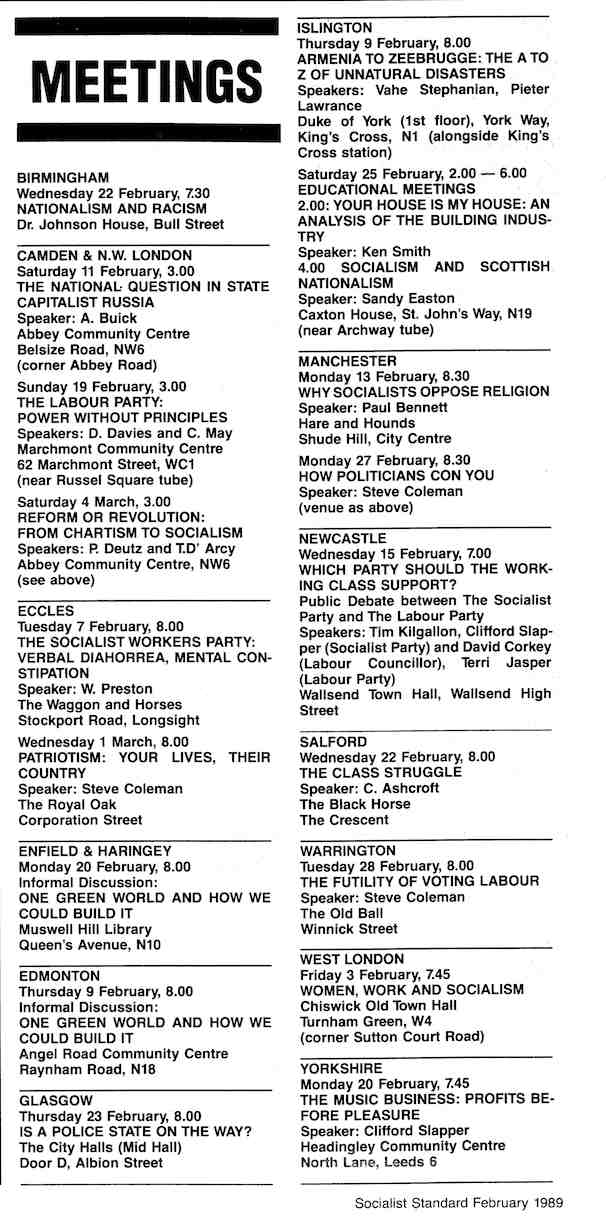
SPGB Meetings (1989)

 Party News from the February 1989 issue of the Socialist Standard


50 Years Ago: The Cripps Popular Front for 
Democracy (1989)

The 50 Years Ago column from the February 1989 issue of the Socialist Standard

The Labour Party puts forward a non-Socialist programme and labels it "Socialist Crusade", while Cripps writes glibly of an all-party aliance. in which nobody “would be expected to relinquish any part of their beliefs or programme except for the specific and limited purpose of the present emergency and for the creation of a temporary combination to fight the National Government."

Fine-sounding phrases, but what is the new Government going to do when it gets into office, except carry on the administration of capitalism? They could not introduce Socialism, even if they wished, because the electorate is opposed to such a course, and the openly capitalist elements have not the slightest intention of putting capitalism in cold storage as their part of the bargain. Nor do they even pretend to have that intention. Like the Duchess of Atholl. who wrote an article on "My Creed" in Reynolds (January 15th. 1939). they desire "to maintain private property as an institution.” The Socialist sheep is asked to join in a pact of mutual assistance with the capitalist wolf under the blessed guise of genuine friends of democracy, but while the sheep is to give up Socialism the wolf carries on in the accustomed way.

(From an editorial. “Cripps and the Labour Party", published in the Socialist Standard. February 1939.)

Fraternal assistance (1989)

From the February 1989 issue of the Socialist Standard

The London International Stock Exchange is to assist the development of a stock exchange in Hungary. The agreement was signed in Budapest on December 12 by Mr J. Knight, the managing director of the London Stock Exchange In an interview he said that a stock exchange in Hungary would encourage foreign investors as they regarded an exchange as a means of gathering information on the financial and economic standing of Hungarian enterprises.

First, however, several private enterprises would have to emerge and operate profitably. He called attention to the need for reliable statistics. He added that the exclusivity or predominance of state ownership in Hungary did not contradict the existence of a stock exchange. In recent decades socialist governments in several Western countries had nationalised mines and steelworks and issued shares and bonds on the exchange.
Hungarian Radio. December 13 (BBC Monitoring)

Russia's fate (1989)

From the February 1989 issue of the Socialist Standard

The March 1924 edition of the Socialist Standard had this to say on the death of Lenin:
So far was he from changing the course of history. . . that it was the course of history which changed him . . . Today Russia stands halfway on the road to capitalism. The communists in their ignorance may howl at this, but Russia cannot escape her destiny.
The Socialist Party stood alone at the time in rejecting claims that Russia had achieved anything more than this: it stood not on the threshold of socialism, but on its way to full integration into the capitalist world economy.

Today we can test the socialist argument against the historical record. Has Russia escaped the destiny predicted for it by us in 1924? President Gorbachev answered the question in his speech to the United Nations in December:
The world economy is becoming a single organism and no state, whatever its social system or economic status, can normally develop outside it.
Alan D'Arcy