Wednesday, March 5, 2008

Weekly Bulletin of The Socialist Party of Great Britain (36)

Dear Friends,

Welcome to the 36th of our weekly bulletins to keep you informed of changes at Socialist Party of Great Britain@MySpace.

We now have 1194 friends!

Recent blogs:

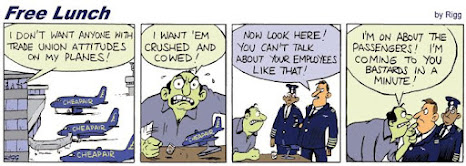
  • Greedy bastards
  • The politics of joining
  • The workfare state: enforcing the wages system
  • This week's top quote:

    "Journalism is one of the devices whereby industrial autocracy keeps its control over political democracy; it is the day-by-day, between-elections propaganda, whereby the minds of the people are kept in a state of acquiescence, so that when the crisis of an election comes, they go to the polls and cast their ballots for either one of the two candidates of their exploiters." Upton Sinclair, The Brass Check, 1919.

    Continuing luck with your MySpace adventures!

    Robert and Piers

    Socialist Party of Great Britain

    Tuesday, March 4, 2008

    Guns and Toys (2008)

    Book Review from the March 2008 issue of the Socialist Standard

    The Real Toy Story. By Eric Clark. Black Swan. £8.99.

    It is probably not very surprising to learn that the toy industry is very competitive, is driven by marketing considerations and is threatened by children’s growing interest in computers. However, Eric Clark does add some interesting further considerations.

    The US toy and doll industry is a $22 billion business and is by far the world’s largest. Two big manufacturing companies (Mattel and Hasbro) and three big retailers dominate the industry, independent manufacturers and toyshops having mostly gone bankrupt or been taken over. The big retailers include Toys R Us and Wal-Mart, the supermarket chain that sells masses of toys as a way of getting kids and their parents inside the shops. Manufacturers are desperate for Toys R Us to survive, since without it Wal-Mart would be so powerful it would drive down even further the prices it paid to the toy companies.

    Toys and dolls are also used to entice families into fast-food restaurants; McDonald’s is now the world’s biggest distributor of toys. Girls are apparently less keen on fast food than boys, hence the emphasis on toys aimed at girls being given out with meals for kids.

    Toys are relatively resistant to ups and downs in the economy, as parents are reluctant to cut back on buying for their children. A rising divorce rate helps sales too, as both parents will be buying separately. Yet the toy industry has one great fear: KGOY, kids getting older younger and so losing interest in toys. This has been the case, for instance, with Barbie, the doll that now falls out of favour by the age of six or seven. A rival, Bratz, is aimed at pre-teens and features ever-skimpier clothes. As Clark says, this ‘is all part of the sexualizing of younger target groups for marketing reasons’.

    Games are mostly made in the US and Europe, since their manufacture is highly automated. But toy production overwhelmingly takes place in China. This is partly because labour power there is cheap, of course: in the case of one electric toy that retailed in the US at $45, just 81 cents were paid in direct labour costs. But it also means that the suppliers, not the US-based toy companies, have to undertake the investment in factories and equipment and bear the risk of idle capacity at quiet periods. All this has backfired recently, however, with reports of toys made in China being dangerous and having to be removed from retail shelves.

    Clark also observes that toys nowadays tend to ‘do everything’ and leave less and less to the child’s imagination and creativity. Under capitalism the innocence of childhood takes second place to the demands of marketing and profit-making.
    Paul Bennett

    Monday, March 3, 2008

    Can the media be made democratic? (2008)

    From the March 2008 issue of the Socialist Standard

    That there was once a press free from commercial or governmental influence is a myth.
    Since the early twentieth century American journalists have been fascinated by the uneasy relationship between democracy and a media industry that has grown immensely powerful and profitable. The opinion that the democratic process has been undermined – epitomised by declining electoral turnout – by an industry more concerned with increasing corporate profits than the meaningful dissemination of information has repeatedly led to demands for media reform.

    In the first part of the twentieth century the American writer and journalist Upton Sinclair drew attention to the corrosive influence of advertising that led newspapers to adapt content to suit powerful sponsors and encourage editorial self-censorship. Sinclair's book The Brass Check (1919) was a scathing attack on a monopolistic press, in which he said that commercial journalism had become "a class institution serving the rich and spurning the poor," with the task of "hoodwinking of the public and the plunder of labour". Brought in some years after the publication of Sinclair's book, the Federal Communication Act of 1934 was widely seen as the first real attempt to curb media monopoly and reinvigorate the supposedly democratic values embodied in the American Constitution through "public interest, convenience and necessity." But these and later reforms failed to consider one possibility: What would happen if the government ever saw public information as secondary to free market economics? What would happen if the government actually joined forces with the media to communicate a common ideology that devalued "democracy"?

    Media deregulation
    According to Bill Moyers, one of America's best known and respected post-war journalists, this is exactly what happened under the banner of media deregulation. Beginning with Ronald Reagan, deregulation sowed the seeds for a consolidation that eliminated much of the independent media and prompted editorial policy to downgrade the importance of news. But the crowning achievement in the demotion of meaningful news came later with the 1996 Telecommunications Act, which was passed with the support of both political parties. This legislation allowed communications conglomerates and advertisers to join forces to dismantle competition safeguards and devise "new ways of selling things to more people" across the full array of digital and conventional media. Within the media corporations the strategy eliminated remaining divisions between editorial and marketing functions to "create a hybrid known to the new-media hucksters as 'branded entertainment.'" (Bill Moyers, Journalism and Democracy, Alternative Radio, 8 November 2003).

    Moyers' assessment of the American newspaper industry is equally gloomy. Here, according to a study by the Consumers Federation of America, two-thirds of today's newspaper markets are monopolies. Not satisfied with this stranglehold, the major newspaper chains have combined with the trade group representing almost all of the broadcasting stations to lobby for further autonomy to extend cross-ownership of media, claiming that this will strengthen local journalism. Moyers notes that in typical fashion none of the organisations involved felt it necessary to report this news, remarking, "they rarely report on how they themselves are using their power to further their own interests and power as big business, including their influence over the political process". He draws further evidence from the book, Leaving Readers Behind: The Age of Corporate Newspapering, which concludes that the "newspaper industry is in the middle of the most momentous change in its three hundred year history – a change that is diminishing the amount of real news available to the consumer".

    Looking back over American history, Moyers says that during the War of Independence freedom and freedom of communication were the "birth twins in the future United States", but that today freedom of communication has become an obstacle to corporate profits and has been abandoned. He says that the media that once championed democracy now works hand in glove with government to intentionally undermine democratic values. He identifies certain developments that have ambushed democracy. These include censorship by omission, government refusal to disclose or debate in public, and the overarching power of media giants that "exalt commercial values at the expense of democratic values" to produce "a major shrinkage of the crucial information that thinking people can act upon".

    But according to Moyers perhaps the most repugnant development is the rise of a "quasi-official partisan press ideologically linked to an authoritarian administration that in turn is the ally and agent of the most powerful interests in the world". This convergence, he says, "dominates the marketplace of political ideas" promoting the "religious, partisan and corporate right" to engage "sectarian, economic and political forces that aim to transform the egalitarian and democratic ideals embodied in our founding documents". He goes on to provide examples where investigative newsgathering and scrutiny over government, police and the courts has been abandoned to cut costs, avoid institutional embarrassment and maintain this coalition of vested interests. In the absence of a strong opposition party to challenge this hegemony, the task of defending democracy, he says, falls to a reformed media.

    The recurrent theme that runs throughout Moyers' account of the American media is a yearning back to a romanticised "Golden Age", when a free and independent press kept its subscribers fully informed with important news that enabled them to act. He points to the newspapers at the time of the American War of Independence and in particular to Tom Paine's pamphlet Common Sense that helped mobilise opposition to the British. Moyers says that as a journalist Paine practised a principle in need of restoration: "an unwavering concentration to reach ordinary people with the message that they mattered and could stand up for themselves." But was this really a "Golden Age" of democracy or was it, as Sinclair believed, just another instance of the press propagating a class interest under the guise of democracy? Put a different way, has a press free from political or commercial influence ever existed?

    Romanticised past
    For many, a belief in the abstract democratic ideal is closely linked to the myths surrounding the origin of the Constitution and the founding of America as a separate country. But far from being a revolutionary event that encouraged a genuine development of democratic values, the War of Independence was a strictly conservative affair. The colonial rebellion was not the work of enraged peasants but of landed gentlemen, who argued their case on the principles of the British constitution by demanding free assembly, trial by jury, and no taxation without representation. Despite pretensions of being "enlightened" – sweeping aside monarchy, aristocracy and the established church – the new republic was never designed to be anything other than an oligarchic state. The political institutions and Constitution mirrored instincts of conservatism and constructed an array of checks and balances motivated by paranoia, suspicion of central government power, and religion that laid the foundation for laissez faire economics.

    The expulsion of the British eliminated the constraints of the feudal social order substituting in its place the abstract principles that "all men are created equal" and that power is derived from "the will of the people". The desire to protect and then extend private property rights sanctified by religious superstition led to a type of liberty intended to allow the pursuit of individual aims and wealth unconstrained by government interference. To those who took up the reins of power, government was to be judged not by its ability to promote prosperity but by its capacity to leave people alone to pursue private ends. The principle that personal opportunity should be maximised also struck a chord with Puritanism that saw the acquisition of money as the just result of hard work and "the Lord's blessing".

    This moderate civic liberty was deemed more important than any tendency towards democracy, and the architects of the Declaration of Independence – the land and property owners – were quick to construct a system of government based on the division of power that would guard against the "excesses of democracy". They adopted a definition of "the people" which excluded women, non-landowners and slaves.

    While it is undoubtedly true that writers like Tom Paine were influential in pushing the colonial revolt further than originally intended, it is also clear that the real beneficiaries of the break with Britain were the landowners and wealthy traders who were able to expand their own wealth without interference. Although Paine's call to arms, based on abstractions and ideals, appealed to the ordinary person, the benefits accrued were material and went to the wealthy.

    The "democracy" practised today in America is usually held up as the ultimate symbol of "liberty". But from its outset this system was not envisaged as a condition in which individuals would be kept informed and use the knowledge acquired in the decision making process. On the contrary, this type of "democracy" was constructed as the institutional means to exclude the people from this arena by limiting involvement to the periodic election of someone, normally submissive to a political party, who would make decisions for them.

    In capitalist society the media has always had a role to play in the promotion in this kind of vision. The production of a successful newspaper, for example, has always meant that journalistic integrity and editorial objectiveness have been subordinate to the institutional requirement of production for profit. From the moment that newspaper became a commodity and subject to advertising patronage and market forces, the genuine dissemination of information was always going to be the first casualty.

    Prevailing ideas
    So the media, in America as elsewhere, has a vested interest in driving out all but the most benign opinions and instilling a set of values and a code of behaviour that integrate people into class society. But this does not mean that the media are necessarily part of some conspiracy. While the media's role is to circulate information presented in the context of society's prevailing ideas, which have a strong influence over the way people think, this does not mean that the media originate these ideas. In general, the ideas presented by the media are rooted in the social milieu and are traceable, in the main, to the material conditions and the economic relations of society. The class that controls society's economic structure shapes the institutions that arise in order to manage the economic conditions in its own interests and perpetuate its ascendancy over society. As well as its control over society's coercive powers and the means by which the wage and salary earners live, this class also exercises persuasive powers, based on legal rights, traditions, customs and, as in America, historical myth that works its way into the consciousness of the working class. In a society divided by class, based on economic interests, the prevailing ideas are therefore a reflection of the needs and aspirations of the dominant class, which explains why many members of the working class often think and act in ways that are in contradiction to their real interests. The media therefore speaks not just for itself but for the whole of the capitalist class.

    There are two reasons why Moyers' belief that a reformed media can resurrect an abstract vision of "democracy" conjured up from a romanticised image of America's past does not stand up to scrutiny. Firstly, the type of democracy he seems to want has never really existed, and secondly he fails to appreciate that capitalism and genuine democracy can never co-exist. Moyers does not criticise the economic system that compels the media to act in the way it does and does not see that in this system the media cannot operate in any other way – as if in a vacuum, uninfluenced by market forces. Media reform, which tinkers with the detail but leaves the underlying causes firmly entrenched, is, it could even be argued, actually dangerous because it reinforces the belief that capitalism can be made to work in the interests of the working class, when the opposite is patently the case.
    Steve Trott
                     

    Sunday, March 2, 2008

    Marx and the BBC (2008)

    Book Review from the March 2008 issue of the Socialist Standard

    A Socialist Critique of the BBC, Albert Einstein, Amartya Sen and Muhammed Yunus. By Binay Sarkar, Avenel Press, 2007

    Don't be put off by the title; when you read it – as you should – it all makes sense. In 1999 Karl Marx was voted the “Greatest Thinker of the Millennium” in a BBC online poll. Then in 2005 he was voted the “Greatest Philosopher” in a BBC poll. And yet the BBC has always had a problem in dealing with such a great thinker and philosopher, perhaps because he didn't win a Nobel Prize. In the philosopher contest they invited Francis Wheen on to a BBC radio programme to explain Marx's theories but he said they were a form of economic determinism, in that economic relations determined all other features of society, including ideas.

    It's a popular misinterpretation, one which Albert Einstein didn't repeat when he declared to the world that he was a socialist in an article entitled Why Socialism? in 1949. Einstein's analysis of capitalism is still broadly acceptable today even if his conception of socialism is not, being essentially a form of state capitalism. Amartya Sen, a professional economist, also has a state capitalist view of socialism but his understanding of present-day capitalism looks muddled when compared with the analysis of the Nobel Prize-winning physicist Einstein.

    Sen won the 1998 “Bank of Sweden Prize in Economic Sciences in Memory of Alfred Nobel” (not to be confused with the Nobel Prize, which is awarded by the Nobel Foundation) for his contribution to “welfare economics.” Sen correctly saw that famines were caused by poverty and not an inability to feed starving people. However, he put forward a set of “market entitlements” which were meant to combat poverty; but as this left the class monopoly of the means of life untouched it should not be surprising that this could not reduce poverty or famines.

    Binay Sarkar exposes these and other reformist illusions, along with Muhammed Yunus's plans for “Banking for Peace.” Yunus was awarded the 2006 “Nobel Peace Prize” (given by the Norwegian parliament, not the Nobel Foundation) for his “commitment to the Grameen cause.” This envisaged fighting poverty by lending money, mainly to women, to facilitate self-employment projects and promote women empowerment. But as Adam Buick points out in his Introduction to this book, banking “is an integral part of the capitalist system of production for profit which is the cause of modern wars.” Despite the excessive use of quotations, this book deserves to be in every socialist's collection.
    Lew Higgins

    Saturday, March 1, 2008

    Cooking the Books: Who would work for nothing? (2008)

    The Cooking the Books column from the March 2008 issue of the Socialist Standard

    "That would never work! A typical response, I imagine, to the description of a society where people work because they want to, on a voluntary basis". So began the lead article in last month's Socialist Standard.
    The article was about the transformation which work would undergo in a society where it was no longer a source of income for workers and a source of profit for employers, but a means of producing useful things and providing needed services to improve the quality of our lives. But even under capitalism, these critics might be surprised to learn, many people already perform voluntary work.

    According to nfpSynergy, a research group for charities, almost 19 percent of people do unpaid voluntary work in Britain (London Times, 21 January). This – nearly 1 out of every 5 people – is fairly consistent across all age groups. People volunteer for all sorts of jobs: driving people to and from hospital appointments, helping out in hospital shops, looking after people just out of hospital, teaching school kids to read or do maths, teaching English to immigrants, mentoring new parents, serving in charity shops.

    If the critics of socialism were right in their view that it is human nature to be lazy and that nobody would work unless compelled to by economic necessity, this would not happen. Most volunteers under capitalism will be doing so because they want to do something useful and help other people. But even if their motivation was to overcome boredom or to meet and be with other people, that would still be a practical refutation of the view that people are naturally lazy. The reasons why people work, even for an employer, are much more complex than the simplistic assumption that that it's just for the money.

    In fact, the government has adopted a policy of actively encouraging "volunteering" as it is called, as a means of saving money on providing certain services. In 2001 Gordon Brown, then the Chancellor of the Exchequer, launched an initiative to encourage more over-55s to volunteer. As it happens, according to nfpSynergy, this proved to be a bit of a flop. But 16 percent of the 55-64 age group – nearly 1 in 6 – volunteering in 2007 is still fairly impressive. It is certainly enough to refute the view that, if the whip of economic deprivation was removed, nobody would do any work.

    But capitalism distorts everything, even the readiness of people to work for no monetary reward. A whole paid profession has grown up – for which an organisation like nfpSynergy provides reports – of people employed to motivate and organise volunteers. And a large proportion of volunteers are engaged in fundraising for charities, a pretty useless activity in itself only necessary under capitalism even if done on an unpaid basis.

    The widespread existence of volunteering shows that people are prepared to work for other reasons than individual economic necessity. Of course, as in any form of human society, in socialist society too arrangements will have to be made to provide what its members need to live. That will still be a necessity, but that does not mean that these arrangements cannot be based on people volunteering to work, for all sorts of reasons (pleasure, social recognition, wish to do something useful, social contact, even a sense of duty). Socialism could work without economic coercion.

    Friday, February 29, 2008

    Material World: Still in Chains: South Africa After Apartheid (2008)

    From the March 2008 issue of the Socialist Standard

    "They never freed us. They only took the chain from around our neck and put it on our ankles." Anti-apartheid activist Rassool Snyman to Naomi Klein.
    The fight against the system of racial segregation and white supremacy called apartheid ("apartness" in Afrikaans) was one of the great liberal and left-wing causes of my generation. It was a fight not only for political democracy in South Africa but also for socio-economic reform.The Freedom Charter, adopted by the African National Congress in 1955 (www.anc.org.za), called for "restoring national wealth to the people" (understood as nationalization of the mines, banks and "monopoly industry"), "re-dividing the land among those who work it to banish famine and land hunger," improved pay and working conditions, free healthcare, universal literacy, and decent housing for all.

    Apartheid as a political and legal system was dismantled in the early 1990s. South Africa's capitalists did not on the whole object. Apartheid had brought them immense profits from the exploitation of a cheap captive labour force. But it had its drawbacks. By denying training and advancement to a large majority of the workforce, it created a growing shortage of skilled labour. Capitalists are often willing to accept a measure of social change, provided that they can set its limits.

    Little change
    Although apartheid is gone, economically South Africa is still one of the most unequal countries in the world. Almost all the land, mines and industry remain in the same (mostly white) hands. Almost half the population lives below subsistence level. Unemployment is widespread; children scavenge on dumps and landfill sites from sunrise to sunset seven days a week. Life expectancy is falling (a drop of 13 years since 1990) as AIDS, drug-resistant TB and other diseases spread.

    Even segregation still exists in practice. The wealthy take shelter in "gated communities" from the violence pervading the shantytowns. As the wealthy are no longer exclusively but only predominantly white, the proper name for this is class rather than race segregation.

    True, efforts have been made to improve living conditions. Close to two million new homes have been built. (Whether they count as "decent housing" is another matter.) Water, telephone and electricity networks have been expanded. But while millions were rehoused, millions were also evicted for rent arrears.

    Nine million people were connected to the water supply, but during the same period ten million were disconnected as the price rose out of their reach.

    Caught in a web
    How did the main reform goals of the Freedom Charter come to be abandoned? Political journalist William Mervin Gumede tells the story in his book Thabo Mbeki and the Battle for the Soul of the ANC (Cape Town: Zebra Press 2005).

    While political negotiations, conducted in the glare of publicity, moved the ANC toward government office, parallel and almost unpublicized economic negotiations, led on the ANC side by Thabo Mbeki (now president), ensured that when the ANC did take office it would be unable to act against white business interests. A new clause of the constitution made all private property sacrosanct. Power over economic policy was ceded to an "autonomous" central bank and international financial institutions.
    "The ANC found itself caught in a web made of arcane rules and regulations… As the web descended on the country only a few people even noticed it was there, but when the new government … tried to give its voters the tangible benefits they expected the strands of the web tightened and [it] discovered that its powers were tightly bound"(Naomi Klein, The Shock Doctrine pp. 202-3).
    Relentless pressure
    The ANC hierarchy came under "relentless pressure" from local and international business, the (business controlled) media, foreign politicians, the World Bank and IMF, etc. It was "an onslaught for which the ANC was wholly unprepared" (Gumede, p. 72). This does not mean that crude demands and threats played a crucial role. It was a process more of seduction than intimidation, aimed at integrating a set of new partners into the institutional structure and social milieu of the global capitalist class.

    This meant providing opportunities for ANC officials to go into business or train at American business schools and investment banks. Leading figures were lavished with hospitality:
    "Harry Oppenheimer [former chairman of Anglo American Corporation and De Beers Consolidated Mines] was eager to entertain Mandela at his private estate, while Anglovaal's Clive Menell hosted him for Christmas (1990) at his mansion . . . While separated from his wife, Mandela's home for several months was the palatial estate of insurance tycoon Douw Steyn . . . His daughter Zinzi had a honeymoon partly financed by resort and casino king Sol Kerzner, and Mandela spent Christmas 1993 in the Bahamas as a guest of Heinz and Independent Newspapers chairman Sir Anthony O'Reilly." (Gumede, p. 72).
    It seems churlish to begrudge Mandela a little luxury after 27 years in prison. But what were his benefactors' motives?

    The markets: stern taskmasters
    Nevertheless, the most effective form of capitalist influence was the impersonal pressure of "the markets." As Mandela told the ANC's 1997 national conference: "The mobility of capital and the globalization of the capital and other markets make it impossible for countries to decide national economic policy without regard to the likely response of these markets" (Klein, p. 207). And the markets punished the slightest sign of deviation from the "Washington consensus" with capital flight and speculation against the Rand.

    Mbeki was the first to grasp what was needed to win the markets' confidence. Precisely in order to live down its "revolutionary" and "Marxist" past, the ANC leaders had to prove themselves more Catholic than the pope. "Just call me a Thatcherite" – quipped Mbeki as he unveiled his new "shock therapy" programme in 1996.

    South Africa could not afford the protectionist measures with which Malaysia, for instance, warded off the Asian financial crisis of 1997. Orthodoxy, however, was never rewarded with the hoped-for flood of foreign investment. The markets are stern taskmasters: they demand everything and promise nothing.

    A sell-out?
    It is not altogether fair to say that Mandela or Mbeki "sold out." They simply saw no escape from the "web" spun by global capital. Indeed, at the national level there is no escape. Reformers in other countries, such as the Solidarity movement in Poland and Lula's Workers' Party in Brazil, have gone through much the same experience on reaching office. Socialists have long said that socialism cannot be established in a single country. Now we also know that under conditions of globalization even a meaningful programme of reform cannot be implemented in a single country.

    Capital is global. That is its trump card against any attempt to defy its dictates that is confined within national boundaries. The resistance to capital must also be organized on a global scale if it is to have any chance of success.
    Stephen Shenfield

    Thursday, February 28, 2008

    UN predicts food aid rationing

    From the Class Warfare blog:

    The Financial Times has reported that the UN's World Food Programme, charged with relieving hunger in underdeveloped countries, is drawing up plans to ration food aid in response to spiralling prices.

    "The World Food Programme is holding crisis talks to decide what aid to halt if new donations do not arrive in the short term.

    "Josette Sheeran, WFP executive director, told the Financial Times that the agency would look at 'cutting the food rations or even the number or people reached' if donors did not provide more money. 'Our ability to reach people is going down just as the needs go up,' she said.

    "WFP officials hope the cuts can be avoided, but warned that the agency's budget requirements were rising by several million dollars a week because of climbing food prices."

    Back in November, Josette Sheeran said (Guardian, 3rd November 2007):

    "There are 854 million hungry people in the world and 4 million more join their ranks every year. We are facing the tightest food supplies in recent history. For the world's most vulnerable, food is simply being priced out of their reach."

    One major factor, impacting food prices and mentioned elsewhere on this blog, is that pertaining to the growing of crops to supply the biofuels industry.

    As Food First reports today on its home page.

    "FACT: Ethanol is helping drive food prices out of control without lowering the price of gas – Corn planted for ethanol competes for farmland with corn for food production and with other food crops. This drives up the price of all food crops, especially those that contain corn products—which is most of our processed food. Meat is more expensive because our beef cattle eat corn, not grass. Food prices have increased by 25% over last year! Gas prices still went up by 80%..."

    The insanity is that the UN is introducing rationed food aid programmes because it exists as part of a system in which the rationing of commodities is the order of the day. Indeed, rationing has been the order of the day since capitalists realised they could make huge profits by limiting supply.

    Food shortages are very much rooted in a system that manipulates supply and demand to keep prices high. Stories are legion about farmers being paid to take land out of production, of governments stockpiling food, to keep prices low. I remember not so many years ago writing a lengthy letter to the local press screaming my anger at the EC's decision (back then) to destroy 3 million tons of fruit and at the cost of £52 million, because, quite simply, too much had been produced and, it if it was allowed to enter the market, prices would have crashed. And now arable is being used for the biofuel matket!

    And its nothing new. This has gone on for decades. John Steinbeck's Pulitzer Prize winning The Grapes of Wrath (1939), set against the backdrop of the Great Depression, highlighted the issue in California, where tens of thousands of hungry, migrating farmers and their families, encountered mountains of rotting fruit, guarded by law enforcement officers instructed to shoot anyone who dared pick so much as a decomposing apple.

    Organisations like Food First (Institute for Food and Development Technology –) are clear that the world today produces enough grain alone to provide every human being with 3,500 calories a day. "That's enough to make most people fat!" they assert. And this estimate does not take account of many other universally eaten foods—vegetables, beans, nuts, root crops, fruits, grass-fed meats, and fish. Indeed, if all foods are considered together, sufficient is available to provide at least 4.3 pounds of food per person a day. That includes two and half pounds of grain, beans and nuts, about a pound of fruits and vegetables, and nearly another pound of meat, milk and eggs. Put that on a platter in front of most people and ask term to eat it and the thought of it makes them quite nauseous. This much is asserted in a 2006 document entitled 12 Myths About Hunger.

    The document further observes how "the problem is that many people are too poor to buy readily available food. Even most 'hungry countries' have enough food for all their people right now. Many are net exporters of food and other agricultural products."

    In other words, if you're hungry in this world it is inevitably because you lack the purchasing power to buy food. The golden law of capitalism as ever comes into play – "can't pay, can't have". Poor people simply do not constitute a market; no profit can be had for them. It is far simpler, and far more lucrative, to create an artificial shortage which maintains prices at a profitable level. And with biofuel crops entering the equation of late, the problem is only exacerbated.

    John Bissett

    Wednesday, February 27, 2008

    Weekly Bulletin of The Socialist Party of Great Britain (35)

    Dear Friends,

    Welcome to the 35th of our weekly bulletins to keep you informed of changes at Socialist Party of Great Britain @ MySpace.

    We now have 1191 friends!

    Recent blogs:

  • 'Pro-life' hypocrites
  • How We Live and How We Could Live
  • Upton Sinclair and 'The Jungle'
  • This week's top quote:

    "But first, I will say what I mean by being a Socialist, since I am told that the word no longer expresses definitely and with certainty what it did ten years ago. Well, what I mean by Socialism is a condition of society in which there should be neither rich nor poor, neither master nor master's man, neither idle nor overworked, neither brain-sick brain workers, nor heart-sick hand workers, in a word, in which all men would be living in equality of condition, and would manage their affairs unwastefully, and with the full consciousness that harm to one would mean harm to all - the realization at last of the meaning of the word COMMONWEALTH." William Morris, How I became a socialist, 1894.

    Continuing luck with your MySpace adventures!

    Robert and Piers

    Socialist Party of Great Britain

    Tuesday, February 26, 2008

    Profit Laundering: what’s justice got to do with it? (2008)

    From the February 2008 issue of the Socialist Standard
    "Tax Havens Cause Poverty" proclaims the home page of the Tax Justice Network. No, they don't. The profit system does.
    The Tax Justice Network thinks that world poverty can be effectively tackled by reforming the international system of taxing profits so as to eliminate tax havens and tax dodging – "profit laundering" as they aptly call it – by capitalist corporations.

    This would make no essential difference. World poverty is not caused by corporations behaving badly. Their "bad" behaviour as identified and described by the Tax Justice Network is not bad from a capitalist point of view. It is normal, and in fact it is not possible to alter it – either by legislation or by appealing to the "morality" or "ethics" of corporate leaders. It's the way the capitalist profit system works and can only work. As long as you've got capitalism, in the famous – or infamous – phrase, there is no alternative. No alternative, that is, to capitalist corporations pursuing the maximisation of profits above all else. This is not a matter of choice by corporate executives. It is not because they are personally greedy or insensitive and deliberately choose to run their corporations in this way. It's the reflection in their minds of the underlying logic of the system of which in the end they – like the rest of us in fact – are just cogs.

    But what is this underlying logic? What is capitalism?

    Capitalism
    Basically, it's the market system. Not just markets – they existed before capitalism – but a whole economic system where every aspect of the production and distribution of wealth takes place via the market, by means of a vast network of buyers and sellers. This includes the buying and selling of labour – or, more accurately, of labour-power, of a person's ability to work. In fact, capitalism is based on the existence of a class of people whose only productive resource is our ability to work in some capacity or other (whether so-called manual or so-called intellectual) which we are obliged to sell on the labour market for a wage or salary. But sell to whom? To those who own the other resources essential to production: land and natural resources, and mines, factories, transport, communications. In other words, capitalism presupposes the division of society into two classes: those who own the means of wealth production and those who don't. This is not a 50:50 division, more like a 5:95 one. So capitalism is a class society. Like everything else under capitalism, the relationship between these two classes is a market one, one of buying and selling.

    But there's more to this particular market relationship than to that between other buyers and sellers. In other cases, it is a simple exchange of something of one value for something else of an equal value. Such an exchange of equal values is also involved in the wage contract – we get as our wage or a salary more or less the value of the labour-power we are selling – but human labour-power has the unique property of being able to create new value. The difference between wages and salaries and the new value added in the course of producing some good or service is the source of profit, which it is the aim of every capitalist and every capitalist enterprise to extract and maximise.

    Some of this profit is creamed off by fat cat directors and owners to support an extravagant life-style but most of it is re-invested. If a capitalist firm did not do this with a view to keeping its productive methods up to date so as to be able to produce as cheaply as possible, it would lose out in the battle of competition with its rivals and, eventually, either go bankrupt or be taken over by one of them. So, under the pressure of market competition, capitalist firms are forced to accumulate most of their profits as more capital.

    This competitive struggle to make and accumulate profits as more and more capital is the essence of capitalism. It's an impersonal economic mechanism that imposes itself on all enterprises involved in producing for the market, whether they are owned by individuals, corporations, the state or even by a workers' co-operative. The logic of profit always ends by imposing itself, even on governments, and there's nothing that can be done to stop this as long as capitalism lasts.

    Taxes
    Despite what some ideologists of a "pure capitalism" claim, capitalism cannot exist without the existence also of a coercive state – and never has. In fact, the state helped capitalism come into being, as by establishing trading monopolies like the East India Company and as by driving peasants off the land and into factories. But the state produces nothing (unless it is itself involved in production, as it sometimes has been) and so has to be financed by a levy on those who possess wealth or who control the production of wealth, i.e. by taxes. As the 19th century economist (and MP) David Ricardo showed a long time ago, in the end the burden of taxation falls on property and property-incomes such as rent and profit (any taxes on wages are passed on to the employer). Taxes on profits of course reduce the wealth of capitalists but they generally accept the principle of paying taxes as they recognise the usefulness of the services that the state provides them, not least the armed force to back them up in conflicts with other capitalists supported by their state over markets, trade routes, sources of raw materials and investment outlets. But they are not masochists; they'll only pay the taxes they absolutely have to. And a whole business has arisen to advise them how to minimise their tax burden.
    Some companies are better able to do this than others, and the Tax Justice Network have a point when they say that:
    "The ability of transnational corporations to structure their affairs through paper subsidiaries in tax havens provides them with a significant tax advantage over their nationally or locally based competitors. Local businesses, no matter whether they are technically more efficient or more innovative than their transnational rivals, will be competing on an uneven field. In practice, of course, differential tax treatment favours the large business over the small one, the international business over the national one, and the long-established business over the start-up". (John Christensen and Richard Murphy, Development Journal, September 2004).
    Quite true. But why should we, as wage and salary workers, worry about this? Why should we get involved in this dispute between two sections of the capitalist class as to how the tax burden should be shared between them? Why should we take the side of small business as against large business, or national business or businesses in the Third World against international business? Taxation is not our concern as wage and salary workers. Even if multinational corporations were forced to pay more taxes (which is not inconceivable), this would not benefit us, It would only benefit their smaller, national-based competitors. And it wouldn't benefit the mass of the people in the Third World either. Only the business and political elites there who would then have more money to spend on their armed forces and their privileged lifestyles. "Tax Justice" is not our concern.

    Corporations
    The profit logic imposes itself irrespective of the type of enterprise. In Adam Smith's day – the middle of the 18th century – most enterprises were run by individual capitalists who risked all their money; there was no distinction between their personal wealth and that of their business. So, if their business failed they were ruined. As capitalism developed more and more capital was needed to start and sustain a business. This problem was partly overcome by partnerships, but this was complicated legally and partners were also still personally liable for the debts of the business; so, if it went under they went under too.

    The solution, found and implemented from the middle of the 19th century, was the limited liability company. This was a legal business entity in which people could invest money to be used as capital but only be liable in the event of bankruptcy for the amount of their shareholding. Hence the name in Britain of limited liability company. In France it was called a "nameless [i.e. impersonal] society" and in America a "corporation". Whatever they were called, all had a separate legal personality, allowing them to sign contracts, pay taxes, sue and be sued as if they were real people. Even if, as the recent film The Corporation has underlined, they were real people they would be locked up as dangerous psychopaths. No real person is so cold and calculating and so obsessive about pursuing a single aim.
    As might have been expected, many of the early company promoters and directors were rogues who swindled and robbed those who put up the money for their companies, i.e. the shareholders. Legislation was therefore introduced to protect shareholders. Company directors were required to act in such a way as to exclusively further the financial interests of the shareholders, i.e. to make as much profit for them as they could. All their acts as directors had to be justified by this end: they had to try to maximise profits and were not allowed to siphon off money for themselves nor, it could be added, to spend it on "ethical" objectives which they might personally favour.

    As Christensen and Murphy noted in their article:
    " … tax minimization through elaborate and frequently aggressive tax avoidance is regarded as one of the prime duties that directors are required to perform on behalf of their shareholders."
    "Compelled by the profit logic, and by a legal principle that asserts that tax payers may organize their affairs in such a way as to pay the least tax possible under the law, the majority of large businesses have been structured so as to enable tax avoidance in every jurisdiction in which they operate."
    The Tax Justice Network thinks that this can be changed, both by changing company law and by appealing to corporate executives to behave"ethically", but they are wrong. Company law – and the legal obligation on corporations to be "a pure money-making machine" – is a reflection of the underlying economic reality of capitalism which, as we saw, is the impersonal economic mechanism of the making and accumulation of profits as more and more capital. No law will ever be passed that goes against this impersonal logic of profit – and, even if it were, it wouldn't work. Any government which tried it would cripple industry within its borders by rendering it less competitive internationally, so provoking an economic crisis and mass unemployment – and the coming into office of a government that would repeal the legislation in question. Within capitalism there is, quite literally, no alternative to corporations being pure money-making machines.

    So, if there's no way out under capitalism what are we in the Socialist Party proposing? Basically, to end capitalism, not trying to patch it up or trying to make it work in some other way through tax reforms. Capitalism. So, we're talking about a world-wide change, a global change in both senses of the term. Both world-wide and thorough-going.

    To end the operation of the impersonal economic mechanism of the pursuit and accumulation of profits as capital, the first thing that must happen is that the natural and industrial resources of the planet must stop being the property of rich individuals, corporations or States and become instead the common heritage of all humanity. On this basis, the productive resources of the world can be freed from the tyranny of profit-driven market forces and become available to be used, under democratic control, to simply turn out the things that the world's population needs to live and to enjoy life, in accordance with the principle "from each according to their abilities, to each according to their needs".

    In the current atmosphere of cynicism, apathy and alienation, to talk in terms of a world-wide democratic revolution to replace world capitalism with world socialism must seem incredibly utopian. Be that as it may, it is the only way out and until people organise to abolish the capitalist profit system the problems we have been discussing will continue. The real utopians are not us, but those like the Tax Justice Network who still think that you can doing something constructive within the capitalist framework of class ownership and production for profit. You can't.
    Adam Buick

    Saturday, February 23, 2008

    Kosovo: Open for Business (2008)

    From the Socialism Or Your Money Back blog:

    After decades of uneasy existence as part of Serbia the newly independent state of Kosovo has emerged with its inevitable new anthem and new flag. But there are real political concerns best not forgotten in the ballyhoo and hopes for a brighter future.

    One man interviewed by the BBC's Mark Mardell described how during the war he fled his village with many relatives under attack by Serbian troops. He had to leave his aunt behind and she was burnt to death. He said: "Kosovo is rich in minerals and rich in farming land, is rich in all other aspects. Here, we provided wealth for so many years for the whole of Yugoslavia, there is no reason why we cannot provide now for just Kosovo. That's why I'm saying Kosovo has a bright future." (Mark Mardell's Euroblog: 'Mining Kosovo's Future' 29 January)

    Alongside the declared humanitarian reasons for the UN intervention in the Balkans in the 1990s there were other, economic and political, considerations also in play. It is these interests that will shape future developments in the states of the former Yugoslavia and dominate the lives of workers there.

    The New York Times (8 July 1999) carried an article by Chris Hedges about the Stari Trg mining complex in Trepca, Kosovo. Possibly inadvertently, it gave an insight into some of the considerations that surrounded the decision to intervene. According to Hedges, "The sprawling state-owned Trepca mining complex, the most valuable piece of real estate in the Balkans, is worth at least $5 billion."

    It was the reported view of the mine's director, Novak Bjelic, that "The war in Kosovo is about the mines, nothing else. This is Serbia's Kuwait - the heart of Kosovo. In addition to all this, Kosovo has 17 billion tons of coal reserves." The Yugoslav web site www.yugoslavia.com (now defunct) described Trepca as having the "richest lead and zinc mines in Europe." The capacity of the lead and zinc refineries ranked third in the world and the area as a whole represented some 80% of Yugoslavia's mineral deposits. The problem was they were old and inefficient and seriously polluting.

    According to Michael Palairet of the University of Edinburgh, a leading authority on the economic and social history of the Balkans,

    "The Trepca system 'as a rule' lost money under Yugoslav socialism … Because of Trepca's incapacity to generate funding of its own for investment, all investment funding had to be financed externally, by fund providers who did not anticipate that they would see any return on (or of) their capital."

    In his opinion the $5bn figure quoted above was exaggerated. However while Trepca consistently performed poorly, this was not because it could not have been managed more effectively: "Unlike most heavy industry… Trepca had good mining assets and low cost access to energy, so on the face of things there were no structural reasons for its inability to trade profitably." (From European Stability Initiative)

    Further insight may be gained into the economic underpinnings of the UN intervention from a report by the International Crisis Group. The report is interesting in that it provides further evidence that the breakup of the former Yugoslavia was in large part motivated by conflicting economic interests. The various regions of the Federal Republic had fallen out over how their assets and liabilities were to be divided and allocated. The differences were long standing and could not be resolved peacefully. In other words it was a fight among competing capitalists interests. One of these interests lay in Kosovo - the supposed "heartland of Serb identity."

    "Trepca is a sprawling conglomerate of some 40 mines and factories, located mostly in Kosovo ... Its great mineral wealth is the basis of the economy of Kosovo, but the complex is badly run-down as a result of under-investment and over-exploitation by governments in Belgrade." (From Trepca: Making Sense of the Labyrinth ICG Europe Report N°82, 26 November 1999)

    In 1974 Tito's new constitution accorded the province near-republic status, with its own parliament and courts, Kosovo elites enjoyed a period of greatly increased control over their own resources. They used their enhanced authority to build factories in Kosovo that capitalised on their mineral production, created thousands of jobs, and brought some income into the province.

    After Tito's death, pressure grew for more rights and greater political and economic autonomy, but with little success. Belgrade reasserted control of the mines. Kosovo Albanian workers were accused of having stolen vast quantities of gold and silver and many engineers and technicians were fired.

    "From 1981-89, Belgrade monopolised the export of Trepca's minerals to Russia and elsewhere, reaping the profits in hard currency and oil, while compensating the Kosovars only with electricity and other non-fungible forms of payment.…

    "Trepca's Kosovar management attempted to sell its products on the European market and to modernise the facilities' modes of production, only to be foiled time and again by the Serbian government, which was in the process of "integrating" Serbia's economy - that is, of tethering all economic sectors even more closely to Belgrade.

    "By the late 1980s, with the final integration into the Serbian system of the power generating system, Kosovars had lost virtually all control over their economy, as they would over their politics and civic freedoms." (Trepca: Making Sense of the Labyrinth (ICG))

    In 1996 Trepca had exported $100 million of products, making it the largest exporting company in the Federal Republic of Yugoslavia and an invaluable foreign exchange earner at a time when the country was experiencing grave economic difficulties.

    Throughout the 1990s the ownership of Trepca conglomerate was never entirely clear. In November 1997 Trepca was under consideration for privatisation by the federal government in Belgrade. This process stalled when the 'red business man' Zoran Todorovic, was murdered by a gunman in Belgrade. Todorovic had been a close confidant of Slobodan Milosevic and was one of the richest men in Yugoslavia. He was one of a group of state capitalists who had been able to use their political connections to purchase state assets at bargain prices. (He was also director of Beopetrol, another state firm in the process of being privatized.) This was in effect a conversion of state owned assets into de facto privately owned ones by the ruling capitalist class.

    Officials of the UN Interim Mission in Kosovo (UNMIK), who took over governing Kosovo in 1999 after the withdrawal of Serbian troops, concluded that the complex was overall public property and therefore came under their authority in accordance with its mandate. The then head of UNMIK, Bernard Kouchner (now French Foreign Minister), confirmed that an international consortium had been appointed to run the plant. A $16m (£10.7m) investment package was also announced, funded by Britain, France, Spain, Germany, and the EU. The money was to be spent on a full-scale refurbishment of the plant prior to it being sold off. "We have no intention of closing any part of the Trepca mining complex. On the contrary, we're going to make it safe and profitable." he said. (From The Guardian, 15 August 2000)

    But it was not only the mines that capitalist interests had their eyes on. In July 2000 it was announced that a fund run by the billionaire George Soros was to invest $150 million (most backed by U.S. guarantees) in companies in the Balkans. Soros Fund Management would invest $50 million of it own equity in new businesses, expansions or privatization in the region and would have full autonomy to choose the investments in a whole swathe of South East Europe. Soros had invested millions of dollars in philanthropic endeavors in the region, but said this fund would practice "tough love," and be driven purely by profit.

    The U.S. Overseas Private Investment Corporation had agreed to provide a loan guarantee for another $100 million of investments. OPIC describes itself as a self-sustaining federal agency that sells investment services to American businesses expanding into emerging markets around the world. It provides a level playing field for U.S. businesses in emerging economies.

    "Since 1971, OPIC has supported nearly $130 billion worth of investments that will generate over $61 billion in U.S. exports." (From here.)

    The Soros investment was conceived at a "donor" conference in Sarajevo in 1999. It was one of a series of efforts to take advantage of emerging investment opportunities in the Balkans. "A year ago, after NATO won the war in Kosovo, more than 40 leaders came together in Sarajevo determined to win the peace with economic investments", according to National Security Advisor Samuel M. Berger.

    George Munoz President and CEO of OPIC said he was pleased that they were making the region safe for international capital. It was a demonstration that

    "Southeast Europe is an important region on which we should focus our efforts, to enable it to rebuild and enter the global marketplace as a full partner. The Southeast Europe Equity Fund is an ideal vehicle to connect American institutional capital with European entrepreneurs eager to help Americans tap their growing markets."

    The Soros Private Funds Management, he said, was sending "a strong, positive signal that Southeast Europe is open for business."

    Gwynn Thomas

    The Radical Cinema of Peter Watkins

    Cut and pasted from A Very Public Sociologist blog. The blogger, Phil B-C, is a member of the SP/CWI Trotskyist tradition.

    Keele MCC heard from John Cook of Glasgow Caledonian University this evening. He spoke on the little-known work of the radical film maker, Peter Watkins. Watkins was part of the amateur film movement that grew up in the mid-late 1950s and found himself taken on at the BBC on the strength of his short film on the Hungary uprising, The Forgotten Faces. Released in 1961 it was, contrary to popular belief, among the very first films - if not the first - to pioneer the documentary-drama style. Rather than being a straight apologia of either side, it showed how revolutions are necessarily very messy, how circumstances can transform the downtrodden and oppressed into people fired by murderous rage. In one key scene, we are shown crowds coming under fire from uniformed snipers. When they surrender the people wreak bloody vengeance by crushing them beneath their heels and boots. As a tribute to Watkins style, when Forgotten Faces was shown to the founding chairman of Granada, Sidney Bernstein, he quipped "if we showed that film, no one would believe our documentaries anymore".

    Having secured a position at the BBC he became the centre of controversy in 1965 with The War Game. This film imagined the dropping of a nuclear bomb on Kent and its aftermath. Immediately it was banned and remained so for 20 years. Watkins was convinced this decision was taken on political grounds, and was so disgusted by the experience that he left Britain in 1968, and hasn't worked here since. But the hallmarks of his film making had been established. The docudrama style (also seen in his earlier film, Culloden, which involved scenes where participants of the famous 1746 battle were interviewed by filmmakers), his preference for hand held camera work, and the casting of "ordinary" people, not professional actors, have continued to mark out his oeuvre from the mainstream.

    Post-BBC Watkins has continued to make films outside of the conventional production process and on very tight budgets. Typical of this is 1971's Punishment Park. Inspired by the trial of the Chicago Seven, it is set in a future where subversives and hippies jailed for political offences get the chance to have their sentences commuted if they complete a desert wilderness course. All the while they're being pursued by law enforcement as part of their training in tracking, shooting, and apprehending suspects. The clip shown this evening's audience is taken from the trial scene. The defendants are arrayed before a tribunal and time after time the presiding judge disallows pleas and defences guaranteed under the US constitution. Contemporary criticism attacked Watkins for exaggerating the violation of basic democratic rights, but post-Guantanamo these seem rather quaint objections. The film itself was on general release in the states for four days until it was mysteriously dropped, so obviously somewhere the film spoke an uncomfortable truth to power.

    Watkins' last major film is La Commune (Paris 1871). Filmed in 1999 the 200-strong cast was populated almost entirely by non-professional actors, and casting was done to type. The roles of the communards were taken by leftists and students, and the counterrevolutionary forces recruited from adverts placed in Le Figaro. Like previous work, in the battle scenes the film crew interview 'communards', who would alternate between acting as a participant and commenting on current affairs. Furthermore Watkins filmed La Commune chronologically so the actors knew what was coming and helped simulate a more authentic feel, albeit one anachronistically juxtaposed to interventions by modern media.

    Throughout his presentation Cook compared Watkins to Ken Loach, arguing of the two the former was a more radical film maker. Though Loach is famed for the controversial nature of his subject matter how he makes and presents his work is far more conventional. Furthermore Loach's films are very clearly of the left. However, Watkins is a bit more problematic. He describes himself as a leftist, and a superficial acquaintance with the above films seems to reinforce that. But for Cook, Watkins' work is a comment on polarisation and the politics of hate. In Punishment Park for example, there are multiple scenes of the radicals and agents of the state attacking one another verbally and physically. There is a certain even handedness in their portrayal as reaction gets just as much time to put its case against subversion. The same is the case in La Commune - there are scenes capturing the Versailles troops berating and polemicising against the communards and leftism. In both Watkins manages to make visible the polarisation between the two - to take sides and start shouting (as he does in his role as a cameraman in Punishment Park) is to become seduced by hate. What is needed is some middle ground, a space for dialogue between the two antagonistic camps. Only then can real progress be made.

    What to make of this? I don't think Watkins has retreated into the wishy-washy liberalism/populism that tries to be all things to all people. Instead it is a call to the left to realise the views of our opponents are as convincing to them as our politics are to us, that we should not forever hector or starkly oppose our views to theirs but rather take the time to address their concerns and win them over through persuasion. As he puts it, "the ideological left is as flawed as the right - any politics that doesn't take on the views of ordinary people is playing at politics".

                                                                                                                                             Phil B-C

    Friday, February 22, 2008

    The Spectre of Communism

    From the Marx and Coca-Cola blog

    160 years ago today The Communist Manifesto was first published (has it been 160 years already!). Here's a section I think is apropos to today:


    2. Conservative or Bourgeois Socialism

    A part of the bourgeoisie is desirous of redressing social grievances in order to secure the continued existence of bourgeois society.

    To this section belong economists, philanthropists, humanitarians, improvers of the condition of the working class, organisers of charity, members of societies for the prevention of cruelty to animals, temperance fanatics, hole-and-corner reformers of every imaginable kind. This form of socialism has, moreover, been worked out into complete systems.

    We may cite Proudhon's Philosophis de la Misère as an example of this form.

    The Socialistic bourgeois want all the advantages of modern social conditions without the struggles and dangers necessarily resulting therefrom. They desire the existing state of society, minus its revolutionary and disintegrating elements. They wish for a bourgeoisie without a proletariat. The bourgeoisie naturally conceives the world in which it is supreme to be the best; and bourgeois Socialism develops this comfortable conception into various more or less complete systems. In requiring the proletariat to carry out such a system, and thereby to march straightway into the social New Jerusalem, it but requires in reality, that the proletariat should remain within the bounds of existing society, but should cast away all its hateful ideas concerning the bourgeoisie.

    A second, and more practical, but less systematic, form of this Socialism sought to depreciate every revolutionary movement in the eyes of the working class by showing that no mere political reform, but only a change in the material conditions of existence, in economical relations, could be of any advantage to them. By changes in the material conditions of existence, this form of Socialism, however, by no means understands abolition of the bourgeois relations of production, an abolition that can be affected only by a revolution, but administrative reforms, based on the continued existence of these relations; reforms, therefore, that in no respect affect the relations between capital and labour, but, at the best, lessen the cost, and simplify the administrative work, of bourgeois government.

    Bourgeois Socialism attains adequate expression when, and only when, it becomes a mere figure of speech.

    Free trade: for the benefit of the working class. Protective duties: for the benefit of the working class. Prison Reform: for the benefit of the working class. This is the last word and the only seriously meant word of bourgeois socialism.

    It is summed up in the phrase: the bourgeois is a bourgeois — for the benefit of the working class.

    Weekly Bulletin of The Socialist Party of Great Britain (34)

    Dear Friends,

    Welcome to the 34th of our weekly bulletins to keep you informed of changes at Socialist Party of Great Britain @ MySpace.

    We now have 1182 friends!

    Recent blogs:

  • Cuts, cuts and more cuts
  • Why the Daily Mail Hates Karl Marx
  • The white death
  • This week's top quote:

    ""A commodity appears, at first sight, a very trivial thing, and easily understood. Its analysis shows that it is, in reality, a very queer thing, abounding in metaphysical subtleties and theological niceties. " Karl Marx, Capital, Volume 1, 1867.

    Continuing luck with your MySpace adventures!

    Robert and Piers

    Socialist Party of Great Britain

    Thursday, February 21, 2008

    Voice From The Back: Ten Wasted Years (2008)

    Voice From The Back column from the February 2008 issue of the Socialist Standard

    TEN WASTED YEARS

    Socialists have always stressed that supporting schemes of reforms will not fundamentally change the nature of capitalism and here comes an official capitalist institution whose findings back up that view. "There are 1.4 million children living below the poverty line in Britain, even though at least one of their parents has a job. Despite the changes to taxes and benefits, and the introduction of the national minimum wage, the number of poor children in working households is no lower than in 1997, a report by the Institute for Public Policy Research says." (London Times, 3 January)


    NO IMMIGRATION PROBLEM

    Politicians ever ready to seek the votes of little-Englanders often speak about the problem of immigrants from abroad coming to this country and causing problems such as housing, medical care and education. We imagine these politicians will completely ignore this type of immigration though. "Lev Leviev, who until a week ago was classified as the richest man in Israel, has joined the growing list of Israeli billionaires who have made their homes in London, where wealthy foreigners are not asked to pay tax on income earned overseas. This month, Mr Leviev officially moved into a bullet-proof house in Hampstead, which he bought for £35m. His near neighbours include several other mega-rich Israeli tycoons who prefer UK tax rates. In Israel, they are liable for tax on all their income, no matter where it is from. ...News of his departure has shocked the Israeli business community and created a political headache for its government, because of the drain of wealth from Tel Aviv to London. Among those who have made their homes in London are Zvi Meitar, the founder of one of Israel's biggest law firms; Benny Steinmitz, a diamond dealer and property tycoon; Yigal Zilka, head of Queenco Leisure International; and the real estate developer, Sammy Shimon." (Independent, 8 January)


    THIS IS COMMUNISM?

    Socialists have always maintained that countries like Russia and China that have claimed to be establishing socialism were in fact building up state capitalism, and now a pillar of US capitalism agrees with us that China has nothing to do with socialism. "The spending choices for China's rich are multiplying as quickly as the world's fastest-growing major economy can mint new tycoons.In the latest sign of China's rising upper crust and its growing appeal to international marketers, Robb Report, a self-declared catalogue of the best of the best for the richest of the rich, is making its pitch here with a Chinese-language edition. The 200-plus-page Chinese monthly, published under the name Robb Report Lifestyle, is packed with news, product placements and advertising that promotes elite brands such as Volkswagen AG's Bugatti sports cars and Lürssen yachts." (Wall Street Journal, 9 January)


    CHINESE BOOMING DEATH RATE

    "Accidents in China's notoriously dangerous coal mines killed nearly 3,800 people last year, state media reported Saturday – a toll that is a marked improvement from previous years, but still leaves China's mines the world's deadliest. A total of 3,786 were killed in mining accidents in 2007 – 20 percent lower than the 2006 toll, indicating the effectiveness of a safety campaign to shut small, illegal mining operations and reduce gas explosions, the Xinhua News Agency quoted the head of China's government safety watchdog as saying. Coal is the lifeblood of China's booming, energy-hungry economy. The mining industry's safety, which has never been good, has often suffered as mine owners push to dig up more coal to take advantage of higher prices." (Yahoo News, 12 January) The development of capitalism in China has led to more deaths amongst the working class. Surprise, surprise?


    PROPHETS AND PROFITS

    The future of global warming is a complex subject, but many experts believe the growth of carbon emissions could lead to disaster. One of the supporters of that notion is the World Bank with its various schemes to halt or lessen these emmissions, but their difficulty is that they also support the profit system so they are left in a contradictory position. "The World Bank has emerged as one of the key backers behind an explosion of cattle ranching in the Amazon, which new research has identified as the greatest threat to the survival of the rainforest. Ranching has grown by half in the last three years, driven by new industrial slaughterhouses which are being constructed in the Amazon basin with the help of the World Bank. The revelation flies in the face of claims from the bank that it is funding efforts to halt deforestation and reduce the massive greenhouse gas emissions it causes. Roberto Smeraldi, head of Friends of the Earth Brazil and lead author of the new report, obtained exclusively by The Independent on Sunday, said the bank's contradictory policy on forests was now clear: "On the one hand you try and save the forest, on the other you give incentives for its conversion." (Independent on Sunday, 13 January)


    PROGRESSING BACKWARDS

    In a sane society technological advances would be looked upon as a step forward for humanity, but we don't live in a sane society. We live in capitalism. Simon Caulkin the Management Editor of the Observer reveals some alarming outcomes of such technical progress. "More than half of all UK employees – 52 per cent – are now subject to computer surveillance at work, according to research from the Economic and Social Research Council's "Future of Work" programme. That's a remarkable figure, and it has lead to a sharp increase in strain among those being monitored – particularly white-collar administrative staff. ... Substantial pay rises for most managers contrast with static or even declining wages for low-end computer-monitored workers, who are working harder, and longer hours, into the bargain." (Observer, 13 January)


    POOR AND DESPERATE

    Men and women because of poverty are forced to work for wages. Inside Europe and North America they have to do as they are told by their masters, to turn up on time to be respectful and if asked to do so cringe, but it is even worse for our African comrades."Last year roughly 31,000 Africans tried to reach the Canary Islands, a prime transit point to Europe, in more than 900 boats. About 6,000 died or disappeared, according to one estimate cited by the United Nations." (New York Times, 14 January) Men and women of the working class are dying to be exploited. Let us get rid of this mad society. 6.000 died last year, how many this year?


    What it is ain’t exactly clear (2008)

    If we may go by the trend emerging from the presidential primary results so far, we very likely will see the end of the CheneyBush era next November. Voters both Democratic and Republican have turned out in large, often record-breaking numbers to make preliminary choices from among the presidential candidates who have offered themselves. This is a healthy democratic trend.

    According to the Pew Research Center, the upsurge in voter interest is sharpest and heaviest on the Democratic side and therefore concerns a much larger constituency than on the Republican side. More interesting, younger Democratic voters "are considerably more likely than their elders to be Hispanic, and slightly more likely to be black, more apt to say they have no religious affiliation and more likely to say they are 'liberal' in their political orientation."

    Not only that, but across the board regardless of race or ethnicity, "Barack Obama won a majority of the 2008 vote among this [younger] age group in every state that has held a primary or caucus thus far with the exception of California, Arkansas, and Massachusetts Obama also had a 54%-43% advantage among the next youngest age group, those ages 30-44."

    Does this suggest that the Democratic Party is about to become the party of the working class, the sacred vessel of its political interests? Hardly. The Pew Center also notes that their attitudes with respect to the 2008 campaign are not very different from those of their elders and their issue priorities very similar to those of older voters. There is every likelihood, in other words, that young voters will hand over their brains to Those Who Think About These Things.

    That said, turnout records "have been smashed in Iowa and New Hampshire" and many other places since then. So we are apparently about to witness another exercise in Throwing The Rascals Out (to get New Rascals in). But as the above analysis make clear, the pristine energy that is obviously emerging onto the political scene will have nowhere to go and is likely as not to dissipate in a flounder of confusion.

    The Cheney-Bush Administration is an easy villain. The corporate/religious right alliance, as the Mitt Romney debacle suggests, is about to come unglued. Even now, Republicans are scrambling to whitewash themselves as "moderate" (without, however, ceding the point that political elections are mainly about economic issues, which would condemn them to outsider status in perpetuity). But while seeing a light at the end of the tunnel might bring a sigh of relief, the fine points of the above trend imply anything but a radical shift in perspective.

    Still less, therefore, do they imply any increased receptiveness to the socialist point of view. Abolishing capital and wages in favor of community ownership of the means of production, real democracy and free access to the means of life are still on another planet, in another universe or in the "distant future" for most people. Take off the blindfolds, of course, and the changeover is already practically at hand. As it is, the night is only perhaps a little less dark again. It will probably take a much bigger crisis (global warming maybe?) to rock the capitalist political establishment. So treat yourself to an extra beer, but don't get too ecstatic.
    Ron Elbert