Wednesday, March 28, 2018

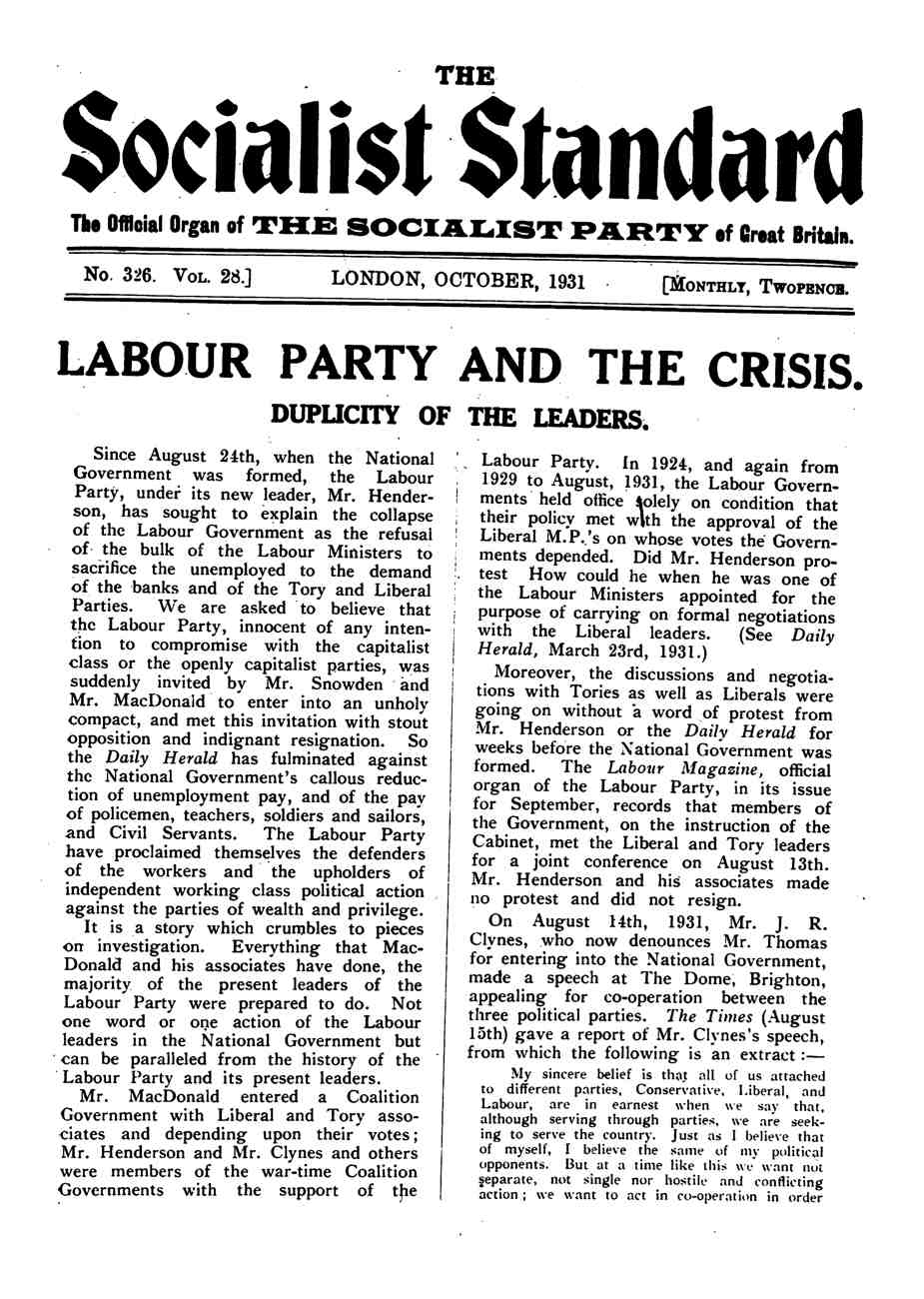
Labour Party and the Crisis. (1931)

From the October 1931 issue of the Socialist Standard

Duplicity of the Leaders
Since August 24th, when the National Government was formed, the Labour Party, under its new leader, Mr. Henderson, has sought to explain the collapse of the Labour Government as the refusal of the bulk of the Labour Ministers to sacrifice the unemployed to the demand of the banks and of the Tory and Liberal Parties. We are asked to believe that the Labour Party, innocent of any intention to compromise with the capitalist class or the openly capitalist parties, was suddenly invited by Mr. Snowden and Mr. MacDonald to enter into an unholy compact, and met this invitation with stout opposition and indignant resignation. So the Daily Herald has fulminated against the National Government's callous reduction of unemployment pay, and of the pay of policemen, teachers, soldiers and sailors, and Civil Servants. The Labour Party have proclaimed themselves the defenders of the workers and the upholders of independent working class political action against the parties of wealth and privilege.

It is a story which crumbles to pieces on investigation. Everything that MacDonald and his associates have done, the majority of the present leaders of the Labour Party were prepared to do. Not one word or one action of the Labour leaders in the National Government but can be paralleled from the history of the Labour Party and its present leaders.

Mr. MacDonald entered a Coalition Government with Liberal and Tory associates and depending upon their votes; Mr. Henderson and Mr. Clynes and others were members of the war-time Coalition Governments with the support of the Labour Party. In 1924, and again from 1929 to August, 1931, the Labour Governments held office solely on condition that their policy met with the approval of the Liberal M.P.'s on whose votes the Governments depended. Did Mr. Henderson protest? How could he when he was one of the Labour Ministers appointed for the purpose of carrying on formal negotiations with the Liberal leaders. (See Daily Herald, March 23rd, 1931.)

Moreover, the discussions and negotiations with Tories as well as Liberals were going on without a word of protest from Mr. Henderson or the Daily Herald for weeks before the National Government was formed. The Labour Magazine, official organ of the Labour Party, in its issue for September, records that members of the Government, on the instruction of the Cabinet, met the Liberal and Tory leaders for a joint conference on August 13th. Mr. Henderson and his associates made no protest and did not resign.

On August 14th, 1931, Mr. J. R. Clynes, who now denounces Mr. Thomas for entering into the National Government, made a speech at The Dome, Brighton, appealing for co-operation between the three political parties. The Times (August 15th) gave a report of Mr. Clynes's speech, from which the following is an extract:— 
   My sincere belief is that all of us attached to different parties. Conservative, Liberal, and Labour, are in earnest when we say that, although serving through parties, we are seeking to serve the country. Just as I believe that of myself, I believe the same of my political opponents. But at a time like this we want not separate, not single nor hostile and conflicting action; we want to act in co-operation in order that we shall guarantee that the nation’s interests shall be served by that united action which we know our condition demands. Parties must act co-operatively when the nation is faced with a financial crisis or a crisis of any other kind. The country has the right not merely to seek but to expect and to demand co-operation on the part of the three great political parties.
It is said that the Labour Government fell because the Trade Union M.P.’s threatened to form a new political organisation.

But by what right can the members of the General Council of the Trades Union Congress condemn the policy of collaboration with the representatives of the capitalist class? What of the negotiations for industrial peace carried on first with the late Lord Melchett and later with the organised employers? As recently as July 22nd, 1931, the News-Chronicle published an interview with Mr. W. Citrine, Secretary of the T.U.C., in which Mr. Citrine expressed views about industrial disputes resulting from attempts to reduce wages:—
   But Mr. Citrine, looking ahead, believes that these difficulties in the relation between capital and labour can be and will be overcome. The modern trend towards large industrial units, towards the separation of the ownership of capital from its administration, towards greater regulation of control, will make it possible. He looks forward to the time when great industrial units will be able to speak with the united voice of capital and labour, and actually bargain for trade on that basis.
   He refuses to accept the old definition of “capitalism” or the old dogmas about it. It has changed out of all recognition.
Mr. Citrine here repudiates the very basis of working-class organisation and looks forward to the time when the exploiters and the exploited will speak with a “united voice." Socialists appreciate the absurdity of this. But on what ground does Mr. Citrine denounce Mr. MacDonald for trying to apply the same absurd policy to politics ?

We are told that the late leader of the Labour Party has carried out the wishes of the City and the banks. True! But which of the Labour leaders is in a position to protest? As early as August 11th, on the instructions of the Cabinet, certain Ministers met the bankers (see Manchester Guardian, September 8th). The Hendersons and Lansburys, who now proclaim so loudly their detestation of consulting with the workers' enemies, made no sign of disapproval. They continued to cling to their highly paid posts, held at the pleasure of the Liberal Party.

On August 14th the Daily Herald reported, without any expression of disapproval, that the Cabinet were to place their economy proposals before the leaders of the other two parties. The Herald said:—
  Whatever steps are taken finally, the Cabinet is as one man on the policy which will govern its decisions. The Budget must be balanced on the basis of equal sacrifices by all. In this it has the complete support of the City. To this extent, also, it is certain it will have the concurrence of all Opposition leaders.
The Herald, it will be observed, had no objection then to a policy of .sacrifices from all, including the workers, so framed that it would have “the complete support of the City."

The Labour Party under Mr. Henderson self-righteously repudiates the policy of balancing the Budget at the expense of the workers and the unemployed. But for how long have they held these views?

On Monday, August 14th—a week before the resignation of the Labour Government—the Daily Herald came out with this great thought:—
   Nobody likes tightening his belt. But the British do it better than most people. They will do it cheerfully if it is plain beyond doubt that they are engaged in a common effort in a common need.
The Labour Press Service, issued by the Labour Party and the Trades Union Congress, in its issue dated August 19th had the following :—
   The nation’s Budget must be balanced. The task is urgent; success depends upon sacrifice, and sacrifice is seldom agreeable. But the Government cannot shirk its duty because of the disagreeableness of the task. The Labour movement would not desire it to shed its responsibility ; on the contrary it will be more confident of a just and equitable handling of the emergency if it knows that its own trusted leaders are in control.
The “sacrifices" agreed to by the whole of the Labour Cabinet included the reductions in the pay of teachers, the police, the Army and Navy, the Civil Service (5-point drop in cost-of-living bonus), increased unemployed insurance contributions, and the imposition of a “needs test" to transitional unemployment pay after 26 weeks. Mr. J. H. Thomas in the House of Commons on September 11th showed that the proposals of the old and the new Governments differed only in respect of the 10 per cent. cut in the amount of unemployment pay. (See Hansard of that date.) The lame reply of the Labour Party opposition was that they had only agreed “provisionally,” i.e., they were still bargaining with the Liberals and Tories and the bankers about their economy programme. Moreover, a clear majority of the Labour Cabinet had agreed to the 10 per cent. cut in unemployment pay. The Daily Herald on August 24th gave the names of the minority of eight Ministers who opposed the cut, leaving a majority of twelve who supported it. The Times of the same date also gave these figures. On the following day the Herald apologised for omitting one name from the minority. 

Let it not be forgotten, too, that these economy cuts had all been prepared for by the former Labour Government and its supporters. The Economy Committee under Sir George May was set up and its members chosen by the Labour Government. The two Labour Party members on it, Mr. Arthur Pugh and Mr. Charles Latham, in their Minority Report, specifically recommended lower pay for Government industrial employees, and a 12½ per cent. cut for teachers (the National Government announced a 15 per cent. cut subsequentlv reduced to 10 per cent.). They also endorsed the majority’s acceptance of further reductions in Civil Service pay in accordance with falls in the Ministry of Labour Cost-of-Living Index.

The seven Labour Party members of the Civil Service Commission likewise endorsed the recommendations which fixed the pay of the lower grades at a level about 9 per cent. below that at which it stood when the Commission commenced its work.

One of the Ministers who resigned was Mr. A. V. Alexander, who as a representative of the Co-operators gave tacit endorsement to their policy of reducing the wages of their employees earlier in the year, justifying the reductions on the ground that prices had fallen. This was the excuse used by the National Government.

As recently as July, 1931, the Labour Government itself introduced the so-called Anomalies Bill, which was for the purpose of reducing expenditure on unemployment pay by £5 millions.

In short, the Labour Party does not differ in any important respect from those of its leaders who joined the National Government. The difference merely is that one body of leaders found that their policy was leading them into conflict with the workers and Trade Unions, without whose support their careers would be endangered. They were willing to carry on capitalism and to do all that that implies, so long as the workers could be hoodwinked into accepting the results of that policy. At signs of revolt, Mr. Henderson and his supporters withdrew into safety. Mr. MacDonald and his associates either interpreted the workers' state of mind differently or have got beyond the stage of needing the support of the Trade Unions and the Labour Party.

The Labour Party remains what it always was, a party composed of all sorts of reformers, only agreed in being prepared to accept the continuance of capitalism.

Their withdrawal into opposition was hailed by them as a timely re-uniting of dissident groups. Actually it disclosed once more the rotten foundation on which the Party is built. Just as the National Government contains capitalist elements whose interests demand free trade, and others whose interests demand tariffs, so also the Labour Party is divided on this question of two alternate methods of conducting capitalism. While Lord Beaverbrook’s Evening Standard (September 10th) was holding out an invitation to the Labour Party Protectionist group to join forces with him, Reynolds's Illustrated News (September 6th), the organ of the Co-operators and strongly Free Trade, was denouncing tariff advocates as “the enemies of the people." The same issue of Reynolds's confessed that tariffs have powerful advocates among the Trade Unions and their leaders. To meet the activities of the Labour Party Protectionists, the Free Trade Labour M.P.’s have now formed their own Free Trade group inside the Parliamentary Labour Party. (See Manchester Guardian, August 22nd.)

The Labour Party is not a Socialist Party. It is not even united in its views as to the best way of running capitalism. Its record shows that its leaders are willing and able to use it against the interests of the workers. Workers who take to heart the lessons of the recent crisis will abandon it and join the Socialist Party. 
Edgar Hardcastle

The Founding of the Socialist Party. (1931)

From the September 1931 issue of the Socialist Standard

Fifty years ago books and pamphlets dealing with the fundamental problems of social life were neither so plentiful nor so accessible as they are to-day. The principal writings of Marx, Engels and others were hardly known outside the few in this country who had a knowledge of languages other than English. Consequently when the Social Democratic Federation was founded in 1881 as a professed Marxian organisation (though Engels would have nothing to do with it) very few of its members were acquainted with the writings of Marx. The new organisation had the merit, however, of pushing the name and works of Marx before groups of working men. Although the few well-to-do people who were at its head, sought to keep it in their pockets as a private concern of their own, the information they made available bore fruit after a number of years and led to much questioning of principles and finally to an attempt to clarify the basis and policy of the organisation to bring it more into harmony with the political needs of the working class movement.

A good deal of the early policy of the Social Democratic Federation consisted of urging the adoption of measures of reform supposedly designed to ameliorate certain outstanding grievances of sections of the working class. These ameliorative measures were not sufficiently embracing to meet the aspirations of a group of radicals who had become dissatisfied with the Liberal Party, but wanted a programme that would appeal to the so-called “professional classes." This group, therefore, formed the Independent Labour Party in 1893. Still there was a feeling that even the new programme of remedial measures was not nebulous enough to attract the large body of people desired, so the leaders of the new party, assisted by certain trade union officials, took part in forming in 1900 yet another new organisation—the Labour Party (known until 1906 as the Labour Representation Committee). From that time onwards the problem of uniting these three parties occupied a good deal of the time and attention of their respective officials and members, and periodical “Unity Conferences” were held. The idea put forward being that they should present a “United Front” to the “Common Enemy”—an idea that still befogs many who claim to be acting in the interests of the working class.

In the meantime dissatisfaction with the equivocal policy and hero-worship of the Social Democratic Federation had been growing, and a small group of critics developed who determined to try and tie the organisation to class conscious political action, and induce it to cut away the self-destructive reformist policy.

At the 1903 Conference the discussions were lively, and at the Conferences during the following two years they were livelier still. On the one side was a small, youthful group endeavouring to keep the class basis of the party clear, and on the other side the official group of older men (mainly well-to-do) who wanted to rule the party and broaden its basis to include all “sympathisers who were against social injustice,” and were straining hard to achieve unity with other non-socialist bodies. Another bone of contention was the equivocal "attitude of the Party Organ, “Justice,” edited by H. Quelch, but owned by a private group over which the party had no control. At one time it opposed the I.L.P. and the Labour Party and their leaders, and at another time it patted them on the back. At one time it denounced Hardie, Snowden, and others, and at another time urged members and branches to help in the election of these people to Parliament. The members who objected to this policy and urged genuine independence, were dubbed by Quelch "The Impossibilists.”

In August, 1902, a paper commenced to appear in Scotland published by Scottish members of the Social Democratic Federation, with the title "The Socialist." The third issue contained an attack on the leaders and policy of the S.D.F. signed "Impossibilist.” Subsequently the attitude of the paper gradually became more hostile, until in 1903 its adherents formed the Socialist Labour Party, copying the American organisation of the same name. This party was crippled at birth, however, with the fatal platform containing "immediate demands.” At first the new party held to the position that the immediate object should be the conquest of political power, but later, under the influence of its American parent, it was swept away by industrial unionism. In fact it soon became apparent that the members of this party had really only changed their idols; Hyndman, Quelch and company were deposed, and De Leon and Connolly took their places.

From 1902 until 1904 the columns of "Justice” contained a good deal of correspondence from members criticising the attitude of the party and its leaders, and much impatient denunciation by Hyndman, Quelch, Lee and Max Beer. At the 1902 Conference there were some heated discussions on the political arrangements with Liberals, Tories, Labour, & co. There were also some caustic remarks made about the public banquet to Hyndman to which people of all political persuasions were invited, and at which they all indulged in back-patting, in spite of previous mutual denunciation as sworn enemies.

During 1902 a member (P. Friedberg) wrote a criticism of the party and its leaders which, as "Justice" did not publish it, he sent on to the American "Weekly People” (the organ of the American Socialist Labour Party). For this action the Executive expelled him and, later, expelled his Branch (Finsbury Park) for supporting his action. The matter came up at the 1903 Conference and, under the influence of the ruling clique, the expulsion was endorsed and another member (G. S. Yates), who supported the action, was also expelled by the Conference on account of articles in the "Socialist” criticising the S.D.F. It is interesting to recall that E. E. Hunter (a member of the present Labour Party) was at that time a fervent supporter of independent class conscious political action; defended Friedberg, Yates and the others, and wrote articles on similar lines for the "Socialist.” 

Throughout 1903 the volume of criticism against the autocratic attitude of the Executive Committee and its compromising policy grew stronger and more articulate.

At the 1904 Conference at Blackburn matters were brought to a head. The Conference met on Friday, April the 1st, and immediately protests were called forth by references in the E.C. report to "Impossibilists,” and a warm discussion followed. The next day (Saturday) the Conference had hardly assembled when Herbert Burrows asked for and was granted urgency to move that those who were constantly criticising the E.C. be called upon to apologise to the Conference and pledge themselves, without any reservations whatever, to cease such conduct in future. This was carried by 56 votes to 6. The six were then called upon for an explanation or an apology. None of them apologised. After hearing their explanation two of them were summarily expelled and left the Conference. The two expelled members, J. Fitzgerald and H. J. Hawkins, were candidates for the new E.C., and some of the delegates present (who had voted for their expulsion) had been instructed to vote for them to the E.C. In speaking to the expulsion resolution, H. Quelch had accused Fitzgerald of fostering discontent by means of economics classes!

The official group complained that the "Impossibilist” movement was a campaign of calumny and intrigue against old and experienced members and therefore against the entire body. They appealed to the Conference on the sentimental grounds of age, connections and years in the struggle, assuring the members that their experience had justified the necessity of political arrangements, "broadening” the basis of membership, and of supporting political representatives who did not share their basic views. Many of the delegates were members of the E.C., past members of it, and personal friends of E.C. members. It was with the assistance of these delegates that the E.C. secured a vote giving them full powers to expel without appeal any member or Branch who did not fall in with the E.C.'s view. 

The two members expelled were delegates from Branches who had received instructions to vote on certain items on the Agenda dealing with questions of policy, but they were expelled before the items came up. The significant fact was that both had been nominated for the E.C. by several Branches, and therefore constituted a menace to the old official group. In fact, at a subsequent meeting of London members, J. Kent (since Conservative Mayor of Acton!) stated that he was present on the evening when the expulsions were arranged by Hyndman, Quelch and company around the tea-table on the evening of the first day of the Conference.

After the Conference the Watford Branch wrote to the Executive asking why their delegate (Fitzgerald) had been expelled. They were informed, that unless they too complied with the Conference findings on the question of criticism they also would be expelled. This was an example of the method that was being adopted all round. The majority of the members of the S.D.F. were unclear on principles; the Executive deprecated discussion on principles, claiming that "we are all Socialists, we want to get on with the practical details." It was alleged that narrowness had hindered the growth of the S.D.F., which "was no longer a sect surrounded by hostility." It was sought to "broaden the base" and unite all "progressives" on temporary objects. The official group carried a packed Conference with them, and secured a vote giving them power (for three years) to expel members and Branches who were not prepared to give unqualified support to the compromising and reformist policy that was being followed.
Gilmac.

The Socialist Party and War (1931)

From the August 1931 issue of the Socialist Standard

The threat of war casts a shadow over all who witnessed the last great conflict—civilians as well as combatants. Death and mutilation, the loss of health, the breaking up of homes and the frustration of hopes and plans; years of anguish while the war dragged on, and when it was over a heritage of sorrow which will last for the lives of millions of the present generation. Nearly nine million men killed, with refinements of cruelty unknown in pre-civilised times; 21 million wounded and hundreds of thousands of men and women suffering from permanently impaired health brought about by the aggravated want which war and blockade inflicted upon the working-class. To this appalling list must be added the lies, the hatreds, and the bestiality that are inseparable from modern warfare. In face of the cost there can be few who want war for its own sake. As Mr. Duff Cooper, now Conservative M.P. for the St. George’s Division, has aptly said, “was anyone going to argue that an Englishman or any other human being liked sitting in a waterlogged trench with the prospect of being blown up by a gun fired miles away, and thinking that his home and family might be destroyed by bombs dropped from the sky? Bring him an Englishman who liked that, and he would endeavour to have him certified as insane and placed in a lunatic asylum.”

But if, as is true, men and women of all parties hate war and are sincerely anxious to prevent it, why cannot we all get together for that purpose? What need can there be for a distinctly socialist attitude towards war? The answer is simple and final. The sincere desire for peace shown by the capitalist parties is nullified by their over-riding will to maintain the capitalist system of society. Did they not with equal sincerity talk peace and want peace before 1914? Did they not seek to justify that war by the most hollow of all claims—that it was a war to end war? And do they not now, with protestations of peace on their lips continue to build up still vaster and more destructive forces on land and sea and in. the air? Mr. Hoover, President of the U.S.A., in his speech on Armistice Day, 1929, said :—
   “The men under arms, including active reserves . . .  are almost 30,000,000 in number, or nearly 10,000,000 more than before the Great War.”
Mr. Lloyd George quoted and endorsed President Hoover’s words in a speech in the House of Commons on December 4th, 1929 (see Parliamentary Report of that date), and then said :—
   "The weapons of destruction . . .  in number and in power, are five times more shattering than those which the whole of the armies had when they went into battle on 4th August, 1914."
The Socialist Party of Great Britain has nothing in common with the parties that preach peace but continue to prepare for war.

Our opponents defend their actions with talk of the need for security. We must, they say, guard the integrity and independence of the nation. They differ among themselves only as to the amount and kind of armaments necessary, for security. They argue the respective merits and costs of the battleship, the submarine, aircraft and poison gas. There are some who urge that the nations should agree to gradual and mutual disarmament, and there are even pacifists who claim that the best of all guarantees of security is for this country to disarm completely without waiting for the rest of the world.

The Socialist Party does not agree with any of these points of view.

For us it is not a question of deciding which is the. best method of achieving security, but a question of deciding whether the security referred to is of any real concern to the working class. We recognise that the capitalists have a real interest at stake. It is in the nature of the capitalist system to perpetuate conflict between the classes and between the nations.

Commercial rivalries set capitalist states and empires one against the other. The class which has property and privilege must maintain armed forces to protect their property and to make secure the social system which affords them their privileges. They need armed forces at home for use when occasion arises against striking workers; they need armed forces abroad to seize and to hold territories rich in raw materials, to protect merchant ships on distant trade routes, to guard vital links like the Suez and Panama canals, and to defend India, where they have £1,000 millions invested, and similar sources of profit. It is for this that armed forces are maintained and set in motion. In 1914 the German capitalist class sought to improve their commercial position by gaining control of ports on the Channel and by extending their colonial empire. The British capitalists saw that their interests were threatened and were prepared to sacrifice the lives of hundreds of thousands of men in order that the danger to British capitalism might be averted. The capitalists and their politicians do not consciously seek war as a means of snatching wealth and power from their rivals but they are driven by the forces at work in the capitalist system to follow policies which bring them into conflict with each other. The employing class in each country strives desperately to sell abroad the superabundant wealth that is surplus to the demands of the home market. The governments are called in to further the interests of the national groups of capitalists. First it is the influence of the trade departments exercised in the form of polite representations to foreign governments. But, ultimately, when commercial rivalry has provoked fierce hostility, there will be charges and counter-charges of “dumping," of unfair discrimination under the cover of taxes or laws, of infringements of “spheres of influence,” and various other resented practices that veil the economic war. Then, when the secret threats of the diplomatists fail to be of use, recourse is had to the armed forces, and war is declared. Under the cloak of patriotism and national defence, with the blessing of the church, the press, the labour leaders and the politicians, millions of workers are thrown against each other in battle. They do not know that they are fighting to defend or to extend the interests of the class that lives by robbing them of the fruits of their labour.

The answer that the Socialist Party gave in 1914 is the answer we shall give to all capitalist wars. What we said in our Manifesto in 1914 represents our views to-day. It is a document of historical interest and is reproduced below:—
The War, and the Socialist Position. 
  Whereas the capitalists of Europe have quarrelled over the question of the control of .trade routes, and the world’s markets, and are endeavouring to exploit the political ignorance and blind passions of the working class of their respective countries in order to induce the said workers to take up arms in what is solely their masters’ quarrel, and
   Whereas further, the pseudo-Socialists and labour “leaders” of this country, in common with their fellows on the Continent, have again betrayed the working-class position, either through their ignorance of it, their cowardice, or worse, and are assisting the master class in utilising this thieves' quarrel to confuse the minds of the workers and turn their attention from the Class Struggle.
   The Socialist Party of Great Britain seizes the opportunity of re-affirming the Socialist position, which is as follows:    That Society as at present constituted is based upon the ownership of the means of living by the capitalist or master class, and the consequent enslavement of the working class, by whose labour alone wealth is produced.
    That in Society, therefore, there is an antagonism of interests, manifesting itself as a CLASS WAR, between those who possess but do not produce and those who produce but do not possess.
    That the machinery of government, including the armed forces of the nation, exist only to conserve the monopoly by the capitalist class of the wealth taken from the workers.
    These armed forces, therefore, will only be set in motion to further the interests of the class who control them—the master class—and as the workers' interests are not bound up in the struggle for markets wherein their masters may dispose of the wealth they have stolen from them (the workers), but in the struggle to end the system under which they are robbed, they are not concerned with the present European struggle, which is already known as the “BUSINESS” war, for it is their masters' interests which are involved, and not their own.
    The Socialist Party of Great Britain, pledges itself to keep the issue clear by expounding the CLASS STRUGGLE, and whilst placing on record its abhorrence of this latest manifestation of the callous, sordid, and mercenary nature of the international capitalist class, and declaring that no interests are at stake justifying the shedding of a single drop of working-class blood, enters its emphatic protest against the brutal and bloody butchery of our brothers of this and other lands who are being used as food for cannon abroad while suffering and starvation are the lot of their fellows at home.       Having no quarrel with the working class of any country, we extend to our fellow-workers of all lands the expression of our goodwill and Socialist fraternity, and pledge ourselves to work for the overthrow of capitalism and the triumph of Socialism.
The World For The Workers!
The Executive Committee.
August 25th, 1914. 
Wage Workers of the World Unite! You have nothing to lose but your chains, you have a world to win!—Marx,
The consequences of the war have fully justified our attitude of opposition to it. The nations which waged war in 1914 were all of them capitalist nations. The Allied group used their victory to further the interests of their capitalists by seizing colonial and other profitable territories that had belonged to the ruling class in the defeated countries, and by imposing heavy financial burdens under the name of reparations. What difference has this made to the working class? Capitalism remains as secure in 1931 as it was in 1914. The working class are still a subject class. Their economic position in the victorious countries is no better than before, and in the defeated countries no worse. In England and in Germany the workers' standard of living is practically at the same level as in 1914. Prices are higher, but wages have increased roughly in the same proportion. It is the German capitalists who have had to pay the reparations out of their profits. The average rate of profit in Germany is now appreciably less than in Great Britain. Germany’s millionaire class almost disappeared as a result of the war. Victory meant victory for the, British, French and American propertied class. Defeat meant defeat for the German propertied class.

For the working class in all countries every death, every wound and every hour of suffering was in vain. The war solved no working class problems, and from a working class point of view, was a crime.

Let us now compare the attitude of the Socialist Party with the attitude and actions of other parties whose claim it is that they are concerned particularly with the welfare of the workers. Little need be said of the Liberal and Tory parties. They are admittedly prepared to go to war and admittedly uphold capitalism which is the cause of war in the modern world.

But what of the Labour Party?

In the opening month of the war we were told that:
  "The Head Office of the Party, its entire machinery are to be placed at the disposal of the Government in their recruiting campaign." ("Labour Leader," September 3rd, 1914.)
Three years later the position remained unchanged. Mr. W. F. Purdy, Chairman of the Labour Party Executive, in an interview with a correspondent of the “Manchester Guardian" (7th June, 1917), said:
    “As Chairman of the E.C. of the Labour Party I am not going to meet or sit in conference with the representatives of the enemy countries while we are at war. I mean to carry out the policy of British Labour as laid down by our representative gathering. That policy is to pursue the war to a successful termination, which means to a complete victory over the enemy.”
One prominent member of the Labour Party, Mr. Arthur Henderson, M.P., took an active part in recruiting and was given a post in the cabinet when the Labour Party joined in the war-time coalition government. It was Mr. Henderson who in 1916 urged that the strike leaders be deported from the Clyde area.

The Independent Labour Party in 1914 allowed its members to support the war and engage in recruiting. Mr. J. R. MacDonald and the late J. Keir Hardie both took part in the recruiting campaign, although at the same time criticising the past conduct and policy of the Liberal government which was responsible for the entry of this country into the war. I.L.P. members in Parliament were permitted to vote war credits, and throughout the war the I.L.P. remained a constituent part of the Labour Party. 

It is important to remember that these organisations have not abandoned the beliefs which in 1914 led them to support the war. At the 1925 Labour Party Conference Mr. Arthur Henderson, on behalf of the Executive Committee, opposed a resolution pressing for disarmament. He said :
   "If France continued in the frame of mind she was now in, had they to overlook the possibilities of defence? They could not afford to ignore this question of defence.”—(Report of Proceedings. Page 232.) .
In 1924 and again in 1930 and 1931, the Labour Government continued to maintain and even in some cases to increase the strength of the armaments of this country.

The Labour Government is still prepared in certain eventualities to wage war in defence of British capitalism; if not against the German enemy of 1914, then against Mr. Henderson’s French enemies of 1925, or some other enemies of the future.

It must not be forgotten that in each of the two Labour Governments a considerable number of Ministers as well as a clear majority of the Labour Party M.P.’s were members of the I.L.P. so that the latter body cannot escape responsibility for all that has been done in respect of the maintenance of armaments.

We would place on record the words of Mr. Arthur Henderson, uttered in reply to the charge that he supported the war. Mr. Henderson said (“Daily Herald,” 10th January, 1929) that “he was not in the least ashamed of his war record.”

The Socialist Party of Great Britain is also not ashamed of its war record. But we can add, as Mr. Henderson cannot, that our attitude then and now is in line with the interests of the working class.
Edgar Hardcastle

The Mosley Party. Old Fallacies Re-Furbished. (1931)

From the April 1931 issue of the Socialist Standard

One cannot but sympathise with the exasperation of Labour Party members who were promised something new and striking when their party came into office, and now find themselves not even in the position of defending the Government’s actions against criticism, because the Government has, for all practical purposes, not committed any actions. It has just sat tight, apparently paralysed with fear of the consequences should it try to put its programme into operation. As Lady Cynthia Mosley complains, they have had to listen to the Liberal Party smugly reproving the Government for being unprogressive and for allowing itself to be scared into inactivity by the Conservative opposition. If the Liberal demand for action was bluff, as the MacDonald Ministry maintains, why not, she asks, call their bluff? Sir Oswald Mosley, who was a member of the Government, tried to goad .them into adopting his scheme for tackling unemployment. Having failed, he has finally taken the step of forming the “New Party.”

The Origin of the New Party.
In the Leader on March 10th, 1931, Sir Oswald Mosley tells the story of the Party’s formation :—
  A year ago I and many other of the younger men began to see the economic crisis which has since struck this country. I was then a Minister, and I submitted a memorandum to the Cabinet showing this, and outlining an active policy to deal with it. What response did I get? I and my friends were laughed at as alarmists, who were always crying “ Wolf.”
  We were told we were young men in a hurry, that there was no economic crisis, that trade would soon mend of itself, that it was silly and unnecessary to take any special emergency measures to deal with the situation. Not once, but again and again, Mr. Snowden, the present Chancellor of the Exchequer, told us all that trade would mend; sometimes he said within a year, sometimes within six months.
  Well, the year has gone by, and what do we see? This same Philip Snowden, Chancellor of the Exchequer, comes down to the House of Commons, and in a panic speech announces a crisis. All of a. sudden he has been converted to our view, and calls for sacrifices from all.
  What does this phrase, “sacrifices from all," mean in plain language? It means simply wage reductions, reductions in all the so-called social services, it means less money for everybody. This is his way of dealing with the crisis.
The Mosley Programme.
Sir Oswald Mosley, in the article referred to above, and in the pamphlet, “A National Policy” (Macmillan’s, 6d.), sets out the principal points in the policy of his party.

Their first demand is for the reform of Parliamentary procedure:—
“Nothing can be done with that creaking, broken-down, antiquated old machine at Westminster.”
Secondly, they propose a National Economic Planning Council which would rationalise production and marketing with a view to eliminating waste, overlapping and inefficiency.

Thirdly, there would be Commodity Boards to control the importation of foreign goods which under-sold any home industry. The object of restricting the entry of cheap foreign goods would be to enable the home industry to be re-organised. Protected industries would have to pay an adequate wage; how much, he does not say.

There is to be “economic partnership with the Dominions and Colonies,” and trade agreements with foreign countries that are willing to help this country’s export trade.

Is Parliament Too Slow?
Sir Oswald Mosley’s first error is his.supposition that Parliament’s failure to do certain things is due to the machinery being out-of-date. The real explanation is that those who control Parliament are, on the whole, very well satisfied with things as they are, and do not want to make any fundamental change. And in this they accurately reflect the insufficient knowledge, lack of purpose and lack of agreement among the electors. If the electors, or a majority of them, wanted something done, the machinery of Parliament would not stand in the way. In 1912 an occasion arose when capitalist interests required a more stringent Official Secrets Act in order to make preparations for the coming war with Germany. The Speaker of the House said it would be contrary to every Parliamentary. precedent to put the Bill through as quickly as the promoters desired. Nevertheless, the Bill was pushed through the whole of the stages of the House of Commons procedure and given the Reyal Assent all within 24 hours. General Seeley tells the full story in his book, “Adventure.”

Rationalisation and Unemployment.
The new Party’s next proposal is merely a new version of the century-old demand for increased efficiency as a means of solving capitalism’s problems. Sir Oswald Mosley and his lieutenants do not so much as refer to the vital working-class objection to such schemes. Under capitalism the proceeds of the work of the working class do not belong to them. The products of the labour of farm workers and mill hands, railwaymen, clerks, sailors and others are the property of the employing class. Any increase in those products, however it may be obtained, is also the property of the employing class. It does not follow, either in theory or in practice, that the workers will have all or any of the increase in the amount of wealth which may be produced. In addition, rationalisation means the introduction of labour-displacing machinery and devices, with consequent growth in unemployment. (Sir Oswald Mosley promises to “rebuild the trade of this country,” but overlooks the fact that his schemes of rationalisation would enable still more wealth to be produced by fewer workers. Unless society is re-organised on a Socialist basis, the fruits of economy and greater efficiency will continue to be enjoyed by the propertied class. The Workers, when employed, will continue to get as their share wages based roughly on their cost of living.

There Is No Grave Crisis For Capitalism.
The new Party, in common with all the “old gangs” whom it criticises, accepts the fallacious doctrines that the workers are poor and many of them unemployed because of foreign competition, and that the decline in exports in recent years has left capitalist industry unable to afford higher wages.

The workers are poor because the capitalist class own the machinery of production and because they retain and consume a vast amount of the wealth produced.

The volume of imports and exports passing between capitalist countries is related to the total amount of wealth in those countries only in the same way that the exchange of goods between, say, London and Manchester is related to the wealth of the people living in those two cities. The fact that a Manchester firm may lose its London market owing to the opening of a London firm selling the same line of goods, and that a London firm producing some other article may lose its Manchester market to a new Manchester firm, does not mean necessarily that Manchester and London become poorer. If the change has been due to the utilisation of more efficient machinery and methods of production, the amount of wealth produced, and still more the amount capable of being produced, will be greater than before in both areas. But the workers may get none of the increase.

During the years since the war the exports from this country have heavily declined in value, due in part to technical developments in industry and agriculture which have made it more profitable for the capitalists of this and other countries to employ workers on the production of certain articles at home, instead of importing them. Imports and exports have fallen, but the wealth of this country has been increasing.

Mosley, like the Empire Free Traders, points to the fact that there are farmers in the Dominions who cannot sell their grain, and factory owners here who cannot sell their industrial products. He asks, Why not bring the two together? But what about the farmers here who cannot sell their grain, and the factory owners in the Dominions who cannot sell their industrial goods?

When Sir Oswald Mosley says that the position of the industrial capitalist “becomes daily more impossible," and that there is now a crisis which will smash Great Britain unless something drastic is done about it, he is talking nonsense. The capitalists' average rate of profit has remained remarkably stable since tire war at a level well above the pre-war average. (For figures, see March Socialist Standard.) The present two and a half million unemployed is no higher than the number recorded during the Lloyd George Coalition Government’s term of office. It is merely a sign of the periodical accumulation of goods which cannot be sold because the employing class have satisfied all their wants, although they still have vast purchasing power available. Now that production has been severely curtailed, the accumulation is being got rid of. In due course sales will revive and unemployment will fall to a lower figure. The Labour Government went into office gambling that unemployment would decrease. They backed the wrong' horse at that time. Mosley now appears to be gambling that it will continue to increase heavily. He looks like being disappointed.

The Mosley Party A Capitalist Party.
The Mosley Party may make headway among disappointed members of the existing parties, but it seems obvious that, in spite of a lavish expenditure of money on meetings and posters and talk of 400 candidates at the next election, they cannot hope to be in a position to apply their programme except by joining with some other party.

But even if Mosley did manage to get Governmental power, his programme would not solve the problems of the workers. The chief promoters of the Party have every appearance of muddle-headed sincerity, but they have explicitly ruled out the only solution of the workers’ problems, i.e., the abolition of capitalism. In “A National Policy” occurs the following declaration :—
   Questions of the ultimate goal of society are excluded by the urgency of the problem which confronts us. (Page 6.)
Moreover, not only do they exclude questions of the ultimate goal of society, but they do not even admit Socialism—that is, common ownership of the machinery of production and distribution—as being a question at all. For them the question of the ultimate goal of society is merely the issue of State capitalism versus private capitalism—an issue of no concern to Socialists.

Mr. W. E. D. Allen, the Conservative M.P. for West Belfast, who has joined the Party, confesses that his object in joining it is "the adjustment of the capitalist system to the economic needs of the nation as a whole” (Star, March 9th), and he further says that his action is no offence against the "broad principles of Ulster Unionism ” (Manchester Guardian, March 3rd).

The Mosley Party and the Labour Party.
Most of the original support for the new programme came from Labour M.P.’s, the majority of whom, however, deserted Mosley when he actually formed the new Party. Those who went right through with it—Lady Cynthia Mosley, Mr. Strachey and Dr. Forgan—have all defended their action on the ground that it is not they, but the Labour Party which has deserted the Labour programme. They have stated explicitly that they still stand by "Labour and the Nation,” the programme on which they were elected. They also maintain that they are Socialists.

Mr. W. J. Brown, M.P., who left the Labour Party, but now declines to join the Mosley Party, although his name appears as one of the writers of "A National Policy,” and although he was billed to speak at meetings of the new Party, takes up a quite different attitude.

Although he also was elected as a Labour Party candidate on "Labour and the Nation,” he declares that "Labour and the Nation” is a programme of capitalism. This he did in a speech at the 1928 Labour Party Conference (see Conference Report, page 207). He said that its application would give  "not Socialism, but a State-subsidised capitalism.”

From this speech and from Mr. Brown’s subsequent actions, two things emerge. The first is that in his view he and the other Mosleyites, as well as all the Labour M.P.’s, were elected on a capitalist programme. The second is that, whereas in 1928 he rejected "Labour and the Nation” and said he wanted in its place Socialism, he has since changed his mind. He still rejects “Labour and the Nation,” but, in common with the Mosleyites, he wants a different kind of capitalist programme, i.e., the Mosley programme which he helped to draft.

The Angry I.L.P.
The I.L.P. are furious with Mosley, not because the new Party is a capitalist party, but because it threatens to queer the pitch of the Labour Party and the I.L.P.

The I.L.P. are amazed, no doubts at the Mosleyites leaving the Labour Party. Seeing that the Labour Party are acting as "caretakers of capitalism" (as it was put by the prominent member of the I.L.P., Mr. Campbell Stephen, M.P., in the New Leader on March 13th), why go outside and form another party of caretakers of capitalism? The I.L.P. Members of Parliament, who form a majority of the Parliamentary Labour Party, are quite prepared to go on acting as caretakers of capitalism, but they strongly resent the action of the Mosley group who were, apparently, honest enough to leave the Labour Party when they found themselves no longer in agreement with it. The action of the Mosley group shows up the Maxtonites for what they are—a body of dishonest and cowardly time-servers, pretending to condemn the Labour programme as a programme of capitalism, but themselves seeking election on it, and painfully careful never to translate their words into deeds.

The Old “New Party.”
It would be a pity not to refer to a very cruel blow delivered at the new Party by a correspondent of the Manchester Guardian. He points out the marked resemblance between the new programme and the writings of Bishop Berkeley. Mr. John Strachey, M.P., a member of the Mosley group, confesses that Bishop Berkeley was one of his father’s favourite authors, and that the new Party is indeed indebted to the Bishop. But he asks (Manchester Guardian, February 28th), "Why should we deny it?" "Because a man lived 200 years ago, is he necessarily wrong?” We would ourselves like to ask the Mosley Party what reason they can urge against trying Socialism, especially in view of the great age of their own policy?
Edgar Hardcastle

Tuesday, March 27, 2018

The Case Against The 'Living Wage'. (1931)

From the March 1931 issue of the Socialist Standard

Maxton's Curious Mixture.
On February 6th, Mr. Maxton, on behalf of the Independent Labour Party, introduced into the House of Commons a Living Wage Bill. -

The Living Wage, as defined in the Bill, "means a wage at least sufficient to meet the normal needs of the average worker regarded as a human being living in a civilised community, including the satisfaction of reasonable minimum requirements of health and efficiency and of cultural life and the provision of reasonable rest and recreation."

The amount of this living wage is to be determined by a Committee, appointed by the Board of Trade, "and which shall include among its members at least three working housewives, three representatives of trade unions, and three representatives of co-operative societies.”

The Committee is to take into account "actual retail prices and other costs of living,” in addition to various other factors, and is to review the wage at least once a year. 

The wage is then to be made obligatory on Government departments, local authorities, Government contractors, and finally on all industries. That is to say, no industry may pay less than this minimum. Should any industry not be able to afford the wage, a body called the "National Industrial Reorganisation Commission” is to have power to re-organise the industry.

The I.L.P.'s Main Plank.
Mr. Maxton explained in his House of Commons speech that the living wage proposals are the basis upon which the whole programme of the I.L.P. is built up. The programme includes many items, from increased pensions and increased unemployment pay, to nationalisation of the banks and the principal industries, and State control of the import and export trade; but "this proposal for a living wage is a pivotal proposal round which all the others are arranged.”

Miss Jennie Lee, M.P., whose name also appears on the Bill, went further and admitted that the "pivotal proposal” cannot be applied without the other proposals also being applied. She said :—
  I do not pretend that this Bill could be carried into effect without great stress and great difficulties in the country. I believe that it would mean that we should have to go in for controlled prices, and once we got on to controlled prices we shall have to control the banking system.
Let us now examine the theory behind the Living Wage Bill and ask ourselves whether its effects will be worth the time and trouble necessary to apply it. Is it worth the "great stress and great difficulties,” together with all the further measures which Miss Lee admits are necessary?

What is a Living Wage?
The backers of the Bill claim to have defined a living wage. But have they? What are "normal needs”? What is an "average worker regarded as a human being”? What are the "reasonable requirements of a civilised community”? What amount of rest and recreation are "reasonable”?

The employers regard as "reasonable” any wage which makes the worker an efficient producer of profits. Hundreds of thousands of workers in the cotton mills, on the railways, in the Civil Service and Post Office, on the land and in the mines, are getting well under 40s. for a full week's work. Miss Dorothy Evans, Secretary of the Association of Women Clerks, is reported in the Daily Herald (February 19th) as stating that women clerks in the Civil Service, 21 years of age, are paid as little as 24s. 7d. in the provinces and 31s. in London. The Daily Herald on February 17th reported that the pay of farm workers in Suffolk had just been reduced from 30s. to 28s. a week.

This last case is of special interest because agricultural workers already have their “living wage” fixed by law! The Agricultural Wages Act, 1924, passed by the Labour Government (which the I.L.P. claimed was an essentially I.L.P. Government) lays it down that the minimum wage paid to an able-bodied agricultural worker shall be
   adequate to promote efficiency and to enable a man in an ordinary case to maintain himself and his family in accordance with such standard of comfort as may be reasonable in relation to the nature of his occupation:
Translated into hard cash, this means 28s. or 30s. a week!

All Mr. Maxton proposes to do, in effect, is to substitute his nebulous phrase for the nebulous phrase in the above Act, and apply it all round.

Employers To Fix The Wage.
The Bill provides that the wage shall be fixed by a Committee including working women, trade unionists and co-operative society representatives.

The Bill does not say how many persons the Committee shall consist of, nor does it say what other interests are to be represented. It is, however, to include employers.

When the seconder, Mr. Kirkwood, M.P., was asked if employers are to be excluded, he replied, “They are not excluded ” (Hansard, February 6th, col. 2297).

So we have this extraordinary position put up by a so-called working-class party, the I.L.P., that they want the employing class to have a hand in fixing what is a living wage for the workers whom they exploit!

It will be noticed, also, that the co-operative societies are expressly brought in. Why? Does it need legislation to allow the co-operative societies to pay their own employees a living wage? The co-operative societies constantly have strikes and lockouts in their concerns, and have on several occasions been charged by their employees with paying less even than the standard rates of pay. Within the past few months there has been a strike of co-operative employees—the insurance agents. Yet the I.L.P. wants the co-operative societies, with their characteristic petty employer's outlook, to sit,with other employers on the Living Wage Committee. The extent to which the co-operative societies exploit the workers in their employ is shown by the amount of wages, and the amount of profits. The retail distributive societies in 1929 (see New Leader, February 6th) paid an average amount of £130 during the year to its wage-earning and salaried staff. The surplus left after meeting all trading expenses was over £22 million pounds, equal to a further £148 per head of the staff of 176,000. They could double the wages of their workers and still have a surplus. Why does not Mr. Maxton start his living wage campaign among his friends, the co-operators?

Another important point emerges from the composition of the Living Wage Committee. It is usual on committees of this kind for the Government to appoint equal numbers of workers’ and employers’ representatives, together with some so-called "neutral” members representing the Government. Seeing that the Labour Government during their present term of office have appointed at least two wage committees which have recommended lower wages, it certainly cannot be assumed that Labour Government representatives on a Living Wage Committee would press for a wage higher than present wages. On the other hand, the co-operators who would be there to look after their own interests as employers are regarded by Mr. Maxton as being on the workers’ side. So that in fact the Living Wage Committee will be dominated by employers.

Living Wage or Lower Wage?
How much will the minimum wage be? We are given some indication that it will actually be lower than the present average wage of industrial workers.

Miss Eleanor Rathbone, M.P., the enthusiast for lower wages by means of family allowances, gave her conditional blessing to the Bill, but wanted to be assured that the wage would not be enough to keep a family, but only enough to keep a man and wife. Miss Jennie Lee, M.P., gave the desired assurance (Hansard, February 6th, col. 2313). The effect of this is obvious, and it is the effect which Miss Rathbone makes no secret of desiring. It would mean that all unmarried and childless workers would be paid less than the standard rate of wages—to the benefit of the employing class, who would get a supply of cheaper labour. In view of the composition of the Committee, the “living wage” might well be below the present average wage of industrial workers.

The Australian Model.
A memorandum attached to the Bill refers to the Australian attempts to fix and apply a “living wage.” The reference is interesting, because it gives a practical illustration of the futility of the whole scheme. In Australia a “living wage” was fixed before the war, and the scheme has had a run of about twenty years.

Mr. Maxton claims for the living wage proposal that it would permanently raise the standard of living of the workers, and be a definite step towards Socialism. Australian experience shows that it does neither.

In the Australian Senate, on November 14th, 1930, Senator Daly, for the Government, gave the information that, after allowing for the increase in unemployment and the increase in prices, the average real wage in 1929-30 was almost exactly the same as it was in 1911-12. Then in January of this year the Arbitration Court ordered a reduction of 10 per cent. in the basic wage (see Daily Telegraph, January 23rd). This reduction is quite separate from the regular adjustments for alterations in the cost of living. So that after twenty years of “living wageism” the Australian workers are now 10 per cent. worse off than when they started, and are not one iota nearer to Socialism than they were then. That is how capitalism has worked havoc with all the pretty but false theories of the Australian reformers of capitalism. Capitalism here would quickly falsify every one of the flashy. promises of the I.L.P.

Capitalism and Wages.
The living wage scheme is as full of holes as a sieve. Every attempt to fix a statutory wage has run up against the snag of unemployment. If the living wage is not higher than the existing one, it is useless. If it is higher, it will give the employers an added inducement to instal labour-saving machinery and thus increase unemployment. This tendency to instal machines operates in agriculture to-day, in spite of the low level of wages fixed by the Wages Committees.

How is the living wage to be enforced? Anyone who has seen at close hand the operation of the Agricultural Wages Act knows that in many districts the minimum rates are largely ignored. The men prefer to take less than the minimum rather than lose their employment. What remedy has the I.L.P. to offer for that? What will it do with the older men and, those not up to the average standard of fitness who will be sacked to make way for young and fit workers?

It is no answer to say that the I.L.P. also proposes to nationalise various industries. State capitalism, as applied in the Post Office, leaves the worker subject to practically all of the forces which face him in private capitalist concerns. The process of selection and throwing out the less fit men and women goes on in the Post Office as on the land and in the mines and elsewhere, although in the Post Office the method of securing the same end is slightly different. The workers in State industries suffer the additional disadvantage that they cannot seek similar employment with a different employer.

Patching Up Capitalism.
And what justification can the I.L.P. offer for a proposal which in effect is patching up the capitalist system? Mr. Maxton expected that criticism and tried to forestall it. In an interview given to the New Leader (February 6th) he said :—
  I admit that the old method of approaching the living wage problem would be correctly described as patching up capitalism. . . . Our approach is fundamentally different.
This, incidentally, is an admission that the I.L.P. ’s past policy for most of the period of the party’s existence has been a policy of patching up capitalism, as indeed was avowed by Mr. Wheatley in reference to the Housing Act he introduced as Minister of Health in the 1924 Labour Government.

The only difference Mr. Maxton could point to was that the present scheme is not based on what any particular industry can afford to pay, but on what the “nation” can afford. This is a distinction without a difference. The two schemes have precisely the same fundamental defect that they leave the capitalist system intact, and leave the capitalist class in ownership and control of the means of life. Does Mr. Maxton think that the capitalist class as a body will show a different attitude towards the wages question because they are approached nationally instead of industrially? He gives his own answer when he quotes Civil Servants as being people who are already “guaranteed a minimum wage” and whose good fortune he wishes to extend to other workers. Thousands of Civil Servants—adults working a full week —receive less than 40s. Yet influential bodies of employers constantly complain that the levels of pay in the Civil Service are too high and should be reduced. A demand has just been made to the Government by an employers' association, that Civil Service wages should be reduced to the level of the depressed export trades (see Times, February 20th). A postman, aged 32, charged with theft at Kingston, on February 21st, was receiving 49s. Id. per week. Out of this he had to keep a wife and two children and was paying 27s. 6d. a week rent (Evening News, February 21st). Mr. Maxton is a supporter of State capitalism as it exists in the Post Office, and wants to solve the workers' problems by extending that system.

Socialism The Only Remedy.
The only solution for the economic problems of the workers is Socialism. Chasing after the endless revivals of old fallacies evolved by the perverted ingenuity of the I.L.P. has brought them no lasting advantage. It has diverted their attention from things that really matter and has left them as far as ever from achieving Socialism.

Even as regards making the best of capitalism, the living wage scheme is an illusion. It is no substitute for trade unionism—Mr. Maxton admits that—it is not an improvement on trade unionism, and it is open to serious objections from which the former is free. In Australia the 10 per cent. reduction in the basic wage, referred to above, has taken place in spite of a Labour Federal Government. Resistance to the award of the Arbitration Court set up by the Australian Maxtons devolves upon the trade unions.

A measure of the irresponsibility of the I.L.P. is provided by the speech of Mr. David Kirkwood, seconding the Bill. He was asked from what source any higher wage would come. Instead of replying that an increase in the wages of the workers would be at the expense of the employers' profits, he informed an amused House of Commons that wealth can be created without limit merely by printing more bank notes.

It does not seem to have occurred to Messrs. Maxton and Kirkwood that if their money theory is sound, it is a sheer waste of time and trouble to print bank notes at all. Why not issue free blanks to the workers and let them write their own bank notes? Or, better still, solve the street litter problem by presenting used-up bus tickets over the counter in payment for goods ?

It was a curious but appropriate coincidence that on the day of Mr. Kirkwood's speech a very similar purveyor of quack nostrums—a German who collected money on the strength of a claim that he knew how to create gold out of base metals— was sentenced to a longish term of imprisonment. Political quacks who trade on the ignorance and trustfulness of the working class suffer no such penalties.
Edgar Hardcastle

Why Socialists Oppose Family Allowances (1931)

From the February 1931 issue of the Socialist Standard

The argument for family allowances is, at first sight, so plausible and attractive that those who oppose the whole scheme are liable to have their attitude misunderstood. Let there, then, be no misunderstanding about our attitude. We oppose family allowances because they would not be of any assistance to the working class.

The case for them is simple. Most, if not all, working class families have at some time or other realised that children are an expensive item. If they are to be decently provided for, then the parents must go short. And, however willing the parents may be to cut down their own expenditure for the sake of the children, a prolonged spell of unemployment will inevitably result in the children going short, too. The advocates of family allowances believe that they have discovered a simple remedy. Why not, they ask, introduce a system of allowances to be paid to the father or mother in respect of the children? Then the family income would be more nearly adjusted to the size of the family. Working class families with two or more children would be receiving a larger income than families with only one child. Single men and women would receive less still. Such systems have been introduced in France, Belgium, Austria, Germany, the Irish Free State, Australia, and elsewhere. Why not here also?

We oppose the proposal. Are we, then, opposed to the working class receiving more money? Do we object to workers’ children being better provided for? Our answer is that we are most strongly in favour of the working class being made better off, both parents and children. We oppose the family allowance scheme because we deny that it would produce any such result.

Wages are based, in the long run, on what it costs the workers to live. In different climates and for different trades this cost, which normally includes the expense of bringing up a family, differs. It includes certain items of expenditure based upon the traditional manner of living in the various countries. Thus, in France the workers’ cost of living includes the cost of cheap wines, because everyone drinks wine. In the U.S.A., at least where Prohibition is enforced, the cost of living of the workers will not have to include the cost of alcoholic drinks, although, doubtless, it will have to include some dearer or cheaper alternative. The existence of a permanent army of unemployed enables the employers to bring pressure to bear to cut into the traditional element and force the wages of all workers down towards the bare physical minimum.

On the other hand, Trade Unions can be useful centres of resistance to that pressure, but experience shows that the Trade Unions have not been able to overcome the pressure. When prices rise, it costs the workers more to live, and Trade Unions can usually secure some increase, if not a proportionate increase, in wages. When prices have fallen, wages have fallen also, sometimes ahead of the prices. We have seen these two processes at work since 1914. Up to 1920, prices and wages rose. Since 1920, prices and wages have fallen.

Our criticism of the advocates of family allowances can now be more clearly stated. Family allowances would cheapen the cost of living of working class families. The constant pressure would tend to force wages down correspondingly. Five shillings would come in to mother, and be knocked off father’s wages. There is the further objection that single men and single women would suffer also, with the result that the Employers would be in pocket.

This has actually happened. In the Irish Free State, when married Civil Servants were given family allowances, the pay of the single men was reduced to the level of the single women. In the book, “Family Allowances in Practice" (Vibart, published by P. S. King, 1926), it is stated, on the authority of a Dutch economist, De Walle, that in Holland “whenever central and municipal authorities have introduced family allowances it has been with a view to making economies in their wages bills.”

In Australia the pay of unmarried employees in the Post Office was reduced by £11 per head, which just covered the cost of the married men's allowances.

The Australian Worker (Sydney, October 28th, 1927) said that family allowances in New South Wales had been “manna from heaven—for the employers.” Instead of a 12s. cost of living increase all round, which would have cost the employers £13 million a year, and which was due under the existing wage arrangements, the employers "gave” family allowances to the married men. These cost £3 million, thus saving the employers £10 million a year.

L. Ross, of the Australian Labour Party, writing in the Socialist Review (December, 1928), said:—
   The New South Wales scheme, instead of redistributing wealth, actually meant a reshuffling of wages between single and married men.
Prominent advocates of family allowances make no bones about admitting this. They candidly confess that family allowances do not represent any addition to the income of the working class, and are not intended to.

Miss Eleanor Rathbone, M.P., is the best known of all the advocates of family allowances.

In a lecture which she gave to the Faculty of Insurance on April 2nd, 1927 (published in the Journal of the Faculty, July, 1927), she said that her object was not to raise wages or to secure an improvement in the conditions of the poor at the expense of the rich, but to re-distribute the workers' wages among themselves.
In other words, make the single men and women help to pay for the married men's children. Although Miss Rathbone's heart bleeds for the unfortunate children of the workers, her remedy was not to touch the superfluous wealth of her own class, but to lower thev standard of living of unmarried workers. Let the rich go on with their horse-racing, their cigars, and their expensive society functions, but “the young men and the young women . . . would be expected to be willing to make some sacrifice at the expense of their cigarettes, cinemas, and betting on football.”

Of course, we are told by the I.L.P. that their family allowance scheme is fundamentally different from Miss Rathbone’s. They want family allowances to be a real addition to wages. They want them paid by the State, not by the employer. The I.L.P. believe that, if paid by the State, they could not have the effect of lowering wages, and in any event the Trade Unions would prevent such action by the employers. Lastly, the I.L.P. believe that family allowances would be paid during strikes and would thus help the Trade Unions.

Not one of these arguments will hold water.

If the I.L.P. scheme is in intention fundamentally different from Miss Rathbone's, why is Mr. Brailsford, the prominent member of the I.L.P. who helped to prepare their scheme, allowed to be a member of the Family Endowment Council in association with Miss Rathbone? Why did Mr. Brailsford act as joint author, with her and others, of a book, “Equal Pay and the Family”?

It is reasonable to assume that Mr. Brailsford attaches more importance to getting any sort of scheme of family allowances, by associating with Miss Rathbone, than to trying to get the I.L.P. scheme in opposition to Miss Rathbone.

Whether the allowances are paid by the State or by the employer makes no difference at all; in both cases they would reduce the workers' cost of living. In New South Wales they are paid by the State, but the effect is the same. In this country we have already seen the Wool Trade Committee, under Lord MacMillan, recommending a wage reduction in 1930 and giving as one of its reasons the fact that the workers' cost of living had been lowered by unemployment pay, health insurance, old-age pensions, etc., all of them paid by the State.

When the I.L.P. fall back on the argument that the Trade Unions will resist such wage reductions, they are arguing with their tongue in their cheek, for their original reason for advocating family allowances was that the Unions were impotent. Here are Mr. Bradford's words, in an article published by the New Leader on January 4th, 1929 :—
  Plainly, with our appalling surplus of unemployed labour, the usual methods for raising mass-purchasing power are beyond our reach. The Trade Unions can hardly defend their standards; certainly they cannot at present raise them. That is our justification for demanding political action in the form, firstly, of family allowances, and then of the fixing by the State of a standard living wage. . . .
It will be seen that the I.L.P. are simply arguing in a circle. They say, in effect: “As the Trade Unions cannot resist the employers, let us ask for family allowances; and then ask the Trade Unions to resist the employers' attempts to reduce wages."

Lastly, there is the question of strikes. There was a strike of textile workers in France in August, 1930. The following is a report by the Paris correspondent of The Times (August 28th, 1930):—
  2,800 workmen are reported to have returned to work during the last two days, and an even larger number is expected to return on September 1st in order not to lose the marriage and family allowance for that month.
The whole scheme is a fraud from the workers’ standpoint. The bulk of its advocates never intended it to be anything else. The others, the I.L.P., find themselves in this anti-working-class camp for the same reasons as on many other occasions. The reasons are their own clear ignorance of economics and of Socialist principles generally, and their incurable weakness for what Mr. Ramsay MacDonald has called “flashy futilities.''
Edgar Hardcastle


The Economic Crisis and the Workers (1931)

From the July 1931 issue of the Socialist Standard

There is one respect at least in which the “New Party” founded by Sir Oswald Mosley is exactly like all of the older non- Socialist parties. That is in its emphasis on the trade depression as a reason for putting, aside the question of Socialism. The argument is that capitalism's in the throes of an unprecedented crisis. Ruin stares not only the worker, but also the employers, in the face. Great Britain must either take some novel and drastic steps to escape from the threatening disaster, or grave decline will follow and this country will become a third-rate power. “Let us,” say the New Party leaders; “defer the consideration of Socialism until we have stabilised capitalism once more.”

This is a very old story—as old as capitalism. In the eyes of the defenders of capitalism no time is an opportune time for the workers to interest themselves in their class interests. And many organisations engaged nominally in protecting the workers have shared the views of the capitalists on this question.

There have been at least eleven marked industrial crises in the past 100 years. Every one of them has shown the same general characteristics. Every one of them has been viewed as a sign of irretrievable ruin, and every one has been used to dissuade the workers from looking towards Socialism.

There was one great crisis during 1829, at a time, that is, when this country was strongly Protectionist. Listen to the description given by William Huskisson in a letter dated December 30th, 1829 (published in the Huskfsson Papers, p. 310):—
   I consider the country to be in a most unsatisfactory state, that some great convulsion must soon take place. . . .  I hear of the distress of the agricultural, the manufactural, the commercial, the West Indian, and all trading interests.  . . . I am told land can neither pay rent nor taxes nor rates, that no merchant has any legitimate business. . . .  I am also told that the whole race of London shopkeepers are nearly ruined.
Huskisson, sometime President of the Board of Trade, was one of those who believed that England must go over to Free Trade. The Liberal manufacturers, who had an interest in Free Trade because it meant cheap food and therefore low wages, urged the workers to neglect their own class interests and to support the demand for the abolition of the Corn Laws, which restricted the import of corn from abroad. The workers did this. They listened to the specious argument that they should only concern themselves with so-called practical, bread-and-butter questions. And the result was the building up of fabulous fortunes for the manufacturers and the continuation of poverty for themselves.

After Free Trade was introduced, the crises recurred periodically as before, although it is often represented by present-day politicians that everything was satisfactory during this period when Britain was the “workshop of the world.”

The following is Lord Randolph Churchill’s account of the crisis of 1884, in a speech at Blackpool (published in The Times, June 10th, 1931):—
    We are suffering from a depression of trade extending as far back as 1874, ten years of trade depression, and the most hopeful, either among our capitalists or our artisans, can discover no signs of a revival. Your iron industry is dead, dead as mutton. Your coal industries, which depend greatly on the iron industries, are languishing. Your silk industry is dead, assassinated by the foreigner. Your woollen industry is in articulo mortis, gasping, struggling. Your cotton industry is seriously sick. The shipbuilding industry, which held out longest of all, is come to a standstill. Turn your eyes where you will, survey any branch of British industry you like, you will find signs of mortal disease.
The difference between Huskisson and Churchill was that Churchill saw the remedy in a return to Protection! Large numbers of workers, seeing that Free Trade had not brought prosperity to them, were persuaded to assist this section of the employers in their campaign against Free Trade; while other workers sided with the Liberal Free Traders and supported their campaigns for the 1909 Land Tax and against the House of Lords. In the meantime working-class interests were neglected as usual.

After the War came the industrial crisis of 1921-22, which moved the Prime Minister, Mr. Bonar Law, to assert in a speech at Glasgow in December, 1922, that—
There is almost no business that is making  profits to-day.
In May, 1921, the percentage of insured workers unemployed rose to as much as 23 per cent.—higher than it has been in any subsequent month, including 1930, and 1931 to date. There were, in May, 1921, 2½ million unemployed.

The present crisis, which follows 10 years of unemployment never appreciably below the million line, is similar to the others and will take the same general course.

Industrial depressions are not evidences of capitalist poverty or capitalist. weakness They will not of themselves result in the collapse of the capitalist system, and only a misunderstanding of the nature of crises leads the workers to slacken their efforts to maintain wages at those times. Trade depression arises simply from the over-production of goods in relation to the demands of the market. The world is overloaded with goods for which purchasers cannot be found. Purchasers cannot be found because the workers, who have unsatisfied needs, have only a limited amount of money with which to buy, and the wealthiest section of the propertied class, who have the bulk of the purchasing power, have no unsatisfied needs. Once depression begins, prices are forced down and every holder of goods seeks to realise them at all costs. The consequent feeling of insecurity causes the rich to curtail even their normal expenditure, thus aggravating the depression and adding to unemployment.

Many industrial capitalists suffer a decline in their profits owing to curtailed sales, while money-lending capitalists on the whole improve their position.

The crisis is overcome simply because the manufacturers close down their factories and turn the workers out to join the unemployed. Then, when the accumulations of goods have been slowly dissipated, production begins again in response to the newly evinced demand, and the crisis is, for the time being, over.

This is a process which is prolonged by wage reductions, and made more acute by the constant improvements in productivity of industry. which increase the volume of surplus goods.

All the parties which accept the popular view of crises necessarily find themselves pursuing courses contrary to working-class interests. The Communists believe, and indeed hope, that the crises will wreck capitalism, and they therefore propagate their dangerous doctrine of waiting fatalistically for the breaking-point of capitalism, at which point they will take to the streets and challenge the armed forces. The basis of the doctrine is unsound. Crises are not the ruin of capitalism, but merely correctives to its contradictions. Capitalism and its crises can, and will, go on indefinitely until the workers take conscious steps to end the system.

The other parties — Liberal, Tory, Labour and I.L.P., and the later rivals, the Empire Free Traders and the Mosley Party—all preach the doctrine that the workers must at times of crisis take joint action with the capitalists in order to save a desperate situation. As this usually means, in practice, taking lower wages and working harder, it is not only anti-working-class, but also has the effect of prolonging the crisis.

The Socialist Party tells the workers that Socialism is the only remedy for their troubles. There is no time which is not a proper time for them to work for Socialism. This is true whatever the excuse offered by defenders of capitalism. Whether the crisis is a war crisis or a trade crisis, the Socialist Party will continue to preach Socialism. Workers who understand the working of capitalism will see through the excuses to the capitalist interests behind them, and will help us with our task.
Edgar Hardcastle