Sunday, April 10, 2022

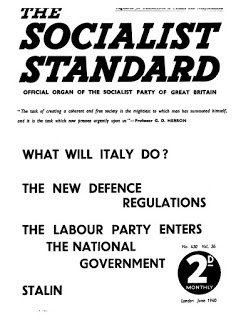
The Labour Party Enters the National Government (1940)

From the June 1940 issue of the Socialist Standard

The entry of Labour leaders into Mr. Churchill’s National Government on May 11th makes the fifth occasion in the history of the British Labour Party on which prominent Labour leaders have occupied Cabinet posts and been wholly or partly responsible for the affairs of government. The first time this happened was during the first great war, when Mr. Arthur Henderson, Mr. John Hodge, Mr. J. R.. Clynes and others entered the Government. It ended rather ingloriously with Mr. Henderson resigning in August, 1918, because the Government refused his and the Labour Party’s wish for a restatement of war aims and an international conference of Labour Parties, and with his Labour successor, the late Mr. G. N. Barnes, signing in 1919 the Versailles Peace Treaty. He did so in defiance of the declaration of the Labour Party National Executive repudiating the Treaty because “The Treaty involves a violation of the principles embodied in Labour and Socialist Conference decisions.” (Manifesto of June 4th, 1919, issued by the National Executive of the Labour Party.)

The second occasion was the minority Labour Government of 1924, which ended with the Zinoviev letter and the election of October, at which the Labour Party’s representation was reduced from 191 to 151.

In 1929 the Labour Party were back in office. Then, after two years of mounting unemployment and falling confidence, the “crisis” found their leaders, MacDonald and Snowden, entering the National Government, but repudiated by the bulk of the Labour Party.

Now, in order to prosecute the war, Mr: Attlee, Mr. Herbert Morrison, Mr.. Greenwood, Mr. Bevin and others, take office under Mr. Churchill.

Speaking at the Labour Conference at Bournemouth, where the decision to join the Government was endorsed by 2,413,000 votes to 170,000, Mr. Greenwood explained that the Labour Party had for years “built up a strong policy of resistance to aggression, and when at long last a wavering Government plucked up its courage to resist, the Labour Party had no alternative but to accept the implications of its own policy.” (Daily Herald, May 14th, 1940.)

He went on to prophesy : —
“Because we have the courage of our convictions as a movement now, we shall have greater power when it is over than we have to-day. We shall have a trembling capitalist system which can never recover again. We shall have broken the back of the vested interests, and we can build a socialist commonwealth which will be a powerful factor in the world.”
Socialists would wish that the words were really prophetic; but time will show them to be otherwise. Socialism does not spring from the catastrophe of capitalism at war any more than it came from the other catastrophe of capitalism, the crisis of ten years ago. No doubt Mr. Greenwood hopes that something else as well as victory may come out of participation in the Government; but Socialists remember similar hopes in the last war when the Labour Party, in its 1918 declaration of policy, “Labour and the New Social Order,” affirmed that it would not tolerate the revival of the social and economic system which the war was supposed to have destroyed, but would seek to build up a new social order based on co-operation in production and distribution for the benefit of all who labour by hand or by brain.

Nothing came of those hopes, and the men who cherished them still do not show that they understand why. They spent years preaching peace and disarmament, and trying to lessen international antagonisms, and tried equally hard and unsuccessfully at home to lessen the evils of the social system. The two things they never frankly faced up to are that there never will be or can be any real solution to the twin problems of poverty and war until capitalism has been replaced by Socialism. So, little by little, each one of them had to abandon his belief in Peace by disarmament or appeasement or League of Nations. It is not, as Socialists have been at pains to point out, that war is a kind of capitalist conspiracy—the view of the Communists—but that capitalism forces states into deathly rivalry even though at a given period one group of states may be doing their utmost to preserve peace against the encroachments of their rivals.

The Socialist is consistent in opposing the Labour Party policy.

The Communist critics of the Labour Party can claim no such consistency. Apart from having vigorously supported in the opening weeks the war that they now oppose, they are in the curious position of denouncing a Government which is as nearly as possible their own choice.

Communists Get the Government they Asked for
The Communist Party is annoyed about the new Government. They do not like the Government led by Mr. Churchill, which includes Mr. Attlee and other Labour leaders, along with Sir Archibald Sinclair and other Liberals. The Daily Worker of May 10th, 1940, says in its editorial: —
“The Daily Herald thunders against Chamberlain, but it is silent about Churchill.
What a man to take under the wing of the Labour Party !”
The next day (May 11th, 1940) the Daily Worker had another fierce article against the National Government, under a headline “Fight against Labour participation in Churchill’s new War Government.”

So far it is clear enough, except to those who recall that, only in September last, after the war had broken out and Churchill was already in the Government, the same Daily Worker was backing the war wholeheartedly and writing of “determination that now that war has come it shall be fought in our cause, and to a finish. This war must be made a people’s war to end Nazism, and its attendant evils of oppression and violence for ever.” (Daily Worker, September 16th, 1939.)

By the time Mr. Churchill had become Prime Minister in order to fight the war to a finish, th Communists no longer wanted the war.

But further examination shows more mystery. The Communists now do not want the war, or Mr. Churchill, or Mr. Attlee or Sir A. Sinclair It was not always so. Only last year the Daily Worker was campaigning for a Popular Front Government and urging that the men of its choice should get together and form an all-party Government in order to carry out an active policy of “collective action against new aggression and threats of aggression” from Nazi Germany.

And who were the men of the Communist Party’s choice ? None other than Mr. Churchill, Mr. Attlee and Sir A. Sinclair ! The front page of the Daily Worker (March 30th, 1939) carried in bold headlines : —
“COMMUNIST APPEAL TO ATTLEE, SINCLAIR AND CHURCHILL—URGED TO DEFEAT CABINET AND FORM NEW GOVERNMENT.”

It went on to say: —

“In a swift and sensational move to get practical action to save the country in the rapidly deepening crisis, Harry Pollitt, on behalf of the Communist Party of Great Britain, yesterday addressed to Major Attlee, leader of the Parliamentary Labour Party, Sir Archibald Sinclair, leader of the Liberal Party and Mr. Winston Churchill, most prominent of the Conservative ‘rebels,’ an appeal that they shall get together without another minute’s delay.”
We live in tragic days, when wrong theories have culminated in appalling consequences for the workers of all countries. One of the most tragic aspects of the situation—as tragic as working-class support for Nazism in Germany—is the spectacle of workers accepting misguided Communist theories.

New Phases of the War—What Will Italy Do? (1940)

From the June 1940 issue of the Socialist Standard

The conflict now raging on the Continent has awakened the average worker to some extent from the lethargy of a decade, but the serious character of the world’s situation he does not, in general, as yet perceive. When his friends or relatives are called up he is induced to try to follow world events, but in regard to them his attitude is one of resignation: he leaves political direction to others : he may have a vague feeling of uneasiness but he relies absolutely upon those in authority for guidance: what is involved is too much for him to grasp: in the main his mental blindness condemns him to be controlled solely by circumstances and be obedient to the will of those in authority.

All the same, 1940 is not 1914. Subconsciously the working class have imbibed knowledge from bitter experience; it may be latent, but it is there, and it can, and will, eventually find a means of expression.

The Tablet, a Catholic paper, has in its current issue summed up the Nazi power in strong but correct language : “Its weapons are the weapons of fear and falsehood. Debauched by the vision of authority acquired by the bomb, and maintained by the jack-boot and the whip, the German people have placed their strength and their abilities at the mercy of a ruthless gang, who are using that strength to enthrone themselves as the masters of an enslaved continent.”

The Government here has come into being as a result of various groups arriving at a tacit understanding, anything may happen as a consequence, even a new orientation on the part of Russia and the Communist Party.

The Labour ministers of the Crown, newly appointed, can hardly do anything for the working class: their business will be to show that they can run the system efficiently and well; the leaders of the older parties found themselves in difficulties, the leaders of Labour are to help them out. ‘Twas ever thus.

The paper quoted from above has something to say which lends colour to our viewpoint: “Some of the appointments are conspicuously good. Mr. Herbert Morrison at Supply and Mr. Ernest Bevin at Labour are both men with proved reputations as organisers well able to defeat obstructions and delay. What is more important, they can go ahead without the feeling that they may impair national unity and incur charges of Fascism (if they ask for suspension of the ordinary privileges and safeguards, normally enjoyed by business firms and trade unionists). The old Government had to walk very warily, simply because opposition journalists and speakers had for so long been blackening its character.”

The Tablet, being an upholder of the old religion, is naturally opposed to Stalin and Co., but it may be right when it surmises that the suppression of the Communist Party in France has greatly hindered the work of the Russian Foreign Office. “We must be wary of attaching any importance to signs and rumours of estrangement between Stalin and Hitler. They may be true, but they may equally be intended to restore more freedom of subversive action inside Britain and France to the hidden army.”

The Daily Mail is jubilant over the Discipline Act.

We are told it is the most revolutionary law that Parliament has passed in modern times. “At one stroke we relinquish our right to choose our own tasks or to dispose of our own property as we think best.”

The wage slave has, in reality, had few rights in regard to choosing what he should do and as to property: he has few possessions. Why the Daily Mail should see anything revolutionary in the Discipline Act is beyond us : it makes little difference in the lives of those who live by selling their labour-power. . . .

The invasion of Holland has brought about certain international complications. The latest news at the time of writing is that Germany, Russia and Japan are to hold a conference to discuss and decide what to do about the Dutch East Indies. This is likely to bring the United States directly into the war and induce Roosevelt to run for a third term.

The readers of the Socialist Standard will be alive to the importance of these developments, but, to refresh the memories of our readers, we would remind them that 15 per cent. of the world’s bauxite comes from Dutch Guiana and over 17 per cent. of the world’s tin from the Dutch East Indies. In rubber also, the Dutch East Indies produce a third of the world’s supply and they are also the most important source of copra and produce a quarter of the world’s palm oil. The petrol produced in the Dutch East Indies is not inconsiderable in amount and, what is more, Dutch interests in the oilfields of Roumania and the Near East have been placed unreservedly at the disposal of the Allies.

Japan is finding China a problem, the war game there is not worth the candle: the exploiters of the wage slaves of Nippon perceive that, if their hands were free, they could make large profits by taking advantage of their industrial rivals’ troubles in Europe: the markets are waiting, but the war in China absorbs all the efforts of the industrialists of Japan and the gains from the conflict are not perceptible.

The Evening News of May 21st says: —
“American and European fears that Japan might interfere in the German campaign against Holland is easily understood in view of the pronouncement of a number of Japanese naval and military authorities.
Behind it there is the economic question of oil.

The Japanese Navy, like every other, has turned exclusively to oil fuel; and the tremendous enthusiasm for Diesel engines in the Merchant Service, only recently checked by Government decree which demanded the return to coal wherever it was economically possible, has increased the shortage of oil.

Demand Now Greater.
Even in peace-time Japan consumes two million tons of oil a year—the greater part of it by the Navy and Merchant Service—and can produce less than a quarter of a million tons herself.

If she obtained complete control of the oilfields in Sakhalien, which Russia would prevent to the limit of her forces, it would mean rather less than half a million tons more.

That was in peace-time, but the campaign in China has greatly increased the demand for the Navy, Air Force, and Merchant Service which is caring for the supplies.

Rubber, Too.
The greater part of this excess demand has had to come from the United States. This is paid for in silk, but the mobilisation of the Army has depleted the supply of peasant labour available for its production.

So the exchange with the United States is not nearly as advantageous as it might be.

Possession of the Dutch East Indies would supply Japan with all the oil that she would require, as well as other commodities, of which the principal is rubber, which Japan has to import to the tune of 100,000 tons a year.”
Before concluding this article we must draw attention to events in the Mediterranean. The situation appears to be dangerous to the peace of the Near East. Mussolini, however, is not having all his own way. The Italian papers do not give us the true opinion of the Italian people. When Italian journalists get their instructions, and understand what the Government line is, they must not go against it, and the only way they can distinguish themselves is by their zeal for it. The organ of the Vatican, Osservatore Romano, solidly supports the Allies. It has a circulation of 300,000 and is supported by a following strong enough to cause Mussolini to pause before lining up on the side of Germany.

If Italy does enter the war on the side of Germany, and the resistance of the Allies becomes too strong for the Germans to overcome in Northern France, Germany will, no doubt, invade Switzerland with Italy’s aid. Hitler is pressed for time : he had to win quickly or he could not hope to win at all.

From what has been written the reader will be able to perceive that, owing to the inter-relations prevalent in the productive world of capitalism, all countries are likely to be involved in the conflict sooner or later. Marx says : “Force is the midwife of an old social order pregnant with a new one, that it is the tool by the means of which social progress is forwarded and foolish, dead political forms destroyed.”

When the smoke clears away from the battlefields, and we can calmly view the results, we can better judge the outcome of force in the present instance. In the meantime we continue our task of striving to bring into being a new social order “in which there shall be neither rich nor poor, neither master nor master’s man, neither idle nor overworked, neither brain-sick brain-workers nor heartsick hand-workers, in a word, in which all men would be living in equality of condition and would manage their affairs unwastefully and with the full consciousness that harm to one would be harm to all—the realisation at last of the meaning of the word commonwealth.”

The quoted words are from William Morris, who hated with all his heart “the dull squalor of capitalist civilisation,” whose fruit is so often war. In the commonwealth of Morris there is no cause for conflict—when we establish Socialism we establish peace and plenty.
Charles Lestor

What We Have Said For Over Twenty Years (1940)

From the June 1940 issue of the Socialist Standard

The following is from a review of “Stalin—Czar of all the Russias” (Harrap, 9s.), by Philip Page, in the Daily Mail, May 18th, 1940 : —
“Our local Communists will not relish the assertion, carefully argued and incontestably proved, that Soviet Communism owes little to, and has even less affinity with, the doctrines of Karl Marx.”
Marx will yet be rescued from his Bolshevik perverters.

Everything and Everybody (1940)

From the June 1940 issue of the Socialist Standard

The new Emergency Powers Bill, which the Daily Herald (May 23rd) describes as a Bill which gives power to the State “to control everybody and everything” was passed in 2½ hours from first to last. The Bill was introduced without prior warning at 3.45 p.m. and taken through all its readings in Commons and Lords by 5.57 p.m. At 6.9 p.m. it received the Royal Assent. As the Daily Herald says, it shows “the speed at which Parliament can work in a crisis.” Against many Labour Party and other critics of Parliamentary Government who argue that Parliament is too slow, the S.P.G.B. maintained that Parliament can act just as speedily as it wants to act. It has taken a war to convince some people that this is so.

The New Defence Regulations (1940)

From the June 1940 issue of the Socialist Standard

On May 9th the Home Secretary, Sir John Anderson, announced in the House of Commons that the Defence Regulations affecting propaganda had been amended. The amendment had taken place after consultation with members of the opposition parties, but it was pointed out by Mr. Attlee for the Labour Party that the consultations “in no way implied that those members either approved or disapproved of the regulations, which were, necessarily; put forward on the sole responsibility of the Government.”

The relevant part of the Home Secretary’s speech is reproduced below : —
The Home Secretary’s Statement

“The second group of Regulations is concerned with the activities of individuals and organisations who, by spreading defeatist or anti-war propaganda, are seeking to undermine public morale and to weaken the resolution of the people to prosecute the war to a successful issue. As I said in my reply to Questions on 25th April, there is a risk that our traditional reluctance to limit the free expression of minority opinions may be exploited by persons whose real purpose is to hamper, for ulterior motives, the war effort of the nation. The Defence Regulations introduced on the outbreak of war included stringent provisions dealing with propaganda, under which it would have been an offence for any person to endeavour to influence public opinion in a manner likely to be prejudicial to the defence of the realm or the efficient prosecution of the war; but after the Debate on the Regulations which took place in this House on 31st October last there was a drastic curtailment of those provisions of the Regulations which had attracted special opposition on the ground that they were capable of being used for the suppression of minority opinions. The Government are anxious to avoid any unnecessary interference with our traditional liberties, but they feel that a distinction can and must now be drawn between the mere expression of honest opinion on the one hand and, on the other, the deliberate and systematic advocacy of defeatist or antiwar policies with intent to weaken the national resolution to prosecute the war to a successful conclusion.

Legal provisions on this subject must necessarily be cast in somewhat general terms if they are to cover all forms of propagandist activity which are prejudicial to the national interests; and the difficulty has always been to find a form of words which will suffice to check the really mischievous activities without at the same time penalising expressions of opinion, with which we should all desire to avoid interference, however much we may disagree with the opinion expressed. The consultations which I have held have led me to the conclusion that this point cannot be fully met except by giving, to a responsible Minister answerable to Parliament, an administrative discretion to determine in what cases individuals or organisations should be made liable to criminal proceedings for engaging in mischievous activities of this kind; and in the new Regulation which has now been made a novel procedure has been adopted in order to secure that the sanctions of the criminal law shall be applied only to persons acting with deliberate intent to prejudice the national interest. The Regulation provides for the issue of a warning to any person or organisation who appears to the Secretary of State to be concerned in the systematic publication of matter calculated to foment opposition to the prosecution of the war to a successful issue. The warning will draw attention to the matter objected to and will make it clear that if after the warning there is any future publication of matter calculated to foment such opposition the person or persons concerned will become liable to prosecution under the Regulation. Until a warning has been issued no person can be prosecuted for an offence under the Regulation; but if after receiving such a warning there is a continuance of mischievous activities those responsible then become liable to prosecution and, if convicted, to heavy penalties—namely, seven years’ penal servitude or a fine of £500, or both.

The Regulation provides ample safeguards against any misuse of the new powers which it confers. In the first place the Secretary of State must be satisfied, not by an isolated remark but by a consistent course of conduct, that there is systematic publication of matter which is calculated to foment opposition to the prosecution of the war to a successful issue, and further that the continuance of these activities may cause serious mischief. Then there must be a formal warning by a notice in writing of the consequences of persistence in this course of conduct. Then, if such conduct is persisted in, proceedings based on a specific contravention of the Regulation can be instituted only with the consent of the Attorney-General and can be taken only at Assizes or courts of corresponding jurisdiction; and the defendant cannot be convicted if he can show to the satisfaction of the court that he had no intent to foment opposition to the prosecution of the war to a successful issue and had no reasonable cause to believe that his activities were calculated to foment such opposition. I hope that what I have said will suffice to satisfy the House that this new Regulation is so drawn as to penalise only deliberate, organised and systematic efforts to undermine the national morale; and I need hardly add that it is the firm intention of the Government to apply the criminal sanctions provided by this Regulation only in cases of real gravity where the national interests may be seriously threatened.

A second Regulation in this group is designed to extend and strengthen the provisions of Defence Regulation 39A, under which it is already an offence to endeavour to seduce from their duty persons in His Majesty’s service or in the various services of Civil Defence. Experience has shown that it is not enough to restrict this provision to persons already embodied in the various services. The efforts of those who wish to undermine the efficiency of these services may be directed not to persons already serving but to those who are shortly to be called up for service; and the Regulation has therefore been amended so as to make it equally an offence to endeavour to incite persons liable to such service to evade their duties or to endeavour to incite persons to abstain from enrolling voluntarily in any of the defence services. Here again care has been taken to avoid penalising the mere expression of opinion. It will be no offence merely to state the statutory rights of men liable to military service to claim exemption on conscientious grounds, nor will the Regulation prevent the giving of guidance to a young man who is troubled in conscience and seeks advice from a priest or a friend. The Regulation is aimed at those who try to incite young men liable to military service to simulate conscientious objections for the purpose of evading their duties. I am satisfied that this limited provision is necessary and that it will command general support.

Finally, power has been taken to apply really effective sanctions against the use of printing presses for the production of publications which contravene either the new Regulation dealing with the corruption of public morale, or the expanded provisions of Regulation 39A regarding attempts to cause disaffection or Regulation 39B dealing generally with the publication of false statements prejudical to the national interests. Under this new Regulation the Secretary of State may, if he is satisfied that any printing press has been used for the production of any document in respect of which any person has been convicted of an offence under any of these three Regulations, direct that the press shall not be used for any purpose until the leave of the High Court has been obtained for its further use. The High Court may grant such leave if satisfied that the use of the printing press for the production of the offending document was due to a mistake, or even though not so satisfied may grant leave for its future use subject to conditions, or may if it thinks fit order that the printing press shall be destroyed. In many cases documents constituting an offence under these Regulations will have been printed, by persons other than those convicted of distributing or publishing them; and in serious cases it is desirable that there should be power to bring it home to the printer that his plant cannot be used with impunity for the production of mischievous documents of this character which contravene the law. A power to seal up the printer’s plant is likely to operate as a more effective deterrent than criminal proceedings leading to a fine; and this new power should materially reduce the extent to which printing presses will be made available for the production of documents of this type.”
Text of the Regulation regarding publications

The following is taken from the Manchester Guardian, May 31st, 1940.
“Power to suppress a newspaper is provided by a new Emergency Powers (Defence) Regulation, issued yesterday, which reads: 
1. If the Secretary of State is satisfied that there is, in any newspaper, a systematic publication of matter which is, in his opinion, calculated to foment opposition to the prosecution to a successful issue of any war in which his Majesty is engaged, he may by order apply the provisions of this regulation to that newspaper.
2. No person shall print, publish, or distribute or be in anyway concerned in the printing, publication, or distribution of any newspaper to which this regulation applies.
3. An order of the Secretary of State under this regulation specifying a newspaper by name shall have effect not only with respect to any newspaper published under that name but with respect to any newspaper published under any other name if the publication thereof is in any respect in continuation of, or in substitution for, the publication of the news¬ paper named in the order.”

Another regulation empowers the Secretary of State to seize printing presses used in the production of a newspaper it he is satisfied that the newspaper is one in which there has been a systematic publication of matter which is, in his opinion, calculated to foment opposition to the prosecution to a successful issue of any war in which his Majesty is engaged.

Editorial: How will the Defence Regulations be Used? (1940)

Editorial from the June 1940 issue of the Socialist Standard

Elsewhere in this issue we reproduce the Home Secretary’s statement on the new Defence Regulations. The Home Secretary declared that it was his desire to avoid “penalising expressions of opinion, with which we should all desire to avoid interference, however much we may disagree with the opinion expressed.” Elsewhere he referred to “mere expression of honest opinion.” Much depends of course on how the regulations are used and what the Government regards as honest opinion. As far as the S.P.G.B. is concerned it should be clear even to the most embittered opponent of Socialism that there could be no better indication of honest opinion than the fact that, unbrokenly for 36 years, the members of the S.P.G.B. have constitutionally and democratically propagated the same unchanged Socialist principles. It is our claim now, as always, that we are Socialists and we preach Socialism. And if the declaration made by Mr. Justice Stable in a recent libel action holds good we shall continue to do so : —
“The expression of views, no matter how unpopular, how fantastic, or how wrong-headed they might appear to the majority, was a right, and a right which he (the judge) was paid to see was observed”.— (Reproduced in Manchester Guardian, May 10th, 1940.)
As was however to be expected, certain newspapers (including some which for years were expressing admiration of odious aspects of Fascist regimes abroad) are using the fierce feeling against Quislings to support action against every opinion uncongenial to themselves. The following appeared in a Times editorial on May 23rd, 1940:- —
“But public indignation and suspicion are undoubtedly being aroused also against the activities of British citizens who, consciously or unconsciously, ally themselves with the evil forces against which their country is fighting. The Defence Regulations have already been amended to give the Home Secretary powers to deal with such people. They provide heavy penalties for persistence in anti-war propaganda and for attempts to dissuade men from undertaking defence duties. They give power also to require persons to reside within a specified area and not to travel outside it without permission. No one would be sorry to see these powers exercised immediately against those responsible for publications or activities which seek to traduce or to impede the high purposes of their country in waging this war, and many would prefer to see such persons confined to their own society in internment camps. They have a right to their own opinions, if indeed these opinions are their own and not manufactured or procured by the nation’s enemies : but they have no right to inflict them on others at such a time.”
It will be observed that The Times proclaims the principle of “right to their own opinions”—“in internment camps.”

It can hardly be supposed that this specious doctrine is held by the Labour Party representatives now in the Government. If it were it would be against their own long-proclaimed Party tradition.

We may add that, in the matter of forming opinions of our own, “not manufactured or procured” by any other person, party or government, here or abroad, the S.P.G.B. and the Socialist Standard, during the period of their existence, have not had to take guidance from The Times.

Looking Back and Looking Forward (1940)

From the June 1940 issue of the Socialist Standard

In the midst of the present titanic struggle in France and Belgium it appears to the majority of people that the past and the future are alike matters that can be left alone. Every energy, every thought, must, they say, be concentrated on the present; and with the impatience of those who are in the fight they are resentful that anyone should be concerned with past causes and future consequences. Socialists can appreciate the attitude of mind, for, we have felt similar impatience for years with the opponents of Socialism. For years the Socialist has had to put up with the apathy or wrongly directed zeal of the great majority. Before 1914, and right up to the outbreak of the present war, Socialists have been trying to get the workers of all countries to realise that, without a fundamentally different and better basis for the social system, there never would be or could be any safeguard against, poverty and war. But we who were on the job of showing the only way of escape were not listened to. We had to put up with the people who were “not interested in politics,” or who thought they knew of short cuts or easier roads, or who privately said they agreed with the S.P.G.B. but publicly put a different case because of the alleged ignorance and hopelessness of the working class.

We remember the Communists and their many Labour Party admirers who suddenly discovered, 20 years ago, that dictatorship—and its likely accompaniment, civil war—were the golden road to Socialism. In face of scornful taunts that we were out of date we replied that Socialism and democracy are indissolubly linked together, and that those who preached dictatorship would inevitably provoke reactionary terrorism. The Bolshevists cannot escape their major responsibility for the rise of Fascism.

We remember, too, the blind guides who thought they saw Socialism sweeping Europe because of the Labour and Labour-Coalition Governments set up in many countries after the war. We were told that “Over a large part of Europe definitely Socialist administrations are actually in office, and the principles of Socialism are avowedly accepted as the basis of social and economic reconstruction.” (Sidney and Beatrice Webb, in Preface to “A Constitution for the Socialist Commonwealth of Great Britain,” Fabian Society, 1920.)

The answer to this illusion was plain to see even in the journals which fostered it. The Daily Herald in 1919 had sent a correspondent, Madeline Doty, to study conditions in “Socialist” Germany. She interviewed, among others, a well-known German woman Socialist, a close friend of Karl Liebknecht and Rosa Luxembourg, and said to her: “The world talks of a Socialist Republic in Germany.” This was her answer: “It is a lie. There isn’t an atom of Socialism. The Monarchy has gone, a Republic has come; but it is a capitalist Republic, a capitalist Republic that is more deadly and relentless than the Monarchy.” (Daily Herald, July 30th, 1919).

We remember again the legion of Labour Party supporters, including men now in the Cabinet, who preached pacifism, disarmament and appeasement; who, in face of our insistence that it was a dangerous illusion founded on a complete misreading of the world we live in, declared that if only German capitalism were treated generously there would be prosperity, stability and international reconciliation. The S.P.G.B. maintained unceasingly that neither greater armaments nor disarmament, neither punitive peace terms nor a policy of loans and concessions and a League of Nations, would alter essentially the basic forces driving to conflict. The S.P.G.B. continued to preach its only “ism,” Socialism, never on any occasion lending support to sentimental illusion and dangerous dreaming, and all the time we had to put up with the scoffing of the open enemies and misguided would-be friends of Socialism.

We are, of course, now asked to face the charge that we, too, failed in our effort to get the workers to realise the true nature of the situation confronting them. True, we failed in our task. The workers were not ready. They had too many and too persuasive leaders preaching the comfortable doctrine of the short and easy way to Socialism, against which we were almost powerless. But with our unanswerable case fortified by the experience of the past 20 years, and the present tragic outcome, what should we do ? Give up the struggle ? Stop pointing out the truth ? Plainly, No. The world needs the Socialist message more urgently than ever before. Let us rather determine that, to the best of our ability, old false doctrines in a new disguise shall not again be allowed to take root. Let us recognise with Sir William Beveridge there is need of a new idea; that “in view of the failure of the peace settlement of 1919, and of the despondency created by it in many minds, there is need of some new idea for the next peace. …” (Speech to Manchester Reform Club, reported in Manchester Guardian, January 31st, 1940.) Let us, however, determine that that demand for a new idea in the workers’ minds shall not be met, as Sir W. Beveridge proposes, with the sterile idea of Federal Union, but with the one fruitful conception for the human race, the idea of Socialism.
Edgar Hardcastle

Saturday, April 9, 2022

The cancelled debate with Mr. Bradley (1940)

Party News from the June 1940 issue of the Socialist Standard

A large audience filled Conway Hall on May 19th to hear a debate between Comrade Rubin, for the S.P.G.B., and Mr. G. Bradley, for the Fourth International. Unfortunately, the debate did not take place, owing to the non-appearance of Mr. Bradley. Without any preliminary warning a letter was received from Mr. Bradley at the Hall itself, at the time the debate was to have taken place, saying that he was prevented from attending owing to illness.

As the debate was off, Comrade Rubin gave an address on the question at issue (“Which Way to Socialism — Democracy or Insurrection?”), which was greatly appreciated by the audience.


To Readers of 
“The Socialist Standard” (1940)

Party News from the June 1940 issue of the Socialist Standard

Hitherto war-time conditions have not placed as many obstacles in the way of producing and distributing The Socialist Standard as had been expected. Now, however, difficulties are rapidly increasing. Paper is more costly and the shortage has already made it impossible to print as many copies as could have been sold. Later on it is probable that the size will have to be reduced.

At the moment, however, a more pressing problem is the difficulty of selling The Socialist Standard at meetings in streets and parks. The number of meetings has been reduced, and, for various reasons arising out of war-time conditions and restrictions, opportunities for selling The Socialist Standard in the streets may be drastically curtailed.

We therefore ask readers who have been in the habit of buying The Socialist Standard at meetings to cease relying on this and take out a subscription for six months or a year.

All that is necessary is to send a postal order to the Literature Secretary, at 42, Great Dover Street, S.E.l.

The cost has been increased owing to the recent raising of the postage rates, but it will still cost you only 1s. 6d. for six months, or 3s. for twelve months.

Send in your order now if you want to be sure of receiving your The Socialist Standard regularly each month.

Please cross your postal orders.

ORDER YOUR “SOCIALIST STANDARD
Your retail newsagent will get The Socialist Standard for you from his wholesaler.

You can have it sent by post each month by taking out a subscription: 1s. 6d. for six months or 3s. for twelve months (post free). Send your postal order (crossed) to Literature Secretary, 42, Great Dover Street, London, S.E.l.

Newsagents in Central London who Stock "The Socialist Standard
Holloways, Fleet Street, E.C.l.
Colletts, 66, Charing Cross Road, W.C.2. 
I.L.P. Bookshop, 35, St. Bride’s Street, E.C.4. 
Marble Arch Kiosk, Hyde Park, W.l.

The Lie (1940)

From the June 1940 issue of the Socialist Standard

Lying , as an art, flourishes in modern civilisation. The lie which is the main concern of Socialists, is the one which is persistently repeated by the Communist Party and its crude satellites, namely, that SOCIALISM exists in Russia, The average worker, not understanding the principles of Socialism, is misled by a cunning, though simple, device. The Communist Party propaganda consists of playing upon the petty grievances of the workers in demagogic fashion and the frequent use of the words “Socialist Russia.” Never will they lecture on “Socialism,” because an understanding of Socialism would enable the workers to KNOW themselves whether or not Russia was Socialist. This, the Communist Party avoid at all costs, and is the KEY to Socialist Party work. The question arises WHY ?—and the answer is clear. Russia is a land of STATE CAPITALISM with a totalitarian dictatorship. Being a capitalist power, she is faced with the competition for markets by other capitalist powers. This makes her plan out a method of obtaining allies, so she subsidises her agents abroad. It would be impossible to obtain support on the ground of Nationalism (this is only useful if you are a SMALL nation) so Russia is called Socialist. However bewildered the workers may be as to what Socialism IS, they are not consciously ANTI-Socialist, and the Bolshevists strike a good note by playing on this sentiment. There are, however, Socialists who DO understand the meaning of Socialism and who point out that the existence of WAGES—PRICES—PROFITS, plus group dictatorship, is a denial of Socialism and a feature of capitalism. The art of lying now is seen. In order to justify the CAPITALISM masquerading as “Socialism,” Moscow INVENTS a difference and says “Socialism” is a stage on the road to “Communism,” and instructs its followers to popularise this lie. Men who, for twenty years and more, have never shown any difference between the two terms, now deliberately pass on this perversion and lie to the innocent workers. Just as the Nazis pass on the lie of “National Socialism” to cover up their capitalism, so the Bolshevists spread their lie of “Socialism” in Russia to cover up their form of capitalism. Two of a kind. This lie must be exposed and can only be done so by a party having Socialism as its goal, hence the need for the Socialist Party.
Lew.

The Great Nazi Fraud (1940)

From the June 1940 issue of the Socialist Standard

Seven years ago the world was offered a statement to the effect that a revolution had taken place in Germany. A revolution, which being peculiarly German, was unique in history. By persistent propaganda and the constant shouting of slogans, the Nazis almost converted the world to the belief that they had done something original. Well! where is this revolution ? When we talk of the French revolution we mean Feudalism transformed into Capitalism. When we speak of the Industrial revolution we mean the transformation from handicraft, etc., to steam and machine industry. Whenever we speak of revolution throughout history we can always show what WAS and then what IS. In this mysterious Nazi “revolution” it seems as we say in Yorkshire “You can’t tell t’other from which.” The more it changes, the more it remains the same, as the wanderer in an old melodrama said on his return— “same old street, same old house, same old picture on the wall, my God! how things have changed.” Let us ask a few questions. Was it a revolution against foreign domination ? Long before the Nazis came to power all foreign troops had left Germany. Was it against a despotism which denied the Nazis the franchise ? The Nazis gained a majority at the election. Was it a majority, enslaved by a group, which seized office ? Hitler went to Hindenburg and asked for the “power of Mussolini” and when refused, said he could wait, being much younger. After the State power had been HANDED OVER to him he proclaimed his “revolution.” The word is merely used as a cover for savage brutality and plundering gangsterism. The Chicago brand was less astute. Their German counterpart knew the value of POLITICAL POWER. No wonder Al Capone exclaimed “What a racket.” He was an expert.

It is quite true that the property of some capitalists has been confiscated— only to be given to other capitalists or Nazi supporters.

CAPITALISM, however, has not been abolished, merely re-arranged. It may have been a revelation, but never a REVOLUTION. The means of production and distribution are still in capitalist hands. The workers still sell their labour-power for wages. The coloured shirt and salutes were taken from Italy, the “four years plan” was borrowed from Russia, the persecution of Jews was an old stunt in Russia, Roumania, Poland, Spain, etc., the mania for a “Saviour Leader” has whiskers on—Moses, Genghis Khan, Aladdin and his lamp—their name is legion. No ! not until the world’s workers have established SOCIALISM, can we say there has been a REVOLUTION in Germany.
Lew.

The Miners’ Strike (1972)

From the February 1972 issue of the Socialist Standard

The National Coal Board was set up in 1947 to run the collieries the post-war Labour government bought from the old owners. Miners up and down the country celebrated vesting day, 1 January 1947, as the dawn of a new era; traditional Labour songs were sung and placards displayed claiming that the mines now belonged to the people. Few miners realised that nationalisation was merely an administrative change aimed at making the provision of coal for British capitalist industry more efficient (even if it did at the same time provide a framework within which real improvements in miners’ working conditions could be, and were, made).

The NCB’s task of supplying coal as cheaply as possible inevitably brought it into conflict with the miners whose wages were a large part of the costs of mining coal. Collective bargaining, strikes and even the prosecution of strikers continued. Lord Robens, who was NCB Chairman until last August, used to describe the Coal Board as “state capitalism”. He chose the right term. Despite nationalisation the collieries continued to be used to exploit the wage-labour of the miners. That the NCB does not make profits (does not extract surplus value from its employees) is a myth. It does, and always has done, even if this hasn’t always showed up in its own accounts.

The profits from the unpaid labour of the miners still found its way into the pockets of the capitalist class. First, coal was for many years sold to industry below its value so allowing private capitalist firms to make bigger profits. Second, the NCB has had to pay interest on the bonds given the old owners as compensation (for years of mercilessly exploiting the miners) or purchased by new investors. Since 1956 the NCB has borrowed money direct from the government so its interest payments—the fruits of course of the miners’ toil—now go directly into the pockets of the capitalists who own the National Debt.

Anticipating nationalisation the miners’ unions decided in 1945 to reorganise themselves to face the new employer. The Miners Federation of Great Britain, and its constituent unions, became the National Union of Mineworkers, and its “Areas”. Despite the name not all these Areas are geographical; some are trade or occupational catering for some craftsmen, clerks, foremen, etc. The NUM is supposed to be a national industrial union but still retains many of the features of a federation. The Areas, which until the Industrial Relations Act were registered trade unions in their own right, enjoy considerable autonomy. In fact the miner’s first loyalty is to his Area, not the national union, which often hinders the effectiveness of the NUM as a national industrial union. Militant and moderate Areas alike are equally guilty of sectionalism here.

1967 was a turning point in the mining industry. It saw the adoption of the Labour government’s fuel policy; the introduction of the National Power Loading Agreement (NPLA); and the beginning of moves to force the union’s national executive to take a more militant line on wages.

The Labour Party, including the NUM, had long called for a National Fuel Plan. When it came it can hardly have been what the miners expected for it provided for a drastic cut in coal production and a massive pit closure programme. Actually, as has now become evident—and this well shows that capitalist production can not in fact be planned—this policy was based on the temporarily low price of oil at the time it was drawn up. Since then oil prices have risen making coal more competitive so that the pit closure programme has been stopped or, as will probably be the case, delayed.

In the four years from April 1965 to April 1969 (all years of Labour government) 204 pits were closed. This caused considerable suffering and unrest in the coalfields and has helped prepare the ordinary miner for the present strike.

The NPLA was introduced to take account of the replacement of hand hewing by machine cutting. Previously colliers had been paid on a piecework system. Under the NPLA they switched to timework. Undoubtedly this meant reductions in pits where geological conditions were easier, even though the union’s leaders had a point when they said it was unfair that those in the older, and so harder-to-mine, coalfields should be penalised because of conditions beyond their control.

Up until 1967 the annual wages settlement with the NCB was put for approval to a vote of the Areas (with block voting in accordance with the Areas’ numerical size). But in 1968 the moderate majority on the union’s executive felt than an Area vote might turn down the settlement. So they by-passed Areas and put it straight to an individual vote, which accepted the settlement since the mass of any union’s membership—as the executive’s moderate majority well knew—tend to be moderate in the sense of thinking that a bird in the hand is worth two in the bush.

In 1969 such was the pressure from militants, both in the Areas and on the executive, that the executive had to refer the settlement first to a special conference. The conference (with a voting system similar to an Area vote) did in fact reject the settlement, but an individual ballot again voted for a bird in the hand.
Not to be outmanoeuvred a third time the militant South Wales Area put down a resolution for the 1970 conference at the Isle of Man calling for a £5 a week increase for all grades and adding that a strike should be called if this was not conceded by the Coal Board. South Wales refused to allow their resolution to be “composited” (i.e. emasculated by a moderate-dominated business committee) and, despite the opposition of the executive, it was carried by a narrow majority.

There are three main grades in mining: the men doing ordinary jobs on the surface; the men doing ordinary jobs underground away from the coal face; and the men working at the face with machines, or “power-loaders”. After the 1970 conference the NUM was committed to calling a strike ballot if the Board did not offer to increase the wages of these three grades to £20, £22 and £30 respectively. The Board offered increases of £2.50. The resulting strike ballot gave 55½ percent in favour, well below the then required two-thirds. So the executive had no constitutional authority (nor, most of them, any desire) to call a strike. The Coal Board offered another 50p which was accepted by a majority of the executive and by another individual ballot.

At the 1971 conference the two-thirds rule was replaced by a 55 per cent rule and a resolution (a composite one at that!) calling for £26, £28 and £35 and a strike ballot “in the event of an unsatisfactory response” was carried unanimously. Not surprisingly the Coal Board’s offer of a mere £1.75 for most grades was unsatisfactory, not to say insulting. A special conference unanimously called for the strike ballot and an immediate ban on overtime. This time 59 per cent voted for the strike. A month’s notice to strike ( to comply with the Industrial Relations Act, and to get over the Christmas holiday period) from midnight on 8 January was given. The Board offered an extra 15p (yes, 15p!) a week—an offer so derisory as to suggest that the Board either wanted a strike or thought one inevitable (they may, for instance, believe that one big strike now will end the unofficial strikes which have become an annual event since 1968. Or they may want an excuse to resume the pit closure programme). Later they offered a few more pennies for some grades.

The strike ballot revealed that the largest Area, Yorkshire, with a 75 per cent strike vote, is now making the running in the NUM (the strike vote in South Wales and Scotland slumped drastically, but this was because under the NPLA powerloaders there were due for an increase from 31 December of £2.77½ a week—on top of the £1.90 the Board had offered, and so a very attractive bird in the hand). Yorkshire in fact supplied the figures of £26, £28 and £35 for what the union thinks the basic wage for the three grades should be.

A comment on these figures is in order since the Board has made such play of them. Since the three grades are now paid £18, £19 and £30 they represent increases of 44, 47 and 17 per cent respectively, or an increase of over 40 per cent on the Coal Board’s wages bill. But the miners are not really striking for an increase of this order. Their executive would have considered (and will consider) settling for much less. The strike is to get the Coal Board to offer more than the £1.90 they have—which to a power-loader is only 6.3 per cent, far less than the rise in the cost of living between November 1970 and November 1971.

Of course the figures are unrealistic in the sense that the union has no chance of obtaining them given its present bargaining position, but they are by no means unreasonable. After all, most people would demand a lot more than £28 a week before they would agree to go and work down a dirty, dusty, dangerous hole in the ground. Besides, the following statistics speak for themselves:

During the same period the cost of living (the index of retail prices) increased 27 per cent (These figures can all be checked in the official Department of Employment Gazette).

Over the past four years, in other words, the standard of living of the average miner had actually declined. It has been estimated that in order to restore the miners to the position they enjoyed in the wages league in 1967 (what might perhaps be called their relative standard of living) an increase in basic wages of at least £5 a week would be needed. The miners will be lucky to get half that, even by striking.

The whole sad episode of the miners’ wages illustrates the limitations of trade union action, including strikes. Trade unions can only work with labour market trends. Miners have slipped down the wages league for the simple reason that coal-mining is a relatively unprofitable and so declining industry, a fact their union cannot alter (indeed, some would argue that this strike is an expression of the miners frustration at this fact-of-capitalist-life). This does not mean that trade unions are useless. Far from it. Without their union, for all its previous moderation, the miners would have fared even more badly.

So the miners are striking to maintain and re-establish their standard of living. They should have the support of all other workers, despite the inconvenience the strike will cause some of them. Strikes inevitably cause inconvenience, not least to the strikers (and, remember, thanks to recent government legislation, the miners and the families will be existing below the official poverty line for the duration of the strike), because they are battles in the continuous class war between all workers and all capitalists over the control of the means of production. Resentment should not be directed against the strikers, or their union, or their union’s leaders, or even against the members of the Coal Board, but against the system which compels human beings to have to struggle like this just to get the basic necessities of life.
Adam Buick

Blogger's Note:
In the actual published Socialist Standard, the article was signed off as written by the mysterious initials of  'B.K.'. 'B. K.' was Adam Buick, writing under a temporary pen-name because of . . .  well, you know.

Why must the rent go up (1972)

From the February 1972 issue of the Socialist Standard

House-property is, proverbially, the best investment. The proverb in fact dates back to before the first world war, when over 90 per cent of the households in Britain were rented from private landlords. The legislation for rents at present being framed by the government has already given it some fresh vigour. A house bought as investment—that is, for income from unfurnished letting—may now cost half as much again as a year ago, in a rising market created by anticipation of the new Act.

Today about 20 per cent of houses and 30 per cent of households are privately rented (the figures given by Robert Millar in The New Classes, 1966, and D. V. Donnison in The Government of Housing, 1967, are 21 per cent and 28 per cent respectively). The difference is accounted for almost entirely by furnished letting. Nearly 50 per cent of houses are owner-occupied, and the remainder—approximately a third of the total—are council-owned dwellings. The only other mode of tenure, by housing associations, is statistically insignificant : less than 1 per cent.

The proportions vary, of course, from place to place. The 1965 Report of the Committee on Housing in Greater London informs us that while Kensington has only 5 per cent council tenants in its population, Dagenham has 67 per cent. Nearly half of Newcastle lives in council houses. Under Labour governments since 1945 local-authority building has been favoured over building for sale, while the Tory emphasis has been the opposite. In rural areas council building is small-scale, concerned chiefly with housing the elderly whose working lives and therefore their tenure of tied farm cottages are over. Over Britain as a whole, however, more than half the population are tenants, and have to pay the rent.

All private tenancies except those of furnished accommodation are governed by the Rent Acts of 1957 and 1965, which lay down control of rents and security of tenure. “Furnished” lettings have only minimal sketchy controls. The tenant—usually of a flat or rooms—may be evicted at two months’ notice. He may appeal to a local Tribunal over his rent, and be given six months’ security while he does so; but legal intervention ends there. This is the only form of letting in which a market exists. There are special agencies for directing tenants to furnished flats, the normal fee being one week’s rent.

The 1957 Act solidified the processes begun by the Rent and Mortgage Interest Act of 1915 (which marked, in fact, the beginning of the end of private building for letting). It fixed rents at the figures being paid by tenants in 1956, but with a “repairs increase”. The aim was to arrest the deterioration of older houses with rents kept low by the previous legislation. Landlords had protested since the first world war that rent restriction made it impossible to maintain houses decently from income. From the governmental point of view, slums were being created by the failure of proper maintenance; to allow two-fifths extra on rents was at least a palliative.

The next few years opened disparities, however. Under the 1957 Act, rent control ceased when a house became vacant: the owner could charge what he liked to the next tenant. This itself was an inducement to “Rachmanism”, the harrassing of statutory tenants to leave so as to make way for exorbitant rents. More generally, as wages and prices rose in the nineteen-sixties a wide gap appeared between the “controlled” and the “decontrolled” rent. To give examples, a London suburban house built before 1914, in reasonably good condition but lacking modern amenities, might have been let before 1956 at 19s.6d a week; and the increase permitted by the 1957 Act took this to 27s.6d. Should the tenant have died or moved away in, say, 1963 the house immediately became available for letting at £5 or more.

The 1965 Act was to some extent a consequence of the newspaper publicity over Peter Rachman’s activities. It extended controlled tenants’ security of tenure to the decontrolled, who were now to be known as “regulated”. Local Rent Officers were set up, to consider applications from tenants or landlords of these properties to have “fair rents” settled-upon and registered. These are for three-year terms, and supply-and-demand is excluded as a factor in determining rent. To return to the example of the last paragraph, the “fair rent” of the same house under the 1965 Act would be perhaps £3.15s. a week.

Theoretically, the 1965 Rent Act was a tenants’ charter. In practice, more landlords than tenants invoked it. “Decontrolling” after 1957 had been so new a phenomenon that many landlords has not fully grasped the opportunity offered, and had been cautious about asking rents hugely disparate from “controlled” figures. Controlled rents became a mounting grievance amongst landlords, however: houses paying not much more than £1 a week, when one might rent a garage for not much less !

The governmental problem has been to try to maintain the stock of habitable houses. The improvement grants system has had hardly any effect on landlord-and-tenant housing. A landlord may increase rent by, annually, one-eighth of his own expenditure on recognised improvements. If he received a grant of £400 (the maximum standard grant under the pre-1969 system) and spent £400 himself, the extra return would be less than £1 a week. The revision of the system under the 1969 Act offered the special inducement that a “controlled” house brought thoroughly up to standard would thereby pass into the “regulated” class. So far, it has remained unattractive to most landlords.

The economics are simple. A house standing empty represents a realisable value of, say, £4,500. The installation of a tenant at £4 a week at once reduces the capital value to about £1,500. The return on the capital is, therefore, roughly 7½ per cent. If repairs and insurance are deducted, the figure comes down to about 6 per cent. A fairly substantial outlay on improvements raises the capital value and the income; but within the present rent structure the increases are not enough to make the expenditure worth the property-investor’s while.

Moreover, tenants themselves are frequently opposed to improvements which would raise their rent: a sad demonstration of the chronic poverty-problem of the working class. Before 1969, a landlord could not modernise a house without the tenants agreement. Now, if he is determined about it, he can go to the County Court and apply for an order that the tenant let work be done and pay the consequent increase. In every city there are large areas of near-slum dwellings which, much as the reformers inveigh against them, are sought after and tolerated by the occupants because they are the only cheap housing available.

From the landlords’ point of view, cheap housing is either a safe but poor investment, or one made adequate from neglect permitted by the tenants’ poverty. Since the Rent Acts, the most profitable form of letting has been “furnished”. Most often it means the division of houses into rooms and flatlets, producing multiple rents from single properties; it means tenants can be got rid of, and in any case tend to be short-term; and, besides higher rents, there are means of additional profit from gas and electric meters that arc permitted by law. The obvious effect of this situation has been to reduce further the stock of unfurnished housing available for letting.

The new legislation is therefore a Bill to increase rents—in this case, the controlled-property rents which have been static since 1957. They are to be put on the same basis as regulated rents, which means something over a million households will have proportionately far greater additions to pay each week than were permitted in 1957. As an estimate from the kinds of figures now laid down as “fair rents” for regulated tenancies, the increase is likely to be 150 per cent above the present “controlled” amounts—as against the 1957 increment of 40 per cent.

Conscious of the economic consequences of so heavy an increase in the cost of living, the government proposes that it be staggered over a two-year period. It is proposed, too, that the rent-subsidy scheme become general so that poorer-paid workers can have some or all of the increase made up. This, posing as a paternalistic scheme to help the needy, is a strategy to try to keep wages in check. The principle, which was first applied socially in Family Allowances, is to see that extra money to meet extra expenses is paid only in the cases where the expenses exist. Why, the reasoning runs, should an army of workers claim more pay when the ones to whose need it refers can be selected?

One interesting aspect of the proposed Bill is that it intends taking local-authority houses into the rent structure. Until now, councils have been outside the Rent Acts. They have been able to levy increases according to the needs of their housing accounts, to impose their own conditions of tenancy, to serve notice on tenants without showing reason. Their incorporation in a general system with private landlords, to whom these privileges have been an irritation, may well mean their becoming the pace- and precedent-setters in applications for rent increases in the future.

Why do half the people in this country have to pay rent for their homes? It is an ignominy that is taken for granted: a weekly fee for living in someone else’s house, with the assurance of being able to stay a matter of the temper of parliamentary Acts. The answer to the question is that under capitalism you get only what you can buy, and half the population can buy only the use of a house week by week. Not that the alternative, owner-occupation, gives exemption from the problem. For most people it means crippling mortgage repayments for the greater part of their working lives, and the same shadow always there: if you can’t pay, you’re out.

The proposed legislation is another in the endless series of attempts to solve particular problems in the complex of the housing problem. It seeks to extend the lives of older houses by making investment in them more profitable, and so forestall the need for expensive clearance schemes and the addition to housing lists of still more people in sub-standard accommodation. The fact is that the majority of the working class have never been satisfactorily housed since capitalism began. Even today, many are not housed at all — living in hostels, on muddy caravan sites, with relatives — and, in appalling cases which come to light, in places like the back seats of cars.

In 1872 Engels wrote, in The Housing Question: “But one thing is certain: there are already in existence sufficient buildings for dwellings in the big towns to remedy immediately any real ‘housing shortage’, given rational utilization of them.” This is at least equally true today. Two or three years ago a Housing Minister was slated on all sides for remarking that the number of empty houses in Britain was about the same as the number of housing applicants. Of course it was fatuous—the implication that the two could tidily be brought together, in society as it is. The more important implication, however, is that capitalism’s sovereign remedy of continually building more houses is no remedy at all.

Given houses built to the cheapest standard, whose maintenance is a matter of their profitability as investments, there is no end to the housing problem. As in Engels' day, the clearance and replacement of run-down houses is their being “. . . not abolished; they are merely shifted elsewhere! The same economic necessity which produced them in the first place, produces them in the next place also.” (Today, for instance, many councils use their “old”—i.e. pre-1939—housing estates for families deemed unsuitable for better new accommodation.) Thus, legislation like that of 1957 and its present continuation is inescapable under capitalism, but it cannot answer the problem inherent in the way society is organised.

Bricks and mortar are of vital importance to human beings. Housing is involved in innumerable social and personal questions: health, sex, the facilities for both privacy and sociability, education, recreation. Nor is bad or good housing a matter simply of the building by itself. A dwelling which is suitable at one phase of a person’s or a family’s life will be inconvenient at another; a well-to-do person can buy mobility as necessary or desired, but most people are stuck for life. Underlying it all are the coercions of the society which produces only for profit. One may compare the technical possibilities of our civilisation with the way people have to live, and see that in this regard as in all others Socialism offers what capitalism cannot.
Robert Barltrop

The fair rent system (1972)

From the February 1972 issue of the Socialist Standard

The “Fair Rent" system is fundamental to the operation of the 1965 Rent Act introduced by the Labour government. Broadly speaking, its object was to please both landlords and tenants, by ensuring that the tenant paid a “fair” rent, and that the landlord received a “fair” return on his capital. This was to be achieved by ignoring the existence of the laws of supply and demand. Not a very promising start. However, it is intended that this system will gradually replace the present forms of rent control which have existed since 1915.

State control over rents is supported by all political parties (except us), including Communist and Left-wing splinter groups, and is hailed by them as a measure which is in the interests of the working class. It is nothing of the kind. Since 1915 most rents from workers houses let by private landlords have been kept artificially low by successive statutes controlling rents. The result has been that little or no fresh capital has gone into working class housing, either to replace old houses or maintain existing ones. In 1915 there were 8 million houses in England, 90 per cent were owned by private landlords. In 1970 there were 17 million houses, of which 3.4 million or 20 per cent are now owned by them. (White Paper Fair Deal for Housing, 1971). In Scotland in 1915 practically all houses were owned by private landlords. In 1970 only 13 per cent are now owned by them. (Francis Committee on Rent Acts, 1971).

According to the White Paper Fair Deal for Housing, there are over 2 million houses without bathrooms or indoor sanitation, etc. and which urgently require basic improvements like installing hot water. When the alleged benefits of low rents and rent control are paraded by Labour and Communist reformers, this should always be balanced against the disadvantages and inconveniences suffered by those workers whose house is rapidly deteriorating into a slum. It cannot be said to be in the interests of the working class to live in overcrowded conditions in sub-standard decaying houses, even if the rents are low.

One other effect of rent control has been virtually to abolish the letting of unfurnished houses and considerably increase the rents of furnished apartments. In theory these are subject to control, but in practice, anyone taking advantage of the Acts to get his rent reduced almost signs his own eviction notice.

Governments always claim that through rent control they are protecting the tenant from exploitation by the landlord during periods of housing shortages. What in fact they are doing is to take the sting out of wage demands and prevent wages from rising. Wage restraint and rent control are twin policies pursued by all the major political parties. Undoubtedly some workers have benefitted initially from low rents at the expense of the landlords, but as their accommodation becomes dingy and dilapidated they will begin to wonder whether it was worth it.

The Labour Party rank and file have apparently miscalculated the effect of their own 1965 Act. Most of them thought it would reduce rents. The reverse has happened. The Committee on the Rent Acts (Francis Committee) reported in 1971 that in the majority of cases where an application was made to the Rent Officer the rent was increased. From 1965-1970 29.3 per cent of rents were decreased, 8.7 per cent were unchanged, and 62.0 per cent were increased. In over 40 per cent of the cases where the rent was increased, the increase was over a half.

Probably the unkindest cut of all was when the Tories decided that Labour’s Rent Act, based on the fair rent principle, should in future be applied to council houses. At present there are 4.5 million council houses in England and 894,000 in Scotland. Hitherto these have not been covered by the Rent Acts. The present Housing Finance Bill before Parliament will alter this. The subsidies, at present running at the rate of £220 million per year, will be discontinued. Rents will then be fixed on the “Fair Rent” principle, which, in effect, means they will rise. Local authorities are to be legally bound to charge economic rents. Tenants who cannot afford the new and higher rents will receive rent rebates up to a maximum of 60 per cent. For the purpose of calculating the rebate, the incomes of man and wife together with any interest on Post Office savings or other income, plus 0.1 per cent of any uninvested capital over £300, i.e. savings, will be included. This Means Test will also apply to tenants of private houses who, under this Bill, will be given cash grants to help pay their increased rent. The Means Test dragnet will leave nothing uncovered.

The general strategy is that those workers who can afford to pay the higher rents will help those who cannot, with the government making up any deficit. Any deficit will be spread over the general body of tenants, and rents adjusted upwards to get rid of it. This redistribution of poverty among the working class is nothing new. Neither is the appalling ignorance of Labour MP’s and their Communist and other supporters of how the capitalist system works. The worker, generally speaking, receives only sufficient wages to enable him to live and reproduce future workers. The value of his labour power determines his purchasing power. He cannot increase his wages without attacking the capitalists’ profits. He cannot get something for nothing, whether it be food, housing, etc. The social reformer will never face these facts.

The debate on the Housing Finance Bill has put the Labour Party, and their running dogs, the Communists and Trotskyists, in a curious position. They were responsible for the legislation embodying the “Fair Rent” principle, as the Tory government spokesmen shrewdly reminded them.

They are in real difficulty. If they vote against the Bill they will be voting against the principle of rent rebates (which they accept) and financial assistance being given to needy tenants living in private houses. If they support the Bill they will be in favour of supporting rent increases for millions of Council tenants. Such is the dilemma of the reformer. As it is, the entire effort that has gone into legislation to abolish or even ameliorate the workers’ housing problem has proved to be a complete waste of time.

After fifty-five years the greatest political minds working within all three of the major political parties have produced a solution to the housing problem which really amounts to the proposition—that the worker will get what he can afford to pay for.

The real solution to the housing problem is not financial but social. The freeing of the technical means of production from their financial stranglehold is a task of a Socialist society.
Jim D'Arcy

Letter: Women's freedom (1972)

Letter to the Editors from the February 1972 issue of the Socialist Standard

Dear Sir,

While there is a local branch of your party here, one finds the movement a little impersonal. It is easier for local people to get elected to the council than for any of them to discuss Socialism in the true sense. This town, a potential beauty spot, has had to become a "workers paradise” of cars and motorway systems, and for whose benefit I cannot find out, having little need of a private vehicle, yet travelling about a good deal.

It would be futile to ask whether you have yet successfully sponsored women advocating to serve the community on local councils, for this attitude seems to attract tremendous opposition from the working class. So if there is seen lo be a need for a non-monetary society, there is also a greater need for a non-discriminatory society. The laws discriminate so powerfully against women that it is only because their husbands keep them in absolute comfort that prevents them from standing up to be elected onto councils. The distress in wives who finally must take their freedom from the marriage bond, is actually measured in cash terms. If misery were money, most ex-wives would be tremendously rich from the experience.

So what do you do towards relieving women of their onerous position as carrier of the family burdens, but reaper of no rewards for it?
Yours faithfully,
H. Ibrahim, 
Stevenage.
Herts.


Reply:
H. Ibrahim is concerned about local issues—motorways etc.—and wants us to sponsor “women ... to serve the community on local councils”.

We do not sponsor candidates to help run capitalism at national or local level. This is a task for a reformist party, like Labour, not for The Socialist Party of Great Britain. All the problems facing local councillors and MP’s derive from the nature of capitalism—a society where motorways and cars pollute the land and endanger the people, not because this is the best means of transport, but because it suits a system of production for profit.

It would be wasted labour for Socialists to exhaust themselves mending the scars of a profit-seeking society and healing its self-inflicted wounds. Our job is to abolish it, and our candidates both men and women, stand for world Socialism, not a better bypass.

H. Ibrahim is particularly distressed by the position of women in capitalist society. There is, indeed, legal and financial discrimination against women of the working class, 97 per cent of women. (We will leave out the Jackie Kennedys from this discussion as the wealthy do not suffer hardships of this sort.)

Marriage is a bondage. The wife is “tied” to the kitchen sink and the drudgery of daily chores. Going out to work simply means two jobs, not one, as she still has the chores to do. The housewife has no fixed hours of leisure, no holidays and no prospect of retirement. She often does not get a dinner break and usually works overtime unpaid.

Yet work in the home is not counted as work. A recent BBC discussion led off with the remark that “At present around 25 million people are at work” — this on a Monday morning! The 25 million or so housewives then engaged in laundry, cleaning up after the weekend and getting dinner for the kids; their work was not paid so did not count. In capitalism people are supposed to work only for rewards — wages.

However, even under capitalism, the family is still organised in a socially co-operative way. No one, male or female, expects to get paid for helping in their own home. The family functions almost on the principle of “from each according to their ability, to each according to their needs”—the same principle which will operate in Socialist society.

Only when we have a society without wages, only then will women cease to demand “rewards”. Only then will they and their husbands feel secure enough to break up a bad relationship, without worrying over the mortgage and probable hardship for the children. Only then will men be relieved of money worry. Only then will love be free and marriage ceases to be a bond.

The emancipation of the workers will involve, necessarily, “the emancipation of all mankind, without distinction of race or sex”—and this does include women.
Editorial Committee.