Saturday, July 15, 2017

Coal Strike (1986)

Book Review from the July 1986 issue of the Socialist Standard

Striking Women. Communities and Coal (Pluto Press. £5 95).

In photographs by Izabela Jedrzejczyk, Raissa Page, Brenda Prince and Imogen Young, this book documents women's involvement in the year-long miners' strike. There is no text as such but captions to each photo, in words by the women pictured. There are women cooking, sorting food parcels, holding meetings (sometimes still in the kitchen) and on the picket line. "We didn't just peel tatties"; "As my children are small, my husband had to look after them while I went to the kitchen, went to meetings . . . " Women were heartened by the strength they gave each other; "I miss it now It was like being part of a family", but it wasn't all fun, especially at pits where many men were still working "I've had intimidating letters, with filthy language".

The solidarity and determination were increased by adversity: "We'll never forget this strike. I don't think it 's over . . . it's just beginning for me. My husband hasn't done seven days in jail for nothing'; but in spite of saying "In one way Margaret Thatcher has done us a favour, because I'm more aware now of what's going on" all the mining communities are asking for is the right to carry on being wage slaves, and not for the abolition of this slavery and for common ownership of the earth's resources.

However, the book does not set out to put forward political theory but simply to show women as they were during that year, and as social history it makes its point The postscript by Angela John adds a useful list of articles, pamphlets and videos made by community groups. The photo that stays in my mind is of a woman with a hesitant smile and anxious eyes, leaning on crutches, with the colliery behind her in the evening light. Her kneecap was shattered by a truncheon blow. No wonder they won't forget.
AEB

Editorial: Socialism and Ecology (1986)

Editorial from the August 1986 issue of the Socialist Standard

Only when the Earth has become the common heritage of all will humanity be able to face up to the ecological problems posed by its existence as the only animal species that changes nature to satisfy its needs.

All other animal species merely take (the rest of) nature as they find it, feeding off the plants and/or other animals that nature spontaneously supplies and are in fact, both during and after their lives, part of what nature supplies for other animal species. All forms of plant and animal life are linked together in a network of relationships known as an "ecosystem". This system is normally self-sustaining and self-correcting in the sense that if an imbalance develops it is spontaneously eliminated, either by the old balance being restored or by the establishment of a new balance. This latter course is how change, including evolution, occurs.

The animal species known as homo sapiens is also part of nature and must have evolved out of a related species that at one time also merely lived off the spontaneous fruits of nature, gathering plants and insects. Pre-humans came to be distinguished from the other animals — became "human" — when they began to change nature to satisfy their needs, as for instance by systematically using sticks and stones as weapons to capture and kill other animals which they would otherwise have been unable to do. This introduced a new. potentially disturbing element into the ecosystem that had not existed before. Previous disturbing elements which upset the balance had resulted from changes in the non-living part of nature, from climatic and geological changes. Now the activities of a living species also introduced changes. This human activity — changing nature to supply their needs — is what we call today production and is an activity engaged in by no other animal species.

Production inevitably upsets the previously existing balance of nature. This is not necessarily a problem in itself since, as we saw, a new, different balance will sooner or later come into being and there is no reason to suppose that one particular balance is any better than any other. This new balance, like the old one, will tend to be self-sustaining as long as new changes — such as a change in productive methods — do not happen. Humans are in fact quite capable, despite the production (changing nature to satisfy their needs) they engage in, of being a fully integrated part of a self-sustaining ecology system. This was the case of many early human societies which lived in full harmony with the rest of nature and there is no inherent reason arising from the nature of production why this should not be possible today on the basis of modern technology and productive methods.

It is not production itself that is incompatible with a sustainable balance of nature - though all the great productive innovations, from hunting, fire and metal-working to agriculture and the domestication of animals, will have initially been upsetting factors — but the application of certain productive methods as if there was no balance of nature to be upset or which introduce changes too quickly to allow a new sustainable balance to develop. This, basically, is what capitalism's use. or rather abuse, of industrial methods of production has done over the past two hundred or so years and is still doing today. As a system of society rent by property and class divisions in which economic units compete to achieve relatively short-term economic gains (monetary profits), it is inherently incapable of taking into consideration the longer-term and overall factors which ecological science teaches are of vital importance.

This is why it is only when the original communist condition of humanity is restored, but at a global level with modern technological knowledge, that the ecological problems involved in industrial production and in supplying the needs of over 4.000 million people will be properly faced. Of course capitalism has ultimately to face up to the ecological problems its pursuit of profit creates, but only after the event, after the damage has been done. Capitalism in fact goes on from energy crisis to energy crisis adopting new sources when the old ones have become exhausted or too expensive; it exploits one source after another according to their relative cheapness without any concern for the future.

Humans occupy a unique place in nature. Not only are we the only species that engages in production and the only species whose activities are a potentially disrupting element, but we are also the only conscious part of nature, the only part which can, at least in principle, choose its patterns of behaviour. We are what the ecologist philosopher Murray Bookchin has described as the "self-conscious spokesmen of nature" and as such we have a special responsibility to the rest of nature in the sense of our being the only animal species capable of taking steps to ensure that a sustainable ecological balance is maintained.

Bookchin has attempted to derive from this an "ethic" in the sense of a code of behaviour governing what human societies should and should not do: we should abstain from using productive methods which are incompatible with a sustainable balance of nature or, expressed positively, we should only employ productive methods which are compatible with such a balance. Of course this is not a question of choosing particular productive methods in isolation from the structure of society but of the objectives and so of the structure of society itself.

Clearly, a class-divided society geared to production for profit is incompatible with humans fulfilling their responsibility to the rest of nature since, being governed by economic laws operating as external constraints on human productive activities, such a society allows no free choice as to what productive methods to adopt. In fact it is obliged to adopt those methods which serve profit rather than ecological considerations — with the consequences in terms of pollution, plunder of non-renewable resources and waste that are well-known.

We can only meet our responsibility as "the self-conscious spokesmen of nature" in, and by establishing, a society without property rights and the profit motive, a society in which humans would be free to choose which productive methods to adopt because it would be a society freed from the uncontrollable economic laws of profit-seeking and capital accumulation. Only a world socialist society, based on the common ownership and democratic control of the world's resources, is compatible with human responsibility to the rest of nature.

Proper Gander: Maid In America (2017)

The Proper Gander column from the July 2017 issue of the Socialist Standard

Lengthy, weighty, glossy dramas have become a speciality of US television producers in recent years. The more interesting examples have had some political slant: The Americans follows the increasingly complicated lives of Soviet agents undercover in 80s Washington DC, while House Of Cards depicts the power games and machinations in Congress. The premise behind The Handmaid’s Tale (Channel 4) is less familiar, but its themes have wider relevance to society today. The series is an adaptation of the 1985 novel by Margaret Atwood, who is one of the show’s producers and makes a blink-and-you’ll-miss-it cameo appearance. Leisurely dramatised over ten episodes (with a second series already commissioned), the series has more time to explore its setting than previous stage and screen versions and, arguably, the novel itself.

The story is set in near-future America, renamed the Republic of Gilead when a fundamentalist Christian movement took power following a terrorist attack on the government. Gilead is ruled as a theocracy-cum-military dictatorship, with tropes familiar from other dystopias: stormtroopers, unpersons, secret police (the ‘Eyes’), a strict caste system, surveillance and an underground resistance network. Gilead’s economy isn’t explored in detail; tokens are needed to purchase particular commodities, which could imply some form of state capitalism. Pollution has caused many people to be infertile, so women able to have babies have become a valuable commodity. These ‘Handmaids’ have been appropriated to bear children on behalf of the ruling elite, and are forced to be live-in sex slaves. The drama follows the repressed, trapped life of one such Handmaid, named Offred (literally ‘of Fred’, the Commander who owns her). Other women work as housekeepers or instructors for the Handmaids, and all are forbidden to read, write, own property or go outside unaccompanied. The system is enforced not only by cattle prods and rifles, but also by indoctrination using the language of the Old Testament. When writing the book, Atwood was careful to keep Gilead plausible: ‘One of my rules was that I would not put any events into the book that had not already happened in what James Joyce called the ‘nightmare’ of history, nor any technology not already available. No imaginary gizmos, no imaginary laws, no imaginary atrocities’(New York Times, 10 March).

It would be tempting to draw parallels between Gilead and Trump’s America, although work had begun on televising The Handmaid’s Tale months before he became president. The producers have wanted the series to draw attention to longer-term threats to women’s rights; since 2011, a resurgence of conservative lawmakers in America have passed hundreds of restrictions on abortion and access to birth control. America’s shift to the right with Trump’s ascendancy has made the story more politically charged. Lead actor and co-producer Elisabeth Moss is concerned that people could sleepwalk into an even harsher society: ‘People have to stay awake. And after you wake up, you should get out of bed and start doing things. There is no time later. My worst fear is that people become complacent, and apathetic, again’(Guardian Guide, 10 June). So, The Handmaid’s Tale can be interpreted as a warning against complacency. Offred often recalls her comparatively free life before Gilead was established, raising the question of how society could shift so quickly. Atwood suggests that people would be more likely to drift into accepting oppression if it was couched in pre-existing structures. When writing The Handmaid’s Tale, she imagined such a foundation could be ‘the heavy-handed theocracy of 17th Century Puritan New England, with its marked bias against women, which would need only the opportunity of a period of social chaos to reassert itself’(Guardian Review, 21 January 2012).

Atwood had studied Puritanism at Harvard University, which itself would become one of the novel’s settings. She wrote the book during the mid-80s’resurgence of the right wing in America, which encompassed conservative religious preachers as well as government. ‘One third of all federal budget cuts under Reagan’s presidency came from programmes that served mainly women’(Just A Backlash: Margaret Atwood, Feminism and The Handmaid’s Tale, Shirley Neuman). Atwood also drew inspiration for Gilead from her stays in Iran (then going through its Islamist ‘Cultural Revolution’ and at war with Iraq) and countries behind the Iron Curtain. In Ceausescu’s Romania, for example, contraception and abortion were severely restricted and pregnant women were policed closely, with the aim of increasing the birth rate.

The impact of authority on women is the central theme of The Handmaid’s Tale. Moss said ‘for me, feminism is equal rights for men and women . . . I play a breeder, a host, a woman for whom all of her rights, and all of her family and friends, have been taken away. She has nothing. So, yes, it is a feminist story’(Guardian Guide, 10 June). Atwood has said that the book is ‘a study of power, and how it operates and how it deforms or shapes the people who are living within that kind of regime’(New York Times, 17 February 1986). In the story, those who are oppressed also reinforce the oppression of other people around them, such as when a group of Handmaids publicly blame a rape victim for being assaulted. Atwood said that since she first wrote this scene, it has taken on new relevance in our ‘age of social media, which enables group swarmings’(New York Times, 10 March). The most effective dystopias reveal different facets as their real-life context changes. All speculative fiction is really about the past –  and present –  rather than the future. The Handmaid’s Tale reminds us of the dangers of accepting authority, and its new adaptation is as timely now as it was when it was first written.
Mike Foster

Tolpuddle weekend (1986)

Party News from the September 1986 issue of the Socialist Standard

The Socialist Party was once again well represented at the annual Tolpuddle Martyrs' rally which took place on a Sunday in July to remember six Dorchester farm labourers who, in 1834, were sentenced to seven years' transportation to Australia for the "hideous crime" of trying to form a trade union. A weekend of events organised by the Bournemouth branch was supported by members from many parts of the country. Support was given an international flavour by a 79-year-old Australian comrade who is currently visiting the country and he seemed to thoroughly enjoy it all.

The weekend of events started out with a well supported public meeting in Bournemouth, the subject being Socialism and the Labour Movement.

On the Saturday afternoon literature was sold in Bournemouth and Southampton and when the members were reunited at a social event that evening, reports from both venues were very satisfying. So after getting together on the Saturday evening to recount our experiences we all travelled down to Tolpuddle early Sunday morning to put forward the socialist message at what is a very important event in the calendar of the working class movement.

After a slow start in selling and some difficulty in setting up the literature stall, owing to different arrangements in the organisation of the event this year, we soon began to sell all types of socialist literature and the badges started to sell particularly well.

The Socialist Party stall was probably the most impressive with a wider variety of literature than the various left wing organisations. The newer pamphlets, particularly Women and Socialism, raised a good deal of interest and sold very well. 

Events such as the Tolpuddle rally have tremendous political significance as they bring together workers involved in various struggles within capitalism and it is at gatherings such as these that workers are likely to be receptive to what to many of them are new ideas. Of course it is true that at such events there are many groups willing to direct the working class down more wrong roads and dead ends but this is all the more reason for us to be there with a clear socialist message and to attempt to change the various struggles within capitalism into one struggle to end it.

The message from the Tolpuddle weekend is clear; events that bring large numbers of workers together in a mood of unity provide us with a real opportunity to present the one real alternative
Ray Carr

Too much oil? (1986)

From the October 1986 issue of the Socialist Standard

Many ports on the east coast of Scotland have recently had the strange sight of rows of oil rigs moored along the shore. This does not reflect any great new oil discovery, but the current slump in the world market. The "over-production" of oil, resulting in a fall in price to under ten dollars a barrel, meant that many of the fields in the high-cost North Sea have become "uneconomic" and has virtually ruled out any new explorations.

The bright future that North Sea oil was supposed to bring to Scotland's economy has not arrived and few Scottish Nationalist politicians now bother to bring out that empty phrase. "It's Scotland's Oil".

The effects of the slump in the oil industry are continuing to be felt. Many workers who believed that the industry offered security and high wages are having to get used to replacing their wages with thirty pounds a week on the burroo. The benefits that their high wages enabled them to enjoy are becoming the burdens of mortgage and HP repayments.

Those still employed in the industry are feeling the effects as well. In an effort to retain profit margins, wages are often the first targets of any employer, and these have been reduced, often sharply. Previously, wages have been paid for the whole of the "two weeks on. two weeks off " period commonly worked on the rigs but now many are being paid only for the time actually spent off-shore. Expenses that the workers received are being cut back; many are having to buy their own meals.

The unions are unable to do much about these cuts. They are not strong in the higher paid, higher skilled parts of the industry and the workers where they are organised have not much muscle anyway. In any recession, however, the union s position is always weak.

The service and supply industries are also feeling the pinch. Two of the four refabrication yards in the Moray Firth are facing closure. as the reduced amount of work makes them surplus to requirements. This area already has high unemployment. In Aberdeen, there are other industries and employers but the small towns of the Moray Firth have no such hope.

Oil-rig construction in Scotland has been dead for some time and the current slump has only emphasised this. Even if things do pick up it is estimated that the North Sea is about at its peak production and will soon start to decline. Anyway the "surplus" rigs can be brought back into production. The boat yards on the east coast which hopefully viewed the oil industry as an alternative to the decline in shipbuilding, have a grim future.

The OPEC conference at the start of August may offer the industry some respite. It surprisingly agreed to restrict production to beneath the current world demand, in an attempt to force up the price and clear the current glut. It succeeded in the first aim anyway, as the price shot up by four dollars a barrel when the news broke.

Whether the agreement will last remains to be seen. The market for oil remains very depressed and the underlying cause, the world recession, shows no sign of ending. The temptations to bust the cartel are very strong. Many of the oil-producing countries are desperate for revenue and have been hit hard by the slump. Britain, which is not an OPEC member, is continuing to produce at full capacity; OPEC has been annoyed by this and by British oil interests benefiting from its cartel. Some of its members may not restrain production for long.

The unusual factor in the OPEC deal was how the agreement was reached. The main stumbling block had been Iraq, who claimed that it should get special dispensation as it needed the revenue to wage war on Iran. Ominously, at the conference, Iran itself agreed to this saying that it would pursue "other means" to cut back Iraq's production levels. How many more lives this will cost remains to be seen. This war has already cost the lives of hundreds of thousands. The price of oil is sometimes very high.

In a sane society, oil with all its benefits would be used as it could be, solely to satisfy human needs. Such terms as "price", "profit levels" and "uneconomic production" would become meaningless. It is not the price of oil that really determines whether it can be extracted but the cooperative effort of human labour, using all its skill and techniques, which allows such inhospitable places as the North Sea to produce an item of such great benefit.
Ian Ratcliffe

Closed house (1986)

From the November 1986 issue of the Socialist Standard

The editor of the Guardian, Peter Preston, recently issued a much publicised (especially in the Guardian) challenge to the lobby system of briefing journalists. In a letter to the Prime Minister's Press Secretary, Bernard Ingham, he stated that it was his intention that, when Parliament recommences after MPs' summer holidays, journalists working for the Guardian would be instructed to identify the source of information given to them at daily lobby briefings. What is the significance of this proposed change? Will it herald a new era of freedom of information and so enhance democracy?

The Lobby (short for Parliamentary Lobby journalists) is an exclusive "club" of around 150 accredited journalists who, in return for an agreement to abide by the Lobby's own self-imposed rules, are allowed to attend daily press briefings to which government and opposition spokespersons are "invited". These briefings are one of the main sources of information about government and politics in this country. Defenders of the system claim that the Lobby contributes to the flow of information between rulers and the ruled, since politicians feel able to speak freely because they are confident that the Lobby journalists will stick to their own code of conduct and treat everything said at Lobby briefings as "off-the-record" and not reveal the source of their information.

The system has clear advantages for the government. First it means that the political agenda and the flow of information out of Westminster can be effectively controlled. Lobby journalists are fed selected morsels which, it is hoped, will stave off the hunger pangs which might tempt them to go out in search of juicier delicacies in hunting grounds which the government would prefer to keep strictly out of bounds. Secondly, because information thus received is "non-attributable', then politicians can simply deny ever having made a statement that later proves to be too embarrassing or contentious. In other words they can say pretty much what they like without fear of redress and without having to justify themselves.

But the Lobby system has also proved advantageous to journalists who, because of their exclusive access to official information, have managed to retain a virtual monopoly on political news. But that monopoly has been purchased at a cost — the cost of adhering to an out dated set of rules and restrictive practices which compromise them as journalists by forcing them to accept what little information they are offered instead of seeking out what is really happening in the closed world of British politics.

Many newspapers and journalists have clearly felt that this is not an unreasonable price to pay for a staple, if bland, diet of political information. The cost to the rest of us has been much higher. The lack of penetrating and critical political journalism has meant that we have been stuffed full of rumours, half-truths and misinformation designed to show us what a good job politicians are doing running capitalism. The only time that shining image is tarnished is when a member of the government or opposition breaks ranks (usually for opportunistic reasons) and gives the Lobby a different story which they then dutifully pass on to us.

If the Guardian's challenge to the Lobby system is successful and the rules are changed, can we then expect a substantial improvement in the quantity and quality of political news? The most likely outcome if the Lobby agrees to a new system (and that is by no means certain) is that the daily non- attributable press briefings will be replaced by attributable briefings. Journalists will then be allowed to identify their sources and quote them directly. In other words we would end up with a system similar to that which operates in the United States, where White House spokespersons hold press conferences, on the record, to inform journalists of official thinking on the issues of the day.

Some defenders of the Lobby system argue that such attributable press briefings would result in the press being given less, rather than more, information. If they knew that they would be identified and quoted directly, it is claimed, officials would be forced to pick their words more carefully and this could only have an adverse effect on the atmosphere of frankness which is said to prevail at Lobby briefings. More cynical observers might argue that it will only mean that Bernard Ingham will not be at liberty to refer to Francis Pym as "Mona Lott" or John Biffen as a "semi-detached member of the government".

The Lobby system is just one small brick in the wall of secrecy protecting politicians' and civil servants' actions from the public gaze. British government is closed government, protected by the Official Secrets Act and the general obsession with secrecy that infects both Whitehall and Westminster. The public have no "right" to know what politicians do, or how they make their decisions nor, in many cases, what issues are being discussed and by whom. Newspapers contribute to this lack of information not only because of their collusion in the Lobby but because, as capitalist enterprises, they are owned or controlled by members of the same class whose interests are protected by the government. Many journalists themselves often share the same attitudes, values and assumptions that are held by the ruling class, are deferential to the wealthy and powerful and are unlikely to risk their careers by rocking the boat.

The Guardian's attempt to remove that one brick from the wall of secrecy may briefly open up a chink of light on the closed world of the ruling class. But so long as the rest of the wall remains intact, then it is highly unlikely that we will be better informed politically just because we know that "sources close to the Prime Minister" is really Bernard Ingham.
Janie Percy-Smith

Between the Lines: Prole Pop (1986)

The Between the Lines column from the December 1986 issue of the Socialist Standard

Prole pop

Why do TV producers assume that people who want to watch (and hear) pop/rock music on TV must be dummies who deserve no better than the incoherent idiocies and inanities offered by the likes of Paula Yates (presenter of The Tube. C4. Fridays. 5.30pm)? Since TV pop shows first began in the Sixties with The Six Five Special (including the awful Pete Murray — last seen campaigning for Thatcher in the 1979 election together with a bunch of other has-beens). Ready Steady Go and the atrocious Top Of The Pops, hosted by nauseating Jimmy Savile and Tony Blackburn, it has always been assumed that those who like "popular" music are fit only for condescension.

Pop. it is felt by those who run TV. is the music of the proles who are too intellectually limited to appreciate the likes of Beethoven. So if you want to see the latest musicians perform on TV the price you must pay is to be treated like a cultural inferior. The Radio One mentality is that if you like workers' music you can't expect serious presentation. If you are a Radio Three, opera on BBC2 type. TV is prepared to treat you with a little dignity. They get Richard Baker to whisper in pompous tones about what led Verdi to write his four-act Rigoletto. Meanwhile, for the proles who watch the bands which most workers buy (Madness sell more records than Verdi's four acts multiplied by twelve) the best we can expect is Steve Wright being patronising or Paula Yates giggling and plugging her old man (Geldof's) Christmas record.


Negative marketing

The US elections for Congress last month were marked by a new campaigning feature: negative advertising. Candidates for Congress can buy space on American TV in order to sell themselves and it has been this soap-powder approach to politics which has characterised US elections for years. In 1986 the advent of negative advertising — used as a tactic by both of the big parties — has meant that candidates' ads are increasingly based not on what a good guy Our Man is. but what a lying, hypocritical, uncaring ponce Their Man is. All over the USA workers have been appealed to on the basis of purely negative messages.

In one sense nothing could be more fitting for capitalism in the tired, intellectually bankrupt condition it has now reached. No more New Deals or Great Men of the People: the only way to persuade workers that Tweedledum is worthier than Tweedledee is by digging up the dirt on Tweedledee. The British need not feel superior; if Kinnock is to oust Thatcher his main hope rests on negative attitudes to her; if Thatcher is to keep Labour out she will need to play on fears of the Labour Left gaining power. Such is the level of capitalist politics that merchants with nothing to sell can only get your votes by claiming that the merchant at the next stall is selling shoddy products. The best to be said for it is that at least with negative advertising politicians tell fewer lies: after all. if they are buying space to explain what a bunch of crooks the others are workers have only to draw the obvious conclusion.


BBC bias

Yes, Norman Tebbit, the BBC is biased. That is why the oldest party in Britain claiming to stand for socialism, and the only one which does, has never been invited to appear on national BBC TV.

It is scandalous for Tebbit and the Tories to attack the BBC for showing viewers the results of the Libyan bombing of civilian workers, in which the British government colluded with the US government in an act of appalling state terrorism. If Tebbit wishes to blame the messenger for delivering the message that is the slippery slope to total state control of the media by the government.

In addition to criticisms over the Libyan reporting Tories have also been attacking the BBC over a Panorama programme (Maggie's Militant Tendency, broadcast on 30 January 1984) which showed the clear links between several known fascists and the Conservative Party. Two of the MPs named in the programme sued the BBC for libel and. after several months, the BBC caved in and dropped its defence. It is highly probable that the BBC was under government pressure to do so. Several points concerning the Panorama programme need to be made:

• It has been alleged that the two Tory MPs who sued for libel are now totally cleared of any fascist connections. That is false. The MPs concerned — Neil Hamilton and George Howarth — denied the Panorama claim that they were members of a neo-fascist group called Tory Action which has infiltrated the Tory Party. What they did not deny at any time were other claims made in the programme: that when Hamilton was at university he advocated "the abolition of parliament and the suppression of the lower classes” (this and all quotes are from a direct transcript obtained from the BBC); that in 1972 he went to the Youth Leaders Congress of the MSI. the Italian Fascist Party, and that when in August 1983 he was on an official parliamentary delegation to Berlin he shocked his hosts by appearing in public and giving a Nazi salute. In the case of Howarth. he hosted a Tory Action reception in the House of Commons in July 1983 — Tory Action is an explicitly racist group led by G.K. Young. ex-Tory candidate for Brent East of whom Young Conservative chairman Philip Pedley said in the programme: “He is a man who seems to see a Communist under every bed and usually a Jewish Communist. He seems to be convinced that unless you are racist you are some sort of traitor . . . ” Howarth's mother was an active NF member for four years, according to NF records.
• Quite aside from the fact that none of the above points were ever denied by Hamilton and Howarth in court, there is the fact that they were not the only Tory MPs said by Panorama to be backed by Tory Action and linked to fascists. The main MP attacked by the programme was Harvey Proctor, described as having "been involved in Tory Action since G.K. Young first set it up". Why did Proctor not sue for libel, considering that the programme explicitly connected him with the National Front and accused him of stirring up racism? Proctor is now under police investigation for homosexual vice crimes — beating male prostitutes — and again he has remained silent. Proctor was not the only MP apart from Hamilton and Howarth named in the programme If the legal victory of Hamilton and Howarth indicates that they were the victims of false allegations (which, in general, they do not seem to have been) the legal inaction of the other MPs might be taken to read that they had no defence to offer.

• The programme made several other highly damaging points, based on indisputable evidence, to show that fascists are operating in the Tory Party. For instance, the programme opened by interviewing Don Moody who had recently been leader of the paramilitary Nazi group. Column Eighty-eight. He had spent thirty years in neo-fascist parties in Britain. He made his office into a shrine to the memory of Adolf Hitler. In 1983 Moody was a Conservative candidate in Cleethorpes. No denial of this evidence has been offered — indeed. Moody was interviewed on the programme, saying that "I think that Adolf Hitler will go down in history with complete and total detachment as the saviour not only of the white man. if you like, but of humankind". Neither has there been any denial of the programme's damning evidence regarding the pressure group run by the neo-fascist historian. David Irving, who claims on the programme to have bought a copy of the membership list of the Federation of Conservative Students for use by his organisation.

The Panorama documentary provided an excellent exposure of clear links between Tories, some of them MPs, and fascists. As such it made public information which should be known. That efforts have been made to silence the programme-makers and intimidate the BBC is proof that capitalist politicians do not like the facts about themselves given to the workers.
Steve Coleman

The Real World Outside (1975)

From the January 1975 issue of the Socialist Standard

When socialism is established people will look back on today’s society and wonder how it was that we managed to look at everything upside-down. Take something like prison reform. The Socialist points out that crime as we know it can only occur in private property society. The majority of so-called crimes could not happen when everything is owned in common. After all, you can’t steal what you already own. So the obvious solution to the problem of the increasing crime rate is to establish a system of society where want and deprivation have been eliminated.

Now see how this strange social system we live under today completely distorts this clear way of looking at things and makes double think a necessity.

The Howard League for Penal Reform published their annual report in September of last year (The Guardian 16th September 1974.) This august body is the main organization that deals with proposals for improving conditions in prisons. The report states:
    The task of promoting pro-social (our emphasis) behaviour therefore consists primarily in making potential wrongdoers (which means all of us) care whether other people are hurt.
The Howard League are referring to people who behave anti-socially. What comes to your mind in this category? Some of the obvious examples are these: the production and use of instruments of war, the destruction of food crops whilst millions starve, the existence of a minority class living in luxury whilst the majority exist on the borders of poverty, the building of office blocks whilst lists of homeless get longer, the minority ownership and control of the means of life, the deliberate restriction (in a world of shortages) of production to what can be sold at a profit, etc. The list is endless. But the Howard League (like the good bastion of the privileged class that it is) thinks anti-social behaviour means only robbing a bank. Double-think? You decide.

The League point out in their report that putting a person in prison deprives him or her of liberty. They follow that perceptive observation by stating that prisoners, in addition to suffering a loss cf liberty itself:
Are also subject to numerous other deprivations. Of the right to communicate freely even with their families, their lawyers or their MPs: of the right to decide when to get up in the morning or to put the light out at night, of free choice of occupation or study.
You would be forgiven for thinking that the writers of the report had never seen the real world outside the prison gates. Do you choose when to get up in the morning or do you have an alarm clock, church bell or factory hooter telling you that it is time to go to work? Do you decide when to put the light out at night, or is that decided for you by knowing you have to get up for work in the morning and feeling too tired anyway to want to leave the light on? Free choice of occupation? Would you choose, if that word meant anything, the boring repetitive progress of employment you currently undergo? Do you communicate freely with your lawyers (have you ever seen one?) or your MP?

The truth is that capitalism is an inhuman form of society which boasts amongst its vile record the locking away of human beings. All the reformers in the world will not alter the fact that private property has its converse public deprivation. The result is that some people will inevitably try to take for themselves a little of what private property rules forbid, and be treated abominably for doing so. The solution to the problems of prisoners is not going to be found in reforming some of the repressive institutions in society. Only a repressive society needs repressive institutions. Socialist society will have no more need of prisons than it will have of bombs.
Ronnie Warrington

The Guardian of our Free Press (1975)

From the February 1975 issue of the Socialist Standard

It is as well to start by resolving the deliberate ambivalence of the title of this article. The Guardian might have been in italics as we will be dealing largely with the role of its editor, Mr. Hetherington, as the leader of the Editors’ Union (or words to that effect) in the war between them and the combined might of the National Union of Journalists and the government (in the person of Michael Foot) over the proposed law to enforce the closed shop in Fleet Street — including editors. And in this context, Hetherington has adopted the role of the guardian of the freedom of the press. Quis custodiet ipsos custodes? Who will guard The Guardian, as Max Beloff punned in a recent issue of Encounter magazine? And if one word might have been in italics, the last phrase could equally have been in inverted commas. For the freedom of the press is to a large extent an optical illusion, whether Hetherington realizes it or not, even before the government puts its Foot in it. (The Guardian having decided to afflict us all with a plague of puns of sickening puerility, no apology is required either from a Tory Professor or a Socialist propagandist.)

First, let us be clear that freedom of the press is regarded by Socialists as very much a good thing. Democracy is the reverse side of the Socialist coin, and freedom of the press is an integral part of democracy. Socialist society will not be one where all you can read is state-controlled propaganda masquerading as news compiled by the trained monkeys on typewriters of Pravda and Izvestia. We can at once concede that the kind of capitalist democracy we have here which gives us a choice of rags ranging from The Guardian to The Sun, is preferable to dictatorship.

And there is something more important which we readily concede — because it is obvious, some people affect not to see it. The very fact that you are reading this journal; and are doing so without the slightest fear that a copper will nab you; and that unheroic specimens like the present writer can churn this stuff out with never so much as a tremor — all this shows that we have at least a modicum of freedom of the press. Socialist propaganda can hardly begin to breathe in the “communist” dictatorships until that amount of freedom is won. They have, of course, in their samizdat, the underground press, the embryo of a free press (though by no means necessarily a Socialist one). But by its very nature, this can only hope to reach the tiniest minority of the working class.

Censors Possible
The row between the editors (and with them the managements) and the NUJ is based upon the fact that if, or rather when, the closed-shop law comes into effect, all journalists, including editors, are to be compelled to belong to the NUJ. This, unsurprisingly, is something the editors regard with horror. Up to now, the editor has either been the actual boss of the paper (as in the case of Hetherington’s predecessor C. P. Scott); or he has been the boss’s representative, rather like the Pope being the Vicar of Christ (except that the Pope is reasonably secure from interference from his boss, while the editor is not always so comfortable. But more of this anon). And of course it becomes pretty difficult for the boss when he has to join the same union as his underlings.

The idea of having to attend a meeting of the NUJ chapel (union branch) is anathema to editors. They fear (not without cause, it must be said) that this will make the editor subservient to the majority vote in the chapel meeting. And, say the Hetheringtons, this will mean that the usual vocal minority of agitators and “Marxists” (but the editors don’t use inverted commas; a Hetherington wouldn’t recognise a true Marxist if he tripped over Karl’s beard) would use their power to control the paper. And bang goes the freedom of the press.

There is something in what they say. How much freedom of the press we enjoy, we will deal with shortly. But, though the Socialist Party has always supported the cause of unionism as an essential protection for the working class (while making it clear that the real job of a Socialist is to agitate and educate for the ending of class society) there can be no doubt that, in many cases, a closed shop could lead to a clique using its power to dictate what goes in the paper — and what doesn’t. The implicit and explicit power of censorship which now resides with the editor and his proprietor could pass to a group of IS types or Communists.

— and Actual
One inkling of the sort of anti-free speech attitude that could lead to was shown a few years ago over the visit of a white South African cricket team to these shores. During the winter in which the Hain campaign was being built up there was a cricket Test series going on in Apartheidland between the Springboks and the Aussies — fully reported of course in Hetherington’s Guardian which was at the same time running the Hainites for all it was worth. But The Observer didn’t print anything, not even the scores. Why not? Had the paper decided it was improper to report racialist sport — and after all the Aussies were in some ways as bad as the Boers for their racialism?

No. The Observer chapel had decided to indulge in some censorship off its own bat — if you’ll excuse the phrase. Observer readers were not permitted to decide whether or not they wanted to read the stuff. Some ignorant little commissars had decided for them. Little Big Brothers are watching you; and that is no good at all for the freedom of the press. Censorship is an evil no matter who wields the blue pencil — even fully paid-up members of the NUJ. Who should have been thoroughly ashamed of themselves. Censorship is traditionally the weapon of the rulers against workers; it is dangerous and deplorable when the latter use it themselves. This foretaste serves to justify the fears of the Hetheringtons of how a clique could take advantage of closed-shop conditions.

But having said all that, it remains true that the freedom of the press which the rulers of Fleet Street have boasted about has been severely circumscribed. If these editors and managements really cared about freedom, they would have opened their columns to their opponents and thus showed that they believed in it. In practice, they have almost totally denied freedom to Socialists to print even a letter putting their views. Like the BBC, the press has done its best to keep a blanket over Socialist views. So whose freedom are you worried about, Mr. Hetherington? Are you really afraid of censorship in principle? Are you not the censor yourself? (To be scrupulously fair, The Guardian did print a quite decent notice of the SPGB’S 70th birthday: the only paper that did. One tiny swallow. And summer nowhere in sight.)

Independence?
It is worth referring before concluding to a contribution in the Lords’ debate on the matter from Lord Devlin, former Chairman of the Press Council (that sham tribunal if ever there was one). He said: “The man who had the power to let in or keep out must be free and independent and professionally pledged to make his choice primarily in the public interest  . . . That is the editor  . . . The freedom of the press depends on the . . . tradition that he is independent. He can be dismissed but he cannot be told what to do.” Only a top judge with an IQ of a million can possibly pack so much twaddle in so small a space. Only a Devlin could emit such crass poppycock as to say that an editor cannot be told what to do by a Beaverbrook and in the same breath admit he can be told: Put your hat and coat on and eff off out of your fine job with its fat salary. In other words, the press is just another part of the business of capitalism and exists primarily not “in the public interest”, but in the interest of the owners. Who are, indeed must be, concerned with circulation and profits. So that “independent” editors can be hired and fired by those who own the show just like less exalted members of the working class.

Whether the editors will be able to wring concessions in the Foot bill is not clear at the time of writing. What is always clear is that there is no happy solution to the problem of freedom of the press under capitalism, however much the Hetheringtons on the one hand and the NUJ chapels on the other delude themselves.
L. E. Weidberg

Art and Civilization (1975)

From the March 1975 issue of the Socialist Standard

Art Historians apply their knowledge of the lives of great men from the past; kings, artists, sculptors, writers and so on, and assess the worth of past ages on the basis of work done during the period. Socialists have a better approach. They apply the materialist conception of history. Only the social and economic environment explains how man acquires certain aesthetic tastes and conceptions. Above the level of barbarism, that environment is determined as much by the mechanics of the class struggle as by nature, while the majority of the population—slaves, serfs and the like— have remained passive for long periods. So we may say that the ruling ideas of any age, are the ideas of the ruling class of the time. The history of art is one continuous proof of this statement.

EGYPT. What’s left after an empire lasting 3000 years? Little more than the tombs and monuments of the pharaohs. The size of the pyramids makes them the epitome of slave-state architecture. Long since looted of their wealth, but inside there are the frescoes: the paintings on the walls—all with one subject. The dead pharaoh. The compositions are all about his life; how many slaves, wives, subjects he had. The battles he won with his armies. There are even illustrations of his favourite sports, hawking and fishing. Strikingly, the pharaoh is always portrayed larger than his subjects. Women smaller than men. Slaves a different colour altogether. All of this gives one a picture of the social hierarchy in Ancient Egypt. It was a neo-romantic civilization. The dead were worshipped.

More, the pharaoh was expected to rise from the dead. The pictures are, therefore, subordinated to the one end of informing him, when he woke up, of his past history, his greatness and the shape his body should reassume out of his embalmed tissue. This is the key to an understanding of Egyptian life-painting. All the figures are portrayed in one general pose, displaying the most typical views of their separate limbs. Heads in profile, to show the cranial curve, facial features, chin and neck. Torso and hips in a front view, showing the triangulation between the shoulders and waist and the shape of the pelvic bone. Both arms extended left and right, one palm outermost, the other innermost. The legs were both in profile, each foot pointing the same way, showing the inside and outside of foot, leg and knee. No painting survives from Egypt which did not assume this form. Therefore the ideas and needs of the ruling class, determined the artist’s and the public’s conception of beauty.

CLASSICAL GREECE. Athens was one of the first places in Europe where the old system of tribal councils gave way to government by the city-state. The social structure for them was: - patrician, plebian, slave. History for them ran from the battle of the Gods and the Titans, to the interlocking of heavenly spheres. From the Heraclitean fire to the eternal flux and slow change. The ruling class needed to promote this idea of harmony; their civilization was top-heavy with slaves. Twenty slaves for every free man! And great restrictions on employment for poor freemen. The art and architecture of the time was the ruling class’s propaganda against social unrest.

Have a look at the Elgin Marbles in the British Museum. Notice how geometrically harmonic are the bodies of these heroic men and women. The sculptor built up the proportion of his figures from one basic dimension: the distance between the elbow and the wrist. The perfect man or woman was one whose body, when stood with feet that much apart, formed a series of equilateral triangles. Most humans are not good enough to model for a Greek statue. Neither were the Greeks! It was just a false theory, a ruling idea imposed upon nature. This is how you account for the ridiculously small heads on the statues by Praxiteles; the continuous line between their foreheads and noses: there was a secondary system of triangulation for the face as well!

ROME. Much that is true of Greece applies to Rome also. This can be illustrated from one Roman building: the Pantheon. The temple of all the gods. The Roman empire had continuous trouble on its borders. The marauding tribes of well-organized barbarians had to be placated. One way of doing this was to find a place in your temple for a statue of the enemy’s god, then invite the enemy chief to Rome to worship it. The Greek temple plan wasn’t much good for this. The barbarian shrines were a circle of tree-trunks with a conical thatch, an altar in the centre and a hole in the roof to let out the smoke. So the Romans built their enormous Pantheon on just these lines.

From within it is a ring of pillars supporting a celestory, with blind niches holding statues of the minor gods; below and between the pillars, are the shrines of the major gods. In the centre was an altar, while, the roof was a spherical web of arches. An arch needs a keystone to hold it up. But the Romans calculated that if they cross-vaulted arches to build up a dome, they could take out the large centre-stone and the whole structure would stand confined by its own stress. The building would then be lit directly from above. It worked. The barbarians were duly impressed and the Roman civilization lasted for another 350 years. This form of Architecture was admired as much for its political usefulness to the ruling class, as for anything else. Beauty, once again, born out of expediency.

MEDIEVAL EUROPE. The Cathedral Church. Here the decorative artist, architect and sculptor had but one patron—the church. The basis of Catholicism is mystery. No revealed religion can stand up to open enquiry. So the huge gothic churches they built had to be full of mystery. The large congregation was shut off from the sacrament by a tall choir-screen. Daylight had to be the tinted light of a religious vision. The wall hardly exists in a gothic church; just holes between piers and arches—all filled with lead - framed painted glass. The statuary carved on these piers and arches shows how closely art is connected with the ruling class’s ideas. Despite the tradition of free-standing statues from Greece and Rome; these are completely tied to the structure of the church and reflect the artist’s dependence. They are slim vertical figures and are mirrored in the dress of the time; with its tall hats and slender costumes, perhaps for people who went through narrow pointed doorways. Architecture and fashion for the ruling class were connected for the first time.

CAPITALISM. The Industrial Revolution. Once the first stage of the movement towards enclosing the land was completed in the 18th century and great capital accumulation had enriched the aristocracy; they began to improve their lands, have their parks landscaped and country palaces built. In literature this period sees the beginning of the romantic revival. In art the sudden renewal of landscape painting, by Gainsborough, Constable, Turner and others. The popular conception of a good landscape painting still survives.
Among civilized people the technique of production more rarely shows direct influence upon art. This fact, to the superficial observer a contradiction to the materialist conception of history, in reality, when considered in the profound manner of a sociologist gives it brilliant support.
We can now develop upon this conclusion to Plechanov’s essay Materialism and Art. He wrote this at the end of the 19th century. Perhaps he was too close to the machine-made decorations of the time to see that they would be known as art. Some of the wrought-iron stair bannisters of the period were very beautiful. The Eiffel Tower and the early iron bridges were new ideas in three-dimensional form. The difficulty with even the best industrial products under capitalism, is that they are built for profit. Who has ever looked at one of the latest engineering “triumphs” and not felt that it could have been improved with a little more art and a little less profit? wasted sentiment, of course; capitalism will not work that way. But sometimes, by chance, it makes half-art.

The best example of techniques of production influencing art is that of the painter Seurat and “pointilism”. This style being a reflection of camera technology and research into the nature of light and colour, which produced the chemical pigments needed for the fast-dyeing of fibres. All the colours of the rainbow produce white light. Seurat found that by clustering a multitude of points of pure colour he could suggest lightness or darkness more after the manner of nature.

Since Plechanov’s time we have seen prefabricated “component art”, “chrome-plated art”, “collage”, and art formed from ready-made industrial products—all perfect examples of how the business of capitalism is beautified by art. Civilization remains the attempt on the part of the ruling class to impose order and permanence upon the wealth they possess.

What will be the conception of beauty under Socialism? Without a ruling class, will we have a unified art? It will be socialized, not civilized art. Human life shows infinite variety and for the first time, the people in an industrialized world will create an art which is a reflection of their own lives. We can’t use life under capitalism as a guide to Socialism. A few tribal peoples hold to conceptions of beauty which are attractive to people dissatisfied with capitalism, but that is not the answer.

Socialism will produce something other than the vicarious satisfactions of capitalism. Fewer people will want passively to look at works of art; many will want to create socially. One can imagine artists, artisans and craftsmen swarming over large-scale projects; but instead of being slaves toiling over pyramids, they will be free men and women creating their own kinds of beauty by their own conceiving.
B. K. McNeeney

Friday, July 14, 2017

Obituary: Charles Curtis (1975)

Obituary from the April 1975 issue of the Socialist Standard

Charles Curtis

The EC were saddened to learn of the death of this old comrade who for the past ten years has given splendid service to the Party, first assisting Comrade McClatchie and then himself carrying out the Head Office Assistant’s job.

He joined on 20th July 1934, after knowing the Party for many years, and was a member first of West London Branch and then of Ealing Branch. He was a mainstay of the Branch’s propaganda work—a regular attender at meetings, selling literature and using personal persuasion to encourage the interest of bystanders. His special contribution lay in his quiet but effective approach. He was a painstaking and methodical worker, as members in London and the provinces will recall.

Though affected by deteriorating health, which necessitated hospital treatment he carried on his work for the Party, ably assisted by his wife, until eventually he could do so no longer. In this way he gave practical demonstration to new young members, about whom he was always concerned.

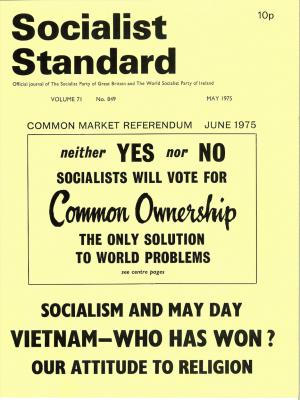
Religion and Ourselves (1975)

From the May 1975 issue of the Socialist Standard

Several letters have come in recently about the Socialist Party’s attitude to religion. They might appear to show a revival of religious belief, but we do not think so. The more likely explanation is that we have extended the Correspondence section of the Socialist Standard and religious people, who seem to take as a natural right that they may stuff their views down others’ throats, have applied themselves to it.

It will therefore save much repetition if the Socialist position on this matter is stated here. From its formation the SPGB has opposed all religion, and no-one holding a religious belief is admitted to membership. The reasons for our opposition were explained fully in our pamphlet Socialist and Religion, which first appeared in 1910 and was reprinted continually in the next twenty years.

The opening section of Socialism and Religion was headed "The Need for Frankness’’. In 1910 as now there were several organizations using the word “socialism”, but none was willing to declare itself on this question. Instead, they took refuge in the evasive principle “Religion is a private affair”; in other words, out to catch votes and nothing else, they were not going to risk alienating supporters by insisting on proper understanding.

The Socialist Party’s position is altogether different. Of course we want more members and supporters, but on the essential condition that they understand Socialism and its implications. That is why our attitudes and policies are stated unequivocally all the time. On religion, we say now what was said in 1910: “No man can be consistently both a Socialist and a Christian. It must be either the Socialist or the religious principle that is supreme, for the attempt to couple them equally betrays charlatanism or lack of thought.”

Irreconcilable
It is noticeable that no letter-writer argues a case for the established Churches. In bygone years it was sometimes put to us that the Catholic Church was benevolent to the workers; we do not recall anyone ever defending the Church of England. Generally our correspondents appear to take for granted what our pamphlet in 1910 had to spell out, that the big religious institutions are in the pockets of the ruling class. What they urge us to accept is that Christian belief in “the brotherhood of man”, etc., is in harmony with Socialism.

Whatever social messages are inferred from religious beliefs, they are first and foremost beliefs — that is, they start by envisaging the supernatural; the divinity of Christ, the soul, the after-life. These are probably the bare minimum, but if they are reduced still further there remains a fundamental element of all religions which makes them the antithesis of Socialism. This is what in philosophy is called idealism: the belief that ideas have an existence independent of natural and social causes.

Socialism is not a philosophical idea, but the expression of the material interest of a class created by historical development. Its foundation therefore is materialism, in opposition to idealism. The materialist standpoint towards man is that given his social existence (a datum everyone is bound to accept) everything results, or will be found to result, from the interplay of social forces. Any alternative explanation must lead to other conclusions than Socialist ones.

The Losing Side
However, we do not find that it is Socialism our correspondents want. Professing to have common ground with us, they approach it in a remarkably one-sided way. It might be possible to have sympathy with one who said: “Christianity and Socialism are both vital. In order to join forces, let us both give up a principle. If you will abandon a Socialist attitude, we will reject a chunk (which you may select) of our belief.” But of course they say nothing of the kind. Their demand is for Socialists to give way to Christian claims. What sort of common ground is that?

It is also asserted, frequently, that the influence and fervour of Christianity can never be extinguished. The writers seem unaware of what is happening, and not at the hands of Socialists. In October last year the newspapers reported a national poll of religious beliefs undertaken for a BBC religious programme. Only 29 per cent. of those asked believed in a personal God, and 40 per cent. of the 16-34 age group rejected the idea of life after death. (Guardian, 14th October 1974.)

When we say that Socialist society will do without religious beliefs, it is greeted with indignation as our proposal to abolish. That is not the case; we simply remark that in a sane, stable world people will not need consolation by illusions. But the abolishing is being done by capitalism, which once needed religion and now no longer has much use for it. Perhaps that is why Christians have taken to petitioning the Socialist Standard; but it is they, not we, who must change.
Robert Barltrop

Socialism—A Sane Society (1975)

From the June 1975 issue of the Socialist Standard

Long before pollution became a popular cause, and ecology a fashionable term, the Socialist indictment of capitalism included the waste that is inseparable from market production. A minority in society own the means for production, that is the land, raw materials, factories, communications etc. Through this ownership they are able to buy from the majority, the working class, their working ability.

It is members of the working class who run the transport system, who run industry from the gate to the board room, who research, design and make every kind of commodity etc. In other words it is the men and women of the working class who co-operate to perform all of the work necessary to the running of capitalism. But it is not done on their own behalf. All of this work is geared to the profit of the owning class.

Every kind of product, including food, has sale at a profit as the first motive for its existence. It may be thought that it is because commodities are useful that their sale will realize a profit. The fact is that goods are not produced to fulfil human need, on the contrary needs are stimulated so that the results of enormous productive capacity can be sold. A whole industry is devoted to sales promotion; to persuading consumers — hideous term — that their possessions are outdated, outworn or that two of everything might be better!
A marketing expert counselled the home-furnishing industry: "Make people discover for themselves that there’s fun and pleasure in changing their décor. Establish a standard based on changeability and not on permanence.” All this helped provide a philosophical base for the throwaway spirit . . .
(p. 164 The Waste Makers, Vance Packard)
Competition between manufacturers of similar items is not necessarily of benefit to their customers for costs must be kept to a minimum.
Manufacturers themselves have improved anti-corrosion techniques considerably in recent years, but a really thorough job would be unacceptably expensive in an industry increasingly dominated by cost accountants.
(Observer Magazine, 6 April 1975)
Not only are goods produced in the knowledge that they are not the best that modern technology is capable of but some commodities are actually designed to have a limited life. “An engineer’s principal purpose as an engineer is to create obsolescence” — board chairman as quoted in The Waste Makers.

Small wonder that even those workers who are supposed to be enjoying the good life have in reality succumbed to the adman’s dream world. Accumulating material possessions to assuage the frustration associated with work in which they can take no pride and the problems of everyday living.

Society does not have to be organized this way. Capitalism is not the natural order of things and it has outlived its usefulness. The quest for profit which provided the impetus to develop large scale, social production, now prevents that production being used to the advantage of society as a whole. A revolutionary change to Socialism will resolve this contradiction.

When an immense majority of working class men and women become aware of their position in capitalism they will join with us in consciously organizing to elect for Socialism. Thus to carry out the legal formality of abolishing private property. Then the means for production will be owned and democratically controlled by the whole, worldwide, community. This vital fact of common ownership and control will mean production at last geared to human needs. The one reason for making any articles and supplying any service will be that they are of use to human beings. Only the best quality need be made and with due regard to the careful use of raw materials.

All of the wasteful elements of capitalist production will disappear. With all that is on and around the earth owned in common by all of its inhabitants there will be no possible use for armed forces and other instruments of war.

Try listing the pursuits which will not be necessary when money no longer has any role to play in production. Included in the list will be duplication of effort when, for instance, airlines compete for passengers over the same route, banking, insurance, nor will we ‘‘carry coals to Newcastle” . . . but you can continue. Some occupations will be adapted to the needs of the new social order. Perhaps marketing research could be redirected to monitoring the actual needs of the community.

Workers co-operate now to run capitalism. How much more will the spirit of co-operation prevail between the free individuals who contribute to the well-being of Socialist society. Each will give to the best of their ability satisfied that the work in hand is socially useful. Each secure in the knowledge that they have free access to the goods and services which they require. Socialism will do more than resolve the problems of poverty, waste etc. It will be a harmonious, caring social system where human beings are at last free to realize their full potential.

We have given only an outline of some aspects of the Socialist future. To fill in the detail we need your help. What are you waiting for?
Pat Deutz

The Communist Course - Humbug! (1975)

From the July 1975 issue of the Socialist Standard

Much can be learnt about the aim and method of a political party from a study of its history. A look at the history of the SPGB shows complete adherence to a certain object and declaration of principles over the last seventy one years. The Communist Party of Great Britain has shown from its formation in 1920, by those seeing the Russian Revolution as a new means of achieving Socialism, to the present day, a consistent course of stooping to the demands of Kremlin policy and distortion of Marxism to fit their objective of establishing State Capitalism.

Socialism was not, and could not be, established in Russia in 1917. The only course for the Bolshevik leaders to take was that of capitalism administered by the State. The Communist Party has remained consistently loyal to Russian State Capitalism despite the multitudinous crimes which Russia has committed against its own, and the international, working class. Whilst the Socialist Party of Great Britain has always expounded the theory of Marxian economics: a system of society in which wealth is owned democratically by the whole world community; the Communist Party has persisted in presenting Socialism as a form of capitalism.

Of course, the modern CPer will agree that the CP supported the continual turnabouts in Russian foreign policy during the last war. He will agree that CPers were hailing Stalin as the Russian messiah in the not too distant past. He will even confess that the “Leadership” has been known to mislead its followers on more than one occasion. But now, he will argue, everything has been put to rights. No more are the days of Russian gold financing the CPGB. Today the Communist Party stands on its own two feet. It’s a force to be reckoned with. He will tell you about 1968 when the British Communist Party stood up and actually condemned the Russian invasion of Czechoslovakia. Much of what he says would be true. After all, we can’t blame the CP for the mistakes of its forefathers, even if it has been an entire history of error. But has the Communist Party really decided to change course?

The answer to this question is yes and no. Yes, the Communist Party in recent years has taken on a new image to make itself appear more respectable. But no, it is no nearer Socialism today than it was in 1920.

The CP is by no means secretive about its new image. Indeed in March 1973 a new policy statement entitled Time to Change Course — What Britain's Communists Stand For was written by CP Executive Committee member Jack Woddis and has since become the principle source of CP policy.

The pamphlet opens with a chapter telling us about the main problems facing Britain.
. . .  an economic crisis manifested in balance of payments problems, inflation, unemployment, monetary difficulties, trade decline and a slow growth of our economy, (emphasis added)
These, we are told are the problems facing the working class in this country. If so, what are the problems facing the capitalist class?

The pamphlet then goes on for a number of pages to complain about the symptoms of capitalism. At no time is the nature of capitalist society explained. Maybe the Communist Party doesn’t think that the working class could manage economic theories. Best give them popular causes like old-age pensioners and the price of beef. It is no mere coincidence that the basis of capitalist society is not explained. For if it was understood by the reader he would be able to see, in the next chapter, “What A Socialist Government Would Do”, that the aim of the Communist Party is not to replace the present system with something else, hitherto unsaid, but to reform capitalism in order to make it work. If the Communist Party were to look clearly at capitalism they would see that it can never be reformed in the interest of the working class.

If the Communist Party is as tame as study shows it to be, why is it disapproved? Surely there must be some revolutionary message somewhere in the pamphlet which has earned the CP its bad name. On page 53 the answer is given. So this is what the CP think Socialism is. Wait for it:
   Once private ownership of the economy is ended and private profit abolished, all the values created by people through their labour will be available to be used by them in their own interests. A part will be available in direct cash — in wages, pensions, children’s allowances, student grants and other benefits. A part will come in the form of social services — health education and so on — in cultural and leisure facilities, in various social amenities in town and country, including housing. transport, roads and town planning. Part will go on the further development of industry and agriculture, on research, on building new enterprises and constructing new machines. Finally, there will be the necessary allocation of funds and resources to maintain the new Socialist State, to staff its administration and to provide the necessary forces and equipment to defend the system against its enemies from without and within, (emphasis added )
So that’s what the Communist Party think Socialism is — them giving handouts from the profits of our labour. This is State Capitalism.

And the CP expect us to accept this nonsense! Or do they? Further on in the pamphlet we come to the third and last chapter, “How To Change Course”. Here, we are told that the “carrying through of a revolutionary change” requires, not the understanding of the working class, but
   a strong revolutionary party, a party capable of leading the people to challenge and defeat the capitalist class. (P.136)
The object of the Communist Party, therefore, is to “lead” the working class into a system of State capitalism. This was Lenin’s intention in 1917, it is the CP’s today. It may have changed its image from that of the violent revolution which it proposed in the 1920s to one of reformist promises as it does today. The slogans may be different, but the aim is still the same.
Steve Coleman

Obituary: Freddie Arnold (1975)

Obituary from the August 1975 issue of the Socialist Standard

We regret to report the death of Freddie Arnold who died in April at the age of 62. His passing will be felt by many of the older members.

Freddie joined the Party in 1933 and soon became a very active and valuable member of the West Ham Branch. Although he had no ambitions for platform speaking, he was a very knowledgeable advocate of socialism, supported many outdoor meetings, and would often be arguing the case long after the official meeting had broken up sometimes until after midnight.

After moving out into Essex he became a member of Central Branch, but invariably looked in at Conference, and made what visits he could to branch meetings in the East End of London. We offer our sincere sympathy to Joyce, his Widow.