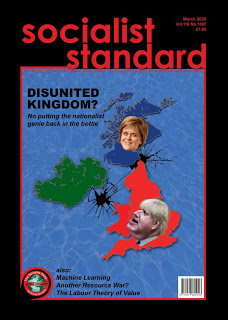
Friday, March 6, 2020

Physical Deterioration and Education. (1905)

From the February 1905 issue of the Socialist Standard

It is frequently asserted by patrons of monopoly that the educating of the masses has been a dismal failure. The snob-employer says it resentfully when dismissing some audacious demand for wage increase, the patrician superciliously when some hireling makes him aware of the rights of men. The cleric contemplating his empty conventicle likewise laments the disastrous results of education. Each and all ascribe the lamentable condition of revolt to the dangerousness of a little learning. Viewed with capitalist eyes, if Education evokes class-consciousness it is indeed anathema, but to the Socialist the murmur of the master is a message of hope.

Is, or is not, compulsory education a waste of public funds?

Under existing conditions a vast amount of expenditure receives no ultimate return whatever. Statistics of five years back proved that 75% of the lowest class who had passed through all the standards of school had great difficulty to write legibly and read unstumblingly when the age of thirty was attained. Only this last week in discussion with an enthusiast on education who has much practical experience in slum schools and is quite anti-socialistic, the following valuable admission was made: "Nothing can be done to obtain happier results unless the surroundings of the pupils are materially altered."

This current year in one of the poorer schools an inspector contrasted the work done by children of eleven with the studies easily understood by his young daughter of nine. The elder— offspring of the picker-up of a precarious, hand-to-mouth existence—lagged far behind the junior whose childhood was unharassed by trade fluctuations. If it be true that "Where Care lodges, Sleep will not lie" verily it is daily proven that study and worry have no dealings one with another. How is it conceivable that the horrors of the home can be superseded by the joys of knowledge ? For instance, our little ones come to morning session mainly breakfast-less, certainly lacking a nourishing meal after a night of unrefreshing repose: children and adults alike occupy one bed in the vitiated atmosphere of the one room constituting their "home" situated in some airless slum—Short's Gardens, Lamb's Conduit Passage, Betterton Street, alleys in the New Cut and Canning Town. One child in the Third Standard three weeks ago awoke to find her mother dead by her side. Such shocks as these are not conducive to alertness of apprehension or retention of facts.

Again, compare the average age of scholars in higher grade and very poor schools. It is two years behind in the latter case; and then, too, the middle-class school displays no such divisions as are found in the less favoured one. Here the pupils are classified thus—An intelligent majority, who, by dint of incessant drudgery will be capable of passing up one standard every twelve months, then the obviously dull, who will be tutored in same class two or more years,— sometimes when the age-limit of fourteen is reached the child is still in the Second Standard, —thirdly, those most pathetic specimens, pupils passed on from our defective centres. Very few people have any idea of the vast expense of these little citizens to the nation !

Although the Code of Instruction is supposed to be compiled for all schools under Government there is a significant clause in it to the effect that all regulations shall be enforced "as far as circumstances will permit." After arduous attempts to adopt the full curriculum the exemption has over and over again had to be claimed, owing to the total inability of the learners to grasp more than the merest rudiments. Inspectors will discourage the ambitions of a freshly installed head-teacher who places before them for their approval a most comprehensive syllabus. One who has just retired after many years service said that it was a sheer impossibility and absurdity to seek to compel such stunted capacities to comprehend anything which required concentration of thought.

Various illustrations can be cited of teachers who have believed not these reports, but, with a faith in their own powers beautiful to behold, have made a brave fight to establish more advanced subjects,—several of such disillusioned ones are personally known to the penner,—who after strenuous struggles have abandoned the position : beating the air is a singularly disheartening process. Even in lessons such as Drill when acumen is not demanded the body-conquering is noticeable. In every class there are children too weak to take muscular exercise, and many of the others are utterly wearied by half-an-hour's training.

In conclusion, we admit the failure but do not attribute it to the causes so frequently assigned, but to the dwarfing due to semi-starvation. Reforming the methods employed, altering the requirements, or any reform whatever will be futile : the sound, healthy body and teachable mind cannot be the lot of the youth of the nation under Capitalsm.
Kate Hawkins

Thursday, March 5, 2020

Marx in Soho (2020)

Book Review from the March 2020 issue of the Socialist Standard

Marx in Soho – A Play on History” Howard Zinn. South End Press $12

Witty, imaginative, to the point, with the ability to stir the emotions from frustration and anger to amusement, hilarity even, this was originally conceived as a traditional play which Zinn later reworked into this monologue. Zinn read Das Kapital (Volume I at least) before the age of twenty and was excited to recognize ‘certain core truths’ about the value of labour, surplus value and the division of the classes, i.e. labour was the source of all value; labour produced a value beyond its meagre wages; surplus value went into the pockets of the capitalist class.

The play was written at the time when the collapse of the Soviet Union brought on much gloating from the media and politicians because ‘ot only was “the enemy” gone, but the ideas of Marxism were discredited.’ Zinn wanted to show ‘that Marx’s critique of capitalism remains fundamentally true in our time.’ The opening of the play has Marx, having been granted an hour to return to Earth to defend his stance of a century and a half earlier, arriving in the wrong Soho – New York, not London – to point out the relevancy of his writing to today’s working population (the audience). Zinn states that the major events are historically accurate but that there is some literary licence regarding his meetings with Bakunin and the relationships within his own family (especially with Jenny and Eleanor) and although most of the dialogue is invented he uses Marx’s own words liberally.

This is a refreshingly different approach to bringing the fundamental ideas of Marx home, stressing, by using humour, just how relevant the principles of Das Kapital still are. ‘Did I not say 150 years ago that capitalism would enormously increase the wealth of society but that this wealth would be concentrated in fewer and fewer hands?—(reads from newspaper)—“Giant merger of Chemical Bank and Chase Manhattan Bank. 12,000 workers will lose jobs—Stocks rise.” And they say my ideas are dead.’

Commonly held confusions about communism and socialism are laid bare here with Marx becoming angrier as he looks back at Stalin’s legacy. He barks out ‘Socialism is not supposed to reproduce the stupidities of capitalism.’ Industry, war, national borders, prisons, the Paris Commune, education, all subjects are covered with relevant jibes at the situation since his time.

Marx’s anger builds as he remonstrates at the slowness of succeeding generations to accept and act on what he foretold but, realizing that he only has limited time to get his message across at this, his second coming, he mellows somewhat, reiterates the basic premises and leaves us with hope for the future – if we get off our arses!

This book is fun and will serve both to rekindle and enliven the tired socialist spirit and to encourage and further motivate active participation by armchair socialists.
Janet Surman

Scottish Independence : Tartan Delusions (2020)

From the March 2020 issue of the Socialist Standard

On the 31 January the blue Euro-banner was hauled down at Westminster and the Union flag raised in its stead. In Edinburgh, though, the self-awarded gold stars flag was pointedly left fluttering in place next to the saltire.

The SNP are making a none too subtle point. The antidote to the referendum they don’t like is to be… another referendum. It would seem the political ‘logic’ is that the best way to counter leaving a union is to leave a union.

It is somewhat ironic that the clash between Holyrood and Westminster stems from a single shared source, nationalism, be it competing nationalisms. The cause is perceived sovereignty, as if Scotland, or England, or Britain can stand alone, or at least break away from a power portrayed as inhibiting its freedom.

However, what would the SNP do in short order should they achieve independence? Give it up to the EU of course. Similarly, should Britain shake off the last vestiges of EU influence, then treaties will be sought and signed with such as the USA.

Not only will the USA want untrammelled access to the NHS for its big pharma, for example, there will be a demand for any arrangements to be subject to America’s legal system. For the USA substitute any other major trading nation/bloc and something similar will apply.

This is what ‘independence’ means in a global capitalist world. Significant change cannot be achieved by a binary vote in a referendum. At best there is some reordering of the arrangements, but essentially, adjustments made, capitalism continues unhindered other than by its own contradictions.

The SNP has previously stated its intention of retaining the monarch as their country’s head of state, continuing the use of sterling and joining NATO. Presumably unaware of any contradiction, they also want to be rid of the Trident submarine bases.

Do they really think that if capitalism degenerates to the point where international warfare results in the use of nuclear weapons, the removal of Trident bases will somehow insulate Scotland from the consequences?

Should the SNP decide the monarch was not to be their head of state, then a president or some such would fulfil that function. Has being a republic lessened the grip of capitalism, with its extremes of war, inequality and crises, on the USA?

If Scotland was denied the use of sterling presumably that would mean embracing the euro with all its financial hazards and, more importantly, subservience to, not independence from, the European Union. If sterling is retained, then economic policy would, ultimately, continue to be determined in London.

The formation of Britain enabled the industrial revolution to create a dynamic economy in which Scots, Welsh and English played full parts. This also led to the formation of the working class with interests transcending those of constituent regional and national parts. Workers in Scotland faced the same exploitative capitalism as they did in England and Wales and expressed their voice through their own organisations, the trade unions.

And nothing has changed. Workers on any side of a border, wherever it is drawn, all face the same fundamental problem, capitalism. To exist, capitalism must exploit workers to make profit. Painting your face blue with crossed white stripes alters this not one iota.

Whatever the outcome of another referendum the people of Scotland will continue to live under a parliamentary system designed to preserve the interests of capitalism. If they have opted for ‘independence’ they will find ‘sovereignty’ surrendered to the EU.

The parliamentary system has evolved to serve the interests of capitalism, not democracy. It does not matter if a parliament is situated in London or Edinburgh, nor if its benches are upholstered in tartan and populated by nationalist MSPs, it will remain subservient to the needs and preservation of capitalism.

Referendums are designed to give apparently simple solutions to complex problems, they are the chosen way of despots and demagogues attempting to garner some semblance of popular support of their self-serving programmes.

The ballot box can indeed be part of the response of the working class to taking economic and political power away from the capitalist class. But this will have to be just one element of a much wider movement in which the working class consciously acts for itself.

No referendum can solve problems for the working class, not in Scotland, not in Britain via Brexit (or re-joining the EU at some point), not anywhere. There is no Tartan alternative to socialism.
Dave Alton

The Irish Election: Sinn Fein Resurgence (2020)

From the March 2020 issue of the Socialist Standard

What about Ireland?

Sinn Féin, recycled from being the political wing of one of the physical-force Irish republican groups into a left-wing reformist party, did surprisingly well in the elections in Ireland last month. They got the most first-preference votes (24.5 percent) and ended up with 37 of the 160 seats in the Dáil. The result was in effect a tie between them and each of the two other rather absurdly named traditional Irish political parties, Fine Gael (‘Tribe of the Gaels’), the party of the outgoing Prime Minister, Leo Varadkar, and Fianna Fáil (‘Soldiers of Destiny’), founded by Republican hard-liner De Valera, which got 35 and 37 seats respectively.

When the original Sinn Féin was founded in 1905 it was an Irish nationalist party (‘We Ourselves’) catering for small-scale Irish capitalists eager to break away from the rest of the UK so as to be able to erect tariffs to protect them from the competition of bigger British capitalists. Its first leader, Arthur Griffith, proclaimed that, if an Irish capitalist firm was being undercut by an English competitor, ‘it is the first duty of the Irish nation to accord protection to that Irish manufacturer’ and that ‘under the Sinn Féin policy… no possibility would be left… for a syndicate of unscrupulous English capitalists to crush out the home manufacturer and the home trader’ (Arthur Griffith, The Sinn Féin Policy, 1907).

This was the policy that the De Valera Fianna Fáil government that came to power in 1932 began to implement, involving a tariff war between Britain and Ireland.

Now it’s a different story. In a 2019 policy document, Ownership Matters, Sinn Féin states that it wants ‘an economy that works for workers’ (mind you, don’t they all, given that workers make up the vast majority of electors?). After citing figures for wealth inequality and poverty in Ireland, SF went on:
  ‘Sinn Féin believes that this wealth inequality is a result of our economy being detrimentally ‘short-termist’ in its outlook – with private firms, through financial intermediaries, weighing near-term profit outcomes too heavily at the expense of longer-term sustainability. This has become the hegemonic strategy for private enterprise. The reality is that ownership shapes purpose. If we allow our economy to be owned and controlled by a small group of elites whose objective is that of profit, then that will be the purpose of our economy. If, however, we agree as a society that our preference is to establish an economy based upon productivity, sustainability and equality then ownership of our economy must be equitably spread across society’.
Then came the punch line: ‘This new economy can be achieved through alternative models of business ownership. Sinn Féin believes that the Worker Co-operative Model offers an exciting and innovative alternative.’ Not to be achieved in one go, but, in the words of a slogan the document coins, ‘Own the Change: Building Economic Democracy One Worker Co-op at a Time’.

Those who voted SF are unlikely to have voted for this, but merely so that something should be done about growing inequality and poverty. However, it does illustrate the illusions of SF’s policy makers. They criticise traditional private enterprises for concentrating on short-term profits, but if worker co-ops are to compete against them with any chance of surviving they, too, would have to pursue the same economic objective of profit. They would have to make profits as they would be operating within the context of a capitalist economy, which is based on competitive profit-seeking.

The capitalist economy

The capitalist economy – which SF would leave unchanged while launching ‘one worker co-op at a time’ – is based on separate enterprises competing to meet paying demand in their sphere of activity. The weapon used in this struggle is to produce more cheaply than your rivals but, to do this, you must re-invest the major part of the profits you make in machinery and other ways that reduce the cost per unit produced. The first enterprise to adopt some cheaper production method reaps extra profits, but this encourages, in fact obliges those that can, to follow suit and the price of the product falls, with the innovator’s profits falling back to normal. If an enterprise were to distribute all the profits it made to its owners for them to spend on their consumption, then its cost of production would not fall and its products would become uncompetitive; eventually it would go under and its owners would lose their money. Very few private enterprises are that short-termist.

The point is that the same pressure to give priority to profit-making and re-investing most of it applies whatever the legal form and internal structure of the enterprise. A worker co-op would have to operate on the same basis. Internally it might be more democratic and less hierarchical but the decisions that have to be taken, whoever takes them, will have to be the same. And of course a worker co-op can also go under, with the workers losing not only their jobs but their savings too. Some succeed but those that do end up behaving like any other business enterprise, even employing non-members as wage-workers.

In any event, given the nature of Irish politics, SF will never govern on its own but only as part of a coalition. Its openly pro-capitalist partners may well indulge it by allowing it to fund setting up a worker co-op or two but that will be as far as it goes. And if the experience of those set up by Tony Benn in Britain when he was minister of industry in the 1970s is anything to go by, their chances of succeeding wouldn’t be that high; all those he patronised eventually folded.

Up the Border?

Sinn Féin still stands for a 32-county Irish Republic – as did, at one time, the more fiercely named Fianna Fáil party – but this has come into prominence, not as a result of SF’s election successes north and south of the Border but as a fall-out from Brexit. Which is rather ironic in itself since Sinn Féin, as an isolationist nationalist party, opposed Ireland joining the EU and urged a No vote in all the referendums to amend and extend the EU’s powers.

People in Northern Ireland voted 56 to 44 percent in favour of Remaining in the EU and the EU insisted – and Boris Johnson acquiesced – that the political border on the island should not become an economic border again. It never was until De Valera and Fianna Fáil came to power in the ‘Free State’ as it then was and pursued a policy of independent capitalist development before they eventually gave up and signed the Anglo-Irish Free Trade Agreement in 1965. In 1973 Ireland and Britain joined the European Economic Community(as the EU was then called and still essentially is) together.

So, the north and south of Ireland will continue to have frictionless trade. As with the EU itself, there are those who think that a single market will be a prelude to a single political entity, especially as in the case of Ireland the Good Friday Agreement provides for a referendum on uniting with the Republic to be held if it is judged that a majority might favour this. But this does not necessarily follow, as the co-existence in Ireland for years of the political border with the economic unity of the single market and customs union showed. Even if a majority were to favour political unity, holding a referendum would risk igniting ‘the Border’ as a burning – and completely irrelevant and dangerously divisive — issue again, with a significant minority likely to be fiercely opposed to it, even to the extent of taking up arms. It would be better from all points of view to let sleeping dogs lie.

But even if it did happen without re-igniting political violence, it wouldn’t make much difference to the life of ordinary people. Capitalism would remain, and they would remain excluded from ownership and control of the means of life and so obliged to work for a wage or salary for those who own and control them. The pillar boxes in the North might be painted green – or maybe the settlement would allow them to remain red – but that would be all.
Adam Buick

Socialist Action (1981)

Party News from the March 1981 issue of the Socialist Standard

On May 7, the workers of Islington South and Finsbury will have a chance to register a vote for world socialism: a system of society in which human beings will stand in social equality to the means of living. That many of them will not wish to cast their votes for social revolution cannot be denied, but that every effort will be made to persuade them is certain. The socialist campaign is already underway and even if the workers who reside in the constituency do not yet know it, they are about to have their minds assailed from all directions by the powerful case for a world without poverty or deprivation.

Why do we contest elections? Firstly, because to confront and defeat the arguments of the pernicious apologists for the profit system at election time has considerable propaganda value. Secondly, because socialists are democrats. No, not the defenders of that perverse "democracy’ which requires the working class to follow like sheep their political leaders. We are democrats in that we stand for a new system which will not be characterised by the divisions of class, sex, age or race. Only when a conscious majority want and understand socialism will the new social order be created. The ballot box is a means of registering that consciousness. And thirdly, because election campaigns help to organise workers in a particular area. Islington branch hopes to come out of the campaign with new recruits to our recently increased numbers.

Why are we contesting Islington South and Finsbury? The branch is a strong and enthusiastic one and the local workers are in just as much need of fresh political thinking as those in any other constituency. Every household will be receiving an election manifesto. Houses will be canvassed; street corner meetings arranged; eardrums blasted by our loud-speaker messages; indoor meetings held to clarify the electoral issues. Any worker in the constituency who does not want to come into contact with socialists (lest he catches a dose of political intelligence) had better keep away from the area as from April.

Those local workers who want to lend a hand are invited to help us in the following ways:

  1. MANIFESTO DISTRIBUTION. From mid-April, manifesto distributors will be required on Monday, Tuesday, Wednesday and Friday evenings. The meeting place is the Angel tube station at 7pm. If you cannot make those times or if you want to do some distributing on your own during the day, make contact with the election agent who will give you some manifestos and a list of houses to cover.
  2. SOCIALIST STANDARD SELLING. The Party only wants politically conscious votes, so plenty of literature will have to be sold in the constituency in the month before the election. Either come to Chapel Street market any Saturday in April from 11am until 3pm or get in touch with the election agent who will book you a place on the rota for tube station selling.
  3. ATTEND OUR PUBLIC MEETINGS. Come along to the public meetings in Islington in the weeks before the election. Bring along any friends who can be persuaded to come, even if you know that they are not yet in agreement with socialist ideas. Details of all meetings will appear in the Socialist Standard.
  4. DONATIONS. This campaign will cost money. Manifestos have to be printed, halls have to be booked. Members and sympathisers may not have much to spare, but any coins, notes, postal orders and cheques will be gratefully received and acknowledged by the election agent. We will report on how our funds are going in future issues of the Socialist Standard.
  5. GET IN TOUCH WITH THE BRANCH. Let us know any ideas you may have for furthering our propaganda during the election campaign. Send us names and addresses of anyone in the Islington area who may be interested in hearing from us.
Remember, we cannot promise you “Socialism in one Borough”, but we can urge you to reject Sir Horace Cutler and his opportunist colleagues in County Hall and make the great political leap from poverty to freedom.
Islington Branch

The Socialist Standard is the genuine Socialist paper (1981)

Advert from the March 1981 issue of the Socialist Standard


A matter of principle (1981)

From the March 1981 issue of the Socialist Standard

OUR OBJECT:

The establishment of a system of society based upon the common ownership and democratic control of the means and instruments for producing and distributing wealth by and in the interest of the whole community.

This is a clear definition of socialism. Nothing to do with rationing everything out so that we all get exactly the same. Nothing to do with sharing a coat, eating off the same plate, living in a commune or going back to primitive times. What will be commonly owned will be the means and instruments that produce the things all human beings need to live: land, factories, mines, energy resources, transport, machines, tools, raw materials. Social ownership is the only proposition entirely in line with the technological age: everything else is hopelessly inadequate and antiquated.

Socialism is a society where everyone will stand in equal relation to everything that is produced; where everyone will be able to contribute to running life according to their own willingness and aptitude and take freely from the available wealth. It has long been possible for this next stage in human evolution. A society with no leaders, no governments, just a totally democratic and harmonious administration for the good of all. No buying and selling, no exchange, no money. A society where goods are produced solely for use and not for sale and profit as today.

OUR PRINCIPLES:

1. That society as at present constituted is based upon the ownership of the means of living (i.e. land, factories, railways, etc.) by the capitalist or master class, and the consequent enslavement of the working class, by whose labour alone wealth is produced.

This is a straight definition of the world system we live under: capitalism. There are basically only two classes. If you are dependent on an employer for a wage or salary in order to maintain your standard of Living, then you are working class (whether you wear a tie, overalls, uniform or whatever). The capitalist class, the owners of the means of production and distribution, have no need to work because they live off the profits they obtain from the wealth produced by workers. There is in reality no such thing as the middle class: it is a myth.

2. That in society, therefore, there is an antagonism of interests, manifesting itself as a class struggle, between those who possess but do not produce, and those who produce but do not possess.

One section of society, the vast majority, always have to struggle to maintain or improve their standard of living; the other small owning section, the capitalist class, is always doing its utmost to keep wages down so as to keep profits up. And there can be no doubt whatsoever that this difference of interests exists. Trade unions prove the point. Strikes, lock-outs, go slows, works to rule, overtime bans. All workers—brain labour-power and manual labour-power—are forced at some time or other to consider taking some kind of action to back up wage claims, claims which are always resisted by the employers. It is perpetual antagonism the world over.

3. That this antagonism can be abolished only by the emancipation of the working class from the domination of the master class, by the conversion into the common property of society of the means of production and distribution, and their democratic control by the whole people.

All efforts to try and make the capitalist system work in the interests of all people have failed. A glance at the history of the last 150 years bears this out. In fact, these principles—unaltered since their introduction in 1904—prove that nothing in the structure of society has fundamentally changed. Many varieties of the capitalist system have been tried and all have failed to serve the needs of the majority. Absolutely none of them works; not one of them provides a fulfilling and rewarding existence for even a sustained period of time. Labour, Liberal, Conservative, Communist . . . every single one is a disaster because very single one is trying to run an inhumane system. The only logical thing to do is to reject the whole useless and out-dated system, a system where most people in a world of potential abundance have to constantly worry about money, have to do without one necessity so as to afford another; where old people die of cold because they can’t afford fuel; where desperately ill patients suffer because they can’t afford treatment. A system where millions are malnourished and even starve to death because they can’t afford food, which is often deliberately burned or dumped as unprofitable; where thousands go homeless because they can’t afford the rent or can’t obtain a deposit and yet there are bricks, sand, cement, tools, machines and manpower in superabundance. A system where millions are bored sick unemployed and bored sick in employment. How can there honestly be anything said in the system’s favour?

4. That as in the order of social evolution the working class is the last class to achieve its freedom the emancipation of the working class will involve the emancipation of all mankind without distinction of race or sex.

Once the majority of the working class—which, remember, means everyone who works for a living—realises its own position and acts accordingly, then it will mean the freedom of everyone whether black, white, yellow, man, woman and child. Simply because it is the wage-slave class — the class you and we belong to — who make up the vast majority of the world’s population.

5. That this emancipation must be the work of the working class itself.

The capitalist class doesn’t need another system—it’s doing alright with this one. So it’s clear that the employers are not going to bring it about. And neither can some kind of enlightened elite or arrogant intellectual working-class-hero types masquerading as leaders bring it about for the rest of us either. It’s just not possible. That’s why socialists totally reject all concepts of leadership and why we are one hundred per cent a democratic organisation, where each has an equal right to contribute opinions. Only knowledge and understanding coupled with conscious, democratic political commitment by the large majority can possibly bring world socialism about. To believe otherwise is to delude yourself.

6. That as the machinery of government, including the armed forces of a nation, exists only to conserve the monopoly by the capitalist class of the wealth taken from the workers, the working class must organise consciously and politically for the conquest of the powers of government, national and local, in order that this machinery, including these forces, may be converted from an instrument of oppression into the agent of emancipation and the overthrow of privilege, aristocratic and plutocratic.

Once the majority understand and want socialism, have deliberately organised within the socialist movement, and have placed in Parliament—and its equivalent in other countries—democratically elected delegates, then there will be absolutely no problem. It will be as simple and straightforward as that. For how could a minority capitalist force stand the remotest chance against the socialist majority? Who would do their fighting for them? This is why we reject political violence, not on pacifist grounds but because it is completely unnecessary, damaging and futile. The act of voting is the only way, since this is how affairs in the new society will be conducted. Forget all about ends justifying means; power obtained by violence can only be maintained by violence and force. The truth is that the means condition the end.

7. That as all political parties are but the expression of class interests, and as the interest of the working class is diametrically opposed to the interests of all sections of the master class, the party seeking working class emancipation must be hostile to every other party.

You cannot be on two sides at once. You either want, work and vote for socialism alone, or you want capitalism one form or another. Vote Labour, Liberal, Tory, Communist or any of the left-wing groups and you will get capitalism. So instead of wasting your time and energy tampering about with the system, go straight to the root cause of nearly every problem you can think of capitalism itself and concentrate solely on its global abolition and replacement with socialism.

8. The Socialist Party of Great Britain therefore enters the field of political action, determined to wage war against all other political parties, whether alleged labour or avowedly capitalist, and calls upon the members of the working class of this country to muster under its banner to the end that a speedy termination may be wrought to the system which deprives them of the fruits of their labour, that poverty may give place to comfort, privilege to equality and slavery to freedom.

It is war—a class war—and we are the only socialist party in this country (there can only be one socialist party in any country), no matter what others may call themselves. We are in total opposition to all other parties because not a single one of them can ever abolish this system, no matter what they claim. Ours is not a war of bombs, bullets, street-fighting or any form of mindless violence, but a war in which our weapons are irrefutable facts. We expose all who deal in myth, illusion, ignorance and deceit. No problem is fully solved under capitalism by the time one is half-solved another presents itself, and by the time this one is half dealt with the original is festering again. Poverty, war, hunger, homelessness, hardship, monotony. So long as capitalism lasts so will these.

So there you have it—clear, straight and uncompromising. You agree that socialism is a highly desirable proposition. You agree that it is a straight choice. You agree that this new world can only come about when a majority understand and want it. Now make your choice. Join us and help to bring a sane and harmonious society all the closer. Don’t wait for others to do it—they may be waiting for you.
Paul Breeze

How can too much food be a threat to a sane society? (1981)

From the March 1981 issue of the Socialist Standard

The whole world today is dominated by the market system. Goods and services are only produced if they can be sold in the market at a profit. Each year, millions of people die of starvation. But in the market system, their hunger is not “effective demand”; they have no money with which to buy food. While those people starve, food is stored and even destroyed just in order to keep up prices and profits. The Daily Express (6/2/81) carried a large photograph of an ex-RAF hangar containing a 10,000-ton stock of barley. Across Europe there arc several millions of tons of “surplus” barley. The Daily Express suggests the feeble solution of Britain leaving the Common Market. The only real solution is for there to be no market, with food produced simply to be eaten by people who need it.

* * *

Workers who are taken in by the advice of Geoffrey Howe and Keith Joseph should take note of this: “Most of the workers at a Yorkshire wool mill who accepted a 10 per cent wage cut to save their jobs are to be made redundant after all, because trade has continued to decline” (Guardian 12/1/81).

* * *

The government are planning an “anti-scrounger” campaign for April. Social Security claimants will be investigated if they have a “suspiciously high” standard of living. Will this include Denis, Thatcher’s husband, or Elizabeth, Thatcher’s queen, both of whom enjoy luxurious life-styles without ever doing a day’s work?

* * *

The Office of Health Economics have published a report (Suicide and Deliberate Self Harm) showing that there were 4,200 suicide cases in 1979 in Britain (as against only 571 homicides): 500 more than in 1975. The last surge in suicides was in the 1930s. It is probably no coincidence that the ’30s was the last period of mass unemployment.

Wednesday, March 4, 2020

The Socialist Party and Revolution: No Compromise! (1976)

From the April 1976 issue of the Socialist Standard

The above title was the subject of a meeting at our lecture room at 52 Clapham High Street, earlier this year. What follows, is the writing up of the notes for the meeting.


The Socialist Party of Great Britain was formed on June 12th 1904 by a group of one hundred and twenty members of the working class, some of whom had been expelled and others who had broken away from the Social Democratic Federation. The SDF (founded in 1881) had turned its back on the class struggle and revolution, and had openly opted for reformism, compromise and political dealing. They were wedded to the canker of leadership and determined on the policy of “broadening the base” and widening the appeal. This meant going in for alliances with parties and leaders they formerly denounced to attract the support of greater numbers of people who had no interest in nor understanding of Socialism. To gain some temporary advantage, support was given to candidates of the Liberal Party and the Independent Labour Party. The latter organization had itself been formed as a break-away from the SDF in 1893.

To remain inside the SDF and function as Socialists, had become impossible. Our founder members were determined to stop the rot and halt the drift into reformism and compromise. Either Socialism would be submerged and lost in the countless day-to-day issues of opportunist politics, or a new organization had to be formed. An organization, which CONSCIOUSLY and DELIBERATELY took an exclusively REVOLUTIONARY stand. An organization, whose members were acutely aware of all the pitfalls of playing politics, and who resolutely and purposefully set out NOT to engage in capitalist politics, NOT to seek power within the framework of existing society, NOT to build up a blind mass membership on “popular” demands. The pitfalls were now obvious. The lessons had been learned. They had just come through the experiences that showed the way to disaster. All the “left-wingers” who today still urge us to "work inside the Labour Party” are seventy-two years behind the times.

Pitfall number one: The idea that a politically ignorant working class could be dragged behind the train of a revolutionary leadership or elite. First gain power on a broad programme, then bring in Socialism by easy stages. Pitfall number two: The idea that some momentary advantage could be gained by posing as the workers’ champions on some reform demand, the enactment of which left capitalism intact. Pitfall number three: The idea that joining forces with capitalist parties, particularly at election times, could serve some purpose for a party claiming to be out for Socialism. Pitfall number four: The idea that all the ills of capitalism could be eradicated one at a time by piecemeal reforms, Socialism via the day-to-day struggle or, many roads to the same objective.


The new party had to frame itself in such a way that it pursued only the objective of Socialism At its formation a Declaration of Principles and an Object were drawn up and agreed upon as the basis for membership. Those Principles had to safeguard against repeating the mistakes of earlier organizations. It was essential that they be broad enough to include all who are Socialists and yet, narrow enough to exclude all who are not.

The first Principle defines the class basis of capitalism as centring upon the ownership of the means of production and distribution with the enslavement of the working class as its consequence. There follows the antagonism of interests between the capitalist class (owners) and the working class (non- owners). There is no room here for political trading. The antagonism integral to capitalism can be ended only by making the means of production and distribution the common property of society and democratically controlled by the whole people.

The Principles make clear the nature of political power and point out that the state is the machinery for the rule of one class over the other, to preserve for the capitalists the wealth they take from the workers.

Political parties exist only as expressions of class interests. Our Principles demonstrate with irresistible logic that although a variety of parties may represent the sectional interests of the capitalist class, only one party can seek working-class emancipation. The workers’ party must be hostile to every other party. Because the interests of the working-class is diametrically opposed to all sections of the exploiting class. This is the concept of NO COMPROMISE crystallized in a political principle. Every party whose programme and policies leave the working class as wage slaves (employees) is perpetuating capitalism and exploitation and is therefore, necessarily anti-working-class.

With the definition of Socialism as its object and in clause three of its Principles, the circle was completed. The new party was unique, fundamentalist, revolutionary. The analysis of history, the way of looking at society from which the Object and the Declaration of Principles are derived bear the indelible imprint of Karl Marx. The dynamic nature of the class struggle as the force for change in history. The understanding of the State as a class instrument. The need for the workers to capture political power. The outcome of history’s final class struggle being classless society. The abolition of private-property relationships, including the wages system. This is Marxism. This is the meaning of revolution. All leadership is rejected and the vital pre-condition of working-class understanding is stressed as the key to changing society.

The policy of NO COMPROMISE is not a piece of isolationist dogma, nor a fanatic’s defiance hurled at the rest of society “we are right and you are all wrong”. It is a simple recognition that between reformism and revolution, there is no meeting point. The politics of those who seek only the retention and modification of capitalism are incompatible with the quest to get rid of it.


It is not by what we say about ourselves or our own appraisal of our ideas, that we are to be judged. In the passage of time since 1904, the SPGB with its Object and Principles, has been subject to a series of acid tests. We have applied our Principles, our analysis of history and society, to every major issue and social problem. We have examined the cause of war and found no working-class interest involved. This while our opponents including erstwhile pacifists of the “left” were lining up to support one side or the other. We have examined the industrial struggle and the claim that this was the real path to class emancipation, and seen only an integral part of capitalism at work. While we have always urged workers to as much as they can of the wealth they produce under capitalism, we have seen nothing to distract us from the conscious political struggle to end the wage system. The industrial struggle is a self-perpetuating cycle of disputation about the degree of exploitation.

Then, we have looked at Russia and China during their periods of upheaval, and whilst others rushed to proclaim examples of Socialism, we saw the development of the wages system and knew that capitalism was emerging.

We applied our Socialist Principles in our analysis of the Labour Party and their nationalization schemes, we saw no solutions forthcoming to any major social problems, only the perpetuation of the system that produces the problems.


But there is also another judgment to be made. If, over all the years since 1904, our opponents had been right, then by legislating reforms they would have banished poverty, ended unemployment and taxed the rich out of existence. If they were right there would be no housing problem now and no old people existing in misery. Nobody in the world would be starving while food is destroyed, and there would be no weapons of mass extermination, because according to them going to war would mean no more war. If, in any sphere our opponents had succeeded the SPGB would have become a political irrelevance and no doubt long since disappeared. History (and living experience) shows our opponents are not only irrelevant but politically moribund. By their own criteria they have failed and are overdue for the scrap heap.

In the final analysis, this is what it is all about, what is has always been about. Not some “above-the-fray” commitment to academic principles, but the removal of social problems. It has been about the question of which way works, revolution or reform. We welcome this opportunity to reaffirm the stand we took from the start. Socialism means revolution — no compromise.
Harry Baldwin

Proper Gander: All’s Whale That Ends Well? (2020)

The Proper Gander Column from the March 2020 issue of the Socialist Standard

Stacey Dooley has an open-minded, grounded approach to her documentaries, with an engagingly genuine interest in the contentious subjects she covers. Her latest programme, Stacey Dooley Investigates: The Whale Hunters (BBC3), follows on from her previous investigations into women suicide bombers and sex offenders, among other topics. Stepping out of her comfort zone, she goes out on a Norwegian boat hunting minke whales, and watches as one get harpooned and dragged aboard. Most of the programme, though, is taken up by her meeting families on the Faroe Islands, where eating long-finned pilot whale meat has been part of their culture for a thousand years. Hunting pilot whales is called the ‘grind’(grindadráp) in Faroese; when a podis sighted out at sea, fishing boats herd the whales towards the beach where they are killed by hand. The recommended method claims not to cause any suffering: a sleek-looking tool called a spinal lance, the use of which is monitored and regulated. 

The Faroese live a rural life, close to nature and therefore not as distanced from where their food comes from as most of us. When we load our supermarket trolleys with meat or fruit or any food, we scarcely think about how it was produced. The Faroese see pilot whale hunting as ‘taking food from nature’, which it is their ‘duty’ to do. They emphasise that they don’t catch any endangered species and it’s more environmentally friendly than rearing cattle, which carries a significant ‘carbon footprint’. The grind is small-scale subsistence farming, with the meat just distributed among the islanders rather than being for export. Pilot whale meat remains popular among the Faroese, despite the islands’ officials recommending years ago that eating it should be avoided. This is because it contains high levels of mercury, DDT derivatives and polychlorinated biphenyls (chemicals largely banned in the 1970s), leached into the oceans and ingested by the pilot whales.

The Faroese see the grind as part of their culture, which others don’t have the right to interfere with. Whaling around the Faroe Islands isn’t covered by the International Whaling Commission’s ban on commercial whaling. For starters, the long-finned pilot whales hunted there are a kind of dolphin, despite their name. Also, as the Faroe Islands are devolved territories of Denmark, as Greenland is, their autonomy means that they don’t go along with Denmark as one of the countries which agreed to the ban. ‘Aboriginal whaling’, defined as the hunting of whales by indigenous communities is exempted from the ruling anyway. Japan always got round the ban by hunting whales for ‘scientific’ reasons, while Norway, Canada and others object to the moratorium and have continued commercial hunting. The hunting of whales was banned because many species were declining rapidly towards unsustainable levels. Another factor is that whales and dolphins are more intelligent than most other mammals, raising questions about their capacity for suffering and awareness.

Objections to the grind mostly come from the Sea Shepherds, a direct-action group, whose mission ‘is to end the destruction of habitat and slaughter of wildlife in the world’s oceans’. They used to actively protest against the grind, but since being banned from this their work has shifted largely to raising awareness by posting grisly videos of the hunt online. The group of them which Stacey meets are made up of activists from the UK and America, while none are Faroese. The Sea Shepherds emphasise their non-aggressive methods, and argue that the grind is a tradition which should be left in the past, and that it’s not as humane as its proponents make out. They point out that the spinal lance often isn’t used correctly, causing suffering to the pilot whales. Stacey shows an adviser to the Faroese government gory footage of a dolphin being killed in a clumsy, drawn-out way. Official reports claim that the methods used are humane and quick, whereas a fifth of whales take up to six minutes to die. The adviser recognises that sometimes the grind can be brutal, but that’s because it takes place in an uncontrolled environment, not in a slaughterhouse.

Objections to the grind and the risk of contamination haven’t stemmed the Faroe Islanders’ love of pilot whale meat. The grind, and whaling in general, have been traditions for hundreds of years, and could continue for hundreds more. How would the issue of whaling be handled in a socialist society? Of course, we can’t say with any certainty, as it’ll depend on whatever the situation is at the time. But the practice is still likely to divide opinion and represent bigger questions about cultural differences, animal ‘rights’ and sustainability. A socialist society would make its decisions democratically, rather than through hierarchies, commercial interests or laws, as we have to in capitalism. All sides would be able to have their say, and all relevant facts – about contaminants, whale populations, the methods used – would be freely available so that people can make an informed decision. This could be made by voting directly on whether or how to hunt whales, or by electing people into roles to resolve the issue, or some other approach we can’t imagine now. Would it be only for the whaling communities to decide? Maybe, maybe not, if hunting had a wider impact. It’s likely that a socialist society would have some decision-making structures with a global reach, more accountable and accessible than their equivalents today and not run through states (as states would be obsolete). So, it’s possible that something like the International Whaling Commission could remain in a socialist society, albeit structured differently and more democratically. Whichever way any decisions about whaling would be made in socialism, they would aim to directly meet people’s needs and wants, in balance with nature. There are no easy answers with controversial issues like whaling, but a socialist society would enable us to make decisions in the most reasonable way.
Mike Foster

Cooking the Books: Same difference (2020)

The Cooking the Books column from the March 2020 issue of the Socialist Standard

So, the UK left the EU at 11 pm on Friday 31 January. Well, not exactly. The UK left the EU’s political institutions (Parliament, Commission, Council, Court of Justice, etc) but remains in its economic arrangements (customs union, single market, free movement, trade deals, etc) until at least the end of this year. No wonder nobody noticed the difference.

Some ultra-nationalists wanted us to celebrate ‘independence day’, though Boris’s idea to have Big Ben bong fell flat. But what is ‘independence’? As far as states are concerned, it’s the same as ‘sovereignty’. A political territory is independent if the rulers there have the final, supreme, say in matters concerning it.

‘Independence’ and ‘sovereignty’ are political concepts, but politics is one thing and economics another. A state can make what ‘sovereign’ decisions it likes but whether they are effective is another matter. No state can be independent economically as all are dependent directly or indirectly on the world market, which places limits on the effective exercise of their sovereignty. The UK has an additional problem. It and the EU countries are economically interdependent and have become more so over the nearly half-century of UK membership. The UK can’t become ‘independent’ of that, whatever ultra-nationalists might want, at least not without a severe disruption which would affect both the UK and the EU. So both have an interest in avoiding this.

Given that previous options of staying in the single market and/or customs union are now ruled out, the only one left to avoid this is some sort of agreement for the UK to ‘align’ in some way its regulations on technical standards, food standards, workers’ rights, state aids and the like, with those of the EU. At the moment, both sides are at the pre-negotiation stage of rhetoric and laying down ‘red lines’. Even so, some ministers have made fools of themselves, the Chancellor of the Exchequer, Savijd Javid, for instance.

On 18 January the BBC reported that he ‘has warned manufacturers that “there will not be alignment” with the EU after Brexit and insists firms must “adjust” to new regulations’. Faced with the resulting howl of protest from the CBI and other representatives of capitalist industry at this expression of unconcern for their interests, when he went to the annual world leaders’ junket in Davos a week later, he was forced to backpedal and explain:
  ‘“Britain will not diverge from European rules “just for the sake of it” after Brexit, Sajid Javid said yesterday, as he softened the government’s rhetoric on future EU trade talks. In a move to reassure business, the chancellor said that while ministers were determined that Britain would not become a “rule taker” from Brussels, it did not mean the UK would necessarily diverge from European standards. “We will be a sovereign and independent country,” he told a lunch for British executives at the annual meeting of the World Economic Forum in Davos. “But we’ll always protect the interests of British businesses throughout this process and we’ll maintain high standards — not because we are told to, but because we want to.”’(Times, 24 January)
One way of interpreting this is that he his saying that the UK will align with EU rules but it will do so as an ‘independent nation’ making its own decision – to do what it would have done had it remained in the EU. If this is indeed the final result, it will confirm that Brexit has been a fuss about nothing, just about how a decision is made not about what it is.

A Letter to Greta (2020)

From the March 2020 issue of the Socialist Standard

Dear Greta,

I wish to write to you on just my own part, first of all to express my support for your courage and your message, and also to present some ideas. Although I am a member of a political party, I am here writing alone.

It is my opinion that any hope you have of impressing the urgency of addressing the climate crisis upon those in power will continue to be dashed. They will talk a lot, summon meetings, etc., but they cannot resolve the crisis because they represent a system of profit over life, and are governed by that system, no matter how sincere some may be. They may be voted in by the majority of people, but they only represent about 1 percent. They do not control the system of production – which pollutes and devastates – but are controlled by it. This system, which is global, and which has evolved in history, has long been obsolete, but still survives because of the habits of docility and helplessness it continues to foster in the majority – who, afraid of responsibility, and oppressed by working for wages and making ends meet, cannot imagine taking the world into their own hands.

The only way to begin to address the urgency now facing us all is to use the vote to liberate the means of production from the 1 percent and take them over, democratically, in the name of all society. This will enable us all to produce only to satisfy need, only for use, abolishing the system of profit and at last to have control over our own destiny as a species, and help other species too who are suffering because of the present system of human society.

With my deep respect and support, I am, yours sincerely,

Anthony Walker, 
Christchurch, England.

50 Years Ago: The mad world of capitalism (2020)

The 50 Years Ago column from the March 2020 issue of the Socialist Standard

Once again bricks are piling up, brick-workers are being laid off and brickworks closing down. All because the manufacturers can no longer find a profitable market. There are about 1,800,000 houses in England and Wales officially classified as “unfit”. But the fact that millions of people need better homes does not affect brick production for the simple reason that it is not profitable to produce bricks to build houses for people who would not be able to pay for them.

Meanwhile, in France the government are worried about there being “too much food”. According to the Times (23 January 1970), the solution advocated by one group of academics and civil servants is that one-third of the present cultivated area of France should be taken out of food production. The Vedel Commission recommended:
  ‘Whatever rate of modernisation is adopted, agriculture will continue to build up surpluses if it continues to exploit the same area as today. Whatever happens, the excess land that will have to be withdrawn will be at least 10m. hectares.’
To do this would be in line with what other governments, notably the American, have already done in a bid to prevent the production of food that cannot be sold profitably. It is not that people do not need the food—the Food and Agriculture Organisation estimate that up to half the world’s population go to bed hungry—but that because they cannot pay for it there is no profit in growing food for them.

Stockpiles of bricks beside slums; proposals to cut back food production in a hungry world—just two more examples of how capitalism cannot serve human needs.

(Socialist Standard¸ March 1970)

Editorial: Towards a Disunited Kingdom (2020)

Editorial from the March 2020 issue of the Socialist Standard

The turmoil of the Brexit process has exacerbated the fissures within the UK, which threaten to tear it apart. The Scottish National Party leader, Nicola Sturgeon, seized on the fact that the majority of Scottish voters opted to remain in the EU, and is demanding a second Independence referendum. The border between the North of Ireland and the Irish Republic which appeared to be invisible since the Good Friday agreement became a stumbling block in the Brexit negotiations. Sinn Fein wasted no time in pressing for a border poll which they hope will lead to the reunification of Ireland.

The spectre of Scottish independence is nothing new. Scottish workers were badly affected by the economic downturns of the 1970s and 1980s which hit the traditional industries (shipbuilding, coal, steel) particularly hard. Many workers were also dissatisfied with Labour governments. North Sea oil seemed to promise higher living standards. In these circumstances the SNP was able to position itself as the workers’ party. With the establishment of the Scottish Parliament in 1999, the then Labour government thought they had seen off the nationalist threat. However, in the wake of the 2008 financial crisis, many workers turned away from the mainstream capitalist parties. In Scotland, this helped the SNP to secure a majority in the 2011 elections for the Scottish Parliament and a landslide in the 2015 General Election.

The Irish border has been in contention since 1921. However, with the repression of the Civil Rights movement in the North of Ireland in the late 1960s, Irish republicanism experienced an upsurge of support. In the 1980s Sinn Féin was able to capitalise on the outrage that the British government’s response to the hunger strikes elicited in Catholic working-class areas. It also managed to gain a foothold by providing welfare services to Catholic workers. With the peace process and the IRA laying down its weapons, Sinn Féin was able to reinvent itself as a workers’ party.

In last December’s general election, the SNP increased its seats in Scotland, whereas the pro-Brexit Conservative Party prevailed in England and Wales. In Northern Ireland, for the first time, Nationalists won more seats than Unionists. Sinn Féin has made a significant breakthrough in last month’s general election in the Irish Republic.

It must be noted that the electoral successes of the SNP and Sinn Féin do not always reflect support for their respective aims of an independent Scotland and a united Ireland, but more often a deep dissatisfaction with the political status quo. Nevertheless, these parties will use their increased leverage to push for their aims.

Do the working class have any interest in whether or not the United Kingdom remains intact? Or should they, as the Left urges them to, support an independent Scotland and a united Ireland? We say no on both accounts as, wherever the boundaries are drawn, workers will still be subject to the vagaries of the global market system and will continue to experience problems such as unemployment and low wages. Workers will need to organise for a socialist society which will abolish borders rather than rearrange them.

Rear View: No gods (2020)

The Rear View Column from the January 2020 issue of the Socialist Standard

No gods

‘China is set to censor all translated versions of classic religious books to make sure that their messages reflect the principles of Socialism’ (dailymail.co.uk, 27 November). Such news concerning Emperor Xi’s regime comes as no surprise to socialists. Kautsky in his Foundations of Christianity shows how its teachings were turned from those of a rebellious sect into a state religion, suitably servile and cringing. All religions have been, in all phases of history, the allies of the ruling classes in keeping the masses bent under the yoke. Churches have crowned the peoples’ oppressors, and crucified our forebears. New Age religion is merely the old repackaged in a new, modern form.

Rather than obeying a priest, they choose the form of our own mental domination and the flight from reality into a magical world. Socialists, by contrast are scientific materialists. We argue that the origin and development of the universe, of life, of society and religion itself can be explained adequately without recourse to the so-called supernatural, and that this is an integral part of socialist theory.

Mao stated in 1949 ‘China must utilize all the factors of urban and rural capitalism that are beneficial and not harmful to the national economy and the people’s livelihood, and we must unite with the national bourgeoisie in common struggle. Our present policy is to regulate capitalism, not to destroy it’. Time to banish gods from our minds and capitalists from the Earth.


No masters

During the election SPEW, formerly Militant, stated that the Labour manifesto ’offered ’a glimpse of jobs, homes and public services for the 99%, protection for our environment – and making the capitalist class pay. No wonder the boss class and their representatives in politics and the press attack it – they will do anything to prevent a Corbyn victory’ (socialistparty.org.uk, 27 November).

No and no. The manifesto was for reforming capitalism. A real socialist revolution would see all means of production transferred to the community to be used, democratically, to directly satisfy people’s needs without any top-down control.

Corbyn was as little a threat to the status quo as earlier Labour leaders. What did they do for us? Just look at Labour’s record. Wage freezes, benefit cuts, racist immigration controls, strike-breaking, student tuition fees, etc, etc. Briefly, running capitalism on its terms of profits first. Corbyn in office would have ended up doing the same as all previous Labour governments have. Capitalism simply cannot be reformed to work in the interest of the many.


Free access

‘Jeremy Corbyn and John McDonnell are part of a breed of socialists who argue that this time will be different. Socialism never failed, they insist: only the walls, barbed wire and jackboots did. So what they plan for Britain, while radical, is bound to work! True, it’s more radical than anything done in any European country today. Comparisons with Venezuela or Cuba or Soviet Russia are unfair, they say. But there is one model that today’s socialists talk fondly about: the Israeli kibbutz’ (spectator.co.uk, 30 November).

Yet more nonsense. ‘Maduro recognizes Venezuela is still a capitalist-based economy…” (mintpressnews.com, 31 May, 2018). Fidel said in 1988: ‘We are capitalists, but state capitalists. We are not private capitalists’ (Daum, Walter, The Life and Death of Stalinism, 1990). Lenin wrote of Russia in 1918: ‘reality says that State capitalism would be a step forward for us; if we were able to bring about State capitalism in a short time it would be a victory for us’ (The Chief Task of Our Time).

Socialism can only be a world community without frontiers. It cannot be established in one country let alone on one farm. The kibbutzim do show that human beings can live without money and can work without wages, but their small scale means that what they can offer is very restricted. In practice they have paved the way for the development of capitalism in Israel and some have themselves become capitalist institutions employing outside wage labour and producing for the market with a view to profit.