Tuesday, July 8, 2025

Military indoctrination for schoolkids (2025)

From the July 2025 issue of the Socialist Standard

A recent headline grabbed our attention: ‘Military gap years for teens and school lessons on defence to prepare UK for war’ (i paper, 2 June)

Amidst the war hysteria being ramped up by the governments of the UK, Germany and France, and by Brussels, our schoolchildren too are not being spared the fear-mongering.

‘Teaching’ them ‘defence’ and ‘respect’ for the killing forces of the capitalist state is not an education in any sense, but an indoctrination in fear and an unpardonable assault on young, impressionable minds. Whilst capitalism exists war is an ever-present reality which can only be removed when capitalism itself is abolished.

As for ‘teaching defence’, it is a repugnant falsehood to make people believe there is any defence to be had in the event of a nuclear war. The weapons defend nobody. They inflict mutual annihilation. There can be no life following such an exchange, let alone any desire to still be alive.

If the word obscenity was ever to be really defined, it is by the present British government’s imposition of war panic on the populace and on our children. Not to mention the psychologically and emotionally vulnerable. The taking away of livelihoods and the continual squeezing of the poorest in society is not, it seems, enough for the Starmerite government.

Every year, capitalism shows us just how low and how anti-life it can sink. It is this defunct and lethal system that needs to be abolished now before it abolishes life on our planet. Only the working class themselves, the vast majority, can and must abolish capitalism – the system of death.
A.W.

Hypocrisy about ‘rights’ (2025)

From the July 2025 issue of the Socialist Standard

The Equality and Human Rights Commission (EHRC) recently moved to secure a High Court injunction banning peaceful protest outside its Vauxhall offices. The aim was clear, to halt a Trans Kids Deserve Better protest encampment calling out the Commission’s anti-trans guidance. Instead, the court firmly rejected the move.

On 3 June 2025, Justice Sheldon dismissed the application, stating the EHRC’s landlord failed to prove a ‘strong probability’ of future trespass or encampment. Campaigners celebrated the decision:
‘Simon Natas of ITN Solicitors, representing campaigners, warned that such so-called “persons unknown” injunctions: “have become increasingly common … their impacts on freedoms of speech and assembly are far-reaching”’.
The EHRC’s website proclaims that ‘Article 11 protects your right to protest’. Now, as Good Law Project points out:
‘The EHRC was created to protect our rights. Now it’s trying to quash peaceful demonstrations.’ It’s hypocrisy laid bare.
This is arguably alarming given that the protest highlighted the EHRC’s recent interim guidance, issued hastily after the UK Supreme Court’s April ruling defining womanhood and EHRC Commissioner Akua Reindorf’s call for a ‘period of correction’ for trans people, believing they had ‘been misled for years’.

The backlash was immediate: the interim guidance prompted Labour to scrap its national women’s conference for the next two years and extend consultations, forcing the EHRC to delay updates to its code of practice.

Last month, ‘thousands’ rallied in London and Edinburgh to oppose the guidance. In Glasgow, activists scaled the EHRC building, displaying a banner reading ‘End Segregation, Trans Liberation’ — a direct challenge to its policies.

This affair lays bare a telling reality: the EHRC, ostensibly set up to be a rights champion, now resorts to court injunctions to silence criticism, specifically from the trans community. Claims of institutional independence crumble when it attempts to suppress dissent aimed directly at itself.

Rights under capitalism are conditional. The EHRC’s failed injunction is significant, not because it defends protest, but because it pushed legal limits on dissent and lost. Socialists can never trust courts or quangos. Genuine rights including freedom of assembly, equality, and dignity, rest only with mass collective working-class control. The EHRC’s attempt to ban protest is an attack on that principle. Fortunately, this time they failed.
A.T.

Vanguards, get lost (2025)

From the July 2025 issue of the Socialist Standard

Maybe it’s because our offices are situated there and it’s done to annoy or provoke us but the street furniture in Clapham High Street in South-West London is frequently the object of posters and stickers adorned with a hammer and sickle saying ‘Join the Communists’. Following the internet links given reveals they come from the ‘Revolutionary Communist Party’ and the ‘Communist Party of Great Britain (Marxist-Leninist)’. Recently they have been joined by a third, ‘Communist Vanguard’, apparently a split from the ‘Revolutionary Communist Group’.

All these, and perhaps up to 53 other varieties, claim to stand for an oxymoron they call ‘Marxism-Leninism’ and use the hammer and sickle as their logo. How oxymoronic they are can be seen by comparing what they say with what Marx and Engels wrote in 1848 in the Communist Manifesto:
‘All previous historical movements were movements of minorities, or in the interest of minorities. The proletarian movement is the self-conscious, independent movement of the immense majority, in the interest of the immense majority’.
This is how ‘Communist Vanguard’ introduces itself:
‘Our main task is to forge the future Communist Party, the revolutionary vanguard of the working class and the only organisation capable of leading the fight to destroy capitalism. For a Marxist-Leninist organisation, building the Party is inseparable from organising the working class. Only the proletariat, as the gravedigger of capitalism, possesses both the objective interest and the collective power to carry out a revolutionary transformation of society. To guide this process, we aim to create communist cadres capable of weaponising their theoretical understanding of capitalism and scientific socialism, clarifying central political questions for the working-class movement, establishing roots in labour organisations, and developing the theoretical and practical foundations necessary for revolutionary transformation.’
Pure Leninism: workers, incapable of organising themselves to overthrow capitalism, need a vanguard and its cadres (‘a small group of trained people who form the basic unit of a military, political, or business organisation’) to lead and guide them in this.

So it’s ‘the self-conscious, independent movement of the immense majority, in the interest of the immense majority’ (Marx) versus ‘the revolutionary vanguard … the only organisation capable of leading the working class … To guide this process … communist cadres…’ (Lenin).

The contrast could not be starker and explains why ‘Marxism-Leninism’ is as much an oxymoron as a ‘square circle’.

The hammer and sickle was the logo of the Bolshevik Party which seized power in Russia in November 1917. This was a typical historical minority movement and led not to socialism but to state capitalism with the section of the cadres who won the internecine struggle that followed Lenin’s death in 1924 emerging as the new, privileged ruling class.

Capitalism wasn’t overthrown in Russia in 1917. It couldn’t have been as, in the absence of a world socialist revolution, it was ripe only for the further development of capitalism. How economically backward Russia was then was reflected in the Bolsheviks’ logo of a hammer to beat metal and a sickle to cut wheat.

It is difficult to see why the rival vanguards think that an ideology and logo that emerged over a hundred years ago in an economically backward part of the world could be attractive for workers today living in an advanced capitalist economy. Both ideology and logo are completely irrelevant.

The vanguards evidently have a high opinion of themselves to appoint themselves the leaders of the working class. The workers need them like they need a hole in the head. The answer of the working class to this arrogant pretension is simple: get lost.

Who are the ‘People’? (2025)

From the July 2025 issue of the Socialist Standard

The People, n. with def. article: a term that arose with the war of independence of American property-owners from the British crown and which came into general international use with the bourgeois revolution in France, where it referred to the ‘Third Estate’ – a general term for those neither of noble nor ecclesiastical aristocracy, but applying specifically to the revolutionary bourgeoisie, or capitalist (middle) class, as applied to themselves.

‘The People’ was therefore a capitalist term and indicated that class’s political and economic interest. It was mistakenly adopted by the nascent French working class of the French Revolutionary period, in ignorance of the fact that it was their masters’ watchword. It is still used today by non-class conscious members of the working class, and also by the representatives of capital desiring to blur the class struggle and keep the workers believing we share one entity with our exploiters, ie ‘The People’ of Britain, ‘The People’ of the United States, ‘The People’ of China, of Ukraine, of Russia, of Japan, of France, etc.

The People does not exist. There are two classes under present conditions: the capitalist minority and the working class majority. Each of us belongs to one or the other.

Only with the expropriation of the capitalist class by the working class will people come into existence, the people of Earth, no more under nation-states, but a real humanity.
A.W.

Kings & Queens (2025)

Book Review from the July 2025 issue of the Socialist Standard

Unruly: A History of England’s Kings and Queens. By David Mitchell, Penguin, 2024

1066 And All That, published in book form in 1930, was a parody on how English history was taught in schools. One of the targets was a history of England as a record of kings and queens, their years of reign and their battles and wars. After the Second World War there was a concerted criticism of this approach from historians — EP Thompson in particular — who argued for a ‘history from below’. One consequence of this criticism was the creation of the GCSE history syllabus in the 1980s. This changed the emphasis from memorising the dates of kings and queens to ‘key skills’ such as empathy. Empathy was an attempt to encourage schoolchildren to imaginatively experience what it was like to live as others lived, such as being a child worker in the cotton factories of mid-nineteenth century Britain. It was controversial, didn’t last long, and the emphasis has shifted back in the other direction.

David Mitchell is a comedian, writer and actor. He has no use for empathy in the study of history. He claims that ‘it’s impossible for a child … to get their head round how different the lives of the people they’re trying to empathise with actually were’. No evidence is offered for ‘impossible’, not even an amusing anecdote of the sort which peppers this book. ‘I’m better with dates, to be honest’, he admits. Mitchell went to a private school, so he might not have done GCSE history. In a book with plenty of autobiographical detail, it’s curious that he doesn’t mention it. So what you do get are a lot of monarchs with a lot of dates and absolutely no history from below. ‘It’s like a soap opera,’ writes Mitchell, ‘It never fucking ends’. He doesn’t refer to Alan Bennett’s The History Boys, but Bennett has a student complaining that history is ‘one fucking thing after another’. This is what can happen when the subject matter lacks context.

If you are after the historical facts, there’s nothing here you can’t get from Wikipedia or Google. Apart from the jokes and one-liners such as his summary of Henry VIII — ‘He was a cunt’, there are some interesting factoids. For instance, according to the Domesday Book of 1086, ten percent of the population of England were slaves. By around 1200, after the Norman invasion, there weren’t any.
Lew Higgins

SPGB July Events (2025)

Party News from the July 2025 issue of the Socialist Standard


Our general discussion meetings are held on Zoom. To connect to a meeting, enter https://zoom.us/wc/join/7421974305 in your browser. Then follow instructions on screen and wait to be admitted to the meeting.

Tiny Tips (2025)

The Tiny Tips column from the July 2025 issue of the Socialist Standard

The watch is a limited edition of only 150 pieces that’s already being delivered to customers. The retail price is $330,000…prices on the secondary market will get a bit bonkers. 


Pakistan’s claims to all of Kashmir are driven by the region’s hydrological importance, its majority-Muslim population, and the military’s interest in rallying the nation behind it on these grounds. 


‘That’s where I sleep, under that bridge’ he says, pointing to a nearby cluster of tents beneath a highway overpass. ‘And the dogs are up there with their own private pool. They probably eat more in a day than we do in a month’. 


Underage workers, in some cases, have been hired to kill poultry flocks, handle dead carcasses and clean industrial poultry farms. Workers sometimes lack personal protective equipment or receive damaged gear, despite the risk of the virus jumping from animals to people. Dealing with a federal backlog, some farms have used killing methods considered inhumane, because it can be quicker and cheaper. ‘The biggest factor in agricultural safety is the urgency’ said Bethany Alcauter, director of research and public health for the National Center for Farmworker Health, a Texas-based nonprofit that advocates for worker safety and health. ‘Everything has to get done in a short amount of time, and that really can be problematic because there’s not the same amount of time to adequately train workers’.


‘Trump’s view of a man at a desk moving pieces of the economy around like rooks and pawns on a chessboard is what socialism is all about—though the old tyrants in Moscow at least had the humility to assume that a committee of experts would be necessary to manage the economy according to ‘scientific‘ principles or at least the guile to pretend that they believed it, whereas Trump apparently has swallowed his own silly god-man horsepucky, being, as he is, an ass of exceptional asininity’. 


On July 28, 2024, Venezuelans turned out to vote in large numbers despite more than a decade of systematic repression and human rights violations under President Nicolás Maduro. Hours after polls closed, the Electoral Council declared that Maduro had been re-elected, with over 51 percent of the vote. The United Nations Electoral Technical Team and the Carter Center, which observed the elections, said the process lacked transparency and integrity, and questioned the declared result. The Carter Center said that the precinct-level tally sheets published by the opposition, which seemed to indicate that opposition candidate Edmundo González had won, were reliable and ‘authentic’. The Electoral Council failed to release the official tally sheets and did not conduct the required audits or citizen verification processes mandated by law. Thousands of protesters took to the streets in demonstrations, most of them peaceful, demanding a transparent and fair counting of the votes. They were met with brutal repression.


(These links are provided for information and don’t necessarily represent our point of view.)

Halo, Halo! (2025)

The Halo Halo Column from the July 2025 issue of the Socialist Standard

Which, in the long term, is going to damage a child’s mind more – the Brothers Grimm fairy tales or the fairy tales implanted from the various so-called holy books of various religions? Ignatius Loyola, said, give me a child for the first seven years of their life and I’ll give you the adult. Why? – to imbue the nonsense that is religion into susceptible minds so that when children become adults they will continue to unquestionably mindlessly spout ‘religion good, atheism bad’.

The imposition upon young minds of the indoctrination from propaganda sources which use colourful pictures redolent of those used in their media by jehovah witlesses pales into insignificance when compared to the actual physical abuse forced upon the very young by some religions.

In May the Washington Jewish Week was outraged against Belgium that it should be apparently mounting a ‘vicious attack’ upon ‘religious freedom’. The report says that Belgium police raided two mohels. A mohel is an individual practised in the religious ‘art’ of cutting of a male infant’s foreskin at the age of eight days.
‘There is no benign interpretation of these events. Armed officers descending upon religious leaders’ homes under the pretence of legal inquiry is the stuff of authoritarian regimes, not democratic Europe. The confiscation of ritual instruments used for one of the oldest and most central commandments in Judaism — brit milah, the covenant of circumcision — is to desecrate more than property. It is to trample upon the millennia-old continuity of Jewish life and identity. The demand that mohels surrender the names of children they have circumcised is especially alarming. It represents not only a grotesque invasion of privacy but a potential threat to those families’ security. Why do the authorities need those names? What database will they enter? What precedent does this set for religious communities across Europe? When religious practice is policed under suspicion, it is not law enforcement — it is persecution.’
The article then moves on to attack Belgium for its stance on animal welfare. Belgium has banned kosher and halal slaughter because the methods used inflict unnecessary suffering.

More article shocked outrage voice: ‘Now, it has targeted brit milah — a core Jewish ritual dating back to Abraham. Such orchestrated anti-religion action by the state is wholly unacceptable’

One can hear them channelling GretaThunberg, how dare you!

In the UK two men, from the other religion that does this have been convicted of ‘serious crimes related to non-therapeutic male circumcision (NTMC) of children…NTMC is an irreversible surgical procedure, which is medically unnecessary by definition, believed to be performed on thousands of UK children annually.’

Let us not forget the thousands of girls who undergo FGM (Female Genital Mutilation).

Meanwhile In Pakistan the Council of Islamic Ideology is peeved because a federal territory passed a bill outlawing marriage to anyone under eighteen. The peevishness is demonstrated by the Council’s response which said that ‘the legislation’s provision to define underage marriage as rape and impose punishments contradicted Islamic teachings.’ and is ‘contrary to Sharia.’
DC

How Labour governed (2025)

From the July 2025 issue of the Socialist Standard

Eighty years ago this month, the Labour Party won a landslide victory in the General Election held on 5 July 1945. Clement Attlee became the Prime Minister of the first Labour government to have had a parliamentary majority.

Labour hadn’t fought the election on a socialist programme, but its manifesto did declare — in words that would cause ministers in the present Labour government to throw up their hands in horror — that ‘The Labour Party is a Socialist Party, and proud of it. Its ultimate purpose at home is the establishment of the Socialist Commonwealth of Great Britain’. By ‘socialism’ was meant the nationalisation of the ‘commanding heights’ of the economy — coal, steel, railways, electricity, gas, and water.

On this they were as good as their word. The coal mines, the steel plants, the railways and the utilities were nationalised, as was the Bank of England. The previous owners were given generous compensation, with the shares they had held being transformed into interest-bearing bonds. The workers in these industries remained wage-workers and the interest paid to the bond-holders came out of the surplus value they produced. This was state capitalism, not socialism.

That the Attlee government governed in the interest of the working class is a myth.

It did establish the National Health Service with free treatment and free prescriptions. Although this was introduced in the capitalist interest to provide a fit workforce, it would be churlish not to recognise that not having to pay for medical treatment and medicines was of benefit to workers. Other measures that could be so regarded were the repeal of the anti-trade union laws introduced after the capitalist class victory in the 1926 General Strike, and a democratisation of the franchise.

But it was still a government of capitalism and, as capitalism cannot run in the interests of the working class, the Attlee government inevitably came into conflict with the workers. A leaflet we distributed in a local election in Northern Ireland in 1963 recalled a number of the actions it took as ‘part of Labour’s black record when it waged war against the workers in the interests of British capitalism between the years 1945 and 1951’:
(1) Used CONSCRIPT TROOPS to BREAK strikes.

(2) Imposed a ‘PAY PAUSE’ and ‘INDUSTRIAL CONSCRIPTION’.

(3) Used (in peace time) a wartime Order, 1305, in an effort to have striking trade unionists JAILED.

(4) Had workers RESISTING BLACK-LEG LABOUR sentenced to IMPRISONMENT and FINES under old PROPERTY-PROTECTION ACTS of 1875.
The Attlee government itself first introduced charges for some health services. It also developed the atomic bomb.

It is not just the present Labour government that is governing in the interest of the capitalist class. The Attlee government, despite its socialist pretensions, had to as well since that is what has to happen if you take on responsibility for running the political side of capitalism. You have to apply its economic laws that prioritise profit-making. It doesn’t matter how able, sincere or sympathetic you might be. Capitalism simply cannot be run in the interest of the working class.


Blogger's Note:
The July 2015 issue of the Socialist Standard carried a number of pieces on, what was then, the seventieth anniversary of the 1945 Labour Government. Articles included:

50 Years Ago: Benn’s road for capitalism (2025)

The 50 Years Ago column from the July 2025 issue of the Socialist Standard

In the run-up to last month’s referendum the man who excited most attention was Anthony Benn. The comments on his prophecies of doom and gloom ranged from stabs in the back from his own colleagues such as Roy Jenkins who said he couldn’t take Benn seriously as an economic minister (Guardian 28th May) to near-hysteria. For example the Daily Mirror (29th May) gave him the Draculean headline of “Minister of Fear”. An “X” certificate will no doubt follow.

The Guardian took the trouble to interview Dracula himself (21st May). The article was headed “Benn’s road to Socialism”. Benn did not define what he meant by Socialism (no Labour politician will do that), he only mentioned the word once. That was almost by accident when he referred to his package of reforms as “British Socialism”.

What concerns Benn is the running of Capitalism. And for those who care to look, it is perfectly obvious that he is determined to run it as efficiently as possible. This means that he is trying to ensure that the workers are exploited as hard as possible — because that is what efficient Capitalism means.

The source of the wealth of the owning class is the amount of unpaid labour that the working class concede to the capitalist class. This may be called robbery. Benn says “I am for more profits…” That is more wealth to the capitalist class. (…)

The rationale behind Benn’s approach is that he can control capitalism by putting into effect his policies. But he plainly admits that it is capitalism that controls the government, and not the other way round. Asked about the best way to use the taxpayers’ money he says:
“The government does not dictate the pace of industrial change. It is forced by events to inter-act with reality”.
Wilson once said the last Labour government was “blown off course”. Benn is saying that there is no course to be blown off in the first place. Capitalism acts, and the government reacts.

[From 'Benn's Road for Capitalism' by Ronnie Warrington, Socialist Standard, July 1975]

Action Replay: Only funding (2025)

The Action Replay column from the July 2025 issue of the Socialist Standard

Governments support capitalism and its ruling class in various ways, such as the police, courts and prisons. They fund transport superstructure and technological research. In addition, among other things, they provide financial support for sport as a way of boosting national ‘pride’ and patriotic fervour.

At the 1996 Summer Olympics, the British team fared very badly, winning a solitary gold medal. Not good enough, in terms of inspiring interest in the national team and endorsing flag-waving. The response was the establishment the following year of UK Sport, a government agency that invests money in Olympic and Paralympic sports. The funding comes from the government and the National Lottery, about £370m over the four-year cycle of the Olympics and Paralympics.

That may sound like a lot of money, but at the level of individual athletes it is a lot less generous. Recently the canoeist Kurts Adams Rozentals was suspended from competing by Paddle UK, the governing body. They have not said why, but he reckons it is because of his posts on OnlyFans, a social media site that hosts adult content.

Rozentals has earned over £100,000 from his posts there, which contrasts with the meagre £16,000 he was getting from UK Sport via Paddle UK. He simply couldn’t get by on that, and so started his OnlyFans site, saying, ‘I came to the realisation about why I started doing this last winter after years of struggle, years of living on the edge, my mum working 90 hours-a-week, having bailiffs at the door’ (BBC online, 29 May).

Some sports of course do better than others in terms of funding, such as over £20m for athletics in 2025–9, but just £700,000 for baseball, which doesn’t have anywhere near the same public appeal. The current focus is on the Los Angeles Games in 2028. According to UK Sport’s website, ‘Olympic and Paralympic sport occupies a special place in the hearts of the British public with more than 80% saying they were proud of Team GB and ParalympicsGB’s performances at Paris 2024.’

Besides individual athletes and sports, the organisation also supports particular sporting events and championships, such as this year’s Women’s Rugby Union World Cup, to be played at a variety of stadiums in England in August and September, which also has official sponsors too.

Other countries vary in how Olympic and Paralympic sports are funded. In the US it is largely private funding, including sponsors and commercial partners. Earlier this year the ‘philanthropist’ Ross Stevens made a $100m donation to the US Olympic Committee; he is the boss of an asset management company, so a wealthy capitalist. The Chinese government has a substantial sport budget, over £2bn a year, mainly for Olympic and Paralympic programmes.

Whether the money comes from the government or direct from capitalists, it is clear that funding for sport is an important part of boosting nationalism and loyalty to ‘one’s country’.
Paul Bennett

Monday, July 7, 2025

Cooking the Books: Did Marx respect the rich? (2025)

The Cooking The Books column from the July 2025 issue of the Socialist Standard

‘Even Marx respected the rich more than Reeves’ was the headline of an article by Sunday Telegraph columnist Michael Mosbacher (18 May). He accused Reeves of putting up taxes on the rich because she believes it immoral to be too rich. And quoted Marx as having written in the Communist Manifesto of 1848 that ‘the bourgeoisie, during its rule of scarce one hundred years, has created more massive and more colossal productive forces than have all preceding generations together’.

It is true that Marx did regard capitalism as historically necessary and, for a while, progressive. He respected – if that’s the word – the bourgeoisie not because they were rich (their opponents, the landed aristocracy, were too, even more so in fact) but for when they had played a revolutionary role. Capitalism has long since fulfilled its role of developing the material basis for a world socialist society, so capitalists are no longer revolutionary or necessary.

More generally in his analysis of capitalism, Marx regarded capitalists as essentially personifications of capital whose role was to accumulate more and more capital for re-investment and from which their life of luxury was a deviation. As he put in the Preface to the first German edition of Das Kapital:
‘I paint the capitalist and the landlord in no sense couleur de rose. But here individuals are dealt with only in so far as they are the personifications of economic categories, embodiments of particular class-relations and class-interests’.
Mosbacher went on to say about Marx:
‘Marx believed that capitalism’s overthrow would come about through its own success. The market – and this is where old Charlie got it spectacularly wrong – would eventually satiate all bourgeois demand. Overproduction, and counter-intuitively mechanisation (he was also quite wrong about this), would reduce the capitalists’ profits. Marx’s adoption of the labour theory of value – the idea that the worth of any good is determined by the amount of work put into it (…) – meant that the bourgeoisie would only have one option to maintain their riches. And that is scalping a larger share of what the workers’ labour has produced. The eventual result of the proletariat’s consequent immiseration would be world revolution’.
Did ‘Old Charlie’ hold that ‘the market… would satiate all bourgeois demand’? Mosbacher is not expressing himself very clearly here. He probably meant that production will eventually exceed what can be sold under capitalist conditions, whether to workers or capitalists, and so capitalism comes to suffer a permanent crisis of overproduction.

Marx never held that capitalism would end up in that situation. He did, however, hold that capitalism would overproduce in relation to market demand from time to time, though not for the reason Mosbacher gives. It was because, when the market was expanding, competing capitalists all plan to benefit from it and end up by producing in total more than the market can absorb. But this would not bring capitalism to an impasse, just to a temporary slump in production, which would eventually create the conditions for a recovery. It was cyclical not terminal.

Did Marx say that ‘mechanisation … would reduce the capitalists’ profits’? Here Mosbacher seems to be referring to what Marx called the tendency of the rate of profit to fall. This was connected to mechanisation insofar as mechanisation resulted in proportionately more capital being invested in machinery than in employing wage labour. This would tend to reduce the rate of profit as only the part of the capital invested in wage-labour yielded a surplus value whereas the rate of profit was calculated on total capital.

Marx called this a ‘tendency’ because there were also counter-tendencies which might prove stronger at times and pointed out that a fall in the rate of profit did not necessarily mean a fall in the amount of profits. It wasn’t the iron law that Mosbacher makes it. Capitalism is not going to break down from lack of profits any more than from lack of markets.

Editorial: Yet another Middle East war (2025)

Editorial from the July 2025 issue of the Socialist Standard

Israel, the US’s rogue proxy in the Middle East with its own agenda, initiated the current war by attacking Iran with the declared aim of physically preventing it acquiring the nuclear bomb.

According to Netanyahu, Iran’s possession of the nuclear bomb would present an existential threat to the state of Israel. The suggestion is that, if Iran had the bomb, it would use it to annihilate Israel. This is just propaganda as Iran wants the bomb for the same reason as the United States, Russia, Britain, France, China, India and Pakistan have it – as a deterrent against being attacked. If Iran did have the bomb it would be very foolish of it to use it against Israel as Israel itself is a nuclear state.

The real reason for the war – and why the United States, Britain and the others are behind Israel in practice – is to maintain the balance of power in the Middle East. In relations between capitalist states ‘might is right’ and Iran’s possession of nuclear weapons would increase its ‘might’ and so shift the balance in its favour. It’s this that the Western states, who currently dominate the area because it is the source of much of the oil and gas they need to power their production, wish to prevent, ideally by diplomacy, but Israel has forced their hand.

Who controls the oil, and the trade routes and pipelines to get it out, has been the stake in all the many wars in the Middle East since the end of the last World War. On the surface the issue appears to be the existence of the state of Israel, established in 1948 as a ‘Jewish homeland’ on land that been the home for generations of non-Jews. This, in itself, was bound to create resentment but it might have worked had not the United States decided to build up Israel’s military might as its proxy on the ground in the region to defend its economic interests there.

The rulers of Iran may invoke religion as why they don’t want a Jewish state to control Jerusalem but they are well aware of the economic issues at stake. Here is what Ayatollah Khameini declared on 4 October last year:
‘The insistence of the United States and its allies on ensuring the security of the usurping regime serves as a cover for their murderous policy of transforming the [Zionist] regime into a tool to seize all the resources of this region and use it [this regime] in major global conflicts. Their policy is to transform this regime into a portal for exporting energy from West Asia to the West and importing Western goods and technologies to the region, to ensure the survival of the usurping regime and the dependence of the entire region on them’ (translated from French).
Which capitalist states control the economic resources of the region is of no concern to the workers and other ordinary people living there. The civilians on both sides are being killed and wounded and buildings and useful infrastructure destroyed, as happens in all wars, for an issue that is only of capitalist concern. The interest of workers in both Israel and Iran is to join with workers everywhere to bring to an end the war-prone capitalist system.

Thursday, June 26, 2025

70 Years of the S.P.G.B. and the Socialist Standard (1974)

Party News from the June 1974 issue of the Socialist Standard


Blogger's Note:
Both the May and the June 1974 issues of the Socialist Standard carried details of an exhibition that was to be held at Head Office in June of that year marking the history of both the Socialist Standard itself and of the SPGB.

We are lucky enough that a slide show of the exhibition and a recording of a narration by Edgar Hardcastle ('H.' in the Socialist Standard) was preserved, and it has been uploaded onto YouTube by 'DJW' on his excellent YouTube channel, The Monument.

Embedded below is the video of that slideshow with 'Hardy's' narration. Obviously, it would have been wonderful if there had been actual close-ups of the individual photographs, leaflets, journals and pamphlets from the exhibition but that wasn't to be. We will enjoy what we have. According to Hardy's narration, there were over 400 visitors during the course of the week, and there was a write up of the exhibition in The Guardian. I'll have to see if I can find that Guardian piece. If I locate it, I'll post it on the blog.


Sunday, June 22, 2025

Photographs and illustrations from the 70th anniversary issue of the Socialist Standard (1974)

From the June 1974 issue of the Socialist Standard

Blogger's Note:
This special 70th anniversary issue of the Socialist Standard carried a number of historical photographs within its pages. Some of the photographs tied in with specific articles, but a number appeared as standalone images illustrating aspects of the history of the SPGB. I thought it best to place all the images in one separate post. For certain images that tie in with a text, I've provided a link to the article where they originally appeared.


The handbill below was issued by the Watford Branch of the SPGB in 1905. This image appeared within Robert Barltrop's article, "Seventy Years for Socialism".


#    #    #    #

The undated photograph below is of the party headquarters in Great Dover Street, which was located in the Southwark area of South East London. This was the party's head office from 1929 until it was hit by a bomb - and partially destroyed - in 1941.

'Gilmac' mentions Great Dover Street in his September 1954 article, "Our Many Head Offices":
In 1927 Fitzgerald, with the aid of map and compass, succeeded in proving to a majority of the E.C. members that the Elephant and Castle was really in the centre of London. Anyhow we moved over near there to 42, Great Dover Street. We took an old house with three floors and a basement. One of the members made fittings for keeping the S.S. and literature in proper order in one basement room. The other basement room ( a very small one) had tables and chairs, and a stove on which a woman member cooked for those who wanted a meal. The smoke and heat in the little place was stifling, and getting out when one had finished was a problem.

The ground floor front room was used for selling literature and packing. There was a small shop front in which literature was displayed. The first floor consisted of one good sized room in which meetings were held as well as an occasional social—when the place shook as if it was about to collapse. E.C. meetings were also held in this room. Here we had some interesting discussions on the Spanish Revolt and at the beginning of the last war. In the room above lectures were given on many subjects during the winter months.
I know 'Gilmac' mentions 1927 in the excerpt above but Great Dover Street is first listed in the Standard as the Party's Head Office in its June 1929 issue.

I've always wondered if the young woman front and centre in the photograph was May Otway. I guess I'll never know.


#    #    #    #

The text accompanying the photograph below from the Standard was 'Conference photograph, 1928. at Fairfax Hall. Harringay, where Party Conferences were held from 1910 to 1936.' 

There's a strong chance that the bald man holding the board at the bottom centre of the photograph was Ted Kersley.


#    #    #    #

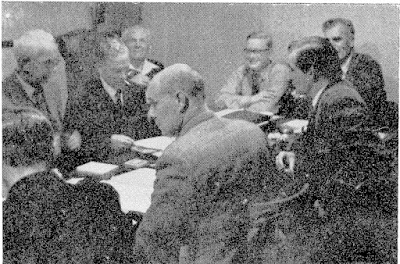
The text accompanying this photograph was 'No leaders: The Executive Committee in session, 1956.' It was part of the article "This is Socialism !'" I believe the younger man with the darker hair in the right of the photograph was Robert Barltrop, and the older, bald man to his left was Harry Young. ('Horatio')


#    #    #    #

Clifford Groves contested the Paddington North constituency for the SPGB at the 1945 General Election. He also stood in the same seat in the 1946 by-election. The July 1945 issue of the Standard carries the Party's election manifesto.


#    #    #    #

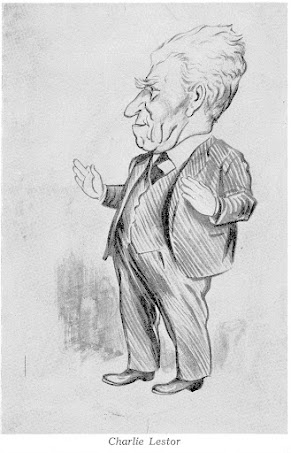
Both the photograph of Jack Fitzgerald and the cartoon caricature of Charlie Lestor were part of the "Some Members" article. I'm guessing that Robert Barltrop drew the image of Lestor.


#    #    #    #

The Metropolitan Theatre was located in Edgware Road, and was used on many occasions in the 1940s and early 1950s when the SPGB were contesting parliamentary seats in Paddington, but also when the Party held mass rallies. By all accounts these mass meetings had upwards of two thousand people in attendance. This photograph accompanied the "Early Election Campaigns" article.


#    #    #    #

No name for speaker on the platform. This photograph illustrated the "On the Platform" article.


#    #    #    #

Sadly, no names are listed but members of Walthamstow Branch in the late 1920s included, amongst others, Mr and Mrs Francis Brooks, Maurice Cole, Thomas Davis, C. Elliott, A. J. Godfrey, A. McDermott, May Otway, L. Otway, Jane Robinson, Frederick Wellavise, J. Wilkinson, S. E. Williams, Byron Young and Percy Young.

Surely May Otway is in this photograph? I know I keep mentioning her but she was one of my favourite Socialist Standard writers in the interwar years.


#    #    #    #


So, here's the conundrum: The June 1974 Socialist Standard states that the Conference photo below dates from 1950 but when it was included in the June 2004 Socialist Standard, the text said the photo was from the 1951 Annual Conference. I demand a recount.

As a point of interest, the September 2004 issue of the Socialist Standard carried a letter from Richard Botterill, identifying two of the delegates from Dartford Branch in the photo. (Spoiler alert: one of them was his dad.)


With regards to the June 2004 Standard already mentioned above, that was also a special anniversary issue  and it also carries a number of photographs relating to the history of the SPGB. I recommend you check it out. It serves as an excellent companion to the June 1974 issue.