Thursday, February 27, 2014

Mixed Media: Hull Ferens Art Gallery (2014)

The Mixed Media column from the February 2014 issue of the Socialist Standard

Hull Ferens Art Gallery

The Ferens Art Gallery in Hull which opened in 1927 is a great example of how impressive a municipal art collection can be outside the metropolis. In fact this gallery has A View on the Grand Canal (1728) by 'Venetia Vedutista' Canaletto, one of many ‘views’ which were once in demand by the aristocracy and haute bourgeoisie as souvenirs of the Grand Tour, and one of the few in an English municipal collection.

Ruby Loftus screwing a Breech-ring (1943)
Impressionist Laura Knight's evocative Dressing the Children (1906) portrays a woman dressing children by firelight in a kitchen with a cat in the centre of the picture. It was painted in the cottage of an ironstone miner and his family in the fishing village of Staithes on the Yorkshire coast where Knight lived in an artists’ colony. Knight records in her autobiography how she saw in the cottage 'greater poverty and misery than it seemed possible for anyone to bear.' The family relied heavily on Knight's income, and eventually she and her husband gave the family five pounds to buy a horse and cart and to set up a fish selling business. Only part of the loan was repaid, the remainder was offered as a gift. In the Second World War Knight was a 'War Artist' and painted the iconic feminist Ruby Loftus screwing a Breech-ring.

The semi-abstract Keith Vaughan's Coastal Defences (Seaford, East Sussex) (c1959-62) is abstract assemblies of two dimensional geometrical shapes although Vaughan always rooted his paintings in observed reality, and was never completely abstract. There is a Henry Moore sculpture Working Model for Seated Woman (1980) which is a figure seated on a solid but low block base for support with her cloth-bound knees forced upwards by the pose.

Niccolò Renieri's baroque St Sebastian tended by the Holy Irene (1625) is in the style of the great Caravaggio with its strong lighting contrasts (chiaroscuro) and a preoccupation with the human body. A Roman warrior, the legend goes, Sebastian served in the private guard of the Emperor Diocletian, who sentenced him to be shot with arrows as punishment for his Christian faith, but as he lay dying and wounded he was found by the Holy Irene and nursed back to health. This painting is a very popular piece of work in the Ferens Art Gallery due to its striking nature and scale, it has been described as 'one of his most successful works, perhaps even his masterpiece.'
Steve Clayton

Wednesday, February 26, 2014

Cooking the Books: C, V and S (2012)

Cooking the Books column from the June 2012 issue of the Socialist Standard

British Gas customers have been receiving a diagram with their bills which answers the question “where does your money go?” It shows that 56 percent goes on “gas bought from wholesale market”, 21 percent to “delivery to your home”, 10 percent to “government obligations and taxes”, 8 percent to operating costs, leaving 5 percent as “our profit”.

What does Marx make of this? To explain how capitalism works he employs three basic concepts, C, V and S. C stands for what he termed constant capital, V, for variable capital, and S, for surplus-value. By constant capital he means that part of total capital that is invested in factories, machinery, materials and energy.  Constant capital merely transfers its value (hence the name, ‘constant’) to the new product, either in one go or gradually through depreciation. Variable capital is that part of total capital that is invested in the purchase of labour-power and produces a greater value than its own (hence the name, ‘variable’).  This comes about because the exercise of labour-power is the source of new value.  The value that variable capital produces over and above its own value is S, surplus value.

From this Marx derived various explanatory concepts. S/V was the rate of surplus value or rate of exploitation. S/(C + V) was the rate of profit.

Some of Marx’s concepts can be translated into the categories of conventional bourgeois economics, except that Marx’s analysis is in terms of values whereas conventional economics is in terms of prices, which in practice are hardly ever the same. With this proviso, S + V corresponds to what conventional economists call “added value”. But there is a complication, even in Marx, regarding C. It can mean either total capital invested or only that part of constant capital that is transferred to a product in one process of production. Any confusion can be avoided by confining the “rate of profit” to the first case and introducing for the second the concept of “profit margin” as S/(C + V + S) even though this is not in Marx explicitly.

In his Guardian column (23 April) Aditya Chakrabortty drew attention to a study by the Centre for Research in Socio-Cultural Change (Cresc) on the “Apple Business Model”. He highlighted the fact it cost only $178.45 to assemble an Apple iPhone in China whereas it was sold in America for $680, “a whacking gross margin of 72%” as he put it.

There was, however, something more interesting in the article itself (which can be found on the Cresc website). Here the authors employ the concept of “labour share of value added” (LSVA), defining “value added” as “Labour costs including social charges (L) + cash surplus (C) (calculated as depreciation and amortisation + interest paid + profit retained & distributed)”.

The authors quote figures to show that “in the long run, US manufacturing LSVA has been declining unsteadily from a 70% level since the early 1980s to reach 55% in 2007; the German decline started later but there is a full 10 point difference between the 75% level of the early 1990s and 65% level of the early 2000s”. In China, on the other hand, “manufacturing LSVA ratios are currently at an extraordinary low level of 27.2% in 2007 and an estimated 26.2% in 2008.”

It’s good of conventional economics to provide us with a tool for calculating the rate of worker exploitation, since LSVA is L/(L + C), the equivalent in Marx of V/(V + S), from which the rate of exploitation S/V can be derived as C/L.

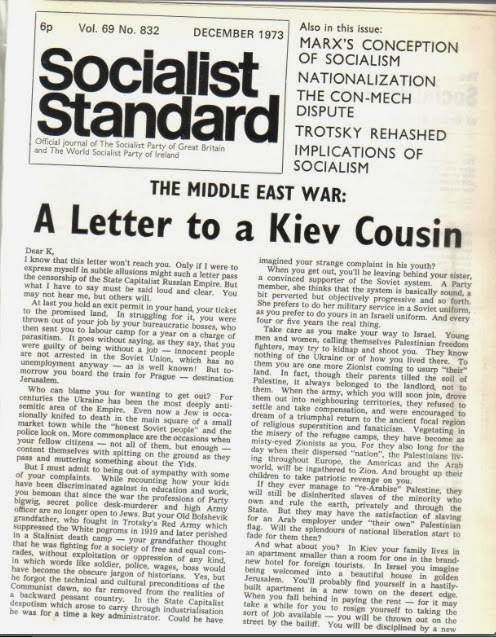
The Middle East War: A Letter to a Kiev Cousin (1973)

From the December 1973 issue of the Socialist Standard

Dear K,

I know that this letter won't reach you. Only if I were to express myself in subtle allusions might such a letter pass the censorship of the State Capitalist Russian Empire. But what I have to say must be said loud and clear. You may not hear me, but others will.

At last you hold an exit permit in your hand, your ticket to the promised land. In struggling for it, you were thrown out of your job by your bureaucratic bosses, who then sent you to labour camp for a year on a charge of parasitism. It goes without saying, as they say, that you were guilty of being without a job — innocent people are not arrested in the Soviet Union, which has no unemployment anyway — as is well known! But tomorrow you board the train for Prague — destination Jerusalem.

Who can blame you for wanting to get out? For centuries the Ukraine has been the most deeply anti-semitic area of the Empire. Even now a Jew is occasionally knifed to death in the main square of a small market town while the "honest Soviet people" and the police look on. More commonplace are the occasions when your fellow citizens — not all of them, but enough — content themselves with spitting on the ground as they pass and muttering something about the Yids.

But I must admit to being out of sympathy with some of your complaints. While recounting how your kids have been discriminated against in education and work, you bemoan that since the war the professions of Party bigwig, secret police desk-murderer and high Army officer are no longer open to Jews. But your Old Bolshevik grandfather, who fought in Trotsky's Red Army which suppressed the White pogroms in 1919 and later perished in a Stalinist death camp — your grandfather thought that he was fighting for a society of free and equal comrades, without exploitation or oppression of any kind, in which words like soldier, police, wages, boss would have become the obscure jargon of historians. Yes, but he forgot the technical and cultural preconditions of the Communist dawn, so far removed from the realities of a backward peasant country. In the State Capitalist despotism which arose to carry through industrialisation he was for a time a key administrator. Could he have imagined your strange complaint in his youth?

When you get out, you'll be leaving behind your sister, a convinced supporter of the Soviet system. A Party member, she thinks that the system is basically sound, a bit perverted but objectively progressive and so forth. She prefers to do her military service in a Soviet uniform, as you prefer to do yours in an Israeli uniform. And every four or five years the real thing.

Take care as you make your way to Israel. Young men and women, calling themselves Palestinian freedom fighters, may try to kidnap and shoot you. They know nothing of the Ukraine or of how you lived there. To them you are one more Zionist coming to usurp "their" land. In fact, though their parents tilled the soil of Palestine, it always belonged to the landlord, not to them. When the army, which you will soon join, drove them out into neighbouring territories, they refused to settle and take compensation, and were encouraged to dream of a triumphal return to the ancient focal region of religious superstition and fanaticism. Vegetating in the misery of the refugee camps, they have become as misty-eyed Zionists as you. For they also long for the day when their dispersed "nation", the Palestinians living throughout Europe, the Americas and the Arab world, will be ingathered to Zion. And brought up their children to take patriotic revenge on you.

If they ever manage to "re-Arabise" Palestine, they will still be disinherited slaves of the minority who own and rule the earth, privately and through the State. But they may have the satisfaction of slaving for an Arab employer under "their own" Palestinian flag. Will the splendours of national liberation start to fade for them then?

And what about you? In Kiev your family lives in an apartment smaller than a room for one in the brand-new hotel for foreign tourists. In Israel you imagine being welcomed into a beautiful house in golden Jerusalem. You'll probably find yourself in a hastily-built apartment in a new town on the desert edge. When you fall behind in paying the rent — for it may take a while for you to resign yourself to taking the sort of job available — you will be thrown out on the street by the bailiff. You will be disciplined by a new boss, preached to by new politicians, led to the slaughter by new generals. Your freedom will consist in the bailiff, boss, politician and general being Jewish. You will no longer be suspected of disloyalty, unless you "act against the Jewish nation" — but you will learn to shun others as alien.

You know that the fourth major Middle East war, the worst yet, is in progress as I write. It began as I set out on a week's coach tour of Italy. The idyllic Isle of Capri used to be an exclusive resort of the capitalist class — a small fortune (tens of thousands) is still required as a condition of residence, but recently they have let in a few package tourists. The group I was in was among the first to be granted this honour.

A few hundred miles across the Mediterranean I knew that relatives of mine on one side, and friends on both sides, were killing one another on the blazing hot sand, strewn with metal wreckage and human carrion. I'm boycotting newspapers until the end of the war, but headlines are written on the news-stands which I can't help seeing. Like "human wave attacks". Think what that means.

In my mind the war means mainly the Sinai front. This is the front I've heard people speak of. Three Cairo students I knew at university are there — if not already dead. With one I never discussed politics. The second was cynical. The third (in private) sympathised with Israel. He had an extensive knowledge of Jewish history, told me that Egyptian soldiers taken prisoner by the Israelis were so impressed by their treatment that they refused to fight them again. My Israeli friends, those still alive, are in that minority which sympathises more or less openly with the Arabs. From them I have heard stories of Israeli torture prisons, of Israelis who have openly boasted how they blew up Iraqi synagogues in order to stampede the oriental Jews into Israel. Then there's the persecution of Copts and dissidents in Egypt, the Nazis working there . . .

Recently a young drifter in Libya, unable to hold down a job, concerned with the plight of the Libyan Jews, wanting to show the Israelis that not all Arabs want to throw them into the sea, hijacked a plane and took it on a personal peace mission to Tel Aviv, where he is now safely in prison — thinking what? Ghaddafi and Golda Meir were for once in agreement in diagnosing him insane. They should know. And the furore in Israel over two elite paratroopers who, sensitive to the position of Arabs inside Israel, spied for Syria! These people reverse the usual illusion, and make of the "enemy" country their ideal homeland. They have resisted the conditioning to which their fellows succumb. As their experience broadens, we can hope they will reach a more Socialist position — a plague on both your houses!

Back on Capri. A fellow traveller — mild-mannered and chivalrous, the perfect English gentleman — comes up: "You're Jewish, aren't you? Is the war going well? I hope your side is winning."

"I don't. Since when do wars go well? Whoever wins, my side loses."

This reply confused him. It took him several seconds to close his mouth. This same man, in a conversation about pollution, commented within earshot of coloured fellow tourists — "On the subject of pollution, what shall we do with our coloured friends who are polluting the country?" Perhaps he was considering gas chambers. But he was very embarrassed when challenged. There's hope for Socialism yet.

Arriving back in England, the driver of the bus taking us from the airport to the terminal treated his passengers to an analysis of world affairs. Passing through a Jewish area he commented: "All these Israelis have gone to fight their war. I hope they win it soon, or we're bound to get dragged into it. And they can stay there, as far as I'm concerned." Perhaps my astonishment was the product of a sheltered life?

There is no need for me to expose the mythical and unscientific nature of nationalist ideologies in the Middle East. The Jewish Zionists debunk the Arab Palestinian "Zionists" with excellent scholarly analysis, and vice versa. Literature available from the Al Fatah office, Zionist bodies and so on.

Until the hold of nationalist and racist poison on the minds of the world's workers is destroyed, it will not be possible to live the full and satisfying life of Socialism. Stand up for yourself as a human being and fight for the only worthwhile end — the achievement of a free humanity. And when you come to Western Europe, why not stay rather than go on to Israel? Corpses in the sand cannot, among other things, work for the Socialist revolution.

Yours,
STEFEN.

Tuesday, February 25, 2014

Rallying For Jobs (1981)

From the August 1981 issue of the Socialist Standard

How many marchers were there? The police said seven thousand. The organisers said between fifteen and twenty thousand. At any rate there were a lot of them and the procession seemed never-ending as it wound down Cardiff's main street away from the centre and out towards a large field on the edge of the city. Sweet fresh-faced little girls from the Welsh valleys played drums, xylophones and kazoos for the march to proceed by. Badges and banners gave colour and spectacle. Rhythmic chants of "Maggie, Maggie, Maggie-Out, Out, Out" broke out frequently as the march progressed. This was the latest in the series of anti-Tory unemployment rallies organised by the Labour Party.

The marchers, as their banners showed, came from many different places—not just Wales but Glasgow, Southampton, Manchester, London—and represented a wide range of occupations, manual and professional. But the one thing they all had in common was an ardent desire, expressed in the flags, placards and choruses, to "kick Maggie out".

All kind of left-wing newspapers could be bought, from the least to the best known and all kins of leaflets were given out. There were times when the majority of people there seemed to have papers to sell or leaflets to distribute.

It was a close, warm day and after the two-hour march to Pontcanna Fields everyone was tired and over-heated. Banners were laid down, sandwich packets were opened up and queues developed at the stalls selling food and drink. No queues developed at the stalls selling left-wing books, badges, posters and more newspapers.

Organisation was efficient. A brass band was on hand to entertain the arriving marchers, followed by a girls' choir. With powerful loudspeakers the whole thing was relayed across the two-acre field from the large platform at the far end. Clearly a lot of trouble and expense had been gone to.

As the girls sang, the important people mounted the platform and took their places. After the choir had finished, the master of ceremonies asked over the loudspeaker if all the "platform party" was present on stage. It seemed that they were, so the speeches began.

First, a trade union official or two talking almost identically about the need to "save jobs" and "get the Tories out". Then a local MP who said a few words in Welsh. Then a message of fraternal greetings from Tony Benn, too ill to attend but whose words brought cheers from some of the crowd, especially those wearing "Benn for Deputy" badges. Finally the first of the big-name politicians—Michael Foot himself. He talked in tired platitudes about "investing in public spending", "silly, wicked Tories", "the first essential attack on the present appalling unemployment total", and "how we can save ourselves and the whole world". He admitted that there was a slump in world trade and that this was partly to blame for unemployment but added that some governments, especially 'socialist' ones (he didn't name any), had been able to protect their people from the effects. He mentioned the "magnificent socialist victory" in France and said that in the coming months Mitterand would be pursuing the same socialist policies as a Labour government itself would put into effect when next elected. His speech bore little resemblance to the report carried the same evening by the local papers up and down the country and by the nationals the following day. The prepared press release on which the reports had been based dealt in detail with the precise reforms a future Labour government would bring in to "combat inflation" and "reflate the economy".

But no matter, for the next big name to speak, Eric Heffer, had a whole detailed programme of "socialist" reforms to offer, He started promisingly: "The reason we've got unemployment is that we've got capitalism and we can only get rid of unemployment when we have socialism". But the promise didn't last. We soon found out that what Heffer meant by socialism wasn't a moneyless, wageless society of common ownership, free access and production for use, but "a 35-hour working week", "earlier retirement", "a wealth tax", "the baks and insurance companies in public ownership", "abolition of the House of Lords", "unilateral nuclear disarmament", and so on  . . . 

The crowd responded warmly to Heffer's old style oratory. They responded less warmly to the next major speaker, the bête noire of the Labour Left, Denis Healey. "Healey out", "Tony Benn", "Traitor", "Join the SDP" were some of the cries. Foot intervened and angrily told the hecklers that they were playing into the hands of the Tories and that they must allow Healey the right of free speech. Some did, some didn't. But by this time many of the crowd were drifting off. It had been a wearying day for everyone, especially for those who had travelled long distances. Even the most ardent anti-Tories were looking jaded. They weren't relishing the walk balk to the city centre and perhaps an evening's travel to follow.

What is there to be said about rallies of this kind? Firstly they undoubtedly show a remarkable degree of solidarity among a cross-section of those who, in order to live, have to sell their energies to an employer (if they can find one) for a wage or salary—the working class. Secondly, however, they show that many workers have short memories for, as I heard one disgruntled participant say after Michael Foot had spoken about fighting unemployment, under the last Labour government with Foot as Employment Minister unemployment doubled to 1½ million. Thirdly, and this is the truly sad thing, a host of people are exhibiting an enormous amount of social concern, but unfortunately it is pointing in the wrong direction. Unemployment, one of the worst evils of capitalism, cannot be eliminated by a change of government.

One lone brave marcher carried a crude home-made placard that said it all. One side read "Kicking Maggie out won't make any difference", and the other "Production for need not for profit". He was not a member of the Socialist Party of Great Britain but his scrawled slogans neatly summed up the essence of the socialist case. He knew, as the vast majority of the demonstrators seemed not to know, that as long as the buying and selling system remains, "Maggie" can only be replaced by another leader committed to administering that system. And that leader, however labelled and whether they like it or not, will be obliged to adopt all the anti-working class measures imposed by the system.

Enthusiasm and good intentions were what the demonstrators had.  Understanding was what they did not have. Hasten the day when as many will make mature socialist demands for a world of free access, common ownership of the world's wealth, and the abolition of the wages system.
Howard Moss


A Question of Class Identity (1999)

Theatre Review from the October 1999 issue of the Socialist Standard

Summerfolk, by Maxim Gorki. National Theatre.

Summerfolk is a compelling, exciting, entertaining, hugely relevant play, that was written in 1904; that is, in the same year that the Socialist Party of Great Britain was formed. Like Philistines and Barbarians, two of Gorki's other plays written at about the same time, it is about the emergence, in significant numbers, of the "professional people"—lawyers, doctors, engineers, administrative civil servants, etc—who were needed to service the emerging capitalist state. Today's chattering classes jet round the world for their extended holidays, but in turn-of-the-century Russia the practice was to rent summer villas in the country. Summerfolk follows the lives of one group of such people and their dependants, over a period of several weeks.

Anyone familiar with the plays of Chekov and Turgenev (see, for example, the review of Turgenev's A Month in the Country, Socialist Standard, April 1999) will recognise the terrain. Indeed Chekov's The Cherry Orchard describes the sale of land which is to be divided into building lots for summer villas. Most of the new breed of professionals and their partners, are the sons and daughters of serfs. Most of them, as once of the characters puts it "knew poverty in our youth", but now it is many of their lives which seem impoverished, listless, and apparently lacking in point and purpose.

Whilst Chekov and Turgenev frequently seem content to describe the behaviour of their characters and to acknowledge their collective ennui, Gorki is concerned to understand the roots of that behaviour and to speculate about its consequences. One critic argues that Chekov has more "symphonic mastery", by which he presumably means that Chekov handles his plots with greater panache and subtlety. But then Chekov seems intent on accounting for human behaviour in terms of individual traits and characteristics which make no reference to people's social experience. For Chekov it seems, the psychological domain is not only prime, it is often, in practice, all that there is.

Gorki takes a contrary view. His characters behave differently, firstly, because they are attached to different views of the world; and secondly, because these opinions are socially constructed. At the heart of the play is a dilemma. Are newly-rich professionals entitled to "a good meal and a drink", content with the justification of "My right to live any way I want"? Or should they, as a matter of loyalty to the class from which they come, strive "to improve and regenerate and illuminate the lives of our own people—people who toil and toil, till the day they die, trapped in dirt and darkness"? This is the question that Gorki would have us face and interestingly, the more enlightened, humanistic perspective is voiced predominantly by the female characters. The gossip, the drinking, the conflicting points of view—the talk of evolution or revolution, despotism or democracy, pessimism or optimism—are all finally tied to this central question.

Whether Gorki has "symphonic mastery" of his material may be a moot point. I can only report that three minutes listening to a reformist politician has often felt infinitely longer than the spell-binding three-and-a-half hours during which the drama unfolds across the vast expanses of the Olivier stage.

I frequently meet people who accept both the legitimacy of the socialist case and its implications for their status as workers. But, like some of the characters in Summerfolk, they argue that given their professional salaries, health benefits, share options and alike, they feel little sense of identity with the more deprived members of the working class in this country, let alone the wider world. For them, and for people like me who would have them think otherwise, Summerfolk is as relevant today as it has ever been. I hope to find an early excuse to see the play again, and to marvel at the skill of the actors and the wonder of its staging. Thoroughly recommended.
Michael Gill

Monday, February 24, 2014

Death of a tendency (2006)

From the September 2006 issue of the Socialist Standard

The recent death of Ted Grant at the age of 93 has been a landmark, albeit a minor one, in British political history.

Grant was the last of the three great gurus of the British Trotskyist movement and the eminence grise of what became known as the Militant Tendency. Along with his two main Trotskyist rivals, Gerry Healy (of the Socialist Labour League/Workers' Revolutionary Party) and Tony Cliff (of International Socialism/the Socialist Workers' Party) he had a considerable input into what became - with the decline of the Communist Party - the most significant political trend to the left of the Labour Party. 

Born Isaac Blank just outside Johannesburg, he changed his name to Grant when he came to Britain during the turbulent mid-1930s with a small band of other South African militants, convinced that it would be more fertile political territory than his country of birth. Attracted to the political ideas of the exiled Russian revolutionary Leon Trotsky, this small group of South African émigrés had already been influential in the founding of South Africa's first Trotskyist organisation, the Workers' International League, and soon made a mark on the fledgling British Trotskyist movement. Of the two small British Trotskyist groupings of the time, the Balham Group and the Revolutionary Socialist League (later to be called the Militant Labour League, selling a newspaper called Militant), Grant and his colleagues were attracted towards the latter. In what became a tradition of the Trotskyist movement not only in Britain but internationally, they soon split from it though to form their own organisation, this time a British version of the Workers' International League they had left behind in South Africa. Among those joining them was the Scottish orator Jock Haston and a voluble Irish militant, Gerry Healy. 

Fourth International 
In 1938 Leon Trotsky and his followers set up an international organisation intended to rival the worldwide Communist ('Third') International. This 'Fourth International' cast around for a British section, but the tiny group around Grant, Haston and Healy was ignored and the franchise went instead to the larger Militant Labour League. For this key event in Trotskyist history then, Grant and his comrades were shunned and Grant himself never got to meet Trotsky before the 'Old Man's' assassination by Soviet agents in Mexico in 1940. 

During the Second World War, Grant's WIL was active on the industrial front and soon began to eclipse its parent organisation in both membership and influence - so much so, that by 1944 the Fourth International persuaded the two organisations to merge, in what was effectively a WIL takeover. The new organisation created was called the Revolutionary Communist Party and was the first (and last) time the British Trotskyist movement was united in the one organisation. 

Grant became editor of the RCP's paper, Socialist Appeal, and Grant and Haston were the organisation's first delegates to the Fourth International. The RCP existed for three years and grew to 500-600 members, being a thorn in the side of the Communist Party before, in true Trotskyist fashion, internal strife led to decline and a split. 

Significantly, in the late 1940s three main factions had begun to emerge which were to be the main tendencies within the Trotskyist movement in Britain in the decades thereafter. Those around the Palestinian émigré Tony Cliff developed a distinctive version of the theory that what existed in the Soviet Union was a form of state capitalism (though only after Stalin's accession to power in 1928) and therefore couldn't be supported by socialists, while the groups around Grant and Healy held on to Trotsky's own belief that what existed in Russia was a workers' state, albeit a degenerated one. Indeed, the Grant and Healy factions had much in common politically, and it was mainly the bitter personal hostility that developed between the two men that kept their groupings separate. 

Secret organisation 
In the early 1950s, Grant and his small number of followers started a magazine called International Socialist. Grant lived in London and worked as a night-time telephone operator, which left him free to pursue his political work as a Trotskyist during the day. At this time he began to build up a close political relationship with a Trotskyist from Birkenhead called Jimmy Deane, who was the driving force behind Rally, a paper popular with the youth section of the Labour Party in the North West of England (and soon edited from Liverpool by a teenage Pat Wall, later one of the Militant supporting Labour MPs). 

By 1955 Grant and his supporters decided that the time was right to found a new organisation. Harking back to the group Grant first joined on his arrival from South Africa, it was called the Revolutionary Socialist League and its first General Secretary was Jimmy Deane. It effectively fused two small Trotskyist bases in London and Liverpool where Grant had an influence, and was a tightly-knit organisation built on the Leninist principles of the vanguard party, being hierarchical and secretive in almost equal measure, operating like other Trotskyist groups before it as a clandestine faction within the Labour Party. 

Coincidentally, two years earlier the Trotskyist Fourth International had split. Healy's faction had the UK franchise but went off with the splitters, leaving a vacancy for a British Section which the leadership of the FI allegedly tried to fill by placing an advertisement in Tribune, which Grant answered. By 1957, the RSL was given the British franchise by the FI but advanced only sporadically, starting a new paper called Socialist Fight but otherwise being eclipsed by other Trotskyist groups, particularly Healy's. At the time the Healy, Cliff and Grant factions were all building up support by working inside the Labour Party as secret parties within a party, focusing especially on the Labour League of Youth, but Grant's faction was so unsuccessful that the FI forced it to merge with an up-and-coming young group of Trotskyists in Nottingham around Ken Coates called the International Group. When this marriage of convenience led to the inevitable divorce within a year or so, the FI took the opportunity to rescind Grant's franchise altogether, giving it instead to the Nottingham faction which by then had turned itself into the International Marxist Group (IMG), a current which went on to develop a strong student base under the leadership of Tariq Ali.

Militant 
The loss of the Fourth International franchise was an understandable blow to Grant, but around the same time his group had begun to take steps which were to prove more fruitful, the most significant of which was the creation of a new publication to be called Militant - for Labour and Youth. It's editor was a young Liverpudlian with strong organisatiuonal abilities called Peter Taaffe, who became Grant's lieutenant-in-chief, while Grant himself was political editor. The striking design of the paper was created by Roger Protz, later of the Campaign For Real Ale, but who was a notable activist at various times in each of the three main Trotskyist factions in British politics (later, in Cliff's International Socialists, he became editor of Socialist Worker). It was to be growing sales of Militant, combined with systematic, organised activity in the Labour Party, which was eventually to bear fruit for Grant's faction. 

By 1966 they were the only one of the three main Trotskyist factions still inside the Labour Party. Healy's group had, by the early 1960s, almost completely taken over the (now renamed) Labour Party Young Socialists and after several attempts they were eventually expelled, with Grant personally refusing at one stage to vote to keep Healy-ites in the Party. Cliff's faction disengaged from Labour in the mid-1960s, seeing propaganda opportunities in disassociating itself from Wilson's Labour government, leaving the field free for Grant. By 1970 Grant's RSL had a majority on the Labour Party Young Socialists Executive and from 1972 onwards always had one of its members on the Labour NEC as the LPYS representative. 

Throughout the 1970s, the influence of what by this time was becoming known as the 'Militant Tendency' grew apace, both in the Labour Party and trade unions. Grant's organisation moved from being the least well-known of the major Trotskyists sects to becoming the most well-known, with something of a 'workerist' face, placing less emphasis on building up student support than most Trotskyist groups and more on recruiting the skilled and semi-skilled working class, especially local government workers. 

By the 1980s Militant's growth and influence was such that it could claim scores of Labour councillors across Britain as 'supporters' (when in reality they were RSL members who couldn't publicly admit to being a 'party within a party'). In addition, they could claim several Labour Parliamentary candidates - three of whom (Dave Nellist, Terry Fields and Pat Wall) eventually became MPs, and - most controversially of all - they took effective control of Liverpool City Council, with Derek Hatton as the council's Deputy Leader and Tony Mulhearn (a long-time RSL member more trusted by Grant) as his aide de camp. 

The mid-1980s, when the Tendency claimed over 8,000 'supporters', was the peak of Militant's influence on British politics and the nearest Grant came to fulfilling his dream of creating a mass Trotskyist base within the Labour Party. But its size, influence and the notoriety attached to it by the mainstream press led to the first systematic attempt to deal with Trotskyist infiltration in the Labour Party since the expulsion of the Healy-ites. Earlier, in 1975, Lord Underhill had written a report on Militant's activities in the Labour Party for a left-wing dominated Labour NEC that chose at the time to do nothing about it. But in the 1980s the Labour leadership acted, first under Michael Foot and then under Neil Kinnock, with his famous attack on the Militants on Liverpool City Council at the 1985 Labour Party conference, after they had deployed the tactic of refusing to set a rate, issuing 30,000 council workers with redundancy notices. 

Labour initially started by picking on the most obvious candidates for expulsion, the five members of Militant's Editorial Board, including Grant and Taaffe, who were expelled in 1983. After this, large and increasing numbers of their comrades were systematically put outside the Party they claimed was 'the mass party of the working class'. 

Political positions 
Throughout the lifetime of the RSL, 'entryism' into the Labour Party was one of its defining characteristics as a Trotskyist current. Others used entryism as a tactic, including Cliff and Healy, but for Grant's group it appeared to amount to more than this - it was a defining political position. Sometimes called 'deep entryism' it was not simply about a Trotskyist organisation going into the Labour Party, building up support and effectively raiding it for new members before emerging into the outside world stronger and fitter. For Grant, as Militant's main theoretician, the task of his tendency was to 'win the Labour Party to socialism' on the grounds that a united Labour and trade union movement under a Trotskyist leadership was unstoppable. 

The means for achieving this goal was deep entryism plus a particular variety of Trotsky's 'transitional demands' programme, a strategy developed from Lenin's premise that the working class in capitalism was not capable through its own efforts of developing a socialist consciousness. This transitional programme was a carefully calculated list of demands - such as massive public works programmes, the nationalisation of the top 200 monopolies, and an implausibly generous minimum wage - which would be superficially attractive to supporters of reforms in the wider Labour and trade union movement, and which Militant thought contained the seeds of a future socialist society. The intention was a dishonest one, for Grant and Militant's other leaders knew that these demands were not generally capable of realisation within the normal politics of capitalism - indeed, that was the very point of advocating them. The resultant anger they expected within the working class when these demands were unmet would lead, they hoped, to a lurch towards the left under the leadership of the Trotskyist vanguard itself - the RSL. 

The desire to stay in the Labour Party at all costs coupled with distinctive transitional demands that could lead to a Trotskyist leadership introducing 'socialism' (really state-run capitalism based on nationalisation) via an Enabling Act in parliament - and supported by workers' councils in the industrial field - was what really defined Militant in relation to the other Trotskyist sects. Also, and uniquely, the RSL quickly identified the arena of local government as a means for criticising traditional, piecemeal reformist politics (saying they would always oppose rent and rates increases), raising its programme of more radical transitional demands instead as the 'bridge to socialism': 
"To lift the horizon of the local parish pump politicians on to the broader national and international field - this is the first task of the revolutionary Councillor . . . It is necessary within the Labour Groups and in open council to point out the limitations of particular struggles and reforms and show how (in theory and practice) reformism (nationally and locally) cannot resolve the contradictions of capitalism." (RSL 'Notes on Council Work', by Ellis Hillman, 1961.) 
These socialist-sounding phrases, in reality masking the advocacy of what were, in effect, just more radical reforms of capitalism, was typical of their entryist tactic, as later exemplified in Liverpool. Combined with their relentless workerism and disdain for non-economic issues, this constituted their 'Unique Selling Point' within the Trotskyist milieu (unlike others, Militant had relatively little interest in sexual or student politics, or supporting Third World nationalist movements). 

These were the key perspectives handed down by Grant himself, consistently over decades. Indeed, it was often said by his supporters and opponents alike that Grant was saying the same things in the 1980s as he had been saying in the 1940s, and his book, "The Unbroken Thread: the Development of Trotskyism Over 40 Years", is testament to this. This would have to include his oft-repeated claim (following Trotsky, and like his rival Gerry Healy of the WRP) that capitalist collapse leading to a Trotskyist leadership of a revolutionary working class was imminent in 'the coming period' of the next 10-15 years, somewhat in the perpetual manner of 'tomorrow never comes'. 

Post-Militant 
In the eventually, capitalism outlived Grant himself. Indeed, Grant's end appears to have been a rather sad one, in an old people's home, years after having been kicked out of the Labour party and then, rather more remarkably, the RSL itself. The campaign of the Labour leadership in the 1980s against Militant had been so successful that by 1992 the majority of the RSL, led by Taaffe, came to the conclusion that continuing with entryism was pointless and stood 'Militant Labour' candidates against the official Labour Party, with mixed success. A group around Grant and one of his protégés, Alan Woods, refused to accept this reversal of what the Tendency had always stood for, and were expelled. 

Just as Grant had borrowed from early Trotskyist groups when founding the Revolutionary Socialist League and its paper, Militant, so this expelled rump from the RSL started a new paper called Socialist Appeal, the name of the journal Grant edited while one of the leaders of the RCP just after the war. Never more than a couple of hundred at most, this group made little impact, while after a period of serious decline the slightly larger Militant Labour eventually voted in 1997 to dishonestly turn itself into the 'Socialist Party' (of England and Wales - SPEW to its enemies), effectively trying to usurp the name of the SPGB. This grouping has since declined further, though its leading elements in Scotland, such as Tommy Sheridan, were instrumental in forming the rather more successful but equally reformist Scottish Socialist Party. 

The modern legacy of Ted Grant is an interesting one, for in many respects he was the most successful of the three main British Trotskyist leaders, while still falling well short of his ultimate goal. From a socialist perspective, the Militant Tendency (like the other Trotskyist groups) did much to muddy the waters of revolutionary politics in the UK, posing as socialist while supporting the usual Trotskyist stew of radical reformist demands with the long-term aim of state-run capitalism organised by a Leninist vanguard party, another classic 'dictatorship over the proletariat', with Grant as leader-in-waiting. 

Grant knew full well of the real socialist alternative promoted by the Socialist Party of Great Britain and our companion parties overseas (he debated Socialist Party speaker Tony Turner in 1945 and was wont to deride us as 'ultra left' sectarians) but he rejected real socialism for the type of politics that cast him in the role of leader, manipulating the mass of the proletariat towards a 'revolutionary situation'. But, as history proved, the working class were not so easily manipulated by Grant's particular mix of Trotskyist tactics, and his lifetime was effectively wasted on an ultimately dishonest political cause. 

This was a shame, because like Tony Cliff, Grant had much energy and some talent as a writer and speaker. He was an obsessive analyst of - and collector of information about - the capitalist economy, though arguably (because of his unsupported belief in capitalist collapse) his best works were not in this field. His political tract Against the Theory of State Capitalism in 1949, for instance, was a relentlessly logical attack on the irrationality of the Cliff (SWP) position from an orthodox Trotskyist perspective, implying that the only coherent state capitalist theory applied to the Soviet bloc, etc came from those, like the Socialist Party, who rejected Leninist and Trotskyist politics altogether. And in more recent times, he collaborated with Alan Woods to write an excellent book called," Reason and Revolt: Marxist Philosophy and Modern Science", a history of science and scientific methods from a general Marxist standpoint. Grant will be remembered, above all else though, for founding a political tendency which hit the headlines and gained public notoriety but which otherwise did the socialist movement huge amounts of damage. His political heirs in Socialist Appeal and SPEW fittingly continue to peddle the same kind of elitist and outdated reformist nonsense now as Grant did when he first became a Trotskyist in the 1930s. Indeed, for years Grant was derided by many for sounding rather like an old, broken record - and today, his surviving political heirs most certainly stand out as badly scratched vinyl in what is a transparently digital age.
Dave Perrin

The great divide (1987)

From the April 1987 issue of the Socialist Standard

The "North-South divide" has become part of political rhetoric. The government recently issued figures which showed that of the jobs lost in recent years, 94 per cent were in the north of the country and only 6 per cent in the south, thereby seeming to provide still more evidence of a division between North and South. In fact the "north" now includes almost anywhere outside the south-east of England as the Midlands have also suffered massive job losses. Predictably, the opposition parties have blamed this on the government's mismanagement of the economy. Roy Hattersley, Labour's deputy leader and shadow chancellor, said the government had "scandalously neglected those areas of the economy with which it does not feel any emotional sympathy and deep political interest" (Independent, January 21). He accused them of favouring city and financial interests in the south-east at the expense of manufacturing industry, which is synonymous with the interests of the regions. Edward Heath, the former Tory Prime Minister and leading "wet", said that the North-South divide was moving further south and that the government should pursue a policy of investment for the regions. What was required, he claimed, was a "constructive, co-ordinated development policy for the country as a whole".

The Liberal-SDP Alliance is always keen to talk about divisions in society. At the recent launch of their joint election programme, which was designed to paper over the damaging splits between the two parties, they talked of the need to unite the country through co-operation and partnership. Partnership in government, they argued, is the only way to heal the divisions between North and South. They also urged co-operation between workers and employers. that class division should be forgotten in the interests of a united nation. This is rather like urging someone being mugged to co-operate with the mugger.

Chancellor Nigel Lawson and other Tory ministers denied the existence of any North-South divide. Lawson claimed that the worst of the recession is over, that the economy is growing fast and that over one million new jobs have been created since 1983. But these new jobs have not been spread evenly across the country. On the government's own figures, since 1983 there were 446,000 new jobs in the South-East, but only 135,000 new jobs in Scotland, the North-West, the North-East and Yorkshire and Humberside added together. There has been a five per cent increase in jobs in the financial services to 2.25 million, but manufacturing output is still four cent below its 1979 level. Thatcher has claimed that it is wrong to talk of a North-South divide as parts of the South are doing badly. She has got a point, although it does seem strange that she would want to remind people of the severe deprivation and decay that exists in parts of the South-East, especially areas of inner London.

Manufacturing industry has suffered badly in the current world depression. Many coalmines, steelmills, shipyards and factories have been closed and many others have had severe job losses. Some towns and cities have rates of unemployment in excess of 20 per cent, with some pockets in these areas having much higher levels. This is not a deliberate government policy however - governments can do little to affect the way the economy operates. All wealth under capitalism is produced for sale on the market in the expectation that it will make a profit for the owners. If a product cannot be sold at a profit then production is cut back and workers thrown on the dole. Many industries in the north of the country have been faced with this situation and have acted accordingly. Most of the political criticism seems to want a "fairer" spread of employment prospects across the whole country. Even if this were possible, the implication of this kind of argument is to spread poverty across a wider geographical area. Which ever way capitalism inflicts its suffering on the working class is unacceptable. To argue about its location but ignore its real cause serves only to perpetuate it.

Talk about a North-South divide, or indeed whether workers are employed or unemployed, only covers over the real division in society -  the class division. If you have to work in order to live, if you are a member of the working class, then you are likely to experience a life of shortage, insecurity and relative poverty. Whether you live in London or Liverpool or whether you earn 300 a week or are on the dole will not change this. Clearly existing on a giro means more intense poverty than existing on a wage packet but compared to the life of ease and luxury lived by the capitalist class, these differences are meaningless. As long as workers allow capitalism to continue there will be arguments about who is doing best (or least badly). We will be told that northerners are being hard done by compared to southerners, despite the fact that both endure various levels of poverty. In fact workers themselves will contribute to these artificial divisions - not so long ago there were reports of trouble at a football match when supporters of a London club waved bunches of 10 notes at Liverpool fans and sang songs about them being on the dole.

There always seem to be a plentiful supply of Scottish nationalists who claim that the "English" parliament doesn't care about the Scots, who should get their own parliament and run their own affairs. The Brixton and Tottenham riots happened almost within spitting distance of the House of Commons; clearly, having the "mother of parliaments" on your doorstep is no sure way to peace and prosperity. Not so long ago we were told how lucky we are to live in a developed country like Britain, because if we lived in parts of Africa we'd be starving to death. They were still talking about the North-South divide, but now in global terms. It is cold comfort to people on the dole to be told that they are lucky that they don't live in Ethiopia. The absolute poverty is not the same, but its cause and solution certainly are.

The possibility of finding differences in working class existence are endless. The urgent need is to put an end to the system that creates these artificial divisions. Capitalism is by its nature divisive and competitive, whether it divides people on the grounds of race, sex, nationality or geographical location. Workers have got to transcend these artificial differences and recognise our common interest - that of a degraded, exploited class. Once we recognise our basic class interests then no force on earth can prevent us from acting accordingly, and putting an end to all social division once and for all.
Ian Ratcliffe


Orange myths (1985)

From the August 1985 issue of the Socialist Standard

It is Sunday 7 July. In Portadown this morning a riot took place and working people, including policemen, were hurt; some were arrested. Another battle  . . . another myth . . . another contribution to the bitterness and hatred that divide the working class in Northern Ireland.

The government and police and wanted to ban this morning's march through the exclusively Catholic Obins Street district. The marchers, Orangemen going to church accompanied by bands playing sectarian tunes and flaunting sectarian symbols, refused to obey the Government, the police and the law despite their vociferous protestations of loyalty to all three. The police - probably working on the assumption that they could cope more easily with the Catholics than they could with the loyalists - gave in and the march took place. The holy men of the Orange Order marched defiantly through Obins Street to communicate with their god.

The Orange Order intend repeating this exercise on the twelfth and thirteenth of July. The police have issued a notice proscribing these marches and - to compound this lunacy - the Catholics have announced their intention of staging parades at the same time and on the same date.

Paisley and several other loyalist politicians and hate-mongering clergymen have let it be known that they will defy any Government order banning the march. In their eyes the issue is sufficiently serious to justify a civil war. Serious enough to endanger the lives, homes and liberties of working people, for, make no mistake, it is workers who would be asked to slaughter one another. Not because they suffer poverty or live in slums; not because they endure the miseries of unemployment or have mean lives. No. Paisley, who has used bigotry and hatred to become one of the best paid politicians in Europe, and his friends don't experience these things. What they are asking Protestant workers to spill their blood for is something really wholesome and important: the right to march through avenues of Catholics reminding them that their forbears were defeated in 1690!

We would ask our Protestant fellow workers to examine some of the historical facts that make up the myths and damned lies for which their leaders want them to kill and be killed. We have, many times, in the past, exposed the myths that make up the "principles" behind the IRA murder campaign and the fallacious reasoning used to inveigle Catholics into support of Irish Nationalism, so it cannot be said that in exposing the lies and deceptions underlying Unionism we have any sympathy whatsoever with nationalism or republicanism. Our purpose is to disabuse workers on both sides of the notions and fictions that keep them divided; to show that neither Unionism nor nationalism have anything to offer the working class and, to bring them to an examination of the cause of their real, common problems.

King James and King Billy
James II succeeded to the throne of England following the death of his brother, Charles II, in 1685. A convert to Catholicism and a sickly pious man - following a life of profligacy and sexual abandonment - he was determined to re-establish the power of Catholicism in his kingdom. Within three years of becoming king, James' policies had provoked fierce opposition in England and fear and distrust among the Protestant population of Ireland. In 1688 seven members of the English parliament petitioned James' son-in-law, William, Prince of Orange, to become king of England. James reacted by allying himself with the French king, Louis XIV, who manipulated the situation to his own advantage by making England a semi-dependent of his own kingdom.

According to Orange fiction, James was the agent of Rome and popery. Nothing could be further from the truth. In seeking the help and support of Louis XIV, King James was allying himself with the pope's bitterest enemy. Louis, bent on European domination, had made Lorraine a subject state, had attacked Genoa and attempted to sack Rome. The pope of the period, Innocent XI, was outraged and humiliated. In 1686 some of the European powers, alarmed at the strength and ferocity of the French, entered into the Treaty of Augsberg. This Treaty, established specifically to resist the marauding armies of Louis XIV, was subscribed to by the king of Spain, the Emperor of Germany and by William, Prince of Orange. The nominal head of the Treaty powers was Pope Innocent XI. 

So, rather than being an enemy of the pope, as Orange mythology asserts, "King Billy" was the pope's ally when, in November 1688, he invaded England and his armies were partially provisioned and equipped by the powers of the Augsberg Treaty - and he had the official backing of the Roman Catholic church! Contrary to myth, when they fought in the Battle of the Boyne on 30 June and 1 July 1690, King Billy was an ally of the pope and King James an ally of the pope's most bitter enemy, Louis of France. Indeed, when news of King William's victory over King James at the Boyne percolated through to Rome the pope ordered the singing of a special Te Deum in St. Peter's and similar celebrations and rejoicings were held in Catholic churches in Madrid, Brussels and Vienna.

James was a Catholic, of course, and William a Protestant but, as always, the politics and economics underlying their conflict rose above religion.

Religious liberty
What about the notion that King Billy established religious liberty in Ireland and saved the Protestants from persecution? Again, Orange fable stands historical fact on its head.

It was James, as the legitimate incumbent of the English throne, who signed the Acts of the Dublin Parliament, giving freedom of religion to all citizens. King Billy, too, when he agreed the Treaty of Limerick in October 1691, accepted that the various religious denominations should continue to enjoy the freedom of religious worship established in the reign of Charles II and under the Acts of the Dublin Parliament agreed by James. Later he established the Episcopalian Church and effectively outlawed not only Catholicism but Presbyterianism -  the religion of the great majority of Protestants in Ireland.

A Presbyterian clergyman in 1691 was liable on conviction of delivering a sermon or celebrating the Lord's Supper to a term of imprisonment and fine of £100 and they were similarly punished for performing marriage rites. There are many recorded convictions for these "offences" during the period, especially in the counties of Antrim and Down. In 1694 the Williamite government passed a Test Act which effectively precluded Presbyterians from offices under the Crown and a further Act of 1713 set a punishment of imprisonment for Presbyterians convicted of schoolteaching and banned the marriage of Presbyterians and members of the Established church.

The History of Irish Presbyterianism gives the political and economic reasons for the persecution thus:
Presbyterians, having no political power, had to submit to political persecutions. The feudal system which transferred ownership of the soil from the toiler to the landlord was one of many evils introduced by the power of England.
King Billy was the chief agent of that feudal power which persecuted, viciously and equally, both Catholic and Presbyterian in Ireland.

Driven out of Ireland
Such was the "civil and religious liberty" enjoyed by the then, as now, numerically strongest Protestant denomination in Ireland that, in the first half of the eighteenth century, almost a quarter of a million Ulster Presbyterians were driven out of the country. These went mainly to America, where many played a distinguished role in the war of the American colonists to gain political and economic independence from England.

On both sides of today's sectarian divide it is ordinary working people, usually the very poorest, who are the victims of both the republican and loyalist myths. The hate mongers and fable peddlers don't live in the slums and are rarely victims of the violence they so actively promote.

When Presbyterians march to celebrate the Battle of the Boyne on "The Twelfth" and the victory of King Billy over his equally degenerate father-in-law, King James, they are commemorating a victory which was as opposed to the interests of their forbears in 1690 as it is to their own class interests in 1985.
Richard Montague
Belfast Branch WSP


A Great Exaggeration (1972)

Book Review from the October 1972 issue of the Socialist Standard

The Bolsheviks and Workers' Control by Maurice Brinton. Solidarity. 25p.

Built-in to capitalism is a conflict between the capitalists who own the means of production and the wage-earning or working class who operate them. This conflict goes on without its participants being necessarily or fully aware of its nature and its most obvious signs are strikes over wages and working conditions. However, this is not just a wages struggle; it is a struggle between the two classes for control over the means of production. In its highest form the workers consciously organise to win political power with the aim of transferring the ownership of the means of production from the capitalist class to the community as a while.

This stage has yet to be reached, but incidents in working class history already show that the class struggle is more than mere wage bargaining. When, under exceptional circumstances such as occur after wars, the capitalists' control over their factories has broken down the workers have themselves on a number of occasions taken over the means of production and through trade unions or factory committees tried to keep production going. Such "workers' control" was not Socialism nor could it have led to Socialism because most of the workers involved had never been convinced socialists. The State has always been able to re-assert capitalist control.

The classic example of this was the occupation of the factories in Northern Italy in 1921, but before that in Russia in 1917 something similar had happened. Engineering workers in Petrograd in particular took over control of the factories where they worked. Brinton's book is an account of how between 1917 and 1921 the Bolshevik government suppressed this "workers' control" and instituted instead their own state (capitalist) control.

This process of suppression began soon after the Bolsheviks had seized power in November 1917 which clearly showed up right from the start (rather than from the death of Lenin) their anti-working class character. These facts have long been known to Socialists but will probably be new to Trotskyists and their ilk.

The book suffers from a number of defects, not least that when he conies to theorise Brinton shares the illusions of the anarchists, syndicalists and dissident Bolsheviks he quotes. He does not bring forward any evidence to show that "workers' control" enjoyed the general support of the workers he seems to suggest it did. He ignores the problems the partisans of "workers' control" would have faced had they triumphed, in view of the economic backwardness of Russia as a whole where four-fifths of the population were peasants who had never been near a factory.

To see, as Brinton does, the Russian Revolution as essentially an unsuccessful attempt to establish "workers' control" is a great exaggeration. The occupation of the factories was only incidental to the seizure of political power by the Bolsheviks and their use of it to sweep away out-dated obstacles to the development of capitalism in Russia — and was only made possible by the same breakdown of law and order which allowed the Bolsheviks to seize power.

The attempt to maintain "workers' control" was doomed to fail not only because of Russia's economic backwardness but also because of the lack of understanding of the Russian workers. Oddly enough at one point Brinton comes very near to expressing our view — and almost in our own words — of events in Russia in 1917:
"The year 1917 certainly saw a tremendous social upheaval. But it was a utopian dream to assume that socialism could be achieved without a large proportion of the population both understanding and wanting it. The building of socialism . . . can only be the self conscious and collective act of the immense majority."
We do not mind people making the analysis we pioneered but we would prefer this to be openly acknowledged rather than disguised by the kind of inaccurate account of our position given by Brinton in his introduction.
Adam Buick

Sunday, February 23, 2014

Class against class (2011)

From the June 2011 issue of the Socialist Standard

It’s exploitation that causes workers’ problems.
               
On an ultra-simplistic level we could say that capitalism in the persona of capitalists uses capital (in its basic form, money) to make a profit. By utilising capital in the form of property, equipment, machinery, investment or speculation the capitalist needs to employ members of the working class in order to increase the original capital for the benefit of the capitalist. This can only be done if the workers agree knowingly or unknowingly to their own exploitation.

Why exploitation? In the monetary world society we live in everyone has a need for money on a regular ongoing basis in order to secure the essentials of life. By accepting employment workers undertake to work (knowingly or unknowingly) part of the time for their own remuneration and part of the time in order to meet the capitalist’s need for reinvestment in their business and to augment their accumulation of profit.

There are three elements to the capitalist’s expectation in relation to employees. First, workers must be paid sufficient remuneration to keep them returning to work; the terms and conditions of work may change depending on the available source of labour. Second, the capitalist’s own ongoing costs must be met – replacement machinery, upkeep, purchase of materials etc. And third, there must be a sufficient element of profit for the capitalist as his incentive to continue. As a business gets bigger, employing a larger workforce, the accumulated ‘extra’ time (over and above the length of time required to earn the wages) from this extra workforce gets added to the capitalist’s pot, increasing their profit, not the workers’ pay packets. When demanding a fair day’s work for a fair day’s pay who stops to ask about the capitalist’s own fair day’s work? Capitalism labour to make profit, to make big money for a few at the expense and from the labour of the majority, i.e. exploitation.

When the recognition hits home that money is the recurring impediment, the fundamental issue in the daily life of the worker awareness grows of all the many problems it causes. Whatever issue is under consideration – be it getting to and from work, getting married, having children, repair and maintenance of personal property, heating the home sufficiently, having a holiday or a reasonably comfortable retirement – the primary issue is a financial one. Money is the issue.

A season ticket for premier league football is beyond the means of most of us, as is a ticket for the opera, a family trip on an open-top London bus, or even higher education for a growing child (add your own would-be-nice list). For the worker it’s a constant prioritising of seemingly never-ending constraints in the form of utility bills, car payments and servicing, rent or mortgage – all eating away at the possibility of a financially stress-free enjoyable family day out, let alone a financially stress-free month until the next pay day rolls around.

None of the simple pleasures mentioned above are beyond the capitalists’ reach however. They, the tiny minority, can have it all. But, actually, who is dispensable, who indispensable? In a monetary society the worker needs the capitalist and likewise the capitalist needs (some) workers. Notice just how unbalanced this equation is: there are always more looking for work than can find it, whilst those seeking workers have an almost inexhaustible supply. However, in a world of voluntary work and free access (a post-money society) the worker will have no need for the capitalist who will then need to join the rest of us and become a contributor too to fit into the new, inclusive and cooperative society.

Whether from an individual or community standpoint economic problems greatly impinge on social life. Individuals are severely limited within the system as to the impact they can have on their overall situation. Similarly, communities are limited by their local budgets as to the overall impact they can have on the general quality and quantity of facilities available for their residents. Any so-called political ‘solutions’ that are offered or imposed to ease social problems are almost invariably economically based (because what can be done without money?) and limited in scope (because of economic limitations) thus not offering genuine, complete, satisfactory solutions at all.

It’s a vicious circle of individual or community issues requiring solutions which invariably need economic input. The entanglement of social/political issues with economic concerns keeps us bogged down in an illusory, ostensible, false position, one we are led to believe has no alternative– an apparent but deceptive case. Inequality of access, whether to goods or services, is largely an economic factor alienating sectors of society one from another.

The main factor – exploitation – being the element that needs to be eliminated if we are to win the class war, let’s ask ‘who needs money most?’ The working class can win this fight when they recognise the antagonism between the capitalists’ need and their own needs. Money is not what we need – it’s the things it buys us we need. Capitalists do need it – it’s the basis of their accumulation. We win the class war when we plan together for a society of voluntary work and common ownership that will overcome the constraints of capitalism and rid ourselves of the divisive class system. It’s not a moral issue but a simple material fact: the principles of capitalism and socialism being opposite and antagonistic.
Janet Surman

World View: China – fighting back (2002)

From the October 2002 issue of the Socialist Standard

The leaders in China no longer even pretend to make Marxist noises – they are too busy trying to oversee the country's fuller integration into the world capitalist system. Despite the rate of growth in the Chinese economy, this is no easy task, and moreover China's workers need to be kept in their place as well, since capitalism inevitably produces resistance on the part of the exploited.

It is easy to underestimate the extent of China's involvement already in global manufacturing: the country now produces half the world's toys and two-thirds of its shoes, for instance. In December 2001 China became a member of the World Trade Organisation (WTO), part of the system set up by the major capitalist countries to try and ensure that the world economy operates without slumps and on the basis of “free” trade. Chinese imports and exports should increase, but under WTO rules, government subsidies to many industries will have to be phased out and various tariff barriers reduced. The Chinese government accepts that the 10th Five Year Plan (2001-5) will involve much economic disruption, including at least three million workers – and possibly far more – being laid off from state-owned companies. The benefits of all this will accrue to the 0.6 percent of the population who own private businesses and the 2.6 percent who are top government officials, not to the ordinary workers.

A number of recent reports have emphasized the resentment felt by many Chinese workers at the way they are treated and the way their bosses line their own pockets. In the north-eastern city of Daqing, once presented as a model for industrial development, workers at a petroleum company have been staging a sit-in to protest against a buy-out package. Oil production has been reduced, as more oil is imported and the main oil company gets listed on the Hong Kong and New York stock exchanges. Elsewhere in Daqing, a construction company simply told its employees not to come to work, as there was no money to pay them. The were not sacked, so had no chance of receiving state benefits. To make ends meet, some were forced to sell vegetables in street markets. They have staged demonstrations, but have not linked up with the oil workers, as they know little of what is happening elsewhere in the city. The government-controlled press, and the lack of any real workers' organisations, make cooperation among different groups of workers very difficult.

Elsewhere, disputes at work are reaching staggering levels, as can be seen from a few examples. In the large city of Shanghai, the number of disputes has increased by 40 percent a year. In February 2000, over 20,000 miners in Liaoning province attacked government buildings and fought with police for three days, as a response to the mine where they worked going bankrupt and their being offered an unacceptable redundancy package. In January 2001, hundreds of workers from a chemical company in Jilin province that was being shut down blockaded a major road for three days in freezing temperatures. But again, these actions tend to be taken in isolation from each other.

In the “Special Economic Zones”, especially in the south of China, overseas companies have been lured in by the promise of tax breaks and cheap labour. The result has been the creation of sweatshops for the likes of Nike, where working conditions are as bad as anywhere in the Philippines or Indonesia. Such places are death traps, with minimal fire precautions and emergency exits often being locked shut. This is the kind of freedom that the advocates of free trade are really talking about. But operating in China can present unexpected problems for overseas companies: for instance, the Italian sportswear manufacturer, Diadora, set up a factory in central China, only to find it often producing more than they had ordered and selling the surplus to local shops at lower prices.

In addition to cheap labour power, the earth's capitalists are attracted by the prospect of China as a market – who can ignore the chance to get at a billion potential new customers? Big US-style shopping malls now exist in most cities, and international brands are well-known. At an elite level, China is the world's largest importer of French brandy. The market for personal computers is growing rapidly, and one prediction is that by the end of 2002 China will be the second largest market (after the US). Apple, who currently have just 0.2 percent of this market, are frantically trying to improve their market share.

Socialists have long pointed out that the Maoist victory of 1949 was not socialist, that ordinary folk were not in charge of the so-called People's China. Surely nowadays nobody can deny that China is just another capitalist country.
Paul Bennett

Saturday, February 22, 2014

When Adam Delved and Eve Span (2004)

Book Review from the December 2004 issue of the Socialist Standard

When Adam Delved and Eve Span: A History of the Peasants’ Revolt of 1381. by Mark O’Brien, New Clarion Press, Cheltenham, 2004.

The publishers say that “the aim of this book is a modest one”, and there are in fact only 86 pages of text. Nevertheless, O’Brien describes the revolt, and its background and origins, in reasonable detail. Of the author, the publishers state that he is a “lifelong socialist and trade unionist”, and then give the game away by adding that “he has stood twice as a Socialist Alliance candidate in Liverpool”. And it does show in parts of his narrative.
   
By the end of the fourteenth century, feudalism was breaking down. The plague earlier in the century had decimated the population, with between a third and a half dying. Many former peasants moved into the towns. Artisans and others demanded, and often achieved, higher wages. The government attempted to keep wages down by law, but with little success. The Church was in crisis, and was corrupt. Jon Wycliffe and, to a greater extent, priests such as John Ball, preached a kind of primitive Christian communism: hence, when “Adam delved and Eve span, who was then a gentleman?” And, moreover, the Hundred Years’ War with France was crippling the English state. The government attempted to increase the poll tax by three groats. As O’Brien comments, “England was seething with unrest.”
   
By 1381, a peasants’ revolt was inevitable. All over Essex and Kent and, later, beyond the peasants and their supporters organised their army, first  taking Rochester Castle. John Ball had, for some time, been sending letters as well as travelling from town to town, preaching rebellion couched in allegorical and religious sentiments. Wat Tyler, until then unknown, organised an army of probably 30,000 peasants who, on 12 June, arrived on Blackheath, south of the Thames.
   
O’Brien details the taking of London, the capture of the Tower and the attempts of the government, and the king, to placate the peasants. A number of aristocrats and government officials were captured and then beheaded by the rebel army. The showdown between Tyler and the king and his representatives occurred on 14 June, at Mile End, when Tyler was stabbed and, shortly after, taken from St. Bartholemew’s Hospital and beheaded.
   
Meanwhile, as O’Brien writes, the revolt had been spreading throughout Kent, Essex and East Anglia. But by this time, the government had been able to cobble together a few hundred disciplined troops. There were battles in Cambridge. Rebels gathered in Billericay in Essex, but were soon forced to retreat to Colchester. As O’Brien notes, by 15 June, “the revolt was in full flow”. In Norfolk, events were proceeding apace. Incidentally, on the same day that Geoffry Lister mustered rebels on Mousehold Heath near Norwich, on 17 June, my ancestor Thomas de Newell of Craneworth in  the Hundred of Mitford, was indicted for “depriving John de Harlyngg and Adam Galyon of their goods and chattels”. He was, like many others, almost certainly hanged or beheaded.
   
Inevitably, as Mark O’Brien demonstrates, the government won the day and defeated the peasants in battle. The chronicles of the time tell of the execution of 7000 peasants “by the axe and the noose”. Reliable estimates have since reckoned the final toll to be about 2000.
   
What then was the outcome of the revolt of 1381? O’Brien says that it played a decisive role in putting an end to villeinage and the economic base of feudalism in England. It further weakened the power of the Catholic Church. In more recent times, it captured the imaginations of historians as well as writers such as William Morris, who wrote The Dream of John Ball, and whom O’Brien quotes. He also mentions a number of works written by Stalinist and Trotskyist writers, although he does not appear to be conversant with a much longer fictionalised account, English Episode, by Charles Poulsen written in 1946. For those interested further in the revolt and its background, I would recommend G.M.Trevelyan’s England in the Age of Wycliffe despite his “Whiggish prejudices”.
Peter E. Newell