Wednesday, February 8, 2017

The Passing Show: Change of Mood (1959)

The Passing Show column from the November 1959 issue of the Socialist Standard

The glad news was heard in a million households on the Friday night after the General Election: the class war is obsolete! Mr. Macmillan announced it on TV. “This seems to me," he added, “ a great gain for the future." This sentiment will be echoed by workers everywhere. For now clerks, dockers, factory-operatives, will be able to put in immediate demands for wage increases and improved conditions, and the employers will agree forthwith. If they resisted, and defended their profits, they would be taking part in a struggle between, classes—between those who own the means of production and those who have to work them. But they won't resist—we have Mr. Macmillan's own word for it: the class war is obsolete.

Perhaps if the employees in Mr. Macmillan's own family firm, the publishing business, took him at his word, we should soon enough see the difference between. Mr. Macmillan, the soft-soap politician, and Mr. Macmillan, the member of the ruling class.

Change of Mood
There was another significant phrase in the course of the Prime Minister’s speech. Before the election we all heard Conservative candidates promising that “it will be even better if you vote for us"; but in his TV speech Mr. Macmillan could only venture as far as "I hope that in the course of the next Parliament it may be possible to maintain the national prosperity," and so forth. Before we voted, it was the indicative mood—“it will be better"; now the ballot boxes are closed again, the mood is subjunctive —“I hope it may be possible.” How soon the victorious party begins to tone down its pre-election promises!

Democracy
As against all the other parties, the Conservatives start with a great advantage: that very powerful instrument of propaganda, the Press, is largely on their side. In the field of the mass-circulation daily newspapers, the Conservative “Telegraph,” “Mail,” “Express,” and “Sketch,” together have over eight million customers; while the Labour-supporting “Herald” and “Mirror” have a circulation of just under six million (The Guardian, 9/10/59). On Sundays the Conservative papers sell over fifteen million copies, while again the Labour papers sell fewer than six millions. As for the provincial press, both daily and evening, the overwhelming majority of papers support the Conservatives. Apart from this, the British electoral system itself has a bias towards the Conservatives—admittedly small, but occasionally decisive, as in 1951, when the Labour Party had 220,000 more votes than the Conservatives, but twenty-six fewer seats (The Observer, 11/10/59).

Of the two Houses of Parliament, the House of Lords (although its powers are now greatly cut down) has a permanent Conservative majority. As to the elected House of Commons, the results of the Conservative advantages detailed above are soon seen. The Commons just returned should last, with a Government majority of 100, for the full five years, until 1964. If it does, it will mean that in the forty-six years between the “khaki” election of 1918 and 1964. the Labour Party will have had a majority in the House of Commons for only six years. For three years (1923-4 and 1929-31) no single party had a majority: while for thirty-seven out of these forty-six years, the Conservatives will have had a clear majority over all other parties. The only General Election since Asquith was Premier to have produced a workable non-Conservative majority was that of 1945 (the narrow Labour majority of 1950 was not, of course, a workable one and lasted only eighteen months!- And the 1945 result was the product of the holocaust of the Second World War. It seems, in fact, that it takes a cataclysm to unroot the Conservative majority in Parliament.

Labourism
The only sure way to alter these conditions is to bring about Socialism: and the way to do that is by the steady spread of Socialist ideas. Even if the Labour Party did form Governments more often it would make no difference to the economic system. The Labour Party used to claim it was a Socialist Party, but apparently it is now abandoning this pretence, judging by Mr. Gaitskell’s remark that "Labour wants to make Capitalism work better and more fairly than it does under a Conservative Government'' (The Observer, 11/10/59). As to that, one can only say that there is only one way to run Capitalism, and that, is for the benefit of the Capitalists.

SOUTH AFRICA
From The Times, 12/10/59:
Pretoria, October 11th.—Five British Socialist publications have been banned as objectionable literature under an official "Gazette" list published here. They are the fourth revised edition of “Questions of the Day,” “Socialism S.P.G.B.,” “Socialist Comment,” “The Socialist Party and War,” and “Socialist Party of Great Britain—its Principles and Policy.” The “Gazette” notice gave no reason why these publications are regarded as objectionable.—Reuter.
For those who have forgotten, South Africa is one of the Western allies, united in defence of democracy and freedom of speech, or so they tell us. It is interesting to observe that the South African Government, by banning these Socialist Party pamphlets, has paid an unwilling tribute to their effectiveness.
Alwyn Edgar

The Passing Show: The BMC Strike (1959)

The Passing Show column from the October 1959 issue of the Socialist Standard

The BMC Strike

The recent strike of workers employed on the new small car produced by the British Motor Corporation evoked some curious statements by the employers. The employees were dissatisfied with the rates of pay offered them for the work on the new car, alleging that they meant a reduction in wages. To this, a representative of the management replied:—
The company regard this as blackmail and want it to be understood clearly that they are not prepared to hold any discussions until normal work is resumed. The Guardian, 1-9-59.
Those who defend capitalism sometimes do so on the grounds that free bargaining is the best way to reach fair prices for the goods or services that everyone has to offer. The workers, they say, are not forced to work for any particular employer, or for any particular wage; they are free to bargain, and thus arrive a "fair" wage. This ignores the fact that the workers are in the nature of the case exploited by their employers; no business-owner will employ a man to work for him unless the man brings him a surplus over and above the value of his wages.

But even ignoring the exploitation of the workers, on which the whole capitalist system is founded, and even accepting the arguments about “free” bargaining and “fair” wages, how can the BMC defend its attitude? The workers are not prepared to accept the pay offered them for this particular job, and so stop work until agreement can be reached between the two sides. In doing this they are merely acting in accord with the teachings of the classical laissez- faire capitalist economists (“each acting to forward his own interests will produce the greatest general good”). But the BMC refuse even to discuss the question until the men resume work on the BMC’s terms! When that happens of course, the employers are free to spin out the talks as long as they want to— negotiations, adjournments, deferments committees, re-appraisals—and all the time the men are working on the BMC’s terms. It is exactly as if the men were to say that they would not even start talks until the BMC employs them at the higher rate of pay they are asking. If the men did this how Fleet Street would gasp in horror; how the leader-writers would lash themselves into a frenzy, denouncing such a departure from the established ways of behaviour! But when the employers do it, that’s all right. Fleet Street certainly gasped in horror at the latest BMC strike; but, the reason was that the workers had dared to cease work, instead of accepting whatever the management graciously decided to pay them, and touching their forelocks in gratitude that they were paid anything at all.

Fleet Street denounces forced labour when practiced by the Russians in faraway Siberia; but the only thing which appears likely to satisfy the big newspaper owners, and their class-comrades the big industrialists, is to forbid the workers to strike in any circumstances, and establish forced labour in this country as well.


Disaster

Religiously inclined people present many problems to the inquiring mind. After the recent crash of a Dakota near Barcelona, which resulted in the deaths of all on board, a man who narrowly failed to catch the plane is reported to have said “God saved me” (Daily Herald, 21-8-59). Does he, one wonders, really believe that the Almighty personally intervened in his case, and put difficulties in his way so that he wouldn't catch the plane? If the Almighty went to this trouble, why didn’t he stop the other passengers catching the plane, or indeed simply prevent it crashing? Perhaps the Christian theologians could answer this question—they must have had a lot of practice—but to the rest of us it remains puzzling. 


In the East

Another event reported the same day is also difficult to understand. At a Buddhist procession in Ceylon an elephant ran amok and killed fourteen people, including eleven women and a child. The Guardian, 21-8-59. Christians pondering on the Barcelona air crash can reflect that their Buddhist rivals will have an even harder time explaining this disaster away.


Plums

A correspondent of the Daily Herald (26-8-59) raises the following point:—
I read . . . the other day that there is a plum glut in Worcestershire, and that the fruit would be left to rot. Why can’t they be picked and sent to orphanages, children’s homes and hospitals?
It’s a comment often heard. If there is too much food at a certain time or place, why can’t it be given to those who really need it ?

The answer is that we live under a capitalist system. It wouldn’t pay anybody to transport the surplus fruit from Worcestershire to the people who could eat it. And, by capitalist ethics, what doesn’t pay isn't done. Besides that, to distribute free fruit to institutions like those mentioned in the letter would mean that they would reduce their purchases through the normal channels. This would strike at the profits of the middlemen and the farmers. However generous and kind-hearted such men may be personally, they can only stay in business if they play the capitalist game; and they would have to resist any suggestion which would have the effect of destroying their own trade.

There is a way in which we could distribute the products of society freely to the members of society; and that, of course, is the establishment of Socialism.
Alwyn Edgar

The Passing Show: The Devlin Report (1959)

The Passing Show column from the September 1959 issue of the Socialist Standard

The Devlin Report

The Devlin Report was in line with the opinions of those who see the future of the Rhodesias and Nyasaland lying in the creation of a multi-racial, capitalist society. This strand of thought sees the Africans as being the wage-workers of this society, and wants them treated as wage-workers are treated here, with (ultimately) votes and "free speech" and the rest of the paraphernalia of capitalist democracy. This, in effect, would delude the Africans into believing that they are the real rulers of the country, just as the capitalist class tries to delude the workers in Britain. The result of this would be to turn the Africans (so this school believes) into respectable wage-workers, labouring as steadily for the profit of their employers as the wage-workers do in this country.

It seems likely that this trend of thought will prevail in the counsels of the ruling class, although for the present the British Government, and British officialdom in Nyasaland, seem to have been won over to the “settler" views of the white Rhodesian landowners, who regard the Africans merely as labourers on the land who must be kept in submission at all costs. But whatever the ruling class thinks and does, the view of the Socialist Party is clear. The only way to bring about a sound society, and to secure the free development of the human personality, in Nyasaland as elsewhere, is to establish Socialism.


Beating and Killing

The Devlin Commission allowed the Government one or two crumbs of comfort. It found that at the famous meeting of Congress leaders on January 25th “there was talk of beating and killing Europeans," and that when the trouble started “the Government of Nyasaland had to act or abdicate" The Observer (26-7-59). As to that, those of us who have frequently come into contact with white settlers from Kenya and Southern Africa can only say this: that if every settler who talked of beating and killing Africans were put in jail without trial, then the Africans would have to govern themselves, for there would be too few whites left to do it.


Religious Wars

A recent television broadcast of Bertolt Brecht's play “Mother Courage and Her Children" elicited this information in the Radio Times (30-6-59):
The Thirty Years’ War 1618-1648 was a religious war waged by the King of Sweden and the Protestant Princes of Northern Germany against the Catholics under the Emperor of Austria, aided by Poland and France. It ravaged the whole of Europe and killed half its population on the battlefields or by plague and famine. It brought no advantage to either side.
Socialists, in the light of the materialist conception of history, realise that the Thirty Years’ War was not a religious war, and that men do not murder each other merely because they are of different religions—or we should have civil war in this country between the Anglicans and Catholics, who now dwell peaceably together. The Thirty Years’ War was fought, like other wars, because the ruling classes of the countries taking part believed that they would get something out of it—either an increase of their wealth, or at least the safeguarding of the wealth they already had. But the Christians hold up their hands in horror when they hear the theory that the Thirty Years’ War (and others like it) was not a religious war. Such beliefs, they cry, are atheistic and blasphemous, and people who hold them are merely encouraging the spread of materialism.

How the Christians love to claim the slaughter and the devastation for their own!


Sidney Webb

The spate of speeches about Sidney Webb on his centenary mostly contained some sad, head-shaking references to the praise given by the Webbs to the Stalinist system in their book “Soviet Communism: A New Civilisation?" (This was the title of the first edition: the Webbs even went so far as to remove the question mark in subsequent issues.) For example, Lord Attlee’s speech, reported in the Manchester Guardian (14-7-59):
Webb tended to deal too much with institutions and not enough with people, and that may have accounted, Lord Attlee thought, for the extraordinary aberration towards the aid of his life of' his admiration for the Soviet Union.
But why arc these Labour Party men, these Fabians, so surprised? Sidney Webb spent his life working for Fabianism, the slow conversion of private capitalism into state capitalism. Then he and his wife went to Russia, and found their ideal system, state capitalism, in full operation; so, being honest if misguided people, they wrote a book praising it. What is so surprising in that?
Alwyn Edgar

The Passing Show: National Anthems (1959)

The Passing Show column from the July 1959 issue of the Socialist Standard

National Anthems

There is a famous story to the effect that the King and Queen of a foreign country used to hold hands whenever their National Anthem was played, and say to each other “Darling, this is our tune." But apart from monarchs, National Anthems appear to have few friends in these unpatriotic days. The writer has often been nearly trampled underfoot in the fierce rush for the exits which cinema audiences make at the end of the programme, in order to avoid having to stand through “God Save the Queen.”

This has no doubt given our rulers pause for thought. For centuries the workers have been encouraged to rally round the flag, and defend their masters' profits on the battlefield, by the singing of patriotic songs and anthems. This was so useful to the ruling class that they could hardly be expected to let the habit die out without some effort to preserve it.


“God Save Nato"

If a third world war comes, it seems likely at present that the NATO powers will all be on the same side. So the latest production in the patriotic song line is the “NATO hymn,” copies of which were sent recently to many schools in this country. The help of God is freely invoked, the Almighty making his appearance in the very first line. The exact aim of the hymn is a little obscure. The first verse says “ Let . . . violence disappear.” while the second demands “ Build up the power of right . . . Let NATO grow in might, and put its foes to flight.” How exactly NATO is to put its foes to flight, and violence is to disappear simultaneously, is not made clear. Presumably the NATO armies are to be trained to spring out from behind convenient corners, and all shout “ Boo!” at the same time: at which the Russians will burst into tears and run away.

But these criticisms no doubt approach the subject from the wrong angle. Patriotic songs do not, and are not meant to, appeal to reason; they rely on rousing the emotions. G. K. Chesterton remarked that to say ‘‘My country, right or wrong,” was like saying “My mother, drunk or sober.” But “My country, right or wrong,” is just the feeling that a national anthem aims to instill. The NATO hymn is well in the tradition of previous patriotic anthems.

Even the Manchester Guardian, which whole-heartedly supports NATO, found that the NATO song's invocation of God stuck in its gullet. It quoted Sir John Squire's famous verse (21-4-59):
God heard the nations shout
  “Gott strafe England" "God save the King,"
God this, God that and God the other thing.
  "Good God! said God. "I've got my work cut out."
The Manchester Guardian thinks that a righteous God will be on NATO’s side; but his help, it believes, ought to be asked a little more decorously. This will, no doubt, not prevent the paper urging us on to battle in any third world war just as it did in the first two.


The Poverty of "Our" Judges

The Labour Party, which claims to represent the organised workers, appears to be angling for the support of a small group of labourers who have not yet formed themselves in a union affiliated to the T. U. C. The sons of toil in question are the county court judges and the Metropolitan magistrates. The Labour Party when in power attempted to enforce a wage-freeze on the miners and railwaymen, but it is not doctrinnaire about these things. One of the Ministers in the post-war Labour Government was Mr., now Lord, Silkin; and he realises that there are some people who ought to be free from the wage-restraints he and his colleagues recommended to the workers. In 1957 the county court judges’ salaries were raised to £3,750 per annum, and those of the Metropolitan magistrates to £3,400 (Manchester Guardian, 13-5-59). Now they are to be raised again, to £4,400 and £3,800 respectively. No one in the Lords spoke more enthusiastically in support than the Labour Lord Silkin. “There is no doubt in my mind," he said, "that a good many of our county court judges particularly, and magistrates, have been living in relative penury in the last few years—certainly since the war.”

What a wonderful word "relative” is! No doubt the judges and magistrates are poorer than the richest members of the ruling class. But if Lord Silkin is so worried about the "relative penury” of the judges, why couldn't he spare a word for the poverty in which many members of the working class have to live? There’s nothing relative about that.


“Something For Nothing”

Field-Marshal Montgomery said at the Founders’ Day celebration at the Royal Hospital. Chelsea, "I shall be very sorry when National Service comes to an end, as 1 think it is good for young people to learn to give something for nothing.” (Observer, 21-5-59.) 4

Such [as] a thrust in the stomach with a bayonet?

But Lord Montgomery needn't be sorry. For the ninety per cent. of the population who belong to the working class, their entire lives are spent giving something for nothing. Their employers exact surplus value from them: the value of their work over and above what they are paid. Without the workers giving "something for nothing” throughout their working lives, the capitalist system would collapse.

Perhaps that is what Lord Montgomery is afraid of.
Alwyn Edgar

The Passing Show: Hand in hand (1959)

The Passing Show Column from the June 1959 issue of the Socialist Standard

Socialists are continually being asked by reformers to put their objective—which is, naturally enough, Socialism— into cold storage and instead use their time and energy to support “immediate demands," such as the abolition of the H-bomb, the ending of the new laws in Rhodesia, action by the N.C.B. about miners’ unemployment, and so on. But the only objective, immediate or otherwise, of Socialists is Socialism. And if the efforts of the world’s reformers had in the last fifty years been used to work for Socialism, their “immediate demands” would probably by now be unnecessary.


South Africa

Prominent among the objects of the reformers’ interest is South Africa. They abhor apartheid. The result of their reforms would be to give the African workers the same opportunities as the white workers: that is, to work on equal terms for the South African capitalists. The objective of Socialists is to free both white and black workers from wage-slavery, and to end the evils of capitalism in South Africa as elsewhere


Hand in hand

The aims of the reformers in regard to South Africa are, in fact, exactly the same as the aims of the capitalists in regard to South Africa. The present state of affairs in the Union is the result of the political dominance of the large farmers, who are determined to keep the land (which gives them their economic and political power) for themselves, and to deny the Africans any political or educational equality, since that would only strengthen the Africans’ desire to own the land themselves, instead of merely working on it for the benefit of the white owners. The farmers wish to keep the Africans in subjection, as uneducated hewers of wood and drawers of water. But this is in direct contradiction to the desires of the South African capitalists, who want an educated working class, and one which is not made discontented by being deprived of the vote. The South African landowners strongly oppose giving the Africans the vote, since propaganda will no longer fool landless men into believing they can never be anything else: but the capitalists do not think that the grant of the vote will deprive them of any power, since they can see that in much of the capitalist world the workers possess the vote and yet make no attempt to use it to overthrow the capitalist systems (private or state) which sit on their backs.


Half-Baked

The identity of aims between the reformers and the capitalists has come out strongly in recent weeks. No journal, perhaps, can claim to speak for British capitalists with as much truth as The Director, the journal of the Institute of Directors. And in its April issue it shows great hostility to the South African Government's latest face-saving plan. Hoping to side-track the Africans’ demands for political equality, Dr. Verwoerd has announced his plan to create five Bantustans out of the present native reserves (which cover only one-sixth of the Union's territory) and to hold out to Africans in the Bantustans the hope of eventual political independence. The Africans would thus regard the Bantustans as their real homes, and would be treated in the much larger white area (including all the industrial districts) as a mere drifting population. But capitalism requires a steady, settled, tied-down, working class: and The Director damns the scheme comprehensively, dismissing it finally with “The Bantustan plan, in short, looks half-baked and wholly impracticable, politically and economically."


Spinach collecting

The supporters of South African capitalism in the South African Parliament itself similarly attacked the Government’s bill to segregate whites and non-whites at college, by creating new universities for Africans only. “Situated in remote rural areas," The Observer (12-4-59) reports, “and cut off as far as possible from contact with Western civilisation, the ‘universities’ will be too small to provide anything like the facilities available at proper universities." But universities under a capitalist system exist to supply the capitalists with the upper ranks of the workers in their industries and in their state services. The Opposition was therefore much disquieted with the repeated statements of Government M.P.S that “the separate universities would restore to the African his ‘Bantu culture.’"

What was this “Bantu culture" that had to be preserved and promoted, inquired an Opposition M.P. To answer his own question he turned to the chapter headed “The Culture of the South African Bantu" in the most famous of apartheid documents, the Tomlinson Report.

Bantu Culture, declares the report, embraces “Bride price" polygamy, ritual practices, ancestor worship, the brewing of beer and the collection of wild fruits and spinach.

And the collection of wild fruits and spinach is scarcely a preparation for work in the higher levels of capitalist industry.


Afrikaaner industrialists

The division among the whites in South Africa is not between English and Afrikaaners, but between the capitalists and the landed interests. Hitherto capitalist industry has been owned chiefly by English speakers, and the land mainly by Afrikaans speakers. But South African industry is growing year by year, and more and more of it is owned by Afrikaaners. The Manchester Guardian (13-4-59) says:
At the same time it is known that influential people in the growing Afrikaans industrial and commercial world are apprehensive about the effects on world opinion and on the economy of the country of such measures as the bill to create separate African “states." the bill to impose stringent forms of job reservation (for whites) on industry, and the bill to impose university apartheid.
Here lies the real danger for the supporters of apartheid—the increasing strength of capitalism. But when the South African capitalists have gained their inevitable victory, and have given the African workers equal rights with the white workers, then the only change that matters, in South Africa as in the rest of the world, will still have to be accomplished: the abolition of capitalism and the establishment of a Socialist society.


Sir David in trouble

Sir David Eccles has been getting into trouble again. He told a German audience that the British royal family was all the better for its Hanoverian blood (The Observer, 3-5-59). Great exception was taken to this in the British newspapers. What they principally objected to was that anyone should mention the subject at all. It is never admitted in polite political circles that Prince Philip is German (coming from the German family that rules over the lucky Greeks) and that the Queen is part German (the family which occupies the British throne having been German, and having married Germans, from 1714, until the future George VI broke the custom by marrying an English-woman). Sir David Eccles will get no further in politics if he drops any more bricks. He must learn that the successful politician doesn't say things merely because they are true: he only says what the audience wants to hear.
 

“Love Thy Enemies"

The Archbishop of Canterbury, returning from a tour of the Far East, tells us that the Japanese “are a lovable people” (Daily Herald, 29-4-59). And a fine, appropriate sentiment it is from the head of a church which claims to advocate love and kindness. Only one criticism: why didn’t the Archbishop tell us this between 1941 and 1945, when Britain was at war with Japan? All we heard then from the bishops were exhortations to work harder and fight more fiercely to wipe out the bestial, inhuman Japs. But there it is. When British capitalism requires the organisation of a wave of hate, all its subsidiary concerns do their bit to help: and that includes the Church. Now, when the Japanese are our allies against the Russians, the latter, who were lovable from 1941 to 1945, have become bestial and inhuman, and it is the Japs who are lovable. How thankful the Church must be that the average man seems to have no memory.
Alwyn Edgar

Tuesday, February 7, 2017

Trip to Ireland April 4-11th (1959)

Party News from the June 1959 issue of the Socialist Standard

The following is a short report of the activities in Ireland and matters which arose during my visit.

We travelled from Belfast to Dublin on the Saturday evening after I arrived, and a get-together had been arranged at the home of Comrade Chris Walsh, who had travelled to Dublin for the occasion.

On Sunday the Conference was held in the Boilermakers’ Hall. This was the first Conference to take place in the Socialist Party of Ireland, and its chief aim was to set the Party on its feet as a national organisation. Until now there has been little contact between the Dublin and Belfast Branches, and they have been virtually two separate organisations.

The Conference appointed an Executive Committee, which will meet alternatively in Dublin and Belfast on the first Sunday of each Quarter. Its members are Comrades Montague and Devine, of Belfast, Comrades McBrain and Adams, Dublin, and Comrade Hackett of Armagh, where there is a sturdy group which probably will soon become a Branch. Montague was appointed General Secretary and Adams, Party Treasurer; one of the E.C.s first tasks will be to go into the question of dues, Central Funds, and Party Finances generally.

The Conference also adopted The Socialist, which hitherto has been produced entirely on the initiative (and at the expense) of two Belfast Members, as the official organ of the S.P. of I. It will still be produced in Belfast, but will now be under the control of the Executive Committee. A Central Branch Secretary was appointed (Comrade Tennyson) who will keep contact with outlying members. The other proposal before the Conference, that the name “World Socialist Party” should be adopted, was turned down.

Five members from Dublin, five from Belfast, Comrade Walsh and myself from England, Comrade Earp from Canada and a sympathiser were present at the Conference. There was some disappointment that the tape recordings of greetings could not, be available for the Conference, and also that I had not been appointed officially as a fraternal delegate by the E.C.

In the evening a propaganda meeting was held in the same hall, and there was a “full house” for this. Collections at the Conference and the meeting totalled nearly £8 and wipe out the deficit in Dublin's funds.

We returned to Belfast on Monday morning, and public meetings were held on Monday, Tuesday and Wednesday evenings. The Tuesday one was on Socialism and Religion, a rather daring subject in Ireland, but the audience was appreciative throughout. At the Wednesday meeting a group of Communists made weak attempts at opposition but did accept a challenge to debate, and if this materialises it should be an excellent thing for the Belfast Branch. On Thursday we travelled to Armagh and held another successful indoor meeting; I was told before I left that on the following day the Armagh members had many callers asking for Party literature.

There was no meeting on the last night. Friday, but on this night and all the others, members gathered together to discuss and ask question after question. I left with the impression that the Socialist Party of Ireland is really on its feet for the first time, and the prospects are good. At the same time they need help in various directions.
Robert Barltrop

The Passing Show: The Cart Before The Horse (1959)

The Passing Show column from the May 1959 issue of the Socialist Standard

The Cart Before The Horse
The Conservative papers are filled with complaints about the money lost by nationalised industries. Do not— they adjure the voters—let the Labour Party in again, or “the dead hand of State control” will descend on more industries. But such complaints miss the mark.

Those who held shares in the coal-mines and the railways faced a bleak prospect in 1945: a prospect of many years without a penny of interest on their holdings, while the coal-mines and the railways recovered from the pre-war years of insufficient capital investment, and from the war itself. But just in time these maidens in distress were rescued from the terrible calamity of having to rub along without the surplus value extracted from the coalminers and the railwaymen. The knight-errant was to some of them perhaps unexpected: the Labour Party. Attlee won the election, formed his government, and put the mines and railways under boards whose duty was to pay out interest each year (in “compensation” for industries which no one in his senses would have thought of buying) amounting to £14 million for the coal shareholders and £40 million for the rail shareholders. (Both these figures have since increased.)

Profit To Be Made
This explains, of course, why the Conservatives, in power for nearly eight years, have left the State ownership of these industries untouched. But some of our private enterprisers are worried at the thought that even in these run-down and out-of-date industries there may yet lurk unexploited pockets of potential gain. An article in the Sunday Express on March 29th concedes that “no financier or industrialist in his right mind" would touch much of the railways. But the writer of the article is not discouraged. “Profit," he says, “has not been entirely eliminated. Even in their present condition, the Transport Commission’s hotels, buffets, docks and ships would make a sound investment . . . They should be the first to be hived off to private enterprise." Later on, he thinks, one of the railway networks themselves should be handed back to a private company. Realising that this suggestion might cause heart-failure to some railway shareholders, he adds hastily that in the first few years, the “free enterprise railway” might need loans from the State, plus a guaranteed “minimum dividend to investors for a period." Later still, he hopes, the rest of the railways “would also become qualified" (i.e. profitable enough) “ for handing back to private enterprise."

Safety Net
In other words, nationalisation is a device to take the risk out of some capitalist industries—for investors. If they allow the industries they own to fall behind the times, through not devoting sufficient funds to re-equipment, the State representing the capitalist class as a whole will step in and modernise their industries for them, paying them a guaranteed minimum of interest while it does so. And then, when the job is done, they can always demand that the industries concerned be “ returned to private enterprise," so as to turn the screw on the workers in them and jump up their dividends once more.

These proceedings are dressed up in a lot of long words and fancy phrases. But, stripped of verbiage, it can be summed up in the formula which has been the motto of the confidence trickster throughout the ages: Heads I win, tails you lose.

Still More
According to a book written by Clive Jenkins—Power at the Top (Macgibbon and Kee, 21s)—nationalisation has still more advantages for the capitalists. He says that “the industries may theoretically be owned by the people, but they are largely operated by the representatives of private enterprise in the interests of private enterprise" (Reynolds News. 22-3-59). Mr. Jenkins “shows how the dominant figures" on the State boards, “through interlocking directorships in private firms, are in close business and personal relationships with Britain’s industrial and financial oligarchy." He maintains that the capitalists have made good use of public ownership, and “instances below-cost coal supplied to industry, excessively cheap gas, electricity and freight services, and the way lucrative services have been taken away from nationalised airlines." Aneurin Bevan himself is quoted as saying in 1956—“Perhaps it is time we took the nationalised industries into public ownership?" This, from one of the leaders of the Labour Party, is an extraordinary confession of failure. No doubt he contemplates another variation on the State capitalist theme. But what must be done is to reject the variations and the theme together, and work for a Socialist society.

The Horse's Mouth
When capitalism is at last thrown into the dustbin of history, how many crowded cemeteries will remain as its memorials! You have heard often enough from Socialists about the bloody hands of capitalism, about the wars fought because each capitalist struggles for strategically-placed colonies, for sources of raw materials: but leading supporters of capitalism are themselves often as frank. M. Soustelle, one of the leaders of the movement which overthrew France’s Fourth Republic and placed General de Gaulle in power, says that France must keep Algeria “because he who possesses this strategic springboard controls the Western Mediterranean . . . because Algeria means the Sahara and the Sahara means oil. . . .  That is why France must make sure of retaining free access to the Sahara and prevent it from falling under any other than French sovereignty" (Manchester Guardian 19-3-59). In the last four years in Algeria, 1,500 French civilians and 80,000 Algerians have lost their lives in the fighting: but France must stay in Algeria, because of its strategic position and because of its oil. No Socialist could put the facts more damningly than M. Soustelle has done.

Very Successful
Blood is the main by-product of capitalism: Recently a book was published about the Flanders offensive of 1917—In Flanders Fields (Longmans, Green, 25s) by Leon Wolff. One attack went on for weeks, “some positions changing hands eighteen times. When the attack finally petered out, Haig had gained a few hundred yards of shell-torn country, and lost 74,000 British and French casualties " (Everybody's, 28-2-59). The same kind of thing happened day after day: “On September 20, the British line was pushed forward half a mile, and 22,000 men were killed or injured. September 26: 1,000 yards were gained, and 17,000 men lost. October 4: 700 yards gained, and 26,000 men lost. . . . On October 9, the attack was aimed at Passchendaele. . . . Thirteen thousand allied soldiers were killed and injured that day, with no ground gained. Haig wrote in his diary: ‘The results were very successful.'"

In four months, nearly half a million men were killed or injured, to gain about four miles of ground. British capitalism won that war. But what a price in blood the British working class had to pay for its masters’ victory.

Mon Repos
But enough of the dark side of our society. Every day the newspapers report some further instance of progress. In The Times (12-2-59) we are told of an improved prison cell. The old ceil was usually about 7 ft by 13 ft. At Everthorpe, a prison opened last year, the cells are 7 ft by 10 ft; now, the new "Butler” cell (which the Home Secretary helped to design) is 7 ft 1 in. by 8 ft 3 in. The Times special correspondent looked it over. “The effect," he said approvingly, “is of greater snugness."

It would be interesting to hear his opinion of the “snugness" of these holes after he had spent, say three years, in one of them.
Alwyn Edgar

Monday, February 6, 2017

The Church's One Foundation (1959)

From the April 1959 issue of the Socialist Standard

From the Sunday Express (January 18th, 1959): “The Church of England stands to make millions of pounds if the Tories win the next election. The money will come from investments in free enterprise steel. The Church’s 2,187,000 shares put it among Britain's top ten investors in steel. . . . The investment is worth around £3,400,0000. Growing confidence that Tory success at the polls will end the threat of renationalisation has brought a rise of nearly 50 per cent. in steel shares from the low points touched last year. This suggests that the Church is already showing a profit in the region of £1,000,000 on its holding . . .  Soon the Church’s advisers will face the problem of reinvesting the £1,100,000 to be received from the take-over of its $260,000 British Aluminium shares.. This single transaction has brought the Church a profit estimated at £500,000."
The prophets of the early days for truth made spartan search,
     They lived on nuts and wore apparel strange;
But now in more enlightened times the profits of the Church
      Are made in dealings on the Stock Exchange.
"Take no thought for the body,” said the Gospel of St. Luke,
    “Consider ye the lilies of the field.”
They considered: but, while thinking, much more worldly steps they took,
     And placed their Cush to get the highest yield.
Do they pray, in their churches, that the Consols may not fall?
     Do they beg, as they kneel, that oil may rise?
Do they summon the Almighty to keep closer on the ball
      So their shares, like their prayers, may hit the skies?
The Church complains it cannot reach the workers—it despairs
      That it doesn't find them very fruitful soil;
But the Church can reach the workers other ways—by buying shares,
      And grabbing surplus value from their toil.
Alwyn Edgar

The Passing Show: Another Colonial Plot (1959)

The Passing Show column from the April 1959 issue of the Socialist Standard

Another Colonial Plot
In Nyasaland the Governor proclaims a state of emergency because, he says, a plot by. the Africans to massacre the whites has been discovered. Southern Rhodesian security forces have been drafted into the country. There are three million Africans in Nyasaland, a sea of Negroes in which are scattered a handful of whites, no more than eight thousand all told. Despite this enormous disparity of numbers, the number of whiles so far killed as a result of the “massacre plot” is—none. But more than forty Africans have up to now been slain by the security forces.

The disturbances in Nyasaland originated in the desire of the Southern Rhodesian ruling class for aggrandisement. In Southern Rhodesia, the situation is much like that in South Africa. The white farmers and planters insist on "apartheid’’--although they don’t call it that. Hotels, restaurants, schools, are run strictly on racial lines. Political power lies in the hands of the whites. Theoretically anyone can vote, but the great majority of Africans are barred because they must pass a means test before they can exercise the franchise. If too many Africans apply for enfranchisement, then the means test can be stiffened—this, says a writer to the Manchester Guardian (March 11th, 1959) has been done twice in the past.

The devil they know
But the parallel with South Africa goes further than this. Successive governments of the Union, while pressing the desirability of keeping whites and blacks apart, nevertheless regularly, demand the handing over of Bechuanaland. Basutoland, and Swaziland—although these three territories together would add nearly a million Negroes to the population of South Africa. What the white South Africans want is not separation, but white domination: and so it is in Southern Rhodesia. Fcderation—which is in fact rule by Southern Rhodesia—was imposed on Northern Rhodesia and Nyasaland against the wishes of the great majority of the Africans living in those countries. Many Nyasas travel far afield to find work: they have seen the subjection of the Africans of Southern. Rhodesia to the whites, and they don’t like it.

Not British
These developments have aroused much uneasiness in Britain. Modern capitalism demands educated workers; at school the worker learns enough arithmetic and English to labour at his employer’s bench or keep his employer’s books. Capitalism also demands enfranchised workers; the worker who votes from time to time —whether in Britain. America or Russia believes he is ruling himself, and this encourages him to think that the prevailing economic system is fashioned in his interests, fhc Southern Rhodesian ruling class, whose power is based not on industry but land, has shown itself hostile to both of these requirements. Hence the divergence of views between Britain and Southern Rhodesia. Sir Robert Armitage, the British-appointed Governor of Nyasalund, has been markedly less active in the latest developments than Sir Roy Welensky, the Southern Rhodesian Prime Minister of the Federation, and Sir Edgar Whitehead, the Premier of Southern Rhodesia itself. In Southern Rhodesia, where there had been hardly any civil disorder reported except some stone-throwing by strikers, a state of emergency was declared on February 26th. On the same day in Nyasaland, where the trouble was, a spokesman of the Government "said, “there was no question of a situation requiring a state of emergency in the protectorate" (Manchester Guardian, February 27th, 1959): the Nyasaland state of emergency was not in fact declared until March 3rd.

As in South Africa, the inevitable industrialisation of the country will settle these problems as capitalism wants them to be settled.. Socialists can leave capitalism to get over its own difficulties, and concentrate on the spread of Socialist ideas.

Never
In 1954 Mr. Henry Hopkinson, then a Conservative Minister, stood up in the House of Commons and said that there were some British colonies which could never hope to achieve independence: as an example he cited Cyprus. For the next four years the island was torn with violence: hundreds of human beings—British, Greek, Turkish—died: repeatedly British Governors announced that they could not bargain with violence, and that law and order must be restored before any constitutional advance could be made. Last month, with the terrorist groups still at large in the hills, Cyprus was granted its virtual independence. But do not expect the Ministers of the Crown to be at all abashed at having done what they said could never be done. To make a meal of their own words is no new experience for our present political leaders. They seem to thrive on the diet.

And Mr. Henry Hopkinson, whose use of the word “never” started it all? Like many another unsuccessful politician before him, he has been rewarded with a peerage. The costly struggle of the British ruling class to keep Cyprus has, at least for Mr. Hopkinson, not been entirely fruitless.
Freedom from the oppressor
The Cypriot workers, who have now exchanged their British musters for a home-grown variety, and the Nyasa people, who arc trying to do the same, might ponder an item of news from Pakistan. The long light against the British with its killings on both sides, its violence, its long jail sentences, its executions — which is only now ending in Cyprus, and seems to be getting under way in Nyasaland, has long been over in Pakistan. A decade and more ago, the British handed over authority to the new Pakistani rulers, and withdrew. The Pakistani workers expected their long struggle to result in a new and better era. How disappointed they must be now..

A letter to the Editor of the Manchester Guardian (March 12th, 1959) runs in part as follows
   "A little less than a month ago you briefly reported a large strike at the largest jute mill centre in the world at Narayanganj, East Pakistan. This involved some twenty thousand workers, and the dispute resulted worn a demand for the continuance of Sunday as a day of rest, instead of staggering holidays throughout the week as ordered by the managements on alleged technical grounds.
   "On the following day there was a partial return to work, and a large cavalcade of officers descended on the mills, led by Major-General Umrao Khan, the East Pakistan Martial Law Administrator.
    "Addressing the workers, he proclaimed that 'the strike being illegal, everyone who had absented himself from work had committed an offence, and was liable to punishment under the Martial Law Regulations. He made it clear that the ringleaders who had been arrested, would not in any circumstances be released and those who continued to play into their hands would not escape punishment.'
    "That this was intelligent anticipation has since become clear by an announcement that Lieutenant-Colonel S. A. Zaman Khan, President of the Special Military Court trying the ten employees of the Adamjee Jute Mills under the Martial Law Regulations, had sentenced them to between five and six years' rigorous imprisonment and flogging for resorting to an illegal strike.
Five years’ jail, and a flogging, for going on strike to keep Sunday as a day off! The British themselves could hardly have been worse than the new rulers of Pakistan. What a lesson this is on the futility of those who mislead the workers into fighting for the removal of one ruling class, and its replacement by another. If only the Nyasa workers could learn this lesson now, instead of when they have firmly saddled a new Nyasa ruling class on their own backs, what years of useless strife could they save themselves. Even if the fight for “independence” is won quickly, the real battle will still have to be faced: the struggle for an end to all ruling classes, the struggle for Socialism.
Alwyn Edgar

The Passing Show: The Optimists (1959)

The Passing Show column from the January 1959 issue of the Socialist Standard

The Optimists

How times change! For a dozen years after the war successive Governments, Labour and Conservative, exhorted the coalminers to sweat and strain and push up coal production at all costs. The National Coal Board regularly took advertising space in the papers to tell us all how much the miners were earning, and to insist that never in our lifetime could there be too much coal. The miners, they said, had an assured job for as long as they wanted. Unemployment, dismissals, the dole—they were all things of the past. The future could not have been rosier.

Occasionally lonely voices were heard to observe that there is no security under Capitalism: that Capitalist industry has its booms, but also its slumps: and that the strenuous drive to produce more coal might well lead only to a situation in which there was more coal than people could buy—which would mean the sack for many miners.

But the N.C.B. and all the great parties derided these fears. Much scorn was poured on the “pessimists,” who were "living in the past.” All these things, it was said, might have been true in Marx’s day, but now everything was different. The laws of Capitalist economics, of expansion and recession, had somehow ceased to operate, so we were told. Capitalism in the coalmines was transformed now that it was administered by a state board instead of by the private owners. Many a well-phrased sneer was launched at those who "hadn’t moved with the times,” who "sought to apply nineteenth-century theories to twentieth-century conditions,” and so on.


The Pay-off

And now, what happens? On December 3rd last the N.C.B. announced that it had too much coal, and that it was going to close thirty-six pits. Between twelve and thirteen thousand miners will be affected. Of these, there can be found no other jobs for four thousand: they will have to "leave the industry.” Many of these are in Scotland and Wales, where there is already a high degree of unemployment. Their chances of getting other jobs near their homes must be slight.

So much for the pledges made to the miners that their jobs were secure. So much for those who said that Capitalism in the nineteen-fifties was not at all the same thing as Capitalism in the nineteen-thirties.


Sound Economics

Of course, these sackings are not the fault of the Coal Board. It has too much coal—to sell. If every family had all the coal it needed to keep warm this winter, no doubt the stocks the Coal Board have been accumulating would disappear quickly enough. But the system of society under which we now suffer does not operate like that. Coal is not dug out primarily to burn: it is dug out to sell. If people can’t buy it, even though they may want it to put on their fires, then, in the language of the Capitalist economists, there is “too much coal.” And when the Coal Board cannot sell all the coal it produces, it simply closes down mines, and sacks miners. In this it does exactly the same as would the board of Tate and Lyle’s, or the Imperial Chemical Industries, or any other private concern, in the same circumstances. Coal is a Capitalist industry just as much as sugar or chemicals.


Dr. Attlee’s Remedy

Back in the brave days of 1945, the Labourites used to claim that nationalisation was Socialism. Some of the simpler ones still do. But even these ardent souls must have been given a chill by the latest news. As for the Labour Party spokesman in the Commons discussion on the announcement, Mr. Robens, he had no explanation of how an industry now dismissing four thousand men could be called “Socialist” (The Times, 4th December, 1958). True, he pointed out that the losses on imported coal had been unfairly thrust by the Government upon the Coal Board, although strictly speaking they were nothing to do with the Board at all: and that apart from this fiddling with the accounts, the Coal Board had made a surplus of forty million pounds in its ten years of operation. This argument, while quite justified, only goes to show that the coal industry is now a profitable state Capitalist concern.

The moral of this story is that Capitalism doesn’t change merely because it is twenty years older.


Indiscipline

On December 4th there were two illuminating items side by side in the Manchester Guardian. The first was about the recent strike of the Argentine railwaymen for better pay. The Argentine Government’s answer to this was to mobilise the railwaymen under military law, and court-martial two hundred of the strikers for “indiscipline.” The strikers were sent to jail for terms from five days to fifteen months.

Workers who go on strike are merely acting on the fundamental assumptions upon which our society is based. Everyone has something to sell, and everyone tries to sell it for the highest price obtainable. The great majority, the workers, have nothing to sell but their labour-power. The small minority, the Capitalists, sell the goods and services the workers produce for them. When a chain of baker's shops put up the price of bread from sevenpence a loaf to eightpence, all that has happened is that the baking firm has gone on strike as regards the sale of loaves at sevenpence, and is now demanding eightpence before it will sell. When workers demand a rise in pay from seven pounds to eight pounds a week, they are not refusing to work, for that would mean greater privation: they are simply putting up the price of a week’s labour-power from seven pounds to eight pounds. They are just as much available at the new price of eight pounds a week as loaves are at the new price of eightpence.


It all depends who does it

What the Argentine Government has done, by jailing those workers who refuse to work for the old price, is to introduce a policy of forced labour at a forced wage. The most the railwaymen can be guilty of is a breach of contract: and under the Capitalist’s own law this is only a civil wrong, for which a defendant can be made to pay damages, but not sent to prison. But apparently the Argentine ruling class doesn’t consider itself bound by pre-existing law when profits are at stake.

When evidence comes through of forced labour in the Soviet Union, how horrified are the rulers of Britain and America! What denunciations are made of the Russian tyranny! But not a word has yet been said of the forced labour in the Argentine. The reason is not hard to find. The Argentine Government, with all the other South American rulers, is the close ally of what is called “the free world.” In the column next to the news about the Argentine railway strike, the Manchester Guardian remarked (about the United Nations debate on Cyprus):—
  “At this point the mute allies of Britain thought wistfully of the Latin Americans: the only reinforcements always available to the Anglo-Americans in a jam, but only to be recruited at the bidding of the United States, who had sought and cherished a back seat in the grandstand. Mr. Lodge was faced with the unpleasant alternative of risking the victory of the Indian resolution or mobilising the Latin Americans behind an opposing resolution, and so enraging the Greeks.”
There we have it. The Latin Americans, including the Argentines, can always be relied on to back the American Government in world affairs. No wonder the American and British rulers have nothing to say about the denial of human rights in Argentina. But what a commentary it makes on the claim of the British and American Capitalists to be fighting for freedom and democracy, when they openly accept the support of a country where the ruling class introduces forced labour to safeguard its profits.
Alwyn Edgar

A Land of “No Class War.” (1926)

From the September 1926 issue of the Socialist Standard

The Dream of Dean Inge. 

The Newspaper Press has lately been flooded with articles by prominent pillars of the Church upon social questions. Not only do these articles bring material reward to their "spiritual" authors, but they perform a valuable service to the ruling class. That still large element of workers saturated with religion are inclined to be guided by the clergy and hence the clerics are hired to sing the praises of the present system of society.

One of the busiest writers in defence of Capital is Dean Inge of St. Paul's Cathedral. In an article in the Evening Standard (August 26th) illuminated by his photo, he discourses on "The Class War." The gloomy dean has become very optimistic about the Kingdom of Capital, in fact, more hopeful than he is about the "Kingdom of God." This "cultured" cleric, who spent twenty years of his life studying the mystics of the ancient World, has spent about twenty minutes studying Socialism, and hence miles of articles denouncing "the horrid thing."

Let us hear the brilliant words of the very reverend divine:
All who are interested in social questions—and who can escape from these painful problems?— should study the conditions in America, for there we have an alternative to Socialism in working order. Two results have followed. There is, as I was assured last year when I visited America very little Socialism there now, because every working man is himself a capitalist. That is one result; the other is that no country has ever been half so prosperous as the United States is to-day. 
Notice his discovery on his brief lecturing tour in America. He discovered or "was assured," that every working-man is himself a capitalist."

Just previously, we are given the reason for this amazing example of an Eldorado. We will again quote the Dean:— .
    The fact is, simply, that while Europe has been following various will-o’-the-wisps which are usually described collectively as Socialism, America has adhered to the economic creed of the Benthamite Radicals and the Victorian Liberals. Bentham, for example, said that "if the laws do nothing to combat it, if they put no shackles on industry and trade, in a prosperous nation there is a continual progress to equality.” Marx said the exact opposite—that the natural progress under "capitalism” is towards a nation of millionaires and beggars. Mill’s remedy for unrest was to turn labourers into capitalists, which is easily done in a joint-stock limited company, though it is not so easy in a private firm.
    The much-abused economists of 80 years ago have now been proved to be right, while every prophecy of the Socialists has been completely falsified, and every one of their schemes, as soon as it has been tried, has been proved to be unworkable.
"The continual progress to equality" is a fine phrase. While it may be true of the dead—the special field of the Dean—it certainly is not true of America. Not only so, but America is the country, par excellence, where the gulf between the worker and the owner gets wider every day.

If figures are required, they have been marshalled in many books, and our new pamphlet on Socialism quotes some of them. The actual income-tax returns of the United States showed that even with assessing the tax on incomes of over £200 per year for single persons, only a minority came within the tax. That figure of two hundred pounds or 1,000 dollars annual income in America meant a very low standard of existence.

America, the land of "no class war" is actually the country used as an illustration by many anti-Socialist writers of the truth of Marx's prophecy of the concentration of wealth.

Since the millionaire, Henry Laurens Call, wrote his statement of “The Concentration of Wealth,” there have been many proofs of the truth of Marx’s prophecy applied to America. The most carefully selected body ever convened by the United States Senate to study Industrial Relations reported that 2 per cent, of the population owned 60 per cent, of the wealth. (Report of Industrial Relations Committee, 1916.)

The country of the most brutal and bloody suppression of striking workers is chosen by the Dean as a country without a class war! Recent industrial history in the United States shows a record of textile workers in Patterson (New Jersey), striking for a bare existence; the millworkers of New England, the metal miners of Minnesota, the mine workers of Virginia, the steel toilers of Pennsylvania and Indiana—a whole series of struggles brutally suppressed and with starvation driving the workers back to work. Read the almost suppressed report of the Inter-Church World Movement upon the Steel Strike! A report made by Church investigators which showed the terrible conditions of the steel workers that caused the strike and the bloody methods used in its suppression. Does the Dean of St. Paul’s tell his readers of horrible steel towns like Johnstown, Pennsylvania where over 200 out of every thousand born die in their first year ?

Our Dean, who writes of America’s every working-man a capitalist, seems to doubt his own statement, for we read the following little qualification of his Eldorado:—
There are no doubt extreme and violent Labour associations in America. There is the notorious I.W.W., which stands for “Industrial Workers of the World,” though its enemies say that “I Won’t Work,” would be, more descriptive, a society which has been guilty of many murders and other crimes. In the Pennsylvania coal mines there were, a few years ago, conditions of labour, which we should consider scandalous. But on the whole there is far less antagonism between employers and employed than there is in England. The American employer grudges his men no wages that they can really earn ; and the workman understands that if he wants good wages he must earn them. The machinery is usually better in the United States, which makes mass-production easier; but the spirit of co-operation is the decisive factor. The American workman does not feel that the employer is his natural enemy, whom he must try to injure in every possible way.
The spirit of co-operation as shown in the long and bitter struggles referred to in John R. Commons’ “History of American Labour” or Brissenden’s “History of the I.W.W.”

The spirit of co-operation is easily explained, however, by the Dean. Each working man being a Capitalist, he cooperates with himself!

Later on our reverend writer forgets his contrast between European class war and American brotherly love. He begins to urge that the difference is really not so much, after all.
Besides, we must not exaggerate the contrast between American prosperity and English distress. There must be a great deal of sound work and sound economics in the country, or we should be worse off than we are. We are still, I believe, second only to the United States in national wealth per head of the population, or, rather, third, for my readers will be surprised to hear that Cuba has passed us. And the British working man saves more than is usually supposed. 
But the most pathetic picture painted by the Dean is in his closing paragraph :—
A house divided against itself is brought to desolation. This is the fate which threatens us now. If the evil were caused by moral decadence, it might be useless to preach against it; but if it is largely caused by a gigantic economic heresy, it may be possible to combat it successfully. We have two object-lessons before us—on one side America, faithful to sound economic traditions, and rolling in prosperity; on the other side Russia, the Russia of Lenin, of whom Mr. Cook boasts to be a “ humble disciple,” ruined, miserable, paralysed with terror. May we not say, ” Look on this picture, and on this”?
Consider the marvellous amount of information gained by the Dean on a short tour in America. How much more marvellous is the information gained about Russia by his complete absence from that country? But perhaps this is another instance of where he was “assured” that it was so.

Somebody, not a clergyman, who wished to compare Russia and America would at least deal with the economic development of both countries. The forgetful Dean had only just finished telling us of America’s highly developed machinery and technical progress. Did Russia ever have that? No, Russia’s most noted possession, apart from Czars, right up to a few years ago, was a highly-organised Christian Church which preached no class war and stifled every attempt at education and progress. While America was developing machinery, Russia was making more ikons! But what are facts to a very reverend?

The greatest horror which haunts Dean Inge is the painful fact stated by him in the article, that although Marx theories are all wrong, have all been disproved, are completely surpassed, there are evidences, in spite of all this, that Marx's ideas are appealing to the working class.
Adolph Kohn

Reality (2012)

Book Review from the September 2012 issue of the Socialist Standard

The Atheist’s Guide to Reality by Alex Rosenberg. Norton, 2011

A frustration shared by socialists and many scientists is the persistence of belief in a god to explain the world. This is partly because ‘god’ is such a quick and easy answer to so many important questions: How did we get here? Why should I behave morally? Why am I here? While science has provided a comprehensive explanation of how and when we got here, and what we are made of, it is less certain when answering the question, why?  Instead, many people have turned to religious or other unfounded explanations. This potentially leaves a gap in the atheist’s belief system. How can the scientifically-minded atheist explain issues like morality and purpose? In The Atheist’s Guide To Reality, Alex Rosenberg aims to prove that science can explain these matters. He argues that a consequence of science – and physics, in particular – is that we should abandon many of our fundamental assumptions.

Science – especially neuroscience – has explained the workings of our brains, and this entails that we abandon the concept of a ‘soul’. Moreover, science requires that we should also jettison related concepts like ‘mind’ and even ‘self’. As our brains are organic machines, they function by responding to learned inputs with predictable behavioural outputs. So, it is wrong to describe the brain as a ‘soul’, ‘mind’ or ‘self’. Self-awareness and even consciousness are just by-products of non-conscious, involuntary functions of the brain. This also means that the thoughts, intentions and meanings we attach to ourselves aren’t really about anything; they’re just mechanical processes. And therefore we lack free will, as well as a mind and a self.

According to Rosenberg, evolution by natural selection has led to our false assumptions about ourselves. Our ancestors survived long enough to reproduce by using the most expedient beliefs and explanatory frameworks, regardless of whether they were correct. Now, science has exposed how wrong these assumptions are, and atheists should adopt a different way of thinking about life.

Rosenberg says that this should lead to ‘nice nihilism’, a stance which combines niceness (which has been evolutionarily advantageous) with no longer believing in moral facts. He doesn’t devote quite enough space to discussing the political implications of his theory. He says that his science-based outlook should encourage “a fairly left-wing agenda” (p.292). But while he says we should act co-operatively and helpfully towards others, he also argues that we shouldn’t believe we have any purpose. This is not only because science doesn’t need non-physical concepts like ‘purpose’, but also because it doesn’t use narratives, like we use to explain how we live. So, history, sociology and politics are based on false premises, and should only be seen as a type of entertainment.

Rosenberg’s fascinating, imaginative theory is argued clearly and convincingly. If he is right, then science requires us to rethink all our beliefs about ourselves. He claims that future scientific developments won’t discredit his argument, as the basics of physics are already known. But if we’ve got the physics right, should we agree with what Rosenberg says? By downplaying the role of politics – and, by extension, economics – in favour of science to explain the world, he ignores how science is itself influenced by economic forces. It is these forces and their impact on our ideologies which shape science and how we view it. Rosenberg’s views are also influenced in this way. So, science is not the objective, all-encompassing explanatory framework he believes it to be. Despite this, his argument remains persuasive and important to all Marxists and atheists. Exercise your free will by reading it for yourself.
Mike Foster

Obituary: Walter Ford (1958)

Obituary from the January 1958 issue of the Socialist Standard

We are sorry to announce the death of another old member. Comrade Walter Ford died peacefully in his sleep on November 26th, he was in his 94th year.

Loyal to his last wish his family buried him without religious ceremonial at Putney Vale Cemetery on Tuesday, 3rd December. Comrade McLaughlin conducted the oration at the graveside and the General Secretary and Comrade Rhoda Taylor attended and paid their last respects on behalf of the Party. Unfortunately, due to his age, Walter Ford had outlived most of the older members who knew him when he was active in the old Battersea and Tooting Branches.

He joined the Party during the first World War, but had been a sympathiser for many years before then. In his younger days he was very active in the Tooting area, and was for a time Secretary of Tooting Branch, which used at that time to meet in his home at Beechcroft Road.

When Tooting Branch closed he became a member of S.W. London Branch. He was probably unknown to many younger Branch members because in his latter years he became extremely deaf. Unable to follow branch business he decided not to attend the branch, but he never lost complete contact with the Party and its members. He made a point of "looking in ” during Conference to meet older comrades and talk about the old days.

He delighted in meeting younger members at his home to discuss current Party matters, and up until his death he personally delivered copies of the Socialist Standard to about half-a-dozen old contacts whom he had interested in the Party.

Although he will not be remembered as a speaker or a writer, he will remain in the memory of those who knew him as a loyal worker for Socialism.

We extend to his family our deepest and sincere condolence.
V. W. Phillips

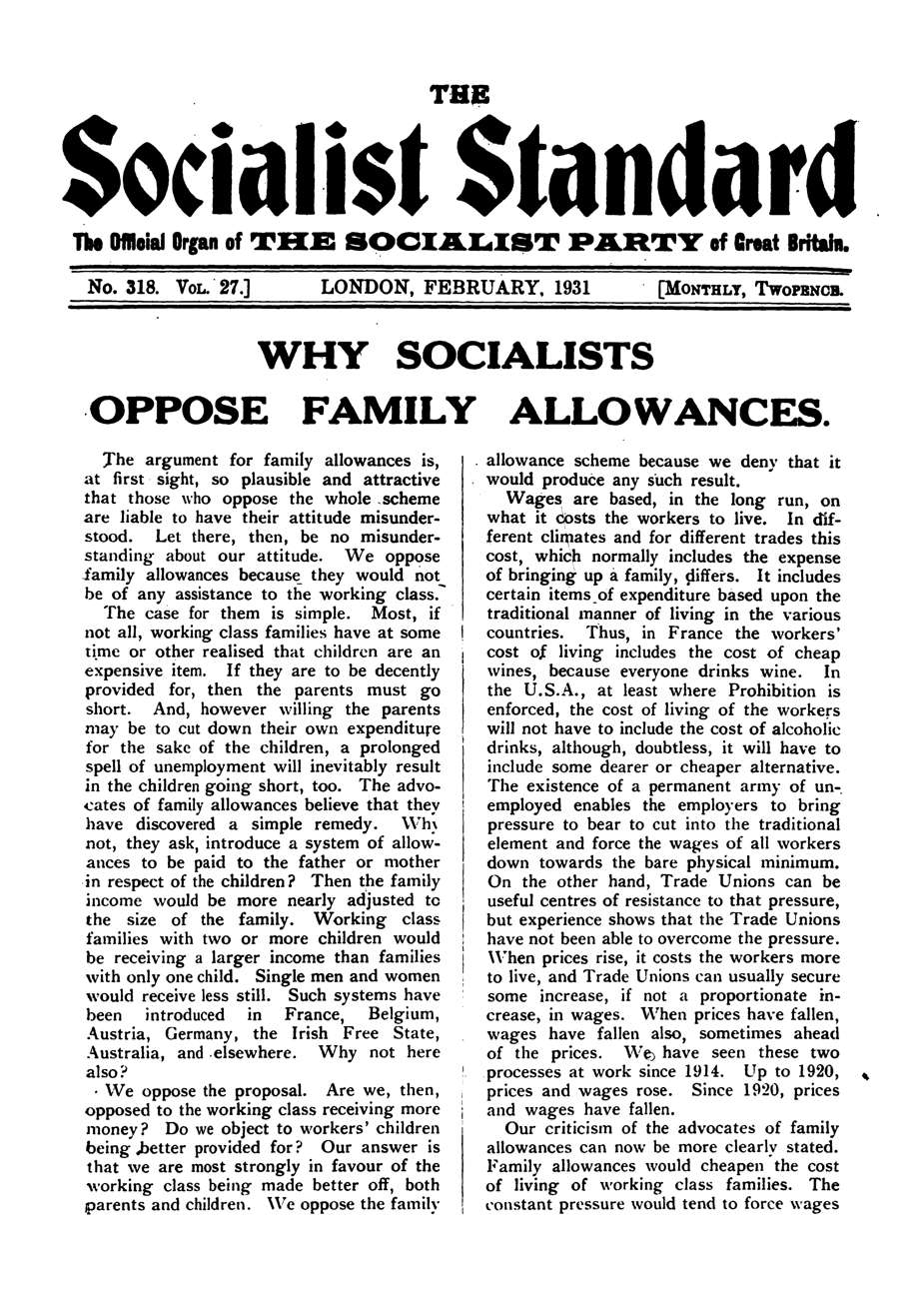
The Socialist Party and the Trade Unions. (1931)

From the February 1931 issue of the Socialist Standard

The Socialist Party and the Trade Unions have a common origin in the class struggle. The former is the organised expression on the political field of the conscious recognition of that struggle by the workers. Its growth is the measure of their determination to end the struggle by converting the means of living into common property, and thus establishing a harmony of interests within society.

The class struggle, however, does not commence with the conscious recognition of it as a fact. “In the beginning is the thing ”; the idea follows in its wake, and is, in fact, its reflection in the human mind.

Long before the origin of the Socialist Party the class struggle was in progress. Strikes and lock-outs, machine-breaking and penal legislation have all testified to the antagonism of interests in modern society for over a century.

With the rise of the factory system, the workers found themselves involved in the struggle in grim earnest. It was no choice of theirs but thrust itself upon them with relentless and increasing force with every step in industrial evolution. At first the workers acted instinctively rather than rationally. The Luddite machine-smashing riots were a type of this phase of the conflict, but with further experience and time for reflection, the need for some form of organisation impressed itself upon the workers. The grouping together of the workers in the factories provided a basis for the organisation. They began to realise that the machines had come to stay; that henceforward they were condemned to lives of toil for the profit of the factory owners, and the former independence which they had enjoyed, while still often working in their own homes under the handicraft system, had gone for ever. Hence the Trade Unions arose, uniting the workers in similar or allied occupations in order to get from the masters the best terms obtainable.

From the first the strike was their most important weapon. Under the handicraft system, in its decay, the workers had to bargain with the merchant capitalists over the price of the goods produced; but the factory system changed all that. The price of the workers' own labour-power became the object of dispute. They sold their energies piecemeal by the hour, day or week, and the system of piece-work, which was retained here and there, only disguised; did not alter that fact. The individual worker had lost all substantial freedom, and his only alternative to working at the terms of the master was starvation. Hence the right to withhold his labour-power in conjunction with his fellows became an essential means of resistance. Without it the workers would have been crushed beyond power of recovery, and would have become, in Marx’s words, quite incapable of “initiating any large movement.” (See the pamphlet, “Value, Price, and Profit.”)

From the outset, however, the Trade Unions found arrayed against them, not only the individual masters or groups with whom they were directly struggling, but the forces of the entire master-class, as represented by the State. For long enough the Unions were subject to legal persecution as unlawful conspiracies and monopolies, and only by dint of considerable perseverance, were those obstacles overcome. The workers, indeed, had their backs to the wall, and only the fact that the Unions were rooted in the new conditions saved them from annihilation.

By degrees, however, the master class saw the unwisdom of trying to destroy the new organisations, and the Unions were granted a legal status. In like manner the teeth of the Chartist’s movement were also drawn by the partial granting of their demands.

In the course of time the masters discovered that respectable labour leaders, whether upon the field of industry or politics, were useful in helping to maintain industrial peace, which was so much needed by the employers.

Judicious flattery, not to speak of more tangible inducements to make terms favourable to the employers, have stimulated the ambitions of numerous leaders whom the workers have all too readily trusted. Underlying this process, however, has been the steady progress of capitalist industry. The constant improvement of machinery, methods of working, and financial organisation on the part of the masters, have placed very strict limits upon the demands of the workers for generations past, because the latter’s power to exact these demands has grown steadily less. Trade Union organisation has failed to keep pace with its capitalist counterpart, if only for the simple reason that competition between the workers grows keener as the army of the unemployed increases and the number of competing capitalist concerns grows less numerous. Under these circumstances, the efficiency of the Unions as fighting forces has been steadily undermined, until it has become recognised as a matter of course among observant workers that even on the rare occasions when market conditions favour the workers they are fobbed off with a meagre concession.

More ominous than any of the factors mentioned above is the part played by the armed forces of the State. As the magnitude of the forces engaged in the struggle on either side increases, so the intervention of the State in industrial disputes is rendered more certain. The necessity of maintaining order under capitalism leaves the Government no alternative, and as the technical efficiency of the forces at its disposal (as exemplified in aeroplanes and poison-gas bombs) has now reached a terrifying pitch, the futility of the strike as an offensive weapon against the State authorities should be obvious to every thinking person.

What, then, is to be the future of the Trade Unions? At present they appear to have become to a large extent merely jumping-off grounds for so-called Labour politicians and to that extent less useful to the workers; but there is no obvious reason why, with the spread of understanding among their members, they should not be once again valuable centres of resistance to capitalist attack.

As we have seen, the Trade Unions arose from the pressure of their immediate needs upon the workers in the early days of capitalism. They necessarily took the form most convenient at the moment, and have adapted themselves to changing circumstances more or less blindly. They have, therefore, invariably over-emphasised the importance of sectional distinctions between the workers. The Socialist Party, organised as it is for the emancipation of the workers as a class, insists upon the necessity of subordinating all such distinctions to class solidarity. On the political field the workers have but one interest, and that involves winning political power, and dispossessing the master-class.

The supreme conflict with that class leaves no room for sectional antagonisms between the workers.

The Socialist Party, therefore, advises Trade Unionists to offer their utmost resistance to the worsening of their conditions, but never fails to point out that under capitalism the pressure upon the workers is inevitable. It is insufficient, therefore, merely to apply the brake. We must change the direction of social development, and for that purpose the establishment of Socialism is essential.
Eric Boden